Archive for GAIA

Top Ten Gaia Facts

Posted in Astrohype, The Universe and Stuff with tags , , , on December 20, 2013 by telescoper
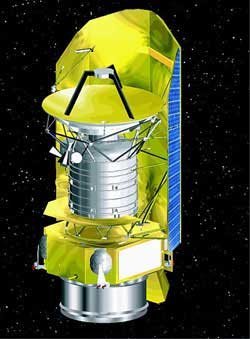
Gaia looks nothing like the Herschel Space Observatory shown here.

Gaia looks nothing like the Herschel Space Observatory shown here.

Since yesterday’s successful launch of the European Space Agency’s Gaia mission I have been inundated with requests for more information about this impressive satellite and the science behind it. As a service to the community, and for the edification of the public at large, I therefore thought I’d share my list of top ten Gaia facts via the medium of this blog:

  1. The correct pronunciation of GAIA is as in “gayer”. Please bear this in mind when reading any press articles about the mission.
  2. The GAIA spacecraft will orbit the Sun at the Second Lagrange Point, the only place in the Solar System where the  effects of cuts in the UK science budget can not be felt.
  3. The data processing challenges posed by GAIA are immense; the billions of astrometric measurements resulting from the mission will be analysed using the world’s biggest Excel Spreadsheet.
  4. To provide secure backup storage of the complete GAIA data set, the European Space Agency has commandeered the world’s entire stock of 3½ inch floppy disks.
  5. As well as measuring billions of star positions and velocities, GAIA is expected to discover thousands of new asteroids and the hiding place of Lord Lucan.
  6. GAIA can measure star positions to an accuracy of a few microarcseconds. That’s the angle subtended by a single pubic hair at a distance of 1000km.
  7. The precursor to GAIA was a satellite called Hipparcos, which is not how you spell Hipparchus.
  8. The BBC will be shortly be broadcasting a new 26-part TV series about GAIA. Entitled WOW! Gaia! That’s Soo Amaazing… it will be presented by Britain’s leading expert on astrometry, Professor Brian Cox.
  9. Er…
  10. That’s it.

Countdown to GAIA

Posted in The Universe and Stuff with tags , , , on December 18, 2013 by telescoper

Just a quick post to point out that tomorrow morning at 9.12am GMT will see the launch of the European Space Agency’s Gaia mission.  You can watch the launch live here from about 8.50 GMT. I’ll be in a meeting at 9am tomorrow morning, so I’m probably going to miss it.

Gaia arrives on the Launchpad at Kourou, French Guyana, on 13th December

Gaia arrives on the Launchpad at Kourou, French Guyana, on 13th December

I remember first hearing about Gaia about 15 years ago when I was on a PPARC advisory panel and was simultaneously amazed  by the ambition of its objectives and sceptical that it would ever get off the ground. Now its almost ready to go, so fingers crossed for a successful launch tomorrow.

Coincidentally, Gaia is among the various telescopes and observatories featured in the STFC Roadshow we put on  viewfor an Astronomy Master Class we have been putting on for local schools over the last couple of days here at the University of Sussex:

IMG-20131218-00248

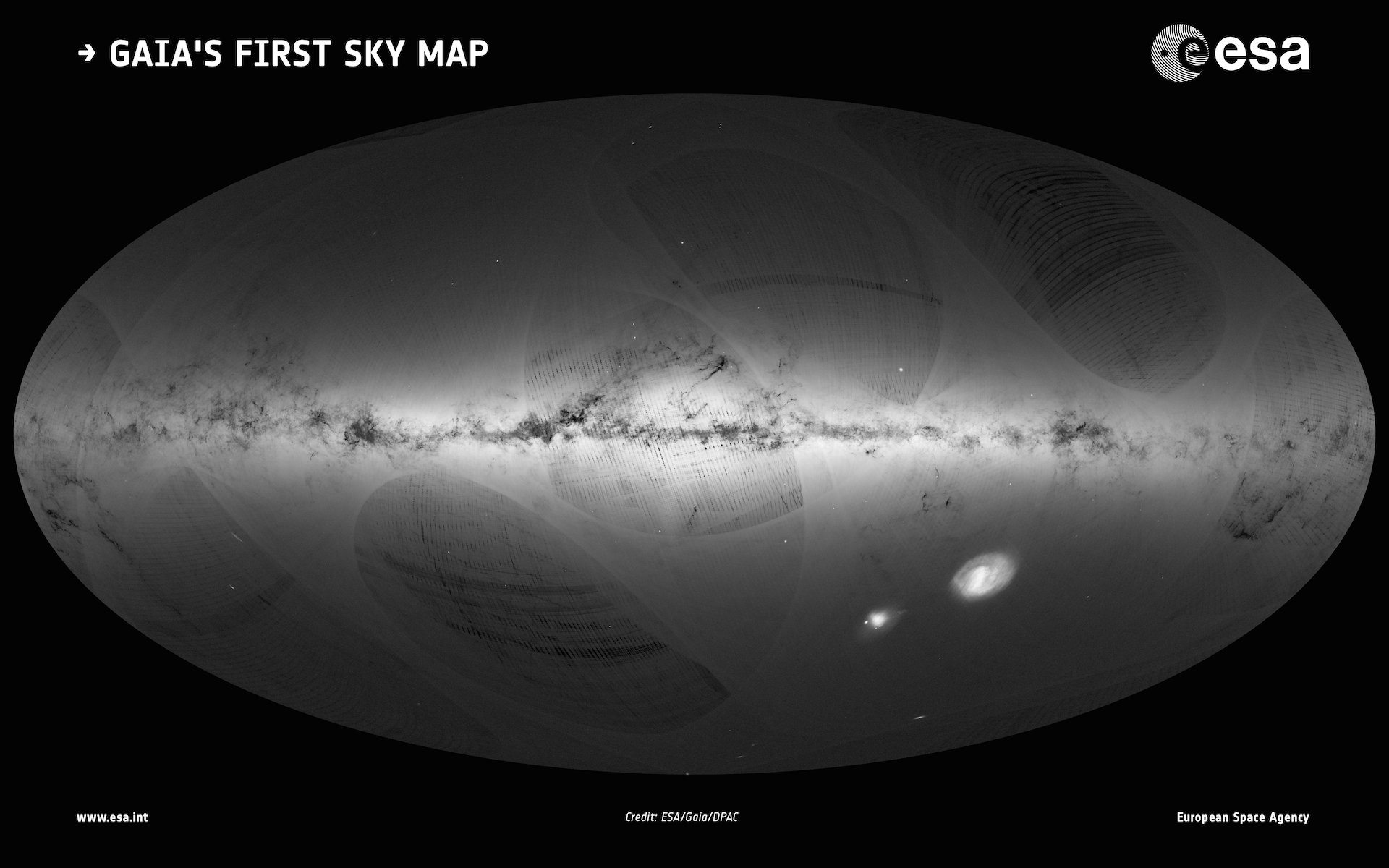
Gaia is a global space astrometry mission, which will make the largest, most precise three-dimensional map of our Galaxy by surveying more than a thousand million stars. In some sense it is the descendant of the Hipparcos mission launched in 1989, but it’s very much more than that. Gaia will monitor each of its target stars about 70 times over a five-year period. It is expected to discover hundreds of thousands of new celestial objects, such as extra-solar planets and brown dwarfs, and observe hundreds of thousands of asteroids within our own Solar System. The mission is also expected to yield a wide variety of other benefits, including new tests of the  General Theory of Relativity.

Gaia will create an extraordinarily precise three-dimensional map of more than a thousand million stars throughout our Galaxy (The Milky Way) and beyond, mapping their motion, luminosity, temperature and chemical composition as well as any changes in such properties. This huge stellar census will provide the data needed to tackle an enormous range of important problems related to the origin, structure and evolutionary history of our Galaxy. Gaia will do all this by repeatedly measuring the positions of all objects down to an apparent magnitude of 20. A thousand million stars is about 1% of the entire stellar population of the Milky Way.

For the brighter objects, i.e. those brighter than magnitude 15, Gaia will measure their positions to an accuracy of 24 microarcseconds, comparable to measuring the diameter of a human hair at a distance of 1000 km. Distances of relatively nearby stars will be measured to an accuracy of 0.001%. Even stars near the Galactic Centre, some 30 000 light-years away, will have their distances measured to within an accuracy of 20%.

It’s an astonishing mission that will leave an unbelievably rich legacy not only for the astronomers working on the front-line operations of Gaia but for generations to come. I have a feeling that there might be  a few sleepless nights tonight waiting for the launch, but I suppose astronomers should be used to that!

UPDATE: 19/12/2013 Success! Launch went smoothly, separation of the Gaia spacecraft achieved. Now we have to wait for a month or so for it to get to L2, settle itself down, and then start doing science. The first data release isn’t due for 22 months…Bon Voyage!

On the Dearth of Dark Matter in the Solar Neighbourhood

Posted in Astrohype, The Universe and Stuff with tags , , , , , , , , on April 22, 2012 by telescoper

I’m a bit late getting onto the topic of dark matter in the Solar Neighbourhood, but it has been generating quite a lot of news, blogposts and other discussion recently so I thought I’d have a bash this morning. The result in question is a paper on the arXiv by Moni Bidin et al. which has the following abstract:

We measured the surface mass density of the Galactic disk at the solar position, up to 4 kpc from the plane, by means of the kinematics of ~400 thick disk stars. The results match the expectations for the visible mass only, and no dark matter is detected in the volume under analysis. The current models of dark matter halo are excluded with a significance higher than 5sigma, unless a highly prolate halo is assumed, very atypical in cold dark matter simulations. The resulting lack of dark matter at the solar position challenges the current models.

As far as I’m aware, Oort (1932, 1960) was the first to perform an analysis of the vertical equilibrium of the stellar distribution in the solar neighbourhood. He argued that there is more mass in the galactic disk than can be accounted for by star counts. A reanalysis of this problem by Bahcall (1984) argued for the presence of a dark “disk” of a scale height of about 700 pc. This was called into question by Bienaymé et al. (1987), and by Kuijken & Gilmore in 1989. In a later analysis based on a sample of stars with HIPPARCOS distances and Coravel radial velocities, within 125 pc of the Sun. Crézé et al. (1998) found that there is no evidence for dark matter in the disk of the Milky Way, claiming that all the matter is accounted for by adding up the contributions of gas, young stars and old stars.

The lack of evidence for dark matter in the Solar Neighbourhood is not therefore a particularly new finding; there’s never been any strong evidence that it is present in significant quantities out in the suburbs of the Milky Way where we reside. Indeed, I remember a big bust-up about this at a Royal Society meeting I attended in 1985 as a fledgling graduate student. Interesting that it’s still so controversial 27 years later.

Of course the result doesn’t mean that the dark matter isn’t there. It just means that its effect is too small compared to that of the luminous matter, i.e. stars, for it to be detected. We know that the luminous matter has to be concentrated more centrally than the dark matter, so it’s possible that the dark component is there, but does not have a significant effect on stellar motions near the Sun.

The latest, and probably most accurate, study has again found no evidence for dark matter in the vicinity of the Sun. If true, this may mean that attempts to detect dark matter particles using experiments on Earth are unlikely to be successful.

The team in question used the MPG/ESO 2.2-metre telescope at ESO’s La Silla Observatory, along with other telescopes, to map the positions and motions of more than 400 stars with distances up to 13000 light-years from the Sun. From these new data they have estimated the mass of material in a volume four times larger than ever considered before but found that everything is well explained by the gravitational effects of stars, dust and gas with no need for a dark matter component.

The reason for postulating the existence of large quantities of dark matter in spiral galaxies like the Milky Way is the motion of material in the outer parts, far from the Solar Neighbourhood (which is a mere 30,000 light years from Galactic Centre). These measurements are clearly inconsistent with the distribution of visible matter if our understanding of gravity is correct. So either there’s some invisible matter that gravitates or we need to reconsider our theories of gravitation. The dark matter explanation also fits with circumstantial evidence from other contexts (e.g. galaxy clusters), so is favoured by most astronomers. In the standard theory the Milky Way is surrounded by am extended halo of dark matter which is much less concentrated than the luminous material by virtue of it not being able to dissipate energy because it consists of particles that only interact weakly and can’t radiate. Luminous matter therefore outweighs dark matter in the cores of galaxies, but the situation is reversed in the outskirts. In between there should be some contribution from dark matter, but since it could be relatively modest it is difficult to estimate.

The study by Moni Bidin et al. makes a number of questionable assumptions about the shape of the Milky Way halo – they take it to be smooth and spherical – and the distribution of velocities within it is taken to have a very simple form. These may well turn out to be untrue. In any case the measurements they needed are extremely difficult to make, so they’ll need to be checked by other teams. It’s quite possible that this controversy won’t be actually resolved until the European Space Agency’s forthcoming GAIA mission.

So my take on this is that it’s a very interesting challenge to the orthodox theory, but the dark matter interpretation is far from dead because it’s not obvious to me that these observations would have uncovered it even if it is there. Moreover, there are alternative analyses (e.g. this one) which find a significant amount of dark matter using an alternative modelling method which seems to be more robust. (I’m grateful to Andrew Pontzen for pointing that out to me.)

Anyway, this all just goes to show that absence of evidence is not necessarily evidence of absence…