Archive for Galaxy Cluster

Weekly Update from the Open Journal of Astrophysics – 04/10/2025

Posted in OJAp Papers, Open Access, The Universe and Stuff with tags , , , , , , , , , , , , , , , , , , , , , , , , on October 4, 2025 by telescoper

It’s Saturday again, so it’s time for a summary of the week’s new papers at the Open Journal of Astrophysics. Since the last update we have published five more papers, which brings the number in Volume 8 (2025) up to 146, and the total so far published by OJAp up to 381. At this rate Volume 8 will contain around 190 by the end of 2025.

Anyway, here are this week’s papers, starting with three published on Monday 29th September 2025.

The first paper is “Cosmic Multipoles in Galaxy Surveys II: Comparing Different Methods in Assessing the Cosmic Dipole” by Vasudev Mittal, Oliver T. Oayda and Geraint F. Lewis (U. Sydney, Australia). This is in the folder Cosmology and Nongalactic Astrophysics. It presents a comparison of methods for determining the number count dipole from cosmological surveys with a discussion of the implications for the known discordance with the CMB diple.

The overlay is here:
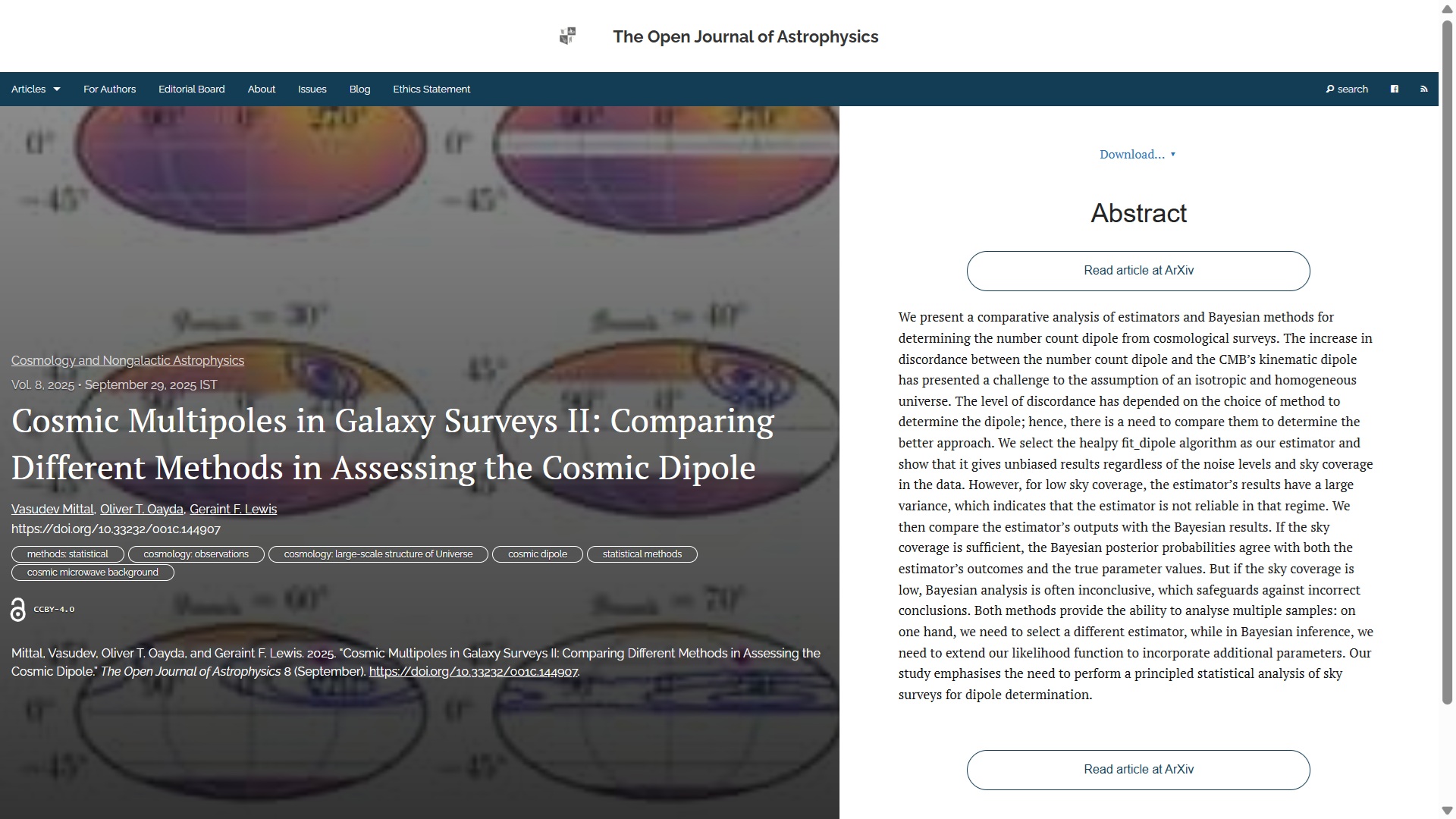
You can make this larger by clicking on it.  The officially accepted version of this paper can be found on the arXiv here.

The second paper this week, also published on Monday 29th September, is “SDSS-C4 3028: the Nearest Blue Galaxy Cluster Devoid of an Intracluster Medium” by Shweta Jain (University of Kentucky, USA) and 11 others based in the USA, Australia and Korea. This describes a galaxy cluster with an unusually high fraction (about 63%) of star-forming galaxies which may be a result of ram pressure stripping; the article is in the folder Astrophysics of Galaxies.

The corresponding overlay is here:
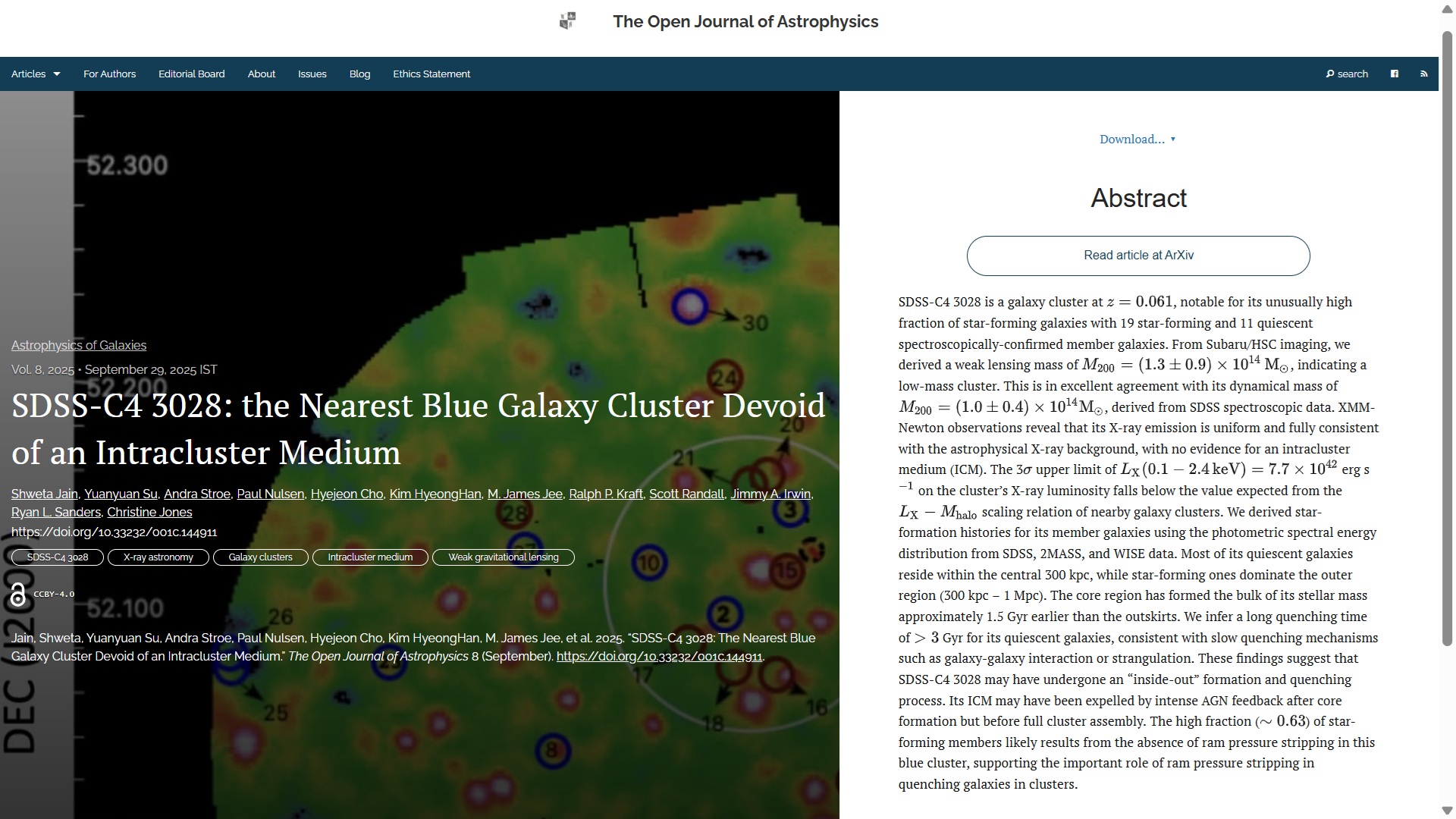
 

You can find the officially accepted version on arXiv here.

The third one this week, published on also published on Monday 29th September but in the folder Earth and Planetary Astrophysics, is “Comparing the Architectures of Multiplanet Systems from Kepler, K2, and TESS Data” by Robert L Royer and Jason H. Steffen (University of Nevada, USA).  This paper explores the trends seen in exoplanet survey data, including Kepler, TESS, and K2 including many planetary systems with multiple planets.

The overlay is here:
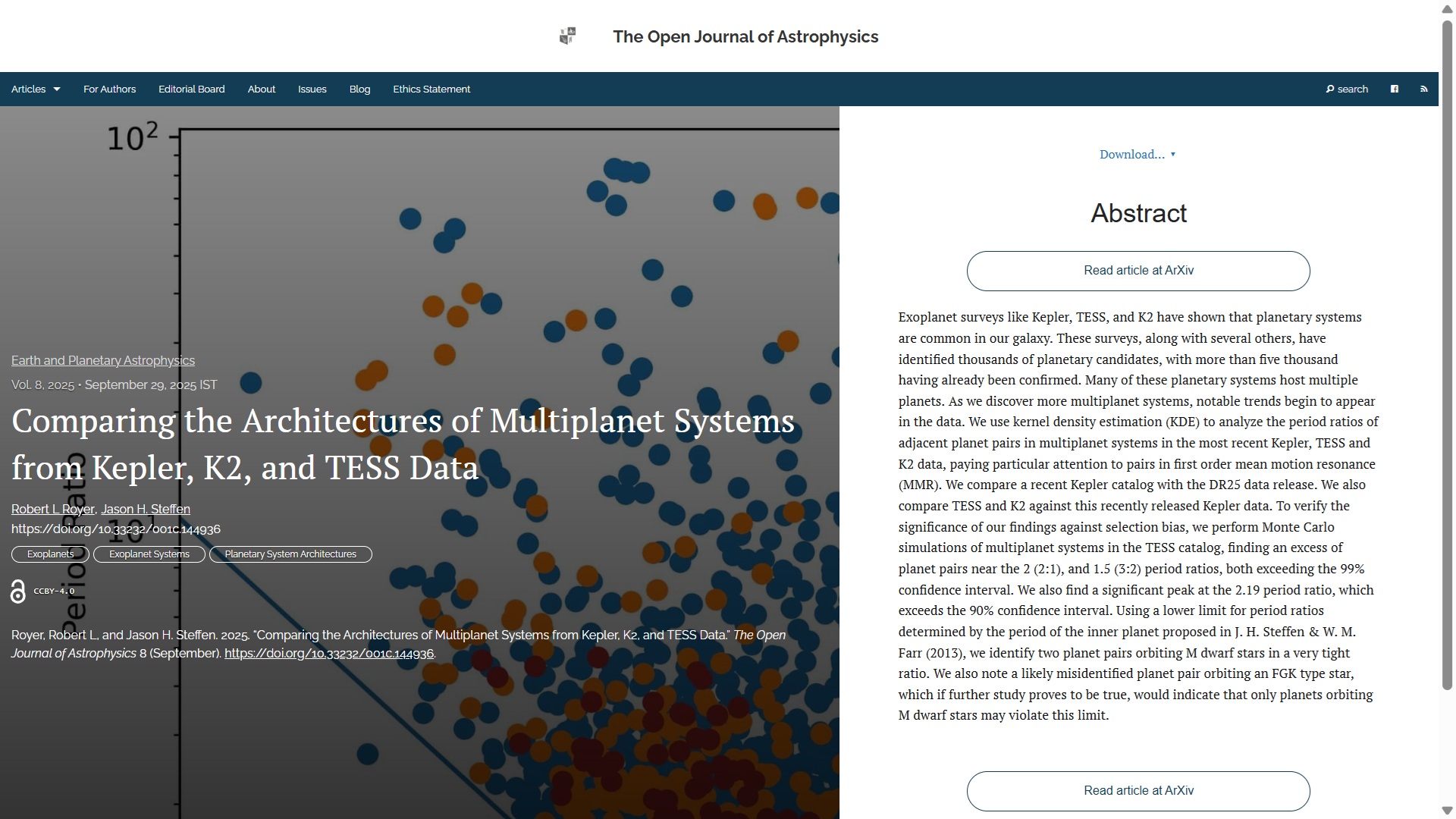
 

You can find the officially-accepted version on arXiv here.

The next one up is “Seeding Cores: A Pathway for Nuclear Star Clusters from Bound Star Clusters in the First Billion Years” by Fred Angelo Batan Garcia (Columbia University, USA), Massimo Ricotti (University of Maryland, USA) and Kazuyuki Sugimura (Hokkaido University, Japan). This paper was published on Thursday 2nd October in the folder Astrophysics of Galaxies. This is about modelling the formation of Nuclear Star Clusters using cosmological radiation-hydrodynamic simulations, with discussion of the implications for seeding supermassive black holes and the little red dots seen by JWST.

The corresponding overlay is here:

You can find the officially accepted version of this one on arXiv here.

The fifth and last one for this week, published on Friday 3rd October 2025, is “Efficient semi-analytic modelling of Pop III star formation from Cosmic Dawn to Reionization” by Sahil Hegde and Steven R. Furlanetto (University of Californi Los Angeles, USA).  This is also in the folder marked Astrophysics of Galaxies. It uses a self-consistent analytic model to trace the formation of the first stars from their birth through the first billion years of the universe’s history. complementing semi-analytic and computational methods.


You can find the officially-accepted version of this paper on arxiv here.

That concludes the report for this week. I’ll post another update next Saturday.
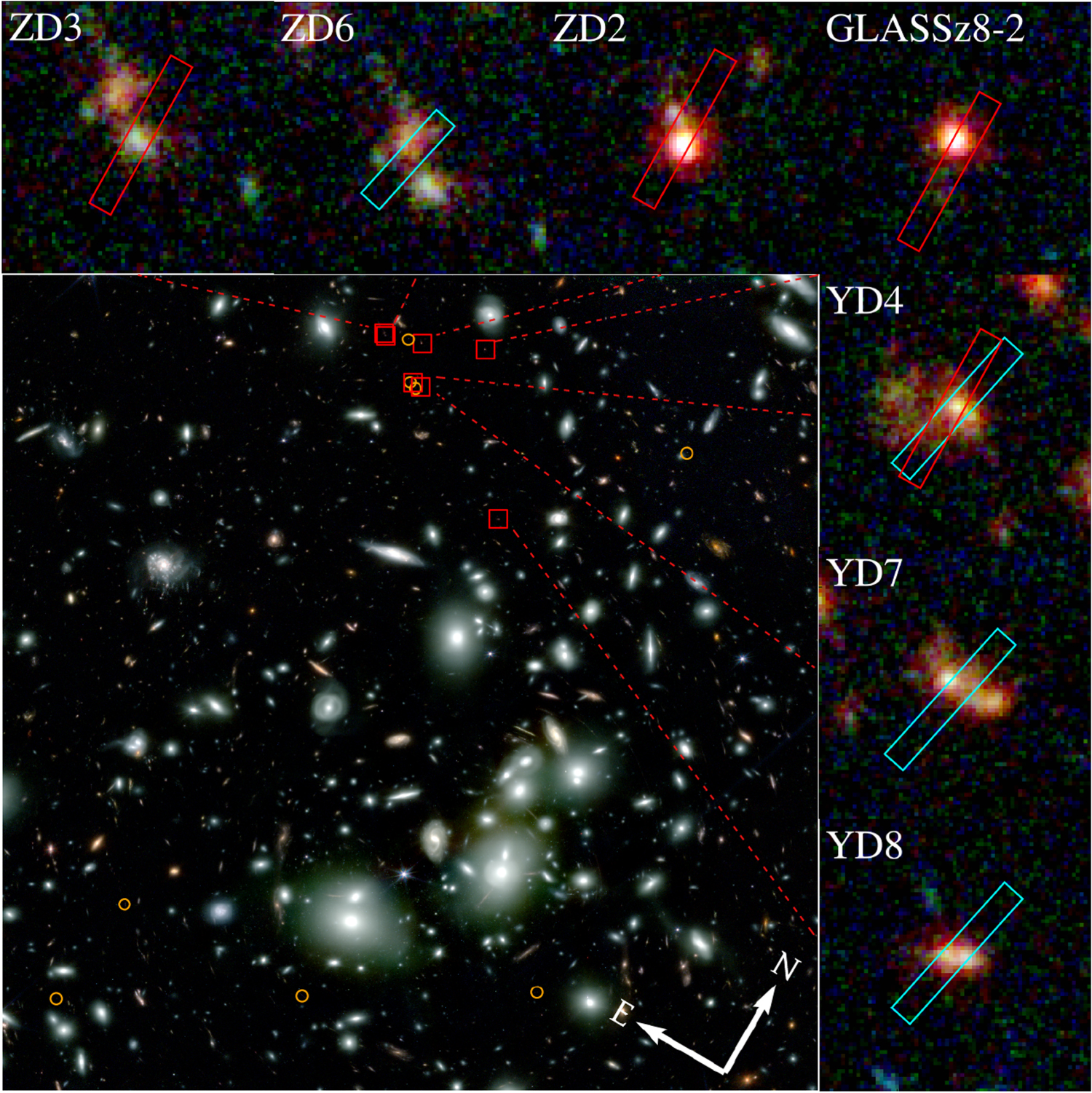
A proto-cluster at z ~ 8!

Posted in The Universe and Stuff with tags , , , , on April 26, 2023 by telescoper
Blow-ups of the seven galaxies with spectroscopic redshifts, shown together with their positions near the line of sight to a foreground cluster.

I missed the paper containing this impressive picture when it first appeared on the arXiv, the primary source for astrophysics and cosmology research, but fortunately it has now been published on a secondary site, Astrophysical Journal Letters, with an accompanying press release so I can now do a quick post about it.

The article concerned, with lead author Takahiro Morishita of the California Institute of Technology (Caltech) et al. describes the detection using JWST of an apparent proto-cluster – seven galaxies in close proximity – at redshift z = 7.88. Here is the abstract:

Although only seven galaxies are identified, this does look like the very early stages of formation of an object that will grow into a giant galaxy cluster by the present epoch. The redshift of this progenitor corresponds to a stage of the Universe just 650 million years or so after the Big Bang, compared with the current age of about 14 billion years. As the abstract says, we would need to know more about other possible constituent galaxies and their motions to be sure, but it looks like a baby destined to grow into a monster…

MADCOWS and Extreme Galaxy Clusters

Posted in The Universe and Stuff, Uncategorized with tags , , , on November 4, 2015 by telescoper

I thought I’d do a quick post just to have an excuse to post this very pretty picture I found in a press release from  JPL:

extreme cluster

This is a distant galaxy cluster found in the “Massive And Distance Clusters Of Wise Survey“, which is known by its acronym “MADCOWS”. Ho Ho Ho. If the previous link is inaccessible, because you don’t have a subscription, then don’t worry: the paper concerned is available for free on the arXiv. If the previous link isn’t inaccessible, because you do have a subscription, then do worry because you’re wasting your money…

Anyway the abstract of the paper, by Gonzalez et al., reads:

We present confirmation of the cluster MOO J1142+1527, a massive galaxy cluster discovered as part of the Massive and Distant Clusters of WISE Survey. The cluster is confirmed to lie at z = 1.19, and using the Combined Array for Research in Millimeter-wave Astronomy we robustly detect the Sunyaev–Zel’dovich (SZ) decrement at 13.2σ. The SZ data imply a mass of M200m = (1.1 ± 0.2) × 1015M, making MOO J1142+1527 the most massive galaxy cluster known at z > 1.15 and the second most massive cluster known at z > 1. For a standard ΛCDM cosmology it is further expected to be one of the ~5 most massive clusters expected to exist at z ≥ 1.19 over the entire sky. Our ongoing Spitzer program targeting ~1750 additional candidate clusters will identify comparably rich galaxy clusters over the full extragalactic sky.

I added the link to WISE, by the way.

This cluster is obviously an impressive object, and galaxy clusters are always “extreme” in the sense that they are defined to be particularly large concentrations of mass, but this one is actually in line with theoretical expectations for such objects. The following graph shows the spread of extreme cluster masses expected as a function of redshift:

If you mentally plot the mass and redshift of this beastie on the diagram you’ll see that it’s well within the comfort zone. As extreme objects go, this one is quite normal!

Heart of Darkness

Posted in Astrohype, The Universe and Stuff with tags , , , , , on March 6, 2012 by telescoper

Now here’s a funny thing. I’ve been struggling to keep up with matters astronomical recently owing to pressure of other things, but I could resist a quick post today about an interesting object, a galaxy cluster called Abell 520. New observations of this complex system – which appears to involve a collision between two smaller clusters, hence its nickname “The Train Wreck Cluster” – have led to a flurry of interest all over the internet, because the dark matter in the cluster isn’t behaving entirely as expected. Here is the abstract of the paper (by Jee et al., now published in the Astrophysical Journal):

We present a Hubble Space Telescope/Wide Field Planetary Camera 2 weak-lensing study of A520, where a previous analysis of ground-based data suggested the presence of a dark mass concentration. We map the complex mass structure in much greater detail leveraging more than a factor of three increase in the number density of source galaxies available for lensing analysis. The “dark core” that is coincident with the X-ray gas peak, but not with any stellar luminosity peak is now detected with more than 10 sigma significance. The ~1.5 Mpc filamentary structure elongated in the NE-SW direction is also clearly visible. Taken at face value, the comparison among the centroids of dark matter, intracluster medium, and galaxy luminosity is at odds with what has been observed in other merging clusters with a similar geometric configuration. To date, the most remarkable counter-example might be the Bullet Cluster, which shows a distinct bow-shock feature as in A520, but no significant weak-lensing mass concentration around the X-ray gas. With the most up-to-date data, we consider several possible explanations that might lead to the detection of this peculiar feature in A520. However, we conclude that none of these scenarios can be singled out yet as the definite explanation for this puzzle.

Here’s a pretty picture in which the dark matter distribution (inferred from gravitational lensing measurements) is depicted by the bluey-green colours and which seems to be more concentrated in the middle of the picture than the galaxies, although the whole thing is clearly in a rather disturbed state:

Credit: NASA, ESA, CFHT, CXO, M.J. Jee (University of California, Davis), and A. Mahdavi (San Francisco State University)

The three main components of a galaxy cluster are: (i) its member galaxies; (ii) an extended distribution of hot X-ray emitting gas and (iii) a dark matter halo. In a nutshell, the main finding of this study is that the dark matter seems to be stuck in the middle of the cluster with the X-ray gas, while the  visible galaxies seem to be sloshing about all over the place.

No doubt there will be people jumping to the conclusion that this cluster proves that the theory of dark matter is all wrong, but I think that it simply demonstrates that this is a complicated object and we don’t really understand what’s going on. The paper gives a long list of possible explanations, but there’s no way of knowing at the moment which (if any) is correct.

The Universe is like that. Most of it is a complete mess.