Archive for galaxy surveys

Weekly Update from the Open Journal of Astrophysics – 04/10/2025

Posted in OJAp Papers, Open Access, The Universe and Stuff with tags , , , , , , , , , , , , , , , , , , , , , , , , on October 4, 2025 by telescoper

It’s Saturday again, so it’s time for a summary of the week’s new papers at the Open Journal of Astrophysics. Since the last update we have published five more papers, which brings the number in Volume 8 (2025) up to 146, and the total so far published by OJAp up to 381. At this rate Volume 8 will contain around 190 by the end of 2025.

Anyway, here are this week’s papers, starting with three published on Monday 29th September 2025.

The first paper is “Cosmic Multipoles in Galaxy Surveys II: Comparing Different Methods in Assessing the Cosmic Dipole” by Vasudev Mittal, Oliver T. Oayda and Geraint F. Lewis (U. Sydney, Australia). This is in the folder Cosmology and Nongalactic Astrophysics. It presents a comparison of methods for determining the number count dipole from cosmological surveys with a discussion of the implications for the known discordance with the CMB diple.

The overlay is here:
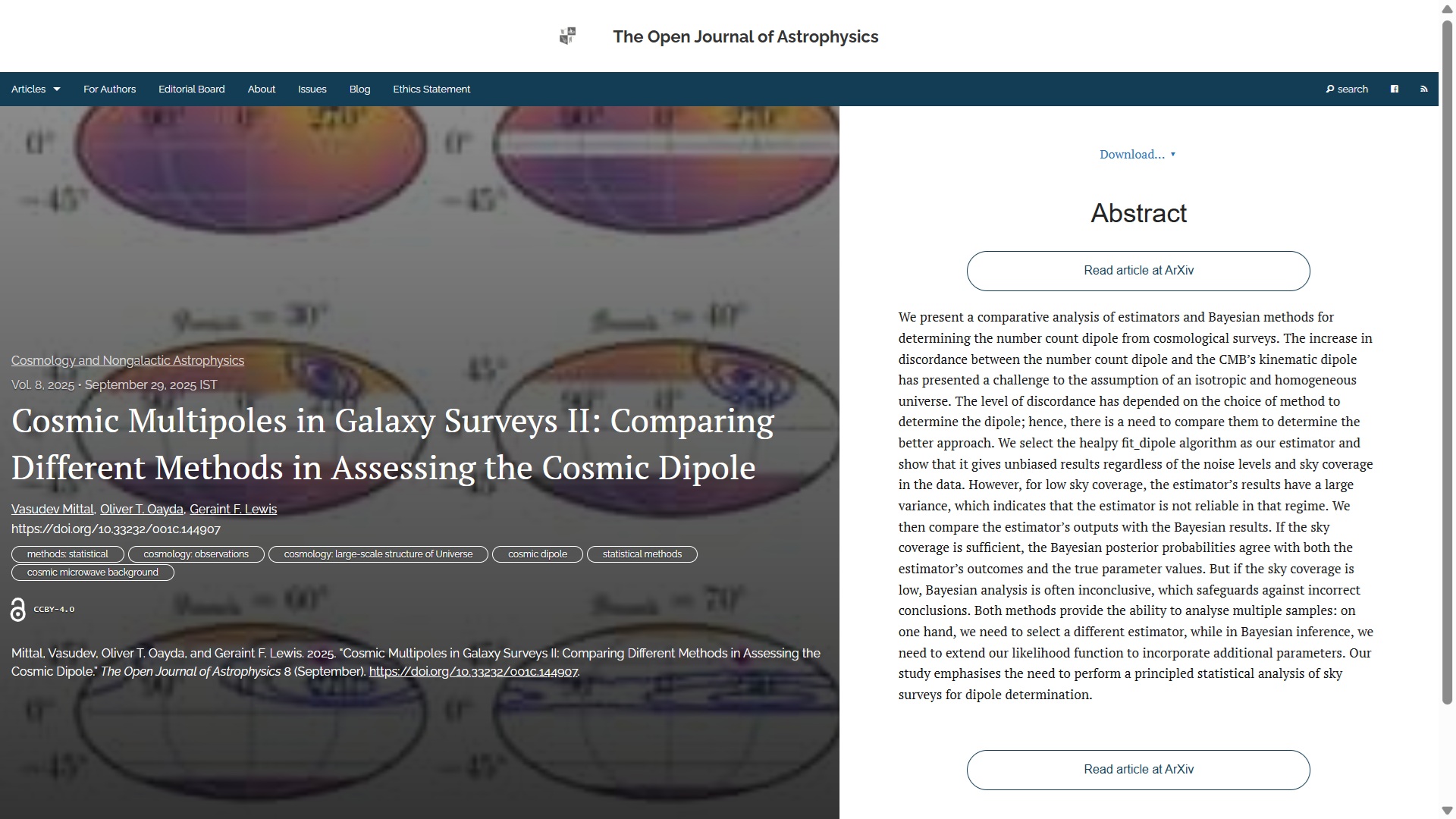
You can make this larger by clicking on it.  The officially accepted version of this paper can be found on the arXiv here.

The second paper this week, also published on Monday 29th September, is “SDSS-C4 3028: the Nearest Blue Galaxy Cluster Devoid of an Intracluster Medium” by Shweta Jain (University of Kentucky, USA) and 11 others based in the USA, Australia and Korea. This describes a galaxy cluster with an unusually high fraction (about 63%) of star-forming galaxies which may be a result of ram pressure stripping; the article is in the folder Astrophysics of Galaxies.

The corresponding overlay is here:
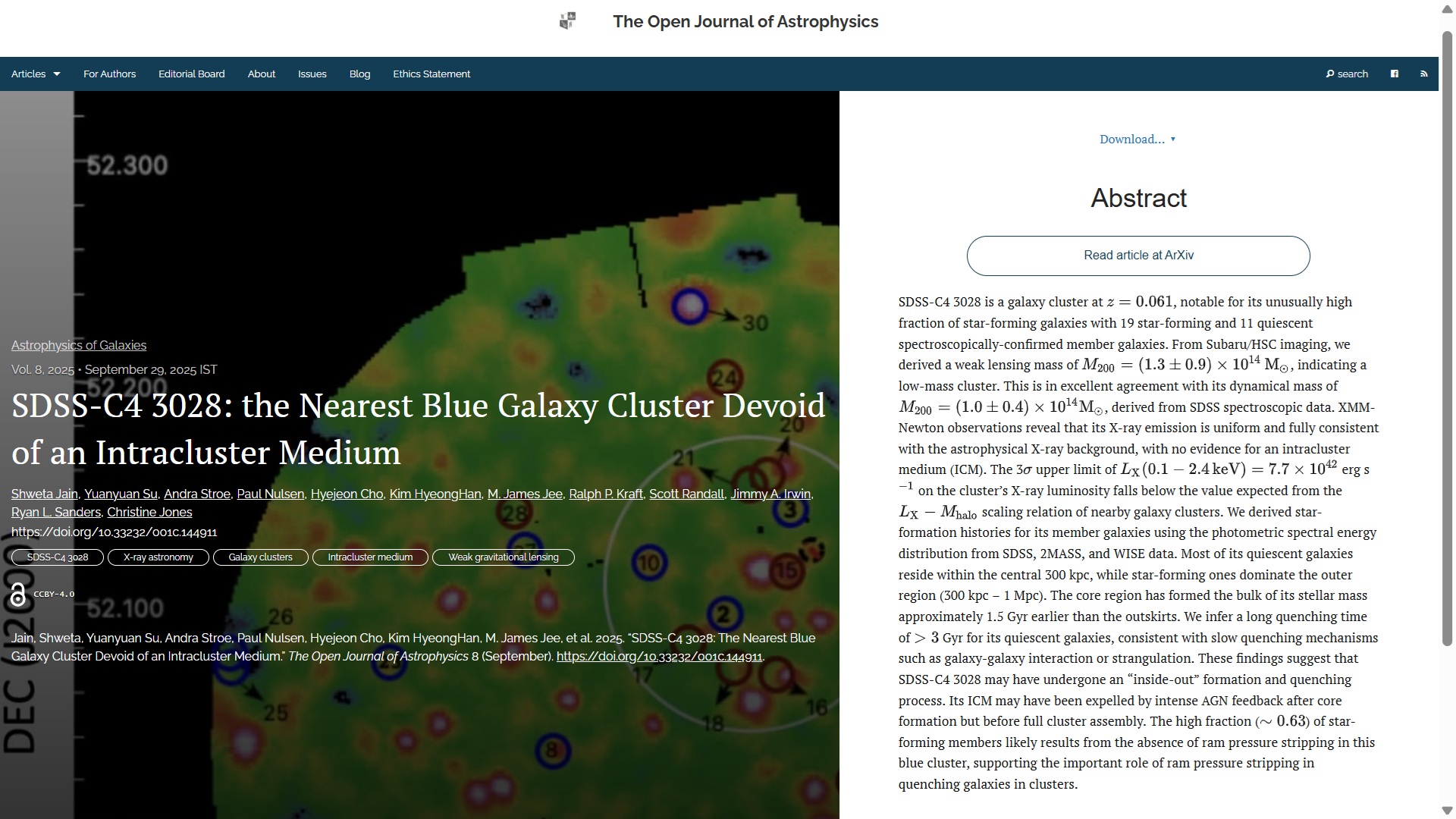
 

You can find the officially accepted version on arXiv here.

The third one this week, published on also published on Monday 29th September but in the folder Earth and Planetary Astrophysics, is “Comparing the Architectures of Multiplanet Systems from Kepler, K2, and TESS Data” by Robert L Royer and Jason H. Steffen (University of Nevada, USA).  This paper explores the trends seen in exoplanet survey data, including Kepler, TESS, and K2 including many planetary systems with multiple planets.

The overlay is here:
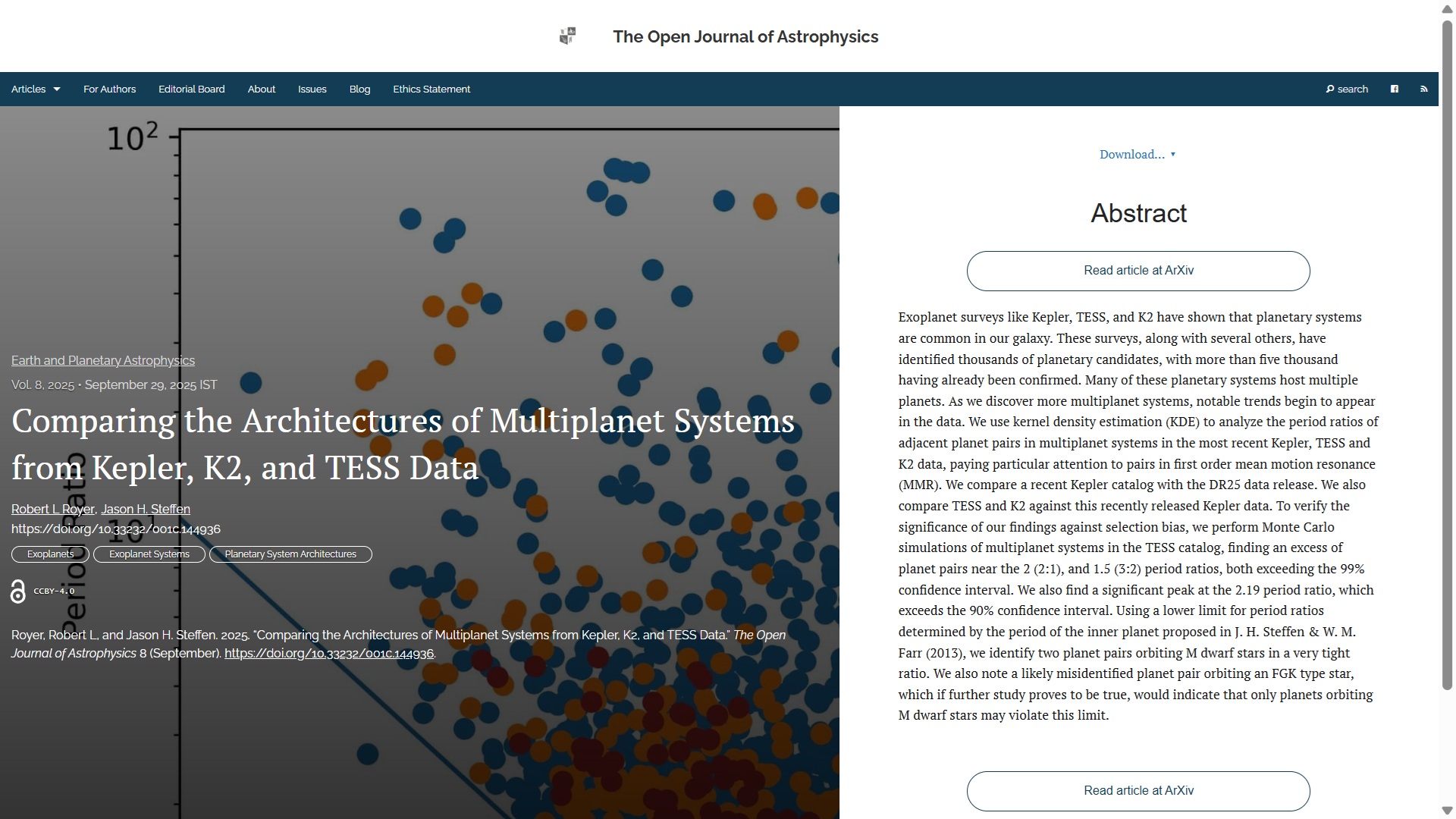
 

You can find the officially-accepted version on arXiv here.

The next one up is “Seeding Cores: A Pathway for Nuclear Star Clusters from Bound Star Clusters in the First Billion Years” by Fred Angelo Batan Garcia (Columbia University, USA), Massimo Ricotti (University of Maryland, USA) and Kazuyuki Sugimura (Hokkaido University, Japan). This paper was published on Thursday 2nd October in the folder Astrophysics of Galaxies. This is about modelling the formation of Nuclear Star Clusters using cosmological radiation-hydrodynamic simulations, with discussion of the implications for seeding supermassive black holes and the little red dots seen by JWST.

The corresponding overlay is here:

You can find the officially accepted version of this one on arXiv here.

The fifth and last one for this week, published on Friday 3rd October 2025, is “Efficient semi-analytic modelling of Pop III star formation from Cosmic Dawn to Reionization” by Sahil Hegde and Steven R. Furlanetto (University of Californi Los Angeles, USA).  This is also in the folder marked Astrophysics of Galaxies. It uses a self-consistent analytic model to trace the formation of the first stars from their birth through the first billion years of the universe’s history. complementing semi-analytic and computational methods.


You can find the officially-accepted version of this paper on arxiv here.

That concludes the report for this week. I’ll post another update next Saturday.

Weekly Update from the Open Journal of Astrophysics – 15/02/2025

Posted in OJAp Papers, Open Access, The Universe and Stuff with tags , , , , , , , , , , on February 15, 2025 by telescoper

Time for another quick update of papers published at the Open Journal of Astrophysics. Since the last update we have published two new papers, which brings the number in Volume 8 (2025) up to 14 and the total so far published by OJAp up to 249.

Here are quick descriptions of the two papers concerned; you can click on the images of the overlays to make them larger should you wish to do so.

First one up is “AI-assisted super-resolution cosmological simulations IV: An emulator for deterministic realizations” by Xiaowen Zhang & Patrick Lachance (Carnegie Mellon), Ankita Dasgupta (Penn State), Rupert A. C. Croft & Tiziana Di Matteo (Carnegie Mellon), Yueying Ni (Harvard), Simeon Bird (UC Riverside) and Yin Li (Shenzhen University, China).  It presents a method of achieving super-resolution to rapidly enhance low-resolution runs with statistically correct fine details to generate accurate simulations and mock observations for large galaxy surveys and was published on Monday 10th February 2025 in the folder marked Cosmology and NonGalactic Astrophysics.


You can find the officially accepted version of this paper on arXiv here.

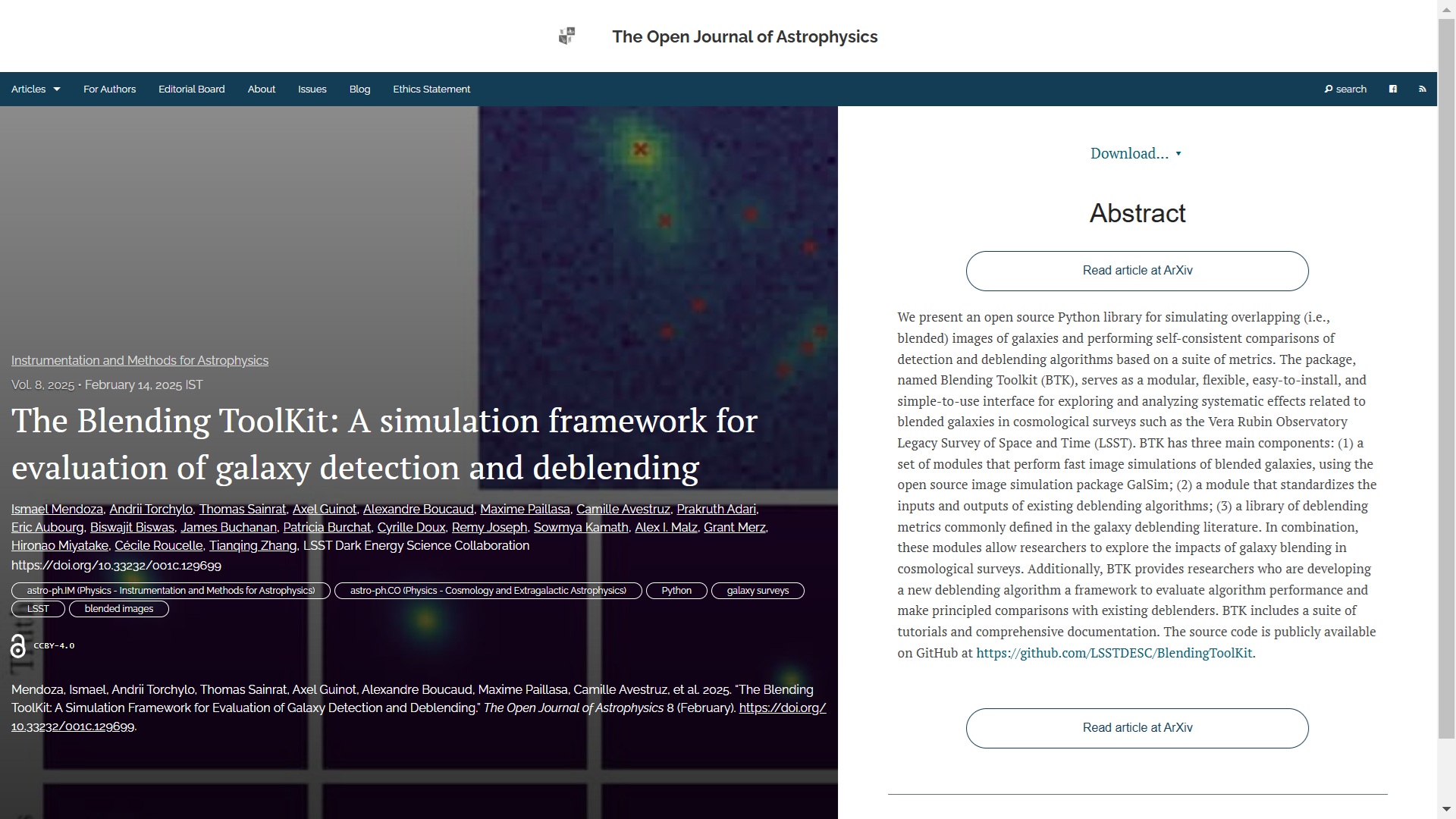
The second paper, published on Friday 14th February 2025 in the folder Instrumentation and Methods for Astrophysics is “The Blending ToolKit: A simulation framework for evaluation of galaxy detection and deblending” which describes a modular suite of Python software for exploring and analyzing systematic effects related to blended galaxy images in cosmological surveys. It was written by Ismael Mendoza (U. Michigan, Ann Arbor, USA) and 19 others, on behalf of the LSST Dark Energy Science Collaboration. I don’t have time to list all the authors here but you can find them on the overlay here:


The accepted version of this paper can be found on the arXiv here.

That’s all for this week. I’ll do another update next week, when I expect to be able to report that we have passed the 250 publication mark.

Four New Publications at the Open Journal of Astrophysics

Posted in OJAp Papers, Open Access, The Universe and Stuff with tags , , , , , , , , , , , , , on December 14, 2024 by telescoper

It’s Saturday morning once again so here’s another quick update of activity at the Open Journal of Astrophysics. Since the last update a week ago we have published  four papers, which takes the count in Volume 7 (2024) up to 114 and the total published altogether by OJAp up to 229. If we publish just one more paper between now and the end of the year, we will have published as many papers in 2024 as we have in all previous years.

Anyway, in chronological order of publication, the four papers published this week, with their overlays, are as follows. You can click on the images of the overlays to make them larger should you wish to do so.

First one up is “Star formation beyond galaxies: widespread in-situ formation of intra-cluster stars” by Niusha Ahvazi & Laura V. Sales (UC Riverside, USA), Julio F. Navarro (U. Victoria, Canada), Andrew Benson (Carnegie Obs. USA), Alessandro Boselli (Aix Marseille U., France) and Richard D’Souza (Vatican Obs.). The paper, which is in the folder marked Astrophysics of Galaxies, The paper presents a simulation-based analysis of a diffuse star forming component in galaxy clusters extending for hundreds of kiloparsecs and tracing the distribution of neutral gas in the cluster host halo.

Here is a screen grab of the overlay, which includes the abstract:

You can find the officially accepted version of the paper on the arXiv here.

The second paper to announce, published on 10th December 2024 in the folder Cosmology and NonGalactic Astrophysics, is “Cosmological Constraints from Combining Photometric Galaxy Surveys and Gravitational Wave Observatories” by E.L. Gagnon, D. Anbajagane, J. Prat, C. Chang, and J. Frieman (all of U. Chicago, USA). This article quantifies the expected cosmological information gain from combining the forecast LSST 3x2pt analysis with the large-scale auto-correlation of GW sources from proposed next-generation GW experiments.

You can see the overlay here:

The accepted version of this paper can be found on the arXiv here.

The third paper, also published on 10th December 2024, but in the folder marked Earth and Planetary Astrophysics, has the title “A potential exomoon from the predicted planet obliquity of β Pictoris b” and is written by Michael Poon, Hanno Rein, and Dang Pham all of the University of Toronto, Canada. It presents discussion, based on the β Pictoris system, of the idea that the presence of exomoons can excite misalignment between the spin and orbit axis (obliquity) in exoplanet systems

Here is the overlay

The final version accepted on arXiv is here.

Last of this quartet, published on 11th December 2024, and in the folder Cosmology and NonGalactic Astrophysics is “Map-level baryonification: Efficient modelling of higher-order correlations in the weak lensing and thermal Sunyaev-Zeldovich fields” and is by Dhayaa Anbajagane & Shivam Pandey (U. Chicago) and Chihway Chang (Columbia U.), all based in the USA.

The paper proposes an extension of the semi-analytic formalism to weak lensing and thermal Sunyaev-Zeldovich (tSZ) fields directly on the full-sky, with an emphasis on higher-order correlations. The overlay is here:

You can find the official accepted version on the arXiv here.

That’s all for this week. I’ll do another update next Saturday, and that will probably be the last one of the year. If we publish just one more paper between now and 31st December, we will have published as many papers in 2024 as we have in all previous years put together!

A Universe of Two Trillion Galaxies

Posted in The Universe and Stuff with tags , , , , , on October 13, 2016 by telescoper

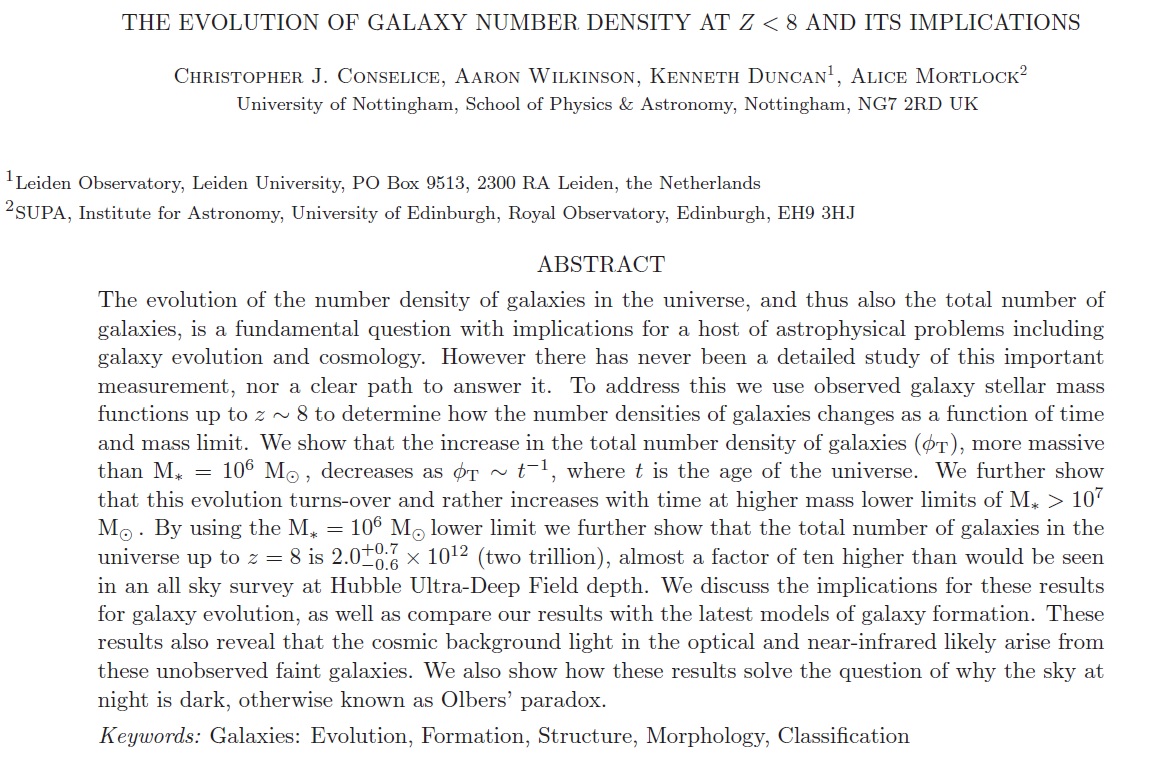
I just saw a press-release that describes a paper, just out, authored by Chris Conselice et al from the University of Nottingham (in the Midlands), with this here abstract:

conselice

The key conclusion of this paper is that when the universe was only a few billion years old there were about ten times as many galaxies in a given volume of space as there are within a similar volume today, but most of these galaxies were much lower mass systems than, e.g., the Milky Way. In fact their masses are similar to those of the satellite galaxies surrounding the Milky Way. These objects are numerous but so faint that even in very deep surveys with very big telescopes they are very easy to miss.

Here’s an image from a deep survey: this is from the Hubble Space Telescoper Great Observatories Deep Survey (HST-GOODS).

hst_goods-south

You can click on this to make it larger if you wish. This is typical of a “pencil beam” survey. It opens a very small window on the heavens – about a millionth of its total area of the sky – in a direction chosen to avoid having too many bright stars from our own Galaxy getting in the way. When you look at such a patch with a big telescope for a long time, what you see is basically all galaxies. The few stars in the above image can be identified by the diffraction patterns they produce, but almost every fuzzy blob in the picture is a galaxy. It looks like there are a lot of galaxies in this image, but the real number seems to be substantially higher than we thought.

When I’ve given popular talks about this kind of thing I’ve always said something like “There are at least as many galaxies in the observable Universe as there are stars in our own Galaxy”. It turns out that I was wise to include the “at least as”. There are about 100 billion (1011) stars in the Milky Way, but the latest estimate is now that there are two trillion (2 ×10¹²) galaxies in the observable Universe. I quote Douglas Adams:

“The Universe, as has been observed before, is an unsettlingly big place, a fact which for the sake of a quiet life most people tend to ignore. Many would happily move to somewhere rather smaller of their own devising, and this is what most beings in fact do.

I believe this explains a lot about modern politics.