Archive for Gamma Ray Bursts

Weekly Update at the Open Journal of Astrophysics – 08/03/2025

Posted in OJAp Papers, Open Access, The Universe and Stuff with tags , , , , , , , , , , , , , , , , , , , , on March 8, 2025 by telescoper

Time for the weekly Saturday morning update of papers published at the Open Journal of Astrophysics. Since the last update we have published four new papers, which brings the number in Volume 8 (2025) up to 25 and the total so far published by OJAp up to 260.

In chronological order of publication, the four papers published this week, with their overlays, are as follows. You can click on the images of the overlays to make them larger should you wish to do so.

The first paper to report is “Partition function approach to non-Gaussian likelihoods: information theory and state variables for Bayesian inference” by Rebecca Maria Kuntz, Heinrich von Campe, Tobias Röspel, Maximilian Philipp Herzog, and Björn Malte Schäfer, all from the University of Heidelberg (Germany). It was published on Wednesday March 5th 2025 in the folder Cosmology and NonGalactic Astrophysics and it discusses the relationship between information theory and thermodynamics with applications to Bayesian inference in the context of cosmological data sets.


You can read the officially accepted version of this paper on arXiv here.

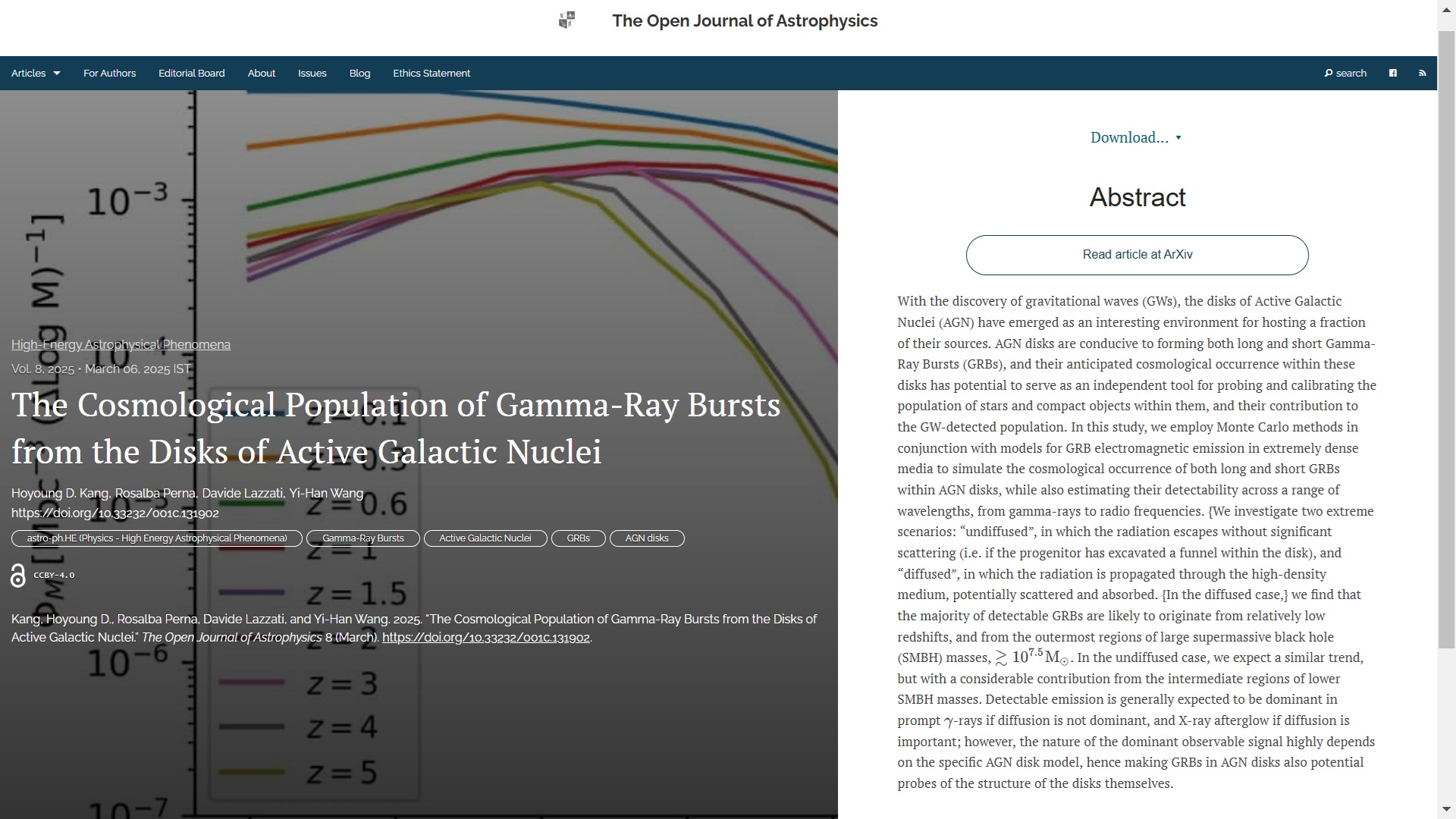
The second paper of the week  is “The Cosmological Population of Gamma-Ray Bursts from the Disks of Active Galactic Nuclei” by Hoyoung D. Kang & Rosalba Perna (Stony Brook), Davide Lazzati (Oregon State), and Yi-Han Wang (U. Nevada), all based in the USA. It was published on Thursday 6th March 2025 in the folder High-Energy Astrophysical Phenomena. The authors use models for GRB electromagnetic emission to simulate the cosmological occurrence and observational detectability of both long and short GRBs within AGN disks
You can find the officially accepted version of this paper on arXiv here.

The next two papers were published on Friday 7th March 2025.

The distribution of misalignment angles in multipolar planetary nebulae” by Ido Avitan and Noam Soker (Technion, Haifa, Israel) analyzes the statistics of measured misalignment angles in multipolar planetary nebulae implies a random three-dimensional angle distribution limited to <60 degrees. It is in the folder Solar and Stellar Astrophysics.

Here is the overlay:


The official published version can be found on the arXiv here.

The last paper to report this week is “The DESI-Lensing Mock Challenge: large-scale cosmological analysis of 3×2-pt statistics” by Chris Blake (Swinburne, Australia) and 43 others; this is a large international collaboration and I apologize for not being able to list all the authors here!

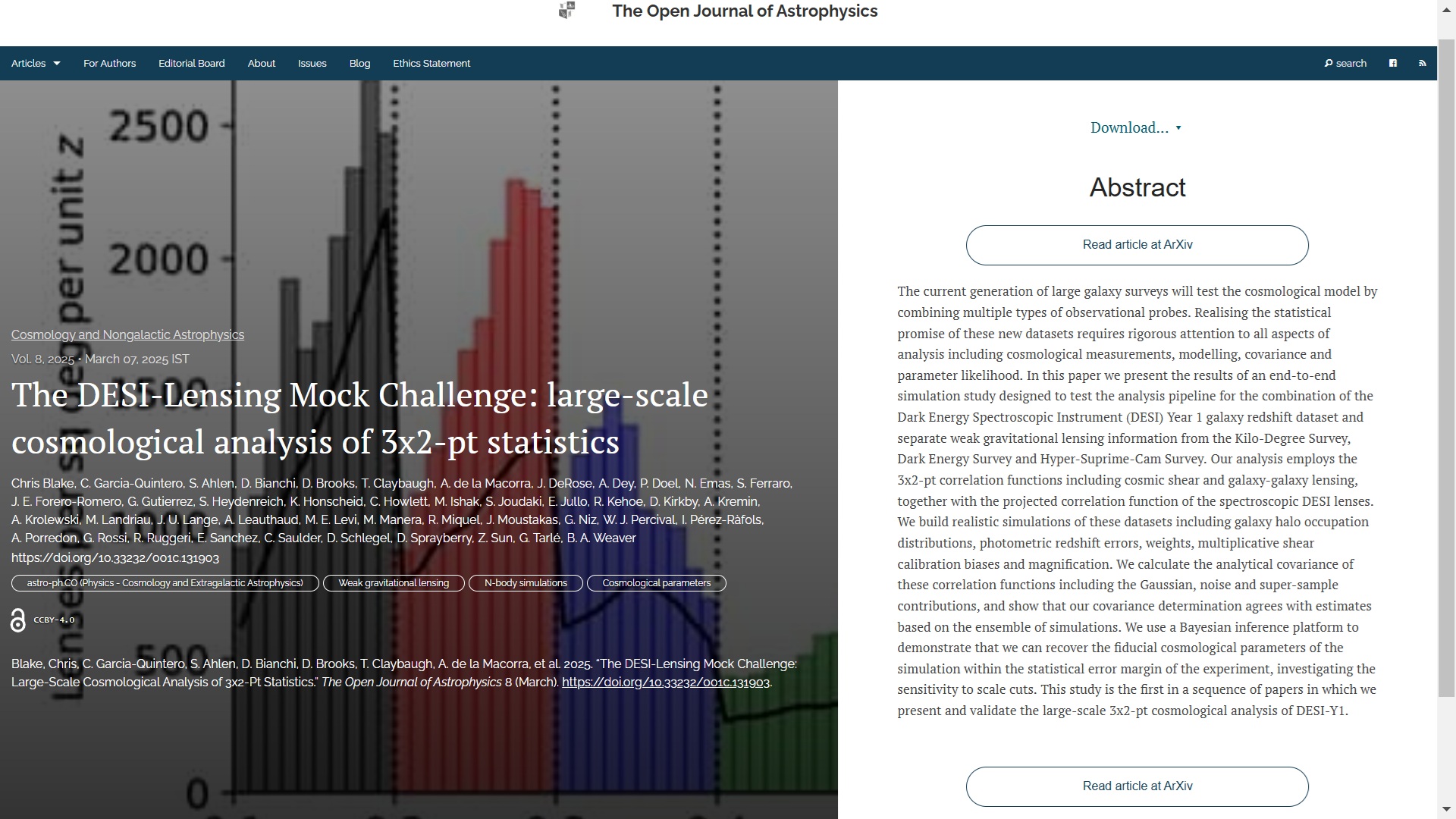
This one is in the folder marked Cosmology and NonGalactic Astrophysics; it presents an end-to-end simulation study designed to test the analysis pipeline for the Dark Energy Spectroscopic Instrument (DESI) Year 1 galaxy redshift dataset combined with weak gravitational lensing from other surveys.

The overlay is here:
 

You can find the “final” version on arXiv here.

That’s all for this week. It’s good to see such an interesting variety of topics. I’ll do another update next Saturday

Never mind the points, look at the line!

Posted in Bad Statistics, Open Access, The Universe and Stuff with tags , , , , , on June 14, 2023 by telescoper

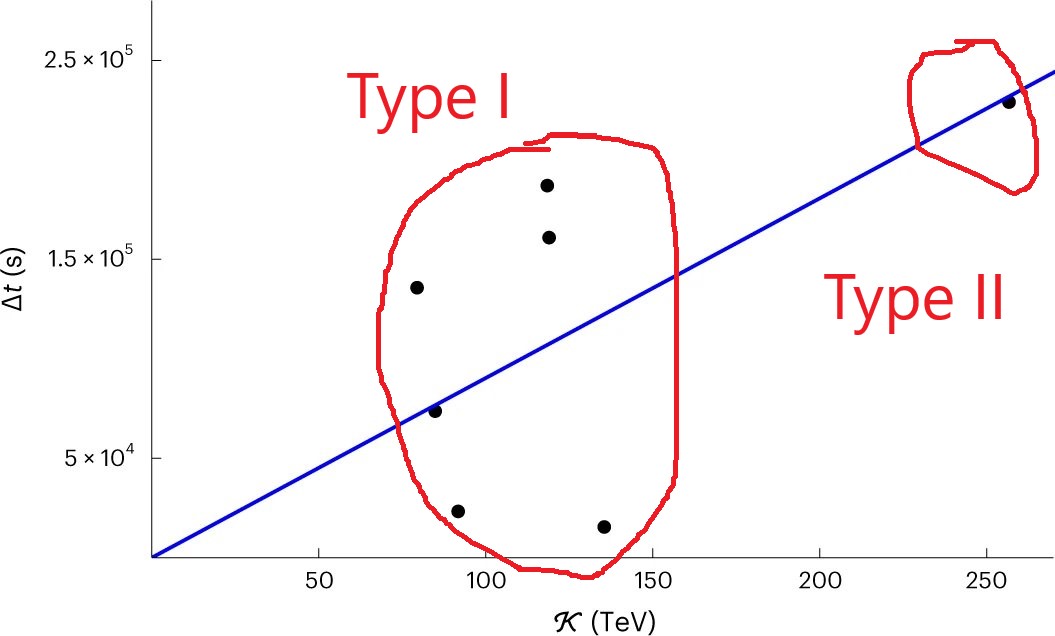
I was just thinking this morning that it’s been a while since I posted anything in my Bad Statistics folder when suddenly I come across this gem from a paper in Nature Astronomy entitled Could quantum gravity slow down neutrinos?

The paper itself is behind a paywall (though a preprint version is on the arXiv here). The results in the paper were deemed so important that Nature Astronomy tweeted about them, including this remarkable graph:

Understandably there has been quite a lot of reaction from scientists on Twitter to this plot, questioning how the blue line is obtained from the dots (as only one point to the right appears to be responsible for the trend), remarking on the complete absence of any error bars on either axis for any of the points, and above all wondering how this managed to get past a referee, never mind one for a “prestigious” journal such as Nature Astronomy. It wouldn’t have passed muster as an undergraduate exercise.

Of course this is how a proper astronomer would do it:

Joking aside, if you look at the paper (or the preprint if you can’t afford it) you will see another graph, which shows two other points at higher energy (red triangles):

The extra two points don’t have any error-bars either, and according to the preprint these appear to be unconfirmed candidate GRB events.

The abstract of the paper is:

In addition to its implications for astrophysics, the hunt for neutrinos originating from gamma-ray bursts could also be significant in quantum-gravity research, as they are excellent probes of the microscopic fabric of spacetime. Some previous studies based on neutrinos observed by the IceCube observatory found intriguing preliminary evidence that some of them might be gamma-ray burst neutrinos whose travel times are affected by quantum properties of spacetime that would slow down some of the neutrinos while speeding up others. The IceCube collaboration recently significantly revised the estimates of the direction of observation of their neutrinos, and we here investigate how the corrected directional information affects the results of the previous quantum-spacetime-inspired analyses. We find that there is now little evidence for neutrinos being sped up by quantum spacetime properties, whereas the evidence for neutrinos being slowed down by quantum spacetime is even stronger than previously determined. Our most conservative estimates find a false-alarm probability of less than 1% for these ‘slow neutrinos’, providing motivation for future studies on larger data samples.

I agree with the last sentence where it says larger data samples are needed in future, but also I’d suggest higher standards of data analysis are also called for. Not to mention refereeing. After all, it’s the quality of the reviewing that you pay for, isn’t it?

P.S. For those of you wondering, this paper would not have been published by the Open Journal of Astrophysics even if passed review, as it is not on the astro-ph section of arXiv (it’s on gr-qc).

Gamma-Ray Bursts and the Cosmological Principle

Posted in Astrohype, Bad Statistics, The Universe and Stuff with tags , , , on September 13, 2015 by telescoper

There’s been a reasonable degree of hype surrounding a paper published in Monthly Notices of the Royal Astronomical Society (and available on the arXiv here). The abstract of this paper reads:

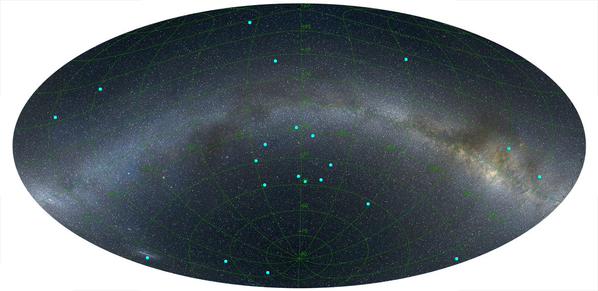
According to the cosmological principle (CP), Universal large-scale structure is homogeneous and isotropic. The observable Universe, however, shows complex structures even on very large scales. The recent discoveries of structures significantly exceeding the transition scale of 370 Mpc pose a challenge to the CP. We report here the discovery of the largest regular formation in the observable Universe; a ring with a diameter of 1720 Mpc, displayed by 9 gamma-ray bursts (GRBs), exceeding by a factor of 5 the transition scale to the homogeneous and isotropic distribution. The ring has a major diameter of 43° and a minor diameter of 30° at a distance of 2770 Mpc in the 0.78 < z < 0.86 redshift range, with a probability of 2 × 10⁻⁶ of being the result of a random fluctuation in the GRB count rate. Evidence suggests that this feature is the projection of a shell on to the plane of the sky. Voids and string-like formations are common outcomes of large-scale structure. However, these structures have maximum sizes of 150 Mpc, which are an order of magnitude smaller than the observed GRB ring diameter. Evidence in support of the shell interpretation requires that temporal information of the transient GRBs be included in the analysis. This ring-shaped feature is large enough to contradict the CP. The physical mechanism responsible for causing it is unknown.

The so-called “ring” can be seen here:
ring_Australia

In my opinion it’s not a ring at all, but an outline of Australia. What’s the probability of a random distribution of dots looking exactly like that? Is it really evidence for the violation of the Cosmological Principle, or for the existence of the Cosmic Antipodes?

For those of you who don’t get that gag, a cosmic antipode occurs in, e.g., closed Friedmann cosmologies in which the spatial sections take the form of a hypersphere (or 3-sphere). The antipode is the point diametrically opposite the observer on this hypersurface, just as it is for the surface of a 2-sphere such as the Earth. The antipode is only visible if it lies inside the observer’s horizon, a possibility which is ruled out for standard cosmologies by current observations. I’ll get my coat.

Anyway, joking apart, the claims in the abstract of the paper are extremely strong but the statistical arguments supporting them are deeply unconvincing. Indeed, I am quite surprised the paper passed peer review. For a start there’s a basic problem of “a posteriori” reasoning here. We see a group of objects that form a map of Australia ring and then are surprised that such a structure appears so rarely in simulations of our favourite model. But all specific configurations of points are rare in a Poisson point process. We would be surprised to see a group of dots in the shape of a pretzel too, or the face of Jesus, but that doesn’t mean that such an occurrence has any significance. It’s an extraordinarily difficult problem to put a meaningful measure on the space of geometrical configurations, and this paper doesn’t succeed in doing that.

For a further discussion of the tendency that people have to see patterns where none exist, take a look at this old post from which I’ve taken this figure which is generated by drawing points independently and uniformly randomly:

pointaI can see all kinds of shapes in this pattern, but none of them has any significance (other than psychological). In a mathematically well-defined sense there is no structure in this pattern! Add to that difficulty the fact that so few points are involved and I think it becomes very clear that this “structure” doesn’t provide any evidence at all for the violation of the Cosmological Principle. Indeed it seems neither do the authors. The very last paragraph of the paper is as follows:

GRBs are very rare events superimposed on the cosmic
web identified by superclusters. Because of this, the ring is
probably not a real physical structure. Further studies are
needed to reveal whether or not the Ring could have been
produced by a low-frequency spatial harmonic of the large-
scale matter density distribution and/or of universal star
forming activity.

It’s a pity that this note of realism didn’t make it into either the abstract or, more importantly, the accompanying press release. Peer review will never be perfect, but we can do without this sort of hype. Anyway, I confidently predict that a proper refutation will appear shortly….

P.S. For a more technical discussion of the problems of inferring the presence of large structures from sparsely-sampled distributions, see here.

Honoris Causa, Dr Chryssa Kouveliotou

Posted in Education, The Universe and Stuff with tags , , , , , on July 10, 2014 by telescoper

This morning I had the privilege of participating in a graduation ceremony at the University of Sussex. It was great to get to shake the hands of all the successful graduates as they crossed the stage to receive their degrees. I hope I’ll be able to collect a few pictures of the occasion and post them in due course.


Kouveliotou

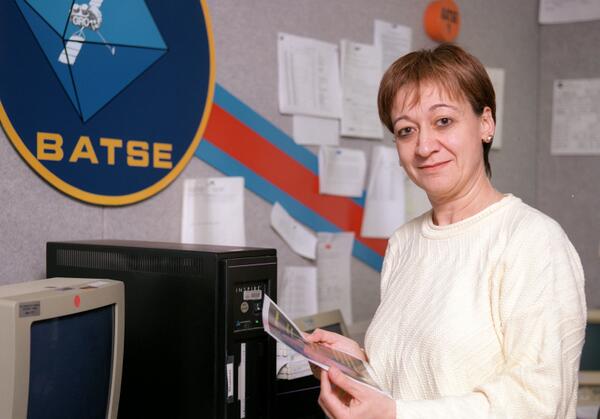
I also had the privilege of being able to present an extremely distinguished honorary graduand, Dr Chryssa Kouveliotou. Here the oration I delivered, which I’m posting simply to record her amazing achievements and to underline that she is one of many people who have done the MSc in Astronomy at Sussex University and gone on to do great things…


Vice-Chancellor,

It is both a pleasure and an honour to present for the award of the degree of Doctor of Science, Dr Chryssa Kouveliotou.

Inspired by watching Neil Armstrong take his first step on the moon, Dr Kouveliotou always wanted to be an astronaut but, with no such opportunities apparently on offer in her native, she instead chose a career in astronomy. However, when she completed college Greece her astronomy professor (who shall remain nameless) advised her that there was no future for her in astrophysics. She has never known whether he really thought it was a poor choice or whether it was because she was a woman. Determined to follow her own path, she disregarded him completely and, even though her open-minded parents’ preference was for her to settle down and stay in her home country, she left to study for her Master’s degree in Astronomy at the University of Sussex; the topic of her dissertation was “The Sodium emission cloud around Io: mapping and correlation with Jupiter’s magnetic field”. She received the MSc in Astronomy in 1977. Although the topic of her subsequent research was rather different, the connection with magnetic fields remained strong.

Dr Kouveliotou then moved to Germany to do postgraduate research on the-then very new topic of gamma-ray bursts. Indeed, she may well have been the very first person to complete a thesis on this, which remains to this day an extremely active and exciting field of research. Gamma-ray bursts are considered to be the most powerful explosions in the universe, second only to the Big Bang itself.

After completing her PhD, Dr Kouveliotou returned to Greece to teach Physics and Astronomy at the University of Athens. All the while she knew that she really wanted to do research so spent her free time pursuing this goal. Every vacation and on her one-year sabbatical she went to the USA to undertake research at the National Aeronautics and Space Administration (NASA). Her work was on solar flares but she moonlighted during evenings, nights and weekends researching her ‘first love’ gamma-ray bursts. Because of the research she undertook outside her “day job”, she found a series of bursts which all came from the same part of the sky and, as a result, became part of the discovery team for a brand new phenomenon called a soft gamma-ray repeater.

By observing gamma rays produced in space, her team discovered an example of a new class of exotic astronomical object called a magnetar, an object which has a magnetic field trillions of times stronger than that of the Earth. A magnetar is now known to be a type of neutron star, a burnt-out relic resulting from the death of an ordinary star in a supernova explosion.

Dr Kouveliotou has always loved to ask big questions, to look at the universe and ask how nature expresses itself. By overcoming obstacles in her path she really has reached the stars. In January 2013 Dr Chryssa Kouveliotou was named the Senior Scientist for High Energy Astrophysics, Science and Research Office at NASA’s Marshall Space Flight Center in Hunstville, Alabama.

She has received many awards for her work, including the Dannie Heineman Prize for Astrophysics and the NASA Exceptional Service Medal in 2012 and the NASA Space Act Award in 2005. She was also named amongst Time Magazine’s 25 Most Influential People in Space in 2012. In 2003 she was honoured with the annual Rossi Prize by the High Energy Astrophysics division of the American Astronomical Society for a significant contribution to high-energy astrophysics. In 2002 she received the Descartes Prize which recognises scientific breakthroughs from European collaborative research in any scientific field. In the awards bestowed upon her she has also been recognised for her effectiveness at creating the sort of large collaboration needed to make effective use of multi-wavelength astronomical observations.

Dr Kouveliotou has published almost 400 papers in refereed scientific journals and has been amongst the top 10 most-cited space science researchers in the academic literature across the world. She has been elected chair of the Division of Astrophysics of the American Physical Society and is a member of the Council of the American Astronomical Society, of which she chairs the High Energy Astrophysics Division.

Vice-Chancellor, I present to you for the degree of Doctor of Science, honoris causa, Dr Chryssa Kouveliotou.


Darwin and After

Posted in Biographical, Science Politics with tags , , , , , , , , on October 10, 2009 by telescoper

Another sign that the academic year is back into full swing is that the monthly meetings of the Royal Astronomical Society have started up again after the usual summer hiatus. Since I’ve got a very heavy week coming up, I thought I’d take the advantage of a bit of breathing space in my timetable to attend yesterday’s meeting and catch up with the gossip at the Club afterwards.

The highlight of the day’s events was the annual George Darwin Lecture which was given this year by Neil Gehrels from the NASA Goddard Space Flight Center on the subject Gamma Ray Bursts and the Birth of Black Holes: Discoveries by SWIFT. This is a very hot topic (of course) and the lecture did full justice to it. The RAS has two other “prize” lectures – the Gerald Whitrow Lecture and the Harold Jeffreys Lecture – which are used to invite eminent speakers from around the world. They’re not always successful as lectures because the speakers sometimes try to make them too specialised and too detailed, but this one was exceptionally clear and well delivered. I enjoyed it, as well as learning a lot; that’s the essence of a good lecture I think.

The main task for visiting speakers when it comes to the George Darwin Lecture is to give their talk without revealing the fact that they hadn’t realised that Charles Darwin had a famous astronomical son!

Then to the Athenaeum, for drinks and dinner, where the current financial crisis at STFC was in the background of a lot of the conversation. Rumours abounded but I didn’t pick up any hard information about what is likely to happen to our funding next year. I suspect that’s because even STFC doesn’t know. After a bit of wine, though, conversation moved onto other,  less depressing, things including football, cheese and the Welsh landscape.

The colleague sitting next to me (an old friend from Queen Mary days, now at Imperial College) reminded me that in January last year Joao Magueijo invited me to give the vote of thanks at his inaugural lecture (as long as I promised to try to make my speech as short and as funny as possible). It turns out his lecture was only twenty minutes long, which didn’t give as much time as I’d hoped to think of something to say so I resorted to a couple of off-colour jokes and a facetious remark about how the brevity of Imperial’s lectures explained why their students never seemed to know anything. I got a very good laugh from the packed lecture theatre, but was told off afterwards by a senior physicist from the Imperial physics department. That particular episode is something I often think about, the pomposity of some of the staff reminding me that I’m not unhappy at not getting a job there I applied for a few years ago.

Actually, I just remembered that they took pictures at the party afterwards so here’s one of me and Joao having a chuckle afterwards. Notice I had put a tie on for the occasion, but Joao’s wardrobe is strictly T-shirts only.

37079699

After Friday’s dinner (roast partridge, if you want to know) I got the last train back to Cardiff from Paddington, snoozing comfortably for a large part of the journey. On time until just outside Cardiff Central, the train then sat motionless on the track almost within sight of the platform owing to the presence of a broken down goods train in front of us. We finally got into the station 50 (FIFTY) minutes late, and I didn’t get home until well after 2am.