Archive for General Election

Why You Should Vote

Posted in Politics with tags , , on May 7, 2015 by telescoper

SuffrageI came across this wonderful photograph this morning via Twitter and couldn’t resist sharing it here.
Some people fought very hard to secure the right to vote, like this courageous Suffragette addressing a vast and hostile audience on Newcastle quayside way back in 1914. The rights we enjoy today were hard won. Don’t squander them.

Polling Day Memories

Posted in Biographical, Politics with tags , , , , on May 7, 2015 by telescoper

At last we’ve reached General Election day and I’ve just been to cast my vote in the crypt of St George’s Church in Kemptown, very close to my Brighton residence.  It was quite busy this morning when I got there, and I had to queue to get my ballot paper. I don’t know what the turnout is like this time, but I hope it’s good. I don’t think there’s really any excuse for not voting, although some people seem to prefer to whinge than to vote.

I doubt if I’ll stay up late tonight to watch the results come in. Polls don’t close until 10pm and until then there’s a blackout of press coverage relating to the vote so there’s nothing to follow until quite late at night, when I’m usually tucked up in bed with my cocoa.  The latest opinion polls suggest that the Conservative Party may just get the biggest share of the vote, but it is highly unlikely they’ll win a majority of the seats. The likelihood therefore is abother hung parliament, at which point there’ll be some frantic negotiation behind the scenes. It will still be interesting to see how the horse-trading works out over the next few days, but after three weeks of phoney war we’ll soon have to face up to reality. I’m not really looking forward to that.

On the corresponding Polling Day eighteen years ago in 1997 I was actually in Lawrence, Kansas. Don’t ask me why. I’d arranged a postal vote, but had to watch the proceedings from afar on the TV. Some expat British friends of mine decided to hold a party that night in their house and I went along to drink beer while the results came in. Watching a British election from the midwest USA is a bit strange, but it’s improved by the fact that the polls close in the UK at what is early evening Kansas-time and it’s all pretty much over by midnight.

That election I was swept up in the euphoria generated by the prospect of a New Labour government with its slogan “Things can only get better”. When they won a landslide majority we celebrated in grand style, singing Jerusalem in the back garden and then tottered not-too-soberly to a tattoo parlour to have a red rose put on my arm.

We had a great time that night, and the good vibes continued after I returned to London from my short stay at the University of Kansas. It didn’t take long, however, for my enthusiasm to wane. Instead of doing the really radical things their large majority would have allowed, they didn’t seem to have the gumption to tackle the really important issues. Then of course Blair took us into Iraq and, despite having voted Labour all my life before then, I vowed never again to vote for the Labour Party while it was led by the people that made that decision.

But I’ve still got the red rose tattoo and this time I returned to the fold by voting for Nancy Platts in Brighton Kemptown. I wasn’t initially very impressed with Ed Miliband but I have changed my mind over the last few weeks. I think during this campaign he has behaved with great dignity and strength of character in the face of some pretty nasty personal attacks from his political opponents. Now I really hope that Ed Miliband leads the next Goverment of the United Kingdom, although it will probably only be able to do so in some sort of coalition with the Scottish Nationalist Party and possibly the Liberal Democrats.

For what it’s worth, my predictions for the consituencies in Brighton is that Labour will win both Kemptown and Hove, whereas in Pavilion Caroline Lucas of the Green Pary will hold the seat for the Conservatives.

But whether or not you agree with my political opinions, please get out there and vote. Tomorrow, VE Day, is the 70th Anniversary of the end of the Second World War in Europe. Remember that as you cast your vote, and have faith in the democracy so many gave their lives to defend.

The Day After

Posted in Finance, Politics with tags on May 7, 2010 by telescoper

I wasn’t planning to stay up last night watching the General Election results come in, but in the end I stuck with it until about 3am, basically hoping to understand what was going on.  Even by that hour there didn’t seem to be a particularly clear pattern emerging, so off I went. I had a revision lecture this morning as well as a lot of other things so I didn’t fancy an all night sitting.

Whenever there’s a General Election I always pay attention to constituencies I used to live in to see how things are changing. Broxtowe (the constituency that contains Beeston, where I used to live when I worked at Nottingham University) changed hands from Labour to the Conservatives. It had been a Conservative marginal in 1997 when it was won during the New Labour landslide. It seemed fairly typical for seats like that to revert to what they were pre-Blair. Brighton – remarkably – returned Britains first ever Green Party MP. Bethnal Green returned to the Labour fold after a flirtation with George Galloway’s Respect party.

Meanwhile here in Cardiff the results were as mixed as elsewhere. My own constituency, Cardiff West, stayed Labour, as did Cardiff South (and Penarth). The Vale of Glamorgan reverted to its pre-1997 Tory hue, unsurprisingly. The Labour candidate in Cardiff North was the wife of former Welsh Assembly leader Rhodri Morgan and it was a definite surprise to see that seat turn blue too. Cardiff Central remained Liberal Democrat.

As it has turned out the exit polls got it just about right, with the Conservative Party leading the popular vote (36%) and number of  seats (306), but not enough to make an overall majority. Labour (28%, 258 seats) and Liberal Democrats (23%, 57 seats) between them have a majority of the votes cast but don’t have enough seats to form a coalition. It’s a well and truly hung Parliament and we look set for days of discussions to see what kind of agreement can be reached between which parties. Gordon Brown remains Prime Minister until some kind of resolution is reached. We live in interesting times.

Although the election results were extremely interesting by virtue of their puzzlingly inhomogeneous variation across the country,  they really amount to little more than a sideshow compared with the spreading panic on international markets. The markets fell sharply, not because of the hung parliament but as part of a worldwide panic over the knock-on effect of the Greece and Portugal sovereign debt problems. The contagion could be very dangerous if Greece can’t convince traders that it’s not going to default and in an attempt to do so its government has put together a severe austerity package. Cue violent unrest. The Greeks live in even more interesting times than us.

I’m not going to pretend that I have the slightest clue how either of these things will pan out, but I’m not very optimistic about the forthcoming months. I hope I’m wrong. We’ll see.

The other thing that struck me  was the story of people being unable to vote because of long queues at the polling stations near 10pm when they closed. At first I wasn’t at all sympathetic. Polls are open from 7am until 10pm, so there’s no need to turn up with only 5 minutes remaining. However, it then emerged that  some polling stations couldn’t cope with the large turnout and people had been queuing for hours by the time the doors closed. The turnout was 65% nationally, higher than last time but by no means ridiculously high. In fact I think it’s a shame the usual turnout  isn’t very much higher than this. However, turnout seems to have been much higher in certain wards and the staff unprepared for the demand, sometimes with insufficient ballot papers and sometimes with out-of-date copies of the electoral register. I don’t mind saying that I found this level of incompetence deeply shaming. We can’t afford to be so careless with our democratic system. It doesn’t matter if only a few hundred people were affected. It’s the principle that matters.

Over the next few days there’ll be a lot of discussion about electoral reform. Perhaps the fact that our current electoral system seems to be showing signs of neglect might generate some impetus for change, quite apart from the scandals of MPs fiddling their expenses. I’ve always been on the fence over proportional representation. Our system is absurd in some respects, delivering huge majorities in the Commons to parties with only a modest share of the popular vote. On the other hand our country is so divided that it’s not obvious what the short-term consequences of changing to PR would be. It seems likely, for one thing, that fringe parties such as the neo-fascist BNP would actually be represented in Westminster. I find that a repulsive prospect, but putting up with people you can’t abide is one of the consequences of democracy.

I have an open mind on electoral reform and I’d like to hear the arguments for and against different systems of PR aired properly. Presumably the Liberal Democrats will want a referendum on this as part of the price of their support in a coalition, so no doubt there’ll be a lot of chat about this.

Polling Day

Posted in Biographical, Politics with tags , , on May 6, 2010 by telescoper

At last we’ve reached General Election day and I’ve just been to cast my vote following the guidance I passed on a few days ago. I was going to go this morning but I had a meeting at 9.15am to go to (which went on until 1pm, in fact) and I didn’t get up in time to visit the polling station, even though it’s in a Church Hall only a few hundred yards from my house. When I eventually got there just after 7pm it was still quite busy and I had to queue to get my ballot paper. It was very different during last year’s European elections, where the turnout is always pretty low. I don’t know what the turnout is like this time, but I hope it’s good. I don’t think there’s really any excuse for not voting.

I’ve already explained why I’m not as caught up in the campaigning this time as I have been in previous years, so I doubt if I’ll stay up late to watch the results come in. Polls don’t close until 10pm and until then there’s a blackout of press coverage relating to the vote so there’s nothing to follow until quite late at night, when I’m usually tucked up in bed with my cocoa.  The latest opinion polls suggest that the Conservative Party will get the biggest share of the vote, but it’s not clear if they’ll win a majority of the seats. Nor should they, in fact, even if they get as high a share as the polls suggest (37%) then that’s still far less than the number that didn’t vote for them. Labour and LibDems are together worth about 55%. The likelihood therefore is a hung parliament, at which point we’ll probably find all parties agreeing with each other to the implement massive spending cuts they’ve been carefully keeping from the electorate. It will still be interesting to see how the horse-trading works out over the next few days, but after three weeks of phoney war we’ll soon have to face up to reality. I’m not really looking forward to that.

Anyway, a comment by Keith Ashman on an item I posted a few days ago reminded me that no less than 13 years ago I was actually in Lawrence, Kansas, on polling day. Don’t ask me why. I’d arranged a postal vote, but had to watch the proceedings from afar on the TV. In fact, Keith and his partner decided to hold a party that night in their house and I went along to drink beer while the results came in. Watching a British election from the midwest USA is a bit strange, but it’s improved by the fact that the polls close in the UK at what is early evening Kansas-time and it’s all pretty much over by midnight.

That election I was swept up in the euphoria generated by the prospect of a New Labour government with its slogan “Things can only get better”. When they won a landslide majority we celebrated in grand style, singing Jerusalem in Keith’s back garden and then tottered not too soberly to a tattoo parlour to have a red rose put on my arm.

We had a great time that night, and the good vibes continued after I returned to London from my short stay at the University of Kansas. It didn’t take long, however, for my enthusiasm to wane. Instead of doing the really radical things their large majority would have allowed, they basically pratted about for four years. I’m not saying they didn’t do any good things, but they were so keen to tie everyone up in red tape that the good ideas often came to nothing except frustration. Then of course Blair took us into Iraq and I vowed never again to vote for the Labour Party until it renounced that decision, which I haven’t.

But I’ve still got the red rose tattoo.

House of Cards

Posted in Finance, Politics with tags , , , on April 29, 2010 by telescoper

There’s now only a week left until polling day in the General Election, and I’ve managed to avoid blogging about it as much as possible. The main reason for this is that I feel almost entirely disconnected from the whole thing, as if it’s all a bit unreal. One of the things in the news this week sparked a memory of something I wrote a few weeks ago which, in turn, made me realise why I find it difficult to take this election seriously.

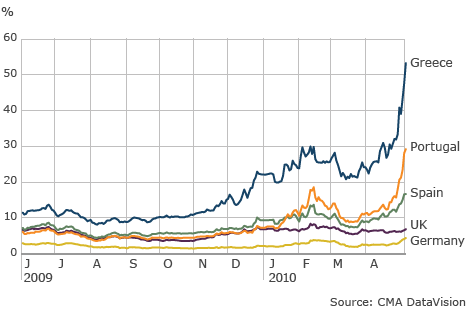
It emerged on Tuesday that the international money markets had downgraded Greece’s credit rating to “junk” status. Portugal and, more recently, Spain have since been downgraded too, but not as far as Greece. Yet. The reason for this downgrading is that analysts doubt whether these countries will be able to control their public spending sufficiently in order for them to honour huge levels of sovereign debt. The probability that Greece in particular will default in a big way has been growing steadily, according to the calculations of financial experts, and has now reached the level at which traders are adopting strategies that essentially involve betting on this actually happening.

The consequence of all this turmoil is that Greece would have to borrow money at huge levels of interest – over 15% – in order to carry on. The eurozone countries – particularly Germany – are trying to put together a package that that can be paid back at less ruinous rates, but while they continue to debate the details the panic continues.

The knock-on effect of a Greek default would be to remove money from the balance sheets of banks and financial institutions around the world. If a  bank has holdings of Greek debt, and the Greeks default, then the bonds become worthless and billions of pounds disappear off its balance sheet. Some British banks are exposed in this way, but nowhere near as much as France, Germany and Switzerland.

The baleout of Greece may work, but if it doesn’t it looks likely that Greece will be ejected from the euro and will have to take drastic measures to set its house in order. Fine, you might say. They’ve been living beyond their means for too long. That’s true. But so has Spain, which suffered even more than the UK from a housing bubble that went pop and is left with a huge budget deficit.  Spain is too large an economy to be rescued, even by Germany.  A default there, and there’s a real possibility of a chain reaction that will probably mean  curtains for the euro and possibly a real meltdown of the global financial system.  I’m just surprised that it has taken since 2007 for phase 2 of the global financial crisis to start. I think the contagion is still spreading.

 By some measures, our economy is in even worse shape than Spain’s.  However, the reason the markets haven’t downgraded us yet is that we’ve been given a stay of execution by the imminent general election. I’m sure analysts will be looking for very prompt and effective action to tackle our budget deficit if they are not going to put us through the wringer like they did with Greece. Greece, Portugal and Spain are all relatively recent democracies and it’s not obvious their governments can deliver huge public spending cuts and survive the resulting social unrest intact. They certainly haven’t managed to convince the markets they can anyway.

 What’s clear from the UK general election campaign is that none of the main political parties is willing to go public about the scale of the challenge facing whoever takes office after the election. The recent budget did a bit of trim around the edges here and there, and the party manifestos talk about the odd billion here and there in savings, but these are dwarfed by the real scale of our deficit. It seems the politicians have agreed to keep quiet about this to avoid frightening the electorate. When the votes are counted we’re going to get a rude awakening. The general election campaign is just a bizarre masquerade that’s too ridiculous to get involved in.

The scale of what could happen here is indicated by what’s happening in Ireland. Politicians here are talking about a public sector pay freeze. Ireland is actually cutting salaries in the public sector by up to 20%. I think the next UK government is going to have to do something similar or we’ll suffer the same fate as Greece. These next three years are going to be very grim for those of us working in the public sector, or at least for those who decide to stay in the UK.

We generally like to think we’re a mature democracy that’s a bit more sensible that all those mediterranean hotheads and that we’ll be able to grin and bear it for the sake of the economy. However, I’m old enough to remind the Winter of Discontent and it’s by no means obvious to me that cuts on the necessary scale will go through without sustained opposition. If – as seems likely – we end up with a coalition government with a fragile majority, this sort of thing could easily bring it down. If the markets see political instability in the UK they will certainly start downgrading our credit rating too. Public borrowing will  become more expensive, deeper spending cuts will be needed, and Britain be well and truly scuppered.

How to Vote: A Helpful Flowchart

Posted in Politics with tags on April 23, 2010 by telescoper

Fears for the Future

Posted in Finance, Politics, Science Politics with tags , , on April 10, 2010 by telescoper

Just came back from a lovely cycle ride to find that my polling card arrived through my letterbox while I was out. Gordon Brown announced the election earlier this week, so it’s quite impressive how efficiently the electoral system swings into action.  It’s a pity so much else is screwed up.  Anyway, Parliament now goes into limbo and we have three weeks of heightened tedium to endure while the politicians try to convince us that, despite all the mess they’ve made of things so far, they do actually know what they’re doing.

I still don’t know how I’m going to cast my vote on May 6th (polling day). I can’t see myself voting for the incumbents – for more reasons than I have time to list. My experience of Thatcher’s Britain in the 1980s convinced me that I’ll never vote Conservative either. And the Lib Dems are just, well, a bit pathetic. I will vote. I just don’t know who I’ll vote for. I’ll have to look at my constituency’s history carefully to see if tactical voting might help. Perhaps more on that in due course…

Anyway, whatever the result of the election turns out to be, I’m pretty scared about what the next three or four years has in store.  The huge budget deficit that the government has built up saving the banks from collapse is going to have to be dealt with. The recent budget didn’t really do anything to tackle it, but everybody knows that was just a holding operation until the election is over. Whoever takes power afterwards will have to take serious measures to fix things. It won’t be pretty. Tax rises and public spending cuts are both inevitable as  the international bond markets threaten to downgrade Britains AAA credit rating. If that happens we will end up with runaway debts and increasingly expensive borrowing.  Don’t think we won’t go the way of Greece.

In the meantime our economy is carrying on as if it is in a trance. House prices continue to rise, the FTSE index is climbing, interest rates are at the astonishingly low level of 0.5%. It can’t possibly go on. Houses are clearly still overvalued, at immense social cost to people wanting to start a family. The stock market is gaining because investors are not getting any return from cash deposits, and companies are boosting their profits by sacking staff and cutting costs rather than generating new demand. As soon as interest rates go up again – which they surely must – I think there’s a good chance the stock market will fall again. If you don’t hold any shares yourself you may think that’s not important. However, it directly affects the pensions of millions of people, most of whom are not wealthy, because that’s where a lot of their pension schemes’ money is invested.

The most pressing issue is not who wins the election but whether there is a winner. If the election turns out indecisively – which at the moment seems quite likely – then we’re going to see turmoil on a scale that makes the banking nightmare of 2007 look like a tea party. And even if there is an outright winner, there’s no guarantee that they will have the gumption to even begin tackling the problem.

Of course, as a scientist working in a University, I’m also concerned about what’s going to happen to my own livelihood after the election. The recent mess this government has made of science funding has blotted its record on this, which was previously not bad. However, the true scale of this country’s economic problems seems to be too much for our political leaders, both present and future, to cope with. I don’t see any of the parties having the vision to manage the current crisis as well as putting together a coherent plan to build a better future. I’m not the only person to think so, in fact, as a letter in The Times today from a group of distinguished astronomers made clear. Other nations (especially the USA and France) are all investing heavily in science as a means to secure future economic growth. We’ve already started cutting back, and don’t see any strong political voice to reverse that policy.

Of course people don’t just vote for their immediate self-interest. Science is important to me, and I think it’s important for the country too, but there are other issues. There’s more to life than economics too. This country has been in a post-Imperial sleepwalk for too long and it needs to snap out of it. We need to renew our political system, which has grown distant and unaccountable. We need to deal with a looming energy crisis. We need to develop a proper education system that is fit for the 21st century. And we need to deal with the problems of a rapidly ageing population. For these reasons, and more, I hope the next Parliament will contain politicians with the vision necessary to see this country through the tough times ahead. Unfortunately, I don’t think it will.

I’m just glad I’m no longer young.

Life Cycles

Posted in Biographical, Science Politics with tags , , , , , on March 13, 2010 by telescoper

This was a strange Saturday. Usually I don’t do very much on the weekend, except for a bit of shopping, tidying up, and of course the crosswords. Today, however, was one of our undergraduate Open Days wherein prospective students visit the department (usually with their adoring parents) in order to have a look around, learn about our research, and meet some of the staff that will be teaching them if and when they come here.  Our usual Open Days are Thursdays, but some people find it very difficult to get here on a weekday – parents working, school commitments, etc – so we have a few Saturdays too. Since I live within walking distance of the department I don’t mind taking part.

Bizarrely, my job today was to act as a tour guide around the experimental physics labs. I must be one of the least qualified people in the School to do that, as I’m a theoretical astrophysicist. As it happens, we had two groups to show around today and the other guide was Ant Whitworth, also a theoretical astrophysicist (though one who works on star formation, not cosmology like I do). Ours not to reason why. I got a free lunch out of it anyway, and also managed to find most of the places I was supposed to take the visitors to, most of which I’ve never seen before!

Anyway, it was nice to meet and chat with so many young people interested in physics. I hope to see at least some of them in October. Funding will be very tight this year for new undergraduates and although we’ve asked the University to increase our quota to take more students in, we haven’t so far been allowed to do so. I think that is the situation around much of England too, so I think some might not find a place at their chosen institution. I hope there aren’t too many disappointments when the A-level results come out.

The recruitment of undergraduates for next year is part of the cycle of academic life. We’re currently doing the same thing with postgraduates, although fewer people are involved in that case. The end of term comes up next week, then it’s the Easter break. Soon after that we’ll be back into examinations. Some will be graduating this year and we’ll have to say goodbye to them as they make their way into the big wide world. Others will leave for the summer and return to continue their studies next year.

The cycle of academic life is embedded within that of the seasons too. Today was a beautiful spring day in Cardiff. We’ve had sunny weather for a week or so already, but yesterday and today were the first days mild enough in temperature to be called spring. Yesterday evening as I walked home I noticed it wasn’t dark at 6pm, a sign that the days are getting longer. Soon I’ll be able to walk home through Bute Park,  which I can’t do at present because the gate on the east side is closed at sunset. I did, however, go back that way this afternoon after the Open Day activities were over.

There’s a lot of construction work going on, associated with Cardiff City Council’s plan to turn Bute Park into Bute Lorry Park, and one has to complete an obstacle course to get into it on foot these days. Still, once away from the affected areas the rest of the Park is shaping up again for spring and summer and there was quite a crowd there today, just quietly enjoying it for it’s own sake. You know, like a Park should be. I’m not looking forward to having to dodge juggernauts on the way, which is what is what the future seems to have in store.

Apart from the seasons and the cycle of academic life, I also thought on the way home about another cycle that is about to unfold. A General Election is due to be held this year. It seems like yesterday that I cast my vote in the last one, while I was living in Nottingham. Now the politicians are gearing up for the interminable months of electioneering that inevitably presage such events. I’m not at all sure at this point who I’m going to vote for. I’m disillusioned with the main parties and skeptical of the alternatives.

I heard last night on Twitter of a story that Lord Mandelson has promised that “The Science Budget will be spared from cuts”. That’s interesting because we’ve already suffered plenty. Perhaps the word “further” was accidentally omitted. Not that I believe him anyway. Why should I? It’s obviously just electioneering. Science Minister Lord Drayson also recently announced on Twitter that under the next Labour government, the UK will be the best place in the world to do science. I don’t believe that either, although I do have a little more faith in Drayson than I do in Mandelson.

I think the deep cuts already made to fundamental physics have in any case guaranteed the exodus of a huge number of talented scientists. And that’s emphatically not the result of the recession. It’s the result of deliberate government policy, sustained since 2007. I won’t believe New Labour’s claims about science until they own up and reverse the damage they have done, which I don’t think they’re going to do.

I have to admit that I am very fearful not just for the future of astronomy in the UK, but for the UK as a whole. Although people talk about the country being out of recession, the fact remains that we’re teetering on the brink of insolvency. I have a deep-seated feeling  that this election is critical. Very difficult decisions will have to be made over the next two to three years, and if we get them wrong, we could be propelled into a catastrophic decline. The trouble is, I don’t trust any political party to deliver a coherent plan for the recovery. The more I think about it, the more my optimism ebbs away. I hope I’m proved wrong.

Now after all that I haven’t done the Guardian crossword yet! Where’s my pen?