I think it’s very sneaky of the LIGO Scientific Collaboration and the Virgo Collaboration to have released two new gravitational wave papers while I was out of circulation fora couple of days, so I’m a bit late on this, but here are links to the new results on the arXiv.
You can click on all the excerpts below to make them bigger.
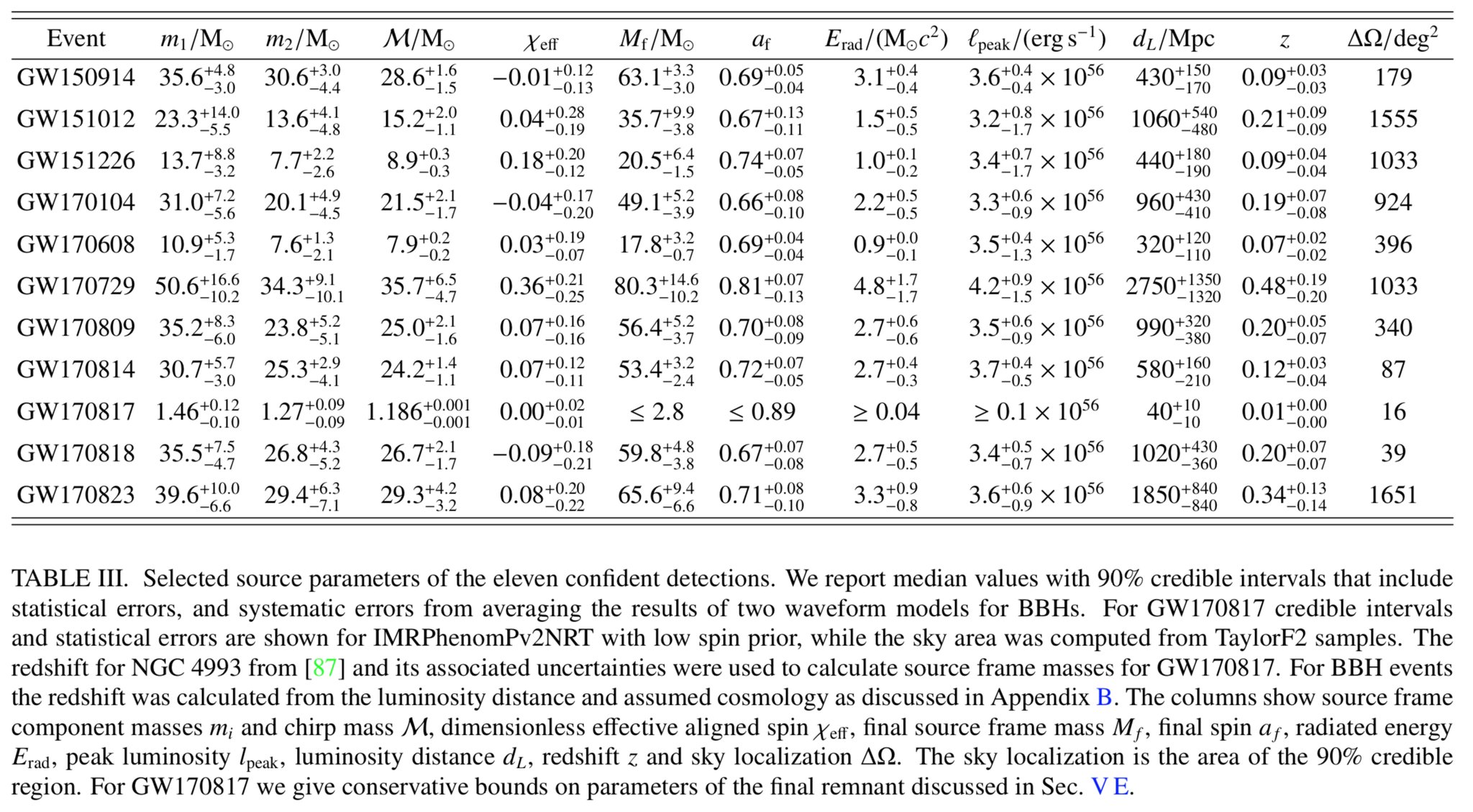
Here is a summary of the properties of the binary systems involved in the events listed in the above paper:
There are several (four) events in this catalogue that have not previously been announced (or, for that matter, subjected to peer review) despite having been seen in the data some time ago (as far back as 2015). I’m also intrigued by the footnote on the first page which contains the following:
…all candidate events with an estimated false alarm rate (FAR) less than 1 per 30 days
and probability > 0.5 of being of astrophysical origin (see Eq. (10) for the definition) are henceforth denoted with the GW prefix.
The use of false discovery rates is discussed at length here as a corrective to relying on p-values for detections. The criteria adopted here don’t seem all that strong to me.
I’ve been teaching and/or preparing lectures all day today, so I haven’t yet had time to read these papers in detail. I will try to read them over the next few days. In the meantime I would welcome comments through the box about these new results. I wonder if there’ll be any opinions from the direction of Copenhagen?
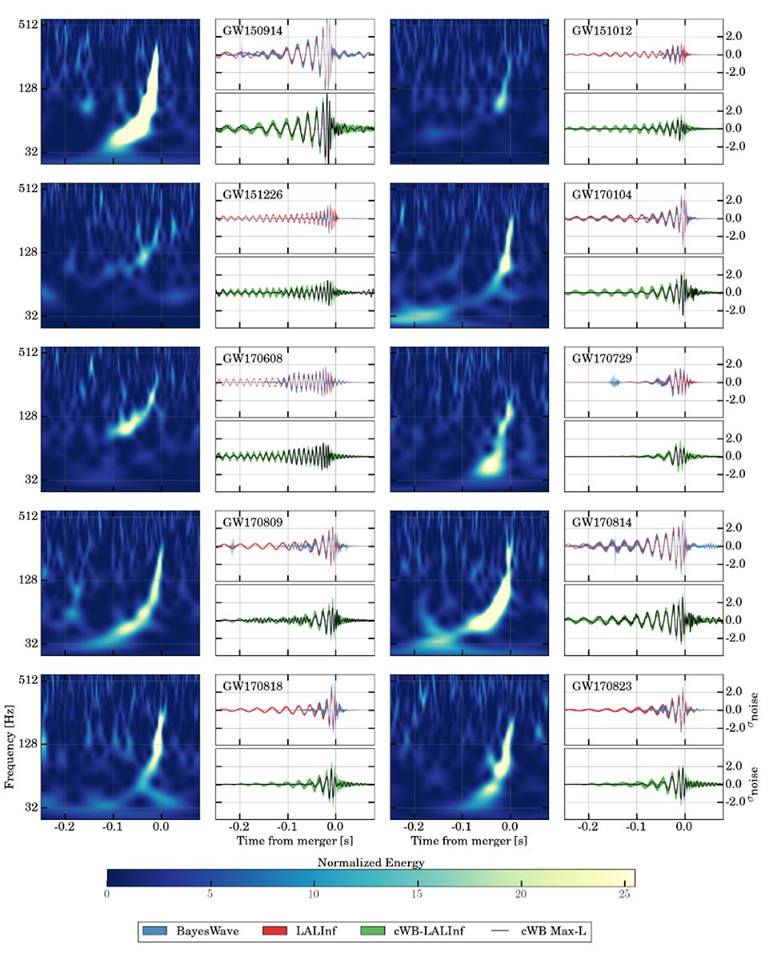
UPDATE: Here’s a montage of all 10 binary black hole mergers `detected’ so far…
I think it’s safe to say that if GW151266 had been the first to be announced, the news would have been greeted with considerable skepticism!
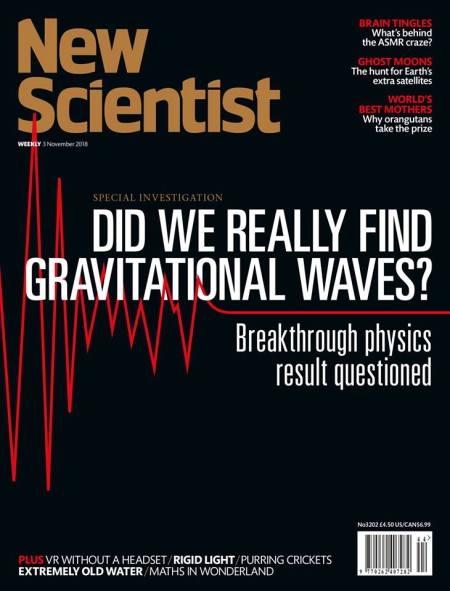
I noticed this morning that this week’s New Scientist cover feature (by Michael Brooks)is entitled Exclusive: Grave doubts over LIGO’s discovery of gravitational waves. The article is behind a paywall – and I’ve so far been unable to locate a hard copy in Maynooth so I haven’t read it yet but it is about the so-called `Danish paper’ that pointed out various unexplained features in LIGO data associated with the first detection of gravitational waves of a binary black hole merger.
I did know this piece was coming, however, as I spoke to the author on the phone some time ago to clarify some points I made in previous blog posts on this issue (e.g. this one and that one). I even ended up being quoted in the article:
Not everyone agrees the Danish choices were wrong. “I think their paper is a good one and it’s a shame that some of the LIGO team have been so churlish in response,” says Peter Coles, a cosmologist at Maynooth University in Ireland.
I stand by that comment, as I think certain members – though by no means all – of the LIGO team have been uncivil in their reaction to the Danish team, implying that they consider it somehow unreasonable that the LIGO results such be subject to independent scrutiny. I am not convinced that the unexplained features in the data released by LIGO really do cast doubt on the detection, but unexplained features there undoubtedly are. Surely it is the job of science to explain the unexplained?
It is an important aspect of the way science works is that when a given individual or group publishes a result, it should be possible for others to reproduce it (or not as the case may be). In normal-sized laboratory physics it suffices to explain the experimental set-up in the published paper in sufficient detail for another individual or group to build an equivalent replica experiment if they want to check the results. In `Big Science’, e.g. with LIGO or the Large Hadron Collider, it is not practically possible for other groups to build their own copy, so the best that can be done is to release the data coming from the experiment. A basic problem with reproducibility obviously arises when this does not happen.
In astrophysics and cosmology, results in scientific papers are often based on very complicated analyses of large data sets. This is also the case for gravitational wave experiments. Fortunately, in astrophysics these days, researchers are generally pretty good at sharing their data, but there are a few exceptions in that field.
Even allowing open access to data doesn’t always solve the reproducibility problem. Often extensive numerical codes are needed to process the measurements and extract meaningful output. Without access to these pipeline codes it is impossible for a third party to check the path from input to output without writing their own version, assuming that there is sufficient information to do that in the first place. That researchers should publish their software as well as their results is quite a controversial suggestion, but I think it’s the best practice for science. In any case there are often intermediate stages between `raw’ data and scientific results, as well as ancillary data products of various kinds. I think these should all be made public. Doing that could well entail a great deal of effort, but I think in the long run that it is worth it.
I’m not saying that scientific collaborations should not have a proprietary period, just that this period should end when a result is announced, and that any such announcement should be accompanied by a release of the data products and software needed to subject the analysis to independent verification.
Given that the detection of gravitational waves is one of the most important breakthroughs ever made in physics, I think this is a matter of considerable regret. I also find it difficult to understand the reasoning that led the LIGO consortium to think it was a good plan only to go part of the way towards open science, by releasing only part of the information needed to reproduce the processing of the LIGO signals and their subsequent statistical analysis. There may be good reasons that I know nothing about, but at the moment it seems to me to me to represent a wasted opportunity.
CLARIFICATION: The LIGO Consortium released data from the first observing run (O1) – you can find it here – early in 2018, but this data set was not available publicly at the time of publication of the first detection, nor when the team from Denmark did their analysis.
I know I’m an extremist when it comes to open science, and there are probably many who disagree with me, so here’s a poll I’ve been running for a year or so on this issue:
Any other comments welcome through the box below!
UPDATE: There is a (brief) response from LIGO (& VIRGO) here.
Back in Maynooth, in between lecture and computer lab session, I only have time for a quick post so I’ll take the opportunity to share the recent news from LISA Pathfinder (which is basically a technology demonstrator mission intended to establish the feasibility of a proposed space-based gravitational wave facility called LISA). LISA Pathfinder is ostensibly an extremely simple experiment, consisting of two metal cubes (made of a gold-platinum mixture) about 38cm apart. The question it tries to answer is how accurately these two cubes can be put an ideal “free-fall” state, i.e. when the only force acting on them is gravity. I say `ostensibly’ however, in full knowledge that is an extremely challenging task that requires lots of clever design and painstaking work.
This confirms that the spacecraft has more than matched the sensitivity requirement demanded of it. Congratulations to the LISA Pathfinder mission on an outstanding success!
Interesting post from a gravitational wave researcher, telling the inside story of the latest gravitational wave detection (a binary black hole merger) announced last week.
Detected in June, GW170608 has had a difficult time. It was challenging to analyse, and neglected in favour of its louder and shinier siblings. However, we can now introduce you to our smallest chirp-mass binary black hole system!
The growing family of black holes. From Dawn Finney.
Our family of binary black holes is now growing large. During our first observing run (O1) we found three: GW150914, LVT151012 and GW151226. The advanced detector observing run (O2) ran from 30 November 2016 to 25 August 2017 (with a couple of short breaks). From our O1 detections, we were expecting roughly one binary black hole per month. The first same in January, GW170104, and we have announced the first detection which involved Virgo from August, GW170814, so you might be wondering what happened in-between? Pretty much everything was dropped following the detection of our first…
…black hole mergers detected via gravitational waves, that is. Here are the key measurements for Number 5, codename GW170608. More information can be found here.
On June 8, 2017 at 02:01:16.49 UTC, a gravitational-wave signal from the merger of two stellar-mass black holes was observed by the two Advanced LIGO detectors with a network signal-to-noise ratio of 13. This system is the lightest black hole binary so far observed, with component masses 12+7-2 M⊙ and 7+2-2 M⊙ (90% credible intervals). These lie in the range of measured black hole masses in low-mass X-ray binaries, thus allowing us to compare black holes detected through gravitational waves with electromagnetic observations. The source’s luminosity distance is 340 +140-140Mpc, corresponding to redshift 0.07+0.03-0.03. We verify that the signal waveform is consistent with the predictions of general relativity.
This merger seems to have been accompanied by a lower flux of press releases than previous examples…
Here is the key result from that paper, i.e. the posterior distribution of the Hubble constant H0 given the data from GW170817:
You can also see latest determinations from other methods, which appear to be in (slight) tension; you can read more about this here. Clearly the new result from GW170817 yields a fairly broad range for H0 but, as I said in my earlier post, it’s very impressive to be straddling the target with the first salvo.
Anyway, I just thought I’d mention here that the method of measuring the Hubble constant using coalescing binary neutron stars was invented by none other than Bernard Schutz of Cardiff University, who works in the Data Innovation Institute (as I do). The idea was first published in September 1986 in a Letter to Nature. Here is the first paragraph:
I report here how gravitational wave observations can be used to determine the Hubble constant, H 0. The nearly monochromatic gravitational waves emitted by the decaying orbit of an ultra–compact, two–neutron–star binary system just before the stars coalesce are very likely to be detected by the kilometre–sized interferometric gravitational wave antennas now being designed1–4. The signal is easily identified and contains enough information to determine the absolute distance to the binary, independently of any assumptions about the masses of the stars. Ten events out to 100 Mpc may suffice to measure the Hubble constant to 3% accuracy.
In in the paper, Bernard points out that a binary coalescence — such as the merger of two neutron stars — is a self calibrating `standard candle’, which means that it is possible to infer directly the distance without using the cosmic distance ladder. The key insight is that the rate at which the binary’s frequency changes is directly related to the amplitude of the gravitational waves it produces, i.e. how `loud’ the GW signal is. Just as the observed brightness of a star depends on both its intrinsic luminosity and how far away it is, the strength of the gravitational waves received at LIGO depends on both the intrinsic loudness of the source and how far away it is. By observing the waves with detectors like LIGO and Virgo, we can determine both the intrinsic loudness of the gravitational waves as well as their loudness at the Earth. This allows us to directly determine distance to the source.
It may have taken 31 years to get a measurement, but hopefully it won’t be long before there are enough detections to provide greater precision – and hopefully accuracy! – than the current methods can manage!
Above all, congratulations to Bernard for inventing a method which has now been shown to work very well!
I will mention a couple of things, however. One is that the signal-to-noise ratio of this detection is a whopping 32.4, a value that astronomers can usually only dream of! The other is that neutron star coalescence offer the possibility to bypass the traditional `distance ladder’ approaches to get an independent measurement of the Hubble constant. The value obtained is in the range 62 to 107 km s-1 Mpc-1, which is admittedly fairly broad, but is based on only one observation of this type. It is extremely impressive to be straddling the target with the very first salvo.
The LIGO collaboration is over a thousand people. Add to that the staff of no fewer than seventy observatories (including seven in space). With all that’s going in the world, it’s great to see what humans of different nations across the globe can do when they come together and work towards a common goal. Scientific results of this kind will remembered long after the silly ramblings of our politicians and other fools have been forgotten.
I took part in a panel discussion after the results were presented, but sadly I won’t be here to see tomorrow’s papers. I hope people will save cuttings or post weblinks if there are any articles!
UPDATE: Here is a selection of the local press coverage.
As if these thrilling science results weren’t enough I finally managed to meet my old friend and former collaborator Varun Sahni (who was away last week). An invitation to dinner at his house was not to be resisted on my last night here, which explains why I didn’t write a post immediately after the press conference. Still, of got plenty of papers to read on the plane tomorrow so maybe I’ll do something when I get back.
Tomorrow morning I get up early to return to Mumbai for the flight home, and am not likely to be online again until Wednesday UK time.
Thanks to all at IUCAA (and TIFR) for making my stay so pleasant and interesting. It’s been 23 years since I was last here. I hope it’s not so long before I’m back again!
I got up early this morning to hitch a ride in a car to Mumbai so that I can give a talk this afternoon. We left Pune about 6am and got here about 8.30 so the trip was a quite a bit quicker than coming here! I’ll post about that and include some pictures when I get a moment, but first I’ll post a quick announcement.
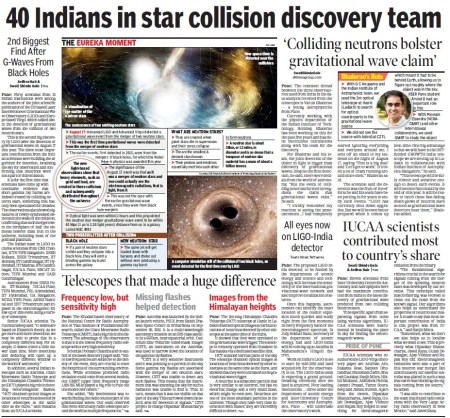
There will be an announcement on Monday 16th October at 10am EDT (3pm BST; 7.30pm in Pune) by `the National Science Foundation (NSF) as it brings together scientists from the Laser Interferometer Gravitational-Wave Observatory (LIGO) and Virgo collaborations, as well as representatives for some 70 observatories’. Further details can be found here. The European Southern Observatory has also announced that it will be holding a press conference on Monday about an `unprecedented discovery’.
The fact that it involves LIGO, Virgo and representatives of other observatories strongly suggests that this announcement will address the subject of the rumours that were flying around in August. In other words, it’s likely that on Monday we will hear about the first detecting of a coalescing binary neutron star system with an optical counterpart. Exciting times!
I’ll be back in Pune by Monday and will probably be able to watch the announcement and will update if and when I can.
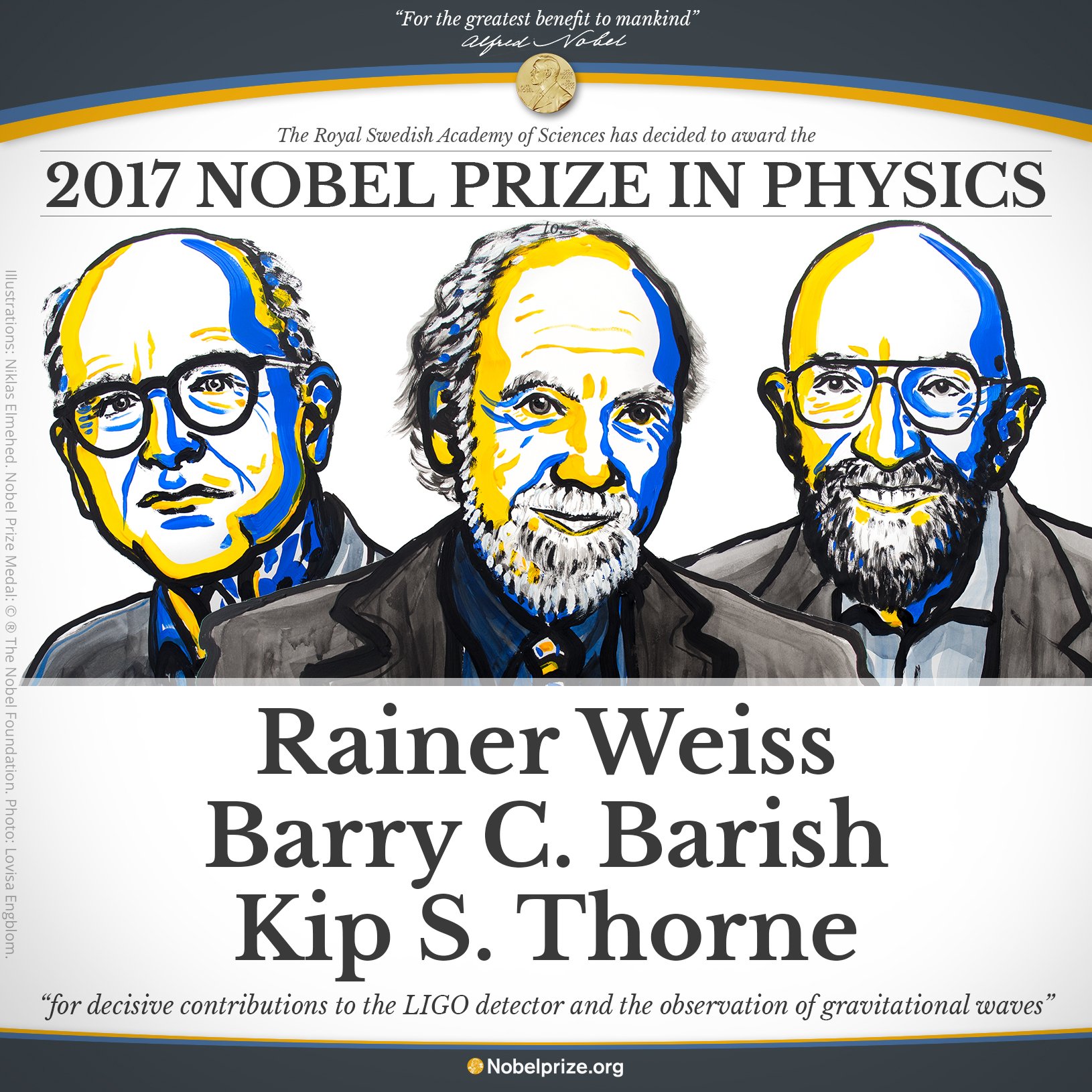
Usually at this time of year I make a point of watching the live announcement of the Nobel Prize for Physics, but this time I was otherwise engaged. On the other hand, this year was the least surprising announcement I can remember for a long time. Confirming almost everyone’s expectations, the award goes to Rainer Weiss (MIT), Barry C. Barish (Caltech) and Kip S. Thorne (Caltech) “for decisive contributions to the LIGO detector and the observation of gravitational waves”. You can see the full citation here.
Perhaps one surprise the split (50% to Weiss and 25% each to Barish and Thorne). I suppose the reason is that it divides the prize equally between MIT and Caltech. Ronald Drever, who had shared in other awards for the LIGO discovery (e.g the Gruber, Shaw and Kavli prizes), sadly passed away earlier this year.
Anyway, heartiest congratulations to the winners and also to all the other members of the LIGO Scientific Collaboration who collectively earned this award! That includes the Gravitational Physics group at Cardiff University who will no doubt be getting pissed celebrating in appropriate style.
Two thoughts. One is that the LIGO Collaboration is very large (the papers have over a thousand authors) but the Nobel Prize rules do not allow this award to be divided among more than three people. This is a problem for `Big Science’ which is always done by large teams. In a real sense, the Nobel Prize for physics reflects the way physics was done when it was founded, over a hundred years ago. It seems to me the limitation perpetuates the myth of the lone genius, when science doesn’t really work like that nowadays. I’m not sure it ever did, actually. I wonder if they’ll ever change?
Another thing that struck me is that the interval between discovery and award seems to be decreasing. For example, he Cosmic Microwave Background was discovered in 1965, but Penzias and Wilson were not awarded the Nobel Prize for its discovery until 1978. I attended the Nobel Prize ceremony in 2005, when George Smoot and John Mather were award the prize for COBE which had happened over a decade earlier. This time the gap between discovery and award is just two years. I suppose that proves that we live in an accelerating universe (Nobel Prize 2011).
Anyway there are too many people in LIGO for them all to be able to attend the Prize Ceremony and Banquet in Stockholm in December, but I hope the winners don’t just give their invitations to senior members of the LIGO collaboration. Perhaps some form of lottery might be organized to allow early career researchers to attend?
As I’ve mentioned before on this blog I had the honour to be invited to the 2006 Nobel Prize ceremony. As a matter of fact, I still have this:
The chocolate has probably gone off by now, though. I stress that I attended not as a winner but as a guest of the Nobel Foundation. It was a wonderful occasion, of which I have very special memories. I’m sure everyone who does get to attend will have a ball! (Geddit?)
Although the Nobel Prize has its limitations as a true reflection of scientific contributions, I still has value in that for once the news media are talking about a great human achievement which contrasts with much of the stuff we have to hear about these days.
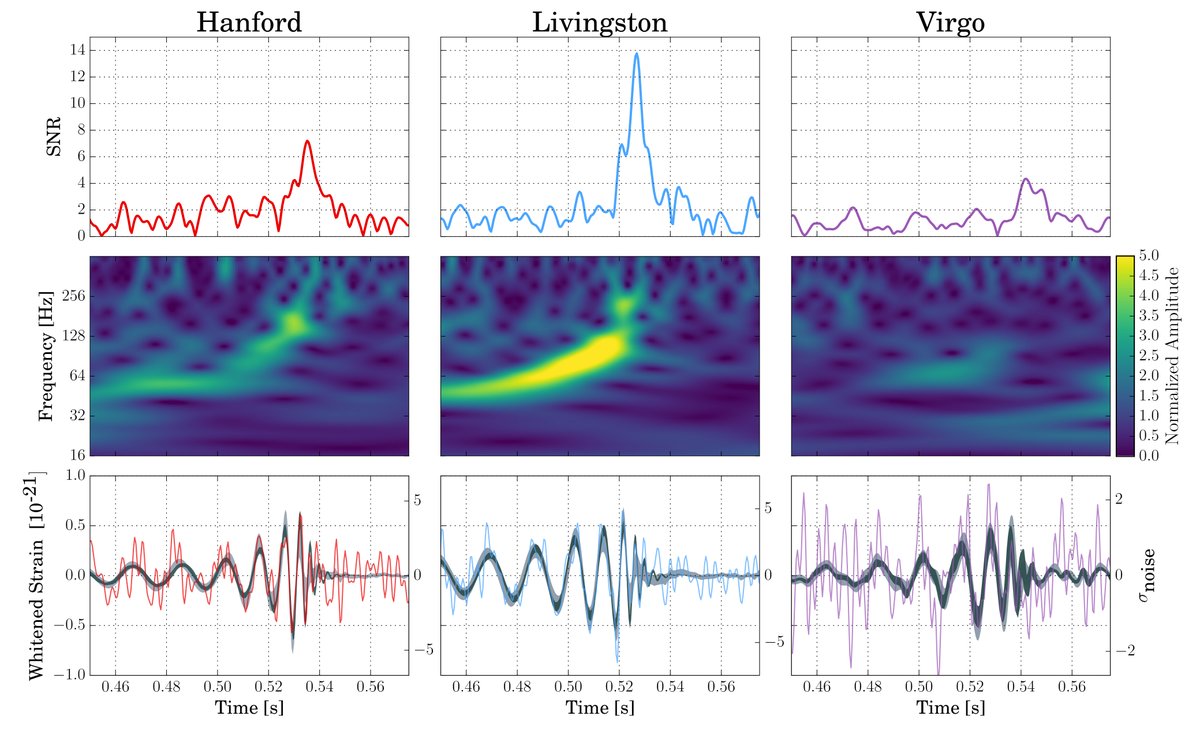
Inconveniently timed just before I was due to go to the pub, a new announcement has come out from the LIGO and Virgo gravitational wave detectors. This time it reports a coalescing binary black hole system detected by all three instruments. The new source is called GW170814, which indicates that the signal from it was received by the detectors on the day I returned from Copenhagen this summer!
Here’s the key figure:
The paper is here and there’s a Nature comment piece here.
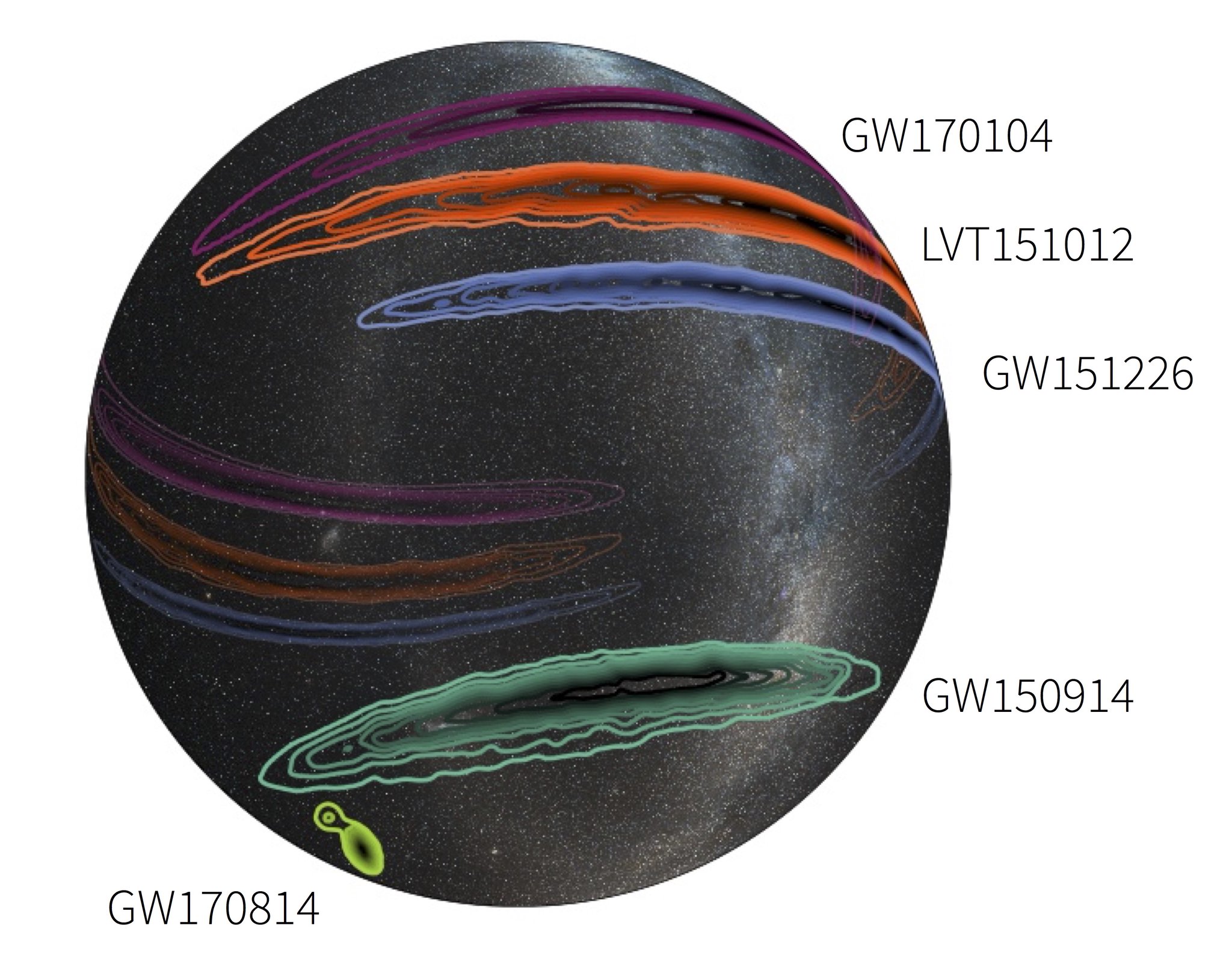
I have to say that, on its own, the Virgo `detection’ looks rather marginal to me, but assuming that it is a detection this graphic shows how much it helps to localize the source compared to previous signals:
More on this in due course, perhaps, but now I’m off for a pint or two…
The views presented here are personal and not necessarily those of my employer (or anyone else for that matter).
Feel free to comment on any of the posts on this blog but comments may be moderated; anonymous comments and any considered by me to be vexatious and/or abusive and/or defamatory will not be accepted. I do not necessarily endorse, support, sanction, encourage, verify or agree with the opinions or statements of any information or other content in the comments on this site and do not in any way guarantee their accuracy or reliability.




 The growing family of black holes. From