Archive for gravitational waves

Black Hole Hunter

Posted in The Universe and Stuff with tags , , , on April 27, 2010 by telescoper

A discussion yesterday with one of my colleagues in the gravitational physics group here in Cardiff gave me the idea of including a little advert here for a fun website called Black Hole Hunter.

The site was developed as a part of the Royal Society Summer Exhibition 2008, Can you hear black holes collide? presented by Cardiff University, and the Universities of Birmingham, Glasgow and Southampton in the UK in collaboration with the Albert Einstein Institute and Milde Marketing in Germany.

The idea is to use your skill, judgement and lugholes to detect the gravitational wave signal from the merger of two black holes in the noisy output of a gravitational wave detector. The image on the left shows the pattern of gravitational radiation as calculated numerically using Einstein’s general theory of relativity. Why not give it a try and see how you get on?

You can play here.

Much Ado About a Null Result

Posted in Science Politics, The Universe and Stuff with tags , , , on August 20, 2009 by telescoper

In today’s Nature there’s an article outlining the current upper limits on the existence of a stochastic cosmological background of gravitational waves. The basis of the analysis presented in the paper is a combination of data from two larger international collaborations, called VIRGO and LIGO. Cardiff University is a member of the latter, so I suppose I should be careful about what I say…

These experiments have achieved incredible sensitivity – they can measure distortions that are a tiny fraction of an atomic nucleus in scale – but because gravity is such a very weak force they still haven’t managed to find direct evidence of gravitational waves. The next generation of these laser interferometers – Advanced LIGO – should get within hailing distance of a detection but in the meantime we have to do with upper limits. Since the sensitivity of the instruments is so well calibrated, the lack of a signal can yield interesting information. The Nature paper is quite interesting in that it summarizes the constraints that can be placed in such a way on some models of the early Universe. Mostly, though, these are “exotic” models that have already been excluded by other means. If I’ve got my sums right the stochastic gravitational wave background expected to be produced within the standard “concordance” cosmology, in which gravitational wave modes are excited by cosmic inflation, is at least three orders of magnitude lower than current experimental sensitivity.

I can’t resist including the following excerpts from a press release, produced by the Media Relations Department at Caltech whose spin doctors have apparently been hard at work.

Pasadena, Calif.—An investigation by the LIGO (Laser Interferometer Gravitational-Wave Observatory) Scientific Collaboration and the Virgo Collaboration has significantly advanced our understanding the early evolution of the universe.

Analysis of data taken over a two-year period, from 2005 to 2007, has set the most stringent limits yet on the amount of gravitational waves that could have come from the Big Bang in the gravitational wave frequency band where LIGO can observe. In doing so, the gravitational-wave scientists have put new constraints on the details of how the universe looked in its earliest moments.

Much like it produced the cosmic microwave background, the Big Bang is believed to have created a flood of gravitational waves—ripples in the fabric of space and time—that still fill the universe and carry information about the universe as it was immediately after the Big Bang. These waves would be observed as the “stochastic background,” analogous to a superposition of many waves of different sizes and directions on the surface of a pond. The amplitude of this background is directly related to the parameters that govern the behavior of the universe during the first minute after the Big Bang.

and

“Since we have not observed the stochastic background, some of these early-universe models that predict a relatively large stochastic background have been ruled out,” says Vuk Mandic, assistant professor at the University of Minnesota.

“We now know a bit more about parameters that describe the evolution of the universe when it was less than one minute old,” Mandic adds. “We also know that if cosmic strings or superstrings exist, their properties must conform with the measurements we made—that is, their properties, such as string tension, are more constrained than before.”

This is interesting, he says, “because such strings could also be so-called fundamental strings, appearing in string-theory models. So our measurement also offers a way of probing string-theory models, which is very rare today.”

“This result was one of the long-lasting milestones that LIGO was designed to achieve,” Mandic says. Once it goes online in 2014, Advanced LIGO, which will utilize the infrastructure of the LIGO observatories and be 10 times more sensitive than the current instrument, will allow scientists to detect cataclysmic events such as black-hole and neutron-star collisions at 10-times-greater distances.

“Advanced LIGO will go a long way in probing early universe models, cosmic-string models, and other models of the stochastic background. We can think of the current result as a hint of what is to come,” he adds.

“With Advanced LIGO, a major upgrade to our instruments, we will be sensitive to sources of extragalactic gravitational waves in a volume of the universe 1,000 times larger than we can see at the present time. This will mean that our sensitivity to gravitational waves from the Big Bang will be improved by orders of magnitude,” says Jay Marx of the California Institute of Technology, LIGO’s executive director.

“Gravitational waves are the only way to directly probe the universe at the moment of its birth; they’re absolutely unique in that regard. We simply can’t get this information from any other type of astronomy. This is what makes this result in particular, and gravitational-wave astronomy in general, so exciting,” says David Reitze, a professor of physics at the University of Florida and spokesperson for the LIGO Scientific Collaboration.

If hyperbole is what you’re looking for, go no further. There’s nothing wrong with presenting even null results in a positive light but, I don’t think this paints a very balanced picture of the field. For examples, early Universe models involving cosmic strings were already severely constrained before these results, so we know that they don’t have a significant effect on the evolution of cosmic structure anyway.

Clearly the political intention was to flag the importance of Advanced LIGO, although even that will probably be unable to detect the cosmological gravitational-wave background.  Overstatements contained in press releases of this type usually prove counterproductive in the long run.

Leonid’s Shower

Posted in The Universe and Stuff with tags , , , , on April 18, 2009 by telescoper

Yesterday (17th April) was the last day of our Easter vacation – back to the grind on Monday – and it was also the occasion of a special meeting to mark the retirement of Professor Leonid Petrovich Grishchuk.

Leonid has been a Distinguished Research Professor here in Cardiff since 1995. You can read more of his scientific biography and wider achievements here, but it should suffice to say that he is a pioneer of many aspects of relativistic cosmology and particularly primordial gravitational waves. He’s also a larger-than-life character who is known with great affection around the world.

Among other things, he’s a big fan of football. He still plays, as a matter of fact, although he generally spends more time ordering his team-mates about than actually running around himself. One of his retirement presents was a Cardiff City football shirt with his name on the back.

My first experience of Leonid was many years ago at a scientific meeting at which I attempted to give a talk. Leonid was in the audience and he interrupted me,  rather aggressively. I didn’t really understand his question so he had another go at me in the questions afterwards. I don’t mind admitting that I was quite upset with his behaviour. I think a large fraction of working cosmologists have probably been Grischchucked at one time or another.

Later on, though, people from the meeting were congregating at a bar when he arrived and headed for me. I didn’t really want to talk to him as I felt he had been quite rude. However, there wasn’t really any way of escaping so I ended up talking to him over a beer. We finally resolved the question he had been trying to ask me and his demeanour changed completely. We spent the rest of the evening having dinner and talking about all sorts of things and have been friends ever since.

Over the years I’ve learned that this is very much a tradition amongst Russian scientists of the older school. They can seem very hostile – even brutal – when discussing science, but that was the way things were done in the environment where they learned their trade.  In many cases the rather severe exterior masks a kindly and generous nature, as it certainly does with Leonid.

I also remember a spell in the States as a visitor during which I heard two Russian cosmologists screaming at each other in the room next door. I really thought they were about to have a fist fight. A few minutes later, though, they both emerged, smiling as if nothing had happened…

Appropriately enough Leonid’s bash was held immediately after BritGrav 9, a meeting dedicated to bringing together the gravitational research community of the UK and beyond, and to provide a forum for the exchange of ideas. It aimed to cover all aspects of gravitational physics, both theoretical and experimental, including cosmology, mathematical general relativity, quantum gravity, gravitational astrophysics, gravitational wave data analysis, and instrumentation. I chaired a session during the meeting and found Leonid in characteristic form as a member of the audience, never shy with questions or comments, and quite difficult to keep under control.

I enjoyed the meeting because priority was given to students when allocating speaking slots. I think too many conferences have the same senior scientists giving  the same talk over and over again. Relativists are also quite different to cosmologists in the level of mathematical rigour to which they aspire.  You can bullshit at a cosmology conference, but wouldn’t get away with it in front of a GR audience.

On the evening of 16th April we had a public lecture in Cardiff by Kip Thorne on The Warped Side of the Universe: from the Big Bang to Black Holes and Gravitational Waves and Kip also gave a talk as part of the subsequent meeting on Friday in Leonid’s honour.
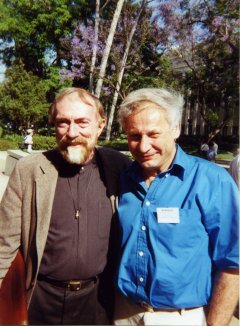
lpg008_test

Kip and Leonid are shown together a few years ago in the photograph to the left here. The rest of the LPGFest meeting was interesting and eclectic, with talks from mathematical relativists as well as scientists in diverse fields who had come over from Russia specially to honour Leonid. We later adjourned to a “Welsh Banquet” at the 15th Century Undercroft of Cardiff Castle for dinner accompanied by something described as “entertainment” laid on by the hosts. That part was quite excruciating: like Butlins only not as classy. Heaven knows what our distinguished foreign visitors made of it, although Leonid seemed to think it was great fun, and that’s what matters.

Once the dinner was over it was time for Leonid to be showered with gifts from around the world and, by way of a finale, he was serenaded with a version of From Russian With Love, by Bernie and the Gravitones. Now at last I understand what the phrase “extraordinary rendition” means.

Clover and Out

Posted in Science Politics, The Universe and Stuff with tags , , , , , , , , , on March 31, 2009 by telescoper

One of the most exciting challenges facing the current generation of cosmologists is to locate in the pattern of fluctuations in the cosmic microwave background evidence for the primordial gravitational waves predicted by models of the Universe that involve inflation.

Looking only at the temperature variation across the sky, it is not possible to distinguish between tensor  (gravitational wave) and scalar (density wave) contributions  (both of which are predicted to be excited during the inflationary epoch).  However, scattering of photons off electrons is expected to leave the radiation slightly polarized (at the level of a few percent). This gives us additional information in the form of the  polarization angle at each point on the sky and this extra clue should, in principle, enable us to disentangle the tensor and scalar components.

The polarization signal can be decomposed into two basic types depending on whether the pattern has  odd or even parity, as shown in the nice diagram (from a paper by James Bartlett)

The top row shows the E-mode (which look the same when reflected in a mirror and can be produced by either scalar or tensor modes) and the bottom shows the B-mode (which have a definite handedness that changes when mirror-reflected and which can’t be generated by scalar modes because they can’t have odd parity).

The B-mode is therefore (in principle)  a clean diagnostic of the presence of gravitational waves in the early Universe. Unfortunately, however, the B-mode is predicted to be very small, about 100 times smaller than the E-mode, and foreground contamination is likely to be a very serious issue for any experiment trying to detect it.

An experiment called Clover (involving the Universities of  Cardiff, Oxford, Cambridge and Manchester) was designed to detect the primordial B-mode signal from its vantage point in Chile. You can read more about the way it works at the dedicated webpages here at Cardiff and at Oxford. I won’t describe it in more detail here, for reasons which will become obvious.

The chance to get involved in a high-profile cosmological experiment was one of the reasons I moved to Cardiff a couple of years ago, and I was looking forward to seeing the data arriving for analysis. Although I’m primarily a theorist, I have some experience in advanced statistical methods that might have been useful in analysing the output.  It would have been fun blogging about it too.

Unfortunately, however, none of that is ever going to happen. Because of its budget crisis, and despite the fact that it has spent a large amount (£4.5M) on it already,  STFC has just decided to withdraw the funding needed to complete it (£2.5M)  and cancel the Clover experiment.

Clover wasn’t the only B-mode experiment in the game. Its rivals include QUIET and SPIDER, both based in the States. It wasn’t clear that Clover would have won the race, but now that we know  it’s a non-runner  we can be sure it won’t.

News Roundup

Posted in Uncategorized with tags , on October 24, 2008 by telescoper

It’s not often that your own department gets onto the BBC News, but to do it twice in a few days with different stories has to be worth a mention!

Earlier this week was an item about the Einstein Telescope project, which has just received 3M euros in funding for design studies. Unlike familiar telescopes, this one is planned to exploit gravitational waves rather than the usual optical, radio or X-ray radiation (which are all varieties of electromagnetic waves). Gravitational radiation hasn’t actually been detected yet, but there are good reasons to believe that it will soon be measured for the first time. The next challenge will be to use gravitational waves from distant sources to study the processes that generate them, such as collisions between black holes. That’s what the new project is intended to do. In principle, gravitational waves will allow us to look much farther into the distant Universe (and therefore farther back in time) than we can do with even the largest optical or radio telescopes so this could be the dawn of a new era of observational astronomy.

But that doesn’t mean that optical telescopes will be defunct, especially when it comes to inspiring the young to take up an interest in astronomy. The other news item on the BBC this week about this department is our own new (optical) telescope which is now fully installed and will shortly to be opened. This is situated on the roof of the building that houses the School of Physics & Astronomy and it will be used primarily for undergraduate teaching, but it will also be available to be used by the general public and school visits on open nights. It should be put to particularly good use in 2009, which is the International Year of Astronomy.

It’s a small telescope by professional standards, about half a metre in diameter, but large compared with what’s available at other Universities in the UK and it promises to be a valuable addition to our already large range of astronomical facilities which is one of the reasons Cardiff is such a good place to work and study.

On the grounds that all publicity is good publicity, I was very pleased to see these things get a full airing on the local media, although I have to admit that the news that really caught my eye this week was the discovery of a headless corpse on the track at Llandaff railway station.