Archive for Great Attractor

Weekly Update from the Open Journal of Astrophysics – 21/02/2026

Posted in OJAp Papers, Open Access, The Universe and Stuff with tags , , , , , , , , , , , , , , , , , , , , , , , , , , , , , , , , on February 21, 2026 by telescoper

It’s Saturday once more so time for another update of activity at the Open Journal of Astrophysics. Since the last update we have published a further six papers, bringing the number in Volume 9 (2026) to 36 and the total so far published by OJAp up to 484.

I will continue to include the posts made on our Mastodon account (on Fediscience) to encourage you to visit it. Mastodon is a really excellent service, and a more than adequate replacement for X/Twitter (which nobody should be using); these announcements also show the DOI for each paper.

The first paper to report this week is “SKA-Low simulations for a cosmic dawn/epoch of reionisation deep field” by Anna Bonaldi, Philippa Hartley, Simon Purser & Omkar Bait (SKAO, UK), Eunseong Lee (U. Manchester, UK), Robert Braun (SKAO), Florent Mertens (Sorbonne Université, France), Andrea Bracco (Osservatorio Astrofisico di Arcetri, IT), Wendy Williams (SKAO) and Cath Trott (Curtin U., Australia). This paper presents a simulation of an SKA-Low cosmic dawn/epoch of reionisation observation to advance foreground-mitigation approaches: the simulation includes various sky components and modelled errors, allowing for efficacy assessment. It was published on Monday 16th February in the folder Cosmology and Nongalactic Astrophysics.

The overlay is here:
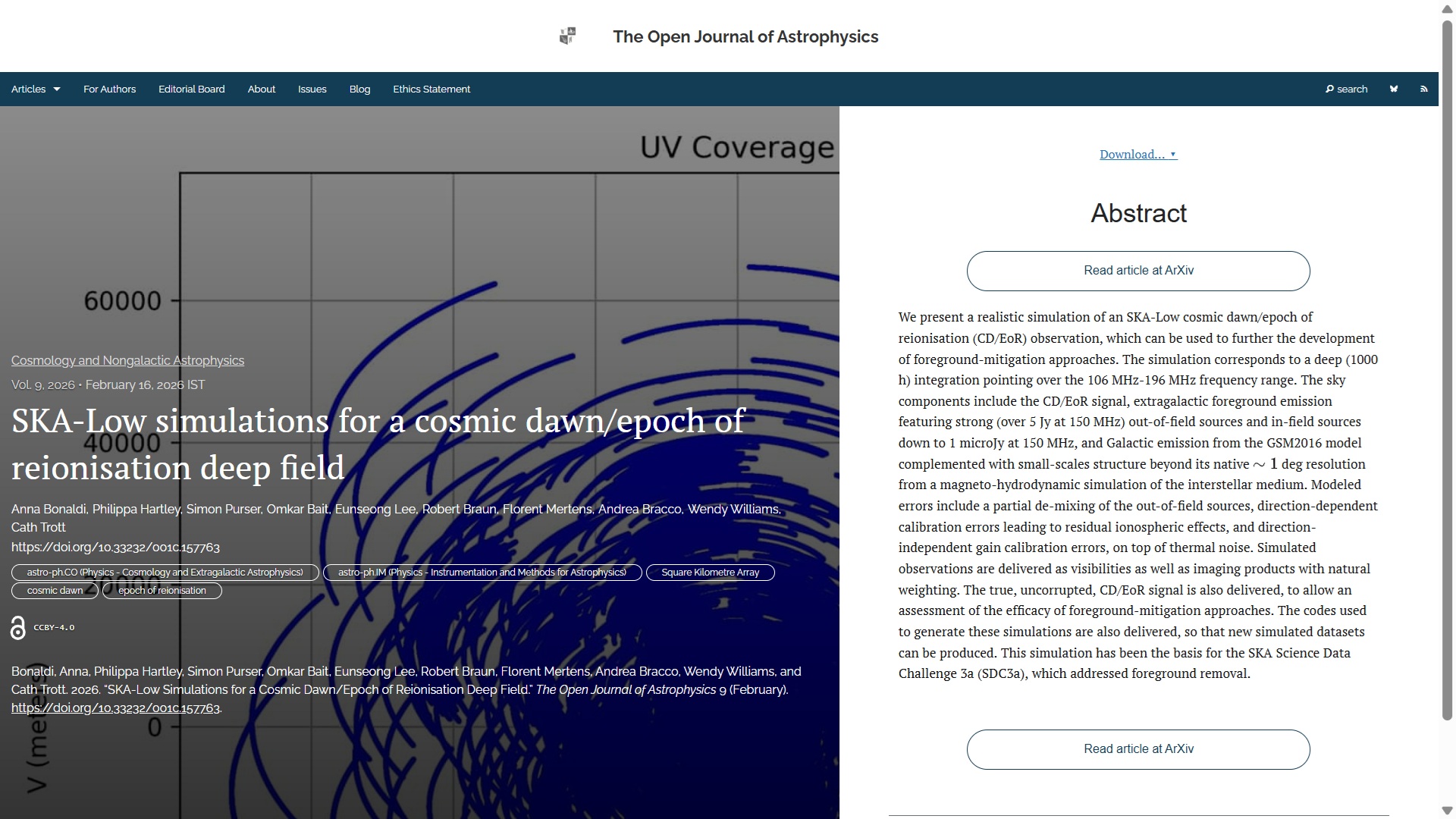
You can find the officially accepted version on arXiv here and the announcement on Fediverse here:

Open Journal of Astrophysics

New Publication at the Open Journal of Astrophysics: "SKA-Low simulations for a cosmic dawn/epoch of reionisation deep field" by Anna Bonaldi, Philippa Hartley, Simon Purser & Omkar Bait (SKAO, UK), Eunseong Lee (U. Manchester, UK), Robert Braun (SKAO), Florent Mertens (Sorbonne Université, France), Andrea Bracco (Osservatorio Astrofisico di Arcetri, IT), Wendy Williams (SKAO) and Cath Trott (Curtin U., Australia)

doi.org/10.33232/001c.157763

February 16, 2026, 8:28 am 1 boosts 1 favorites

The second paper is “V717 Andromedae: An Active Low Mass Ratio Contact Binary” by Surjit S. Wadhwa (Western Sydney U. Australia), Marko Grozdanovic (Astronomical Observatory Belgrade, Serbia), and Nicholas F.H Tothill, Miroslav D. Filipovic, Ain Y. De Horta (Western Sydney U.). This was also published on Monday 1th February, but in the folder Solar and Stellar Astrophysics. The article discusses the contact binary V717 Andromedae, an extreme low mass ratio system with high inclination and moderate contact, showing signs of chromospheric activity but stable and not a merger candidate

The overlay for this one is here:
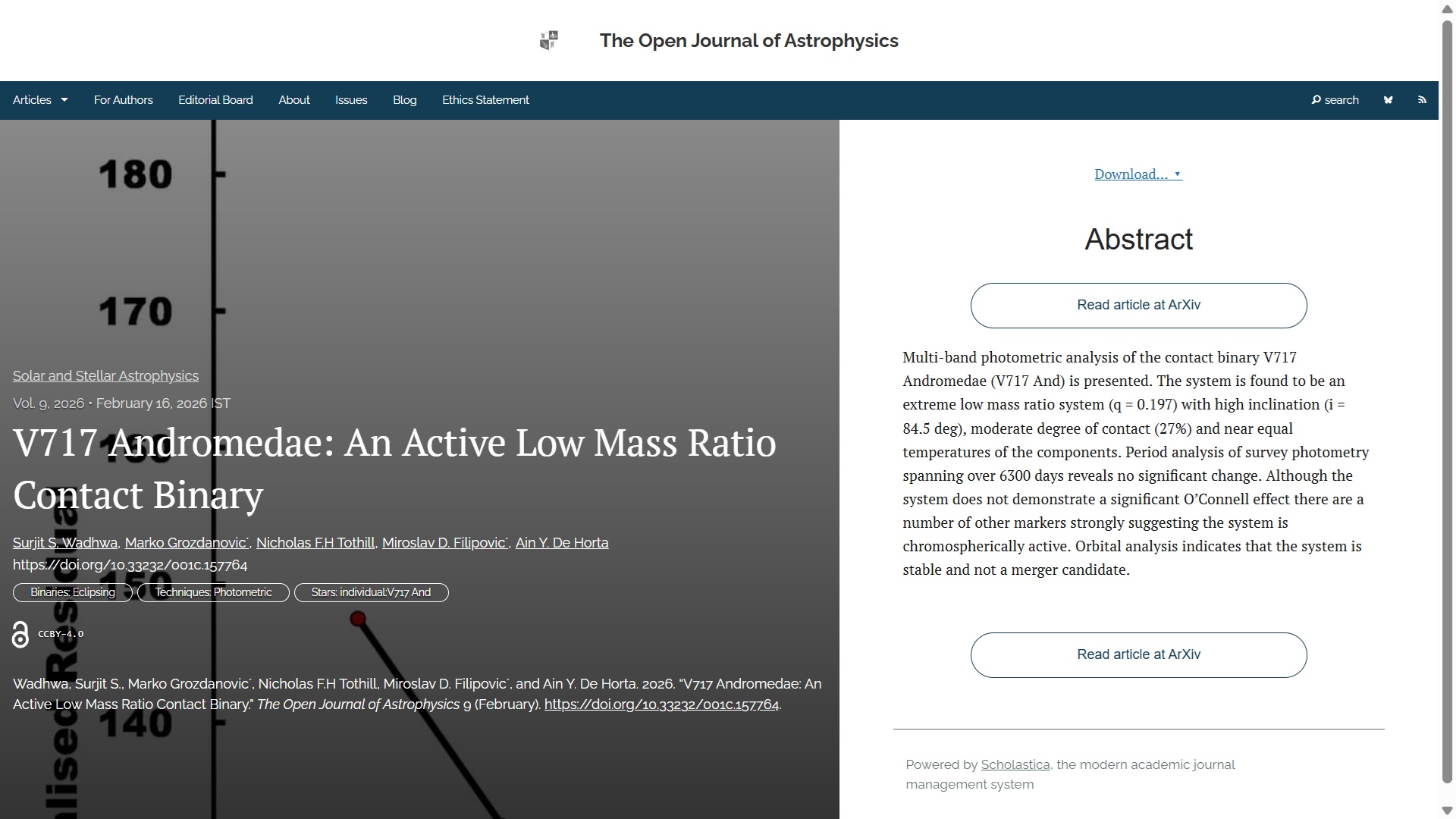
The official version of the paper can be found on arXiv here and the Fediverse announcement here:

Open Journal of Astrophysics

New Publication at the Open Journal of Astrophysics: "V717 Andromedae: An Active Low Mass Ratio Contact Binary" by Surjit S. Wadhwa (Western Sydney U. Australia), Marko Grozdanovic (Astronomical Observatory Belgrade, Serbia), and Nicholas F.H Tothill, Miroslav D. Filipovic, Ain Y. De Horta (Western Sydney U.)

doi.org/10.33232/001c.157764

February 16, 2026, 8:56 am 0 boosts 0 favorites

Next, published on Tuesday 17th February in the folder High-Energy Astrophysical Phenomena, is “DIPLODOCUS II: Implementation of transport equations and test cases relevant to micro-scale physics of jetted astrophysical sources” by Christopher N Everett (Oxford U., UK), Marc Klinger-Plaisier (U. Amsterdam, NL) and Garret Cotter (Oxford). This one discusses further applications of DIPLODOCUS, which is a framework developed for particle distribution transport, with its numerical implementation detailed in Diplodocus.jl. It uses a new sampling technique and is tested on micro-scale physical effects. The first paper in the series can be found here.

The overlay is here:
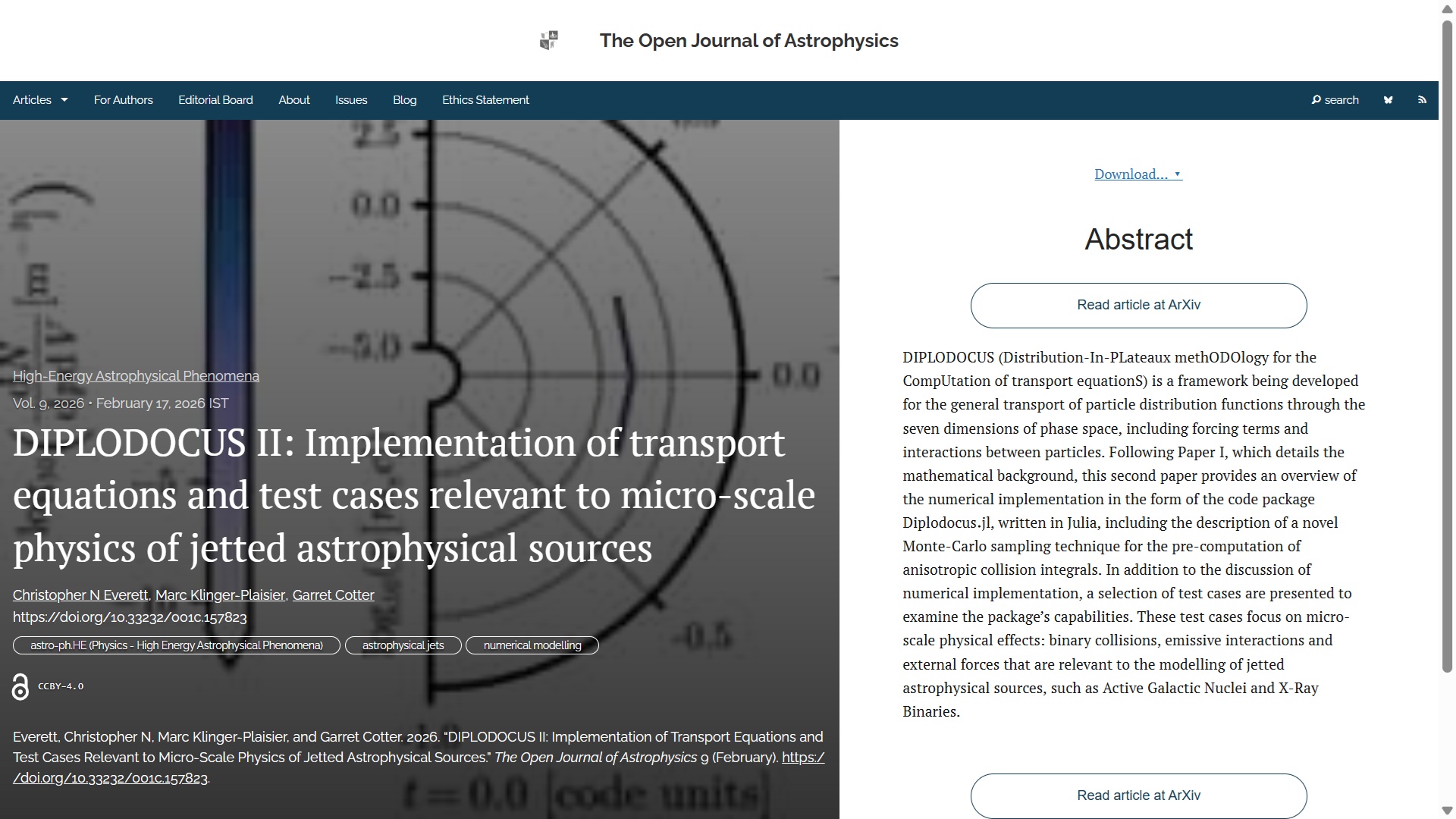
The official version can be found on arXiv here and the Fediverse announcement is here:

Open Journal of Astrophysics

New Publication at the Open Journal of Astrophysics: "DIPLODOCUS II: Implementation of transport equations and test cases relevant to micro-scale physics of jetted astrophysical sources" by Christopher N Everett (Oxford U., UK), Marc Klinger-Plaisier (U. Amsterdam, NL) and Garret Cotter (Oxford)

doi.org/10.33232/001c.157823

February 17, 2026, 7:13 am 1 boosts 2 favorites

The fourth paper this week, also published on Tuesday 17th February, but in the folder Cosmology and Nongalactic Astrophysics is “Revisiting the Great Attractor: The Local Group’s streamline trajectory, cosmic velocity and dynamical fate” by Richard Stiskalek (Oxford U., UK), Harry Desmond (U. Portsmouth, UK), Stuart McAlpine (Stockholm, SE), Guilhem Lavaux (Sorbonne Université, FR), Jens Jasche (Stockholm) and Michael J. Hudson (U. Waterloo, Canada). This paper revisits the so-called “Great Attractor” concept, finding that it doesn’t dominate the Local Group’s cosmic velocity; multiple structures contribute to the motion, with no single attractor accounting for the flow.

Here is the overlay:
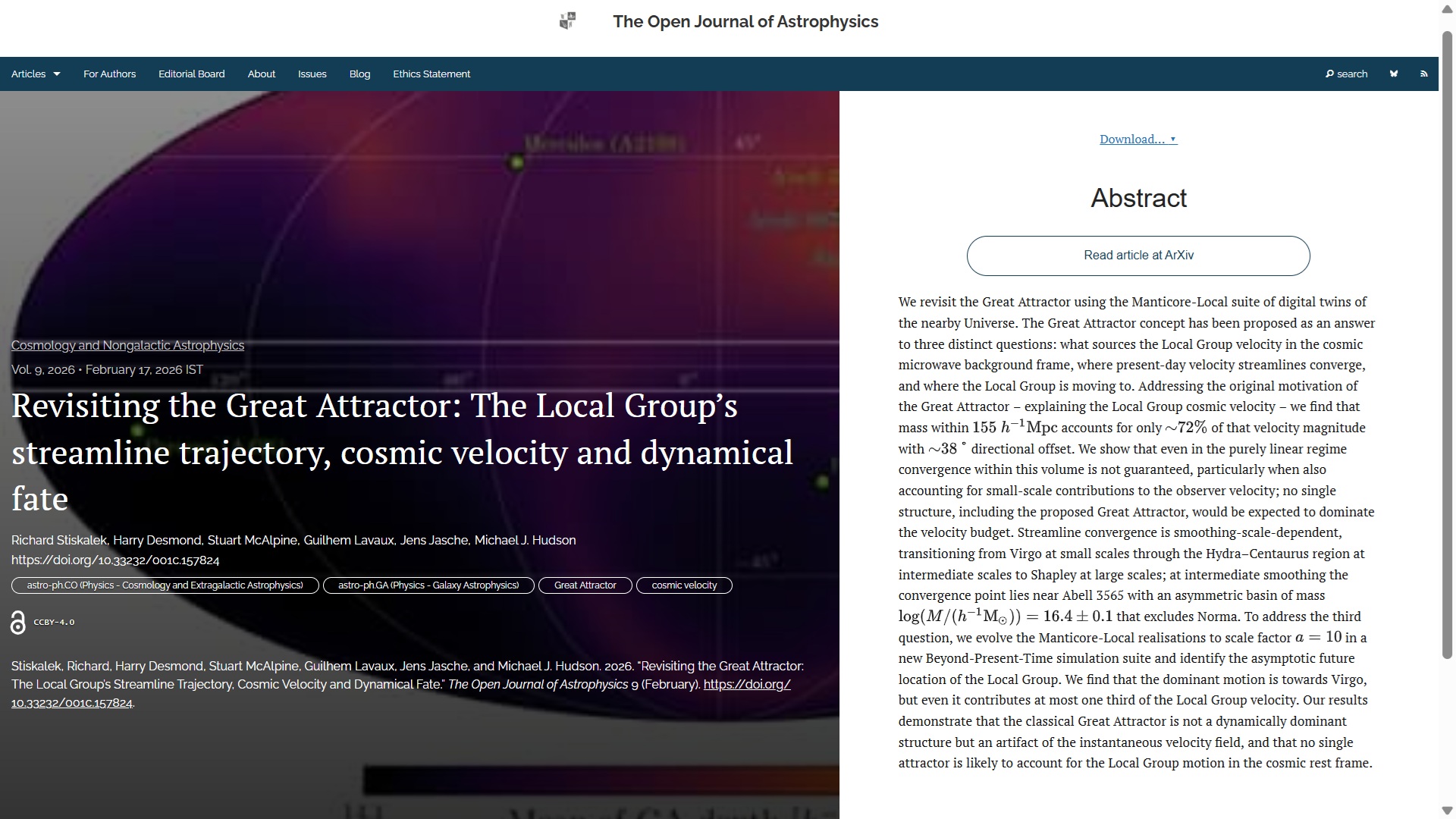
The official version can be found on arXiv here and the Fediverse announcement is here:

Open Journal of Astrophysics

New Publication at the Open Journal of Astrophysics: "Revisiting the Great Attractor: The Local Group’s streamline trajectory, cosmic velocity and dynamical fate" by Richard Stiskalek (Oxford U., UK), Harry Desmond (U. Portsmouth, UK), Stuart McAlpine (Stockholm, SE), Guilhem Lavaux (Sorbonne Université, FR), Jens Jasche (Stockholm) and Michael J. Hudson (U. Waterloo, Canada)

doi.org/10.33232/001c.157824

February 17, 2026, 7:33 am 3 boosts 1 favorites

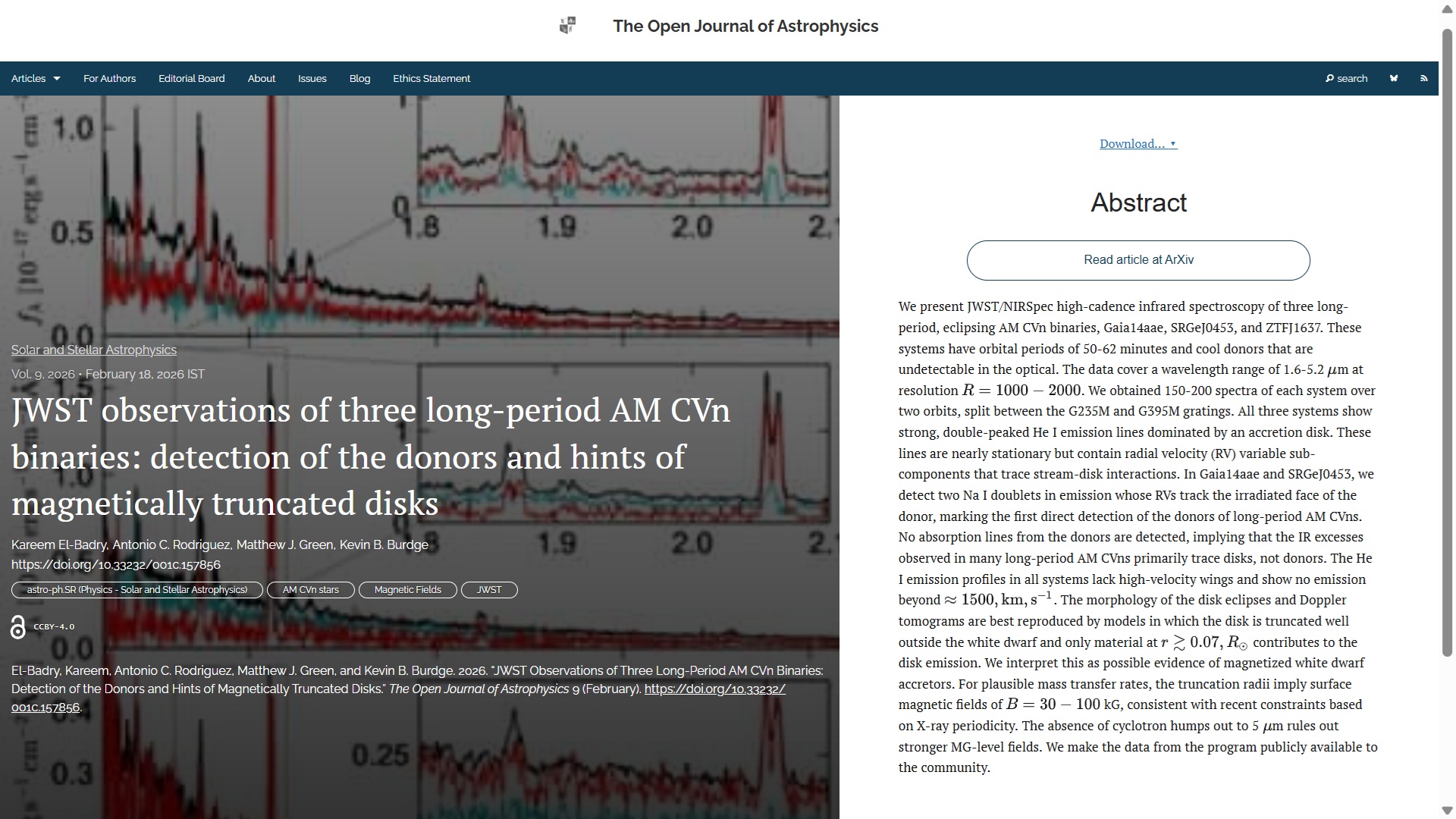
The fifth paper this week, is “JWST observations of three long-period AM CVn binaries: detection of the donors and hints of magnetically truncated disks” by Kareem El-Badry (Caltech), Antonio C. Rodriguez (CfA Harvard), Matthew J. Green (U. Oklahoma) & Kevin B. Burdge (MIT); all based in the USA. The article was published on Thursday 19th February 2026 in the folder Solar and Stellar Astrophysics. The paper describes high-cadence infrared spectroscopy used to analyze three long-period, eclipsing AM CVn (AM Canum Venaticorum) binaries; findings suggest the presence of magnetized white dwarf accretors, with surface magnetic fields of 30-100 kG.

The overlay is here:
The accepted version can be found on arXiv here, and the fediverse announcement is here:

Open Journal of Astrophysics

New Publication at the Open Journal of Astrophysics: "JWST observations of three long-period AM CVn binaries: detection of the donors and hints of magnetically truncated disks" by Kareem El-Badry (Caltech), Antonio C. Rodriguez (CfA Harvard), Matthew J. Green (U. Oklahoma) & Kevin B. Burdge (MIT); all in USA

doi.org/10.33232/001c.157856

February 18, 2026, 8:15 am 1 boosts 0 favorites

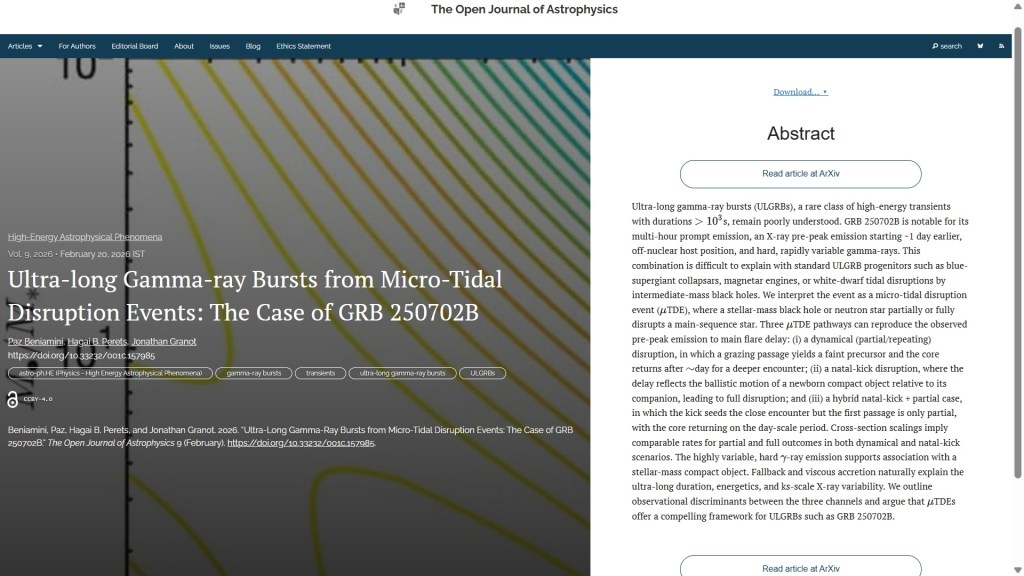
Finally for this week we have “Ultra-long Gamma-ray Bursts from Micro-Tidal Disruption Events: The Case of GRB 250702B” by Paz Beniamini (Open University, IL), Hagai B. Perets (Technion, IL) and Jonathan Granot (Open University, IL); all based in Israel. The paper was published on Friday 18th February 2026 in the folder High-Energy Astrophysical Phenomena.

The overlay is here:
You can find the officially accepted version on arXiv here and the Mastodon announcement is here:

Open Journal of Astrophysics

New Publication at the Open Journal of Astrophysics: "Ultra-long Gamma-ray Bursts from Micro-Tidal Disruption Events: The Case of GRB 250702B" by Paz Beniamini (Open University, IL), Hagai B. Perets (Technion, IL) and Jonathan Granot (Open University, IL)

doi.org/10.33232/001c.157985

February 20, 2026, 8:43 am 0 boosts 0 favorites

And that concludes this week’s update. I will do another next Saturday, by which time I expect we will have published a similar number of papers to this week.

R.I.P. Donald Lynden-Bell (1935-2018)

Posted in The Universe and Stuff with tags , on February 6, 2018 by telescoper

I woke this morning to the very sad news that we have lost one of our great astrophysicists, Donald Lynden-Bell (above). He had suffered a stroke before Christmas but despite the best efforts of the medical staff at Addenbrooke’s Hospital in Cambridge, he never fully recovered. He passed away peacefully, at home, yesterday at the age of 82. The Cambridge University announcement of his death can be found here.

I saw Donald qjust a few months ago at the RAS Club where he seemed in good health. I was lucky enough to sit with him for dinner and he was excellent company, as he always was on such occasions. It’s very sad that he is no more. Sincere condolences to his family, friends and colleagues and especially to his wife Ruth (herself a distinguished chemist).

Donald is probably best known for his theoretical work on the idea that galaxies contain massive black holes at their centre, and that such black holes are the principal source of energy in quasars. He was also a member of a group of astronomers that became known as the ‘Seven Samurai’ who postulated the existence of the Great Attractor, a concentration of matter that might explain the observed peculiar motion of the Local Group of galaxies. What was most remarkable about him, however, was the creativity he brought to a huge range of disparate topics, from data analysis to telescope design, and from thermodynamics to general relativity. Donald refused to be pigeonholed, and worked on whatever took his fancy. He brought unique imagination and insight to everything he did.

I first encountered Donald Lynden-Bell when I was an undergraduate at Cambridge. He taught a first year Mathematics course for Natural Sciences students on how to solve Ordinary Differential Equations. I wouldn’t say he was the most organized lecturer I’ve ever had, but he was enormously entertaining and his remarkably loud voice meant you could never doze off! That was in 1983. I remember being terrified to see he was in the audience when I gave a talk at a conference in Cambridge as a PhD student a few years later, in 1987. He asked a question at the end that completely wrong-footed me, but I soon realised that he had a habit of doing that and it wasn’t at all malicious: he just had an unexpectedly different way of looking at things. It was quite extraordinary in that he stayed that way all through his career. It’s also remarkable how little he seemed to change in the thirty-odd years I knew him. In fact, in pictures of him taken in the 1960 he looks much the same as he did last year. I think that’s at least partly why his death was such a shock. He seemed timeless. One assumed he would live forever.

At first I found Donald Lynden-Bell intellectually intimidating but it didn’t take long to find that, inside, he was actually a very amiable and kind-hearted character who was extremely generous with his time, especially with early career researchers. A couple of years ago in the occasion of his 80th birthday, a friend and former student of Donald’s, Manuela Magliocchetti, wrote an open letter to him on here. Many of his former students have posted similar messages on social media. The sense of loss is everywhere.

I find then when I know someone a bit personally, no matter how much I admire them as a scientist, it’s often other things about them that I remember better than their scientific work. My most vivid memory of Donald is from a visit to India over twenty years ago. I ended up playing croquet with him on the lawn of the Director’s House at the Inter-University Centre for Astronomy and Astrophysics in Pune (where I visited last year). Donald seemed entirely unconcerned with his own progress in the game but concentrated fiercely on sending his opponents’ balls into the shrubbery whenever the rules allowed. That is, of course, a major part of the game but I didn’t expect a distinguished Cambridge Professor to take such impish delight. The game was a blast, but had to be called off in the deepening twilight, with bats circling overhead, as we could no longer see well enough to continue but I’ll remember Donald’s constant laughter. A very serious and brilliant scientist he may have been, but he also had an intensely human capacity for having a bit of fun.

Rest in peace, Donald Lynden-Bell (1935-2018).