Archive for Hans Holbein the Younger

Thomas Cromwell and his Prayer-Book

Posted in Art, History with tags , , , , , , on April 1, 2024 by telescoper
(1532-1533, Oil on Panel, 78.1 cm × 64.1 cm) by Hans Holbein the Younger – The Frick Collection, Public Domain, https://commons.wikimedia.org/w/index.php?curid=207764

The famous portrait of Thomas Cromwell by Hans Holbein the Younger shown above is in fact a copy; the original is lost. There is another copy in the National Portrait Gallery in London, but it’s not as good. The original was painted around 1533, during the period covered by the novel Wolf Hall (which I reviewed yesterday) and is mentioned in the book. Holbein is known for having sometimes painted excessively flattering portraits – most notably of Anne of Cleves – but he doesn’t seem to have done that here. Cromwell is portrayed as dour, stern-faced and more than a little scary. He probably wanted people to fear him, so wouldn’t have minded this.

As well as the nature of the likeness, the composition is interesting. The subject seems to be squashed into the frame, and hemmed in by the table that juts out towards the viewer. He is also looking out towards the viewer’s left, though not simply staring into space; his eyes are definitely focussed on something. I’m not sure what all this is intended to convey, except that the table carries an ornate prayer-book (the Book of Hours) as if to say “look, here’s a symbol of how devout this man is”.

Interesting, just last year scholars published research that argues that the copy of the Hardouyn Hours which can be found in the Library at Trinity College, Cambridge, is precisely the book depicted on the table. If so, it’s a rare and perhaps unique example of an artefact seen in a Tudor painting that survives to this day.
The Dead Christ

Posted in Art, Literature with tags , , , on April 3, 2021 by telescoper

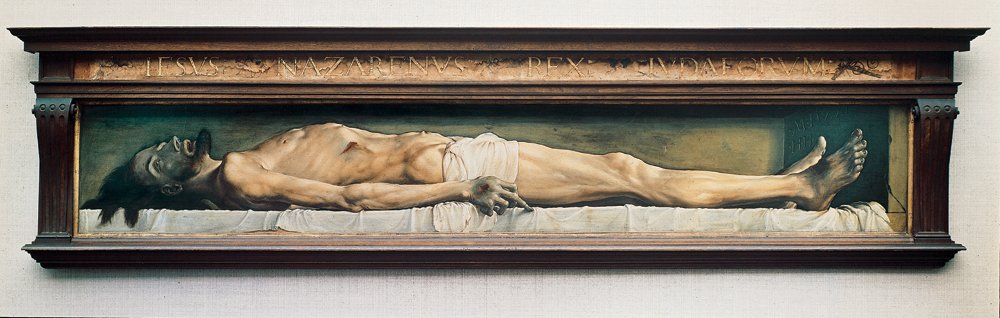
The Dead Christ, 1521 (oil on limewood) by Hans Holbein the Younger (1497/8-1543)

Twitter reminded me this evening of this extraordinary painting by Hans Holbein the Younger and I thought I’d share it here because I realize it was painted in 1521, which means it is 500 years old this year. Despite its age this work still has the power to shock, not least because it is so different from so many works of religious art of its period. The depiction of the dead Christ is 2m long, life-size (so to speak). His eyes and mouth are open, the clear signs of putrefaction appearing in the colouring of his face, hands and feet, the body marked by wounds, is brutal in its frankness and shocking in its authenticity.

But what is the message of this work? Was Holbein questioning the reality of Christ’s bodily resurrection? Or was he emphasizing how miraculous it must have been? And where was a painting of this enormous size and peculiar shape supposed to be displayed? What purpose was it meant to serve? And what’s the reason for the extended middle finger?

I’m not the only one to have asked these questions. The author Fyodor Dostoevsky was famously moved by this work, so much so that in his novel The Idiot he has a character remark “Why, a man’s faith might be ruined by looking at that picture!”.

I don’t expect we’ll ever know what Holbein was trying to say, but perhaps that doesn’t matter. Great art should make you think, but should not necessarily tell you what you should think…