Archive for Higher Education

The Threat to STEM from HEFCE’s Funding Policies

Posted in Education, Finance with tags , , , , , on May 19, 2013 by telescoper

In my job here as Head of the School of Mathematical and Physical Sciences (MPS)  at the University of Sussex, I’ve been been spending a lot of time recently on trying to understand the way the School’s budget works, sorting out what remains to be done for this financial year, and planning the budget for next year. In the course of doing all that it has become clear to me that the current funding arrangements from the Higher Education Funding Council for England (HEFCE) are extremely worrying for Science, Technology, Engineering and Mathematics (STEM) disciplines.

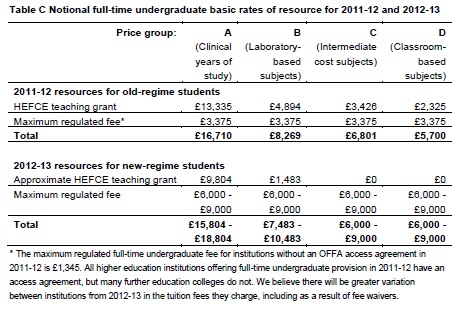
Before the introduction  of the £9K tuition fees this academic year (i.e. in the `old regime’), a University would receive income from tuition fees of up to £3375 per student and from a `unit of resource’ or `teaching grant’ that depends on the subject. As shown in the upper part of Table C below which is taken from a HEFCE document:
Budgets

In the old regime, the  maximum income per student in Physics was thus £8,269 whereas for a typical Arts/Humanities student the maximum was £5,700. That means there was a 45% difference in funding between these two types of subject. The reason for this difference is that subjects such as physics are much more expensive to teach. Not only do disciplines like physics require expensive laboratory facilities (and associated support staff), they also involve many more contact hours between students and academic staff than in, e.g. an Arts subject.  However, the differential is not as large as you might think: there’s only a factor two difference in teaching grant between the lowest band (D, including Sociology, Economics, Business Studies, Law and Education) and the STEM band B (including my own subject, Physics). The real difference in cost is much larger than that, and not just because science subjects need laboratories and the like.

To give an example, I was talking recently to a student from a Humanities department at a leading University (not my employer). Each week she gets 3 lectures and one two-hour seminar, the latter  usually run by a research student. That’s it for her contact with the department. That meagre level of contact is by no means unusual, and some universities offer even less tuition than that.

In my School, MPS, a typical student can expect around 20 contact hours per week including lectures, exercise classes, laboratory sessions, and a tutorial (usually in a group of four). The vast majority of these sessions are done by full-time academic staff, not PDRAs or PhD students, although we do employ such folks in laboratory sessions and for a very small number of lectures. It doesn’t take Albert Einstein to work out that 20 hours of staff time costs a lot more than 3, and that’s even before you include the cost of the laboratories and equipment needed to teach physics.

Now look at what happens in the `new regime’, as displayed in the lower table in the figure. In the current system, students still pay the same fee for STEM and non-STEM subjects (£9K in most HEIs) but the teaching grant is now £1483 for Physics and nothing at all for Bands C and D. The difference in income is thus just £1,483 or in percentage terms, a difference of just 16.4. Worse than this, there’s no requirement that this extra resource be spent on the disciplines with which it is associated anyway. In most universities, all the tuition income goes into central coffers and is dispersed to Schools and Departments according to the whims of the University Management.

Of course the new fee levels have led to an increase in income to Universities across all disciplines, which is welcome because it should allow institutions to improve the quality of their teaching bu purchasing better equipment, etc. But the current arrangements as a powerful disincentive for a university to invest in expensive subjects, such as Physics, relative to Arts & Humanities subjects such as English or History. It also rips off  staff and students in those disciplines, the students because they are given very little teaching in return for their fee, and the staff because we have to work far harder than our colleagues in other disciplines, who  fob off  most of what little teaching their supposed to do onto PhD students badged as Teaching Assistants. It is fortunate for this country that scientists working in its universities show such immense dedication to teaching as well as research that they’re prepared to carry on working in a University environment that is so clearly biased against STEM disciplines.

To get another angle on this argument, consider the comments made by senior members of the legal profession who are concerned about the drastic overproduction of law graduates. Only about half those doing the Bar Professional Training Course after a law degree stand any chance of getting a job as a lawyer in the UK. Contrast this with the situation in science subjects, where we don’t even produce enough graduates to ensure that schools have an adequate supply of science teachers. The system is completely out of balance. Here at Sussex, only about a quarter of students take courses in STEM subjects; nationally the figure is even lower, around 20%…

I don’t see anything on the horizon that will alter this ridiculous situation. STEM subjects will continue to be stifled as universities  follow the incentive to invest in cheaper subjects and will continue to overproduce graduates in other areas. The present Chief Executive of HEFCE is stepping down. Will whoever takes over from him have the guts to do anything about this anti-STEM bias?

I doubt the free-market ideologues in Westminster would even think of intervening either, because the only two possible changes are: (i) to increase the fee for STEM subjects relative to others; and (ii) to increase the teaching grant. Option (i) would lead to a collapse in demand for the very subjects it was intended to save and option (ii) would involve increasing public expenditure, which is anathema to the government even if it is an investment in the UK’s future. Or maybe it’s making a complete botch of the situation deliberately, as part of a cunning plan to encourage universities to go private?
Why participation isn’t widening

Posted in Education with tags , on March 23, 2013 by telescoper

Frustrated at my ongoing indisposition – I had to miss today’s Admissions Day at Sussex University, which has put me in a very bad mood – I’ve decided to deliver a short rant about widening participation. WP is the name given to schemes to open up access to higher education to students from less advantaged backgrounds. An excellent idea, of course.

The problem is that, despite pressure from the relevant quango (OFFA) most self-styled leading universities, especially those in the Russell Group, have consistently failed to widen participation to any significant extent. Why is this?

The easy answer is that universities have to take students who are adequately prepared for undergraduate studies, which means selecting on the basis of A-level grades, which means students from private schools have an advantage.

The problem with this argument is that, at least in Physics and Mathematics, I don’t think A-levels are a reliable indicator of aptitude for undergraduate study at all. If I had my way we wouldn’t use A-levels at all.

Unfortunately we’re stuck with the current, unfair, system because any “leading” university that takes a large number of students with weak A-levels (possibly through a Foundation Programme) will be penalised in the league tables for not being selective enough. Moreover, the Government’s decision to lift the cap on places for students with AAB or better, means that recruiting students with top A-level grades is potentially the most lucrative strategy.

That the system doesn’t work the way it is supposed to is obvious. If you don’t agree, then ask yourself why it’s not the case that virtually all Oxbridge students get first class degrees, when they admit only A*/A students?

Things won’t improve until we abandon the obsession with A-level tariff points and find a way of assessing intrinsic ability.

University Admissions Turbulence

Posted in Education with tags , , , , on January 21, 2013 by telescoper

This morning I’ve been compiling various bits of statistical information for our Annual Programme Review and Evaluation. Yes, it really is as exciting as it sounds. In the course of this I remembered a news item in last week’s Times Higher concerning the latest University admissions figures from UCAS.

The story compares overall admissions figures (i.e. the total number of students entering each university) for 2011 and 2012, pointing out that there are huge changes in some institutions with winners and losers even within the Russell Group. The University of Bristol, for example, increased its intake by a whopping 28% whereas Sheffield was down by 13%.

Similar comments can be found here, in the Grauniad.

For your information you can find complete lists for 2011 and 2012 on the UCAS website.

What I usually do when statistics like this are released is look at the places I have worked in my own career, so here we are:

2011

2012

change

Cardiff

5130

5799

+13%

Nottingham

7187

7160

-0.4%

Queen Mary

3704

3484

-5.9%

Sussex

3203

3221

+0.6%

My current employer, Cardiff University, was well up in 2012 compared with 2011, whereas Queen Mary was significantly down. Nottingham was slightly down and Sussex slightly up, but both these variations are really within the level of √N noise.

Of course these are overall (institutional) figures, and I suspect they hide considerable variations at subject level. For example, although Physics has seen something of a resurgence in popularity lately, it’s difficult for Physics departments to over-recruit given constraints on laboratory space.

I’ve heard these changes described as “Darwinian”, but I’m not sure I agree. The big factor allowing Bristol to do so well has been the ability of institutions to recruit unlimited numbers of students with at least AAB at A-level. This completely changed the dynamics of the UCAS clearing system so it’s not at all surprising that it generated short-term chaotic variations. This year it is different again, with ABB now set to be unrestricted; similar turbulence is inevitable.

It’s difficult enough for universities to navigate safely through such unpredictable waters, and persistent tinkering with the controls is not helping in the slightest. Will the chaos decay naturally, or will it be constantly regenerated by badly thought-out interventions from those in charge?

What’s Your Lecture Face?

Posted in Biographical, Education with tags , , , on December 19, 2012 by telescoper

I was thinking the other day – it doesn’t happen that often so I try to make the most of it when it does – about what a strange situation it is when someone stands up in front of a bunch of students and lectures at them for an hour. In the course module I’ve just finished teaching I’ve had the best part of a 100 people watching, and occasionally listening to, me drone on about something or other. What’s strange is that all those people see basically the same thing, whereas the lecturer gets to see all those different facial expressions. I wonder if the students are even aware that each one has a characteristic lecture face?

I’m one of those people who finds it very difficult to give a lecture without looking at the audience. It’s partly to try to establish some kind of rapport with them, notably in order to encourage them to answer when I ask a question or to offer questions of their own, but also to try to figure out whether anyone at all is following what I’m saying. Not all students are helpful in this regard, but some have very responsive mannerisms, nodding when they understand and frowning when they don’t. When I’m teaching a class for the first time I usually look around a lot in an attempt to identify those students who are likely to help me gauge how well things are going. Usually,  there are only a few barometers like this but I would be lost without them. Fortunately most students seem to sit in the same place in the theatre for each lecture so you can usually locate the useful ones fairly easily, with a discreet look around before you  start.

Most other students seem to have a default lecture face.  The expressions range from a perpetual scowl to a vacant smile (each of which is in its own way a bit scary). There’s the “wish I wasn’t here” face of pure boredom,  not to mention those who are fast asleep; I don’t mind them as long as they don’t snore. There’s the Bookface of someone who’s not listening but messing around on Facebook, and the inscrutable ones whose faces are masks yielding no clues as to what, if anything, is going on behind. The brightest students often seem to belong to the last group, although I haven’t done a statistical study of this so that must be taken as purely anecdotal.

Anyway, I feel a Christmas Poll coming on. Please participate if you can be bothered. If you don’t know what your own lecture face is, then you could always ask….

The Council for the Defence of British Universities

Posted in Education, Politics with tags , , on November 8, 2012 by telescoper

No time for a proper post today, but time to pass on news of the launch of a new independent campaigning body called The Council for the Defence of British Universities.

Here is the CDBU manifesto:

The Council for the Defence of British Universities is independent of any political party, for although we oppose many of the present government’s proposals, the assumptions to which we object were equally evident under its predecessor.

Our core principle is that the Council for the Defence of British Universities exists to advance university education for the public benefit. This is underpinned by nine supporting aims:

• To defend and enhance the character of British universities as places where students can develop their capacities to the full, where research and scholarship are pursued at the highest level, and where intellectual activity can be freely conducted without regard to its immediate economic benefit

• To urge that university education, both undergraduate and postgraduate, be accessible to all students who can benefit from it

• To maintain the principle that teaching and research are indispensable activities for a university, and that one is not pursued at the expense of the other

• To ensure that universities, while responding to the needs of students and society in general, should retain ultimate control of the content of the courses taught and the methods of instruction employed. As well as often providing vocational training, university education should equip graduates with the mental skills and intellectual flexibility necessary to meet the demands of a rapidly changing economy. It should develop the powers of the mind, enlarge knowledge and understanding, and enable graduates to lead fuller and more rewarding lives

• To emphasise that, as well as often having vital social and economic applications and being subject to accountability, academic research seeks to enhance our knowledge and understanding of the physical world, of human nature and of all forms of human activity

• To ensure that methods employed to assess the quality of university research do not encourage premature or unnecessary publication or inhibit the production of major works that require a long period of gestation

• To safeguard the freedom of academics to teach and to pursue research and enquiry in the directions appropriate to the needs of their subject

• To maintain the principle of institutional autonomy, to encourage academic self-government and to ensure that the function of managerial and administrative staff is to facilitate teaching and research

• To ensure that British universities continue to transmit and reinterpret the world’s cultural and intellectual inheritance, to encourage global exchange and to engage in the independent thought and criticism necessary for the flourishing of any democratic society.

For more information about the CDBU, including details on joining, you can visit their website.

Value Added?

Posted in Bad Statistics, Education with tags , , , , , on October 22, 2012 by telescoper

Busy busy busy. Only a few minutes for a lunchtime post today. I’ve a feeling I’m going to be writing that rather a lot over the next few weeks. Anyway, I thought I’d use the opportunity to enlist the help of the blogosphere to try to solve a problem for me.

Yesterday I drew attention to the Guardian University league tables for Physics (purely for the purposes of pointing out that excellent departments exist outside the Russell Group). One thing I’ve never understood about these legal tables is the column marked “value added”. Here is the (brief) explanation offered:

The value-added score compares students’ individual degree results with their entry qualifications, to show how effective the teaching is. It is given as a rating out of 10.

If you look at the scores you will find the top department, Oxford, has a score of 6 for “value added”;  in deference to my alma matter, I’ll note that Cambridge doesn’t appear in these tables.  Sussex scores 9 on value-added, while  Cardiff only scores 2. What seems peculiar is that the “typical UCAS scores” for students in these departments are 621, 409 and 420 respectively. To convert these into A-level scores, see here. These should represent the typical entry qualifications of students at the respective institutions.

The point is that Oxford only takes students with very high A-level grades, yet still manages to score a creditable 6/10 on “value added”.  Sussex and Cardiff have very similar scores for entry tariff, significantly lower than Oxford, but differ enormously in “value added” (9 versus 2).

The only interpretation of the latter two points that makes sense to me would be if Sussex turned out many more first-class degrees given its entry qualifications than Cardiff (since their tariff levels are similar, 409 versus 420). But this doesn’t seem to be the case;  the fraction of first-class degrees awarded by Cardiff Physics & Astronomy is broadly in line with the rest of the sector and certainly doesn’t differ by a factor of several compared to Sussex!

These aren’t the only anomalous cases. Elsewhere in the table you can find Exeter and Leeds, which have identical UCAS tariffs (435) but value added scores that differ by a wide margin (9 versus 4, respectively).

And if Oxford only accepts students with the highest A-level scores, how can it score higher on “value added” than a department like Cardiff which takes in many students with lower A-levels and turns at least some of them into first-class graduates? Shouldn’t the Oxford “value added” score be very low indeed, if any Oxford students at all fail to get first class degrees?

I think there’s a rabbit off. Can anyone explain the paradox to me?

Answers on a postcard please. Or, better, through the comments box.

Will University Swapping Work?

Posted in Education with tags , , , , , on October 21, 2012 by telescoper

Yesterday’s crossword having been more straightforward than usual, I found myself with time to peruse the Independent newspaper at my leisure. While doing so I came across a little item describing a plan suggested by Lord Rees that students from “disadvantaged backgrounds” should be allowed to swap universities after two years of a three-year degree and transfer to a Russell group institution. Apparently this idea is based on a scheme that runs “successfully” in the University of California.

The purported aim of this is to give “a second chance” to students who didn’t do well enough at A-level to get into an “elite” university – which is laudable – but it doesn’t deal with the underlying problem, namely that our pre-university education system is a mess, for two reasons.  First, students can have the misfortune to attend a school where certain subjects are taught badly or not at all. This is a particular problem in my own field, physics. Second, the A-level examinations on which most institutions base their entry criteria do not provide a reasonable assessment of a candidate’s suitability for university study.

Because of these problems many students either don’t apply to top universities or fail to make the grades required. Such universities are reluctant to drop their grades to make special allowance because they would then get penalised in the league tables –  a high entry requirement at A-level is perceived to be a mark of quality. I’m convinced that this is a major flaw in the system. Some of the very best students I’ve had the pleasure to work with at Cardiff, for example, came in at a time when our recruitment team was struggling to meet its quota,  with modest A-level scores that would not normally have been high enough to get in. I worry a great deal about how many more talented young people there are out there who lacked that bit of luck and missed out entirely.

Lord Rees is correct in saying that it will take a very long time to fix the pre-university education system, and his proposal is an attempt to provide a sticking-plaster solution later on. If you like, it’s an admission of defeat. Elite universities will be allowed to carry on using inappropriate criteria to reject talented students applying to join the first year of a degree, but will be allowed to cherry-pick the best performers from other institutions into Year 3.

Although I think this proposal contains some good ingredients, there are several things about it that worry me. I don’t know how many students will want to move after two years in the first place. They will have made friends, formed relationships, and generally settled in at their original university and to up sticks in order to travel to another university for their final year would be very disruptive. Steps would have to be taken to ensure continuity of curriculum too. And what about the financial and other implications for the original institution, which would have to be prepared to lose an indeterminate number of its best students at the end of Year 2, with consequent impact on the quality of its graduating class?

I don’t think it’s fair for the so-called “elite” to exploit the hard work put in by other departments and institutions in order to mask its own failure to recruit appropriately. The only fair solution is to fix the university admission system, which means fixing our  broken A-levels.

And another thing. I’m shortly moving from Cardiff (which is a member of the Russell group) to Sussex (which isn’t).  Look at the league tables for Physics and tell me which one should be regarded as “elite”. Should students choose their University on the basis of which one provides the best education, or on the basis that it provides membership of a prestigious club?

On balance, I don’t think this scheme is workable in the way suggested. There is a variant, however, which I think is more promising. I think we should scrap the current confused system of 4-year undergraduate degrees (MPhys, MSci, etc) and adopt a standard system of 3-year Bachelors degrees. The next level of degree should be standalone postgraduate Masters. I’d prefer these to be two years, actually, but that’s not essential to this argument. Students could then transfer after their Bachelors’ degree into an “elite” university for their Masters if they so wish.

Credentialism and Overexamination

Posted in Biographical, Education with tags , , , , , , , , on September 30, 2012 by telescoper

Only time for a quick post this morning as I have to go into the department to get my things ready for tomorrow, when the Autumn Semester starts and I have to begin lecturing (at 9am on a Monday morning). Anyway, the text for today’s sermon is provided by Ed Smith’s Left Field column in the New Statesman, the latest issue of which I read yesterday. His topic is the rise of credentialism and the resulting excessive amount of examination in the British school system:

It is now widely accepted that British pupils are excessively over-examined. Teachers are so busy focussing on examinations that there is little time left for education. Exam-led cramming has become the year-round norm – like an election campaign that consumes the whole political cycle. Exams are obviously necessary. But there is an optimal amount of assessment and it has been far exceeded. Grade inflation – notwithstanding this year’s controversial “crackdown” – is simply accepted as a fact.

It’s well said, and it’s not just the school system that suffers from disproportionate emphasis on assessment over education. It’s rife throughout the university system too, starting with the reliance on A-level grades as criteria for assessing students’ suitability for university study, through the “modular” undergraduate degree programmes with examinations twice a year for three or four years.

We examine far too frequently and the effect of this has been to turn the entire education system into a meaningless exercise in box-ticking.

It is an unfortunate irony: in our age of credentialism, exams have never mattered more. And yet they have never been more unreliable as gauges of academic quality.

I’ve felt for some time that in my discipline, Physics (and Astronomy) A-levels are virtually useless as indicators of the suitability of a student for doing an undergraduate degree. Some of the very best students I’ve ever had the pleasure to teach came into my university with modest A-level scores; and some students who came in with perfect grades at school never adjusted to the different, more independent type of study required of an undergraduate.

As Ed Smith points out, the increased emphasis on examination grades hasn’t expanded opportunity either.  It may appear to be fairer to base university entrance or award jobs on examination results rather than, say, interviews, but this has just led to a system that can be easily gamed – private tutors, cramming, re-sits to improve grades, and so on. He rightly concludes that the “correlation between exam results and intelligence has been steadily weakening”.

So what’s the alternative? Smith mentions the admissions process at Harvard University, which famously ignores high-school grades and relies on its own interview system. Interviews can be very biased if carried out in an inappropriate way. Subjecting a young person to a 30-minute grilling  in a room with a complete stranger can be enormously stressful for applicants who are shy, and would also play into the hands of those whose educational background has involved specific training for such ordeals. But one thing I’ve found by talking to students face-to-face is that it doesn’t take very long to identify precisely those things that the examination system does not: imagination, enthusiasm for the subject,  and a flair for thinking on your feet:

One teacher told me with regret that she had to advise her most academic pupil not to display her full intellectual range: in order to secure all the ticks, first you have to stop thinking freely.

If you don’t believe this, take a look at this GCSE Science Examination. A truly intelligent student would struggle to find any correct answer for many of the questions on that paper!

This is why we still place so much emphasis on interviews in the postgraduate admissions system: we take it for granted that all applicants for PhD places will have good undergraduate degrees. What marks out an excellent candidate for a position as  research student, however, is not the ability to pass exams but a mixture of creative flair and almost obsessive determination to surmount the difficult challenges involved in independent research. The correlation between these characteristics and degree results is by no means strong.

The problem for a UK University in adopting the Harvard approach is that credentialism is now running the system. Students apply to universities largely on the basis of their predicted A-level grades, lowering their sights if their predicted grades would not be expected to get them into a more “presitigious” department. But departments that take in students with low A-level scores also get marked down in the league tables for taking in “weaker” students. We’re all aware that A-levels are basically useless, but both sides are  bound so tightly into the system that there seems to be no escape.

So what’s the answer? I don’t know if there is one, but I’d love to see what would happen if all universities abandoned A-levels and instead set their own entrance examinations and interviews. It would be a huge amount of work, but it would make a refreshing change if universities could gather useful information rather than relying on the uninformative guff produced by the national examination boards.

And here is Smith’s closing remark that rings very true to me for personal reasons,

There is a further dimension to the problem of credentialism. It encourages life’s winners to underestimate their good fortune and to over-rate the extent to which they deserve their success. Far from advancing talent over privilege, credentialism has strengthened the grip of people already at the top.

Is this the “Squeezed Middle”?

Posted in Education, Finance with tags , , on March 29, 2012 by telescoper

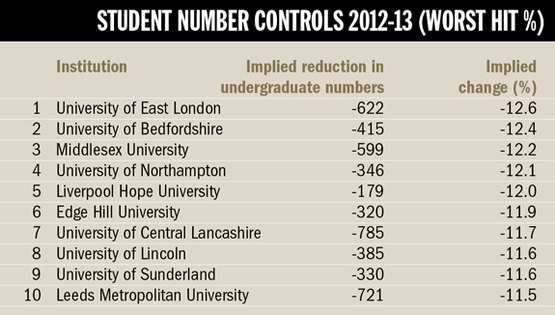
As reported in the Times Higher , the Higher Education Funding Council for England (HEFCE) has announced its allocations to English Higher Education Institutions for 2012/13. As expected, many universities are receiving substantial cuts next year. Here is a table of the biggest losers:

The Times Higher article describes this as the “Squeezed Middle”. It looks more like the “Squeezed Bottom” to me, but then I suppose that would have made an inappropriate headline.

Is there really a University of Sunderland?

Anyways, this allows me the chance to congratulate the former Director of Learning and Teaching in the School of Physics & Astronomy at Cardiff University on his move to the University of Central Lancashire, currently riding high at Number 7 in the above table…


Offa’s Irrelevance

Posted in Education, Politics with tags , , , , on February 18, 2012 by telescoper

There is leader column in today’s Grauniad about the University entrance system which, it rightly says, is “in a mess”. It’s good to have discussion of this subject in the press but the problem is that, in the typical fashion of a Guardian editorial, this piece is worthy in sentiment but misses the basic point entirely.

The reason for visiting the theme of student access to Higher Education at this point is the kerfuffle surrounding the appointment of the next boss of Offa – the Office For Fair Access – a quango set up by the previous New Labour Administration to ensure that universities do everything possible to encourage students from diverse backgrounds to go to University. A laudable aim, but doomed to failure at the outset. The reason for this is that the system of post-16 education is fundamentally flawed (as it clearly is), then no “Access Czar”, however powerful, can hope to accomplish the vast amount of reverse-engineering required to ensure that universities can cope with failures earlier in the system. Just look at how useless Ofgen has been at regulating energy prices, for example, another case of a flawed system impervious to a quango’s attempts to improve it.

The point which is missing – and which our political masters and the educational establishment alike refuse to acknowledge – is that GCE Advanced Levels are neither an adequate preparation for University study nor a reliable way to select applications on their suitability for a given course. People who actually work in Higher Education know that this is true, but the Power That Be won’t recognize it and instead maintain that A-levels constitute a “Gold Standard”. The fact is that in the hands of Examination Boards that compete for business by lowering their standards, A-levels have become nothing other more than base metal, and tarnished to boot.

If I had my way we wouldn’t use A-levels at all to determine whether a student gets a place at their chosen University. I’ve seen so many examples of absolutely brilliant students who entered Cardiff University with modest A-levels – often having not got into their first choice institution and coming to us through the clearing system – that I’m sure there are many excellent potential students out there who didn’t get into university at all. The other side of the coin is that many students who get top A-level grades across the board don’t flourish at university at all. It’s my experience that A-levels are no guide at all to a student’s ability to do well on a course.

If you don’t believe this, then ask yourself the following question. If Cambridge only takes students with grade A* at A-level, why don’t all their students end up with First Class Degrees?

Any attempt to fix the severe problems that beset the student entrance system must begin with a recognition that this is where the fault lies.

So what’s the solution? I think it is to scrap A-levels entirely, and give the system of pre-university qualifications over to the people who actually know what students need to know to cope with their courses, i.e. the universities. There should be a single national system of University Entrance Examinations, set and moderated by an Examination Board constituted by university teachers. This will provide the level playing field that we need. No system can ever be perfect of course, but this is the best way I can think of to solve the biggest problem with the current one. Not that it will ever happen. There are just too many vested interests happy with the status quo despite the fact that it is failing so many of our young people.

Good luck to whoever it is that takes over at Offa, but it won’t make any difference who’s on the bridge because the ship is already on the rocks.