Archive for Illustris

Weekly Update from the Open Journal of Astrophysics – 26/04/2025

Posted in OJAp Papers, Open Access, The Universe and Stuff with tags , , , , , , , , , , , on April 26, 2025 by telescoper

It’s Satuday morning once again, and time for another update of papers published at the Open Journal of Astrophysics. Since the last update we have published two papers, which brings the number in Volume 8 (2025) up to 44 and the total so far published by OJAp up to 279.

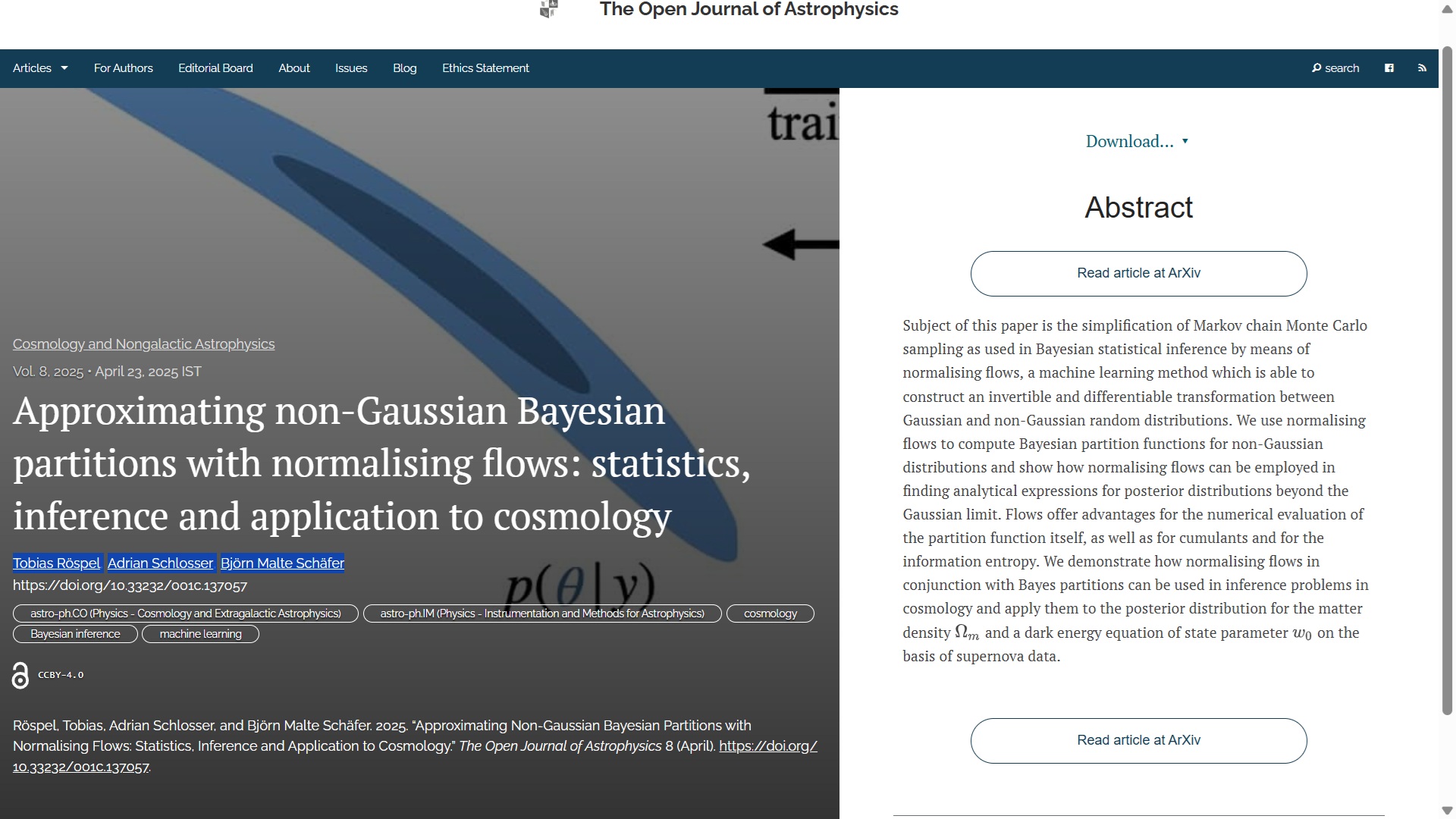
The first paper to report is “Approximating non-Gaussian Bayesian partitions with normalising flows: statistics, inference and application to cosmology” by Tobias Röspel, Adrian Schlosser & Björn Malte Schäfer (Universität Heidelberg, Germany) which was published on April 23rd 2025 in the folder Cosmology and NonGalactic Astrophysics. It is an introduction to normalizing flows – a machine learning technique for transforming distributions – and its application to the extraction of cosmological parameters from supernova data.

The overlay is here:
You can find the officially accepted version on arXiv here.

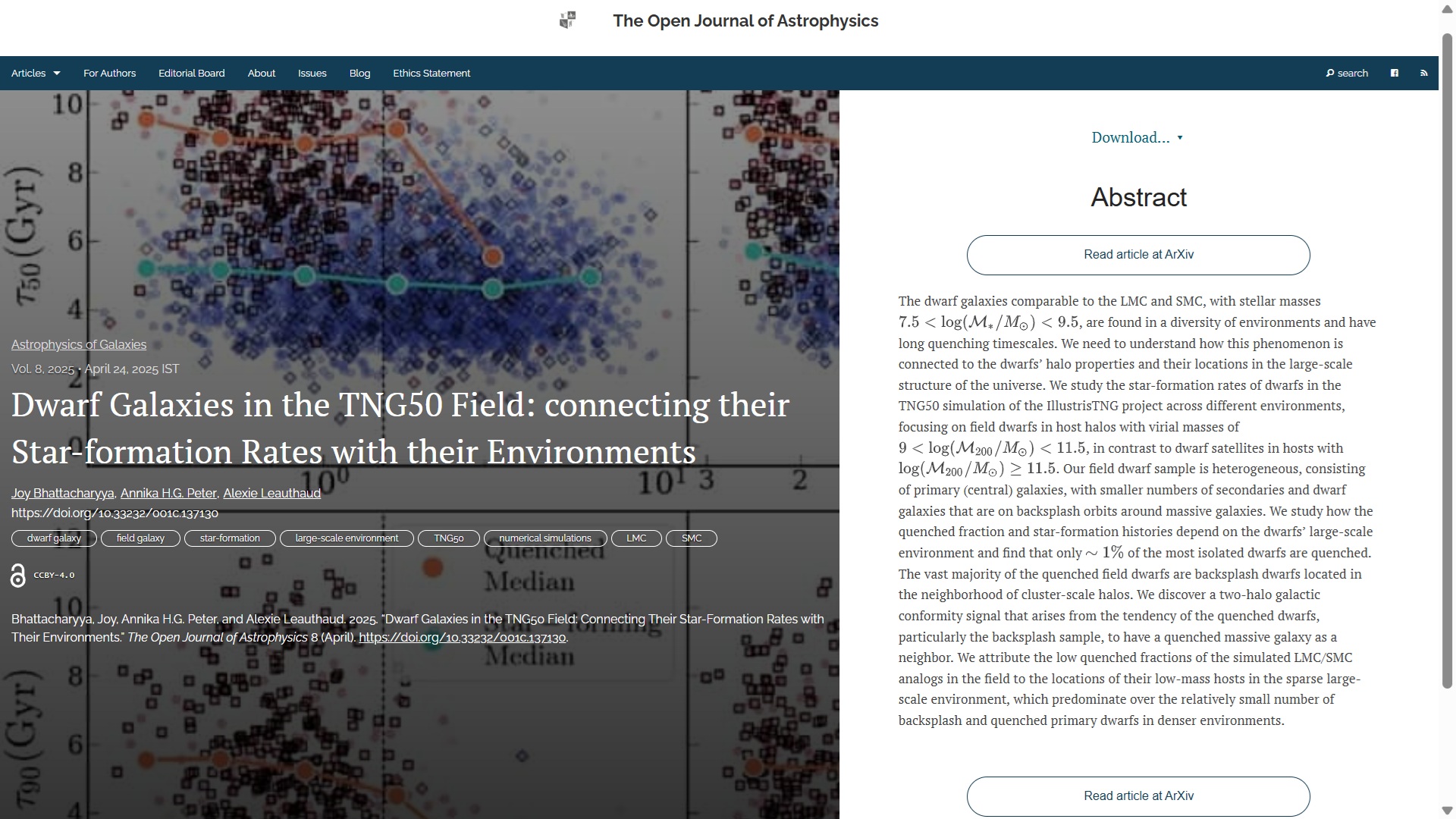
The other paper this week is “Dwarf Galaxies in the TNG50 Field: connecting their Star-formation Rates with their Environments” by Joy Bhattacharyya & Annika H.G. Peter (Ohio State University, USA) and Alexie Leauthaud (UC Santa Cruz, USA).  This one was published on 24th April 2025 in the older Astrophysics of Galaxies and it studies dwarf galaxies with properties similar to the Large and Small Magellanic Clouds that form in different environments in the TNG50 simulation of the IllustrisTNG project.

The overlay is here:
 

and you can find the final accepted version on arXiv here.


That’s all for this week. I’ll have another update next Saturday.

Illustris, Cosmology, and Simulation…

Posted in The Universe and Stuff with tags , , , , , , on May 8, 2014 by telescoper

There’s been quite a lot of news coverage over the last day or two emanating from a paper just out in the journal Nature by Vogelsberger et al. which describes a set of cosmological simulations called Illustris; see for example here and here.

The excitement revolves around the fact that Illustris represents a bit of a landmark, in that it’s the first hydrodynamical simulation with sufficient dynamical range that it is able to fully resolve the formation and evolution of  individual galaxies within the cosmic web of large-scale structure.

The simulations obviously represent a tremendous piece or work; they were run on supercomputers in France, Germany, and the USA; the largest of them was run on no less than 8,192 computer cores and took 19 million CPU hours. A single state-of-the-art desktop computer would require more than 2000 years to perform this calculation!

There’s even a video to accompany it (shame about the music):

The use of the word “simulation” always makes me smile. Being a crossword nut I spend far too much time looking in dictionaries but one often finds quite amusing things there. This is how the Oxford English Dictionary defines SIMULATION:

1.

a. The action or practice of simulating, with intent to deceive; false pretence, deceitful profession.

b. Tendency to assume a form resembling that of something else; unconscious imitation.

2. A false assumption or display, a surface resemblance or imitation, of something.

3. The technique of imitating the behaviour of some situation or process (whether economic, military, mechanical, etc.) by means of a suitably analogous situation or apparatus, esp. for the purpose of study or personnel training.

So it’s only the third entry that gives the meaning intended to be conveyed by the usage in the context of cosmological simulations. This is worth bearing in mind if you prefer old-fashioned analytical theory and want to wind up a simulationist! In football, of course, you can even get sent off for simulation…

Reproducing a reasonable likeness of something in a computer is not the same as understanding it, but that is not to say that these simulations aren’t incredibly useful and powerful, not just for making lovely pictures and videos but for helping to plan large scale survey programmes that can go and map cosmological structures on the same scale. Simulations of this scale are needed to help design observational and data analysis strategies for, e.g., the  forthcoming Euclid mission.