Archive for ireland

The All-Ireland Hurling Final

Posted in GAA, Maynooth with tags , , , , , on July 21, 2024 by telescoper

No prizes for guessing what I’ll be watching this afternoon. Today’s the day of the All-Ireland Senior Hurling Championship Final at Croke Park, between Clare and Cork. The weather isn’t too bad; it’s overcast and a bit cool but there’s no rain forecast and it’s not windy. I’m hoping for a good match.

Clare (An Clár) versus Cork (Corcaigh) is not the final I would have predicted before the semi-finals. I thought Limerick and Kilkenny would be the finalists but that just goes to show how little I know. Cork are favourites with the bookies, by the way (4/7 on Cork, 11/8 against Clare) despite the fact that Clare of won the last two encounters between these teams.

If you’ve never been in Ireland for this occasion you won’t realize what a huge event it is. The atmosphere on this very special day is very much like it used to be in England for the FA Cup Final when I was a kid and the build-up just as long, with constant references on both radio and TV. Maynooth is on the railway line going through Croke Park so we see a lot of supporters in their team colours heading to the match. County Clare (which is in the West of Ireland, straddled by Limerick to the South and Galway to the North) is a bit closer to us than County Cork, which perhaps accounts for the preponderance of blue and gold over red and white.

You can watch the whole game live on BBC2 if you’re in the UK. Throw-in is at 3.30pm.

Update: The attendance is 82,300.

Update: HT score Clare 1-12 Cork 1-12. It’s been a much more open game than I expected. Cork started out the stronger team, finding lots of space in the Clare half and shooting very accurately. Robert Downey scored a memorable goal at which point it looked like Cork might overrun Clare, but that didn’t happen and as the half drew to a close Clare became more confident. It’s all square and poised for an exciting second half.

Update: FT score Clare 3-21 Cork 1-27. What an epic game this is! All square on points after Clare conceded a silly free in the dying seconds to allow Cork to equalize. We go to extra time!

Update: Final Score Clare 3-29 Cork 1-34. Drama to the last second, a long free from the Cork goalie lands in the area but Robbie O’Flynn’s shot to tie the game goes agonizingly wide. Clare are the All-Ireland Champions by one-point. What a breathtaking match. Hats off to both teams for serving up a classic! I wouldn’t have complained if it had gone to a replay though…

Here is a clip of Clare’s amazing 3rd goal, scored by Tony Kelly…

Language on Dry Land

Posted in Football, Irish Language with tags , , , , , , , , , on July 13, 2024 by telescoper

Since I’ve got my own computer again now I thought I’d celebrate by doing one of those rambling, inconsequential posts I haven’t had time to do recently.

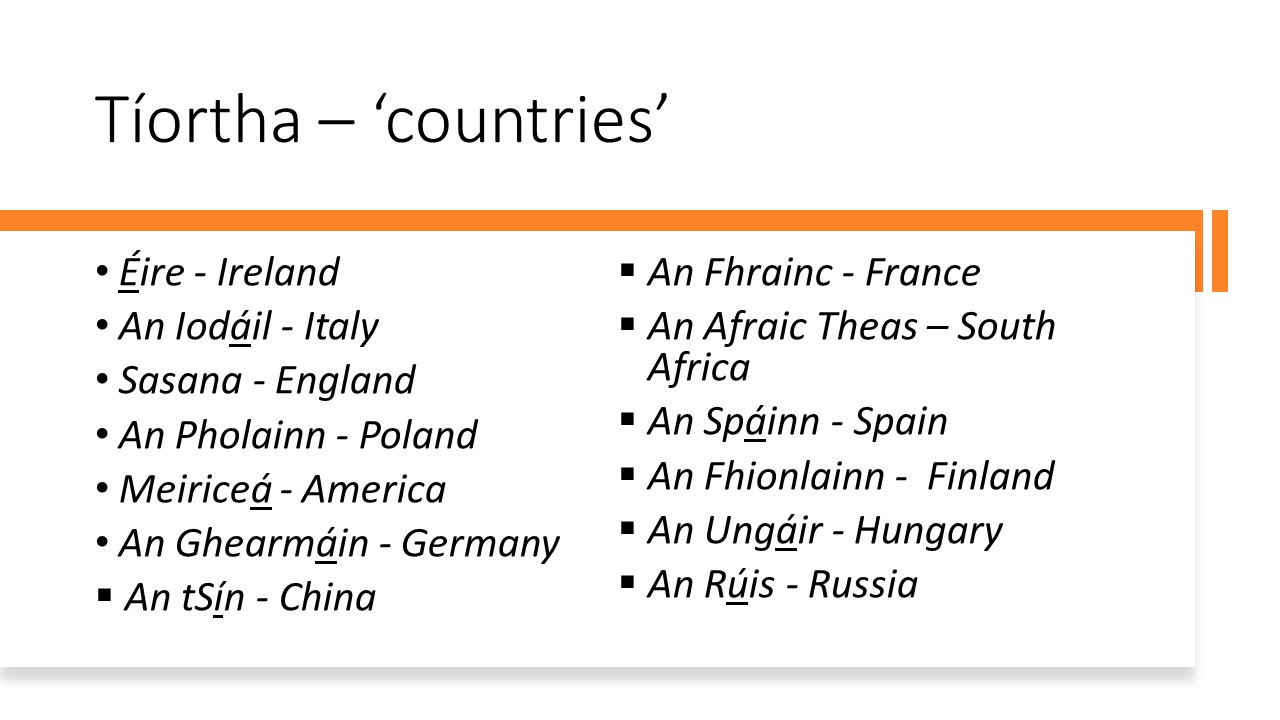
Last week, in the run up to the European Championship semi-final between England and The Netherlands, I for some reason decided to look up what “The Netherlands” is in the Irish language. I did know this once, as it came up when I was trying to learn Irish a few years ago but I had forgotten. I remembered “England”, which is Sasana (cf. Saxon). Anyway, the answer is An Ísiltír. I’ll return to that in a moment.

Here are some other names:

Anyway, a couple of things may be interest. One is that you can see that most country names in Irish are introduced by An. This is the definite article in Irish; there is no indefinite article. This contrasts with English in which only a few names start with the definite article, “The Netherlands” being one. The exceptions in Irish include England (Sasana) and Scotland (Albain). Wales is An Bhreatain Bheag (literally “Little Britain”). Of relevance to the final of the European Championship, Spain is An Spáinn.

I should also mention that some nouns suffer an initial consonant mutation (in the form of lenition, i.e. softening) after the direct article. In modern Irish this is denoted by an h next to the initial consonant, hence Fhrainc, for example; the Irish word for “French” is Fraincis.

The second interesting thing pertains to An Ísiltír itself. The second part of this, tír, means “country” or “nation” – see the plural in the heading above – and the first, Ísil, means “low”. An Ísiltír is therefore literally “The Low Country”. I shared this fascinating insight on social media and found in the replies a mention that the Welsh name for The Netherlands is Yr Iseldiroedda meaning literally “The Low Lands”. The first part of this is clearly similar to the Irish, but the second is the plural of a different word meaning ground or earth or an area of land. There is a word tir in Welsh that means ground or earth or an area of land but it does not mean country or nation like the very similar Irish word; the word for that is gwlad. In Irish the word for land or ground or earth (or turf) is talamh.

Welsh and Irish belong to distinct branches of the Celtic group of languages, the first wave of Indo-European languages to sweep across Europe. I blogged about this here.  Celtic languages therefore share roots with many other Indo-European languages and very basic words in many branches of the tree often bear some similarity in form, if slight but significant differences in meaning. It seems that tír/tir illustrates this rather well. These two words also have a very similar form to the French terre which is derived from the Latin terra. And so I disappeared down an etymological rabbit hole and found that all these words are probably derived from a Proto-Indo-European word meaning “dry”, presumably through reference to “that which is dry” as opposed to the wet bits (although neither Ireland nor Wales is famous for being particular dry).

And to bring this little excursion back full circle, the Irish word tirim means “dry”…

About Sligo

Posted in Biographical with tags , , , , , on May 2, 2024 by telescoper

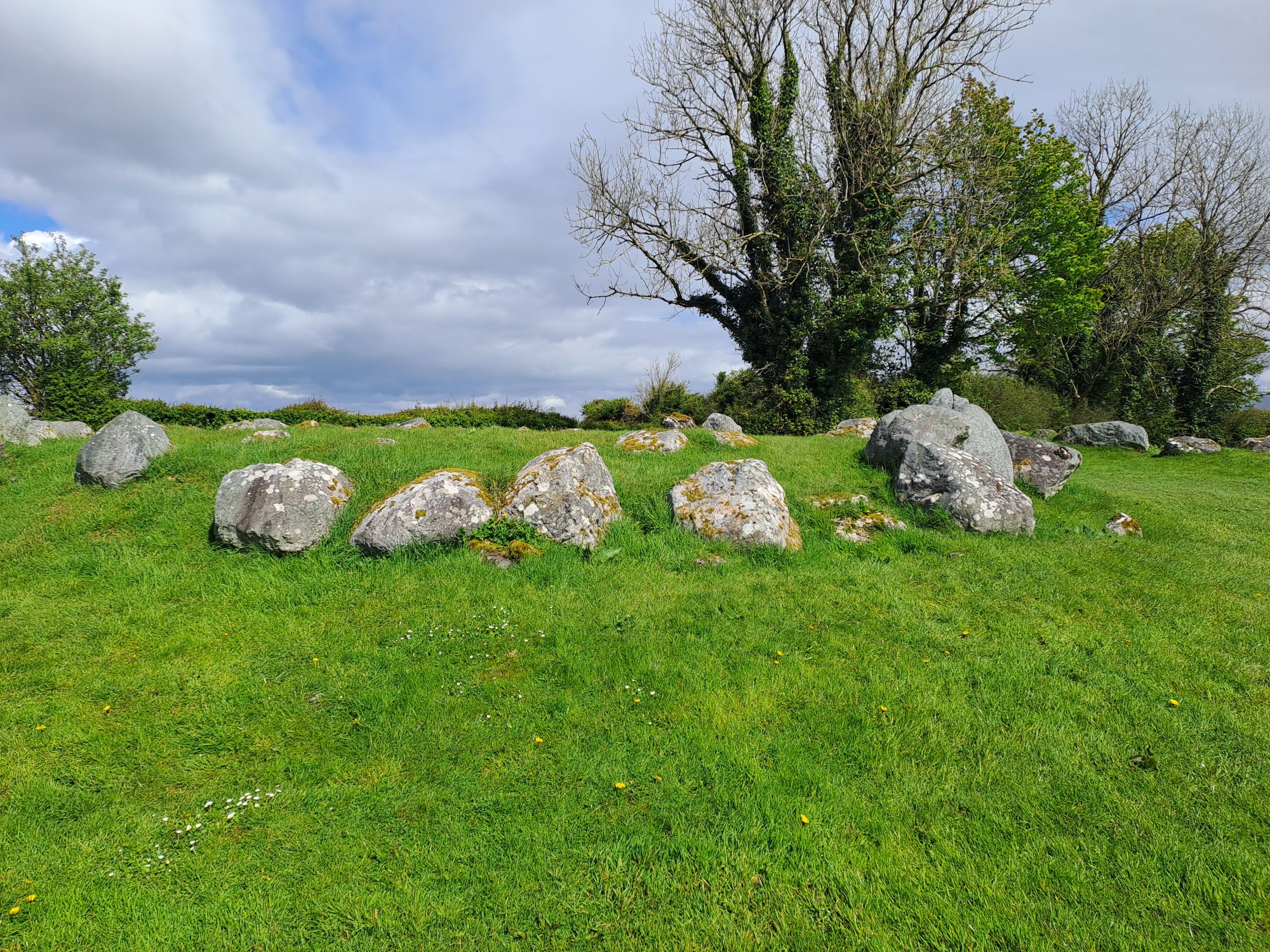
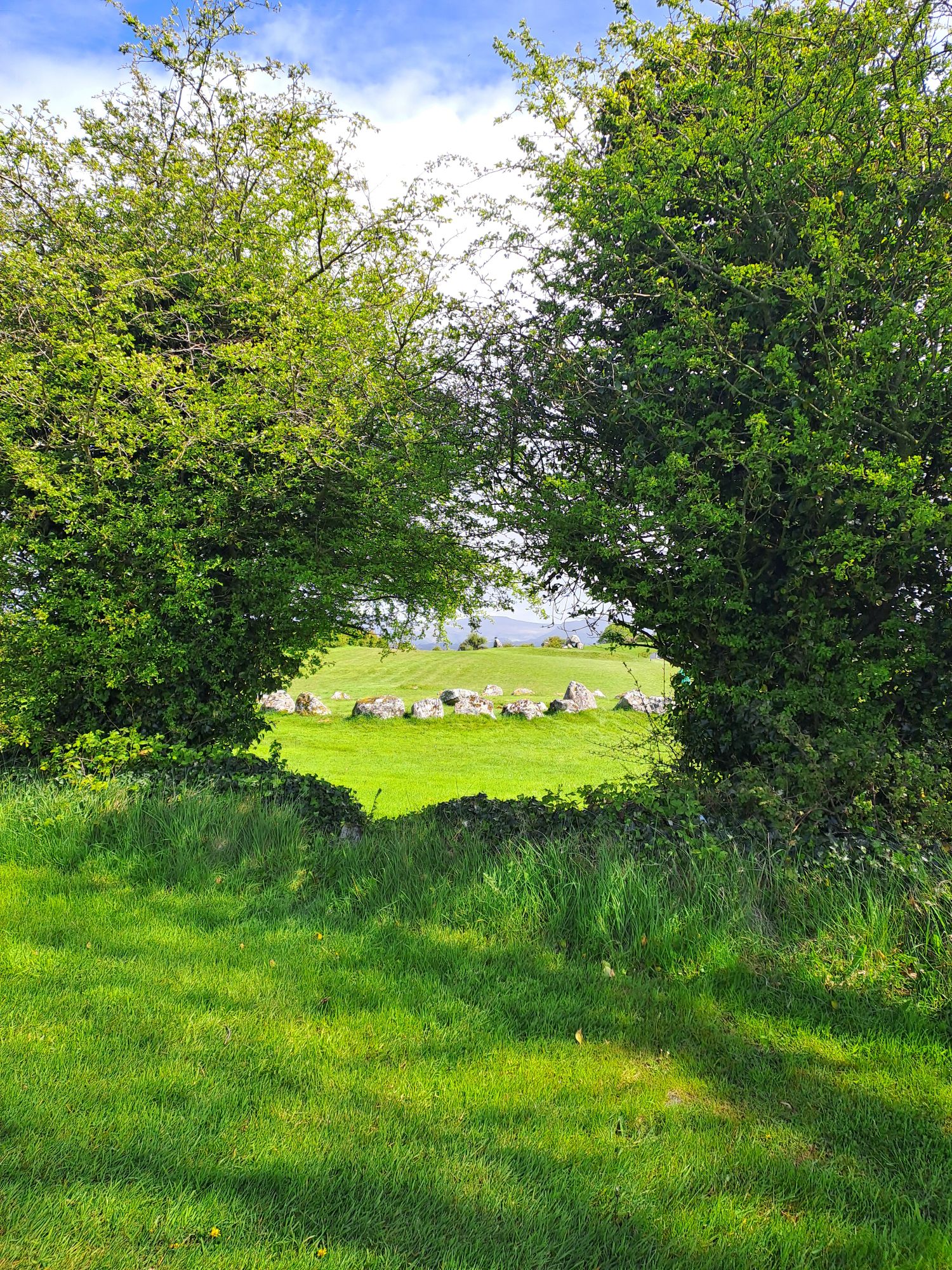
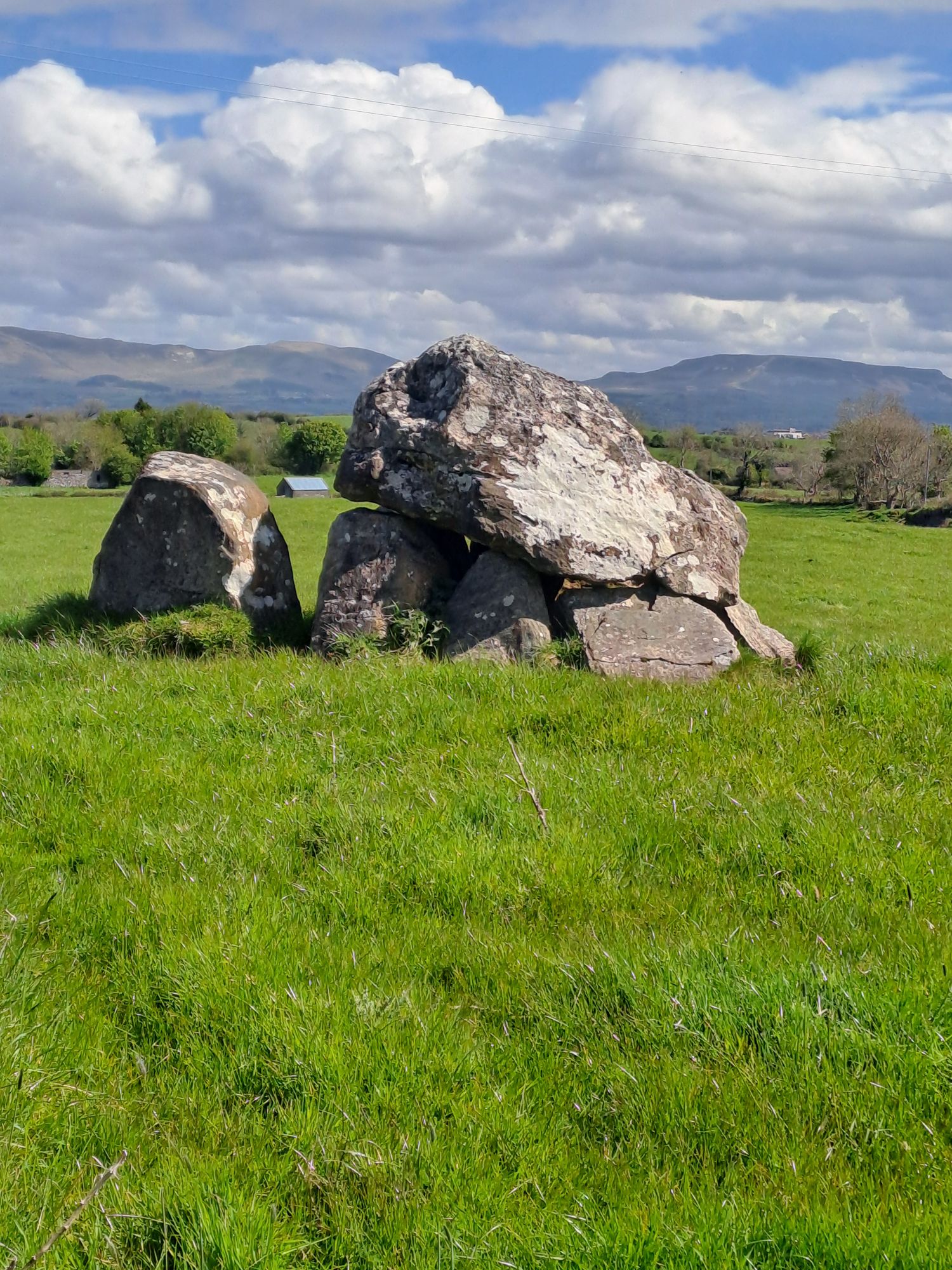
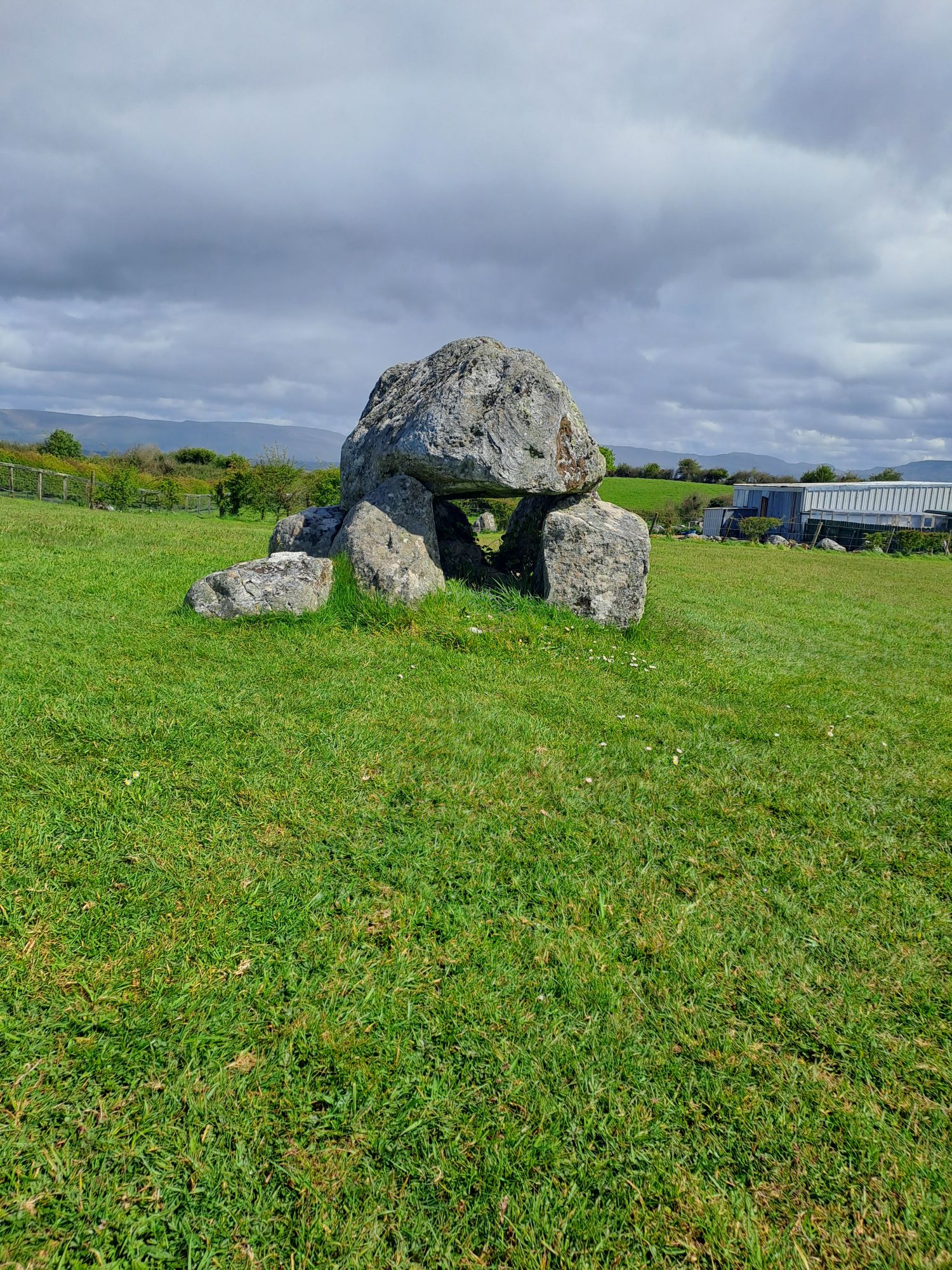
I’m no longer in the part of not-Barcelona known as Sligo (which is Sligeach in Irish) but here are some random pictures and a random video clip I took while I was there.

Carrowmore, County Sligo

Posted in Architecture, History with tags , , , , , on May 1, 2024 by telescoper

Today is 1st May, so it’s the Labour Day Holiday in Barcelona. Colleagues in Ireland will have to wait until Monday 6th May for their equivalent holiday. The First of May, Beltane (Bealtaine in Irish), is a festival of pagan origin that roughly marks the mid-point between the Spring Equinox and the Summer Solstice. It’s one of the so-called Cross-Quarter Days that lie halfway between the equinoxes and solstices.

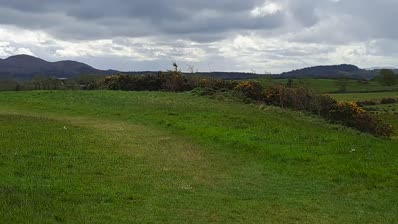
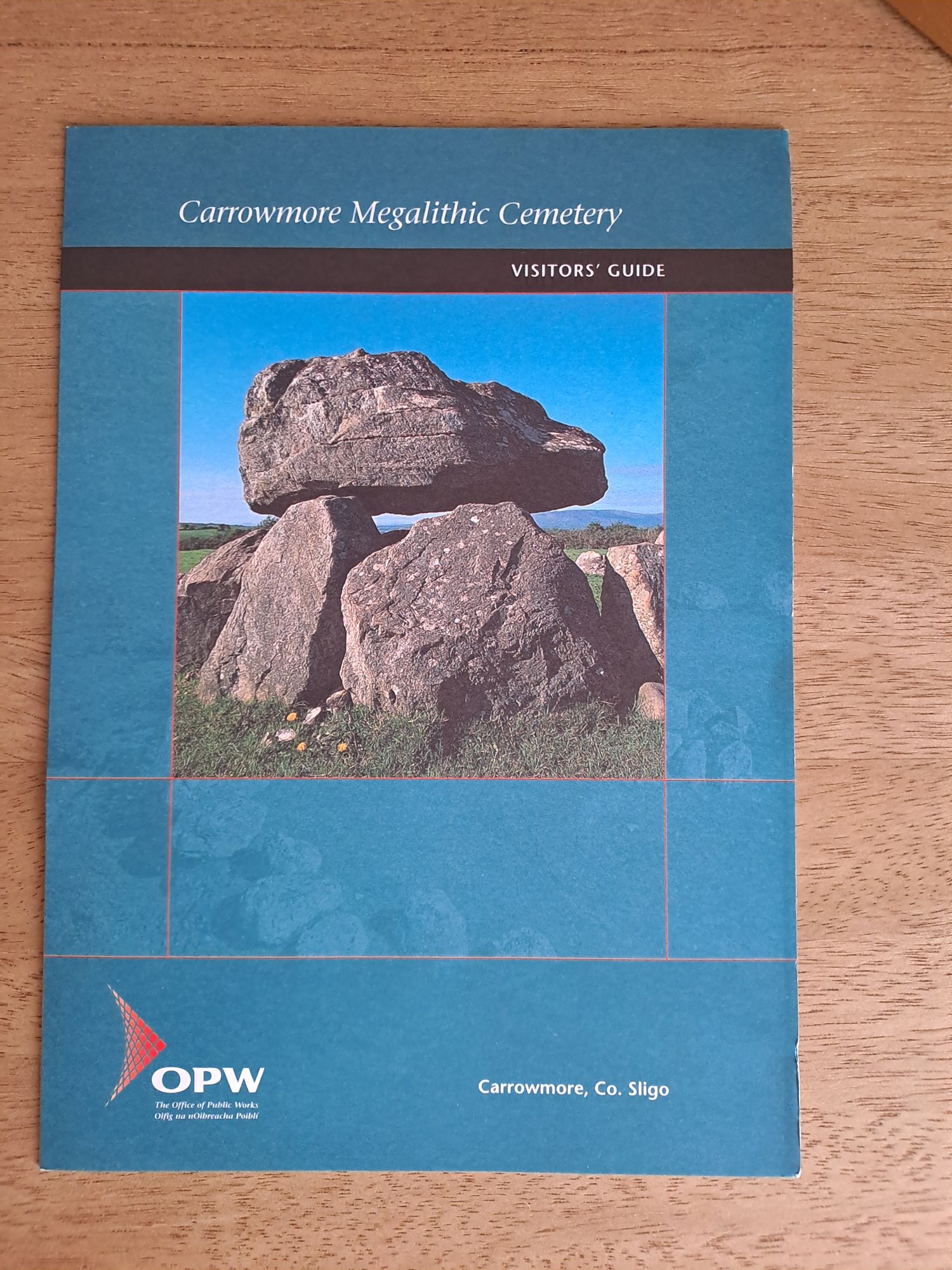
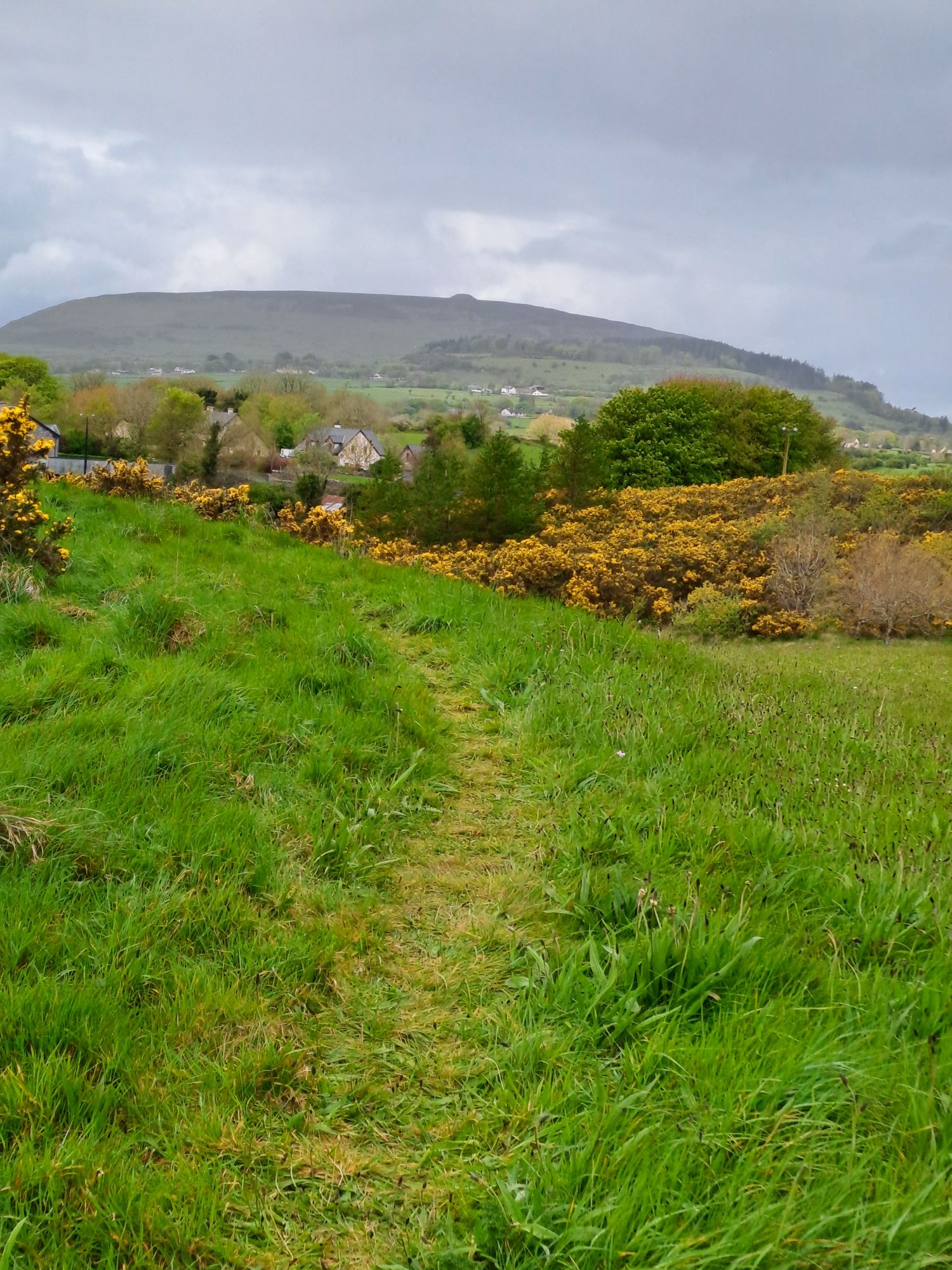
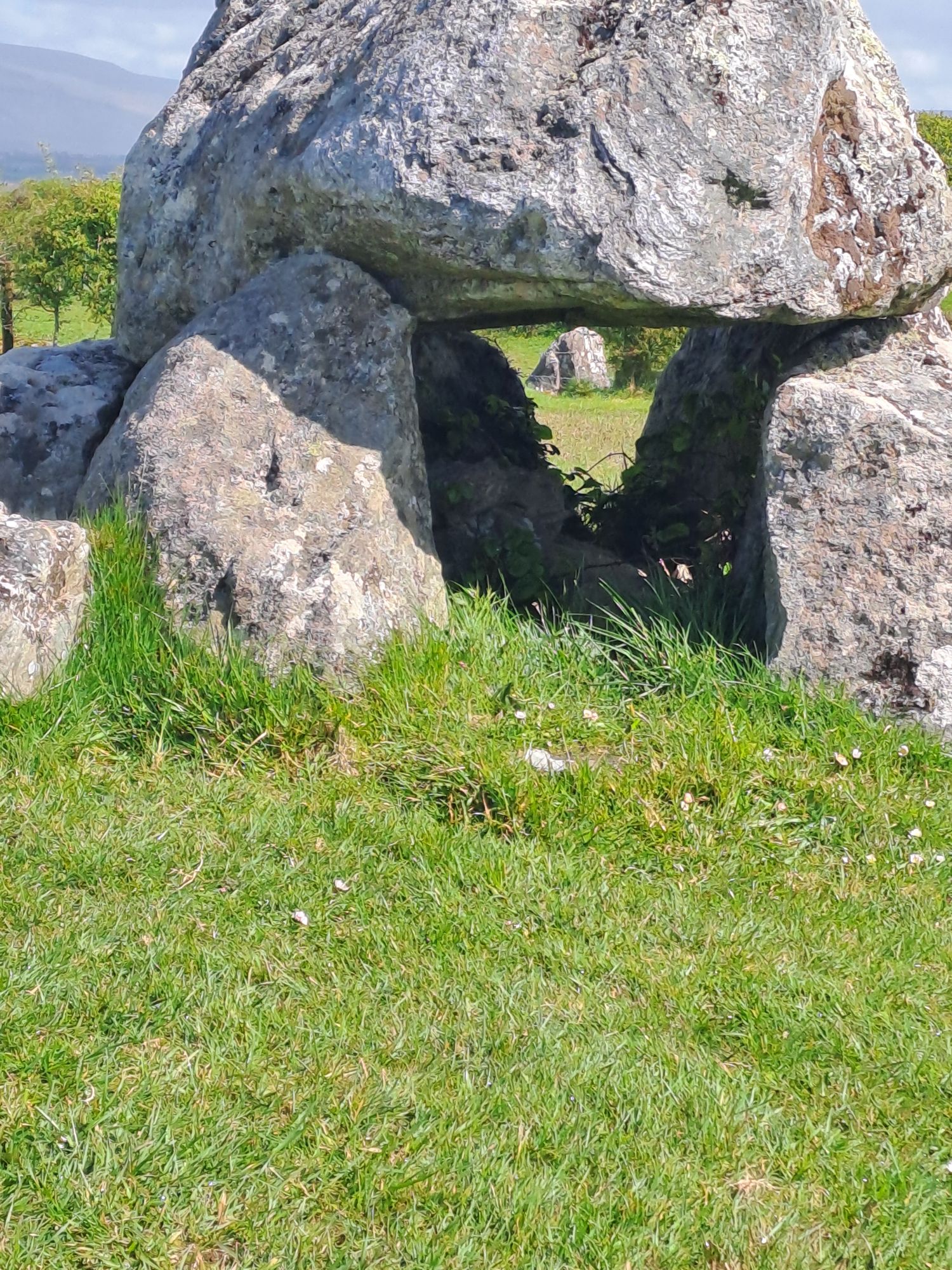
In view of the ancient origins of this holiday I thought I’d share some pictures of the amazing megalithic burial grounds at Carrowmore which is about 4km outside Sligo (where I have been on a secret mission). Carrowmore is the largest of the four megalithic cemeteries in Ireland in terms of the number of tombs, although the tombs are smaller in size and less complicated than the larger structures found at Brú na Bóinne. The structures at are also significantly older; there are signs of human habitation on the site going back at least 6000 years. The English name derives from the Irish An Cheathrú Mhór, which means ‘the great quarter’. Photographs don’t do justice to the extraordinary beauty of the landscape around the site but here is a panorama which gives some impression.

A visitor can easily understand why this was felt to be an appropriate last resting place for the Great and the Good. The surrounding topography is very interesting, as you can see from the first picture (of a model in the Visitor’s Centre); it’s on a peninsula between Sligo Harbour to the North and Ballysadare Bay to the South, and is surrounded on three sides by mountains. In particular, the site is overlooked from the west by Knocknarea, on top of which lies a large cairn, Miosgán Meadhbha, reputed to be the burial-place of the legendary Queen Maeve (Méabh in modern Irish). I was surprised to learn that this has never been excavated, so nobody really knows who or what is inside though it probably contains a passage tomb of similar form to those on the Carrowmore site. The cairn at the centre of Carrowmore, called Listoghil, the entrance to which you can see in one of the pictures, is a reconstruction.

Sadly, many other tombs were destroyed in the 19th Century, with stones being robbed to make walls when the land was enclosed, and large-scale quarrying for gravel in the area. Only some of the tombs are on publicly-owned land, but others are visible in nearby fields and indeed all around the area. There is even a stone circle in Sligo itself, on a housing estate called Abbeyquarter. Who knows what else is lurking under the unexcavated ground?

This forthcoming Bank Holiday weekend there is the Queen Maeve Festival in Sligo, but I will be in Barcelona.

A week is a long time…

Posted in Politics with tags , , , , , , on March 30, 2024 by telescoper

“A week is a long time in politics” is a quotation usually ascribed to Harold Wilson, although there’s no record of him ever having said it; it has nevertheless turned out to be true for the island of Ireland.

I have been thinking about writing about the sudden resignation of Leo Varadkar from the office of Taoiseach just ten days ago, and his impending replacement by Simon Harris (the current Minister for Further and Higher Education, Research, Innovation and Science), but I’ve been too busy and thought I’d wait until the holiday weekend to write something.

(To be honest I didn’t have any great insights to offer, so it’s perhaps just as well that I didn’t attempt any kind of in-depth analysis, not that lack of insight prevents media pundits from having a go. I’ll just say that Harris is an energetic tinkerer who is good at doing superficial – and sometimes positive – things to attract headlines, and is clearly enormously ambitious, but I don’t think he’ll offer any significant change of direction. The biggest issue in Ireland right now is the housing shortage, and in his address to Fine Gael members (given here in full) he didn’t mention the housing crisis or rising homelessness once. We can assume that more inaction is in store as the governing coalition limps on towards the next General Election, that must take place within the next year.)

I also found it amusing how many columnists wrote, after the fact, that they had Varadkar’s resignation coming although they were all far too brave to say so ahead of the event.

Anyway, the events of yesterday turned out to be even more surprising – not to say shocking – than Varadkar’s departure. Jeffrey Donaldson MP, Leader of the Democratic Unionist Party (DUP) resigned yesterday. Nobody knows for sure why Leo Varadkar resigned (except the man himself; my best guess is that he just got bored with the job) but the reason for Donaldson’s resignation is well known: he has been charged with sexual offences, including rape. Since his case is now in the hands of the criminal justice system, further comment or speculation about the charges would be highly inappropriate. Whatever you think of Jeffrey Donaldson’s character or politics – and I don’t think very much – he is, like everyone else, entitled to a fair trial. Just as importantly, if he has committed crimes it is important not to say or do anything that may be construed as prefudicial and might prevent a conviction.

This matter is alarming however because the Northern Ireland Assembly has just returned to Stormont after a two-year hiatus. Although Donaldson was largely responsible for its suspension, he was also largely responsible for its return. A sizeable fraction of the DUP were, and presumably still are, opposed to the agreement that led to reinstatement of power sharing and there is a real danger that the Assembly will collapse again. Fortunately, both sides seem to realize what a disaster that would be for the people of Northern Ireland, but that doesn’t guarantee that another crisis can be averted.

“May you live in interesting times” is another frequently misattributed quotation, but it seems we’re in them anyway.

Six Nations Summary

Posted in Rugby with tags , , , , , , , , , on March 17, 2024 by telescoper

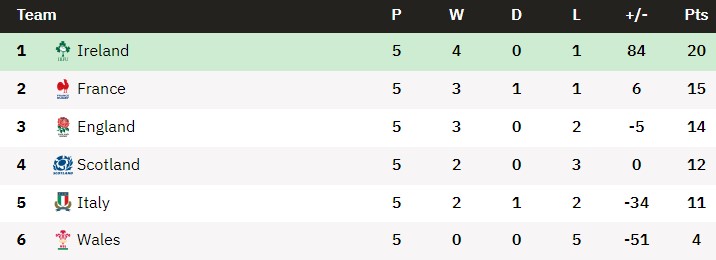
I didn’t see many of the games in this year’s Six Nations Rugby because I was abroad for most of it, but yesterday I saw the last round of matches. The last one, between France and England in Lyon, was probably the best game I’ve seen in this year’s tournament. After a fascinating ebb and flow, England thought they had snatched it with a converted try to make it 31-30 with just a couple of minutes to go, but then immediately conceded a penalty on the halfway line. Up stepped Thomas Ramos, who had scored from a similar distance earlier in the game, stepped up and scored. France won 33-31 in a game that could have gone either way. It was effectively a playoff for 2nd place.

Earlier in the day, Ireland held off a spirited challenge from Scotland in a tense and scrappy match to win 17-13 which guaranteed they would be Six Nations Champions. for the sixth time. I don’t think the team reached the heights of last year’s Grand Slam but it was a deserved victory. It was all a bit more comfortable than the scoreline suggests, though Scotland did score a try late on when Ireland lost concentration which made for a nervy few minutes. A defeat would have meant metaphorical rain on the St Patrick’s Day parades going on today, but in the end there was no rain, either metaphorical or literal.

Given the result in Lyon, Ireland would have been Champions by virtue of their bonus points, even if they had lost to Scotland. England (who beat Ireland last week in a game I didn’t see) had to win with a bonus point to catch them; they managed the bonus point for four tries, but lost the match. Some pundits have commented on whether it was fair for a team to have won having lost more games than the second place team. Of course all the teams know the rules before the competition starts, so there’s no point complaining after the fact. Ireland played attacking rugby knowing that the try count might be important. However, I do think there is a point. In the old Five Nations, and indeed in the World Cup Pools, each team played four games. A bonus point from each of those matches would add 4 to a team’s total, the same as a win. In the Six Nations each team places five matches, so the bonus points could add up to more than a win. A way to remedy this might be to award more points for a win: six for a win and three for a draw is my suggestion.

The first game of the last round yesterday was between Wales and Italy, a game which Italy won to finish 5th. They were unlucky not to beat France earlier in the competition and have played some excellent rugby this year. If they can deal with a marked tendency to fade in the last twenty minutes – as they did yesterday, but managed to hold on – then they will be genuine contenders. Wales had a terrible competition, losing all their games and finishing last. I am reliably informed that “wooden spoon” in Welsh is “llwy bren”. But nil desperandum: the last time Wales got the wooden spoon was in 2003; two years later they did the Grand Slam!

The Forthcoming Referenda

Posted in Politics with tags , , , , , , , , on January 29, 2024 by telescoper

On Friday 8th March 2024, the Irish electorate – that includes me – will be asked to vote on two amendments to the constitution. I won’t go into the relevant issues in detail here, but the proposed changes are intended to (i) broaden the concept of the family to be more inclusive (for example, currently, there is no constitutional recognition of families in which the parents are not married); and (ii) broaden the definition of “care” in the family home beyond the current constitution which emphasizes exclusively the “duties of women” in this regard.

This post is not really about these constitutional amendments but about the much less important issue that the media are describing them as two referendums. I will explain here why I think there is a good argument for the word referenda being used for the voting on 8th March. Regular readers of this blog know that I’m never pedantic about such matters. Well, maybe a little bit, sometimes. Latin was my best subject at O-level, though, so I can’t resist making a comment.

Any dictionary will tell you that “referendum” is obtained from the Latin verb referre which is itself formed as re- (prefix meaning “back”) + ferre (to carry), thus its literal meaning is “carry back” or, more relevantly to the current discussion, “to refer”. Ferre is actually an irregular verb, which complicates the discussion a bit, so I’ll use simpler examples of regular verbs below.

Latin grammar includes two related concepts derived from a verb, the gerund and the gerundive.

The gerund is a verbal noun; such things exist in English in forms that mean `the act of something’, e.g. running, eating, loving.The word formed from a verb with the ending `ing’ can also function as a present participle in English, but we wont be going there. It may easy to muddle up gerunds with participles in English, but not in Latin as they are formed in distinctly different ways.

As an example in the case of ‘loving’ the relevant Latin verb is  amare (which conjugates as amo, amasamat, and all that); the appropriate gerund is amandus. You can this sort of Latin construction surviving in such English words as “graduand”. Note, however, that a gerund has no plural form because that would make no sense in Latin. There are plural forms in English such as `doings’ and `comings and goings’ but I don’t think these are relevant here as I interpret them as jocular, and pedantry is a very serious business.

Related to the gerund is the gerundive which, as its name suggests, is an adjectival form related to the gerund, specifically expressing necessity. Latin being an inflected language, an adjective takes the ending appropriate to the gender of the noun it describes; the gerundive also follows this pattern.

In the ‘loving’ example above, the gerundive form is amandus in a masculine case or, if referring to a female entity, amanda (hence the name Amanda, which means “deserving or requiring love”) or amandum for a neuter noun. In cases where the noun is plural the forms would be amandiamandae, and amanda. Endings for other gerundives formed from other verbs are constructed in a similar fashion depending on their conjugation. An adjective used without a noun usually means a thing with that property, so amanda would mean a feminine entity deserving love.

From this discussion you can see that in Latin amandum could mean either “loving” (gerund) or “a thing to be loved” (gerundive). Latin grammar is sufficiently precise, however, that the actual meaning will be obvious from the context.

As an aside, based on my own experiences in mathematics and physics, the abbreviation `QED’ which is often placed at the end of a proof is short for `Quod Erat Demonstrandum’, meaning `which was required to be shown’ rather than, as I sometimes facetiously write, `Quite Easily Done’.  I’m surprised how many people (especially students) use QED without knowing what it means!

Now, back to referendum. It seems clear to me that this derives from the gerundive and thus means “a thing to be referred” (the thing concerned being of no gender, as is normal in such cases in Latin). So what should be the word for more than one referendum?

I think it depends on the context. The word  referenda implies “more than one thing to be referred” not “a thing to be referred multiple times” because the plural in referenda refers to the things not to the instances of referral. The familiar word agenda is formed precisely this way and it means “(a list of things) to be done”. This is not the desired meaning we want for multiple referrals of the same question, such as a second vote on the same issue, which would have to be referendums in English, as there is no Latin word that encapsulates that particular meaning. This is what I argued here. Referenda is, however, precisely the word needed for March 8th, when there will be a single act of voting on two issues. 

As supporting evidence I quote this source:

…we maintain that there is value in using referendums for multiple events and referenda for multiple propositions.

I rest my case. Any questions?

P.S. I argue for consistency that, if there is only one item on the agenda, it is an agendum.

Mathematical Mystics at Maynooth

Posted in History, mathematics, Maynooth with tags , , , on January 25, 2024 by telescoper

I’m indebted to my colleague David Malone for sending me this small excerpt from an old issue of the Kalendarium of St Patrick’s College, Maynooth, dating back to the 1960s, which deals with the appointments of new members of staff

Halfway down you will see a reference to Mathematical Mystics!

This is obviously a mistake. It should of course be Mathematical Psychics Physics. I also think the name of the Mathematical Mystics lecturer should be Tigran Tchrakian. I think these are both transcription errors from somebody’s very bad handwriting! The current Department of Theoretical Physics at Maynooth was formerly known by the title Mathematical Physics.

There are some other points of interest. in Experimental Physics you will find mention of a young Susan Lawlor who is now better known as Susan McKenna-Lawlor, a very eminent astrophysicist who specialized in space instrumentation, now in her eighties.

I’m also amused by the existence of a lecturer in Elocution

The historical background of St Patrick’s College is that it was primarily a Catholic theological institution (founded in 1795) although it taught secular courses and was a recognized college of the National University of Ireland from 1910. It was only in the mid-1960s that it was opened to lay students, which expanded the numbers considerably. In 1997 that the secular part separated and formed NUI Maynooth (now known by the marketing people as Maynooth University). The remaining theological institution is known as St Patrick’s Pontifical University (or St Patrick’s College or just Maynooth College).

A major role for St Patrick’s College was the training of priests and I suppose it was important that priests should be well spoken, hence the lectures on elocution…

Near the top in connection with Sociology you can see the title An tAth which is the Irish language way of writing the abbreviation “Fr” for “Father”, indicating a priest; “father” is athair and the an is a definite article. Note the lower case t in front of Ath which is an example of prothesis.

Finally, right at the top of the page you can see the name Donal Linehan, which will be familiar to Irish rugby fans but I don’t know if there’s a family connection between the former Ireland intentional who is now a TV commentator and the lecturer in Roman and Civil Law.

Thoughts of Retirement

Posted in Barcelona, Biographical, Maynooth, Open Access, The Universe and Stuff with tags , , , on November 19, 2023 by telescoper

I’ve been reviewing my situation while here in Barcelona. One of the themes that keeps popping into my head is well expressed by part of a little speech by Colonel Nicholson in The Bridge on the River Kwai:

But there are times… when suddenly you realize you’re nearer the end than the beginning. And you wonder, you ask yourself, what the sum total of your life represents. What difference your being there at any time made to anything – or if it made any difference at all, really. Particularly in comparison with other men’s careers. I don’t know whether that kind of thinking’s very healthy, but I must admit I’ve had some thoughts on those lines from time to time.

Healthy or not I’ve also had thoughts along those lines, and sometimes feel I should step aside and create a job opportunity for someone younger. I know my employer wouldn’t mind if I did that either. They’d much prefer replacing me with someone cheaper and more compliant than me. I think if I asked for early retirement they would probably jump at the chance. I’d miss the teaching and the students, of course,

The fact of the matter is though that I can’t afford to retire yet. I have a mortgage to pay and I’ve only had five full years of pensionable service in the Irish system, so won’t get much of a pension. I have the frozen residue of my UK pension, of course, but that is subject to an actuarial reduction if I take the benefit before I’m 65, which is also the standard retirement age for academic staff in Ireland. I can’t be made to retire here until I’m 70, in fact, but I think I’ll be well beyond my best-before date by then and am not keen to overstay my welcome.

So it looks like I’ll have to stay until I’m 65 at the earliest. In fact I won’t be able to collect the State Pension (SPC) until I’m 66, so I’ll probably have to stay another year. That means that when I get back from sabbatical I will have four or five years left until I can retire. I don’t know what I’ll be teaching when I return but I hope I get a chance to teach a few new modules before the end. In particular some cosmology or astrophysics would be particularly nice. All this is predicated on: (a) me living long enough; and (b) Physics at Maynooth not being closed down; neither of these is certain.

When I moved to the Emerald Isle in 2017 I supposed that I would carry on living in Ireland after retiring. Now I’m having some doubts about that. I have been advised by medical experts that my arthritis would be more tolerable in a warmer climate. And there’s the cost of living in Ireland, which is much higher than Spain. I can imagine living here, actually, though I think Barcelona itself might be a bit expensive for a pensioner. Somewhere in the surrounding countryside, or along the coast, might be nice. I’ve got a few years to think about that.

Another thing in my mind is what will happen to the Open Journal of Astrophysics when I retire? I would like some larger organization or community to take it over in the long term. It’s not expensive to run, actually, but someone would have to take over as Managing Editor. Moreover, I don’t think it’s really fair to expect one small University in Ireland to bear the full cost of a global astrophysics journal indefinitely.

Modern Ireland 1600-1972 by R. F. Foster

Posted in History, Literature with tags , , , , on October 30, 2023 by telescoper

My attempt to catch up with a backlog of reading while on sabbatical has now brought me to Modern Ireland, by R.F. Foster, the paperback version of which, shown above, I bought way back in 2018 but have only just finished reading. In the following I’ll describe the scope of the book and make a few observations.

The book was first published in 1988 so it obviously can’t deal with more recent events such as the Good Friday Agreement. The narrative stops almost 50 years ago in 1972, the year of Bloody Sunday and just before Ireland joined the European Economic Community in 1973, but since it starts way back in 1600 one can forgive Roy Foster for not covering such recent events. The start is in what is usually termed the early modern period, but if truth be told much of Irish society at that point was still organized on mediaeval lines.

To set the scene, Foster starts with a description of the three main sections of the population of Ireland in 1600. These were the (Gaelic and Catholic) Irish, the “Old English”, descendants of the 12th Century conquest of part of the country, who were also Catholic, and the Protestant “New English” who arrived with the Tudor plantations. There were tensions between all three of these groups.

The rest of the book is divided into four parts, roughly one per century: Part I covers the continued Elizabethan plantation of Ireland, rebellions against it, the devastation caused by Cromwell’s so-called “pacification”, and the Penal Laws that basically outlawed the Catholic faith. In Part II Foster discusses a period often called The Ascendancy which showed the consolidation of power in the hands of a Protestant – specifically Anglican – ruling class, though there was a sizeable community of non-conformist Protestants, chiefly Presbyterians, who were regarded by Anglicans with almost as much suspicion as the Catholics. This Part ends with yet another failed rebellion, involving Wolfe Tone and the United Irishmen, against the backdrop of the French revolution. Up until the Act of Union of 1800, Ireland had its own Parliament; after that Irish MPs were sent to the House of Commons in Westminster. The century covered by Part III includes the Irish Famine, rising levels of rural violence, and issues of land reform, and various attempts to deliver some form of Home Rule; it ends with Charles Stewart Parnell. Part IV covers the Easter Rising, War of Independence, Civil War, Partition, the creation of the Irish Free State, and the eventual formation of the Irish Republic. A running theme through all four Parts is a recognition of how historical forces – and not only religion – shaped Ulster in a different way from the rest of Ireland.

As I’ve said before on this blog, it disturbs me quite how little of this history I was taught at school in England so I found it valuable to read a detailed scholarly work whose main message is that everything is much more complex than simple narratives – those peddled by politicians, for example – would have you believe. This is primarily a revisionist history, calling much of received wisdom into question. That said, it’s probably not the best book for a newcomer to Irish history. Foster does assume knowledge of quite a few of the major events and, while reading it, I did have to look quite a few things up. Much is said in the jacket reviews of the author’s writing style. To be honest, I found it sometimes rather mannered and self-conscious, though with some enjoyably arch humour thrown in for good measure. It’s thoroughly researched, as far as that is possible when primary sources are sketchy and contemporary records usually written by someone with an axe to grind. It does seem to rely mainly on documents written in English, however, so one might argue that introduces quite a bias. I gather that there is much greater emphasis among contemporary Irish historians on records written in Irish (Gaelic).

The book is rather heavy on footnotes, too. Usually I dislike these, but in this case they are mostly little biographical sketches of important figures which would have disrupted the flow if included in the main text, and I found many of them valuable. Just to be perverse, I have to say I liked his liberal use of semicolons. Though dense, the books is as accessible as I think a scholarly work can be and although I am not so much a scholar of history as an interested bystander, I learnt a lot. It also made me want to learn more, especially about the period between the death of Parnell in 1891 and the Easter Rising of 1916.

It seems apt to finish with an excerpt that illustrates a theme that crops up repeatedly during the 23 chapters of the book:

Irish history in the long period since the completion of the Elizabethan conquest concerned a great deal more than the definition of Irishness against Britishness; this survey has attempted to indicate as much. But that sense of difference comes strongly through, though its expression was conditioned by altering circumstances, and adapted for different interest-groups, as the years passed. If the claims of cultural maturity and a new European identity advanced by the 1970s can be substantiated, it may be by the hope of a more relaxed and inclusive definition of Irishness, and a less constricted view of Irish history.

Modern Ireland, R. F. Foster, p596

I hope that too. It may even be happening.