Archive for ireland

Mathematical Mystics at Maynooth

Posted in History, mathematics, Maynooth with tags , , , on January 25, 2024 by telescoper

I’m indebted to my colleague David Malone for sending me this small excerpt from an old issue of the Kalendarium of St Patrick’s College, Maynooth, dating back to the 1960s, which deals with the appointments of new members of staff

Halfway down you will see a reference to Mathematical Mystics!

This is obviously a mistake. It should of course be Mathematical Psychics Physics. I also think the name of the Mathematical Mystics lecturer should be Tigran Tchrakian. I think these are both transcription errors from somebody’s very bad handwriting! The current Department of Theoretical Physics at Maynooth was formerly known by the title Mathematical Physics.

There are some other points of interest. in Experimental Physics you will find mention of a young Susan Lawlor who is now better known as Susan McKenna-Lawlor, a very eminent astrophysicist who specialized in space instrumentation, now in her eighties.

I’m also amused by the existence of a lecturer in Elocution

The historical background of St Patrick’s College is that it was primarily a Catholic theological institution (founded in 1795) although it taught secular courses and was a recognized college of the National University of Ireland from 1910. It was only in the mid-1960s that it was opened to lay students, which expanded the numbers considerably. In 1997 that the secular part separated and formed NUI Maynooth (now known by the marketing people as Maynooth University). The remaining theological institution is known as St Patrick’s Pontifical University (or St Patrick’s College or just Maynooth College).

A major role for St Patrick’s College was the training of priests and I suppose it was important that priests should be well spoken, hence the lectures on elocution…

Near the top in connection with Sociology you can see the title An tAth which is the Irish language way of writing the abbreviation “Fr” for “Father”, indicating a priest; “father” is athair and the an is a definite article. Note the lower case t in front of Ath which is an example of prothesis.

Finally, right at the top of the page you can see the name Donal Linehan, which will be familiar to Irish rugby fans but I don’t know if there’s a family connection between the former Ireland intentional who is now a TV commentator and the lecturer in Roman and Civil Law.

Thoughts of Retirement

Posted in Barcelona, Biographical, Maynooth, Open Access, The Universe and Stuff with tags , , , on November 19, 2023 by telescoper

I’ve been reviewing my situation while here in Barcelona. One of the themes that keeps popping into my head is well expressed by part of a little speech by Colonel Nicholson in The Bridge on the River Kwai:

But there are times… when suddenly you realize you’re nearer the end than the beginning. And you wonder, you ask yourself, what the sum total of your life represents. What difference your being there at any time made to anything – or if it made any difference at all, really. Particularly in comparison with other men’s careers. I don’t know whether that kind of thinking’s very healthy, but I must admit I’ve had some thoughts on those lines from time to time.

Healthy or not I’ve also had thoughts along those lines, and sometimes feel I should step aside and create a job opportunity for someone younger. I know my employer wouldn’t mind if I did that either. They’d much prefer replacing me with someone cheaper and more compliant than me. I think if I asked for early retirement they would probably jump at the chance. I’d miss the teaching and the students, of course,

The fact of the matter is though that I can’t afford to retire yet. I have a mortgage to pay and I’ve only had five full years of pensionable service in the Irish system, so won’t get much of a pension. I have the frozen residue of my UK pension, of course, but that is subject to an actuarial reduction if I take the benefit before I’m 65, which is also the standard retirement age for academic staff in Ireland. I can’t be made to retire here until I’m 70, in fact, but I think I’ll be well beyond my best-before date by then and am not keen to overstay my welcome.

So it looks like I’ll have to stay until I’m 65 at the earliest. In fact I won’t be able to collect the State Pension (SPC) until I’m 66, so I’ll probably have to stay another year. That means that when I get back from sabbatical I will have four or five years left until I can retire. I don’t know what I’ll be teaching when I return but I hope I get a chance to teach a few new modules before the end. In particular some cosmology or astrophysics would be particularly nice. All this is predicated on: (a) me living long enough; and (b) Physics at Maynooth not being closed down; neither of these is certain.

When I moved to the Emerald Isle in 2017 I supposed that I would carry on living in Ireland after retiring. Now I’m having some doubts about that. I have been advised by medical experts that my arthritis would be more tolerable in a warmer climate. And there’s the cost of living in Ireland, which is much higher than Spain. I can imagine living here, actually, though I think Barcelona itself might be a bit expensive for a pensioner. Somewhere in the surrounding countryside, or along the coast, might be nice. I’ve got a few years to think about that.

Another thing in my mind is what will happen to the Open Journal of Astrophysics when I retire? I would like some larger organization or community to take it over in the long term. It’s not expensive to run, actually, but someone would have to take over as Managing Editor. Moreover, I don’t think it’s really fair to expect one small University in Ireland to bear the full cost of a global astrophysics journal indefinitely.

Modern Ireland 1600-1972 by R. F. Foster

Posted in History, Literature with tags , , , , on October 30, 2023 by telescoper

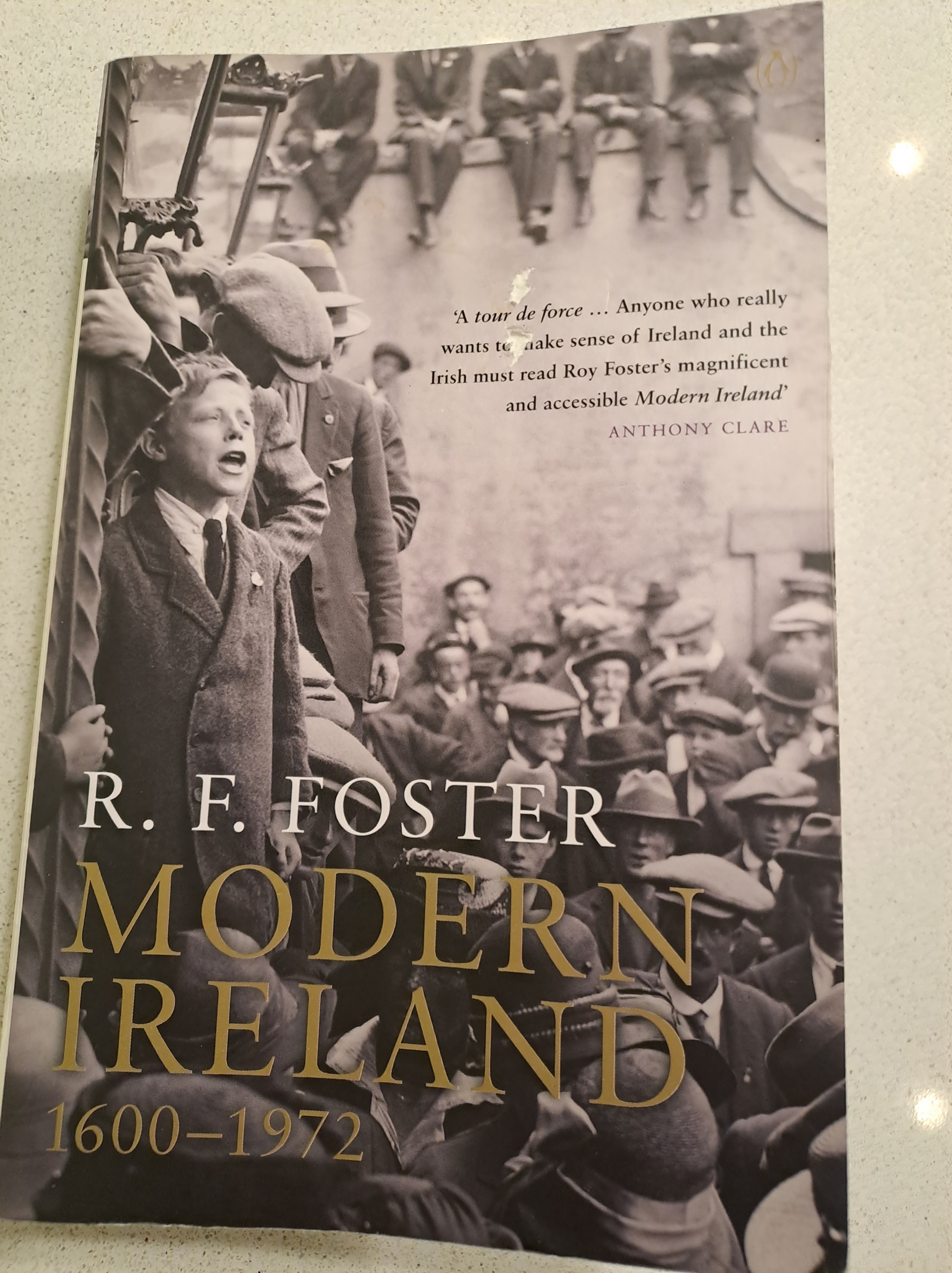
My attempt to catch up with a backlog of reading while on sabbatical has now brought me to Modern Ireland, by R.F. Foster, the paperback version of which, shown above, I bought way back in 2018 but have only just finished reading. In the following I’ll describe the scope of the book and make a few observations.

The book was first published in 1988 so it obviously can’t deal with more recent events such as the Good Friday Agreement. The narrative stops almost 50 years ago in 1972, the year of Bloody Sunday and just before Ireland joined the European Economic Community in 1973, but since it starts way back in 1600 one can forgive Roy Foster for not covering such recent events. The start is in what is usually termed the early modern period, but if truth be told much of Irish society at that point was still organized on mediaeval lines.

To set the scene, Foster starts with a description of the three main sections of the population of Ireland in 1600. These were the (Gaelic and Catholic) Irish, the “Old English”, descendants of the 12th Century conquest of part of the country, who were also Catholic, and the Protestant “New English” who arrived with the Tudor plantations. There were tensions between all three of these groups.

The rest of the book is divided into four parts, roughly one per century: Part I covers the continued Elizabethan plantation of Ireland, rebellions against it, the devastation caused by Cromwell’s so-called “pacification”, and the Penal Laws that basically outlawed the Catholic faith. In Part II Foster discusses a period often called The Ascendancy which showed the consolidation of power in the hands of a Protestant – specifically Anglican – ruling class, though there was a sizeable community of non-conformist Protestants, chiefly Presbyterians, who were regarded by Anglicans with almost as much suspicion as the Catholics. This Part ends with yet another failed rebellion, involving Wolfe Tone and the United Irishmen, against the backdrop of the French revolution. Up until the Act of Union of 1800, Ireland had its own Parliament; after that Irish MPs were sent to the House of Commons in Westminster. The century covered by Part III includes the Irish Famine, rising levels of rural violence, and issues of land reform, and various attempts to deliver some form of Home Rule; it ends with Charles Stewart Parnell. Part IV covers the Easter Rising, War of Independence, Civil War, Partition, the creation of the Irish Free State, and the eventual formation of the Irish Republic. A running theme through all four Parts is a recognition of how historical forces – and not only religion – shaped Ulster in a different way from the rest of Ireland.

As I’ve said before on this blog, it disturbs me quite how little of this history I was taught at school in England so I found it valuable to read a detailed scholarly work whose main message is that everything is much more complex than simple narratives – those peddled by politicians, for example – would have you believe. This is primarily a revisionist history, calling much of received wisdom into question. That said, it’s probably not the best book for a newcomer to Irish history. Foster does assume knowledge of quite a few of the major events and, while reading it, I did have to look quite a few things up. Much is said in the jacket reviews of the author’s writing style. To be honest, I found it sometimes rather mannered and self-conscious, though with some enjoyably arch humour thrown in for good measure. It’s thoroughly researched, as far as that is possible when primary sources are sketchy and contemporary records usually written by someone with an axe to grind. It does seem to rely mainly on documents written in English, however, so one might argue that introduces quite a bias. I gather that there is much greater emphasis among contemporary Irish historians on records written in Irish (Gaelic).

The book is rather heavy on footnotes, too. Usually I dislike these, but in this case they are mostly little biographical sketches of important figures which would have disrupted the flow if included in the main text, and I found many of them valuable. Just to be perverse, I have to say I liked his liberal use of semicolons. Though dense, the books is as accessible as I think a scholarly work can be and although I am not so much a scholar of history as an interested bystander, I learnt a lot. It also made me want to learn more, especially about the period between the death of Parnell in 1891 and the Easter Rising of 1916.

It seems apt to finish with an excerpt that illustrates a theme that crops up repeatedly during the 23 chapters of the book:

Irish history in the long period since the completion of the Elizabethan conquest concerned a great deal more than the definition of Irishness against Britishness; this survey has attempted to indicate as much. But that sense of difference comes strongly through, though its expression was conditioned by altering circumstances, and adapted for different interest-groups, as the years passed. If the claims of cultural maturity and a new European identity advanced by the 1970s can be substantiated, it may be by the hope of a more relaxed and inclusive definition of Irishness, and a less constricted view of Irish history.

Modern Ireland, R. F. Foster, p596

I hope that too. It may even be happening.

RWC: The Southern Hemisphere Strikes Back!

Posted in Barcelona, Rugby with tags , , on October 15, 2023 by telescoper

Sadly, Ireland’s Rugby World Cup dream came to an end last night with a narrow defeat (24-28) to the All Blacks. After being 13-0 down at one stage, Ireland clawed their way back into the match and at one stage trailed by only a point with New Zealand with a player in the sin bin. But the All Blacks defence held firm as wave after wave of Irish attacks broke on them. It just wasn’t to be. It was another titanic struggle between two excellent teams, which would have made a worthy final. Both teams looked exhausted at the end. For the record I have to say that, on the balance of play, I think the All Blacks deserved their win, just.

Unfortunately, the peculiarities of the draw meant that only two of the top four teams in the world rankings could make the semi-finals. Ireland won’t be one of them.

Earlier yesterday, in the other Quarter Final, there was an upset when Argentina beat Wales. That’s a great result for the Pumas, but Wales can justifiably argue that Argentina should have had a player sent off for a dangerous tackle. Inconsistencies in refereeing are a major issue in this tournament.

It’s interesting that the four teams who came top in their pools (Ireland, France, Wales and England) are all from the Northern Hemisphere. Now two of them are out. Today, France play South Africa and England play Fiji. It’s possible, though I would say not likely, not that all four semi-finalists will be from the Southern Hemisphere. I think if Fiji play their natural game they can give England a scare, and the game between France and South Africa is hard to call. I think the Springboks’ lack of a goal kicker may cost them dear.

At the start of the competition I thought that, with home advantage, France were clear favourites. I still think that’s the case, though I may have to revise that opinion after tonight’s match!

P.S. It’s raining today in Barcelona

UPDATE: England 30 Fiji 24. Fiji certainly made England work for that result! I can’t see England beating either France or South Africa in the semi-final though.

UPDATE: France 28 South Africa 29. Another pulsating match, with 6 tries in the first half, but South Africa just sneak it. Tight margins again, and especially one very dodgy penalty decision. Heartbreak for the hosts. I’m not often right but I was wrong again.

So the semi-finals will be New Zealand v Argentina and England v South Africa. The team that Ireland beat in their pool game goes through with New Zealand, the team that France beat in their pool.

The Grand Slam

Posted in Rugby with tags , , , , on March 18, 2023 by telescoper

Just time for a quick post to mark the occasion of the end of the 2023 Six Nations competition, Ireland’s victory over England in Dublin this evening making it a triumphant Grand Slam for the men in green. It wasn’t a great game, to be honest. I think the weight of expectation on the Irish players got to them a bit in the first half, and they made too many handling errors. Ireland also missed a couple of key players after the bruising game against Scotland last week. I half-wondered whether they might fall at the last fence. England couldn’t possibly have played as badly as they did against France last weekend, when they lost 53-10. I dread to think what the mood would have been like around town if Ireland hadn’t won.

In the end, though it was a relatively comfortable victory, with England’s only try, coming very late, was little more than a consolation and was quickly followed by a reply at the other end. In the closing stages The Fields of Athenry was ringing out around the stadium at Lansdowne Road, a celebration only marred by Johnny Sexton having to go off injured in his last-ever Six Nations match. What a career he has had!

Congratulations to Ireland on a magnificent achievement, thoroughly well deserved. This is an excellent team. Bring on the World Cup! (Though with home advantage, the excellent French side who came second in this year’s Six Nations, will be hard to beat.)

I remember Ireland doing the Grand Slam in 2009 by winning their last game against Wales in Cardiff. Judging by the celebrations after that, Dublin will be buzzing tonight, with relief as well as joy!

Covid-19 in Ireland – The Last Post

Posted in Biographical, Covid-19 with tags , , , on March 1, 2023 by telescoper

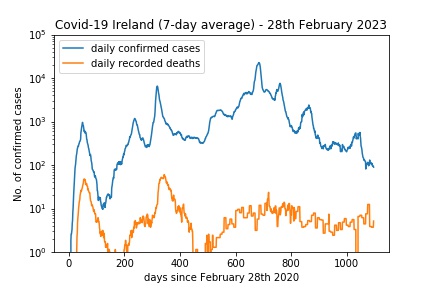
On February 29th 2020, Ireland identified its first case of the novel coronavirus, SARS CoV2, the virus that causes COVID-19. The World Health Organization declared the outbreak a pandemic on March 11th. On March 12th 2020 Schools and Colleges in Ireland were closed.

Since then, I have posted regular updates of the number of cases of COVID-19, initially daily and more recently weekly as the frequency of official announcements on the data hub decreased. The plotting the latest figures actually became a sort of ritual for me over this time and I even found mildly therapeutic.

Now, however, three full years have passed- can it really be three full years? – have since the (official) arrival of the pandemic in Ireland and, with the situation looking stable, I think it’s time to stop posting these updates. I made the decision to stop at the end of February 2023 unless something drastic happened to change my mind. Ironically, I just heard this morning that one of my colleagues has a new case of Covid-19 but that hasn’t changed my mind.  I hope this makes it clear that I don’t think the pandemic is over: there are many people still suffering from new infections and the effects of “Long Covid”. I just don’t see the need to continue my updates here.

I will leave the data online here in case anyone is interested in the numbers, but I won’t be posting any further updates.

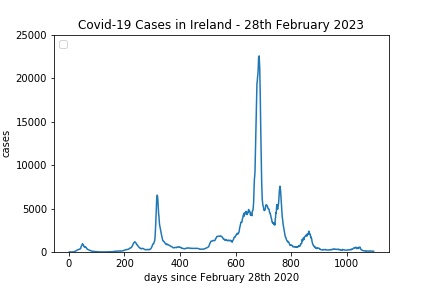
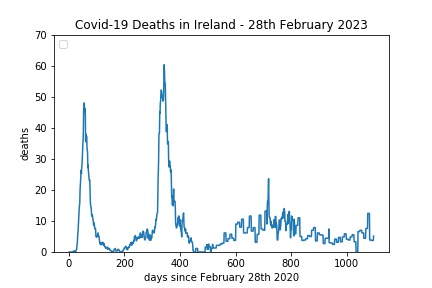
So here are the final graphs from me.  The present 7-day moving average of new cases is just 89.6 per week, down from 103.0 last week and 36 deaths were recorded in the same period.


On a linear scale the cases look like this

The numbers for deaths on a linear scale look like this

State Supports for PhD Researchers

Posted in Education, Maynooth with tags , , , on February 27, 2023 by telescoper

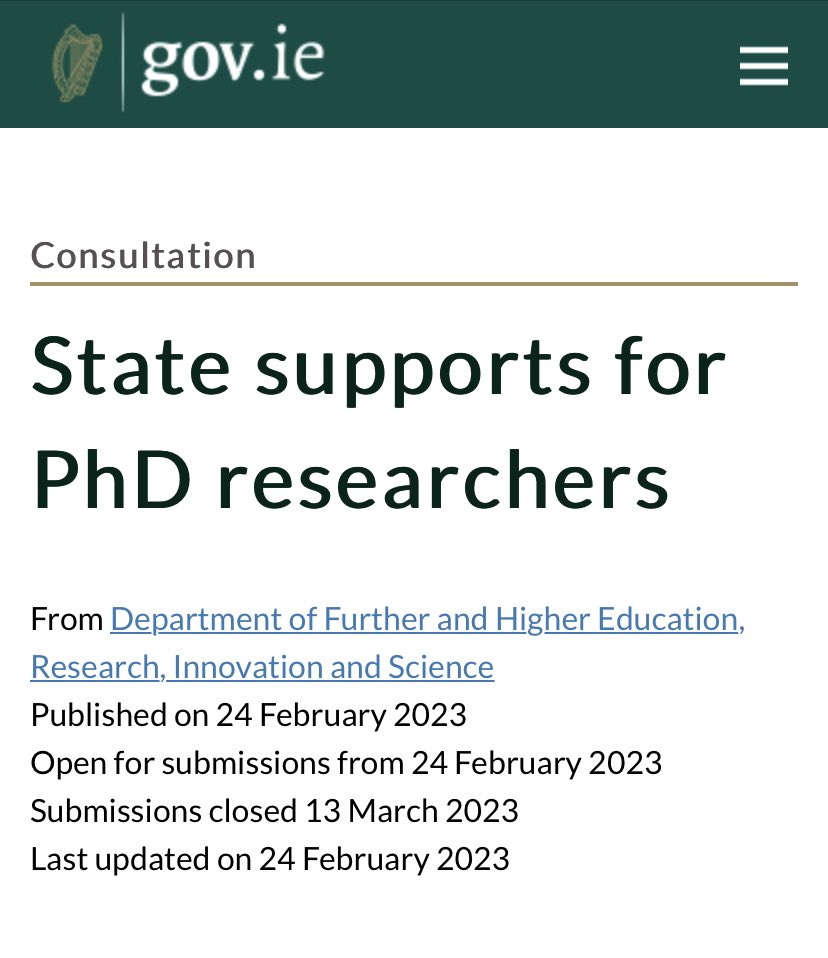
By sheer coincidence, the very same day that I posted a piece in which complained that the issue of PhD stipends for Irish postgraduates had apparently been “kicked into the long grass”, the consultation has at last opened.

You can contribute your submission or submit your contribution, whichever seems appropriate, here.

Ireland and CERN

Posted in Maynooth, Politics, Science Politics, The Universe and Stuff with tags , , , on December 30, 2022 by telescoper

Not long ago I posted an item about Ireland’s potential membership of CERN. There seems to have been some progress at political levels in this direction. In Mid-December, the Seanad called for a detailed proposal for CERN membership to be drawn up. More recently still, Minister Simon Harris has indicated that he will bring such a proposal to Cabinet on the matter.

There’s an article in yesterday’s Irish Times by Cormac O’Raifeartaigh reviewing the situation.

As I understand things, if the Irish Government were to decide to take Ireland into CERN then it would first have to become an Associate Member, which would cost around €1.5 million per year. That’s a modest contribution, and the financial returns to Irish industry and universities are likely to far exceed that. This Associate member stage would last up to 5 years, and then to acquire full membership a joining fee of around €16.8 million would have to be paid, though that could be spread out over ten years, along with an annual contribution of around €13.5m.

While I support the idea of Ireland joining CERN I feel obliged to stress my concerns. The most important of these is that there seems to me to be a real danger that the Government would simply appropriate funding for CERN membership from within existing programmes leaving even less for other forms of scientific research. In order to reap the scientific reward of CERN membership the Government will have to invest the additional resources needed to exploit the access to facilities membership would provide. Without a related increase in research grant funding for basic science, the opportunity to raise the level of scientific activity in Ireland would be lost and science overall may end up worse off.

Ireland recently joined the European Southern Observatory (ESO), a decision which gave Irish astronomers access to some amazing telescopes. However, there is no sign at all of Irish funding agencies responding to this opportunity by increasing funding for academic time, postdocs and graduate students needed to do the actual science. In one respect ESO is very like CERN: the facilities do not themselves do the science. We need people to do that. CERN membership could turn out to be like a very expensive Christmas gift that looks very exciting until you open the box and find that the batteries are not included.

P.S. At least Cormac’s employers in Waterford have been quick off the mark in exploiting the potential of CERN by renaming their entire institution after it…

Revisiting the Case for Irish Membership of CERN

Posted in Politics, Science Politics, The Universe and Stuff with tags , , , , on May 31, 2022 by telescoper

At last week’s Irish Theoretical Physics meeting I had the opportunity to have lunch with particle physicist Professor John Ellis (of King’s College London). Among other things we discussed whether or not it was likely that Ireland might join CERN. Currently Ireland has no official relationship with CERN, not even associate membership, which makes it anomalous among European countries. In November 2019 I blogged about the issue here.

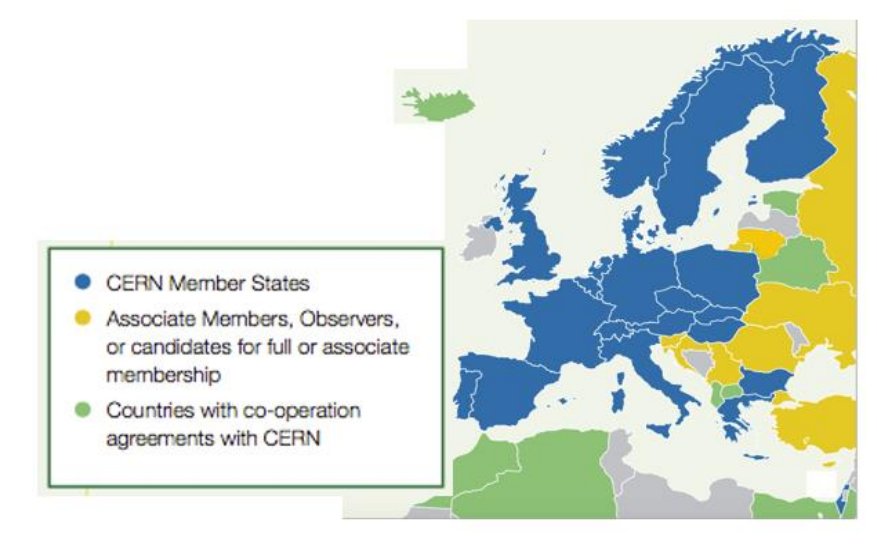
There was a move reported in the news here in Ireland of a report from a Committee of the Houses of the Oireachtas making the case for Ireland to join CERN. You can download the report here (PDF) and you’ll find this rather striking graphic therein:

You will see that there are only three European countries other than Ireland that don’t have any form of membership or other agreement with CERN: Latvia, Bosnia-Herzegovina, Moldova. The fact that almost everyone else is in is not in itself necessarily a good argument for Ireland to join, but it does make one wonder why so many other countries have found it to join or have an agreement with CERN while Ireland has not.

As the document explains, if the Irish government  were to decide to take Ireland into CERN then  it would first have to become an Associate Member, which would cost around €1.2 million per year. That’s small potatoes really, and  the financial returns to Irish industry and universities are likely to far exceed that, so the report strongly recommends this step be taken. This Associate member stage would last up to 5 years, and then to acquire full membership a joining fee of around €15.6 million would have to be paid, which is obviously a much greater commitment but in my view still worthwhile.

There were some positive noises when the document came out, but that was near the end of 2019. Not far into 2020 the pandemic struck and the idea sank without trace. Perhaps now is a good time to raise the issue again?

While I strongly support the idea of Ireland joining CERN I do have a couple of concerns about the case as presented in the Oireachtas report.

One is that I’m very sad that the actual science done at CERN is downplayed in the  report. Most of it is about the cash return to industry, training opportunities, etc. These are important, of course, but it must not be forgotten that big science projects like those carried out at CERN are above all else science projects. The quest for knowledge does have collateral benefits, but it a worthy activity in its own right and we shouldn’t lose sight of that.

My other (related) concern is that joining CERN is one thing, but in order to reap the scientific reward the government has to invest in the resources needed to exploit the access to facilities membership would provide. Without a related increase in research grant funding for basic science the opportunity to raise the level of scientific activity in Ireland would be lost.

Ireland recently joined the European Southern Observatory (ESO), a decision which gave Irish astronomers access to some amazing telescopes. However, there is no sign at all of Irish funding agencies responding to this opportunity by increasing funding for academic time, postdocs and graduate students needed to do the actual science. In one respect ESO is very like CERN: the facilities do not themselves do the science; we need people to do that. The jam is already spread very thinly in Ireland so having an extra thing to spread it on will not necessarily be a good thing for science in general.

A Major Merger in Irish Research

Posted in Science Politics with tags , , , , on May 18, 2022 by telescoper

Taking a short break from examination matters I just read a news item announcing a big shake-up in Irish research funding. As part of a new Research and Innovation Strategy, called Impact 2030, it seems the Irish Research Council (RC) and Science Foundation Ireland (SFI) are to merge to produce a single entity, perhaps as early as next year.

Changes are much needed, especially for science. Science in Ireland is in a dire state of under-investment, especially in basic (i.e. fundamental) research. For many years SFI has only funded applied science, though recently seems to have shifted its emphasis a little bit in its latest strategic plan. Currently Ireland spends just 1.1% of its GDP on scientific research and development and SFI’s current exclusive focus on research aligned with industry that can be exploited for short-term commercial gain) is making life very difficult for those in working in “blue skies” areas which are largely those that dras young people into science, and has consequently driven many researchers in such areas abroad, to the great detriment of Ireland’s standing in the international scientific community.

Here is an excerpt from an old post explaining what I think about the current approach:

For what it’s worth I’ll repeat my own view that “commercially useful” research should not be funded by the taxpayer through research grants. If it’s going to pay off in the short term it should be funded by private investors, venture capitalists of some sort, or perhaps through some form of National Investment Bank. When the public purse is so heavily constrained, it should only be asked to fund those things that can’t in practice be funded any other way. That means long-term, speculative, curiosity driven research.

SFI recently announced a new strategy, to cover the period up to 2025, with plans for 15% annual rises that will boost the agency’s grant spending — the greater part of the SFI budget — from €200 million in 2020 to €376 million by 2025. Much of this is focused in top-down manner on specific programmes and research centres but there is at least an acknowledgement of the need to support basic research, including an allocation of €11 million in 2021 for early career researchers. The overall aim is to increase the overall R&D spend from 1.1% of gross domestic product, well below the European average of 2.2%, to 2.5% by 2025. I hope these commitments will be carried forward into the new organization.

The Irish Research Council funds research in all areas, not exclusively applied science, so what little jam it has is spread very thinly. Applying for IRC funding is a lottery, with very few winners and the vast majority rejected without even cursory feedback.

There are two main worries about the fate of IRC in the merger merger. One is that research in arts & humanities will suffer as a result of being lumped in with science, and the other is that the culture of short-termism will be adopted so the small amount of basic research that the IRC currently funds will be sacrificed on the altar of quick commercial gain.

There is a welcome emphasis in the Impact 2030 document on early career researchers, especially at doctoral level where it is currently difficult to find funding for excellent graduate students. It has to be said though that there are problems in this area which are much wider than the shortage of appropriate schemes. The cost of living in Ireland is such that PhD stipends are inadequate to provide an adequate quality of life, especially in the Dublin area. The same goes for postdoctoral salaries which make it difficult to recruit postdocs from elsewhere in Europe.

Another crucial difficulty is the complete lack of funding for Master’s degrees, for many an essential bridge from undergraduate to research degrees. Many of our best graduates leave for European countries where a Master’s degree is free (and may even attract a stipend) and it is then difficult to entice them back.

There’s no question that the current lack of opportunity, low salaries, high living costs and the availability of far better opportunities elsewhere is leading to a net exodus of young research talent from Ireland. Whether any of this will change with Impact 2030 remains to be seen, but at least it doesn’t propose an Irish version of the dreaded Research Excellence Framework!