Archive for ireland

Election News

Posted in Politics with tags , , , , , on November 10, 2024 by telescoper

On Friday 8th November Taoiseach Simon Harris (left) inspired Ireland’s rugby team to a very disappointing home defeat by New Zealand. Earlier on that day he had visited the President to request a dissolution of the  33rd Dáil and to call a General Election on November 29th 2024.

The Saturday newspapers were full of nonsense about how the “General Election campaign starts now” when in fact I’ve had canvassers knocking at my door for at least a fortnight already. Two of them were for Fine GaeI – far scarier than trick-or-treat! I made it abundantly clear that I wouldn’t be voting for their party and hoped that they wouldn’t bother me again.

Fine Gael’s opening gambit was to announce that if elected they would reduce VAT on the hospitality sector to 11%. There was a budget just a few weeks ago in which they could have announced such a reduction had they really wanted it to happen. If re-elected no doubt they will find an excuse for not doing it. If you believe what they say I have a 340k bike shed to sell you.

Talking about the budget, Ireland’s government is in a very different position from the UK, with a large fiscal surplus thanks to buoyant tax receipts. This year presented a great opportunity to use that cash for much-needed investment in public housing, transport, education, the health service, etc. Instead the Government decided to tinker here and there with allowances and bung some cash to middle-income families in order to buy votes. Simon Harris has the air of a man who would sell his Grandmother if he could buy votes with the proceeds. The FG approach may well work but, if it does, we’re in for many years more of decaying public services, homelessness and high rents. As the Landlord Party in all but name, this will suit Fine Gael very well.

My constituency is Kildare North which in 2020 elected four TDs: 1 Social Democrat, 1 Fianna Fáil, 1 Fine Gael, and 1 Sinn Féin. This time, owing to population growth in the area, the seat will return five TDs. Fine Gael is standing three. I won’t say anything about Fianna Fáil. To all intents and purposes they are indistinguishable from Fine Gael and I won’t be voting for either of them. For me “more of the same” is not an option. I hope it goes without saying that I won’t be voting for any neofascists who get onto the ballot paper either.

Catherine Murphy (SD) is not standing and since she had a strong personal following the SDs will struggle to keep that seat. Angela Feeney, who is very active on the Local Council, is standing for Labour and Réada Cronin for Sinn Féin will be trying to hold onto her seat. Nominations of candidates continue for another week, so I don’t know the final list of candidates. I’ll wait until then before deciding on my order of preferences.

Not that long ago Sinn Féin were riding high in the polls, but a series of missteps have left them trailing Fine Gael. They also did poorly in the local and European elections earlier this year, seeming to have lost supporters of the more extreme nationalist type to overtly right-wing candidates.

The only prediction I am willing to make at this stage is that, owing to disaffection with the mainstream political parties, the number of independent TDs is likely to increase considerably from the 20 last time. This will make the task of forming a government even more complicated than before.

Storm Ashley

Posted in Biographical with tags , on October 20, 2024 by telescoper

Storm season has arrived in Ireland!

Storm Ashley has been battering the West of the country today. It’s not been as bad here in the sheltered environs of Maynooth, though we have had gusts up to 80 km/h which has left my garden in disarray with leaves and twigs all over the place.

Steps to Improve

Posted in Education, Maynooth with tags , , , , , on October 18, 2024 by telescoper

Along with all academic staff at Maynooth University I received an email this afternoon from the Vice-President for Research and Innovation, which contained the following request:

Well, I certainly won’t be providing any such lists at any time for this or any similar purpose, let alone by next Wednesday! I will be boycotting the QS World University Rankings and I urge any of my “peers” who are contacted about it to do likewise.

I assume that request this is a panicky reaction to the fact that Maynooth is so low in the current current QS league tables and falling in most others. This decline is a direct result of policies implemented by the Management Team at Maynooth, pushing up a student-staff ratio that is already the highest in Ireland, and starving core activities of resources while squandering millions on management salaries and perks – latest example of which is  €500,000 on a luxury taxi service for “priority staff members”; you can guess who that means. ..

I would prefer that the people in charge of Maynooth University made some attempt to improve teaching and research – you know, the things that a university is suppose to do – rather than try to game these ridiculous league tables. Such an approach, however, seems to be out of the question. Maynooth’s race to the bottom is bound to continue unless and until attitudes change at the top.

Leaving Certificate Results

Posted in Bad Statistics, Covid-19, Education, Maynooth with tags , , , , , , on August 23, 2024 by telescoper

Today’s the day that over 60,000 school students across Ireland are receiving their Leaving Certificate Results. As always there will be joy for some, and disappointment for others. The headline news relating to these results is that a majority (68%) of grades have been scaled up to that the distribution matches last year’s outcomes. This has meant an uplift of marks by about 7.5% on average, with the biggest changes happening at the lower levels of grade.

This artificial boost is a consequence of the generous adjustments made during the pandemic and apparent wish by the Education Minister, Norma Foley, to ensure that this year’s students are treated “fairly” compared to last year’s. Of course this argument could be made for continuing to inflate grades next year too, and the year after that. Perhaps the Minister’s plan seems to be to keep the grades high until after the next General Election, after which it will be someone else’s job to treat students “unfairly”. Anyway, you might say that marks have been scaled to maintain a Norma Distribution…

One can’t blame the students, of course, but one of the effects of this scaling is that students will be coming into third-level education with grades that imply a greater level of achievement than they actually have reached. This is a particular problem with a subject like physics where we really need students to be comfortable with certain aspects of mathematics before they start their course. It has been clear that even students with very good grades at Higher level have considerable gaps in their knowledge. This looks set to continue, and we will just have to deal with it. This issue was compounded for a while because Leaving Certificate grades were produced so late that first-year students had to start university a week late, giving less time for the remedial teaching that many of them needed. At least this year we won’t have that problem, so can plan some activities early on in the new Semester.

Anyway, out of interest – probably mine rather than yours – I delved into the statistics of Leaving Certificate results going back six years for Mathematics (at Higher A and Ordinary B) level, Physics and Applied Mathematics which I fished out of the general numbers given here.

Here are the results in a table, with the columns denoting the grade (1=high) and the numbers are percentages:

You can seen that the percentage of students getting H1 in Mathematics has increased a bit to 12.6% after falling considerably from 18.1% in 2022 to 11.2% last year (2023); note the huge increase in H1 from 2020 to 2021 (8.6% to 15.1%). Another thing worth noting is that both Physics and Applied Mathematics have declined significantly in popularity since 2019 from 7210.

Now that the results are out there will be a busy time until next Wednesday (28th) when the CAO first round offers go out. That is when those students wanting to go to university find out if they made the grades and university departments find out how many new students (if any) they will have to teach in September.

P.S. When I was a little kid we used to call a “Certificate” a “Stiff Ticket”. I just thought you would like to know that.

Taighde Éireann

Posted in Maynooth, Open Access, Science Politics with tags , , , , , , , , , , on July 31, 2024 by telescoper

On 1st August 2024, i.e. tomorrow, a new funding organization comes into existence in Ireland, formed by the merger of SFI with the Irish Research Council. The new outfit is called Taighde ÉireannResearch Ireland and many of us working in Irish academia were optimistic that it might improve the funding environment in Ireland, especially with regard to basic research.

Taighde Éireann has not got off to a very promising start. In particular, the long-running saga of who would be Chief Executive Officer of the new organization does not inspire confidence. Professor Philip Nolan, former Director-General of Science Foundation Ireland was originally intended to take the helm, but then he was dismissed from his position at SFI which made the prospect of him taking over the new organization seem less likely. Indeed, more recently, it was announced that a new temporary CEO would be appointed “pending the recruitment of a new CEO on a permanent basis”.

Starting with a caretaker manager is far from ideal, although it probably just means that the interim CEO will just look after transferring activity from IRC and SFI to the new organization without actually changing much. I just hope that in the long run a person is appointed who actually understands research rather than a generic management type. Otherwise the only change that will actually happen will be purely administrative rather than the systemic overhaul of attitudes and culture that Ireland really needs. As an outsider, one way of reading the controversy of the CEO the current SFI establishment resisting any possibility of change.

From my own perspective, the fundamental problem is that research funding for fundamental science in Ireland is so limited as to be virtually non-existent by a matter of policy at Science Foundation Ireland, which basically only funds applied research. This is a short-sighted and damaging policy that is causing, among other things, a significant exodus of talented young researchers to opportunities elsewhere (especially in the EU).

I know there will be many competing calls for changes in practice for the new Council but I thought I would add a few suggestions that will probably be ignored but which I’ll make anyway.

  1. A funding stream should be set up to enable scientific exploitation of Ireland’s current memberships of the European Southern Observatory (ESO), European Space Agency (ESA) and future membership of CERN. Ireland’s membership of ESO provides a cautionary tale. The Irish astronomical community was very happy about the decision to join ESO, but that decision was not accompanied by significant funding to exploit the telescopes. Few astronomers have therefore been able to benefit from ESO membership. While there are other benefits of course, the return to science has been extremely limited. The phrase “to spoil a ship for a ha’porth of tar” springs to mind. Even a few PDRA and PhD positions would provide an enormous boost.
  2. There should be far less emphasis on top-down funding ventures, such as the research “Centres”. These lock up a huge amount of money which makes it much more difficult to provide support to exciting curiosity-driven research, which is often where real innovation occurs. Let’s have much more responsive-modem grants, including areas of basic research currently excluded by SFI policy. This could be done by simply expanding the remit of the SFI Frontiers programme.
  3. The current IRC Laureate programme is inadequate. This currently has one call every four years. It should be annual, even if fewer positions are funded in each round, to allow it to be more responsive.
  4. Ban the use of any funds from the new organization being wasted on Gold Open Access, but invest in Diamond Open Access activities across all disciplines (i.e. Arts and Humanities as well as Science).
  5. Work with Government to provide a much more coherent system of funding research infrastructure, including if necessary requiring HEIs to commit a share of their surpluses to capital projects. In the UK, for example, capital projects funded by research councils usually require 50% institutional contribution.

That’s just five off the top of my head. I’m sure others will have suggestions. If so, please feel free to make suggestions through the comments box below.

The All-Ireland Hurling Final

Posted in GAA, Maynooth with tags , , , , , on July 21, 2024 by telescoper

No prizes for guessing what I’ll be watching this afternoon. Today’s the day of the All-Ireland Senior Hurling Championship Final at Croke Park, between Clare and Cork. The weather isn’t too bad; it’s overcast and a bit cool but there’s no rain forecast and it’s not windy. I’m hoping for a good match.

Clare (An Clár) versus Cork (Corcaigh) is not the final I would have predicted before the semi-finals. I thought Limerick and Kilkenny would be the finalists but that just goes to show how little I know. Cork are favourites with the bookies, by the way (4/7 on Cork, 11/8 against Clare) despite the fact that Clare of won the last two encounters between these teams.

If you’ve never been in Ireland for this occasion you won’t realize what a huge event it is. The atmosphere on this very special day is very much like it used to be in England for the FA Cup Final when I was a kid and the build-up just as long, with constant references on both radio and TV. Maynooth is on the railway line going through Croke Park so we see a lot of supporters in their team colours heading to the match. County Clare (which is in the West of Ireland, straddled by Limerick to the South and Galway to the North) is a bit closer to us than County Cork, which perhaps accounts for the preponderance of blue and gold over red and white.

You can watch the whole game live on BBC2 if you’re in the UK. Throw-in is at 3.30pm.

Update: The attendance is 82,300.

Update: HT score Clare 1-12 Cork 1-12. It’s been a much more open game than I expected. Cork started out the stronger team, finding lots of space in the Clare half and shooting very accurately. Robert Downey scored a memorable goal at which point it looked like Cork might overrun Clare, but that didn’t happen and as the half drew to a close Clare became more confident. It’s all square and poised for an exciting second half.

Update: FT score Clare 3-21 Cork 1-27. What an epic game this is! All square on points after Clare conceded a silly free in the dying seconds to allow Cork to equalize. We go to extra time!

Update: Final Score Clare 3-29 Cork 1-34. Drama to the last second, a long free from the Cork goalie lands in the area but Robbie O’Flynn’s shot to tie the game goes agonizingly wide. Clare are the All-Ireland Champions by one-point. What a breathtaking match. Hats off to both teams for serving up a classic! I wouldn’t have complained if it had gone to a replay though…

Here is a clip of Clare’s amazing 3rd goal, scored by Tony Kelly…

Language on Dry Land

Posted in Football, Irish Language with tags , , , , , , , , , on July 13, 2024 by telescoper

Since I’ve got my own computer again now I thought I’d celebrate by doing one of those rambling, inconsequential posts I haven’t had time to do recently.

Last week, in the run up to the European Championship semi-final between England and The Netherlands, I for some reason decided to look up what “The Netherlands” is in the Irish language. I did know this once, as it came up when I was trying to learn Irish a few years ago but I had forgotten. I remembered “England”, which is Sasana (cf. Saxon). Anyway, the answer is An Ísiltír. I’ll return to that in a moment.

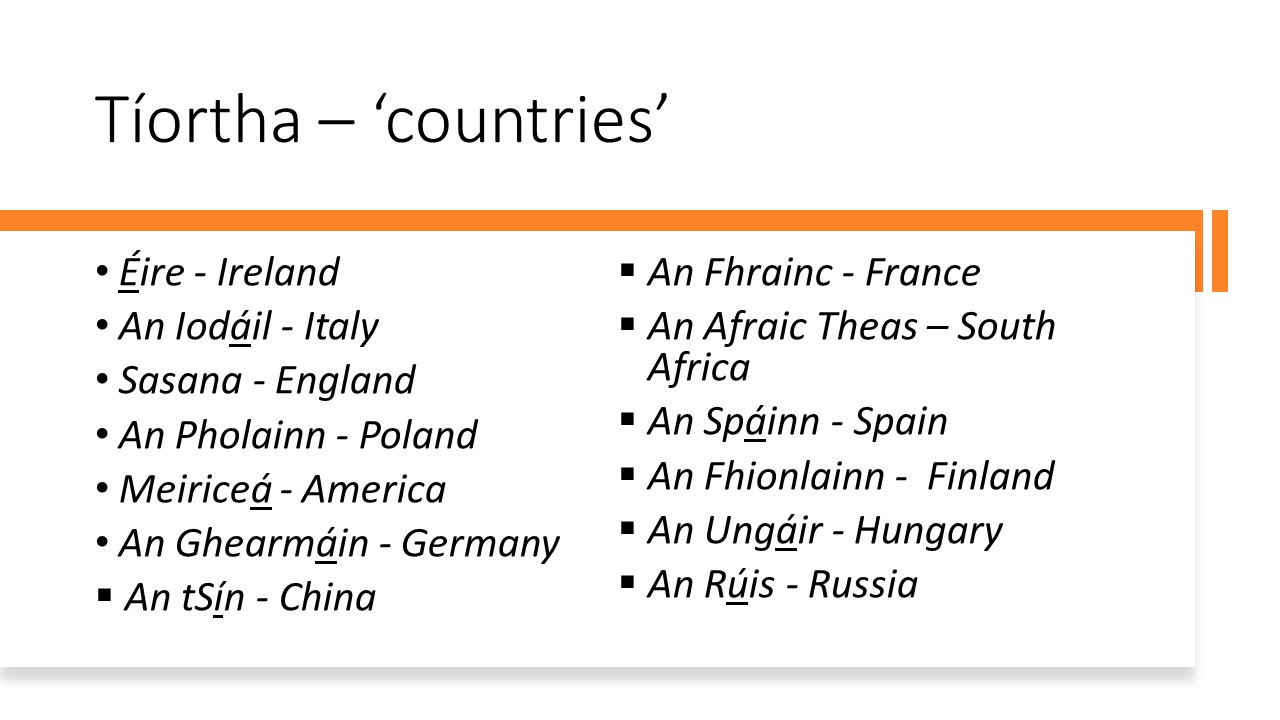
Here are some other names:

Anyway, a couple of things may be interest. One is that you can see that most country names in Irish are introduced by An. This is the definite article in Irish; there is no indefinite article. This contrasts with English in which only a few names start with the definite article, “The Netherlands” being one. The exceptions in Irish include England (Sasana) and Scotland (Albain). Wales is An Bhreatain Bheag (literally “Little Britain”). Of relevance to the final of the European Championship, Spain is An Spáinn.

I should also mention that some nouns suffer an initial consonant mutation (in the form of lenition, i.e. softening) after the direct article. In modern Irish this is denoted by an h next to the initial consonant, hence Fhrainc, for example; the Irish word for “French” is Fraincis.

The second interesting thing pertains to An Ísiltír itself. The second part of this, tír, means “country” or “nation” – see the plural in the heading above – and the first, Ísil, means “low”. An Ísiltír is therefore literally “The Low Country”. I shared this fascinating insight on social media and found in the replies a mention that the Welsh name for The Netherlands is Yr Iseldiroedda meaning literally “The Low Lands”. The first part of this is clearly similar to the Irish, but the second is the plural of a different word meaning ground or earth or an area of land. There is a word tir in Welsh that means ground or earth or an area of land but it does not mean country or nation like the very similar Irish word; the word for that is gwlad. In Irish the word for land or ground or earth (or turf) is talamh.

Welsh and Irish belong to distinct branches of the Celtic group of languages, the first wave of Indo-European languages to sweep across Europe. I blogged about this here.  Celtic languages therefore share roots with many other Indo-European languages and very basic words in many branches of the tree often bear some similarity in form, if slight but significant differences in meaning. It seems that tír/tir illustrates this rather well. These two words also have a very similar form to the French terre which is derived from the Latin terra. And so I disappeared down an etymological rabbit hole and found that all these words are probably derived from a Proto-Indo-European word meaning “dry”, presumably through reference to “that which is dry” as opposed to the wet bits (although neither Ireland nor Wales is famous for being particular dry).

And to bring this little excursion back full circle, the Irish word tirim means “dry”…

About Sligo

Posted in Biographical with tags , , , , , on May 2, 2024 by telescoper

I’m no longer in the part of not-Barcelona known as Sligo (which is Sligeach in Irish) but here are some random pictures and a random video clip I took while I was there.

Carrowmore, County Sligo

Posted in Architecture, History with tags , , , , , on May 1, 2024 by telescoper

Today is 1st May, so it’s the Labour Day Holiday in Barcelona. Colleagues in Ireland will have to wait until Monday 6th May for their equivalent holiday. The First of May, Beltane (Bealtaine in Irish), is a festival of pagan origin that roughly marks the mid-point between the Spring Equinox and the Summer Solstice. It’s one of the so-called Cross-Quarter Days that lie halfway between the equinoxes and solstices.

In view of the ancient origins of this holiday I thought I’d share some pictures of the amazing megalithic burial grounds at Carrowmore which is about 4km outside Sligo (where I have been on a secret mission). Carrowmore is the largest of the four megalithic cemeteries in Ireland in terms of the number of tombs, although the tombs are smaller in size and less complicated than the larger structures found at Brú na Bóinne. The structures at are also significantly older; there are signs of human habitation on the site going back at least 6000 years. The English name derives from the Irish An Cheathrú Mhór, which means ‘the great quarter’. Photographs don’t do justice to the extraordinary beauty of the landscape around the site but here is a panorama which gives some impression.

A visitor can easily understand why this was felt to be an appropriate last resting place for the Great and the Good. The surrounding topography is very interesting, as you can see from the first picture (of a model in the Visitor’s Centre); it’s on a peninsula between Sligo Harbour to the North and Ballysadare Bay to the South, and is surrounded on three sides by mountains. In particular, the site is overlooked from the west by Knocknarea, on top of which lies a large cairn, Miosgán Meadhbha, reputed to be the burial-place of the legendary Queen Maeve (Méabh in modern Irish). I was surprised to learn that this has never been excavated, so nobody really knows who or what is inside though it probably contains a passage tomb of similar form to those on the Carrowmore site. The cairn at the centre of Carrowmore, called Listoghil, the entrance to which you can see in one of the pictures, is a reconstruction.

Sadly, many other tombs were destroyed in the 19th Century, with stones being robbed to make walls when the land was enclosed, and large-scale quarrying for gravel in the area. Only some of the tombs are on publicly-owned land, but others are visible in nearby fields and indeed all around the area. There is even a stone circle in Sligo itself, on a housing estate called Abbeyquarter. Who knows what else is lurking under the unexcavated ground?

This forthcoming Bank Holiday weekend there is the Queen Maeve Festival in Sligo, but I will be in Barcelona.

A week is a long time…

Posted in Politics with tags , , , , , , on March 30, 2024 by telescoper

“A week is a long time in politics” is a quotation usually ascribed to Harold Wilson, although there’s no record of him ever having said it; it has nevertheless turned out to be true for the island of Ireland.

I have been thinking about writing about the sudden resignation of Leo Varadkar from the office of Taoiseach just ten days ago, and his impending replacement by Simon Harris (the current Minister for Further and Higher Education, Research, Innovation and Science), but I’ve been too busy and thought I’d wait until the holiday weekend to write something.

(To be honest I didn’t have any great insights to offer, so it’s perhaps just as well that I didn’t attempt any kind of in-depth analysis, not that lack of insight prevents media pundits from having a go. I’ll just say that Harris is an energetic tinkerer who is good at doing superficial – and sometimes positive – things to attract headlines, and is clearly enormously ambitious, but I don’t think he’ll offer any significant change of direction. The biggest issue in Ireland right now is the housing shortage, and in his address to Fine Gael members (given here in full) he didn’t mention the housing crisis or rising homelessness once. We can assume that more inaction is in store as the governing coalition limps on towards the next General Election, that must take place within the next year.)

I also found it amusing how many columnists wrote, after the fact, that they had Varadkar’s resignation coming although they were all far too brave to say so ahead of the event.

Anyway, the events of yesterday turned out to be even more surprising – not to say shocking – than Varadkar’s departure. Jeffrey Donaldson MP, Leader of the Democratic Unionist Party (DUP) resigned yesterday. Nobody knows for sure why Leo Varadkar resigned (except the man himself; my best guess is that he just got bored with the job) but the reason for Donaldson’s resignation is well known: he has been charged with sexual offences, including rape. Since his case is now in the hands of the criminal justice system, further comment or speculation about the charges would be highly inappropriate. Whatever you think of Jeffrey Donaldson’s character or politics – and I don’t think very much – he is, like everyone else, entitled to a fair trial. Just as importantly, if he has committed crimes it is important not to say or do anything that may be construed as prefudicial and might prevent a conviction.

This matter is alarming however because the Northern Ireland Assembly has just returned to Stormont after a two-year hiatus. Although Donaldson was largely responsible for its suspension, he was also largely responsible for its return. A sizeable fraction of the DUP were, and presumably still are, opposed to the agreement that led to reinstatement of power sharing and there is a real danger that the Assembly will collapse again. Fortunately, both sides seem to realize what a disaster that would be for the people of Northern Ireland, but that doesn’t guarantee that another crisis can be averted.

“May you live in interesting times” is another frequently misattributed quotation, but it seems we’re in them anyway.