Archive for ireland

Census Day

Posted in Bad Statistics, Biographical, The Universe and Stuff with tags , on April 3, 2022 by telescoper

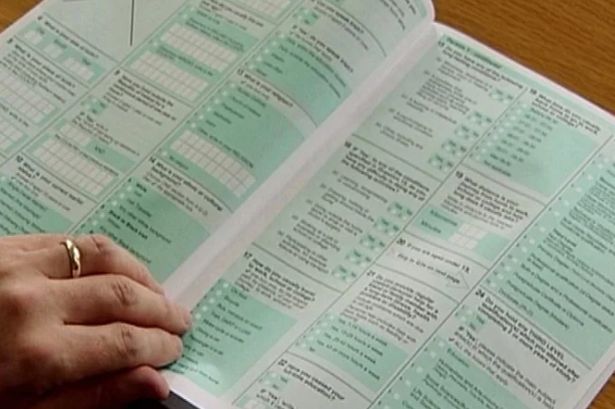
Today is April 3rd 2022 which means that it’s Census Day here in Ireland; I’ve just finished filling in the form, which is 24 pages long but it turns out lots of the pages are duplicates for use in homes with multiple occupancy, and others don’t apply to me at all, so in fact I only had to complete 8 pages and it didn’t take all that long.
The Census should have taken place last year but was postponed because of the Covid-19 pandemic. Apparently the corresponding 2021 census in the UK went ahead, though I wasn’t at, and couldn’t get to, the property I still own in Wales so couldn’t participate. Although I was initially threatened with a fine, the UK Census people seem to have given up trying to chase me. I blogged about the previous census in Wales in 2011 here.

On the holiday after St Patrick’s Day I was at home when I noticed a card had been pushed through my letterbox while I was still in the house. It was from a ‘Census Enumerator’ who said he had tried to deliver the form but I was out. I wasn’t out and he hadn’t rung the doorbell. More importantly he hadn’t simply put the census form through the letterbox. In the UK the census forms are just sent out in the post. This little episode didn’t inspire me with confidence. Anyway, the bloke came back a week later and gave me the form. He also asked me for some personal information such as my phone number, which I naturally refused to give him. Apparently he has to collect the form in person too, which seems daft to me. Why can’t people just send their census returns back in the post?

On the last page there is a so-called ‘time capsule’ in which to leave information for historians to read 100 years from now. All I could think of to write was any historians reading this in 2122 would probably think that it was absurd to be doing this wasteful paper-based census when the digital age started some time ago, so I just said for the record that I was one of the people who thought that in 2022…

Rory O’Neill aka Panti Bliss

Posted in Biographical, LGBTQ+, Maynooth, Politics with tags , , , on April 2, 2022 by telescoper

Yesterday I attended an event at the Maynooth Students Union featuring Rory O’Neill, an LGBT+ rights activist who strongly involved in the campaign for Equal Marriage leading up to the referendum of 2015. Rory is perhaps better known in his drag persona, Panti Bliss. Rory left Panti at home for this event but it was extremely interesting and enjoyable – and a bit sweary! – to hear him talk about his life and experiences, especially why he became an activist and how he started out as a drag performer.

One of the things I remember very well was how he has spent time in countries where homosexuality is still unlawful talking to young LGBT+ people who a lack of hope that life can get better. He countered that Irish society even just a couple of decades ago was deeply homophobic and is now much more inclusive towards LGBT+ people. It’s not perfect, of course, but it’s a heck of a lot better than it was. Ireland proves that things do get better.

Although I’m a bit older than Rory, didn’t grow up in Ireland, and have had a very different career, much of his story did nevertheless resonate with me. I’ve said a number of times on this blog that if someone had told me back in 1988 (when the infamous Section 28 was brought in by the Thatcher Government to attack a community already reeling from the effects of AIDS) that in 25 times there would be equal marriage in the UK I simply would not have believed them. Rory said something very similar yesterday.

Anyway, although there wasn’t a huge turnout for the event yesterday I’m very glad I attended and am grateful for the Maynooth Access Programme for organizing it. The event also gives me an excuse to post this clip of Panti Bliss giving a brilliant (and now famous) speech at the Abbey Theatre in 2014.

Deciphering the past using ancient Irish genomes

Posted in Education, History, Maynooth with tags , , , , on March 30, 2022 by telescoper

I thought I’d use the medium of this blog to advertise the forthcoming Dean’s Lecture at Maynooth University by Prof. Daniel Bradley of Trinity College Dublin which takes place tomorrow evening at 7pm.

Prof. Bradley

The abstract is:

Our genomes are our biological blueprints. Their DNA code also carries the traces of our family ancestry and at a deeper level, the history of the population we come from. With modern instruments we can sequence for the first time the DNA of people who lived thousands of years ago and read their long-lost biological stories. Genomes from ancient Ireland, including from those buried in famous megalithic tombs such as Newgrange and Poulnabrone dolmen, highlight the great migrations that brought different waves of people to the island, and also give us hints of the very different societies that prevailed in our prehistory.

I’ll be attending the lecture in person on Maynooth University campus but it will also be streamed via Youtube so if you find this sort of thing as fascinating as I do but can’t attend in person please do register here in order to get the link that will enable you to join the live stream.

Update: it was very interesting!

After The Treaty

Posted in Biographical, History, Television with tags , , , , , on January 9, 2022 by telescoper

On Friday I saw a bit of a programme on RTÉ One called Treaty Live which covered the events of January 7th 1922 in the form of a modern live news broadcast. It was on that date that the Dáil Éireann voted on whether to ratify the Anglo-Irish Treaty (usually called “The Treaty”) negotiated between the British Government (led by Prime Minister David Lloyd George) and representatives of the Irish Government (led by Arthur Griffith) and signed on 6th December 1921. The Treaty was intended to end the Irish War of Independence and bring about the removal of Crown forces from Ireland, but it fell short of establishing a fully independent Irish Republic, instead creating an Irish Free State with the status of a British dominion rather like New Zealand or Australia (i.e. with its own government but with the British Monarch as Head of State). It also led to the partition of Ireland with six of the nine counties in the province of Ulster remaining under British rule.

Three days of debate preceded the momentous vote in the Dáil which, incidentally, took place in a room in a building in University College Dublin that is now the National Concert Hall. Here is some footage of TDs leaving the building after the debate:

It’s strange to think of the number of times I’ve walked up those steps to attend a concert without realizing this historic event took place there.

Anyway, in the end the vote was to ratify The Treaty by 64 votes to 57. It seems popular opinion at the time was in favour of ratification, and what was surprising was not the fact that the vote was carried but that the margin was so narrow: had just four TDs voted the other way it would have failed.

Éamonn de Valera, then President of the Irish Republic, was the most prominent opponent of ratification. Michael Collins, who was a member of the delegation of plenipotentiaries who negotiated The Treaty, was prominently in favour. Many questions can be asked about the conduct of the negotiations, including why de Valera did not conduct the negotiations himself. During the negotiations Lloyd George insisted that the Irish plenipotentiaries sign the agreement on the spot otherwise there would be “war within three days”. The Irish delegation clearly assumed he wasn’t bluffing so signed it. De Valera was unhappy that they did not consult more widely (especially with him) but then if that’s what he wanted he shouldn’t have sent “plenipotentiaries” – that word means “delegates having the full power to sign agreements” – but participated directly. Valera resigned as President on 9th January 1922 and was replaced by Arthur Griffith.

The anti-Treaty side considered it to be a betrayal of the sacrifices made during the War of Independence; the pro-Treaty side thought it was a stepping-stone towards the goal of independence. As it turned out a fully-independent Irish Republic was eventually established in 1949, though the partition of Ireland is still in place.

In retrospect the narrowness of the Dáil was an indication of what was to come. In June 1922 The Irish Civil War erupted between the two factions that lasted almost a year. All wars are dreadful, but there’s something about a Civil War that is particularly dreadful: people who had fought on the same side against British rule would now fight each other.

And that brings me to the point of this rather rambling post. I moved to Ireland at the end of 2017. Like most people born and educated in England I knew very little of Irish history before coming here; topics such as the Irish Famine are simply not taught in British schools, though they certainly are in Irish schools. I missed being here through the centennial commemorations of the 1916 Easter Rising, for example, but have followed subsequent events in the “decade of centenaries” and done the best I can to read about Irish history to gain some knowledge.

What’s interesting about this is that the events of the Easter Rising and the War of Independence, although commemorated with appropriate solemnity, do form a righteous narrative relating to the heroic birth of a new nation. As we approach the centenary of the outbreak of Civil War the issues are much more complex. An Irish friend told me that when he was taught history at school, it basically stopped at the Civil War. People generally are much less willing to talk about it than the events preceding. The Civil War left deep wounds, some of which have still not healed. Perhaps the centenary will provide an opportunity to confront some of the very difficult issues arising from this period of this nation’s history.

Storm Barra Approaches

Posted in Biographical, Maynooth with tags , on December 6, 2021 by telescoper

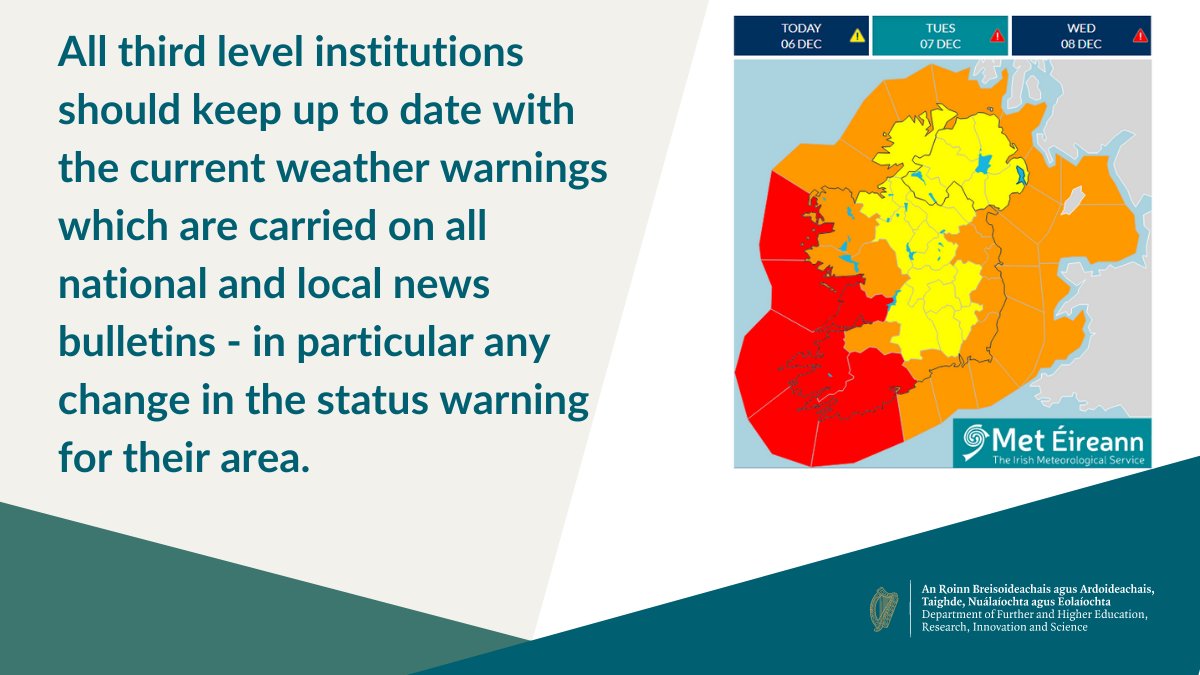
I’m going to have an early night tonight as tomorrow promises to be a very “interesting” day. A large Atlantic weather system – Storm Barra – is heading towards Ireland and is expected to reach the South West coast around 3am tomorrow morning. It is expected to last about two hours.

As if the winds in excess of 130 km/h were not bad enough, the storm will reach the coast just before a very high tide so flooding is expected, especially near Cork.

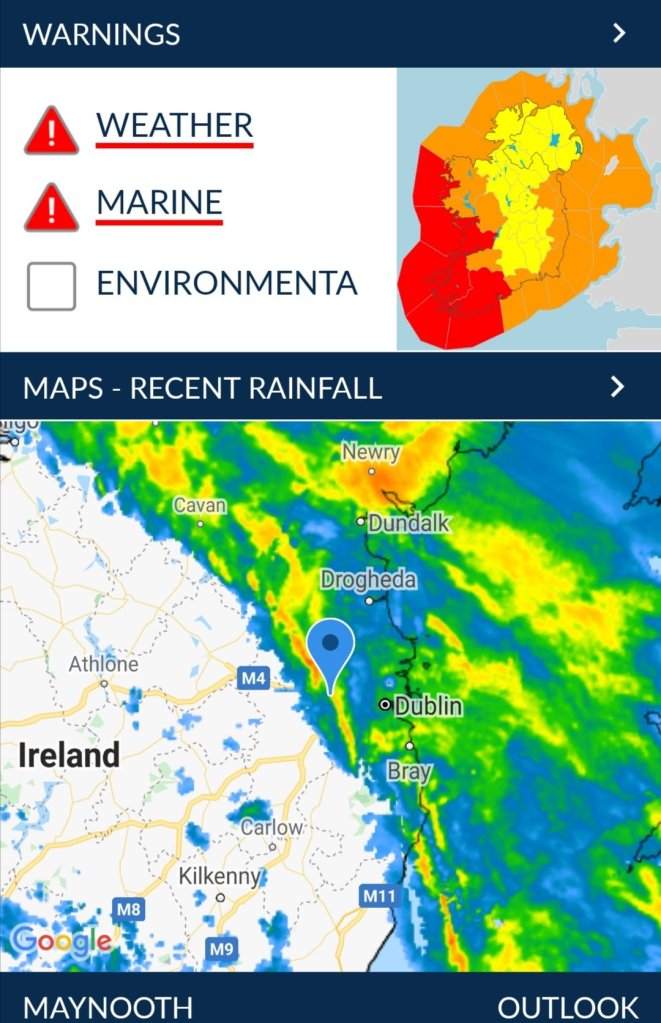
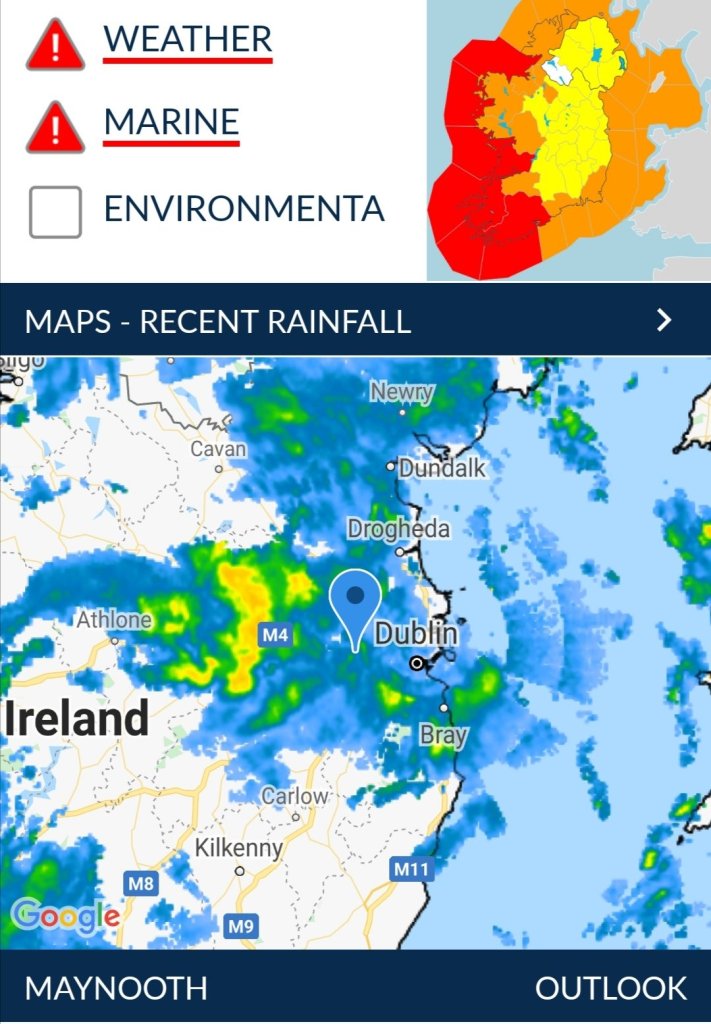
Colleges and schools in the Red and Orange alert areas will be closed tomorrow. Maynooth is in a Yellow alert area so the current plan is for the University to remain open, but it may change to Orange overnight and I suspect a significant number of staff and students will not be able to make it in anyway.

I’ll leave it there for tonight and update tomorrow.

UPDATE: 9.20am. It was very windy from about 6am and is now raining very heavily. Some branches have come down but no serious damage done near where I am.

Update: 14:20pm. Winds steadily backing as the depression moves out across the Irish Sea, now North-Easterly bringing colder air.

Four Years in Maynooth

Posted in Biographical, Maynooth, Politics, Science Politics with tags , , on December 1, 2021 by telescoper


In recent times I’ve found myself remarking quite frequently on this blog how much the Covid-19 pandemic has played havoc with my perception of the passage of time, and I come to reflect on that again now that today (1st December 2021) marks four years since I started work at Maynooth University. So much has happened in that period it seems very much longer since I first arrived here.

I started off working part-time here in Maynooth and part-time in Cardiff, commuting once a week to and fro across the Irish Sea until July 2018. That was a very tiring experience that brought it home very forcefully that I don’t have anywhere near as much energy as I did when I was younger.

I won’t deny that the past four years have had their frustrations. The teaching and administrative workload, especially since I became Head of Department in 2019, and even more so since the start of the Covid-19 pandemic in 2020, has been very heavy and has made it difficult to be very active in research. That’s not helped by the lack of opportunities for funding in basic science, thanks to what I believe to be a very short-sighted policy on research funding by the Irish government.

On the other hand, I have great colleagues and the students are very engaged. There are few things in life more rewarding than teaching people who really want to learn.

I hadn’t realized when I arrived in Ireland that it would take the best part of three years to find somewhere permanent to live, but I managed to buy a house in the summer of 2020. I am very happy here despite the continuing restrictions due to the pandemic.

The thing I’m probably most proud of over the past four years is, with the huge help of staff at Maynooth University Library, getting the Open Journal of Astrophysics off the ground and attracting some excellent papers. Hopefully that will continue to grow next year.

I am also proud of having played a part in the successful application for a new SALI Chair which we will be advertising formally in the new year. That is just one of many new developments on the horizon here at Maynooth, which suggest the next few years should be very exciting for physics and astronomy at Maynooth.

So, after a few years of hard and at times dispiriting slog, things are definitely looking up. Meanwhile, in Brexit Britain, events have turned out exactly as I predicted:

The referendum campaign, followed by the callous and contemptuous attitude of the current UK Government towards EU nationals living in Britain, unleashed a sickening level of xenophobia that has made me feel like a stranger in my own country. Not everyone who voted `Leave’ is a bigot, of course, but every bigot voted for Brexit and the bigots are now calling all the shots. There are many on the far right of UK politics who won’t be satisfied until we have ethnic cleansing. Even if Brexit is stopped the genie of intolerance is out of the bottle and I don’t think it well ever be put back. Brexit will also doom the National Health Service and the UK university system, and clear the way for the destruction of workers’ rights and environmental protection. The poor and the sick will suffer, while only the rich swindlers who bought the referendum result will prosper. The country in which I was born, and in which I have lived for the best part of 54 years, is no longer something of which I want to be a part.

In other words I don’t regret for one minute my decision to leave Britain.

P.S. After I finish my term as Head of Department next year I am eligible for a sabbatical, so if anyone fancies playing host to an old cosmologist please let me know!

P.P.S. Solidarity to all my colleagues in UK universities who are, from today, taking part in strike action against pension cuts and deteriorating working conditions.

Notes from Half Way

Posted in Biographical, Covid-19, Education, Maynooth with tags , , , , , , on November 6, 2021 by telescoper

We’ve now reached the halfway point in our teaching semester at Maynooth University. That means there are another six weeks of teaching before the end of term break. I was looking through the notes of my modules this morning in order to make a plan for the rest of term and was relieved to find that I’m roughly on track to finish on time. That is despite the first years starting a week late and lectures being 45 minutes long instead of 50.

At this point I’m still finding it very disconcerting talking to an audience of masked students, but it’s a heck of a lot better than just talking at a camera. Quite a few times I’ve been walking around campus and a student without a face covering has said “hello Peter” or words to that effect and I’ve smiled and said “hello” back while wondering who they were. Outside, you see, people take their masks off while, inside, I’m the only person whose face is uncovered.

Still, at least during lectures I get to make eye contact with the students. I don’t know why that matters so much to me, but it does. I remember as a student I had some lecturers who were pathologically incapable of making eye contact with the class, usually staring at a spot about six feet over the heads of the students. I found that most off-putting.

Although it still feels a bit weird, I’m glad that the mask-wearing protocol is being observed very well at least in lecture theatres. Unfortunately cases are skyrocketing right now – almost 4000 yesterday, as high as last January – which is all very worrying. Are we going to move to a Plan B? I doubt it, because the Government doesn’t seem to have one. Nevertheless I do think there’s still a significant possibility of our January exams being moved online yet again, but that hasn’t been decided yet.

Meanwhile, in the UK, University staff have been balloted over industrial action relating to the USS pension scheme and to various issues relating to terms and conditions. The majority of votes cast were in favour of strikes, but some institutions did not reach the 50% threshold required for strike action to be legal (some by just a handful of votes) and others achieved the threshold in only one of the disputes. I don’t know what will happen next, but I’d like to express my solidarity with those taking what I consider to be entirely justified action.

I couldn’t resist quoting this from the Universities UK statement on the dispute:

After a difficult 18 months, students do not deserve any further disruption.

Yes, it has been a difficult 18 months for students, but the absence of even a teeny bit of recognition that it has also been very difficult for staff is extremely telling.

I’m taking a particular interest in the disputes not only because I have friends and former colleagues in the UK but also because I have the best part of 30 years’ contributions locked into the USS pension scheme, plus some additional voluntary contribitions, and am relying on the benefits from those for my own retirement. If anything happens to that source of income I am financially screwed.

Apart from the USS scheme, the other side of the UCU dispute concerns ‘four fights‘ over:

  1. Pay
  2. Workload
  3. Equality
  4. Casualisation

These issues don’t only apply in the UK, of course. Workloads in my Department are at ridiculous levels – not only for me – and we have been forced by Management decisions into a situation in which half of our lecturing is being done by staff on short-term contracts. I suspect that the unpaid overtime we have put in during the pandemic is the expectation for the future, and I see no sign of the casualisation of our teaching staff being reversed in the immediate future. I hope I’m proved wrong, but in the meantime I’m keeping a close eye on my USS pension in case early retirement proves the only way to escape…

The Irish Population

Posted in Art, History, Politics, Television with tags , , , , on August 31, 2021 by telescoper

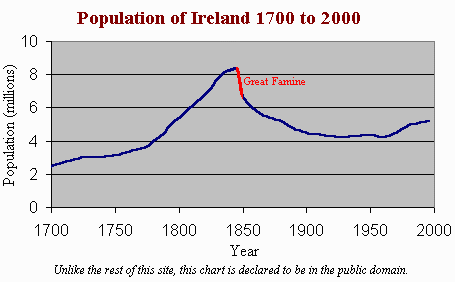
Not long ago I did a post about a documentary series called The Hunger which was broadcast on RTÉ just before Christmas. It was, of course, about the Great Irish Famine, which led to the death of one million (mainly poor) Irish people and the emigration of over two million in the subsequent years. It was a shattering episode that altered Ireland for ever. I remarked at the time that “the population of this island still hasn’t recovered to pre-Famine levels”.

Well today saw the announcement of a significant milestone in the trajectory of Ireland’s population. According to the Central Statistics Office, in April 2021 the population of the Republic of Ireland exceeded 5 Million for the first time since 1851. To be precise Ireland’s population was estimated to be 5.01 million in April 2021, which is the first time the population has risen above five million since the 1851 census, when the comparable population was 5.11 million. By “comparable” I mean the population of the 26 Counties that now constitute the Republic of Ireland.

The total population on the island of Ireland in 1851 was 6.6 million. Including the population of Northern Ireland brings the current population on the island of Ireland to about 6.9 million. The population of Ireland (ie the whole island) in 1841 was over eight million.

The following (rather old) graphic shows that catastrophic drop that was an immediate consequence of the Great Hunger but also the long period of decline caused by emigration and poor public health leading to low levels of fertility. The population did not begin to grow significantly until the 1970s.

Although the population is still nowhere near the level it reached in 1841, Ireland is in the grip of a housing shortage that the present Government seems reluctant to do anything about, not surprisingly when you realize that the present Government represents the property-owning classes in whose interests it is to keep housing scarce and rents correspondingly high. Ireland’s housing crisis is not an accident, it’s a matter of policy. Irish landlords oppressing the poorer classes and exploiting them for monetary gain. Some things haven’t changed…

It fascinates me that, with political will, human societies have made enormous changes – including financial interventions, inventing new vaccines and delivering mass vaccination programmes – to deal with the Covid-19 pandemic. Poverty and homelessness do not require new inventions – we already know very well how to build houses – only the political will is needed, and that’s just not there.

Reasons for Optimism

Posted in Biographical, Covid-19, Education with tags , , , , , , on July 6, 2021 by telescoper

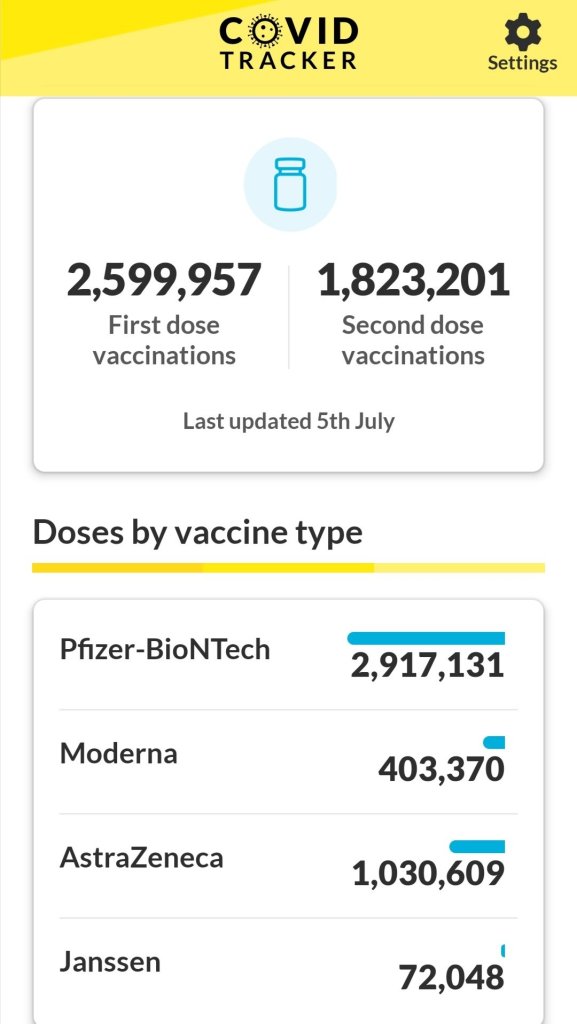
After an interruption of almost two months because of a Cyberattack on the Health Service Executive’s computer system, daily updates of Ireland’s vaccination statistics have at last resumed, including via the Covid-19 app (which has been moribund since 11th May).

You might think it strange but I find the restoration of daily updates reassuring. I suppose it’s because I work in a quantitative discipline but I like having things expressed in figures, though I am of course aware of their uncertainties and other problems involved in interpreting them.

The latest figures above show that about 70% of the adult population has received at least one dose while about 50% have had two doses; the latter are regarded as “fully” vaccinated as are the smaller number who have received the one-shot Janssen vaccine produced by Johnson & Johnson. Although the Government missed by some margin its target of giving one dose to 82% of the adult population by the end of June, I find myself much more optimistic than in past few weeks about how things are going.

Two developments in particular have helped.

First the Government is set to purchase about a million doses of Pfizer/BioNTech from Romania. That would be enough to fully vaccinated about 10% of the population. These doses have become available because take-up in Romania is very poor and the shots would go to waste if not disposed of elsewhere. What’s bad news for Romania is, however, good news for Ireland.

The second change is that the Government has decided to allow the AstraZeneca and Janssen vaccines to be used on adults in the age range 18-34 and that vaccinations of this group are now being carried out by pharmacists. Previously these vaccines were only to be given to persons aged 50 and over. Indications are that there is some reluctance among the younger cohort, which is hardly surprising since it was only a few weeks ago that they were being told these vaccines were too risky, but I suspect this change will go a long way towards fully vaccinating the adult population, which may be possible by the end of August.

I regard the immunization of students next year’s intake to third level education institutions as a necessary condition for opening up campuses to something like “normal” teaching. Just a couple of months ago I didn’t think this would be possible, but now it might be. It’s still possible that there will be disruptions in supply but it’s looking reasonably good at the moment based on the arithmetic of how many doses are available.

The fly in the ointment is of course the so-called Delta Variant, which has already gained a foothold in Ireland and is set to cause case numbers to rise substantially. We will soon see whether this causes an increase in hospitalizations and deaths. The most vulnerable should be protected so the probability of a case turning into serious illness or death should be much lower, but we don’t know by how much. Unfortunately the statistics of Covid-19 are still not being reported publicly. Some people seem to think this means they’re not happening. It doesn’t. It just means the system for reporting them is not working. I expect the forthcoming announcement of the backlog will cause some alarm.

The Irish Government recently decided to pause the gradual reopening of the economy to allow vaccinations to proceed further. There is still a race between the Delta variant and the vaccination programme. The number of people vaccinated increases approximately linearly with time, while the number of Covid-19 cases grows exponentially in the growth phase of the pandemic. I think the pause was sensible.

Across the Irish Sea there is a different situation. The English Government has decided to abandon all attempts to control the spread of Covid-19 at precisely the point when the pandemic is in another exponential phase. The number of cases is now likely to increase dramatically. The number of resulting deaths may be fewer than in previous waves but won’t be zero. Perhaps more importantly, allowing a huge pool of virus to develop increases the chance of yet another variant evolving, perhaps one that can evade the defences afforded by vaccination even more effectively than the Delta variant. I shudder to think of the consequences if that does happen. Perhaps it already has.

Thoughts on Lá Bealtaine

Posted in Biographical, Covid-19, Education, Maynooth with tags , , on May 1, 2021 by telescoper

Today, 1st May, Beltane (Bealtaine in Irish) is an old Celtic festival that marks the mid-point between the Spring Equinox and the Summer Solstice. It’s one of the so-called Cross-Quarter Days that lie exactly halfway between the equinoxes and solstices. These ancient festivals have been moved so that they take place earlier in the modern calendar than the astronomical events that represent their origin: the halfway point between the Spring Equinox and Summer Solstice is actually next week.

Anyway, any excuse is good for a Bank Holiday long weekend, so let me offer a hearty Lá Bealtaine shona daoibh!

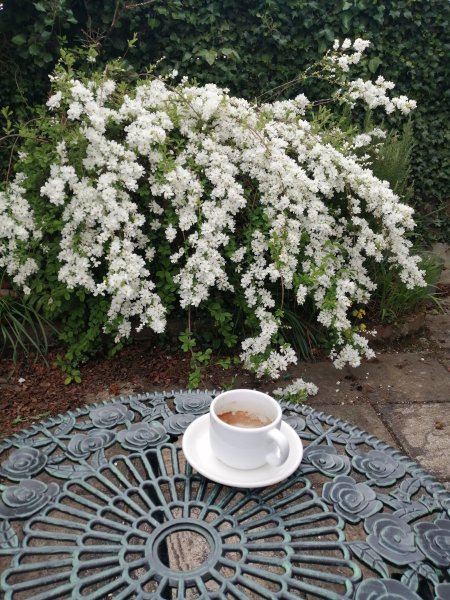
While not excessively warm, the weather is at least pleasant enough for me to have had my breakfast outside in the garden. As I was sipping my coffee I thought how much nicer it is to be in my own home during all this. The one really big positive about last year was that I managed to buy a house and move in during a few-month window when that was possible.

I put up a post last year on May Day that was dominated by Covid-19. I didn’t really imagine that we would still be under restrictions a whole year later, but I didn’t imagine that vaccines would be available so quickly either. Now it seems I will have the chance to register for my shot(s) next week with the view to getting a first dose sometime in June. Possibly.

The precise timing of my vaccination shot isn’t particularly important to me at this point, as it looks like I’ll be stuck at work all summer with no possibility of a holiday (as was the case last year). On the bright side, my three-year term as Head of Department ends after next academic year so there is some light at the end of the tunnel.

Despite the slow progress with vaccination – currently only about 28.5% of the adult population have received a first dose – and the very high case numbers – about 450 per day on average, and not decreasing – Ireland is now entering a phase of modest relaxation. I think this is far too early and that there’s a real risk of another surge here before any kind of herd immunity is achieved. I hope I’m proved wrong. At least it doesn’t look likely to get as bad as India, where the pandemic is truly out of control.

Workwise we have just completed the penultimate teaching week of Semester 2. Monday is a Bank Holiday so we have four days of teaching left, before a Study Week and the start of examinations. The last week will be busy with assessments and other things, though I imagine most lecturers will be doing revision rather than presenting a lot of new material. In the last few classes. That’s what I plan to do anyway.

Examinations Online Timed Assessment start on 14th May. I have three to supervise and then mark so much of the rest of May will be taken up with that, which has to be done before the Examination Boards in June. After that I suppose we’ll find out what our Lords and Masters have in mind for the start of next academic year…