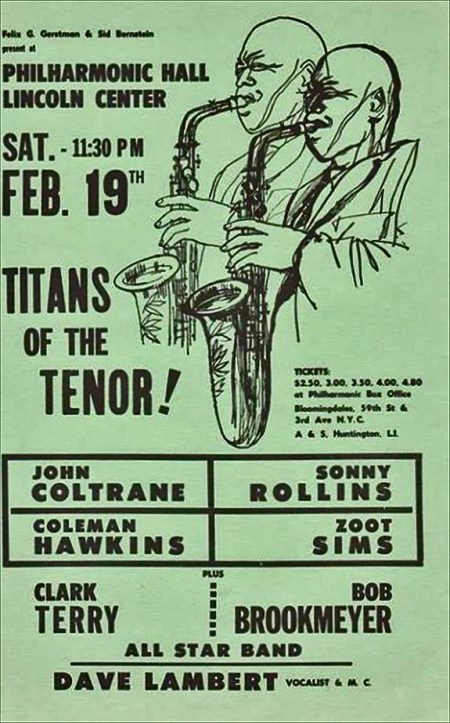
No time for a proper post today, but I couldn’t resist reblogging this advertisement for what must have been an amazing concert with an amazing lineup; so amazing that Pharaoh Sanders and Albert Ayler, who were also there, didn’t even make it onto the poster!
Time for a quick Jazz review, I think. This time I thought I’d pick a classic live performance from May 15th 1953 at Massey Hall in Toronto. Originally released as a vinyl LP with only 6 tracks on it, and called The Quintet of the Year, but subsequently re-released in various versions on CD, with various titles including Jazz at Massey Hall. The whole concert is now available on Youtube here:
This concert was planned to unite the greatest stars of the bebop era who had performed together earlier in their careers but had gradually evolved different styles over the intervening years. The line-up is Charlie Parker on alto, Dizzy Gillespie on trumpet, Bud Powell on piano, Charles Mingus on bass and the great Max Roach on drums which is stellar by any criterion!
Gatherings of star jazz players have often turned out to be disappointing, largely because very great musicians can sometimes interfere negatively rather than positively with each other, not necessarily consciously but because they can have ideas incompatible with one another. This evening, however, was a glorious exception to this rule, doubtless because all the musicians had worked together in the past, and their subsequent individual development had not taken them too far beyond their shared musical background. It is true that the ensemble passages are slight, but that doesn’t matter much because the solos are of such a remarkable and consistently high standard. Charlie Parker turns in some of the very best of his later recorded work, giving the lie to those who argue that his musical abilities were in decline at this time. He might not play as elegantly as he did on the classic Dial and Savoy sessions, but he is significantly more adventurous, with startling melodic contrasts in much of his work. At times this is a bit of a problem in that he seems to full of ideas that what comes out is a sequence of breathtaking fragments rather than a cohesive solo. This happens on A Night in Tunisia, for example, which never quite fulfills the promise of its magnificent opening break. On other tracks, though, especially Hot House his improvisations are just brilliant. It’s hard to imagine listening to this that in less than two years he would be dead.
Dizzy Gillespie matches Parker in superb fashion, betraying none of the offhandedness that often afflicted his later recorded performances, and the pyrotechnical quality of his playing is as exhilarating as it is instantly recognizable. Gillespie was an extrovert on stage and his frequent dancing around on the stage results in him going on and off mike from time to time, but it doesn’t detract from the performance once you realize why he’s fading in and out. It is, after all, a live performance and if you shut your eyes you can imagine Dizzy Gillespie the showman without any difficulty at all!
Most Jazz reviewers confine their comments on the rhythm section to a few kind words, but in this case that would be a travesty. The limitations of live recording technology in 1953 result in a rather unbalanced mix, but the flip side of that is that you can hear particularly well the pivotal importance of the bass playing of Charles Mingus. Between them Mingus and Max Roach lay down a relentlessly propulsive beat as well as taking gripping solos; the drum workouts in Wee and Salt Peanuts are astonishing in their interplay of rhythm and texture. Trumping even them, however, is the genius of Bud Powell who plays at a level consistently high even by his own standards.
Bud Powell is a fascinating musician for many reasons. Much less of a formalist than many Jazz pianists he nevertheless seems to generate a real sense of unity, more through the emotional drive underpinning his phrases than by imposing any set structure on his improvisations. His solo on Wee offers a fine example of this: moving inexorably towards a shattering climax as the right hand figures vary ceaselessly in their length and the chords punched out by the left hand grow more frequent and more percussive.
This album is another must-have for any serious collector of post-War jazz. The individual parts are all superb, but the whole is even greater than their sum.
PS. I had the pleasure of attending a concert at Massey Hall myself, when I was on sabbatical in Toronto in 2005/6.
One of the quirks of being in Japan is the 9 hour time difference between here and the UK, which means I’m just getting up when folk back home are going to bed; and one of the consequences is that BBC Radio 3’s Late Junction is on (via the internet) in the morning. It’s playing as a write this, in fact. Yesterday morning there was a track by Sun Ra, which reminded me that 2014 is the centenary of his birth. It prompted me to look back at an old post I’d written about him where I found the track included there had been deleted from Youtube. I therefore decided to post a new version, including a different track.
Sun Ra was one of the most extraordinary composers and bandleaders of the 20th Century, was born Herman Poole Blount in Bimingham, Alabama, on 22nd May 1914. From the 1950s, until his death in 1993, he led various combinations of musicians in bands with various permutations of names involving the word Arkestra, such as the Blue Universe Arkestra and the Solar Myth Arkestra. He himself played keyboards, sometimes solo and sometimes with huge bands of over 30 musicians; his music touched on virtually the entire history of jazz, from ragtime to swing music, from bebop to free jazz, as well as soul and pop. He was also one of the first musicians, in any genre, to make extensive use of electronic keyboards.
He never achieved mainstream commercial success, but was a prolific recording artist with a cult following, partly fuelled by his outrageous claims to have been born not on Earth but on Saturn and the fact that much of his music was to do with space travel. Quoted in Jazziz magazine
They really thought I was some kind of kook with all my talk about outer space and the planets. I’m still talking about it, but governments are spending billions of dollars to go to Venus, Mars, and other planets, so it’s no longer kooky to talk about space
Quite. In fact, Sun Ra developed a complex performing identity based on his music, “cosmic” philosophy, and poetry. He abandoned his birth name, took on the persona of Sun Ra (Ra being the ancient Egyptian god of the sun), and often dressed in the style of an ancient Egyptian pharoah, as in the video clip. In other words, he was very odd.
Sun Ra’s music is eclectic, outrageous and sometimes downright mystifying, but it also has a marvellous coherence to it maintained as his style evolved over four decades and is consistently imbued with a powerful sense of the Jazz tradition. Anyway, whatever I think, the music of Sun Ra has withstood its skeptics and detractors for generations and long may it continue to do so. The world needs more of his kind of eccentric.
Here’s a number called Door of the Cosmos. See what you think.
I’ve got a short gap in between meetings which I thought I’d fill by posting a classic piece by John Coltrane. This is the title track from the 1961 album My Favorite Things which, as it happens, is one of my favourite things. Coltrane plays soprano sax on this track; apparently he hadn’t played a soprano sax until 1960, when Miles Davis bought him one. I like its use on this particularly recording as it gives the performance a very “Eastern” sound.
You might think that a song from The Sound of Music would be unlikely material for John Coltrane to tackle, but in fact he does something extremely interesting with it: the melody is heard numerous times throughout the track, but instead of playing solos over the written chord changes, the soloists improvise over just two chords, E minor and E major, in a manner that seems influenced by Indian music. The whole thing is played in waltz time. In fact, although John Coltrane and McCoy Tyner are great on this track I can never quite manage to tear my ears away from the drummer, the late and very great Elvin Jones, who keeps an intense but fluidly swinging pulse going in 3/4 but also does so much around and across that central beat that it seems he must have more than one pair of hands…
I’ve become rather slow to find out about things since I gave up buying newspapers regularly. That’s why I only found out yesterday that Jazz musician Yusef Lateef had passed away on 23rd December, at the age of 93. He had a good innings, but it’s still sad to lose someone who was there at the birth of the modern era of jazz; Lateef played with Dizzy Gillespie’s band way back in the 1940s before going on to carve out his own career as a bandleader and a pioneering figure in the development of world music.
The death of Yusef Lateef got me thinking about all the other great jazz musicians who also passed away in 2013 to whom I haven’t yet found time to pay tribute. The list I’ve selected is sadly rather long, and I could have included more. I’ve added links to examples of their playing:
Cedar Walton (August 19, aged 79). Terrific piano player in the hard bop tradition, who came to prominence with Art Blakey’s band of the 1960s as pianist and arranger. Listen to him clearly enjoying himself playing Duke Ellington’s Satin Dollhere.
Chico Hamilton (November 25, aged 92). Drummer and bandleader who, among many other things, sought to merge jazz with classical forms (e.g. by bring a flute and cello into his band). Check out Blue Sands Live , recorded at the Newport Jazz Festival in 1958.
Jim Hall (December 10, aged 83). Brilliant jazz guitarist, also played at the Newport Jazz Festival in 1958, with Jimmy Giuffre and Bob Brookmeyer on The Train and the River.
Donald Byrd (February 4, aged 80). Began his career as a bebop trumpeter, but later moved towards a more popular jazz funk/rhythm & blues/fusion style. Listen to him on his famous Blue Note recording of Cristo Redentor.
Stan Tracey (December 6, aged 86). Uniquely gifted British pianist with an instantly recognizable style. House pianist at Ronnie Scott’s Club in London for many years, in which role he earned the respect and admiration of the very best musicians in the world.The one musician on this list that I’ve seen live. I’ve seen him several times, in fact, and could never take my eyes off his hands:
People such as these are irreplaceable, of course, but at least they will live on in our hearts through their music. I hope they all knew how much we loved them.
So, it’s October again. What happened to September? Anyway, looking back through my archive this morning I discovered that exactly five years ago today I posted a tribute to the legendary Humphrey Lyttelton. I still miss Humph greatly so thought I’d indulge myself by posting the piece again with a few small updates. Well, they say a Bad Penny always comes back….
–0–
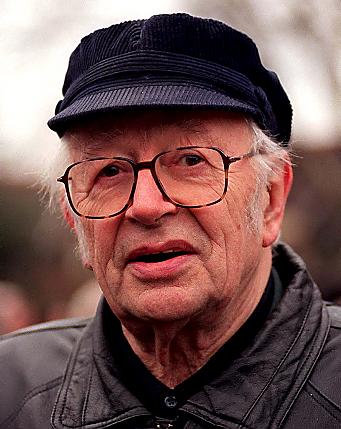
I knew I could’t blog for long without writing something about a great hero of mine, the inimitable Humphrey Lyttelton, better known to his many fans as “Humph”. He died earlier this year (on April 25 2008, at the age of 86) of complications following a heart operation. News of his death came as a massive shock to me, as it had never really occured to me that one day he would be no more. Tributes to him in the media were unsurprisingly glowing in their admiration.
In later years, Humph was best known as the chairman of the long-running radio comedy show I’m Sorry I Haven’t a Clue, subtitled “The Antidote to Panel Games” in which his gravelly but perfectly elocuted voice, schoolmasterish manner and impeccable comic timing proved the perfect foil to the antics of Barry Cryer, Tim Brooke-Taylor, Graeme Garden and many other contributors. I hope I get the chance to say a bit more about this programme in due course, as I treasure my collection of recordings of shows that still make me laugh at the umpteenth listening.
But Humph had many other strings to his bow. He was a talented cartoonist and a gifted writer, and also hosted the BBC Radio programme “The Best of Jazz” on Radio 2 for forty years, counting the great John Peel among his legions of listeners. I owe a special debt to Humph for this programme as I listened to it religiously every monday night at 9pm during my teenage years. He would open the show with “This his Humphrey Lyttelton here, with the best part of an hour of jazz between now and five to ten”. His theme tune then was Wanderlust, recorded by a subset of Duke Ellington’s orchestra with the great saxophonist Coleman Hawkins appearing as a guest and contributing a truly magnificent tenor solo near the end of the piece.
Through Humph I discovered most of the music I still listen to on a daily basis, jazz from the classic era of Louis Armstrong and Jelly Roll Morton, through the swing era of Duke Ellington, Benny Goodman and Count Basie, the postwar bebop period of Charlie Parker, Dizzy Gillespie and Thelonious Monk, Miles Davis and John Coltrane, then modernists like Ornette Coleman, Sam Rivers, Archie Shepp and onto the avant-garde of the time. Humph loved all kinds of jazz, and he communicated his encyclopedic knowledge a style flavoured by a dry sense of humour. I never met him in person, but I would have loved the chance to thank him for helping nurture in me a passion for all that wonderful music.
Humph was also a fine Jazz trumpeter and bandleader in his own right. When my father was at school in the 1950s, the Lyttelton band was the leading “traditional Jazz” band in Britain. Humph had played with many of the greats, including Louis Armstrong and Sidney Bechet, and won their admiration for his trumpet-playing.
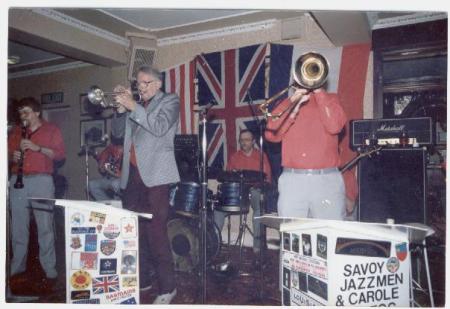
My dad had become a Lyttelton fan at School and it was this that persuaded him to take up playing the drums. He joined the RAF for his national service, and he had the opportunity to play with various bands then and later on when he went back into civvy street. He was a life long admirer of Humph and eventually got to play with him at the Corner House in Newcastle but not until the 1990s. He told me it was one of the proudest moments of his life, although he had been so nervous he didn’t really play very well. Here’s a photograph of this occasion:
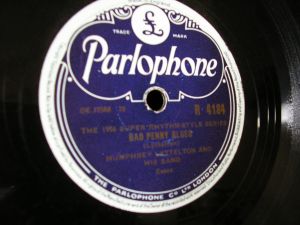
In the late 1940s Humph’s band had started to record a series of 78rpm records for the Parlophone label, starting with a lovely version of “Maple Leaf Rag” and stretching to over a hundred titles. Among these tracks was one record that actually made it into the Top 20 of the British pop charts in 1956, admittedly at Number 19, but nevertheless that’s no mean feat for a Jazz record. I should point out that this was long before my birth, but I remember hearing the track many times around the house when I was young.
The Bad Penny Blues was written by Humphrey Lyttelton and the hit recording features a quartet drawn from his band which, by the mid-1950s, had gravitated to a more mainstream jazz style, away from the “traddy” sound favoured by most contemporary jazz outfits. Indeed, he had incurred the wrath of many conservative fans by daring to include a saxophonist, the brilliant but eccentric Bruce Turner, in his outfit. Bad Penny Blues, though, featured only Humph on trumpet, Johhny Parker on piano, Stan Greig on drums and Jim Bray on bass. It was only recorded as an afterthought because it went down well at live gigs at Humph’s Jazz Club the HL Club (which later became the 100 Club, at 100 Oxford Street.)
But the real key to the success of this record was a young man by the name of Joe Meek. Starting out as a sound engineer at the Parlophone studios, Meek had quickly established an excellent reputation and in this case he was asked to take over the whole production of the record. According to Humph, they were slightly concerned at what he was doing with the microphones before they made the take but after it was done they all went home and left Meek to do some tinkering with the sound before cutting the disk. In those days, recording techniques were relatively crude and there generally wasn’t much in the way of post production, especially in jazz.
When he heard the final record, Humph was shocked. For one thing, Meek had close-miked all the instruments, including the drums – something which wasn’t generally done with jazz records for fear of (a) drowning out the rest of the band and (b) exposing the clumsiness of the drummer, the latter being a particularly problem. As Humph said, his band always sounded like the rhythm section was wearing diving boots. For this reason the drums were usually recorded with a distant mike and generally hidden in the ensemble playing. But in this case it worked out very well. Stan Greig used brushes on this track and his playing served beautifully both to propel and to punctuate the performances of the other musicians.
But it wasn’t the drums that so disturbed Humph. Meek had also fiddled with the double bass and with the left hand boogie-woogie figures of Johnny Parker’s piano, fattening them out and changing the balance to bring them right up in the final mix. He also compressed the overall sound so that the bass lines seem to press in on both the piano’s right hand and the growling muted trumpet lead, tying them closer to Greig’s insistent drum patterns and creating an unusually dense sound. The result is an intense, driving feel, with a dark undertone that is quite unlike any other jazz record of its period and redolent with the atmosphere of a smoky jazz club. I love it, especially the moment when Humph’s trumpet takes over from the piano solo. With a timely kick from the drums and against the backdrop of those bluesy thumping bass lines the band finds another gear and they build up a fine head of steam before riffing their way into the fade.
Here is the original 78rpm single:
Humph didn’t like the way the record had been put together, but it was an instant hit. He later joked that he hated it all the way to the bank.
Joe Meek went on to produce several classic pop records, generating many ideas that were later used by Phil Spector, but ultimately he became a tragic figure. Such commercial success as he achieved didn’t really last and he sank into debt, depression and paranoia. A gay man in an era in which homosexuality was still illegal, he became a victim of blackmail and was questioned by the police for alleged encounters with rent boys. He committed suicide in 1967 at the age of 37.
The Bad Penny Blues went on to be the “inspiration” behind Paul Macartney’s Lady Madonna,a Beatles track which has a lot of the same notes in it and also borrows the same overall feel. I can’t put it more subtly than that. George Martin, who produced the Beatles’ track, was actually in charge of the Parlophone studio at the time Bad Penny Blues was recorded…
And Humph went on to live another 52 years, bringing music and laughter to millions.
To end with, here’s a link to a later version of the tune recorded by a more recent manifestation of Humph’s band, probably in the 1980s. Note the way his technique involved the use of his eyebrows! I may be wrong, but I think the pianist on this performance is Mick Pyne and the bass is played by Dave Green. I can’t really make out the drummer.
The blog’s been quite busy this week, so I’ll take it easy today and just indulge my love of 1950s jazz. This version of Ray Noble’s standard Cherokee is a vehicle for the virtuosity and creativity of the trumpeter Clifford Brown. The changes of this tune are notoriously difficult to improvise on, 64 bars of harmonic twists and turns that have led countless musicians onto the rocks, but Clifford Brown navigates them at full pelt with amazingly agility. Enjoy!
I’m currently sitting in my office eating a sandwich and girding my loins for three hours of appraisal training this afternoon. Just time, therefore, to post this musical gem I recently discovered on Youtube. It’s Bill Evans recorded in 1965
Miles Davis said of Bill Evans “He plays the piano the way it should be played”. I’m not going to disagree with that, because I think Bill Evans was wonderful, but keep an ear out for Chuck Israels fantastic work on bass too!
The term “musical genius” is over-used to the point of absurdity these days, but if it ever applied to anyone at all then that man was Rahsaan Roland Kirk. I saw a version of his Serenade to a Cuckoo on TV last night and it made me realize I haven’t posted nearly enough of Kirk’s music on this blog, so here’s a different version; only a part of the one I saw last night is available on Youtube. This version, followed on this clip by an abrupt edit into another number, was recorded live at the Montreux Jazz Festival in 1972.
Kirk was one of the few jazz musicians of the “modern” era to win wide acclaim outside his own genre: Jimi Hendrix idolized him, for example. And who wouldn’t? He could play umpteen instruments, often several of them at the same time, with a joyous creative energy that would have been wonderful to experience in a live performance. As well as playing just about every wind instrument under the Sun, he was also adept at the difficult art of circular breathing, i.e. in through the nose and out through the mouth in such a way that air is kept moving through the instrument continuously. Kirk could play for as long as 20 minutes without apparently pausing for breath. His extraordinary technique is almost enough to make any aspiring saxophonist give up altogether. But Kirk was never just a technician – he had a wonderful musical imaginative, peppered with originality and wit. And for those people who think modern jazz takes itself far too seriously, this is so obviously full of fun I hope you change your mind. Above all, just bask in the wonder that was Roland Kirk.
I’m up early to travel up to the Big Smoke where I’ll be all day todayday today so here’s something nice while I’m away. Music by George Gershwin, lyrics by Ira Gershwin, and vocals by Louis Armstrong and Ella Fitzgerald. Who could ask for anything more? Take it away, Ella & Louis!
The views presented here are personal and not necessarily those of my employer (or anyone else for that matter).
Feel free to comment on any of the posts on this blog but comments may be moderated; anonymous comments and any considered by me to be vexatious and/or abusive and/or defamatory will not be accepted. I do not necessarily endorse, support, sanction, encourage, verify or agree with the opinions or statements of any information or other content in the comments on this site and do not in any way guarantee their accuracy or reliability.



 In the Dark