Archive for Jazz

Bloomdido – In Memoriam Charlie Parker

Posted in Jazz with tags , , , , , , on March 12, 2015 by telescoper

bird

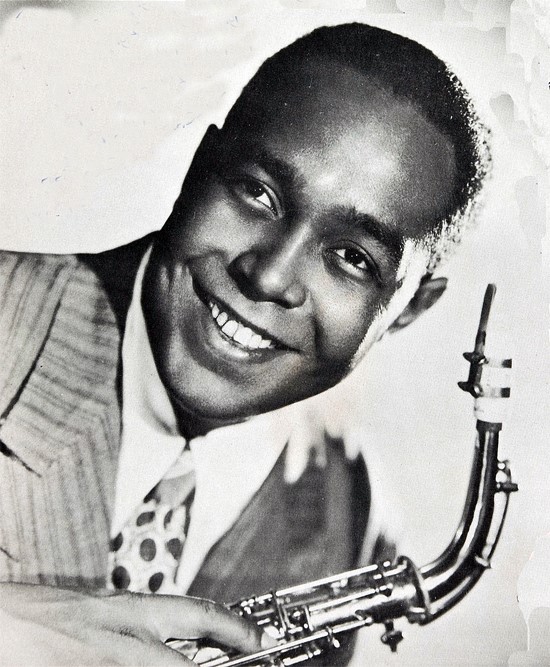
Today marks the 60th anniversary of the death of the great saxophonist Charlie Parker (“Bird”) on 12th March 1955. I’ve written quite a few posts relating to Charlie Parker over the years but today has provided a good excuse to spend my lunchtime writing another one, this time featuring one of my favourite tracks from one of my favourite albums. First released in 1952 but in fact recorded in two separate sessions in 1949 and 1950, the album Bird and Diz was actually the last studio album made under the joint leadership of Charlie Parker and Dizzy Gillespie, the two main architects of the bebop revolution; the track I’ve picked has the added advantage of featuring another great musical genius on piano, Thelonious Monk.

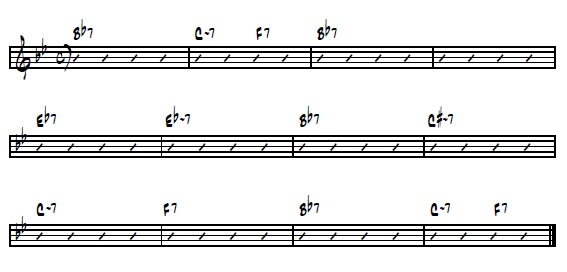
The Charlie Parker composition Bloomdido is yet another of his variations on the blues, though this one is a bit less intricate than some of the others he wrote. Here are the chords for Bloomdido:
Bloomdido

You can see that the progression is based around the standard three chords of a blues in B♭. The foundation is a  “tonic” chord (T) based on the root note of whatever key it’s played in, in this case B♭. This sometimes a basic triad consisting of the first, third and five notes of a major scale starting on that note or, as in this example,  including the dominant 7th so it’s B♭7. The next chord is the subdominant chord  (S), shifting things up by a perfect fourth relative to the tonic, in this case an E♭7 and then finally we have the dominant (D) which brings us up by a fifth from the original root note, in this case F7.

The basic blues sequence in B♭ would be four bars of B♭7 (T), two of E♭7 (S), back to B♭7 (T) for two, then the characteristic bluesy cadence returning to two bars of  B♭7 (T) via one bar each of F7 (D) and E♭7 (S). The sequence for Bloomdido has a few alterations, including a characteristic turnaround at the end instead of the tonic, but is otherwise fairly recognizable. I guess the first part of the title  is a play on the blues origin too, though I wonder if the second part suggests that some of the alterations are inspired by the A-section of the  Juan Tizol standard Perdido?

Some people tell me they find Charlie Parker’s music “too technical” and that somehow if music “needs to be explained” it’s not good music. I don’t understand that attitude at all. I find this music so fascinating and exciting to listen to that I want to try to dig a little bit into it and find out what’s going underneath the surface. It’s particularly striking what a difference a few substitutions and passing chords can make to the overall harmonic “feel” of a piece like this compared to a standard blues sequence, for example. But you don’t need to study the chords to appreciate the sheer beauty of the music that Charlie Parker built on these harmonic foundations; his solo on this track, as on so many others he recorded in his short life,  is just sublime even if you don’t realise how hard it is to play! I guess it all depends whether your way of enjoying a thing is to sit back and let it wash over you, or for it to inspire you to find out more. Many of the physicists I know are deeply interested in music. Perhaps that’s because they’re the sort of people who don’t just think “wow that’s beautiful”, they tend to think “wow that’s beautiful – how does it work?”.

Charlie Parker and Albert Einstein died in the same year, just over a month apart, the former in March 1955 and the latter in April. They were two very different geniuses but it’s as difficult to imagine physics without  Einstein as jazz without Bird.

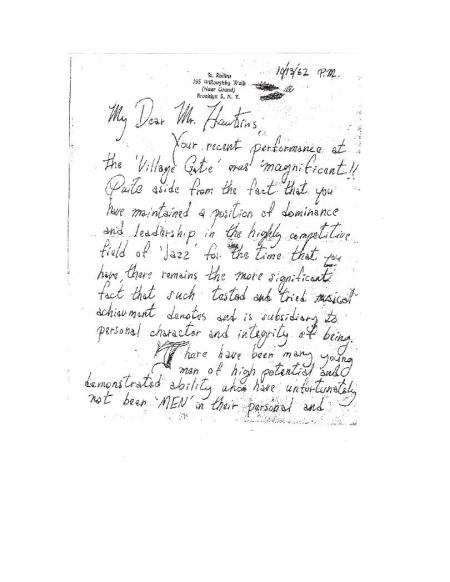
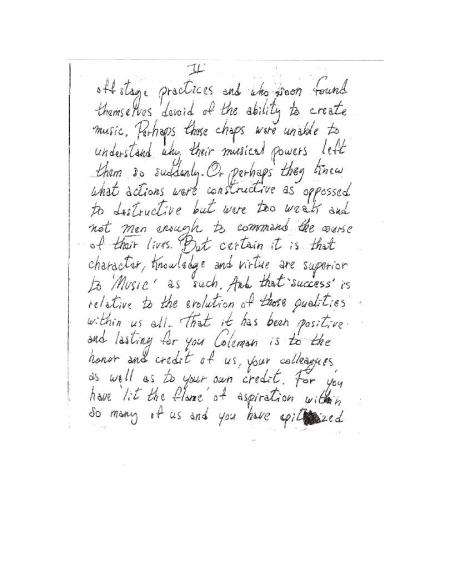
Sonny Rollins’ letter to Coleman Hawkins

Posted in Jazz with tags , , , , on March 4, 2015 by telescoper

I couldn’t resist reblogging this wonderful letter from one great saxophonist, Sonny Rollins, to another, Coleman Hawkins.

The letter was written in 1962. You can find here on Youtube a recording of the two of them playing the great Jerome Kern tune All The Things You Are at the Newport Jazz Festival just a few months later in summer 1963. The title seems to match the sentiments of the letter rather nicely!

Simon Purcell's avatarSimon Purcell

Do read this, a touching letter from Sonny Rollins to Coleman Hawkins in 1962 (from the website www.jazzclef.com). The greatest players possess not only self-discipline and powers of concentration, but generally, great humility.

View original post

It makes my love come down

Posted in Jazz with tags , , , , , , , on February 23, 2015 by telescoper

A very busy day back in Sussex meant that I had no time for a post until I finished lecturing at 6pm, so there’s just time for a bit of music before I head home. I thought I’d put up another track by Humphrey Lyttelton, from the same concert at the Royal Festival Hall in July 1951 sponsored by the National Federation of Jazz Organizations (NFJO) from which I posted The Dormouse some time ago. This is an excellent performance of a blues called It makes my love come down, which Humph probably transcribed from the classic original recording by the greatest female blues singer of all time, Bessie Smith. Again it shows the Lyttelton band’s front line in fine fettle, especially when they come together for the last couple of choruses.


The Dormouse

Posted in Jazz with tags , , , , , , on January 24, 2015 by telescoper

Just spent an extremely enjoyable Saturday morning on the Sussex University campus for one of our Applicant Visit Days; there’ll be several more of these occasions over the next few months and I only hope we have such glorious weather for the others!

I thought I’d celebrate the fact that it all went well by posting a bit of old-fashioned good-time jazz. It’s getting on for seven years since the death of the great Humphrey Lyttelton, who was not only a fine trumpeter and bandleader but also blessed with wickedly dry sense of humour. During the late 1940s and early 1950s Humph’s band had a terrific front line consisting of Wally Fawkes on clarinet and the superb Keith Christie on trombone, led by himself on trumpet. Apparently when they did late-night gigs, Keith Christie had a habit of occasional dozing off while someone else was soloing. Not unreasonably, this behaviour reminded Humph of the Dormouse at the Mad Hatter’s Tea Party in Alice’s Adventures in Wonderland, so he decided to write a tune with that name in honour of Keith Christie. I have the studio recording of The Dormouse, which was released on Parlophone as a 78rpm single, and it’s such a blast that I love it to bits, but this is a live performance which I just came across a few days ago. It comes from a famous concert at the Royal Festival Hall in July 1951 sponsored by the National Federation of Jazz Organizations (NFJO) which featured a number of bands as well as Humph’s.

Anyway, it’s a delicious helping of New Orleans jazz served with a generous side order of English eccentricity, guaranteed to bring a smile to the most crabbed of faces. The trombone introduction and fills by Keith Christie, in whose honour the tune was written, are typically full of humour, but the improvised ensemble playing is absolutely terrific, especially from about 1.55 onwards. Humph’s band of this time didn’t have the greatest rhythm section – Humph himself joked that they often sounded like they were wearing diving boots – but the front line was world class.

ps. It definitely should be “The Dormouse” not “The Doormouse”…

pps. Unless my ears deceive me I think this number is announced by Kenneth Horne…

I wish I knew how it would feel to be free..

Posted in Jazz with tags , , on January 18, 2015 by telescoper

200 Years of Sax – Anniversary Poll

Posted in History, Music with tags , , , on November 6, 2014 by telescoper

Today is the 200th anniversary of the birth of famous Belgian Adolphe Sax, inventor of the saxophone. To mark this occasion I thought I’d undertake a bit of audience participation and get you out there in internet land to vote on the greatest proponent of said instrument. I’ve populated the list with people I consider to be likely contenders, but feel free to add your own if your favourite is missing!

R.I.P. Acker Bilk (1929-2014)

Posted in Jazz with tags , , , on November 3, 2014 by telescoper

Yesterday evening I heard the sad news that “trad” jazz stalwart Acker Bilk had died, aged 85. With his trademark bowler hat and goatee beard, he was one of the leading figures of the post-war British jazz scene. He scored considerable commercial recording success with the Paramount Jazz Band, especially with Stranger on the Shore which was in the British Charts for 50 weeks in 1962, was the first record by a British artist to hit No. 1 in the American Billboard charts, and was greatly admired by no less a figure than Duke Ellington. There are tributes all over today’s newspapers (e.g. here) that do better justice to Acker Bilk than I could, so I’ll just post one track as a special tribute. This track, Train Song, the B-side of The Harem, was recorded in the year of my birth and I have loved it since I was a kid.

Rest in peace, Acker Bilk (1929-2014)


Charlie Christian: Swing to Bop

Posted in Jazz with tags , , , , , , , on November 2, 2014 by telescoper

I was transferring some old CDs onto my iPod the other day, and in the process of doing that I realized that in all the six years I’ve been running this blog I haven’t posted a single item about the great guitarist Charlie Christian, who did more than any other individual to promote the use of the electrical guitar and thus had an enormous influence on the development of  20th century music. The only reason I can think of why his is not a household name is that he died so young, in 1942, of tuberculosis, at the age of just 25.

Born in 1916, Charlie Christian came to prominence with Benny Goodman‘s orchestra during the 1930s. That in itself merits a remark. Benny Goodman was one of the first white bandleaders in the Swing Era to have black musicians in his band at a time when both musicians and audiences were generally racially segregated in the United States of America. Goodman deserves great credit for picking the best musicians he could find, regardless of the colour of their skin; Lionel Hampton is another prominent example. Bringing the young Charlie Christian into his band also testifies not only to his refusal to pander to racism, but also his willingness to experiment with new musical ideas, not least taking the guitarist out of the rhythm section and placing him as front-line soloist.

Here’s an excellent example of Charlie Christian playing with Benny Goodman’s Orchestra in 1939. I remember that my Dad wasn’t all that keen on Benny Goodman’s clarinet playing, which he regarded as “too clinical”. In fact many jazz writers also tend to refer to Benny Goodman’s playing as “unemotional”. I can’t agree. I admit that the band is a bit “slick”, but the clarinet on this track is absolutely sensational to me, and I find it a joy to listen to over and over again.  There’s also fine Cootie Williams on trumpet on this version of Fats Waller’s composition Honeysuckle Rose:

Commercial records from the 1930s were strictly limited by the available technology to 3 minutes’ duration, so Charlie Christian’s solo on that track  is necessarily brief.  You can hear much more of him on the historically important amateur recordings made during the early 1940s of late-night jam sessions at Minton’s Playhouse in New York City. This is an excerpt from a piece called Swing to Bop recorded in 1941, which shows how far Charlie Christian had advanced in just a couple of years. His improvised solo is way ahead of its time in the way it develops through an effortless string of musical ideas into an exploration of the harmonic possibilities of the chord sequence that I find absolutely sensational to listen to.

Not many people knew it at the time, because tracks like this weren’t made commercially available, but a musical revolution was brewing. Charlie Christian changed the course of jazz history, helping to usher in the bebop era, but his influence on rock-and-roll guitar is also incalculable.

Incidentally, I think Swing to Bop is actually the Count Basie tune Topsy in disguise, or at least the chords thereof. Listen to Topsy here and see if you agree..

This Is Our Music – A tribute to Charlie Haden

Posted in Jazz with tags , , , , , on July 14, 2014 by telescoper

I was saddened at the weekend to hear of the death, on Friday 11th July, at the age of 76, of the great jazz bassist, Charlie Haden. I always associate Charlie Haden with a series of great records he made with Ornett Coleman and Don Cherry during the late 50s and early 60s, including The Shape of Jazz to Come and Change of the Century, both of which I’ve blogged about already. I thought I’d pay a little tribute to Charlie Haden by writing about another of these masterpieces, a disc called This Is Our Music. As with the other two, this is also available in full on Youtube so you can listen to it here:

When he first arrived on the jazz scene the licence Coleman allowed himself in his improvisations drew criticism bordering on abuse from several prominent musicians. This a view echoed, for example, by the great Charles Mingus in quote I got from another blog about Ornette Coleman

Now aside from the fact that I doubt he can even play a C scale in whole notes—tied whole notes, a couple of bars apiece—in tune, the fact remains that his notes and lines are so fresh. So when [the jazz dj] Symphony Sid played his record, it made everything else he was playing, even my own record that he played, sound terrible.

Although he clearly admired his originality, Mingus may have been right about the very young Ornette Coleman’s technical ability; but I don’t think any unbiased listener could argue that he lacked mastery of his instrument by the time this record was made, in 1960. His skill in sustaining notes (always difficult on alto sax, which he plays throughout this album) is especially evident on this album in the standard Embraceable You whilst the precision of his articulation at any temp makes it quite clear that he really had little to learn in any aspect of control of his instrument. The slurs and distortions that are so much a part of his style are beautifully managed, and combine with his daring tonal approach to give the impression of great freedom that he strove to convey in his music.

It used to be question whether the liberties in which Coleman indulged were not so as extreme as to preclude overall unity, yet for all his virtuosity in rhythmic and melodic invention, he displays a genuine continuity of line in everything he does on this record. On Blues Connation, for example, his solo evolves with impeccable logic, each phrase growing almost inexorably out of the one before, whilst the general melodic shape bears continuous affinity to the theme. Moreover, his music boasts an intensity of feeling that no charlatan could ever hope to achieve. As I hear it, the dominant emotion in his playing at fast tempo is not love, as some have claimed, so much as fear, although this mood is often relieved by flashes of lyrical sadness. In the slower pieces, such as Beauty is a Rare Thing and Embraceable You, and the medium-paced Humpty Dumpty, the latter sentiment comes through even more strongly.

Don Cherry was an ideal partner, for his work is cast in a similar mould, but at this stage in his own development he did tend to stand in Coleman’s shadow. Drummer Ed Blackwell is very good throughout, but Charlie Haden is nothing short of brilliant, which is why I chose this as a tribute piece for him.

The bassist Haden not only displays all the classic jazz virtues expected of him, but also possesses an amazing sense of anticipation that enables him to work hand in glove with the two hornmen. Blackwell is neither a loud nor an aggressive drummer, but he evinces genuine drive and the interweaving mobility he and Haden achieve together is truly remarkable in its own right as well as fitting well with the richness of the leader’s own work.

Had I the time, I could write a lot more about this album in particular and about Charlie Haden in general, but all I can do his suggest that you listen to the LP for yourself. Coleman was still refining his concept of how his Quartet should function, so it’s a little rough around the edges in places, and in any case I know many devout jazz fans who find this kind of music challenging. It is worth it, though. Charlie Haden was only 22 when This Is Our Music was recorded. He went on to many great things during his subsequent career. Sadly that spark has now gone out, but he will live on in our hearts through his music.

Rest in Peace, Charlie Haden, Jazz legend (1937-2014).

Space is the Place: 100 Years of Sun Ra

Posted in Jazz, The Universe and Stuff with tags , , , , on May 22, 2014 by telescoper

When I’m struggling to find the time or the inspiration to write a blog post, serendipity usually comes to the rescue. A post on Twitter just alerted me to the fact that today is the 100th birthday of  Sun Ra, one of the most extraordinary composers and bandleaders of the 20th Century; was born Herman Poole Blount in Bimingham, Alabama, on 22nd May 1914. From the 1950s, until his death in 1993, Sun Ra led various combinations of musician in bands with various permutations of names involving the word Arkestra, such as the Blue Universe Arkestra and the Solar Myth Arkestra. He himself played keyboards, sometimes solo and sometimes with huge bands  of over 30 musicians; his music touched on virtually the entire history of jazz, from ragtime to swing music, from bebop to free jazz. He was also  one of the first musicians, in any genre to make extensive use of electronic keyboards.

He never achieved mainstream commercial success, but was a prolific recording artist with a cult following, partly fuelled by his outrageous claims to have been born not on Earth but on Saturn and the fact that much of his music was to do with space travel. Quoted in Jazziz magazine

They really thought I was some kind of kook with all my talk about outer space and the planets. I’m still talking about it, but governments are spending billions of dollars to go to Venus, Mars, and other planets, so it’s no longer kooky to talk about space

Quite. In fact, Sun Ra developed a complex performing identity based on his music, “cosmic” philosophy, and poetry. He abandoned his birth name, took on the persona of Sun Ra (Ra being the ancient Egyptian god of the sun), and often dressed in the style of an ancient Egyptian pharoah, as in the video clip. In other words, he was very odd.

At this point you’re probably thinking this is all a bit “New Age” and heading in the direction of Charlie Parker‘s Private Hell, one of my favourite Gary Larson cartoons:

However, although I admit Sun Ra’s music is eclectic, outrageous and sometimes downright mystifying, it also has a marvellous coherence to it maintained as his style evolved over four decades and is consistently imbued with a powerful sense of the Jazz tradition.  In fact, I think Charlie Parker would have approved. I know I do! Anyway, whatever I think, the music of Sun Ra has withstood its skeptics and detractors for generations and long may it continue to do so. The world needs more of his kind.

To give a taste of his music, here is the classic album Space is the Place in its entirety (at least until it gets taken off Youtube for copyright violation!):