The song Mad about the Boy was written by Noel Coward and published in 1932. It’s a song about an infatuation with a movie star and has generally been performed by female singers, although it was apparently inspired by Coward’s own crush on Douglas Fairbanks Jnr (which wasn’t reciprocated). The song became popular again in 1992 when a version recorded by Dinah Washington was used in a famous Levi commercial. . I never liked Noel Coward’s own recording – with him singing in a curious falsetto – very much at all, although I suppose it is authentic to what Coward was writing about. For a long time my favourite version was Dinah Washington’s but recently I came across this version, which has now, for me, eclipsed that one.
Blossom Dearie was a very underrated singer and pianist. Her voice – very high and girlish – was well suited to the whimsical songs she seemed to like to sing, but it meant that she wasn’t taken as seriously as a singer as she might have been. The lack of appreciation of her singing also extended to her piano playing, which was consistently excellent and innovative. No less a pianist than the great Bill Evans was a huge admirer of her musicianship, and he even attributed his use of stacked fourths in the left hand as inspired by Blossom Dearie. Other reasons to like this recording are that it was made live at Ronnie Scott’s Club in London and she goes straight into a verse that’s missed in many versions, probably because it uses the word “gay”. I love the way the accompaniment changes the mood each time she repeats the verses.
Pianist Tete Montoliou was born in 1933 in the Eixample district of Barcelona (where I am staying right now). Blind from birth, he had a brilliant career in jazz, both as accompanist and soloist, in a wide range of styles, until his death in 1997 but is far less well known than he should be. Here’s an example of his work as a soloist, on the John Coltrane classic Giant Steps.
With the passing, on Sunday, of Ahmad Jamal, at the age of 92, another legendary Jazz musician has left us. He was a consistently inventive pianist, of great elegance, and a wonderful knack of deconstructing a tune into its component parts before reassembling it into something fresh. His formative years were a time when many keyboard players emphasized virtuosic brilliance, but Jamal’s approach was relaxed and spare. He was great letting his story develop gradually but very enjoyably through a series of riffs over a compelling rhythmic foundation. A perfect example is this track, Poinciana, from a hugely popular album Live at the Pershing: But Not For Me, recorded in 1958 with Israel Crosby on bass and Vernel Fournier on drums. Ahmad Jamal is no longer with us, but this groove will last forever!
R.I.P. Ahmad Jamal (born Frederick Russell Jones, 1930-2023).
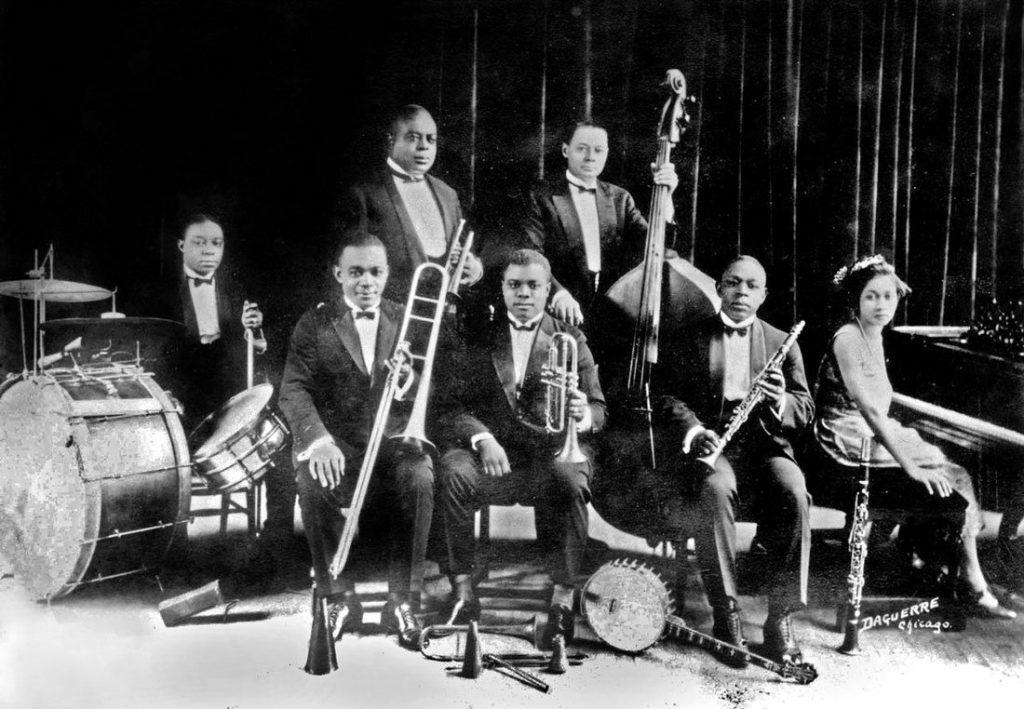
King Oliver’s Creole Jazz Band vintage 1923. From the left: Warren “Baby” Dodds (drums); Honore Dutrey (seated front, trombone); Joe “King” Oliver (standing rear, cornet); Louis Armstrong (seated front, cornet); Bill Johnson (standing rear, string bass and banjo); Johnny Dodds (seated front, clarinet); and Lil Hardin (piano)
I’ve been looking forward to this day because it marks an important jazz centenary. Or at least I think it does. There’s some contradictory evidence about whether it was April 5th 1923 or April 6th, or maybe both, when King Oliver‘s Creole Jazz Band did its first ever recording session at the Gennett studios in Richmond, Virginia. They recorded 20 sides in that session, which may well have involved two days with a break in between or working through the night.
These dates represent a remarkable occasion not only because King Oliver’s band was really the first jazz Supergroup, but also because it had been joined just a few months earlier by a young cornet player by the name of Louis Armstrong. This session therefore represent the first examples of Louis Armstrong ever heard on record.
It is somewhat surprising that this historic session happened at the Gennett studios. The band was based on Chicago, Illinois, and the studios were in Richmond, Virginia, so it required a long road trip to get there. Moreover the studio building wasn’t exactly in a prime location, as it was right next to a railroad line:
Gennett Recording Studios, Richmond Virginia (Picture Credit here)
Musicians had to time their recordings so as to avoid the noise from passing trains. Still, records only lasted about 3 minutes in those days so presumably weren’t so frequent as to make it difficult to fit in a take between two of them! Recording techniques were rather primitive in those days though, and the sound quality that emerged isn’t great.
The lineup for the band is shown in the picture at the top of this page. It’s interesting to note that four of these musicians (Armstrong, Hardin, and the Dodds brothers) were to feature regularly from 1925 onwards in the classic Hot Fives and Hot Sevens. King Oliver’s band, however, had style that was very different from these later records, with a much greater emphasis on polyphony, much more complex arrangements, and much less emphasis on solos. Also, King Oliver’s band played to live audiences on a regular basis, but the Hot Fives and Hot Seven only ever performed as such in recording studios.
As far as I understand how this band worked, King Oliver made the arrangements. I don’t think they used full written scores, but tended to play from wonderfully intricate “head arrangements” worked out beforehand, with ensemble passages, gaps for breaks and solos, and King Oliver introducing the (usually very catchy themes). Armstrong and Johnny Dodds improvised a decorative counterpoint, and Honore Dutrey added harmonic breadth to the ensemble. This must have been a great learning experience for the young Louis Armstrong, has he had to develop a great ear for what was going on around him to play like this. I gather that Louis Armstrong often tended to play very loud so he was kept well in the background in these early Gennett sessions, but such a prodigious talent was never going to play second fiddle for long and in later sessions he effectively duets with King Oliver and swapped leads with him freely and completely intuitively, producing a sound that was entirely unique. I am always astonished by how much is going on in these old records, even if you can’t hear it all very well!
I’ve mentioned before that, over time, this classic type of polyphonic Jazz – derived from its New Orleans roots – gradually morphed into musical form dominated by much simpler arrangements and a succession of virtuoso solos. This change was also reflected in the differing fortunes of Louis Armstrong and King Oliver. The former went on to become an international celebrity, while the latter lost all his savings when his bank went bust during the Wall Street Crash and ended his life working as a janitor.
As well as Gennett, this band recorded with other labels in 1923 including Okeh and Columbia. Sadly however they split up at the end of 1923 over disagreements about a possible tour in 1924. Only about 40 sides were ever recorded King Oliver’s Creole Jazz Band. Many of them are absolutely marvelous.
This is the first track recorded by the band in April 1923. It’s called Just Gone. It’s a scratchy old record, with a rather compressed acoustic, so it’s like putting your next to one end of a tunnel leading back a hundred years, but it’s a good example of the Creole Jazz Band’s style. Joe Oliver’s lead cornet clearly influenced Louis Armstrong’s later style. You have to listen hard to hear Satchmo in the background on this track, but it’s worth the effort. You’re listening to a piece of music history, and a wonderful piece at that.
I just heard today – via the latest Private Eye – of the passing of Wally Fawkes on 1st March at the age of 98. His name won’t be familiar to many of the readers of this blog, but it is a name that I grew up with in a jazz-loving family. Wally Fawkes played clarinet with Humphrey Lyttelton’s band in its heyday in the late 40s and early 50s and was the last surviving member of that group. That band may have had a rhythm section that always sounded like its members were wearing diving boots, but the front line of Humphrey Lyttelton (trumpet), Wally Fawkes (clarinet) and Keith Christie (trombone) was truly outstanding.
Wally Fawkes wasn’t just a musician, though. He was also the acclaimed cartoonist known by the pseudonym Trog, and contributed a variety of cartoons to a variety of magazines and newspapers, including the long-running comic strip Flook. He was also an occasional contributor to Private Eye. He had to give up drawing in 2005 because of failing eyesight, after 62 years in the business.
I’ve already drawn attention to Wally Fawke’s excellence as a clarinet soloist with the Lyttelton band on The Onions at the famous 1954 Festival Hall Concert so it seems apt to pay tribute to his skills as both a cartoonist and a musician by returning to that concert for him playing his own composition Trog’s Blues. Wally Fawkes was a huge admirer of Sidney Bechet, and this tune clearly pays homage to Bechet’s monumental Blue Horizon (which I think is the finest instrumental blues ever recorded) but while Bechet’s blues performances were hewn from granite, Wally’s were wrought from finest porcelain.
Today is Shrove Tuesday, Pancake Day, and Mardi Gras, which gives me three excuses to post an authentic New Orleans parade tune from way back in 1927.
Jazz began with the marching bands that performed in New Orleans but then largely moved into the bordellos of Storyville, the biggest (legal) red light district in the history of the United States. When Storyville was closed down in 1917 as a threat to the health of the US Navy most professional jazz musicians lost their only source of regular income. Fortunately the very lawmakers who condemned jazz for its association with vice and crime soon passed a law that unwittingly ensured the music’s survival, proposing the 18th Amendment to the Constitution of the United States, passed in 1919, which prohibited the manufacture, distribution and sale of alcohol for human consumption. This was soon followed by the Volstead Act, which gave federal government the powers to enforce the 18th amendment. This ushered in the era of Prohibition, which turned Chicago into a bootlegger’s paradise almost overnight and jazz musicians flocked there to perform in the numerous speakeasies. That’s why so many of the great New Orleans Jazz records of the 1920s were actually made in Chicago.
Although the exodus was substantial, not all Jazz musicians left New Orleans. Many stayed there and kept the roots of the music going while it branched out in Chicago and, later, New York. Most of the bands that stayed kept going through the depression but never really achieved great commercial success until the traditional Jazz revival of the 1940s and 1950s. This example is a record produced by the Victor Record Company who sent a recording unit to New Orleans in 1927 to record some of the musicians who had stayed behind, many of them still playing in the marching band tradition of Buddy Bolden.
The title is To-Wa-Bac-A-Wa. I don’t know what it means but it’s an old French creole version of a tune that has subsequently reappeared many times in different forms with different names, most notably Bucket’s Got A Hole In it. The band is Louis Dumaine’s Jazzola Eight. Besides the lead cornet of Louis Dumaine, who lived from 1889 to 1949, it’s worth mentioning the clarinet style of Willie Joseph, which is heavily influenced by that of the great Johnny Dodds.
Anyway, it’s the kind of jaunty march-like number that’s perfect as a Mardi Gras parade tune and it always puts a spring in my step every time I hear it! There are also some old photographs of Mardi Gras parades to get you in the mood.
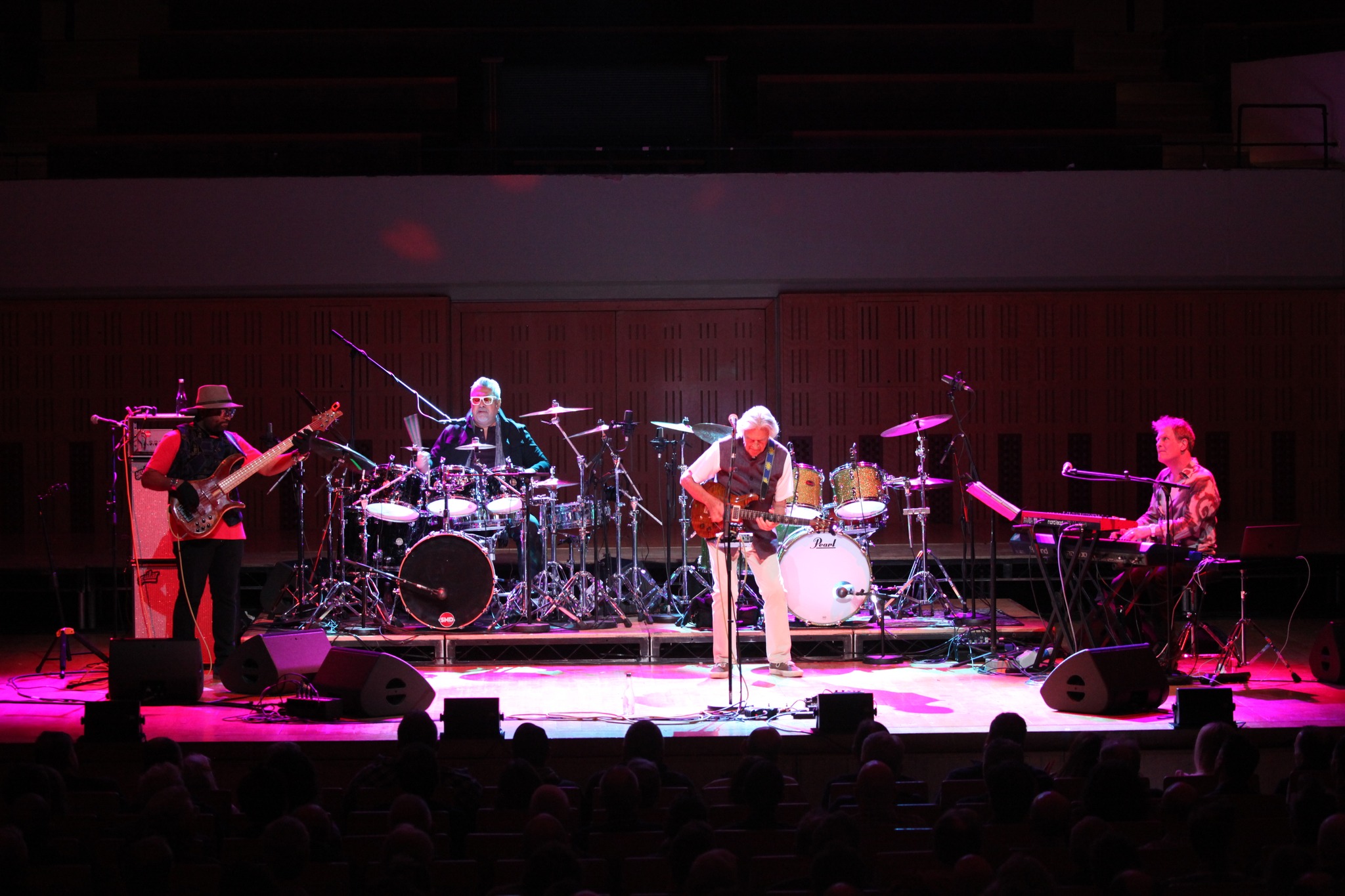
John McLaughlin last night (Picture Credit National Concert Hall)
Last night I went to the National Concert Hall in Dublin for a superb gig by guitarist John McLaughlin with his band The Fourth Dimension. This was the first time I’d seen him live though I have known some of his music on disc, especially two albums he made with Miles Davis in the late Sixties, Bitches Brew and In A Silent Way. Since then John McLaughlin has been consistently regarded as one of the best jazz guitarists ever. He is now eighty years old but apart from the fact that his hair is white you would never guess that. He looks as fit as a fiddle, and last the band played for over 90 minutes without a break.
John McLaughlin (who was born in Doncaster but who referred to Ireland as “the land of my ancestors”) is currently on a European tour and he began his concert last night with a heartfelt expression of his gratitude for being able to perform in person with his band after a gap of over two years. This period has been particularly difficult for Jazz musicians who depend so much on mutual interaction when performing. The first number they played was called Lockdown Blues…
The band The 4th Dimension brings together excellent musicians from different cultures and musical traditions, integrating their all cultural influences in a unique way while at the same time preserving the spontaneity of jazz. The result is hard to classify – there’s definitely more than an echo of McLaughlin’s earlier musical work in jazz/rock fusion, but with diverse elements of world music thrown in. His own musical style is instantly recognizable to anyone who has heard music from his back catalogue, but subtly altered to suit his current band.
Gary Husband (right in the picture), who is from the UK, played keyboards (and drums on a couple of numbers). Ranjit Barot – Indian by birth and living in Mumbai – was the main drummer (sometimes playing together with Husband, hence the two kits in the picture); he also made various vocal contributions. On electric bass (left) was the extraordinarily virtuosic Étienne M’Bappé who is of Senegalese origins. The band played collectively but also in various combinations with and without McLaughlin, who tended to move around the stage generally encouraging and directing the traffic.
It was a fantastic gig with a wide range of musical influences being evidence. I noticed two pieces made famous by Pharaoh Sanders – The Creator has a Master Plan and The Light at the Edge of the World – but there were also numerous references to McLaughlin’s work with Indian musicians.
It was a very enjoyable performance that generated a huge response from the audience. The NCH wasn’t quite full, but it was a good crowd. I think I was in danger of forgetting how much I enjoy watching musicians as well as listening to their music.
So after a break since February 2020 I’ve finally resumed concert-going. It’s not only the musicians who have missed live music! As a matter of fact I’ll be back at the National Concert Hall this very evening after the final day of ITP2022, for a very different concert…
A descendant of Senegalese slaves, George Lewis was born in the French Quarter of New Orleans in 1900 where he learned to play the clarinet and started to play with jazz bands in the 1920s. Many musicians left New Orleans for Chicago during that period but Lewis stayed and lived on in relatively obscurity until the New Orleans “revival” began in the 1940s. After appearing on records with likes of Bunk Johnson, Lewis became a sort of Patron Saint of traditional jazz, with a style rooted in the home-town traditions of Gospel Music and Street Parades that was very different from that of the popular clarinetists of the Swing Era such as Benny Goodman and Artie Shaw. Lewis was never a great player from a technical point of view, but he was an authentic emblem of early Jazz and the back-to-basics move he represented proved very popular especially in Western Europe and Lewis had a late renaissance in his career in which he travelled widely playing with “traditional” bands around the world during the height of the “trad” boom of the fifties and sixties. He died in 1968.
Anyway, because it’s Good Friday I thought I would post this video of him in his later years playing the hymn The Old Rugged Cross, which was written in 1912 and has been a staple of New Orleans funeral processions ever since:
Time, I think, for a quick lunchtime jazz quiz. Here are two great old records from the classical period of Jazz. Can you spot the link between them?
The first is a slow blues recorded in 1928 called Superstitious Blues featuring a formidable singer by the name of Hattie Burleson in the company of Don Albert (trumpet), Siki Collins (soprano saxophone), Allen Van (piano), John Henry Bragg (banjo) and Charlie Dixon (brass bass):
The second, an up-tempo stomp recorded a year earlier in 1927, is one of the hottest jazz records ever made – the way it catches fire for the last 45 seconds or so is absolutely sensational no matter how many times you listen to it. It is performed by the Johnny Dodds (on clarinet) and his Black Bottom Stompers, consisting of George Mitchell and Natty Dominique on cornets, John Thomas on trombone, Charlie Alexander piano, Bud Scott banjo and Johnny Dodds’s younger brother, Warren ‘Baby’ Dodds, drums.
Well, nobody tried to answer so I will: real name of Don Albert, the trumpet player in the first track, was Albert Dominique and he was the nephew of the more famous Natty Dominique who played on the second track. Not a lot of people know that.
Today has been one of those days on which I’ve been quite busy all day but seem to have achieved very little so I eventually retreated home in the rain to have a drink or several before making dinner.
Jazz and classical music don’t always provide a palatable blend, but here’s one cocktail that definitely works, especially as the festive season approaches. It’s from the 1960 album The Nutcracker Suite by Duke Ellington, based on original music for the ballet by Pyotr Ilyich Tchaikovksy. Most of the arranging on the album was done by Duke Ellington’s regular collaborator Billy Strayhorn, and the result is every bit as witty, elegant and charming as you’d expect. This is their gorgeous take on The Dance of the Sugar Plum Fairy:
The views presented here are personal and not necessarily those of my employer (or anyone else for that matter).
Feel free to comment on any of the posts on this blog but comments may be moderated; anonymous comments and any considered by me to be vexatious and/or abusive and/or defamatory will not be accepted. I do not necessarily endorse, support, sanction, encourage, verify or agree with the opinions or statements of any information or other content in the comments on this site and do not in any way guarantee their accuracy or reliability.


 In the Dark