Archive for jets

Weekly Update from the Open Journal of Astrophysics – 20/09/2025

Posted in OJAp Papers, Open Access, The Universe and Stuff with tags , , , , , , , , , , on September 20, 2025 by telescoper

It’s Saturday again, so it’s time for a summary of the week’s new papers at the Open Journal of Astrophysics. Since the last update we have published two new papers, which brings the number in Volume 8 (2025) up to 136, and the total so far published by OJAp up to 371.

The first paper to report this week is “The Moon as a possible source for Earth’s co-orbital bodies” by Rafael Sfair, L. C. Gomes, O. C. Winter & R. A. Moraes (São Paulo State University, Brazil), G. Borderes-Motta (Astronomical Institute of the Czech Academy of Sciences, Czech Republic) and C. M. Schäfer (Universität Tübingen, Germany). This paper was published on Monday 15th September, in the folder Earth and Planetary Astrophysics, and it presents a numerical exploration of the ejection velocities and launch locations necessary for lunar ejecta to evolve into Earth’s co-orbital bodies.

The overlay is here:
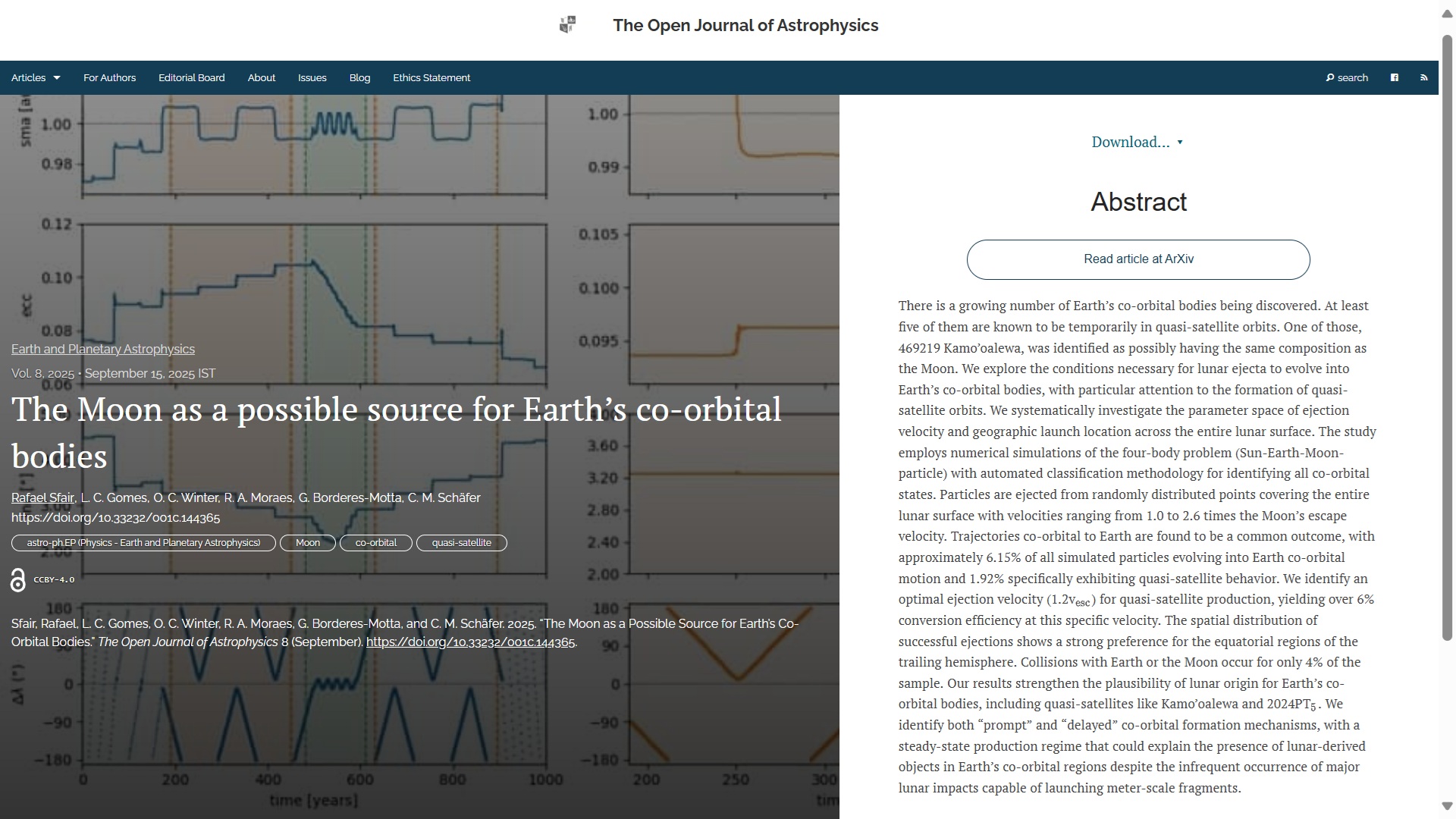
 

You can make this larger by clicking on it.  The officially accepted version of this paper can be found on the arXiv here.

The second paper this week, published on Friday 19th September in the folder Solar and Stellar Astrophysics, is  “Jet-Driven Formation of Bipolar Rings in Planetary Nebulae: Numerical Simulations Inspired by NGC 1514” by Muhammad Akashi, Ealeal Bear, and Noam Soker (Technion, Haifa, Israel). This paper presents evidence from numerical simulations notion that jets play a substantial role in shaping planetary nebulae (PNe).

The corresponding overlay is here:
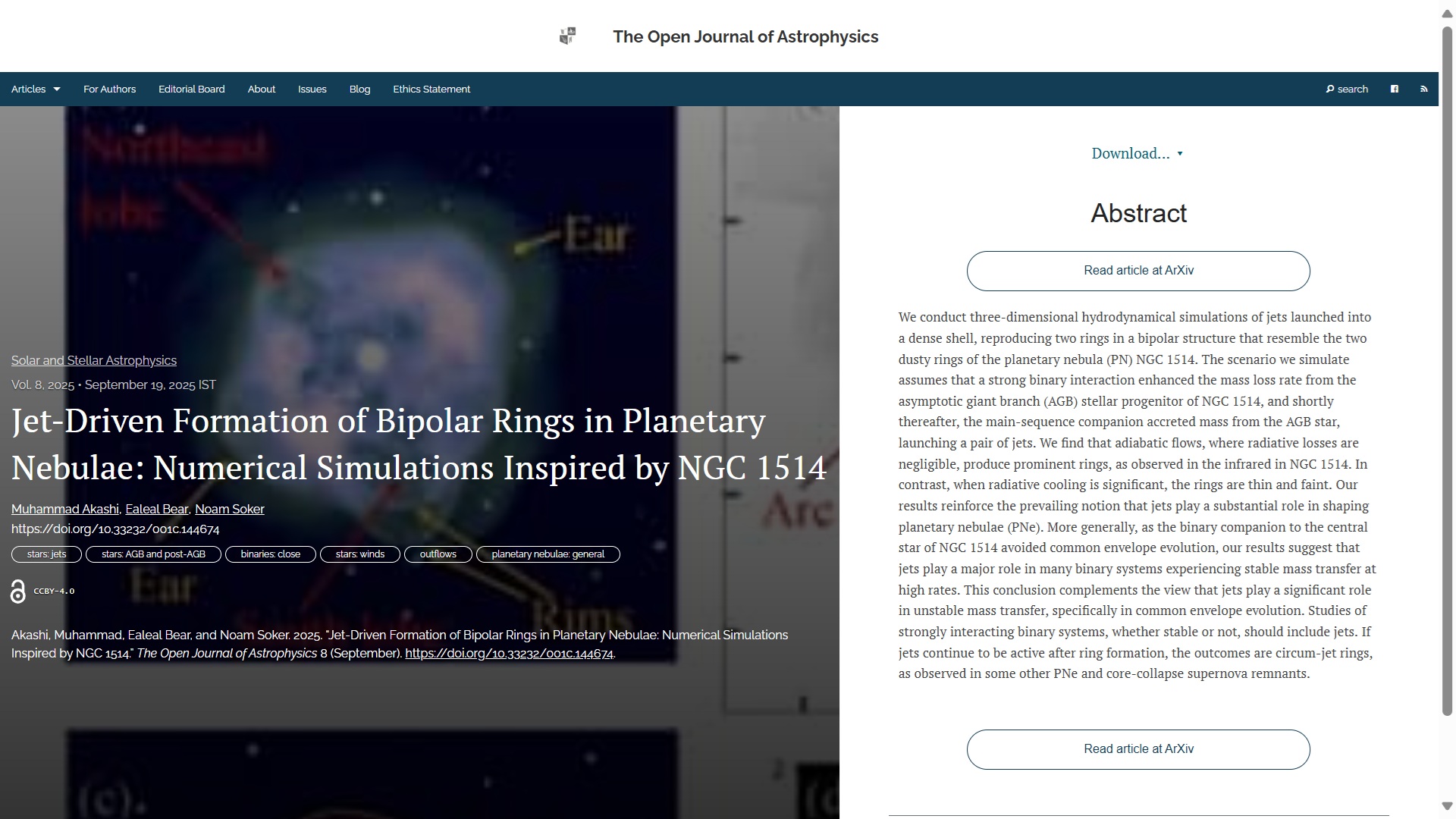
 

You can find the officially accepted version on arXiv here.
Two New Publications at the Open Journal of Astrophysics

Posted in OJAp Papers, The Universe and Stuff with tags , , , , , , on May 4, 2024 by telescoper

It’s Saturday morning in Barcelona, and time to post another update relating to the  Open Journal of Astrophysics.  Since the last update we have published two more papers, taking  the count in Volume 7 (2024) up to 32 and the total published by OJAp up to 147. There’s every chance we will reach 150 next week.

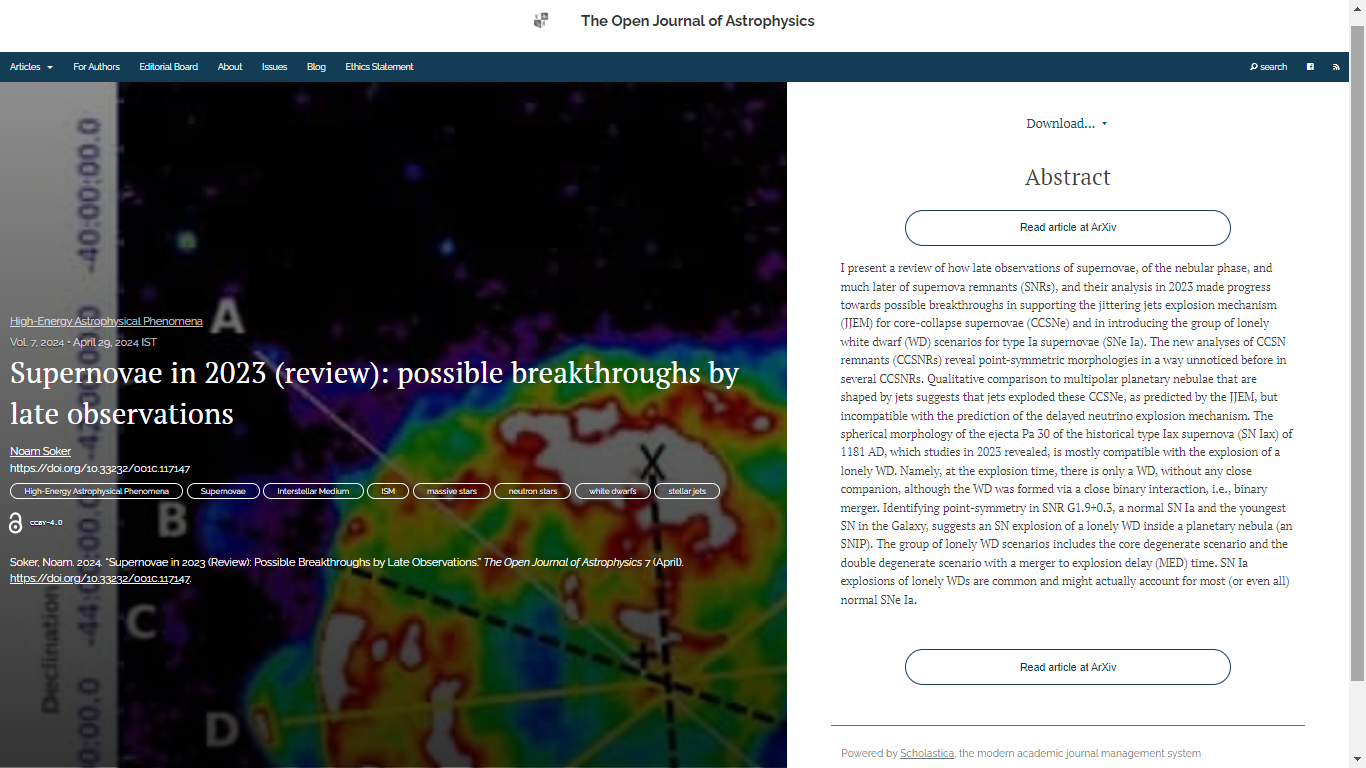
The first paper of the most recent pair – published on  Monday 29th April- is “Supernovae in 2023 (review): possible breakthroughs by late observations” by Noam Soker of Technion in Haifa, Israel. It presents  a discussion of observations of the aftermath of supernovae explosions, such as supernova remnants, and how these may shed light on the explosion mechanism. This one is in the folder marked High-Energy Astrophysical Phenomena.

Here is a screen grab of the overlay which includes the abstract:


You can click on the image of the overlay to make it larger should you wish to do so. You can find the officially accepted version of the paper on the arXiv here.

The second paper was published on Thursday 2nd May and has the title “ΛCDM is alive and well” The authors are: Alain Blanchard (Université de Toulouse, France), Jean-Yves Héloret (Université de Toulouse, France), Stéphane Ilíc (Université Paris-Saclay, France), Brahim Lamine (Université de Toulouse, France) and Isaac Tutusaus (Université de Genève, Switzerland). This one, which is in the folder marked Cosmology and NonGalactic Astrophysics, presents a review of  review of the alleged tensions between observations and the standard cosmological model.

I did a post recently relating to a Royal Society Meeting on this topic. The first version of this paper appeared on arXiv about two years ago but the final version is extensively modified.

Here is a screen grab of the overlay which includes the abstract:


You can click on the image of the overlay to make it larger should you wish to do so. You can find the officially accepted version of the paper on the arXiv here.

And that concludes this week’s update. More next week!

New Publication at the Open Journal of Astrophysics

Posted in OJAp Papers, Open Access, The Universe and Stuff with tags , , , , , , , on February 16, 2024 by telescoper

It’s Saturday morning here in Sydney, which means it is time for another weekly update from the Open Journal of Astrophysics. In fact there is only one paper to report this week, being  the 13th paper in Volume 7 (2024)  and the 128th altogether. It was published on February 15th 2024.

The title is “Jet – counter-jet asymmetry in the jittering jets explosion mechanism of supernovae” and it  This one is in the folder called High-Energy Astrophysical Phenomena. The paper presents a discussion of the production of jets in core-collapse supernovae and the resulting formation of neutron stars, and the implications for the morphology of the supernova remnant.

The sole author of the paper is Noam Soker of Technion, Haifa, in Israel.

Here is the overlay of the paper containing the abstract:


You can click on the image of the overlay to make it larger should you wish to do so. You can find the officially accepted version of the paper on the arXiv here.

A Ghost of a Jet?

Posted in Astrohype, The Universe and Stuff with tags , , on June 4, 2012 by telescoper

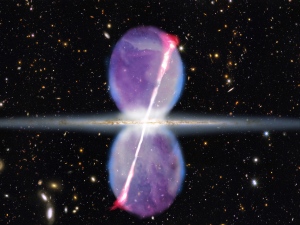
Last week an article in Nature News caught my eye. Ghostly jets seen streaming from Milky Way’s core was the headline. It’s based on a paper by Su & Finkbeiner recently submitted to the arXiv. There’s even a picture showing the jets in glorious technicolour:

Wow! Impressive stuff. If the jets look like that it’s amazing nobody ever saw them before!

Oh, hang on. The picture is an “artist’s conception”. In other words, it’s what the jets might look like if they actually existed, as imagined by a bloke with a box of crayons.

And how strong is the evidence that they do exist? Here’s the last paragraph of the Nature article (my emphasis):

Although the emissions are dim and the observations don’t have the statistical significance that astronomers require for proof, Baganoff says that several properties make them compelling evidence of jets. They are brighter at higher γ-ray energies and also brighter than the surrounding interstellar medium. They also seem to be long and thin, as would be expected of jets. “Taking all of the evidence together, it appears highly plausible that the features are jets emanating from the Galactic Centre,“ he says.

If they “don’t have the statistical significance that astronomers require for proof” then one wonders why they’re being given so much publicity. In any case the “ghostly jets seen streaming from the Milky Way’s core” can’t be said to have really been “seen” for certain. But they are “highly plausible”. In other words, the authors would like them to be there.

All I can say is that it must have been a slow news day at Nature.

Still, nice drawing.