Archive for journals

The Future of Diamond Open Access in Astrophysics

Posted in Biographical, Open Access with tags , , , , , , on November 17, 2024 by telescoper

The Open Journal of Astrophysics is now reasonably well established as a Diamond Open Access journal for the astrophysics community. We have published over a hundred articles so far this year at such a low cost that we can make our publications free to read and to publish. Thanks for all this is due to the volunteers on our Editorial Board, the excellent team at Maynooth University library, who have supported this project for 6 years, to the arXiv, as well of course to the authors who have chosen to publish with us.

Although we have established a good base, we’re still much smaller than the mainstream journals publishing just a few percent of their output. There is no sign of a slowdown at OJAp. Indeed there are signs that pace will pick up. I heard last week, for example, that Oxford University Press (the publisher of Monthly Notices of the Royal Astronomical Society) has decided to cancel the ‘Read-and-Publish’ agreement that allowed authors from Australian institutions to avoid APCs. I imagine we’ll get quite a few more submissions from Down Under thanks to that decision.

Nevertheless, we’ve a long way to go to catch up with the likes of A&A, MNRAS and ApJ in terms of numbers. If activity continues to grow then we will incur greater costs – our provider, Scholastica, charges us per paper. Those costs will still be smaller than regular journals, but I think it’s unfair that the expense of running a journal that serves the global astrophysics community should fall entirely on one small University in Ireland.

Expense is only one issue. I never envisaged that OJAp would be unique. It was more intended to be a proof of concept. I would like to see a range of Diamond Open Access journals offering a choice for authors and serving different sub-disciplines. Most universities nowadays have publishing operations so there could be network of federated journals, some based on arXiv and some based on other repositories. Perhaps institutions are worried about the expense but, as we have shown the actual cost, is far less than they are wasting on Article Processing Charges. I rather think it’s not the money that is the issue, just the unimaginatively risk-averse thinking in what passes these days for university management.

There are two simple – but not mutually exclusive – possibilities.

One is that astrophysics institutions club together and donate funds not only to keep OJAp going, but also to allow us to invest in improvements. A donation equivalent to the cost of just one APC for a typical journal would help us enormously. We do actually get some donations already, but more would always be welcome. In the long run, an investment in Diamond Open Access would pay back many times in savings; OJAp has already saved the worldwide community over £500,000.

The other is that other members of the community follow the lead of OJAp and set up their own journals. I wouldn’t see others as much as competitors, more as allies with community-led federated system. In the light of the OUP decision mentioned above, why don’t Australian research institutions set up their own version of OJAp? I’d be happy to discuss how to start up such a journal with anyone interested.

If you would like to discuss either of these possibilities please use the comment box below or email me here.

P.S. There is another issue concerning the future of OJAp, which is that I will be retiring in a few years, but now isn’t the time to discuss that one!
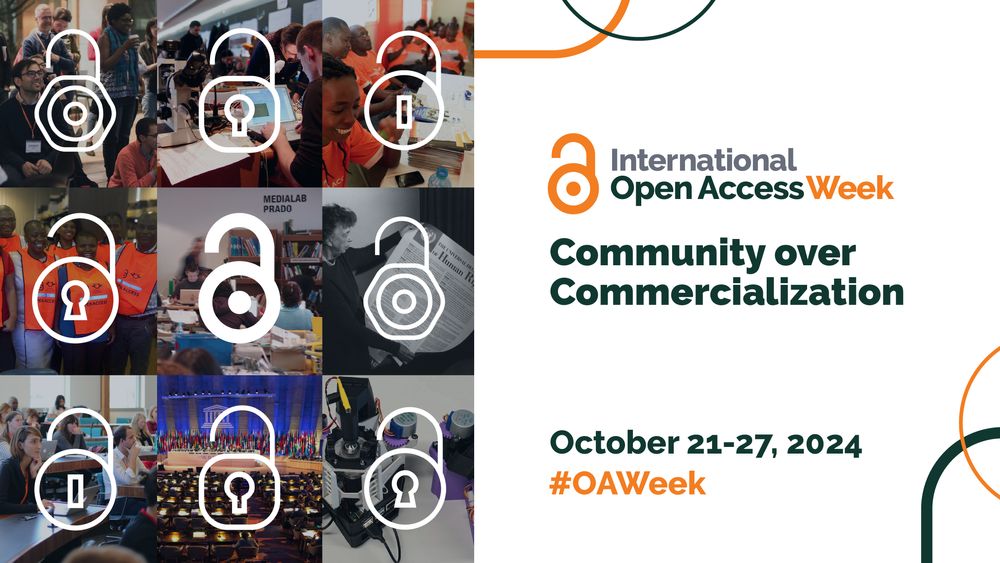
Open Access Week 2024: Community over Commercialization

Posted in Open Access with tags , , , , , on October 22, 2024 by telescoper

This week is Open Access Week 2024, the theme of which is Community over Commercialization. In light of this, among with some other journal editors I was contacted by Scholastica to provide some comments for their blog, Scholastica being the provider of the platform used by The Open Journal of Astrophysics. I was happy to respond to a couple of questions about how to build engaged communities.

Here are the comments of mine that they used in the blog post:

We started with a small editorial board basically formed from people who read various blog posts I’d written about the idea of the journal and followed its germination. We were lucky to have an initial group of high-profile scientists based all around the globe, including the USA. We started to get some papers from very well-known authors from leading institutes, and large international consortia. Some of these papers have generated large numbers of citations and have attracted coverage in the mainstream media, which also helped raise our profile.

Last year I was on sabbatical, which gave me the opportunity to travel and give invited talks about open access publishing in astrophysics at institutions in France, Spain, the UK, and Australia, and to audiences around the world via the Internet. Other members of the editorial board have also done their bit in promoting the journal. Our submission rate increased only slowly at first but is now more than doubling each year and we are currently receiving several submissions a day.  It has taken a while to establish the reputation of the Open Journal of Astrophysics this way, (i.e., mainly by word of mouth), but that has been good for us because it has enabled us to scale up our processes without becoming overwhelmed by a deluge.

My advice to others trying to set up a new journal would be to have a strong editorial board and clear policies, and above all to be patient. It takes a while — in our case more than 5 years — to establish a reputation in the academic community. These days there are too many people talking about this sort of publishing and not enough actually doing it. It’s time for researchers and research institutions to claim back the original purpose of academic publishing, the free dissemination of research for the public good.

You can read comments from three other editors of open access journals in the original Scholastica blog post.

Academic Publishing is a Lucrative Scam

Posted in OJAp Papers, Open Access with tags , , , , , , , , on July 17, 2024 by telescoper

I saw an article in the Guardian yesterday with the title Academic journals are a lucrative scam – and we’re determined to change that. It’s written by Arash Abizadeh who is Professor of Political Science at McGill University in Canada. I urge you to read the piece if you’re interested in Open Access and the issues surrounding it.

I agree with virtually everything in the article. Indeed I’ve been saying much the same thing for about 15 years! I’m also determined to change things too, which is why we set up the Open Journal of Astrophysics, a “Diamond” Open Access Journal. Talking about the system of Gold Open Access, Prof. Abizadeh writes:

There is an obvious alternative: universities, libraries, and academic funding agencies can cut out the intermediary and directly fund journals themselves, at a far lower cost. This would remove commercial pressures from the editorial process, preserve editorial integrity and make research accessible to all. The term for this is “diamond” open access, which means the publishers charge neither authors, editors, nor readers (this is how our new journal will operate). Librarians have been urging this for years. So why haven’t academics already migrated to diamond journals?

I think the reason more academics haven’t already migrated to Diamond Open Access journals is that there are relatively few such journals. The reason for that is that although there are lots of people talking about Diamond Open Access there are many fewer actually taking steps to implement it. The initiative mentioned in the Guardian article is therefore very welcome. Although I think in the long run this transition is inevitable, it won’t happen by itself. It certainly won’t be helped by the Academic Publishing Industry either. We academics have to provide the push.

Here’s another excerpt:

Career advancement depends heavily on publishing in journals with established name recognition and prestige, and these journals are often owned by commercial publishers. Many academics – particularly early-career researchers trying to secure long-term employment in an extremely difficult job market – cannot afford to take a chance on new, untested journals on their own.

This is true, up to a point.

First of all any institution that has signed up to the San Francisco Declaration On Research Assessment (DORA) should not be relying on (often bogus) indicators of prestige such as the Journal Impact Factor or the journal’s presence in the Scopus index. If Diamond Open Access is to gain further traction it has to be accompanied to a wholesale change towards fairer research assessment practices.

Second, although it is true that it has taken some years to reach the volume it has now, I have been pleasantly surprised how many early career researchers in astrophysics have been keen to try out the Open Journal of Astrophysics. I think that’s because (a) early career researchers have not been indoctrinated into the absurdities of existing publishing practices and (b) they can see that the citation rates on OJAp are no worse than other allegedly more “prestigious” journals.

An All-Ireland Diamond Open Access Publishing Platform?

Posted in Maynooth, Open Access with tags , , , , , , on June 24, 2024 by telescoper

Here’s a report on an interesting development about Open Access in Ireland. The article belongs to the Special Issue 10th Anniversary Special Issue “PUBMET2023 Conference on Scholarly Communication in the Context of Open Science” and has the following abstract:

The Government of Ireland has set a target of achieving 100% open access to publicly funded scholarly publications by 2030. As a key element of achieving this objective, the PublishOA.ie project was established to evaluate the feasibility of establishing an all-island [Republic of Ireland and Northern Ireland] digital publishing platform for Diamond Open Access journals and monographs designed to advance best practice and meet the needs of authors, readers, publishers, and research funding organisations in Irish scholarly publishing. It should be noted in this context that there is substantial ‘north–south’ cooperation between public bodies in the Republic of Ireland and Northern Ireland in the United Kingdom, some of whom operate on what is commonly termed an ‘all-island’ basis. The project commenced in November 2022 and will run until November 2024, with the submission of a Final Report. This article originated as an interim project report presented in September 2023 at the PubMet2023 conference in Zadar, Croatia. The project is unique in its mandate to report on the feasibility of a shared platform that will encompass scholarly publishing across the two jurisdictions on the island of Ireland, which are now, post-Brexit, inside and outside the European Union (EU): the Republic of Ireland and Northern Ireland in the United Kingdom. The project is co-led by the Royal Irish Academy (RIA), Ireland’s leading body of experts in the Sciences and Humanities, and the Trinity Long Room Hub Arts & Humanities Research Institute of Trinity College Dublin. There are sixteen partners and affiliates from universities and organisations from the island of Ireland. The feasibility study will be based on a review of the publishing practices in the island of Ireland, with gap analysis on standards, technology, processes, copyright practices, and funding models for Diamond OA, benchmarking against other national platforms, and specifications of the requirements, leading to the delivery of a pilot national publishing platform. A set of demonstrator journals and monographs will be published using the platform, which will be actively trialled by the partner publishers and authors. PublishOA.ie aims to deliver an evidence-based understanding of Irish scholarly publishing and of the requirements of publishers to transition in whole or in part to Diamond OA. This paper provides an interim report on progress on the project as of September 2023, ten months after its commencement.

I think the idea of having a national Diamond Open Access publishing platform is a very interesting one. In principle it could facilitate the federated system of repositories linked by refereeing overlays which I think is the future of academic publishing. I think a national peer review platform would be more to the point than a publishing platform.

I have two comments:

  1. I am surprised that Maynooth University – publisher, among other things, of the Open Journal of Astrophysics (a Diamond Open Access journal) – is not among the partners in this project and does not even receive a mention as a publisher. I wonder how far this project will get if it excludes organizations that are already running Diamond Open Access Journals.
  2. Less of a comment, more of a question: why on Earth is the report published in a journal run by MDPI, a publisher that is controversial (to say the least)? It would be deeply ironic if they had to pay an APC to publish an article on Diamond Open Access!

On “Purpose-Led Publishing”

Posted in Open Access with tags , , , , , , , , , , on March 6, 2024 by telescoper

I was flabbergasted by the cheek of an article that recently appeared in Physics World by Michael Brooks announcing that:

I can’t speak about the American Institute of Physics or the American Physical Society but in the context of the Institute of Physics – of which I am a Fellow and in whose house magazine the article appears – I draw your attention to the last sentence of the above excerpt which contains a commitment to “invest funds generated from publishing back into research” (my emphasis).

Really? The IOP invests in research? That’s news to me. How do I apply for a grant? Will they fund my next PhD student?

The IOP invests its funds in many things – many of them worthy – but it does not spend a significant part of the vast income it generates from its publishing house on research. The claim that it does is just dishonest. There’s point in mincing words.

This is an important distinction, particularly so that publishing in most IOP journals now requires the payment of a hefty Article Processing Charge (APC; Artificial Profit Charge would be more apt) which often has to be paid for out of research grants. Previously the revenue of IOP Publishing was appropriated from library budgets through subscriptions, so physicists were less aware of just how much the IOP was raking in. Now that researchers are having to find the funds themselves from research grants it has become more obvious that the IOP is actually a drain on research funds, not a source of them. The APC is a levy on research, designed to generate funds for other things. I think this model is indefensible. What gives the IOP the right to impose charges that far exceed the cost of disseminating scientific results in order to appropriate funds for its other activities?

Moreover, even if the IOP did fund research, what benefit would that be to a researcher in Spain, South Korea or Singapore or indeed anywhere outside the UK and Ireland?

The slogan for the initiative described in the article is “Purpose-led Publishing”. That reminds me of an old saying from systems theory: the Purpose Of a System Is What it Does (POSIWID). What the system does in this case is to raise funds for the IOP. That’s its purpose. Everything else is just marketing spiel.

The claim that IOP Publishing does not make a profit is disingenuous too. It does make a substantial profit. The only difference between it and the likes of Elsevier is where the profits go. A true not-for-profit publisher would charge only at the level to cover the costs of publication. The Purpose that should be leading Publishing in physics is the dissemination of scientific results, not the generation of revenue for sundry other things.

I have avoided publishing in IOP journals for many years because I think the approach of IOP Publishing is unethical. Now I have decided that I no longer wish to be associated with the IOP in any way. I have paid the subscription for 2024 but when that lapses I won’t renew it. Enough is enough.

IOAP Diamond Open Access Awards 2024

Posted in Open Access with tags , , , , , , , , , , on January 17, 2024 by telescoper

A week or so before Christmas I posted about a new organization called Irish Open Access Publishers whose mission statement is as follows:

Irish Open Access Publishers (IOAP) is a community of practice driven by Irish open access publishers for Irish open access publishers.  The IOAP promotes engagement with the Diamond Open Access publishing model (free to publish and free to read) as well as indexing on the Directory of Open Access Journals and the Directory of Open Access Books. The aim of this dynamic community of practice is to promote publishing activity that is free of pay walls and publication embargoes to further the dissemination of high quality scholarly output to all in society.

These aims are laudable and I support them wholeheartedly. I should also mention that the Open Journal of Astrophysics is listed in the Directory of Open Access Journals here, where you will find details of all the papers we have published so far. This index is all part of the service. We have also been accepted for inclusion in Scopus, in case that matters to you.

Anyway, I thought I would remind readers of this blog (both of them) about the fact that the IOAP is offering a new set of awards, for which nominations are now open:

(Unfortunately the links in the above image are not clickable, but you can the award details here…)

Nominations for the first three categories are by self-nomination only. I will of course, on behalf of Maynooth Academic Publishing, the Editorial Board, the authors, and everyone who has helped behind the scenes, be nominating the Open Journal of Astrophysics.

Nominations for the final category, Outstanding Contribution to the OA Field are described thus:

Category 4 welcomes third party as well as self nominations from academics, students, librarians, research managers, academic leaders, publishers and other stakeholders across further and higher education for an individual who has made an outstanding contribution to open access publishing in Ireland. Nominations from scholarly societies and other scholarly organisations are also welcome. Nominations for individuals based in Northern Ireland are also invited.

Self nominations are restricted to individuals based in Ireland including Northern Ireland. Third party nominations are invited from individuals based in Ireland including Northern Ireland as well as individuals based overseas. All third party nominations must be for individuals practising in the field of open access publishing in Ireland including Northern Ireland solely.

Notice that nominations are not restricted to individuals based in Ireland. So, wherever you are, if you can think of any individual based in Ireland who has done enough to merit being described as having made an “outstanding contribution”, perhaps not only for being a long-term advocate of Diamond Open Access but also for setting up and being Managing Editor of a successful Diamond Open Access journal in the field of astrophysics, then please feel free to nominate me them. I hope you get the message. If you want subtle, you’ve come to the wrong place!

The nomination form is here. The closing date for nominations is 1st February 2024.

IOAP Diamond Open Access Awards 2024

Posted in Open Access with tags , , , , , , , , on December 18, 2023 by telescoper

Last week I found out about a new organization called Irish Open Access Publishers whose mission statement is as follows:

Irish Open Access Publishers (IOAP) is a community of practice driven by Irish open access publishers for Irish open access publishers.  The IOAP promotes engagement with the Diamond Open Access publishing model (free to publish and free to read) as well as indexing on the Directory of Open Access Journals and the Directory of Open Access Books. The aim of this dynamic community of practice is to promote publishing activity that is free of pay walls and publication embargoes to further the dissemination of high quality scholarly output to all in society.

These aims are laudable and I support them wholeheartedly. I should also mention that the Open Journal of Astrophysics is listed in the Directory of Open Access Journals here, where you will find details of all the papers we have published so far. This index is all part of the service.

The reason I found out about the existence of IOAP is that they are offering a new set of awards, for which nominations are now open:

(Unfortunately the links in the above image are not clickable, but you can the award details here…)

Nominations for the first three categories are by self-nomination only. I will of course, on behalf of Maynooth Academic Publishing, the Editorial Board, the authors, and everyone who has helped behind the scenes, be nominating the Open Journal of Astrophysics.

Nominations for the final category, Outstanding Contribution to the OA Field are described thus:

Category 4 welcomes third party as well as self nominations from academics, students, librarians, research managers, academic leaders, publishers and other stakeholders across further and higher education for an individual who has made an outstanding contribution to open access publishing in Ireland. Nominations from scholarly societies and other scholarly organisations are also welcome. Nominations for individuals based in Northern Ireland are also invited.

Self nominations are restricted to individuals based in Ireland including Northern Ireland. Third party nominations are invited from individuals based in Ireland including Northern Ireland as well as individuals based overseas. All third party nominations must be for individuals practising in the field of open access publishing in Ireland including Northern Ireland solely.

Notice that nominations are not restricted to individuals based in Ireland. So, wherever you are, if you can think of any individual based in Ireland who has done enough to merit being described as having made an “outstanding contribution”, perhaps not only for being a long-term advocate of Diamond Open Access but also for setting up and being Managing Editor of a successful Diamond Open Access journal in the field of astrophysics, then please feel free to nominate me them. I hope you get the message. If you want subtle, you’ve come to the wrong place!

The nomination form is here. The closing date for nominations is 1st February 2024.

Retractions and Resignations

Posted in Open Access with tags , , , , , , , , on December 16, 2023 by telescoper

I saw an article this week in Nature that revealed that more than 10,000 research papers have been retracted so far 2023. The actual number is probably much higher than that, as this is just the fraudulent papers that have been found out. Over 80% of the papers mentioned in the article were published by Hindawi, a known predatory publisher that specializes in Gold Open Access journals that charge Article Processing Charges. Hindawi is owned by Wiley but the brand has become so toxic that Wiley no longer wants to use the name. Presumably it still wants the profits.

(Another bit of news this week makes me think that Hindawi might be the academic publishing equivalent of Tesla…)

Here’s a figure showing how the number of retracted research articles has increased over time:

It has always seemed to me that the shift to “Gold” Open Access in which authors pay to have their work published would lead to a decrease in editorial standards. Since the publisher’s income comes from APCs, the more papers they publish the more money they get. This is another reason Diamond Open Access run on a not-for-profit basis with no fees for either authors or readers is a much better model.

At least some academics are taking a stand. Retraction Watch maintains a list of journals whose editors who have resigned – sometimes en masse from the same journal – in response to the imposition of dodgy practices by their publishers. Take the Journal of Geometric Mechanics, for example. The entire Editorial Board of this journal resigned because of pressure from above to increase “output” (i.e. profits) by lowering academic standards.

This is just a start, of course, but I don’t think it will take long for academic community to accept that the this publishing model is rotten to the core and embraces the only really viable and sustainable alternative.

What are scientific papers for?

Posted in Astrohype, Open Access with tags , , on May 30, 2020 by telescoper

Writing scientific papers and publishing them in academic journals is an essential part of the activity of a researcher. ‘Publish or perish’ is truer now than ever, and an extensive publication list is essential for anyone wanting to have a career in science.

But what are these papers actually for? What purpose do they serve?

I can think of two main purposes (which aren’t entirely mutually exclusive): one is to disseminate knowledge and ideas; the other is to confer status on the author(s) .

The academic journal began hundreds of years ago with the aim of achieving the former through distribution of articles in print form. Nowadays the distribution of research results is achieved much less expensively largely through online means. Nevertheless, journals still exist (largely, as I see it, to provide editorial input and organise peer review) .

Alongside this there is the practice of using articles as a measure of the ‘quality’ of an author. Papers in certain ‘prestigious’ ‘high impact’ journals are deemed important because they are indicators of status, like epaulettes on a uniform, and bibliometric data, especially citation counts, often seem to be more important than the articles themselves.

I thought it was just me getting cynical in my old age but a number of younger scientists I know have told me that the only reason they can see for writing papers is because you need to do it to get a job. There is no notion of disseminating knowledge just the need to establish priority and elevate oneself in the pecking order. In other words the original purpose of scientific publications has largely been lost.

I thought I’d test this by doing a (totally unscientific) poll here to see how my several readers think about this.