Archive for JWST

Yet more high-z galaxies from JWST…

Posted in The Universe and Stuff with tags , , , , , , , on December 19, 2023 by telescoper

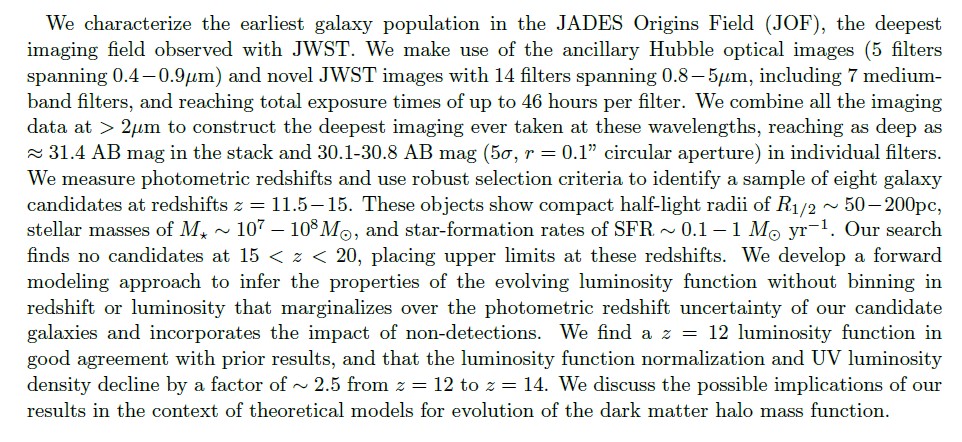
I noticed a paper on arXiv yesterday, by Robertson et al., with the abstract:

You can click on this to make it larger if you find it difficult to read.

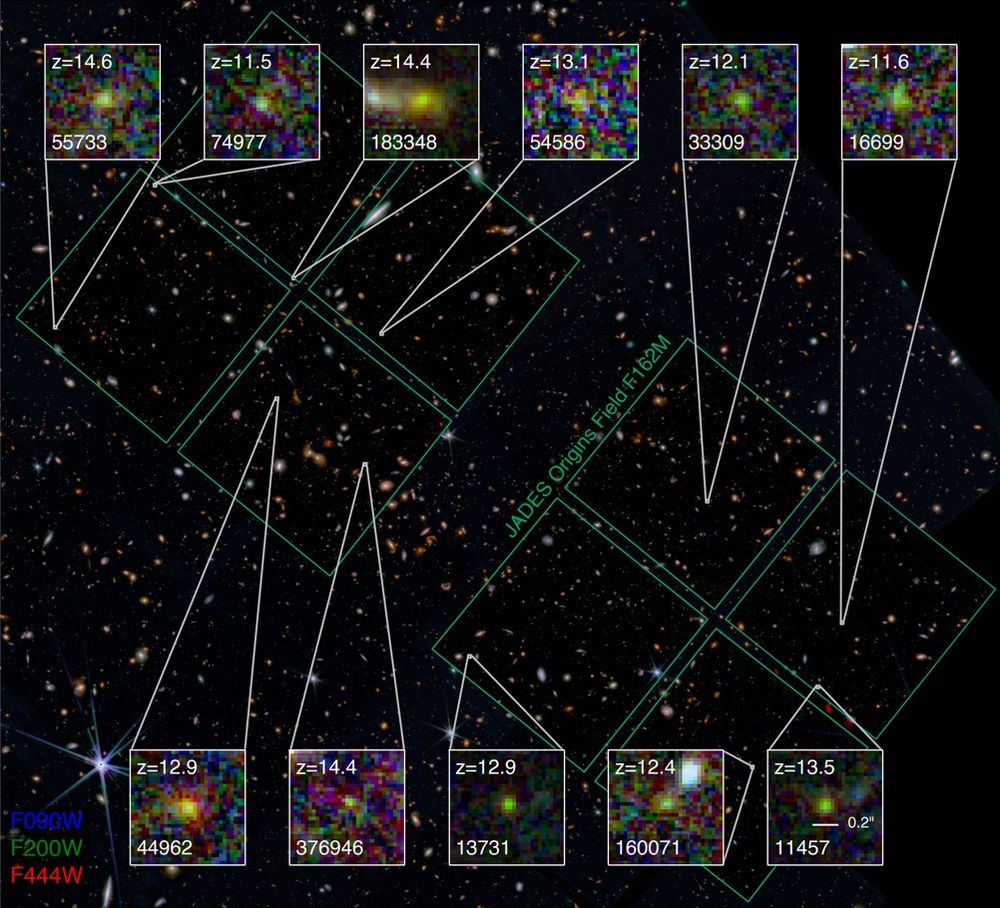
This is the latest in a number of studies by the JWST Advanced Deep Extragalactic Survey (JADES), which is aiming to detect galaxies that formed in the very early Universe; for a previous example see here. The latest batch can be seen in this figure:

There is an important caveat here, which is that these are photometric redshifts, based on the overall shape of the spectrum of the galaxy rather than on spectral lines which give a more accurate result. Follow-up spectroscopy is needed to firmly identify the redshift of the sources. Past experience suggests that some of these candidates may not actually be at as high a redshift as is claimed. If confirmed, however, the existence of large galaxies at redshifts of order 15 will put greater pressure on models of galaxy formation. A recent OJAp publication has shown that galaxies at redshift 10 are consistent with current theoretical ideas, but much larger will increase the tension on theorists. I can imagine quite a few people around the world replotting their graphs right now!

New Publication at the Open Journal of Astrophysics

Posted in OJAp Papers, Open Access, The Universe and Stuff with tags , , , , on December 12, 2023 by telescoper

I was doing some work on the Open Journal of Astrophysics site and realized that there is a paper we published last week that I haven’t advertised on here yet, so I’m remedying that now.

The paper in question is the 47th so far in Volume 6 (2023)  and it’s the 112th altogether. This one was actually published on Tuesday December 5th. Two further papers are imminent; I’m just waiting for their metadata to be registered with Crossref.

The title of this one is “The SPHINX Public Data Release: Forward Modelling High-Redshift JWST Observations with Cosmological Radiation Hydrodynamics Simulations” and it represents  public data release of Sphinx20, a full box cosmological radiation-hydrodynamics simulation that provides a statistical sample of galaxies for comparison with those observed by JWST. It is in the folder marked Astrophysics of Galaxies.

There are 10 authors: Harley Katz (Oxford, UK); Joki Rosdahl (Lyon, France); Taysun Kimm (Seoul, Korea); Jeremy Blaizot (Lyon, France);  Nicholas Choustikov (Oxford, UK); Marion Farcy  and Thibault Garel (Geneva, Switzerland);  Martin G. Haehnelt (Cambridge, UK); Leo Michel-Dansac (Lyon, France); and Pierre Ocvirk (Strasbourg, France).

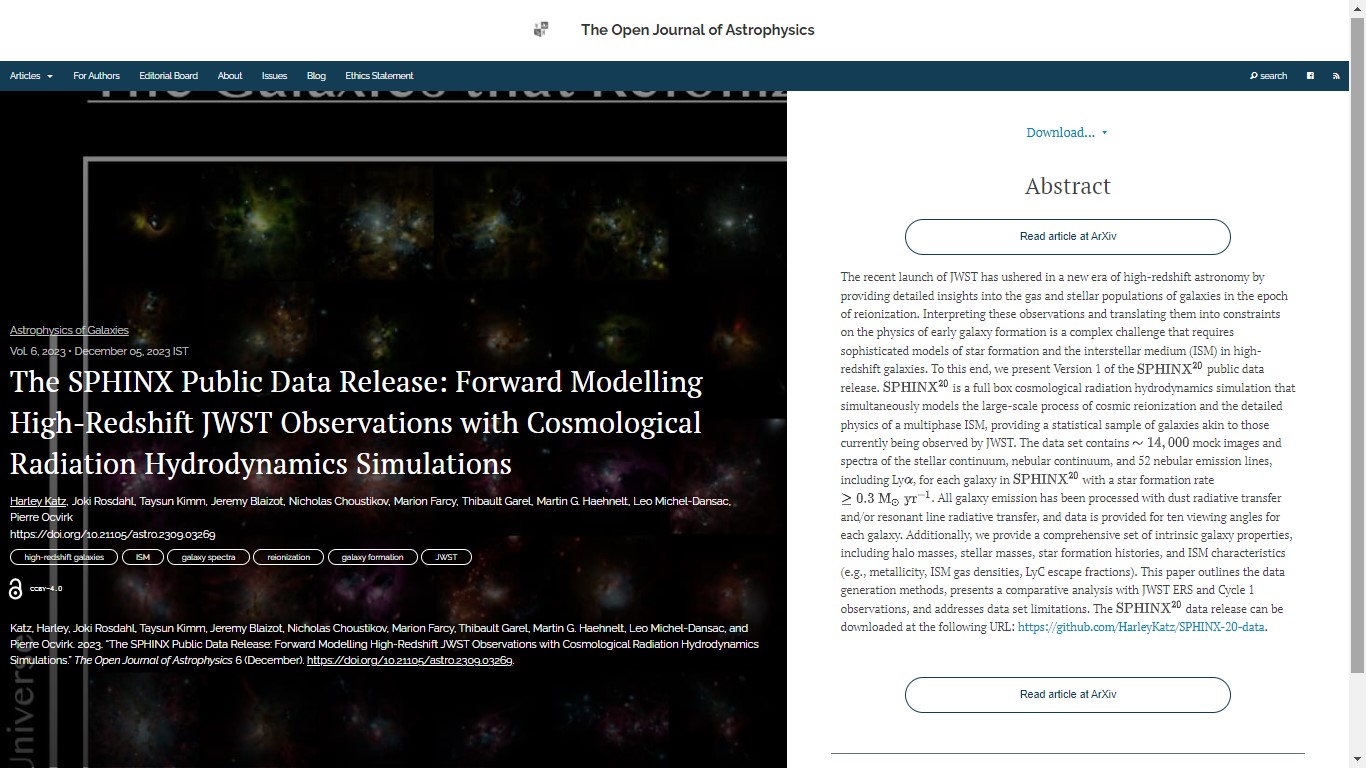
Here is the overlay of the paper containing the abstract:


You can click on the image of the overlay to make it larger should you wish to do so. You can find the officially accepted version of the paper on the arXiv here.

New Views of the Orion Nebula

Posted in The Universe and Stuff with tags , , on October 3, 2023 by telescoper

The Orion Nebula, a stellar nursery about 400 pc away from Earth, is a much-studied object that has yielded considerable insights into the processes of star formation. If you thought that there wasn’t much more to be learned about this object, though, you’d be very wrong. A set of JWST images has been released by the European Space Agency and they are amazing. You can see them all here, but here’s a taster in the form of a detail from one of the pictures. The following image is entitled “Explosion fingers from the BN-KL region in Orion” but to me it looks like demons rising up from the Underworld, like in the last act of Don Giovanni…

Here’s the blurb:

This cutout from the new NASA/ESA/CSA James Webb Space Telescope short-wavelength infrared image of the Orion Nebula shows bright ‘fingers’ of gas racing away from an explosion that occurred roughly 500 to 1000 years ago in the heart of a dense molecular cloud behind the nebula, perhaps as two young massive stars collided. The dense cloud is called Orion Molecular Cloud 1 and lies to the northwest of the visible Trapezium stars in Orion.

The fingers are predominantly red, indicating emission from molecular hydrogen gas that has been shocked by the immense energy pouring out from the explosion site. Near the tips of some of the fingers, the emission turns green due to hot iron gas and even white in some cases where the gas is at its hottest. Further down, the fingers seem mostly turbulent, but in some places, the flow appears laminar.

The Orion Nebula lies roughly 1300 light-years from Earth in the so-called ‘sword’ of the constellation of Orion the Hunter, and the image shows a region that is 4 by 2.75 light-years in size.

Image description: The image shows a series of red fingers of shocked molecular gas expanding from the bottom of the image towards the top and top right. Each of the fingers comprises a series of bright arcs of emission like bow waves, expanding behind tips, the latter often appearing green. There are many stars spread across the image with the characteristic eight spikes due to diffraction in the optics of Webb, and there is a foreground haze of wisp blue clouds due to the Orion Nebula, which lies in front of the fingers.

Two Views of the Ring Nebula

Posted in Cardiff, Maynooth, The Universe and Stuff with tags , , , , , , , , , on August 22, 2023 by telescoper

It’s very nice to have an opportunity, courtesy of JWST, to congratulate astronomers from my current institution (Maynooth, Ireland) and my previous one (Cardiff, UK) – as well as many others – or their involvement in stunning new observations of the Ring Nebula (aka M57 and NGC 6720), a planetary nebula. There is a full story on the Maynooth University website here detailing the involvement of Dr Patrick Kavanagh in the processing of the images and another on the Cardiff University website here about Dr Roger Wesson, who led the programme. Not surprisingly there has been a lot of news coverage about these wonderful images obtained with the NIRCam and MIRI instruments on JWST here in Ireland and in Wales and elsewhere.

A particular excuse for reproducing the pictures here is to try out the fancy “image comparison” tool on WordPress, which allows the reader – that’s you – to slide one picture over the other. Have a go!

This groovy visual shows two images side by side of the Ring Nebula. The image on the left shows the NIRCam view and the image on the right shows the MIRI image. The left image shows the planetary nebula as a distorted doughnut with a rainbow of colours with a blue/green inner cavity and clear filamentary structure in the inner region. The right image shows the nebula with a red/orange central cavity with a ring structure that transitions from colours of yellow to purple/blue. Picture credits ESA/Webb, NASA, CSA, M. Barlow, N. Cox, R. Wesson

The full paper describing these observations can be found on the arXiv here.

A proto-cluster at z ~ 8!

Posted in The Universe and Stuff with tags , , , , on April 26, 2023 by telescoper
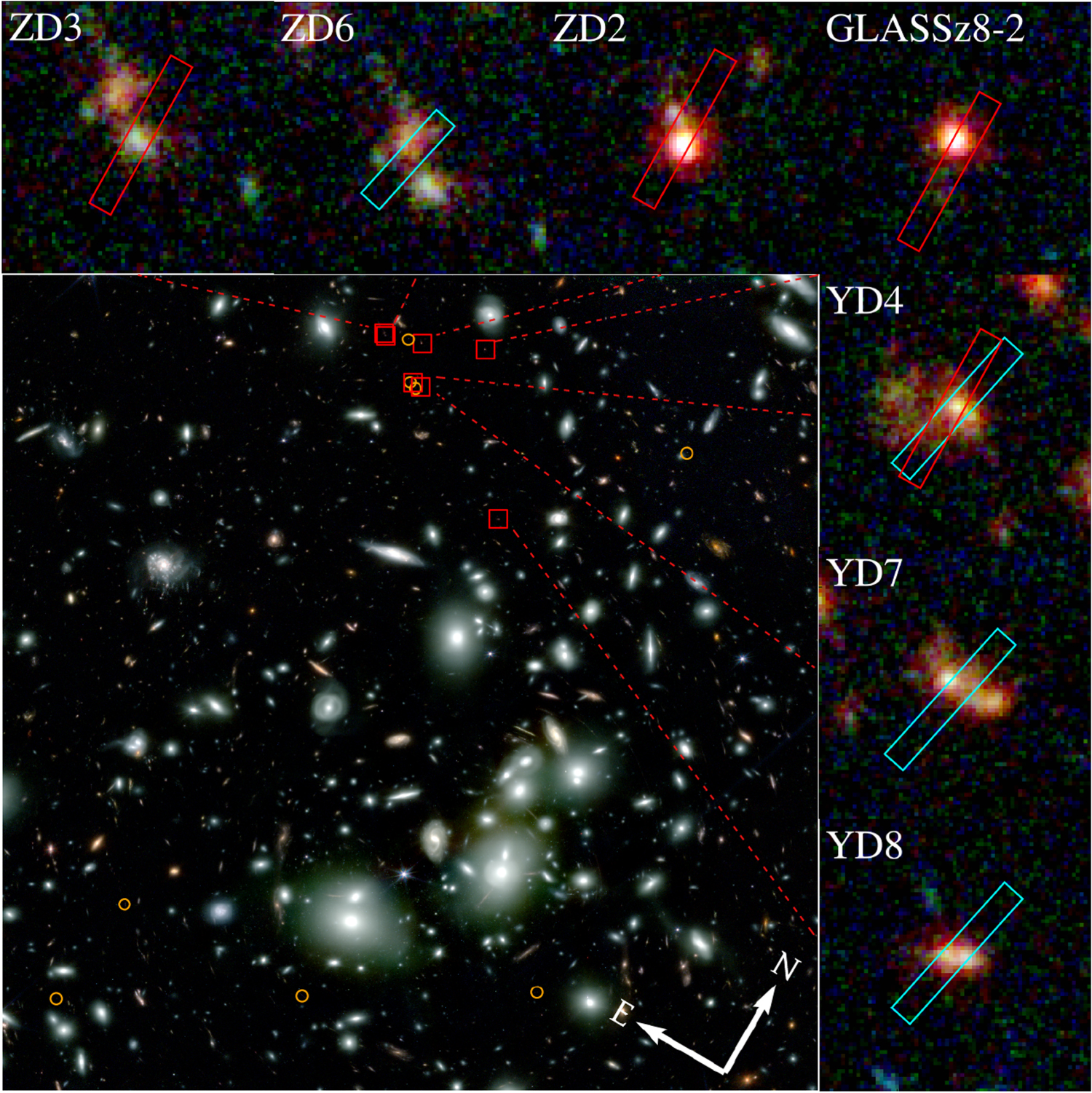
Blow-ups of the seven galaxies with spectroscopic redshifts, shown together with their positions near the line of sight to a foreground cluster.

I missed the paper containing this impressive picture when it first appeared on the arXiv, the primary source for astrophysics and cosmology research, but fortunately it has now been published on a secondary site, Astrophysical Journal Letters, with an accompanying press release so I can now do a quick post about it.

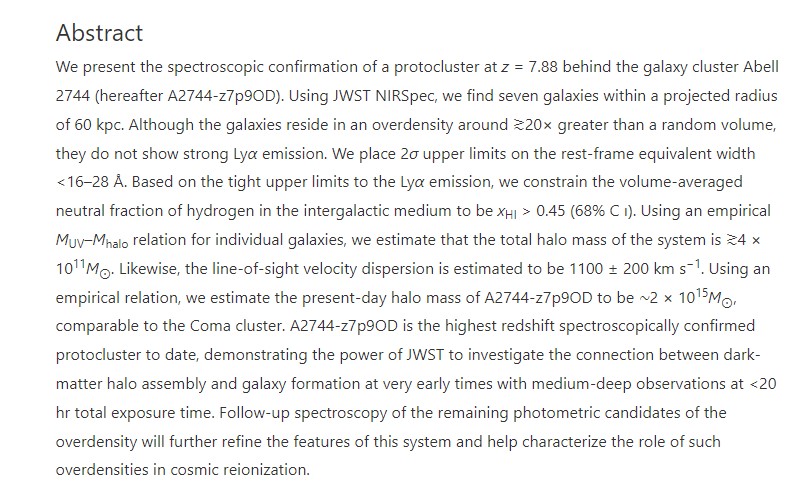
The article concerned, with lead author Takahiro Morishita of the California Institute of Technology (Caltech) et al. describes the detection using JWST of an apparent proto-cluster – seven galaxies in close proximity – at redshift z = 7.88. Here is the abstract:

Although only seven galaxies are identified, this does look like the very early stages of formation of an object that will grow into a giant galaxy cluster by the present epoch. The redshift of this progenitor corresponds to a stage of the Universe just 650 million years or so after the Big Bang, compared with the current age of about 14 billion years. As the abstract says, we would need to know more about other possible constituent galaxies and their motions to be sure, but it looks like a baby destined to grow into a monster…

Spectroscopy of High Redshift Galaxies

Posted in The Universe and Stuff with tags , , , , , on March 28, 2023 by telescoper

The tentative identifications of a number of galaxies at high redshift using JWST on the basis of photometric measurements (see, e.g., here and here) have initiated a huge amount of activity in the extragalactic community trying to establish spectroscopic redshifts for these galaxies. Results of this endeavour have started to appear on the arXiv here with this abstract:

During the first 500 million years of cosmic history, the first stars and galaxies formed and seeded the cosmos with heavy elements. These early galaxies illuminated the transition from the cosmic “dark ages” to the reionization of the intergalactic medium. This transitional period has been largely inaccessible to direct observation until the recent commissioning of JWST, which has extended our observational reach into that epoch. Excitingly, the first JWST science observations uncovered a surprisingly high abundance of early star-forming galaxies. However, the distances (redshifts) of these galaxies were, by necessity, estimated from multi-band photometry. Photometric redshifts, while generally robust, can suffer from uncertainties and/or degeneracies. Spectroscopic measurements of the precise redshifts are required to validate these sources and to reliably quantify their space densities, stellar masses, and star formation rates, which provide powerful constraints on galaxy formation models and cosmology. Here we present the results of JWST follow-up spectroscopy of a small sample of galaxies suspected to be amongst the most distant yet observed. We confirm redshifts z > 10 for two galaxies, including one of the first bright JWST-discovered candidates with z = 11.4, and show that another galaxy with suggested z ~ 16 instead has z = 4.9, with strong emission lines that mimic the expected colors of more distant objects. These results reinforce the evidence for the rapid production of luminous galaxies in the very young Universe, while also highlighting the necessity of spectroscopic verification for remarkable candidates.

arXiv:2303.15431

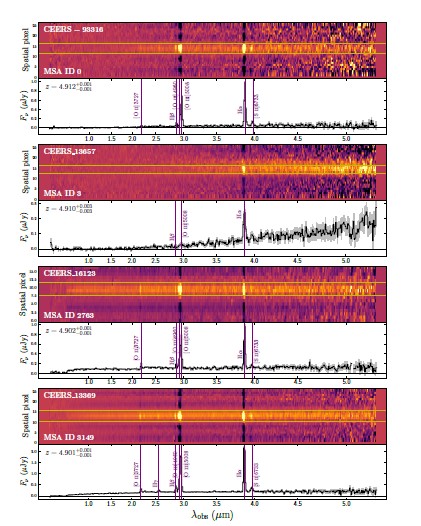
As the abstract explains, the spectroscopic measurements confirm some – but not all – of the galaxies studied to be at high redshift. One galaxy – the one discussed here (known to its friends as 93316) which appeared to have a redshift of 16.6 ± 0.1 now seems to have a much lower redshift of 4.91. Here’s an image of this object:

The redshift 16.6 object was of some interest to cosmologists because an object of large stellar mass at such a large distance is difficult to reconcile with the standard theory of galaxy formation. That is now apparently out of the way, and the remaining high-z galaxies are not as extreme as this one and pose less of a problem.

While this result may disappoint some, and indeed delight others, it is also interesting to note that there are three similar objects at much the same redshift, which may indicate the presence of some sort of group or cluster:

Fascinating!

P.S. It struck me, after writing this, that waiting for spectroscopic confirmation of photometric redshifts is a lot like waiting for VAR to check whether or not to rule out a goal for offside…

A 13-billion-year-old Galaxy Spectrum

Posted in The Universe and Stuff with tags , , , , , on February 16, 2023 by telescoper

The Galaxy GN-z11 has been known for some time to have a very high redshift z~11 (hence the name) but you can now feast your eyes on the exquisite infrared spectrum of this object recently obtained using JWST:

It’s incredible to see so many clear emission lines for an object at such an enormous distance. The light from this galaxy set out towards us over 13 billion years in the past, when the Universe was less than 400 million years old, so it provides clues about the very early stages of cosmic structure formation. The spectral lines can not only be used to establish the redshift with great precision – it is z = 10.603 – but also to probe the physical properties of this source and its environment. The progress in this field is truly remarkable thanks to superb advances in observational technology.

For more details of this amazing result see the paper by Bunker et al now on the arXiv.

How big were the biggest galaxies in the early Universe?

Posted in Biographical, Cardiff, The Universe and Stuff with tags , , , , , , , on August 23, 2022 by telescoper

Once upon a time (over a decade ago when I was still in Cardiff), I wrote a paper with PhD student Ian Harrison on the biggest (most massive) galaxy clusters. I even wrote a blog post about it. It was based on an interesting branch of statistical theory called extreme value statistics which I posted about in general terms here.

Well now the recent spate of observations of high-redshift galaxies by the James Webb Space Telescope has inspired Chris Lovell (who was a student at Cardiff back in the day then moved to Sussex to do his PhD and is now at the University of Hertfordshire) and Ian Harrison (who is back in Cardiff as a postdoc after a spell in the Midlands), and others at Cambridge and Sussex, to apply the extreme value statistics idea not to clusters but to galaxies. Here is the abstract:

The basic idea of galaxy formation in the standard ΛCDM cosmological model is that galaxies form in dark matter haloes that grow hierarchically so that the typical size of galaxies increases with time. The most massive haloes at high redshift should therefore be less massive than the most massive haloes at low redshift, as neatly illustrated by this figure, which shows the theoretical halo mass function (solid lines) and the predicted distribution of the most massive halo (dashed lines) at a number of redshifts, for a fixed volume of 100 Mpc3.

The colour-coding is with redshift as per the legend, with light blue the highest (z=16).

Of course we don’t observe the halo mass directly and the connection between this mass and the luminosity of a galaxy sitting in it is likely to be complicated because the formation of the stars that produce the light is a rather messy process; the ratio of mass to light is consequently hard to predict. Moreover we don’t even have overwhelmingly convincing measurements of the redshifts yet. A brief summary of the conclusions of this paper, however, is that is some of the big early galaxies recently observed by JWST seem to be a big too big for comfort if we take their observed properties at face value. A lot more observational work will be needed, however, before we can draw definite conclusions about whether the standard model is consistent with these new observations.

ChorizoGate: an Accidental Hoax

Posted in Biographical, The Universe and Stuff with tags , , , on August 3, 2022 by telescoper

My Twitter account is usually a quiet backwater of social media, and that’s the way I like it, but there was an unexpected burst of activity and interest in it over the weekend. To amuse myself on Saturday morning I decided to post this on Twitter:

(I deleted my Twitter account some time ago, so have replaced the link with a screenshot.)

I thought a few people might find it funny, but it took off beyond my expectations. By my standards over 5000 likes counts as “going viral” (as you young people say). Most people saw the joke immediately – if you don’t get it, the image is of a slice of chorizo not an astronomical object – and some even joined in with puns and other jokes. Even funnier, some respondents earnestly shared their devastating insight that it was chorizo (or some variant thereof). I honestly didn’t think anyone would think that I was seriously trying to pass it off as a JWST picture; it was just meant to be silly. But there you go. That’s Twitter. I should also report that some people looked at the rainbow flags in my profile and proceeded to indulge in some casual homophobia. That’s Twitter too. Those people all got blocked.

Anyway, the day after I posted the image it seems a prominent French physicist called Etienne Klein who has many times more Twitter followers than I do, posted this embellished version. TRIGGER WARNING – it’s in FRENCH:

Notice the picture is exactly the same. What a coincidence! You might consider this plagiarism; I couldn’t possibly comment. I always regard anything I put on social media as being in the public domain so I’m not really bothered if other people “borrow” it. There’s quite a lot of plagiarism of stuff I’ve written on this blog out there, but life’s too short to get upset about it. Credit would be courteous, but one one learns that it isn’t generally to be expected.

As a matter of fact it’s not a new joke anyway. I didn’t make the picture and don’t remember where I got it from, though it was probably here.

Anyway, the funny thing is that this then got picked up by various other people:

and organisations:

There are others, e.g. here, here, here and here. Also here.

ChorizoGate all took off in a very surprising way. I’m not sure what the moral of this story is, other than if you make a joke no matter how obvious it is there will always be people who take it seriously…

Now a Galaxy at z>16?

Posted in The Universe and Stuff with tags , , , , , , on July 26, 2022 by telescoper

It’s less than a week since I posted an item about an object which is possibly the highest redshift galaxy ever observed (with z ~13) and now along comes a paper describing an object that may be of even higher redshift (with z~16.7). The abstract of the new paper – lead author of which is Callum Donnan of the University of Edinburgh – is here:

As with the previous object the redshift of this one is not obtained via spectroscopy (which usually involves the identification of spectral lines) but via fitting a spectral profile to photometric imaging data seen in different bands. The process for this galaxy is illustrated by this diagram from the paper:

There are 7 images along the top showing the source through various broad band filters. Suitably calibrated these can be converted to the flux measurements shown on the graph. Notice the first three images are significantly fainter than the others, so the first three points on the left of the graph are lower.

If this is a galaxy its spectrum is expected to possess a Lyman Break resulting from the fact that radiation of shorter wavelength than the Lyman Limit (912 Å) is absorbed by neutral gas surrounding the regions where stars are formed in the galaxy. In the rest frame of a galaxy this break is the ultraviolet region of the spectrum but because of the cosmological redshift it is observed in the infrared part of the spectrum for very distant galaxies. In this case the best fit is obtained if the break is positioned as shown, with the first three fainter points to the left of the break and the rest to the right. The break itself is straddled by two observational bands. Employing a number of different estimates the authors conclude that the redshift of this galaxy is z=16.7 or thereabouts.

There is no direct evidence for the sharp edge associated with the Lyman Break – and no spectral lines are observed either – so this all depends on the object being correctly identified as a high-redshift galaxy and not some other object at lower redshift. You have to assume this to get a redshift, but then all inferences are based on assumed models so there’s nothing unusual about this approach. The authors discuss other possibilities and conclude that there is no plausible alternative source. Take away the green template spectrum and you just see a spectrum that rises to a peak and falls again. The authors claim that there is no plausible low-redshift source with such a spectrum.

Anyway, here is a composite colour image of the source:

So is this now the earliest galaxy ever observed? And what object will I be asking this question about next week? One thing I can predict is that there are going to be many more such objects in the very near future!