I’ve commented many times before on this blog about runaway expenditure on management resulting in the diversion of resources away from the core missions of a university, i.e. teaching and research, while producing no significant improvement in the efficiency, and indeed often a deterioration, of administrative processes. David Graeber wrote a book called Bullshit Jobs about this phenomenon. Management response to this is generally to assert that this administrative bloat is a response to regulatory burden. Many of us working in higher education would instead argue that the entire sector has been hijacked by self-serving parasites who are deliberately sucking the lifeblood out of the system.
I just came across a paper on the Physics and Society section of arXiv that tries to explain management bloat from the point of view of systems theory. The title is What Leads to Administrative Bloat? A Dynamic Model of Administrative Cost and Waste, the authors are Vicky Chuqiao Yang and Levi Grenier of MIT and the abstract is here:
The functioning of complex systems depends on the coordination of diverse components, often supported by regulatory structures that incur costs. In human organizations, such costs manifest as administrative burden, which has been rising despite often reducing efficiency. Classic explanations point to bureaucrat self-interest or regulation, yet they do not explain variation across organizations or clarify how this burden can be reduced. Here, we develop a dynamical model of administrative growth that integrates known behavioral mechanisms of process creation, obsolescence, and removal. The model conceptualizes processes as developed for problem solving, but becoming obsolete as conditions change, while continuing to consume resources until actively pruned. This interplay generates two long-term outcomes: stable equilibrium or run-away growth. The threshold separating these outcomes is shaped by organizations’ propensity to create new processes when faced with problems, and their propensity to prune obsolete ones in response to administrative burden. Importantly, their effects are asymmetric: sufficiently high creation propensity leads to bloat regardless of pruning propensity. Faster environmental change shifts this threshold, making bloat more likely. Simulations of interventions show that lasting reductions in administrative costs and waste require permanent shifts in priorities and investments in distinguishing obsolete from useful processes. Temporary efforts or indiscriminate cuts provide only short-lived relief, and counterintuitively, prioritizing direct production can increase waste. Our work highlights a general mechanism by which well-intentioned problem-solving can create self-reinforcing inefficiencies in complex systems, offering insights possibly generalizable to broader applications, such as legal, policy, and software systems where obsolete elements accumulate.
Here’s a a figure from the paper that provides ample illustration of the problem:
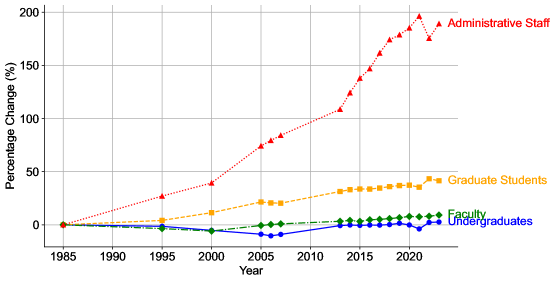
You will find a similar phenomenon on display at universities across the world. In my view this is a large part of the crisis engulfing higher education in the United Kingdom.
It’s an interesting paper, based on a very simple model. The authors also suggest various ways in which this burden could be reduced. The problem with that is that there is no incentive at all for The Management (who hold all the power) to improve the situation, as that would involve eliminating the bullshit jobs held by many of their cronies. With university governance structures notoriously weak and compliant, who manages the Managers? The most likely response from my University would be to appoint a new Vice-President for Self-reinforcing Inefficiency…


