Archive for Maynooth University

The Term Ahead

Posted in Covid-19, Education, Maynooth with tags , , , , on January 28, 2021 by telescoper

After a recent Government announcement that current Covid-19 restrictions would be extended until at least March 5th, this morning we received the expected communication from the University authorities that almost all our teaching at Maynooth University would be online until March 22nd at the earliest. This is because the half-term “study break” is from 15th to 19th March (to include St Patrick’s Day) and there would be no point in trying to get students back for one week (8th-12th March) before breaking up for the following week. In fact, if I had to bet money on it I would say we’ll probably be online all the way through to the summer, and possibly beyond, but that decision has not been made yet.

To nobody’s surprise we’re also going to have online examinations in the summer again. We’ve done two rounds of these already so are getting used to them now so that’s not a problem.

The St Patrick’s Day break was basically when we flipped – by which I mean “changed teaching methods” rather than “went mad” – last year so at least we’ve already got teaching prepared for the second half of the forthcoming semester if Level 5 restrictions do continue.

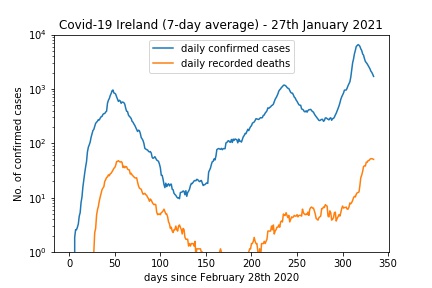
I am actually a bit annoyed at the politicians for making hints about when the restrictions might end. It is clearly far too early to be talking about that. Here are yesterday’s numbers:
If you prefer them on a linear scale here they are:
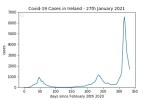
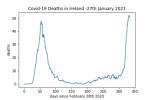
New cases have fallen significantly since the latest peak but at least part of that is due to the fact that automatic close contact tracing couldn’t cope and was abandoned. Testing positivity rate has fallen to around 8.2% (from over 20%) , hospital admissions admissions are falling, and deaths may have peaked, so the evidence suggests there is a is a reduction, but the numbers are still way too high. They need to come down to much less than a 100 before any lifting of restrictions can be contemplated. At the current rate of decline that will take many weeks.  Suggesting opening up is going to happen soon will only make people impatient and reduce compliance.

Teaching term at Maynooth starts on Monday (1st February) and I have three modules to deliver, one of them a module I’ve never given before. Because there has been so much to do behind the scenes since Christmas I don’t think I’ll ever have started a term feeling so exhausted. The cycle of academic life carries on remorselessly despite the fact that everything takes longer to do under Covid-19 restrictions. It is an effort just to keep up.

Still at least we’ve all still got jobs to do and are still getting paid. It’s time to knuckle down and focus on reaching the mid-term break in one piece and then seeing where we go thereafter.


There’s a Moose Loose Aboot this Hoose!

Posted in Covid-19, Maynooth, Music with tags , on January 8, 2021 by telescoper

Artist’s Impression

I am working from home at the moment owing to Covid-19 restrictions on campus activity but I have been informed by on campus staff that an unauthorized mouse bas been seen in the Department of Theoretical Physics. This is a very serious situation as access to the Science Building is for essential work only and this does not include rodents, even if they have a PhD. Furthermore, the mouse is not wearing a face mask and, from what I have heard, is not observing proper sanitary procedures.

More importantly, our Covid-19 protocols require all visitors to the Department to be in receipt of a letter authorizing their presence. I have contacted Human Rodent Resources and no such letters have been issued.

I have therefore instructed all staff and students in the Department that if they see this mouse they should instruct it to leave and that any refusal to comply will be met with disciplinary action, initially taking the form of a formal written warning but escalating if necessary to a meeting with Maynooth University Library Cat.

There now follows a  message concerning these developments from Professor Brian Dolan.

I hope this clarifies the situation.

Remote Exam Time

Posted in Education, Maynooth with tags , , , on January 7, 2021 by telescoper

It’s the day before the start of the January examination period at  Maynooth University so I thought I’d do a quick post on the topic of examinations or, as they are right now, online timed assessments.

First, for readers elsewhere, full-time undergraduate students at Maynooth what is called 60 “credits” in a year, usually split into two semesters of thirty credits each. This is usually split into 5-credit modules with an examination in each module at the end of each semester. Projects, and other continuously-assessed work do not involve a written examination, but the system means that a typical student will have at least 5 written examination papers in January and at least another 5 in May.  This is very similar to the system in most UK universities that I am aware of except that a full year’s work over there is 120 credits so there’s a conversion factor of 2:1. A 5-credit module in Ireland would be a 10-credit module in the United Kingdom, for example, but otherwise the system is similar.

Each examination is usually of two hours’ duration. We’ve kept that length after moving examinations online, although students are given extra time to scan and upload their answers. The question papers themselves have been slightly adapted online use by having much less “bookwork”. Generally these asssessments are unsupervised and students are allowed to consult notes and textbooks so there is little point in asking them to copy out standard derivations and formulae. That means we can concentrate on the problem-solving aspects of theoretical physics, which are the most interesting bits (and perhaps the most challenging).

One big difference between our examinations in Theoretical Physics in Maynooth and those at other institutions I’ve taught at in the UK is that most of the papers here offer no choice of questions to be answered.  A typical format for a two-hour paper is that there are two long questions, each of which counts for 50 marks. Elsewhere  one normally finds students have a choice of two or three questions from four or five on the paper.

One  advantage of our system is that it makes it much harder for students to question-spot in the hope that they can get a good grade by only revising a fraction of the syllabus. If they’re well designed, two long questions can cover quite a lot of the syllabus for a module, which they have to in order to test all the learning outcomes. To accomplish this, questions can be split into parts that may be linked to each other to a greater or lesser extent to explore the connections between different ideas, but also sufficiently separate that a student who can’t do one part can still have a go at others. With such a paper, however, it is a  dangerous strategy for a student to focus only on selected parts of the material in order to pass.

As an examiner, the Maynooth style of examination also has the advantage that you don’t have to worry too much if one question turns out to be harder than the others. That can matter if different students attempt different questions, but not if everyone has to do everything.

But it’s not just the number of questions that’s important, it’s the duration. I’ve never felt that it was even remotely sensible for undergraduate physics examinations to be a speed test, which was often the case when I was a student. Why the need for time pressure? It’s better to be correct than to be fast, I think. I always try to set examination questions that could be done inside two hours by a student who knew the material, including plenty of time for checking so that even a student who made a mistake would have time to correct it and get the right answer. If a student does poorly in this style of examination it will be because they haven’t prepared well enough rather than because they weren’t fast enough.

The structure of the Maynooth examinations at more introductory level is rather different, with some choice. In my first year module on Mechanics & Special Relativity, for example, there is a compulsory first question worth 50 marks (split into several pieces) and then the students can pick two out of three shorter questions worth 25 marks each. This is a somewhat gentler approach than with the more advanced papers, partly adopted because we have quite a few students doing the General Science degree who taking Mathematical Physics as one of their 4 first-year subjects but will not be taking it further.

As both my examinations are not until next week, I’ll have to wait to find out how my students have done. This will be the examination taken at University level for most of my class, so let me take this opportunity to pass on a few quick tips.

  1. Try to get a good night’s sleep before the examination!
  2. Be ready well before the start and try to ensure you won’t be disturbed for the duration.
  3. If you’re doing an unsupervised examination
  4. Read the entire paper before starting to answer any questions. In particular, make sure you are aware of any supplementary information, formulae, etc, given in the rubric or at the end.
  5. Start off by tackling the question you are most confident about answering, even if it’s not Question 1. This will help settle any nerves.
  6. Don’t rush! Students often lose marks by making careless errors. Check all your numerical results on your calculator at least twice and – PLEASE – remember to put the units!
  7. Don’t panic! You’re not expected to answer everything perfectly. A first-class mark is anything over 70%, so don’t worry if there are bits you can’t do. If you get stuck on a part of a question, don’t waste too much time on it (especially if it’s just a few marks). Just leave it and move on. You can always come back to it later.

Oh, and good luck to anyone at Maynooth or elsewhere taking examinations in the next few weeks!

P.S. It snowed overnight in Maynooth, although only a centimetre or so…

Three Years in Maynooth

Posted in Biographical with tags , , on December 1, 2020 by telescoper

It’s 1st December 2020 which means that it’s now been three whole years since I started my job as Professor of Theoretical Physics in the Department of Theoretical Physics at Maynooth University, in County Kildare in the Irish Republic.

Until the Summer of 2018 I was working part-time at Cardiff and part-time in Maynooth, which required a lot of flying to and from between Wales and Ireland.  That situation would have been impossible to sustain during the pandemic for reasons of quarantine and also because FlyBe went bust. The timing of my move to Maynooth was providential in many ways apart from that.

I didn’t think it would take me the best part of three years to buy a house in Ireland, but owing to a combination of circumstances it took until the end of this summer to do that. Still, all’s well that ends well and I’m very happy with my home.

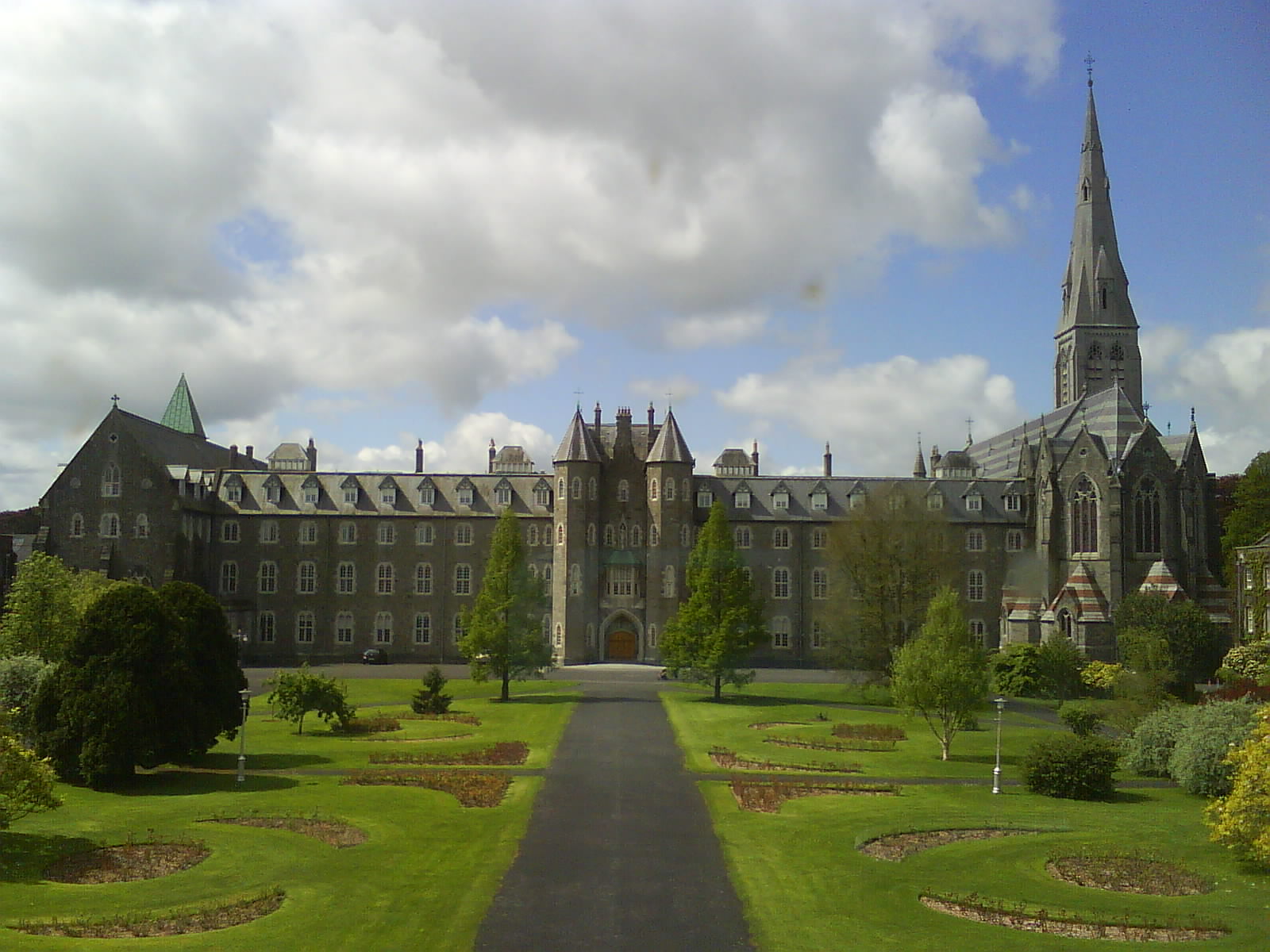
When I first arrived in Maynooth I stayed in St Patrick’s House (above), part of the Roman Catholic seminary on Maynooth University’s South Campus. I took this picture of the corridor I was on the night I arrived because it reminded me of  The Shining:

The arrival of the Covid-19 Pandemic earlier this year has been another completely unexpected development. I wonder what fate has next in store?

Maynooth University Open Days!

Posted in Education, Maynooth with tags , , on November 26, 2020 by telescoper

It’s almost time once again for our autumn open days at Maynooth University. This autumn the two days are virtual events but also differ in that the first day is devoted to clubs, societies and other wider aspects of student life while the second is dedicated to information about the academic side, i.e. courses of study.

I’ve recorded some video material that will be used on the second day and I’m also going to be online on Saturday from 10am to 2pm to answer questions from prospective students. In order to experience these and other delights you have to register, which you can do here.

Here is a video tour of the Maynooth University campus, filmed in better weather!

You will see that it includes an artist’s impression of the new building on the North Campus which isn’t actually finished yet, but which is coming along nicely.

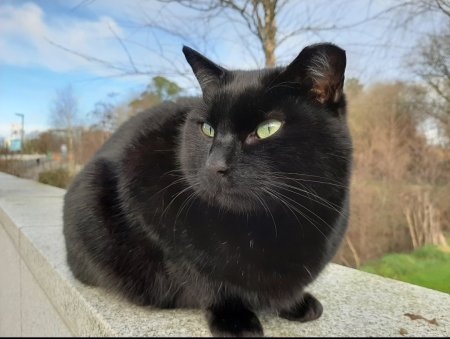
And here is a gratuitous picture of our star attraction:

Maynooth from the Air

Posted in Maynooth with tags , , , on October 12, 2020 by telescoper

I came across this video of drone footage of Maynooth and surroundings and thought I’d share it here. There are plenty of shots of the St Patrick’s College and parts of Maynooth University as well as the town itself and  Carton House. Judging by the state of progress of the new University building and the colour of the Virginia creeper I’d say this was filmed very recently. Enjoy!


Who will be the next President?

Posted in Maynooth with tags , , on October 11, 2020 by telescoper

The question on everyone’s lips here at Maynooth University is who will take over from Professor Philip Nolan when his ten-year term as President of the University comes to an end in August next year.

Over the last few months the current President has had to combine the duties of his office with those as Chair of the Epidemiological Modelling Advisory Group within the National Public Health Emergency Team (NPHET).

Whoever gets the job will face tough challenges even if the Covid-19 has improved by next summer because the University’s finances will have been seriously affected by the pandemic, as will those of many other institutions. That said, it is still a great opportunity in a lovely part of the world.

To quote from the advert

Following impressive growth over the past 10 years under the leadership of Professor Philip Nolan, the Governing Authority is now seeking to appoint a new President to lead this outstanding University and to build on its strategic role at regional, national and international levels. Coming at a time of great change and challenge, the new President will be expected to create, articulate and deliver, in a collegial manner, a shared vision for the future to drive the continued development of Maynooth University.

If you’re interested in applying you can find the details here.

Plan B for Teaching

Posted in Covid-19, Education, Maynooth with tags , , , on September 21, 2020 by telescoper

Yesterday’s Covid-19 figures for Ireland were a bit of a shocker, with 396 new cases (241 of them in Dublin). The latest 7-day average is 283.1 new cases per day. We haven’t seen figures like this since April. Here’s the latest log-linear graph:

Just a reminder: I keep a complete record of the daily figures here.

The surge in cases in Dublin is the the reason for the imposition of additional restrictions. Although we’re not in Dublin, many of our students travel to campus from the areas of West Dublin where the rate of infection is high (such as Tallaght) so Maynooth University has decided to ‘escalate protective measures‘. This means, among other things, that the maximum class size for in-person lectures on campus is 30.

So this morning I’ve been grappling with the implications of this for our teaching plans in the Department of Theoretical Physics. Student registrations are coming in now and though they are not complete we have a much better idea of how many students we will have in each class. The limit of 30 really just makes a difference to second year Mathematical Physics modules where the class size is around 40. We had intended to teach these all together but now they will need to be split into two groups to be taught separately. It will also impact our teaching for Engineering and Product Design, both of which have more than 30 students in class.

The remaining issue is the first year Mechanics & Special Relativity module MP110 which is a much larger class that I’d already decided to split into three groups. The problem would arise if the size of these groups exceeded the capacity constraints. First-year registration has not yet finished but it looks at the moment that we’ll be OK with Plan A. Possibly.

One of the difficulties will be communicating the arrangements to new students in time for the start of lectures on Monday 28th September, a week today. It is important that we don’t have students turning up for sessions to which they have not been assigned. There will be a lot of messages flying around about this for the rest of this week and over the weekend. Even even set up a departmental Twitter feed which you can follow here:

If the situation in Dublin (and nationally) continues to deteriorate we may well be back in the situation in which we found ourselves in March, with everything going online but that isn’t where we are at the moment. The limit of 30 on class sizes is a challenge, but it is our intention that lectures in Theoretical Physics will go ahead on campus starting next Monday.
How long it will take to move to Plan C is anyone’s guess.

Points and Offers

Posted in Education, Maynooth with tags , , , , on September 13, 2020 by telescoper

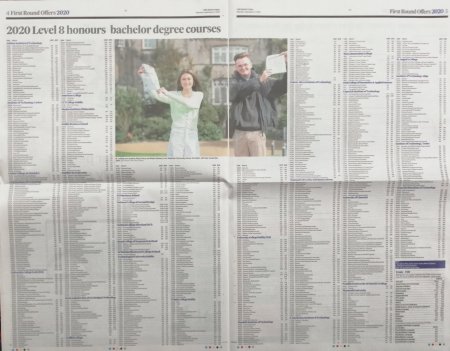
I spent a bit of time yesterday poring over the CAO offers supplement in the Weekend edition of the Irish Times. The extensive listings, of which the above picture shows just part, show the minimum number of points needed for first round offers at Ireland’s third-level institutions. Students who have met the requirements for a course they applied to have until 16th September to decide whether to accept. There is then another round of offers starting a week later on 23rd September and closing on 25th September.

Much has been made of the increase in points needed for many courses since last year. That is indeed borne out by the table, though many of the increases are relatively small.

The denominated programme in Theoretical Physics and Mathematics at Maynooth University, for example, is up 22 points on 510 from last year’s 488 but that’s not an exceptionally high figure in historical terms.

On the other hand, offers for both Mathematics and Theoretical Physics at Trinity College are both down on last year (to 531 from 566 and from 565 to 543, respectively).

There are other courses here and there that have gone down too. I suspect part of the reason for this is that some courses have been allocated extra places and have had to drop their points to recruit the additional students.

Finally I noticed that the first-round points for Equine Business at Maynooth University are unchanged on last year at 357. That may not be the final offer, though. There is probably quite a lot of horse-trading in store…

Asynchronous and Public Lectures

Posted in Education, Maynooth with tags , , , , , on September 11, 2020 by telescoper

This morning I came across a very interesting blogpost by Philip Moriarty which is mainly about teaching quantum mechanics but also includes some discussion of his ideas of how he plans to conduct teaching for the forthcoming semester at the University of Nottingham.

We are in a rather different situation here at Maynooth University with Covid-19 different rules, different numbers of students and different levels of resource in terms of teaching software and equipment, but I think the primary constraints are similar.

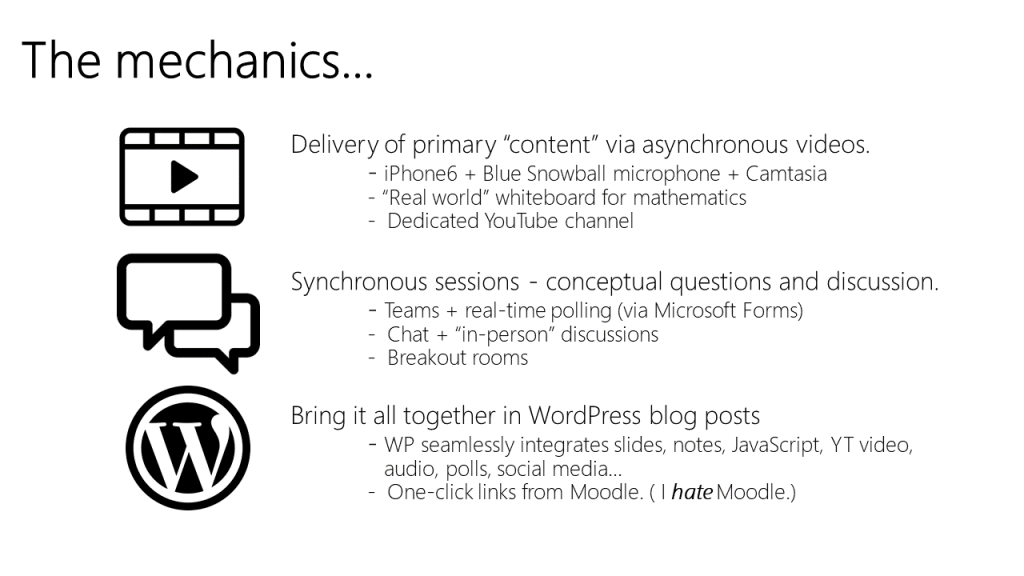
Here is is graphic Philip uses to outline the major elements of teaching he plans to adopt (copied without permission):

I think the University of Nottingham has, in common with many other UK universities, moved all its large lecture classes online. Here in Maynooth we’re restricted by physical distancing to have an absolutely maximum of 50 people in any lecture theatre at one time, so effectively the big classes will be online too. However, many of our smaller classes and tutorials will be on campus `face-to-face’ sessions. Since Theoretical Physics is a relatively small Department many of our modules will run pretty much as normal.

This are a bit different for the first year Mathematical Physics module which I teach (MP110) where the class last year was about 90 students. This class will have to be split, but I am still planning to deliver face-to-face lectures for all students in some form. There are three lectures a week in this class and I’ll probably have to have about one third of the students in each session: the other sessions will be streamed and recorded – assuming our newly-installed Panopto system works (!) – and made available to students not at the class. In addition students will get a tutorial per week, also in person.

I have thought a lot about this over the last few months and I’ve decided that the main `lectures’ (which will be with fewer than 30 students) will not be lectures but more like `workshops’ where I illustrate the main results that I would have given in a “normal” lecture using examples as well as getting students to work on problems in class.

Like Philip I plan to record videos of the “primary content” offline, probably in my office, so the students can view them at their leisure. I decided to record these primarily because I think the production quality of such lectures would be better. I’ve used Panopto before and it’s OK, but it has its limitations. I don’t have access to all the equipment Philip talks about, but at least in my office I can re-take and edit the video whenever I mess up (which will be quite frequently, I’m sure). These won’t be 50-minute lectures as I find that not having the interaction with the audience, going back over things when it’s clear they haven’t understood, giving them problems to try in class, etc, the time taken to cover the material in a video is far shorter.

Making these `asynchronous’ is, I think, extremely important. Timetabling teaching sessions looks likely to be extremely complicated for the forthcoming semester so I think it’s far better to make the content available for students to study wherever and whenever they want.

So my plan is that students will get each week:

  • A set of pre-recorded videos covering the material for that week
  • One interactive workshop on campus
  • Access to recordings of two other workshops
  • A full set of lecture notes
  • Coursework examples (assessed)
  • One tutorial on campus
  • A virtual office hour with the lecturer (me) for Q&A

It’s not the same “as normal” but I think it provides the best blend of learning approaches possible under the constraints we will have to operate. Note also that some students may be “at very high risk” for health reasons and consequently unable to come onto campus. The approach I have outlined here means that such students will miss as little as possible.

Unlike Philip, I don’t hate Moodle, so this will be where all the course materials will be made available. It will also be the principal channel of communication with the class.

Like Philip, though, I am in favour of putting all the primary content on Youtube so that anyone who wants to access it can do so. I have suggested this before and it received mixed reactions, but for me it’s more a point of principle. As my teaching is funded by the public purse, it seems reasonable to me that what I produce should all be in the public domain wherever possible. That obviously excludes some teaching activities (e.g. labs and tutorials) but I don’t see why I shouldn’t do it with lectures or other video content. I won’t make the workshop videos public, because they may accidentally identify students who do not wish to appear on a video.

I know many of my colleagues disagree with this, so here’s the unscientific poll I’ve been running to see what people think. Not that the voting will change my mind….