Archive for Maynooth University

Maynooth University Library Cat (and Bat) Update

Posted in Maynooth with tags , , , on November 27, 2025 by telescoper

On my way to lunch today I saw Maynooth University Library Cat trying the well-known “staring at an empty dish” ploy. It worked, as it always does..

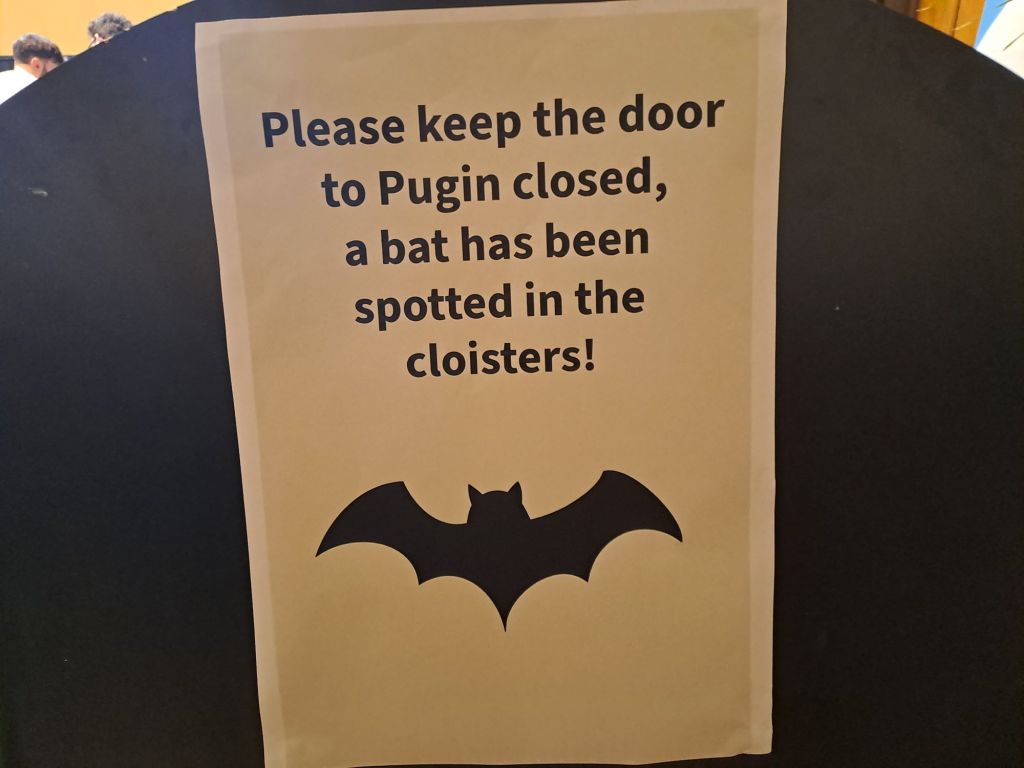
When I got to Pugin Hall for my own lunch I was confronted by this

I didn’t see the bat in question.

P.S. WordPress just told me that this is my 7,500th blog post!

A month to go

Posted in Artificial Intelligence, Biographical, Education, mathematics, Maynooth with tags , , , , , on November 25, 2025 by telescoper

I’ve been a bit preoccupied these recent weeks so it was with a shock that I realised that we’re into Week 9, which means just four weeks (including this one) until the end of term and just a month before Christmas. Teaching finishes here in Maynooth on Friday 19th December, but I don’t have any lectures on Fridays so in my case it will finish the day before (with a tutorial). I don’t know how many students will be there, but the module concerned is my 4th year Mathematical Physics module and the students are very hard-working, so I think most will attend. After such a busy term I’m sure that they will need a break as much as I will.

I had to rejig the schedule for both modules I am teaching this semester to accommodate the introduction of in-class tests to replace take-home assignments (for reasons I outlined here). I’ve also been handing out voluntary exercises for practice, not counting towards the module mark but for formative reasons. Both modules are mathematical in nature, and I think the best way to learn mathematics is by doing it…

Despite the changes with respect to last year, I am still roughly on track. In my Engineering Mathematics module I’ve just finished Laplace transforms, and will start Fourier methods tomorrow. With the mathematical physicists, I am in the middle of complex analysis, having done complex differentiation and conformal mappings and starting complex integration next week.

I still have a couple more class tests to get through. On the positive side, the students are turning up for them and have expressed approval for the fact that they don’t have compulsory homework to do off-campus. This form of assessment is undoubtedly harder work for the students, it’s also better preparation for the examination that take-home assignments.

We’ve just received the draft examination timetable for January, and I’m pleased that both of the examinations for which I am responsible will take place quite early in the examination period (on 12th and 15th January, respectively) so I should be able to get them corrected in time to have a break for some research before teaching resumes at the start of February.

Visiting Speaker

Posted in Maynooth, OJAp Papers, Open Access, The Universe and Stuff with tags , , on November 21, 2025 by telescoper

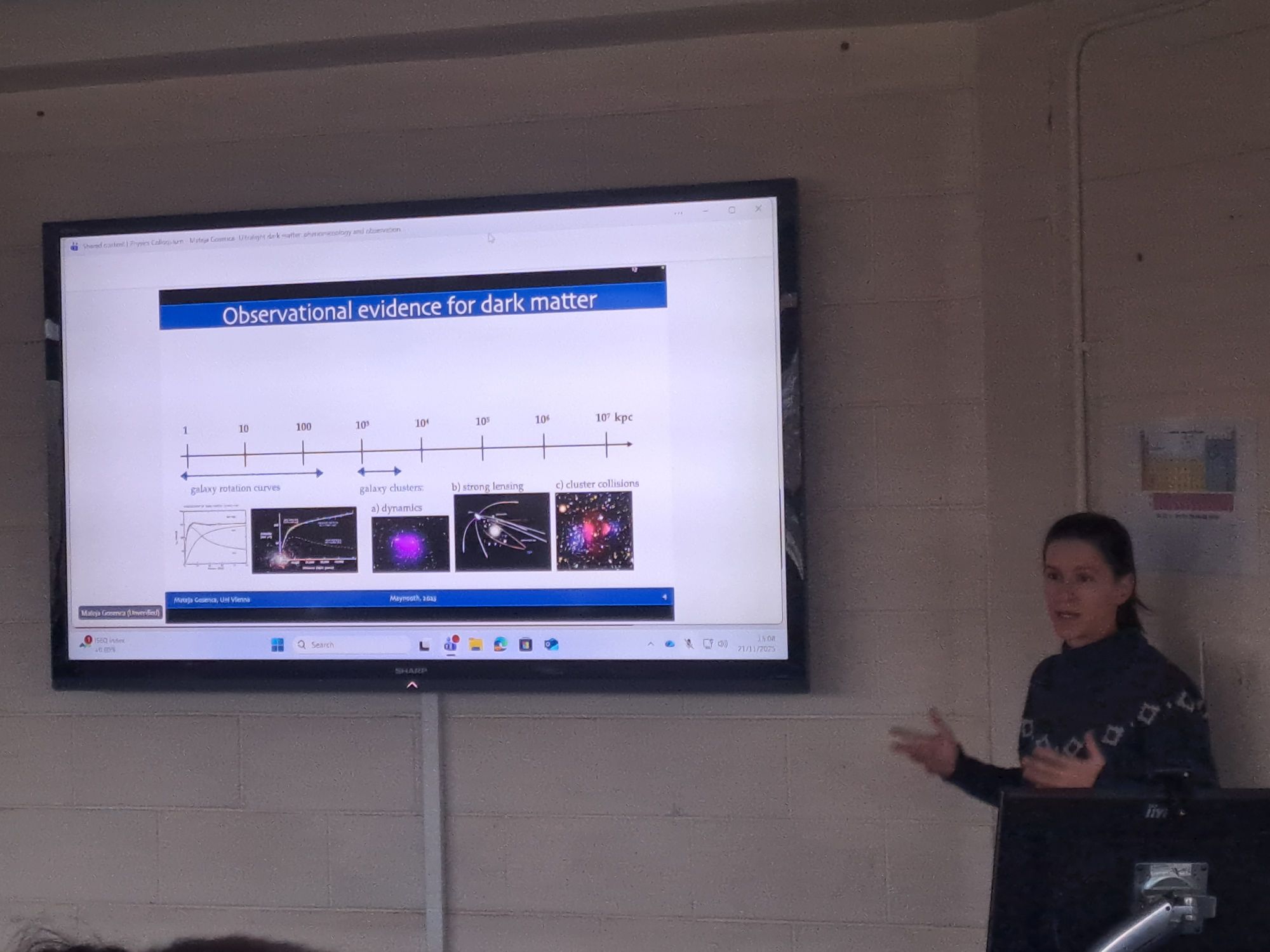
I’ve been playing host today to my former PhD student, now at the University of Vienna, Mateja Gosenca, who gave a talk on “Ultralight Dark Matter: Phenomenology and Observational Constraints”. Mateja did an MSc at the University of Sussex before doing a PhD under my supervision, so it is very nice to have her visit us in Maynooth.

It was only when I started to think about how to introduce her Colloquium that I remembered that Mateja was co-author of the very first paper published by the Open Journal of Astrophysics, way back in 2016. At that time we were running an experimental prototype site before switching to the Scholastica platform we now use, but it was still a landmark. We’ve now published 415 papers.

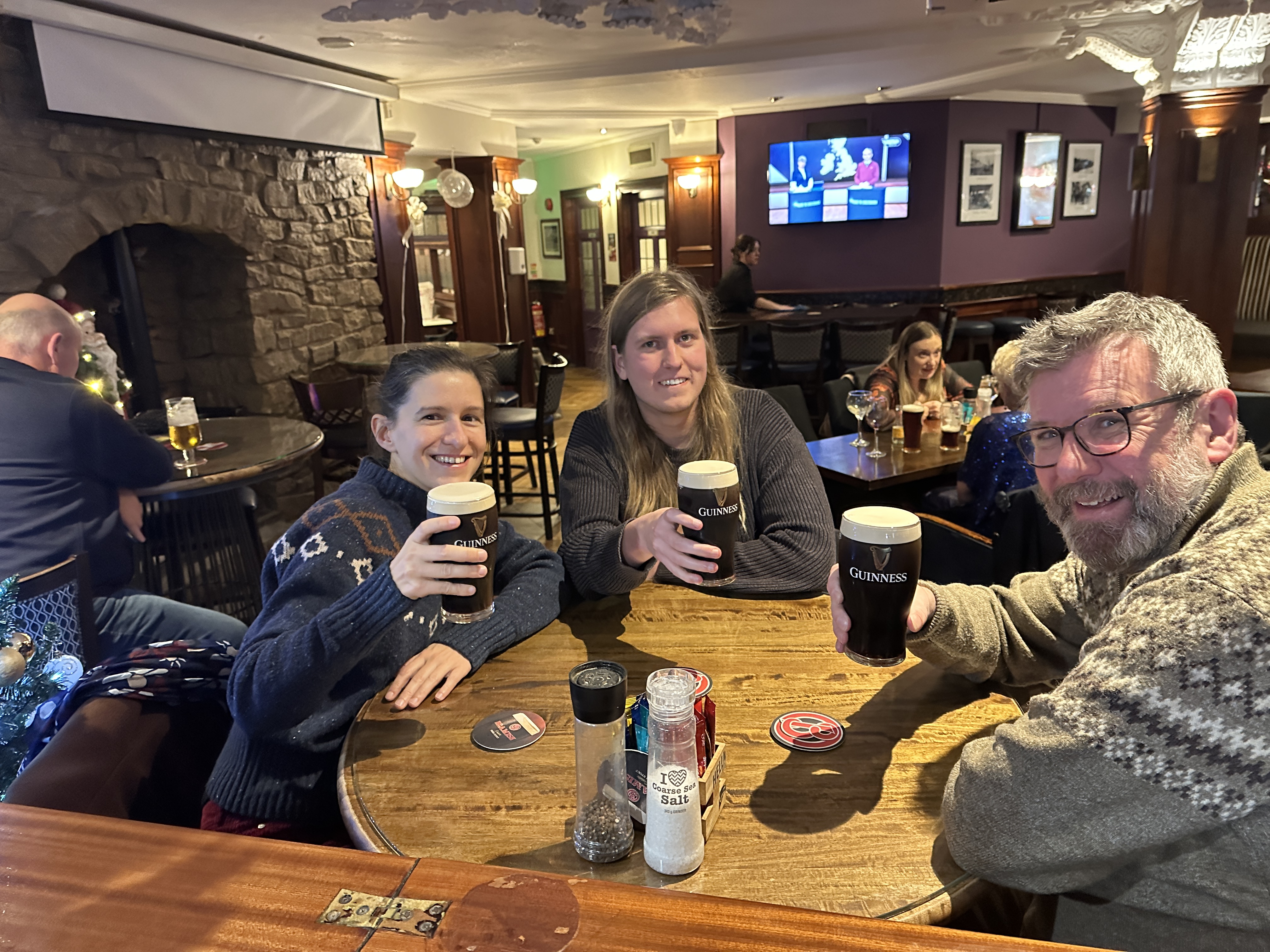
Update: Obligatory pub photograph

Queen’s University Belfast and Dundalk IT (not Maynooth?)

Posted in Education, Maynooth with tags , , , on November 19, 2025 by telescoper

A couple of years ago I posted an item about the news of a proposed merger of Maynooth University and Dundalk Institute of Technology. That piece began with the following:

Life is full of surprises, especially if you’re a member of academic staff at Maynooth University.

Today it was revealed that the institution that employs me is planning to merge with Dundalk Institute of Technology. It was revealed not in a direct message to staff, but through an article in the national media, in this case the Sunday Independent. The article there is paywalled but there is another piece here.

This is astonishing news, not least because of the way it has come out. Yet again, the only way that staff at Maynooth can find out what’s going on is through the newspapers. Senior Management don’t deign to inform us of anything…

Not surprisingly I hadn’t heard anything about how the proposed merger was progressing except for a couple of items in the national media. For example, in May this year, there was an announcement of the formation of a Regional Graduate Academy linking postgraduate education in Dundalk and Maynooth.

Today, however, I saw another news item announcing that Dundalk IT has now decided to become a College of Queen’s University Belfast. It explains:

The new partnership between Queens University Belfast and Dundalk Institute of Technology is not a “parent child relationship,” and represents the first “all-Ireland university”, the Minister for Further and Higher Education has said.

DkIT is set to become a University College following the agreement with QUB, which will see it change from an IT to a University College of Queen’s University Belfast.

What does this new new relationship between DkIT and QUB mean for the old new relationship between DkIT and Maynooth University? Have they called the Maynooth-Dundalk merger off? Or will the three institutions form a ménage à trois?

Don’t ask me. I only work here. Perhaps I’ll be able to find out by reading the newspapers.

P.S. Coincidentally, the next “President’s Update” for staff at Maynooth, scheduled for December, has been postponed until the New Year.

P.P.S. It is about 80km from Belfast to Dundalk and about 100km from Dundalk to Maynooth.

It’s LGBTQIA+ STEM Day!

Posted in LGBTQ+, Maynooth with tags , , , , on November 18, 2025 by telescoper

Just a quick post to point out that today is LGBTQIA+ STEM Day, which aims to celebrate  to celebrate the work of LGBTQIA+ people in science, technology, engineering, and mathematics (STEM), but also to highlight the barriers still facing us.

For more information see here.

This also provides an opportunity for me to send my best wishes to all LGBTQIA+ staff and students at Maynooth and around the world! As far as I know, my Employer is not marking this occasion. This surprises me as it is not unknown for them to engage in pinkwashing from time to time, whenever it suits them for some reason.

P.S. I’m reminded that it was 22 years ago today that Section 28 was finally repealed in England and Wales. With reactionary fforces around the world attacking our hard-won rights, it is important that we cling on to what we’ve got.

After Conferring

Posted in Biographical, Maynooth with tags , , on October 30, 2025 by telescoper
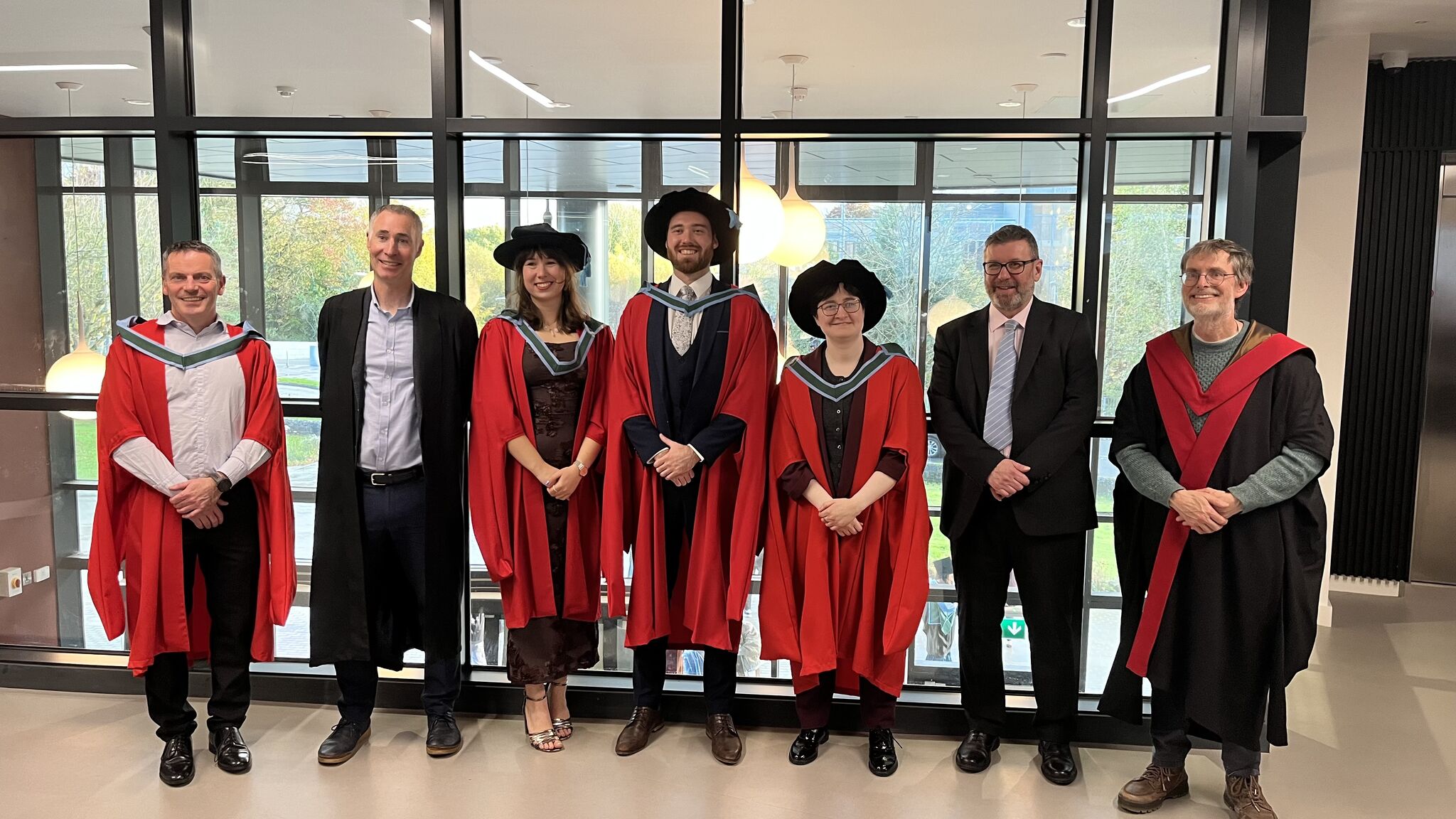
from left to right: Dr Neil Trappe (HoD, Physics); Dr John Regan; Dr Aoibhinn Gallagher; Dr Matthew Birney; Dr Hannah O’Brennan; me; Dr Jonivar Skullerud

Yesterday I attended a conferring ceremony at Maynooth which was a very special occasion because it involved the formal award of the PhD degree to Aoibhinn Gallagher whom I supervised. Two other research students from the Department of Physics got their PhDs yesterday too; Matthew Birney and Hannah O’Brennan. Matthew (ESO Garching) and Aoibhinn (Bielefeld) both now have postdoctoral positions in Germany, incidentally.

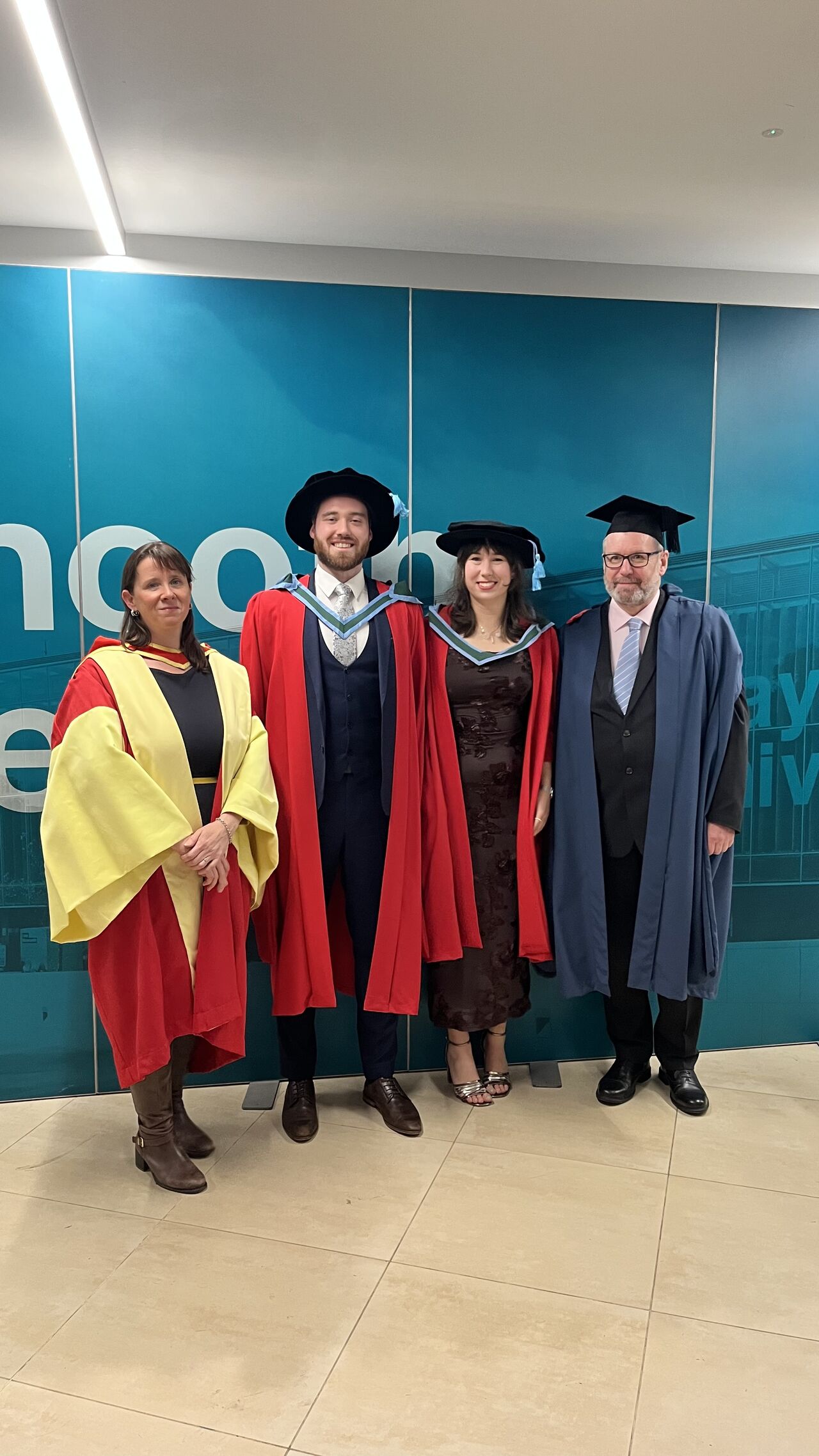
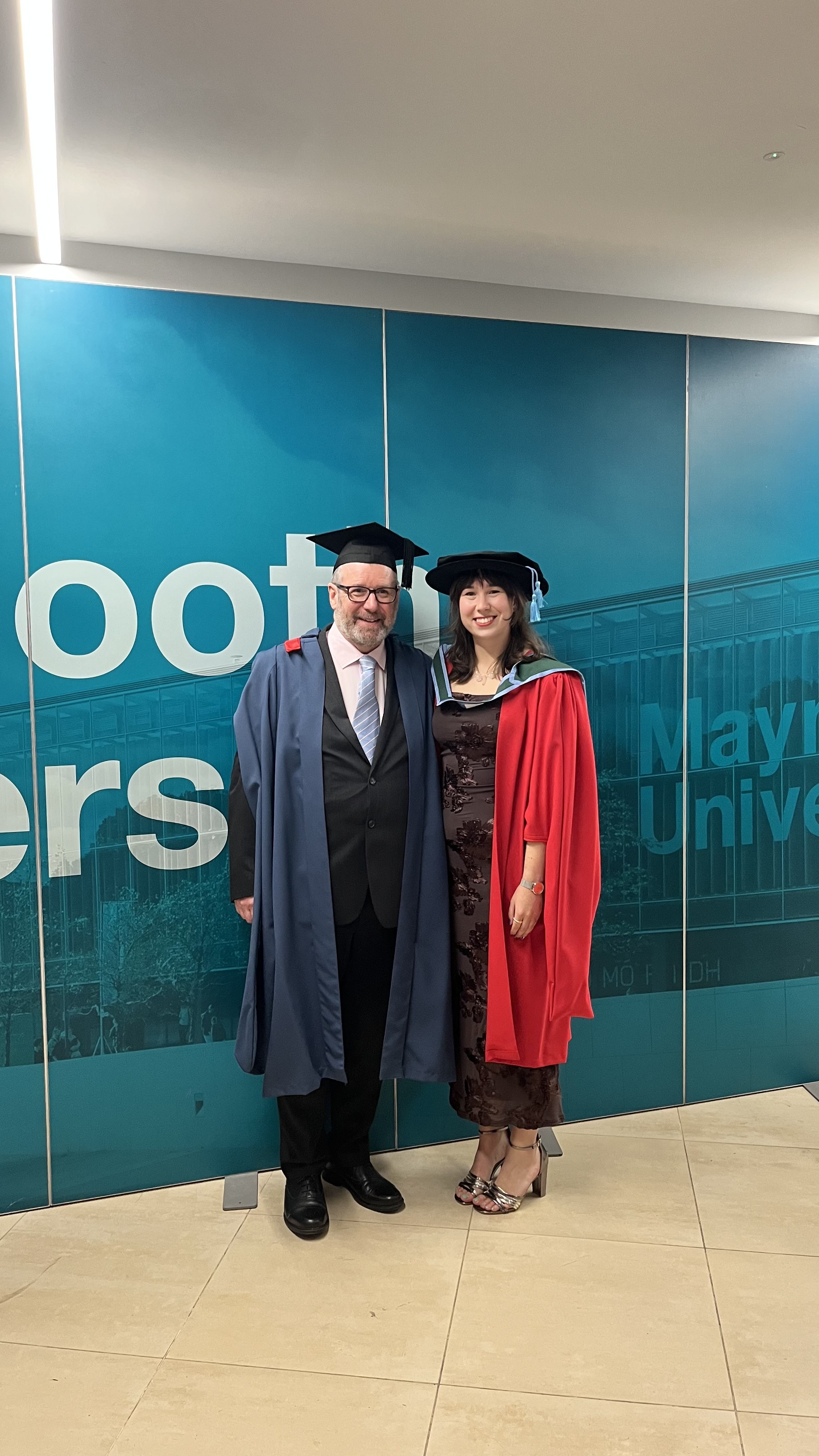
These events are not actually called Graduation Ceremonies here in Ireland but Conferring Ceremonies. I was impressed that the local suppliers of academic dress, Phelan Conan were able to supply the correct 1989 vintage DPhil gown from Sussex University as opposed to the less interesting modern one. I would have worn it for the picture above, but by the time we found Hannah to take the photo I had already returned it to the supplier. Here are two more with myself in the gown and mortarboard:

You can see a picture of me wearing the same sort of gown in Brighton back in 1989, when I was a skinny young queen, here. I’ll add more pictures from yesterday if and when I get them.

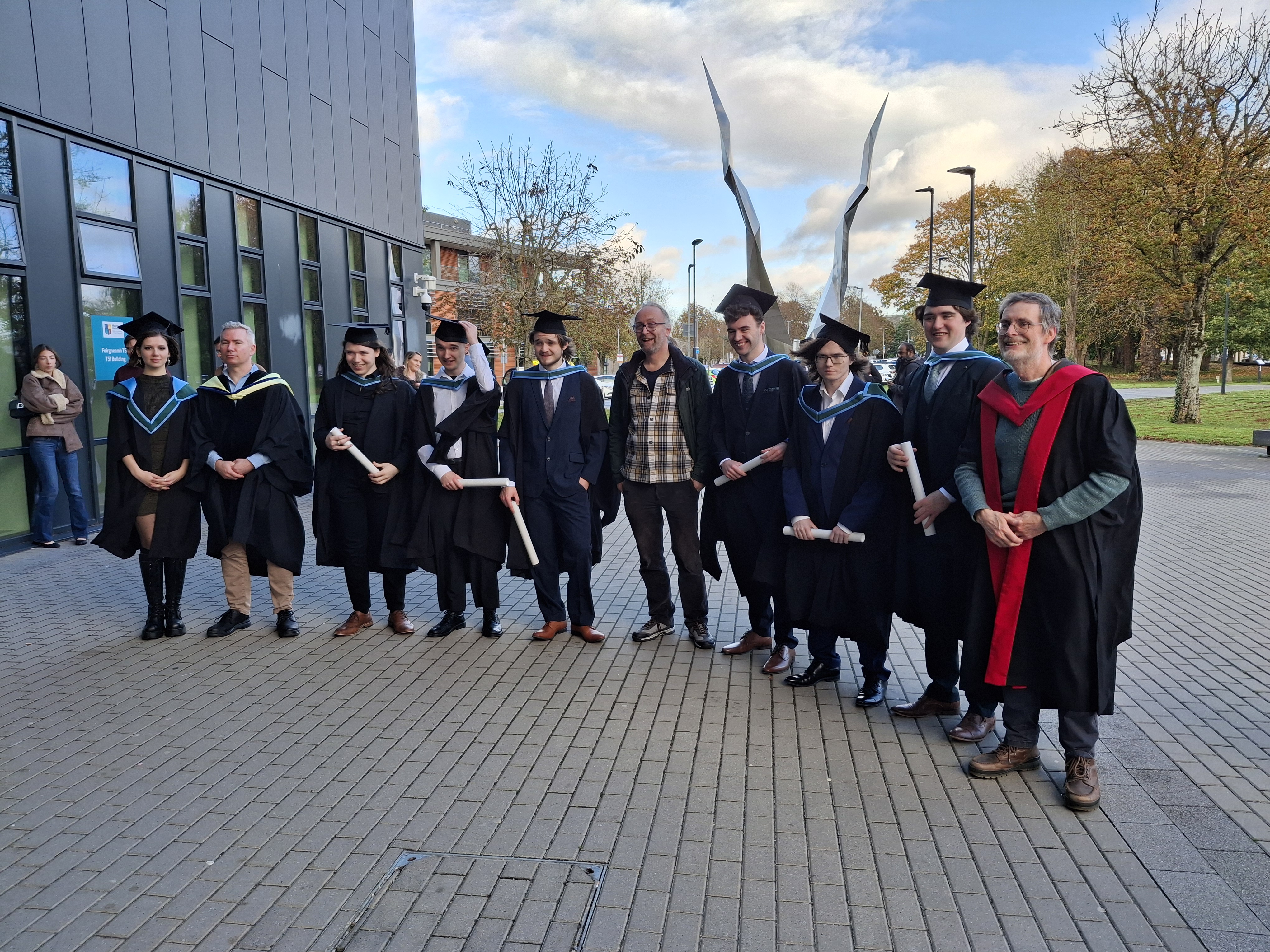
As well as the PhDs we also saw the entire class of our MSc in Theoretical Physics and Mathematics get their degrees. I haven’t got any photographs of them, but will add any that I find. Here is a photograph of them outside the TSI building, courtesy of Jonivar Skullerud.

After the ceremony, those who got their degrees went for dinner with their respective parents, siblings and others who had come to attend the ceremony. We did meet up later on, however, in a local pub for a drink or several. In among all that I didn’t have time to write a post, bringing to an end a blogging streak of 109 days.

Graduation ceremonies are funny things. With all their costumes and weird traditions, they even seem a bit absurd. On the other hand, even in these modern times, we live with all kinds of rituals and I don’t see why we shouldn’t celebrate academic achievement in this way.

I like graduation ceremonies, actually. As each person walks across to be presented with their scroll you realize that every one of them has a unique story to tell and a whole universe of possibilities in front of them. How their lives will unfold no-one can tell, but it’s a privilege to be there for one important milestone on their journey, even those from other departments with whom you have had no contact at all.

I always find these ceremonies bittersweet occasions, though. There’s joy and celebration, of course, but these are tempered by the realization that many of the young people whom you’ve seen around long enough to grow accustomed to their faces, will disappear into the big wide world, in some cases never to be seen again. Although everyone is rightly proud of the achievement – either their own in the case of the graduands or that of others in the case of the guests – there’s also a bit of sadness to go with the goodbyes. It always seems that as a lecturer you are only just getting to know students by the time they graduate, but that’s enough to miss them when they go.

Anyway, all this is a roundabout way of saying congratulations once more to everyone who graduated yesterday, including Matthew, Hannah and Aoibhinn, and I wish you all the very best for the future!

Back to Teaching and Coping with GenAI

Posted in Artificial Intelligence, Education, mathematics, Maynooth with tags , , , , on September 21, 2025 by telescoper

Summer is well and truly over: it’s a chilly day in Maynooth; the Autumnal Equinox takes place tomorrow; and tomorrow I return to teaching at Maynooth University. So begins my antepenultimate academic year as a university teacher.

I’ve often remarked how the academic year at Maynooth is largely defined by the astronomical phenomena of the equinoxes and solstices. This year demonstrates this perfectly: Semester 1 lectures for undergraduates begin tomorrow (22nd September), the day of the Autumnal equinox; they end on Friday 19th December with the Winter Solstice on 21st. The half-term study break coincides with Samhain, a cross-quarter day. It’s all refreshingly pagan.

This time last year, having been away on sabbatical the year before, I was preparing to teach two new modules. I have those two again this year so this year should be a bit easiest than last year. I still have to get everything sorted out, though, including setting up my Moodle pages and preparing the materials, which is what I’ve been doing today.

The timetable for my Engineering Mathematics (EE206 Differential Equations and Transform Methods) module has not changed, so my first lectures on that (a double session) are not until Tuesday. I’m also doing MP469 Differential Equations and Complex Analysis for 4th Year Mathematical Physics students again, but the lecture times for that have changed. That is because, as a consequence of the merger of the Departments of Theoretical Physics and Experimental Physics to form a single Department of Physics, times have been coordinated as far as possible to ensure that Physics students can have flexibility in their choice of theoretical or experimental-based modules. The Engineering Mathematics module has not changed because the times for those lectures are such as to fit with the needs of the Department of Engineering, rather than Physics.

The upshot of all this is that my first lecture of the new term is for MP469, tomorrow afternoon at 2pm and my second is also MP469, at 11am on Tuesday. This means that I have three hours of lectures on Tuesdays this term, but at least that makes it possible to have a day without teaching (Wednesday).

You will notice that both the modules I am teaching this term are mathematical in nature. I have been concerned about the integrity of the coursework element of these modules in the light of improvements in Generative AI. Only a couple of years ago GenAI could not solve the sort of problems I set for homework, but now it generally can – especially for EE206. I don’t altogether object to people applying artificial intelligence to solve mathematical problems, but the issue is that it does make mistakes. Moreover, instead of saying “sorry I can’t solve that problem” it will generally present a superficially plausible but incorrect solution. Although students will probably use GenAI for problem-solving, I think it is important that they learn to do such problems themselves, otherwise they won’t know whether the solution coughed up by the algorithm is correct or not. That way lies disaster.

The only way to learn mathematics is by doing it. If students get GenAI to do the mathematics for them, then they won’t learn it. In the past we have given marks for coursework (usually 20% of the module mark) mainly to encourage students to do them. Students who don’t bother to do these exercises generally do badly in the final exam (80%).

For these reasons I am moving the assessment from weekly homework sheets – which could be tackled with AI – to supervised in-class tests for which students can use notes on paper, but not laptops or phones, just like they would in the final examination. I will of course give examples for the students to have a go at themselves, and I will give feedback on their attempts, but they will not contribute to the module score. Another advantage of this approach is that students won’t have to do so much work against deadlines outside of class.

Anyway, that’s the approach I am going to try. I’d be interested to hear what others are doing to deal with GenAI. The Comments Box is at your disposal.

P.S. There is a rumour circulating that The Rapture will occur on Tuesday 23rd September, but it is as yet unclear whether this will happen before, during, or after the lectures I am due to give on that day.

Maynooth University Library Cat Update

Posted in Maynooth with tags , on September 17, 2025 by telescoper

With Term Approaching…

Posted in Biographical, Maynooth with tags , , on September 7, 2025 by telescoper

With just two weeks to go before we resume teaching at Maynooth University, I find that next week I have no fewer than three medical appointments next week, on different days and in different locations. All of them are (or should be) routine, and none are particularly serious. Much as I dislike hospitals, etc, it will be good to get these bits of scheduled maintenance out of the way before the start of term.

On the other hand, they mean that I have to miss what looks like a very nice meeting in Italy in honour of Sabino Matarrese. I was invited, and initially accepted, but had to cancel. I hope that it goes well!

For old time’s sake I thought I’d post this picture of a youthful Sabino from years ago; he’s in the middle of the row nearest the camera; I’m at the end in the yellow shirt.

Anyway, last Friday our first cohort of MSc students in Theoretical Physics and Mathematics received their final results. This course lasts a calendar year so the results come out later than for the undergraduate courses. Congratulations to them all, but especially to Enda who completed a project under my supervision that we hope to turn into a paper before long.

Some familiar faces will no longer be around, but soon we will be joined by some new ones. Tomorrow, registration opens up for incoming first-year students at Maynooth and later in the week for returning second-, third-, and fourth-year students. By this time next week we’ll have a much better idea how many students there will be in our classes for the new academic year.

On Friday (12th September) I’ll be off to the National Concert Hall for the 2025/6 Season Opener with the National Symphony Orchestra conducted by Leonard Slatkin, another indication that Autumn Semester is nigh.

A Hitchhiker’s Guide to the Swampland

Posted in Maynooth, The Universe and Stuff with tags , , , , , on September 5, 2025 by telescoper

A very comprehensive review article has appeared on arXiv with the title Hitchhiker’s Guide to the Swampland: The Cosmologist’s Handbook to the string-theoretical Swampland Programme by Kay Lehnert (who just happens to be my PhD student). The paper is 170 pages long and contains over 1,800 references, which gives some idea of what a large field this is and how much work Kay has put into writing it!

This is Figure 3 from Kays paper. If you would like to know more of what it is about, turn to page 50…

The abstract reads

String theory has strong implications for cosmology: it tells us that we cannot have a cosmological constant, that single-field slow-roll inflation is ruled out, and that black holes decay. We elucidate the origin of these statements within the string-theoretical swampland programme. The swampland programme is generating a growing body of insights that have yet to be incorporated into cosmological models. Taking a cosmologist’s perspective, we highlight the relevance of swampland conjectures to black holes, dark matter, dark energy, and inflation, including their implications for scalar fields such as quintessence and axions. Our goal is to inspire cosmological model builders to examine the compatibility of effective field theories with quantum gravitational UV completions and to address outstanding cosmological tensions such as the Hubble tension. This comprehensive literature review presents clear definitions, cosmological implications, and the current status – including evidence and counterexamples – of the following swampland conjectures: the anti-de Sitter distance conjecture (AdSDC), the completeness conjecture (CC), the cobordism conjecture, the de Sitter conjecture (dSC), the swampland distance conjecture (SDC), the emergence proposal (EP), the Festina Lente Bound (FLB), the finite number of massless fields conjecture (or finite flux vacua conjecture (FFV)), the no global symmetries conjecture, the no non-supersymmetric theories conjecture, the non-negative null energy condition conjecture, the positive Gauss-Bonnet term conjecture, the species scale conjecture, the gravitino swampland conjecture (GSC), the tadpole conjecture, the tameness conjecture, the trans-Planckian censorship conjecture (tPCC/TCC), the unique geodesic conjecture, and the weak gravity conjecture (WGC), including the repulsive force conjecture (RFC).

This is essentially the literature review part of Kay’s thesis; the aim of his research is to study the implications of the string-theoretical swampland programme for cosmology. He’s particularly interested in the predictions string theory makes regarding inflation, dark energy, and dark matter, and the impact this has on the Hubble tension. The point of writing this review was to suggest projects that might be undertaken to bring string theory into the realm of testability, thus suppling material for the rest of Kay’s thesis, but I think it is also a very good guide for cosmologists of all types to what the swampland conjectures are and what they do and do not say about the Universe we actually live in.