Archive for Mental Health

A Campus Incident

Posted in Biographical, Maynooth, Mental Health with tags , , on February 5, 2025 by telescoper

I received an alarming “All Staff” email yesterday from Maynooth University that contained the following:

 I am writing to inform you of a serious incident on South Campus last night (Monday, February 3rd). An individual entered the campus and engaged in unprovoked physical altercations against a small group of students and staff. Based on our current understanding, this appears to be an isolated incident. The suspect has been arrested, and the Gardaí are investigating.  

That was all it said about the nature of the incident which took place on Monday evening at about 18.50. The University was closed all day Monday for the Bank Holiday and I knew nothing about it until I received the email. I found the lack of information very concerning. More details were available in the local news (e.g. here), however, including the fact that a person had been arrested and charged and was due to appear in the District Court at Naas this morning. The fact that the matter was in front of the courts was no doubt the reason no further information was disclosed to staff.

After the hearing, the case was covered in the usual court reporting (e.g. here) which reveals that the victim of the serious assault was a priest who needed treatment in hospital; three students were also attacked and some property damaged. The accused was charged with four counts of assault causing harm, two counts of criminal damage and one count of burglary; he has a history of psychiatric problems and was remanded without bail for evaluation in the medical wing of Cloverhill prison. It seems the individual concerned may have experienced some kind of psychotic episode.

All we can hope is that the victims recover speedily from their injuries and the shock caused by such an episode. I hope they all receive counselling. This looks like very much like a failure of Ireland’s mental health system to take proper care of the person responsible. In the long term I hope that he gets proper treatment. That way at least some good might come out of this awful incident.

Mental Health and Graduate Studies

Posted in Biographical, Mental Health with tags , , , , , , , , on October 3, 2024 by telescoper

There has been a lot of comment on social media about a recent article in Nature about the mental health of graduate students and the numbers looking for treatment. There are many sources of stress that can have a negative effect on mental health, including financial pressures and poor accommodation to name but two. These aren’t really specific to graduate studies. One that is is the pressure to produce results. That actually continues throughout an academic career – burnout is a very real phenomenon – but it’s probably worse during the “apprenticeship” phase when one is inexperienced and still learning the trade.

“Productivity” is indeed important but should not be interpreted as having to work ridiculously long hours. I remember many years ago commenting on an article that claimed 80-100 hours a week was not unusual. There are people who can sit at their desks for 12 hours a day without producing anything very much at all. It’s not the hours that matter, but what you do with them. In no way will indulging your outside interests (sporting, cultural, political, or “other”…),  or simply relaxing, detract from your ability to do research. As a matter of fact, I think such diversions actually improve your work, as well as (of course) your general well-being.

I think it is fair to say that you have to work hard to do a PhD. I worked hard on mine back in the day. But don’t think that means it has to be a grim slog. I can only speak for myself, but I greatly enjoyed my time as a graduate student. I think this was at least in part because when I was doing my PhD I had plenty of outside interests (including music, sport and (ahem) “nightlife”)  and took time out regularly to indulge them. I did experience mental health problems later during my PhD, but these were not caused by being a research student.

I can think of many times during my graduate studies when I was completely stuck on a problem – to the extent that it was seriously bothering me. On such occasions I learned to take a break. I often found that going for a walk, doing a crossword, or just trying to think about something else for a while, allowed me to return to the problem fresher and with new ideas. I think the brain gets into a rut if you try to make it work in one mode all the time.

There were indeed many times during my time as a research student – and have been since – that I worked extremely long hours – all night sometimes. I wouldn’t say exactly that was because I “enjoyed” it, but that I wanted to know an answer and couldn’t get the problem out of my head.  I’ve stayed up into the early hours of the morning trying to finish a crossword too. Not because I had to, but because I couldn’t put it down unfinished. I know that makes me a saddo in many minds, but I think that’s the sort of obsessiveness and tenacity a researcher needs: becoming so absorbed by the task in hand that you don’t notice the passage of time.

I don’t think anyone should try to infer too much from these personal reflections, but I do think there’s one important point that I try to point to every graduate student I advise and that is to look after your mental health. Perhaps the Nature article has a positive side, in that at least graduate students are seeking help. Recognizing that you might have a problem is a very important first step.

Bullying and Harassment in Astronomy – The Report

Posted in Harassment Bullying etc, LGBTQ+ with tags , , , , , on May 19, 2024 by telescoper

As I advertised a few days ago, The Royal Astronomical Society has now released its report on Bullying and Harassment in Astronomy. You can download the full report (40 pages, PDF) here. I recommend you to read it as the statistics are stark. Here are a couple of graphical summaries from the RAS Website:

Note the greater prevalence of bullying and harassment directed towards LGBT astronomers.

The recommendations include the introduction of more effective bullying and harassment policies, procedures and safeguards to protect all colleagues, to support students, and to ensure that everyone can achieve their potential and work in a safe and satisfying environment, regardless of their background.

Noble sentiments, but the Royal Astronomical Society can do little itself to change policies, as it is not in the position of employer (except for its own staff in Burlington House) and there is no incentive for the universities and research institutions who employ most astronomers to comply. That will only happen if serious sanctions are imposed for mishandling bullying and harassment cases.

My view – born out by experience – is that it can’t be left to individual institutions to deal with this problem. In case after case, instead of dealing properly with bullying and harassment, senior managers have protected the perpetrators and silenced the victims. Reputation management, they call it. What is needed to start with is a system of independent adjudication, as recommended, for example, by the 21 Group.

This problem is neither confined to astronomy nor to the United Kingdom, and at least part of it is due to the ever-increasing cult of managerialism that places institutional branding ahead of positive workplace culture, paying at most lip-service to the latter.

The Hate is still Out There

Posted in Biographical, LGBTQ+, Mental Health with tags , , on May 21, 2023 by telescoper

A few days ago I mentioned on this blog the case of a gay teenager in Navan being beaten up by boys from the same school; there was a news report here. Five youths were subsequently arrested but have now been released without charge. I felt a strong sense of dismay when I heard the news of their release, as the decision to let them go seemed to declare open season on homophobic violence. It may however because the assailants have to be treated as minors.

Press coverage related to this story has generally condemned the sharing on social media of a video showing the violent assault. There are quite a few people, however, including me, who think that the Gardaí would not have taken any action at all had they not been shamed into doing so by the publicity generated by the video.

Regular readers of this blog will probably understand why this case resonates with me: a similar thing happened to me way back in the 1980s. There are differences, of course. For one thing, I was rather older – in my mid-twenties rather than mid-teens. For another, the incident wasn’t reported to the police. There wasn’t any point in those days. The Brighton police at that time were notorious for dismissing complaints of gay-bashing despite the fact it was an endemic problem. People I knew who had reported such incidents usually found themselves being investigated rather than their assailants. In those days the law did not recognize homophobic offences as hate crimes. Far from it, in fact. Attacking a gay person was, if anything, considered to be a mitigating circumstance. This attitude was fuelled by a number of high-profile cases (including a number of murders) where gay-bashers had been acquitted or charged with lesser offences after claiming their victim had provoked them.

Another difference is that I didn’t go to hospital. I had a black eye, a fat lip and a lot of bruises, and had been unconscious for a time, but there didn’t seem to be any serious physical damage. The psychological effects were far from negligible, though, and I have experienced intermittent mental health problems ever since, sometimes needing to be hospitalized for psychiatric treatment. You can read about this here; a short summary is that I should have got help with this much earlier. The important thing now is that the boy who was targeted in Navan gets proper treatment and counselling. I wish him a speedy recovery.

Here’s something I wrote in 2010 after in the blog post describing my own experience of homophobic violence:

Now fast-forward about 20 years. Attitudes have definitely changed, and so has the law. Certain types of criminal offence are now officially recognized as hate crimes: the list treats sexual orientation as equivalent to race, gender, religious belief and disability in such matters. The Police are now obliged to treat these with due seriousness, and penalties for those found guilty of crimes exacerbated by homophobia are consequently more severe.

Recently, there are increasing signs of a backlash against LGBT+ people, most obviously in America but also here in Ireland. Much of this is fueled by toxic rhetoric of the Far Right who seem to want to target trans people. Social media, especially Twitter are awash with transphobic abuse and threats of violence for the reason that trans people are perceived to be easy targets. It’s up to the rest of us to make sure this strategy does not work.

I worry that the rights that the LGBT+ community has taken so long to win, could so easily be taken away. If we are complacent and pretend that everything is fixed because we have equal marriage then we will soon see those rights being eroded. LGBT+ people have to remain active and visible, show solidarity with one another, and keep pushing against all forms of discrimination, harassment and bullying wherever it happens. And the first step in doing that is to raise awareness that there is a serious problem.

I was reflecting on my own encounter with violence the other day. I try not to think about that very much, but I found myself wondering where the four guys who attacked me are now. They were about the same age as me, so will be around 60 now. Do you think the hate they expressed with their fists back in the 1980s has gone away? More importantly, do you think it reasonable that I should believe that? I don’t. The hate is still out there and will find its expression at the slightest provocation.

The reference to hate crimes in the above quote relates to the UK, of course. I was a little surprised to see that until very recently there was no legal definition of a hate crime in Ireland. Legislation has only just been introduced on this subject, with cross-party support. Among other provisions:

The new legislation will criminalise any intentional or reckless communication or behaviour that is likely to incite violence or hatred against a person or persons because they are associated with a protected characteristic. The penalty for this offence will be up to five years’ imprisonment.

The protected characteristics in the new legislation are: race; colour; nationality; religion; national or ethnic origin; descent; gender; sex characteristics; sexual orientation; and disability.

It remains to be seen how the new law works in practice.

Life and Chemical Imbalances

Posted in Biographical, Cardiff, Maynooth, Mental Health with tags , , , , , on July 21, 2022 by telescoper

Although it has weighed on my mind in recent weeks, and I have mentioned it on this blog a couple of times, I’ve managed to avoid writing too much about the fact that exactly ten years ago I was languishing in the high-dependency unit of a psychiatric hospital. Today I saw that there’s an article doing the rounds about mental health issues so I thought I’d use it as a pretext for getting some of the memories of that time off my chest.

The article I mentioned above has the rather misleading title Depression is probably not caused by a chemical imbalance in the brain – new study. What the article argues is that there isn’t a simple cause-and-effect relationship between depression and the chemical serotonin. There may well be a biochemical explanation of depressive illness that involves serotonin, but it’s obviously very complicated. That shouldn’t surprise anyone. Very few things in neuroscience are simple.

Unfortunately some people are misrepresenting the piece by claiming that it proves that a widely-used class of anti-depressant drugs known as Selective Serotonin Reuptake Inhibitors (SSRIs; the best-known of which, Fluoxetine, is known by the trade name Prozac). This class also includes Citalopram and Paroxetine (trade name: Seroxat), both of which I have been on. The latter is not available on the National Health Service through a General Practitioner, but must instead be prescribed by a consultant psychiatrist because of rather serious side-effects.

I refer you to an explanatory article Dean Burnett who explains that nobody really knows how these SSRI anti-depressants work, and why it is not surprising that they can have unexpected side effects. I hope that the articles I mentioned above help make it clearer what is involved being on medication of this sort. These drugs are in widespread use, but ignorance about them is spread even wider.

Anti-depressants are not only prescribed for the treatment of clinical depression but also for, e.g., anxiety disorder, panic disorder, and post-traumatic stress disorder. It is for these things rather than depression per se that I have taken SSRIs. Nobody really knows why anti-depressants work against depression (although there is clinical evidence that they do), and there is even less understanding why (and, in some cases, evidence that) they are effective for these other conditions. Like many treatments they seem to have been discovered empirically, by trial and error.

As Dean Burnett explains in his article, SSRIs work by increasing the level of Serotonin (a monoamine neurotransmitter). However, taking an SSRI increases the level of Serotonin almost immediately whereas the effect on depression takes weeks to register. While low Serotonin levels may play a part in depressive illness, they’re clearly not the whole story.

Ten years ago, in the summer of 2012, I experienced awful problems largely as a result of trying to come off the medication I had been on since the previous autumn. The withdrawal symptoms then included shaking fits, insomnia, visual and auditory hallucinations, nausea, and hypervigilance.

The effect of this extreme collection of withdrawal symptoms was that I didn’t eat or sleep for a couple of weeks. My mental and physical health deteriorated steadily until my GP referred me to a psychiatric hospital just outside Cardiff. When I arrived there they took one look at me and put me in a high-dependency unit, under close supervision.

I think they thought I was suicidal but I really wasn’t. I was just so exhausted that I didn’t really care what happened next. I was however put on a kind of `suicide watch’, the reason for this being that, apparently, even while sedated, I kept trying to pull the tube out of my arm. I was being fed via a drip because I was ‘Nil by Mouth’ by virtue of uncontrollable vomiting. I guess the doctors thought I was trying to sabotage myself, but I wasn’t. Not consciously anyway. I think it was probably just irritating me. In fact I don’t remember doing it at all, but that period is very much a blur altogether. Anyway, I then found myself in physical restraints, so I couldn’t move my arms, to stop me pulling the tube out.

Those days are painful to recall but I was eventually moved to a general ward and shortly after that I was deemed well enough to go home. Fortunately, I recovered well enough to return to work (after taking a short break in Copenhagen). I signed up for 6 weeks of talking therapy. I had to wait some time before a slot became available, but had appointments once a week after that.

At the end of the summer of 2012, I was offered the job of Head of the School of Mathematical and Physical Sciences at Sussex University. I moved from Cardiff to Brighton in early 2013 to take up this new position. I hadn’t been there for long when my old problem returned. The stress of the job obviously played a role in this, and I soon realized that I couldn’t keep going without help from medication. It was then that I was tried out on Paroxetine, the dose being gradually increased until I was at the maximum recommended level (60mg daily).

While this medication was effective in controlling the panic disorder, it had some unpleasant side-effects, including: digestive problems; dizziness; difficulty in concentrating; fatigue; and the weirdest of all, a thing called depersonalisation, which I still experience (in a relatively mild form) from time to time.

I found myself living a kind of half-life, functioning reasonably well at work but not having the energy or enthusiasm to do very much else outside of working hours. Eventually I got fed up with it. I felt I had to choose between staying in my job as Head of School (which meant carrying on taking the drugs indefinitely) or leaving to do something else (which would mean I might be able to quit the drugs). I picked the latter. The desire to come off medication wasn’t the only factor behind my decision to stand down from my job at Sussex, but it played a big part.

I knew however that Paroxetine is associated with notoriously difficult withdrawal symptoms so, mindful of my previous experience in 2012, I followed the medical instructions to the letter, gradually cutting down my dose over a couple of months during the course of the Autumn in 2016. I still had significant withdrawal symptoms, especially the insomnia, but not as bad as before.

In 2016 had no idea that I would move to Ireland in 2017. I’m glad to say, though, that despite the isolation and stress caused by the pandemic, and workload issues generally, I’ve managed without any form of anti-depressants since then, though it hasn’t always been easy. Let’s just say that I am greatly looking forward to reaching the end of my term as Head of Department of Theoretical Physics at the end of next month…

Mental Health and the Reasons for Burnout

Posted in Biographical, Education, Maynooth, Mental Health with tags , , , on May 10, 2022 by telescoper

It is now European Health Week as well as “Employee Wellbeing Month” here at Maynooth University. I’m reminded that ten years ago that I was heading for a breakdown and a subsequent spell in a psychiatric institution so I always try to use this opportunity to encourage friends colleagues and students to do what I didn’t back then, and ask for help sooner rather than later.

Today my colleague from, and former Head of, the Psychology Department at Maynooth shared a piece on twitter that provided me with a new theme, burnout, which is usually described in these terms:

Burnout is a state of emotional, physical, and mental exhaustion caused by excessive and prolonged stress. It occurs when you feel overwhelmed, emotionally drained, and unable to meet constant demands. As the stress continues, you begin to lose the interest and motivation that led you to take on a certain role in the first place.

Burnout reduces productivity and saps your energy, leaving you feeling increasingly helpless, hopeless, cynical, and resentful. Eventually, you may feel like you have nothing more to give.

I’d be surprised if any of my friends and colleagues in the University have not felt at least some of the signs of burnout at some point over the last two years during the which the pandemic drastically exacerbated existing conditions of overwork. I know there’s a tendency among staff to blame themselves for struggling and I know that there’s a even stronger tendency for Management to want staff to blame themselves: “you need to be more resilient” is the catchphrase.

As a counter to this attitude I suggest you read this piece which explains that burnout is not the fault of employees but of the environment created by management. In particular, here are the five main causes of burnout:

  1. Unfair treatment at work
  2. Unmanageable workload
  3. Lack of role clarity
  4. Lack of communication and support from their manager
  5. Unreasonable time pressure

Do any of these look familiar to you? They certainly do to me! I would add a sixth: “6. management determination to make 1-5 even worse in future”. Academic staff on proper contracts are much more expensive than low-paid temporary lecturers on insecure contracts. If you care more about making a profit than providing a quality third level education, why not let the former burn out and replace them with the latter?

My biggest fear is that having seen the lengths to which staff have been prepared to go voluntarily to keep things going during the pandemic, all that has been achieved is to establish in the minds of Management an expectation that this is the way things will be for the indefinite future.

It’s not so bad for me. I’ll be 60 next year and I can see the prospect of retirement on the horizon, but I do worry about what this means for the careers of younger staff.

The Eyes to the Left

Posted in Biographical, Brighton, Mental Health with tags , , , , , , on October 1, 2020 by telescoper

One of the things I managed to squeeze in during these last hectic days was a visit to the optician. I hadn’t had my eyes tested since I lived in Brighton, probably more than five years ago, which is a bit long to leave it for one of my advanced years. Inevitably the test revealed that I needed new spectacles, though curiously one eye – the left – has changed much more than the other since my last test. My prescription has corrections for both astigmatism and myopia (short-sightedness) but these are both well corrected by varifocals, the type of glasses I have worn for some time. My new specs took just a week to arrive and I find reading much more comfortable wearing them than I did with my old ones.

I remember the first time I had to wear varifocals I found it quite difficult, especially looking down through the bottom half of the lens (which is where you are assumed to be looking when reading) as they make it difficult to judge the distance to the ground (or, more dangerously, exactly where the next stair is….). I found after a day or two I was used to the varying focus and now I think nothing of it.

Because it means that your eyes focus differently on horizontal and vertical lines, and that’s exactly how text is constructed, uncorrected astigmatism makes it difficult to read words and numbers at a distance. With varifocals you have to look through the top half of the lens, which is the bit that corrects the astigmatism, and move your point of view until you find the place where the optical performance is best. I’ve often found myself in the audience of a lecture moving my head in odd ways to try to find the best angle to read what’s on the screen. I hope it’s not too disconcerting for the speaker when I do that!

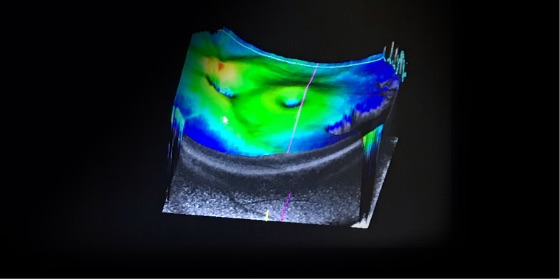
The most interesting bit of my visit to the optician however was that I had an optical coherence tomography scan which generate a three-dimensional picture of the back of the eyeball. I’ve never seen one of those before. Here’s an example (not me):

This type of scan can be used to diagnose things like glaucoma and diabetic retinopathy, neither of which I have. In my case though it did reveal a significant level of unevenness in the surface at the back of both eyes and some signs of swelling of or near the optic nerves. The optician showed me the scan and pointed out these abnormalities, but said that it wasn’t anything too worry too much about as he thought it was historical rather than progressive. He said the only time he’d seen anything like that was in the cases of people who had in the past had some form of trauma to the head (which can cause increased pressure inside and so damage the back of the eyes).

I’ve blogged before about the long term effects on my mental health of the beating I experienced in Brighton over thirty years ago, but this was the first time I’ve seen such clear evidence of the physical damage that I presume was caused by that event. In extreme cases I experience periods of exaggeratedly heightened awareness of things moving in my peripheral vision that I can’t keep track of, accompanied by auditory and visual hallucinations. I’m not an expert but it seems likely to me that what the scan revealed may play a role in these episodes. It doesn’t explain why they seem to be triggered by stress, though, so there must be other factors.

Over the years a number of people have remarked that I often have the blinds closed in my office during the day, and that as well as that as well as being varifocals the lenses I wear in my glasses are reaction lenses (i.e. they go dark in bright light). Avoiding bright light in such ways was suggested by an optician some years ago, who suspected I might have some form of retinal damage but couldn’t see anything definitive with the technology available then. It seems he was right!


Reasons to stay alive

Posted in Biographical, Mental Health with tags , , , , on September 15, 2019 by telescoper

I saw this message from author Matt Haig on Twitter last weekend and it affected me so much I couldn’t write about it at the time.

Twenty years ago, when he was in his twenties, Matt tried to take his own life. He didn’t succeed, but the attempt left him severely ill as he summarises in that tweet. He wrote about his crisis in his book Reasons To Stay Alive, from which I have borrowed the title of this post.

Why did this message affect me so much? It’s largely because the words he uses to describe his condition also exactly describe what I was like seven years ago when I was admitted to an acute ward in a psychiatric hospital. I wasn’t exactly suicidal, just so exhausted that I didn’t really care what happened next. I was however put on a kind of `suicide watch’, the reason for this being that, apparently, even while sedated, I kept trying to pull the tube out of my arm. I was being fed via a drip because I was ‘Nil by Mouth’ by virtue of uncontrollable vomiting. I guess the doctors thought I was trying to sabotage myself, but I wasn’t. Not consciously anyway. I think it was probably just irritating me. In fact I don’t remember doing it at all, but that period is very much a blur altogether. Anyway, I then found myself in physical restraints so I couldn’t move my arms to stop me doing that.

Eventually I was deemed well enough to move to a general ward and shortly after that I was discharged (with follow-up counselling and medication).

Experiences like that – which I sincerely hope none of you reading this ever have to go through – make you feel very isolated because you are lost inside your own head and body. Knowing that other people go through similar things, and not only survive but prosper, helps a lot. You feel a bit less of an outlier. Of course I’ll never appear on stage at the National Theatre, but although the intervening years haven’t exactly been plain sailing, the last seven have brought far more positives than negatives.

It’s hard to explain why Matt’s message had such a resonance. His experience was clearly far worse than mine, but when I was discharged from hospital the doctors made it very clear just how ill I had been, and that if there was any recurrence I should get help as soon as possible. As well as writing about it on this blog, I did a piece for Time to Change Wales, encouraging people to ask for help if they need it.

Anyway, this brings me to the point of this sermon. Yesterday I received this by email:

It’s from Niteline, an organisation whose volunteers offer students free confidential counselling, and it came with a suggestion (which I will follow) that I should share it with students before and after my lectures. I’m not sure how many students will read this blog, but I thought I would share it here too. If it encourages just one person who is struggling to find someone to talk to then it’s worth it.

Health and the Season

Posted in Biographical, Cardiff, Maynooth, Mental Health with tags , , on August 10, 2019 by telescoper

After I came out as having arthritis a few months ago, I’m sure all both my readers are agog to hear news about the state of my knees. There’s only good news to report, actually. The warmer weather seems to have brought considerable respite. I have not taken any anti-inflammatory medicine for a couple of months now, and have largely dispensed with the walking stick too (at least for the time being). I still get the odd twinge, but nothing compared to what things were like during the winter.

I ended my earlier post about this with this paragraph:

One other thing worth mentioning is that this condition does seem to be highly temperature-dependent. This last week the weather suddenly turned a lot colder and the arthritis definitely got worse. Perhaps in future I could learn to use the colour of my knees as some kind of forecasting method?

Talk to anyone who suffers from arthritis and they will tell you a similar story – it gets worse in cold and/or damp weather. Talk to any medical expert, however, and they will tell you that there’s very little hard evidence about this and what evidence there is suggests that the effect is very weak. See, for example, this paper, which has the following abstract:

It is a common observation that pain and stiffness in patients known to have arthritis get worse in cold and damp weather conditions. The objective of this article is to review the available literature on this subject and to put forward an explanation for this common clinical finding. Literature search revealed twelve relevant articles including laboratory experiments and prospective questionnaire-based human studies. Various investigators have tried to study the effect of cold weather on arthritic symptoms and have suggested different theories. The effect of temperature changes localized to the joints has shown to increase stiffness at lower temperatures and decrease stiffness at higher temperatures. The effect of these changes has been found more pronounced in elderly population with arthritis and patients with advanced disease. The evidence to support this common observation is weak; however some studies have reported a trend towards worsening of pain and stiffness with falling temperature and barometric pressure in arthritic patients.

Among the problems associated with studying such effects is the issue of how to measure `pain’ in a reliable way. It may be in the winter people are generally less upbeat about their health which may affect the way they self-report the state of their arthritis. And even if one could measure the level of pain objectively, there are obvious confounding factors: people are generally more active during the summer months, for example, which may help ease joint pain. And what aspect of the weather really matters: temperature, humidity or atmospheric pressure? These tend to be correlated in complicated ways.

All I can say is that the last couple of months have been far better for me. Whether that is because of some direct causative influence of the weather or not I can’t say.

While I am on about health and the time of year, I’ll comment on another personal matter. Seven years ago I was suffering some serious mental health problems, which resulted in me being for some time on an acute ward in a psychiatric institution. That happened in July 2012. I’ve dreaded the arrival of July every year since because it reminds me of that very bad period in my life and I worry that might bring on something similar again. This year, though, has been much better. I can’t attribute this entirely to my move here to Ireland, but the change of scene has undoubtedly contributed.

As a final comment I’ll just say that 31st July was the third anniversary of my leaving Sussex (in 2016) to return to Cardiff on a three-year part-time contract back. I was planning to take early retirement when that expired, but things seem to have turned out rather differently. Things have a habit of doing that. Then again, if life were predictable it would be very dull. Anyway, it was very nice to meet up with quite a few former colleagues from Cardiff during recent week off, including at their summer barbecue at Llandaff. It seems quite a few will be spending the next week or so marking repeat resit examinations, so let me take this opportunity to wish them all the very best!

Sleep Hygiene

Posted in Biographical, Mental Health with tags , , on March 2, 2019 by telescoper

This afternoon I remembered a discussion I had with a few friends last week about insomnia and I thought I’d comment a bit on it here. This topic has come up before, e.g. here, but I’m very happy to say that sleeplessness is not a problem I’ve had recently (apart from once or twice when I’ve had a fever, but that’s different).

When I was struggling to come to terms with insomnia, much of the advice from NHS doctors and psychiatrists concerned sleep hygiene. This does not mean having a shower before you go to bed. It’s a collection of behavioural modifications designed to ensure you get a full night’s sleep every night. Here’s an example of the sort of things:

Received wisdom is that this actually works in most cases. I am, however, bound to say that it didn’t work at all for me. During the worst of my brushes with insomnia I was considered such an intractable case that I was passed around a collection of consultants who, despite their best intentions, didn’t really help either.

Then I had an appointment with a doctor who was refreshingly honest. She said that if insomnia is a result of anxiety or depression then making strict rules about how long you should sleep and what you should do to comply with them can easily make the anxiety worse and hence perpetuate the insomnia. She went on to explain that the practice of sleeping eight hours per night is a relatively recent one. In pre-industrial societies periods of wakefulness in the middle of the night were considered quite normal. Literature from the Victorian period in England, for example, describes how in some communities people would get up in the middle of the night – and even visit their neighbours for tea – before returning home and going back to bed for their `second sleep’. There’s an article in a recent edition of the Irish Times that describes this and cites studies that appear to show that two periods of 3-4 hours each is in some sense more natural than 6-8 hours in one chunk.

So the advice given to me when all else had failed was not to attempt to impose rules on myself but simply not to get stressed if I found I woke up at 3am and couldn’t immediately get back to sleep. Get up if you want to, she said. Relax. Listen to some music. Make a cup of tea. Iron a shirt for the morning. Then go back to bed, but only when you start to feel sleepy again. I’ve done that many many times over the last few years, without feeling anxious about it, although I have to say that nowadays I more often get a solid six to seven hours.

Since I only observe one or two of the list of ten steps to sleep hygiene given above I must be a dirty sleeper, but I much prefer that than being trapped into a cycle of insomnia and anxiety. My advice is sleep the way you can, and don’t worry if it’s not what others think should be the norm.

Come to think of it, that goes for many other things in life.

P.S. If they want us academics to obey rule number 2, why do seminars always go on for an hour?

P. P. S. Anxiety isn’t always the reason for lack of sleep. Sometimes it’s this: