Archive for music

McTee, Mozart & Strauss at the National Concert Hall

Posted in Music with tags , , , , , , , , on September 13, 2025 by telescoper

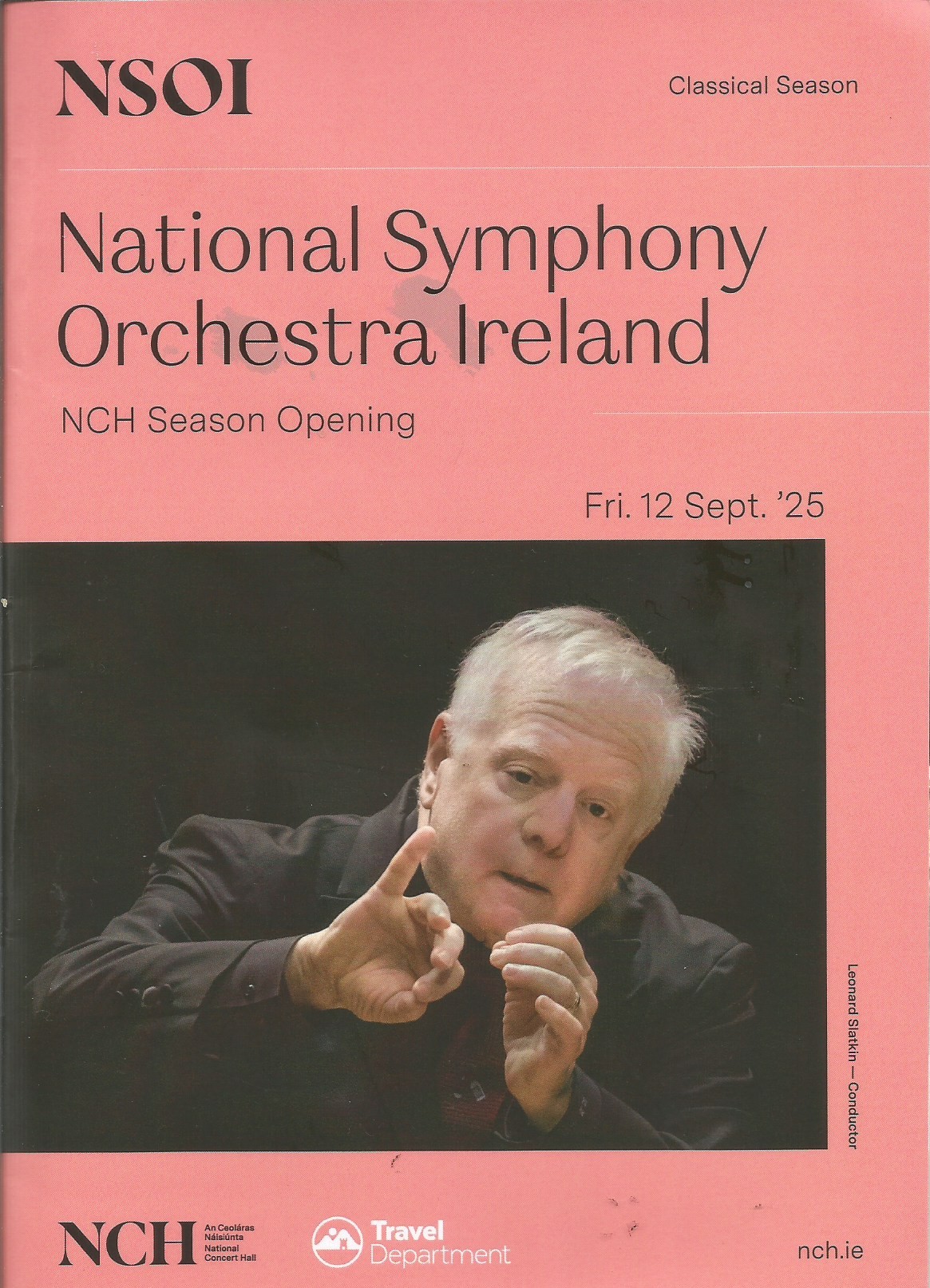
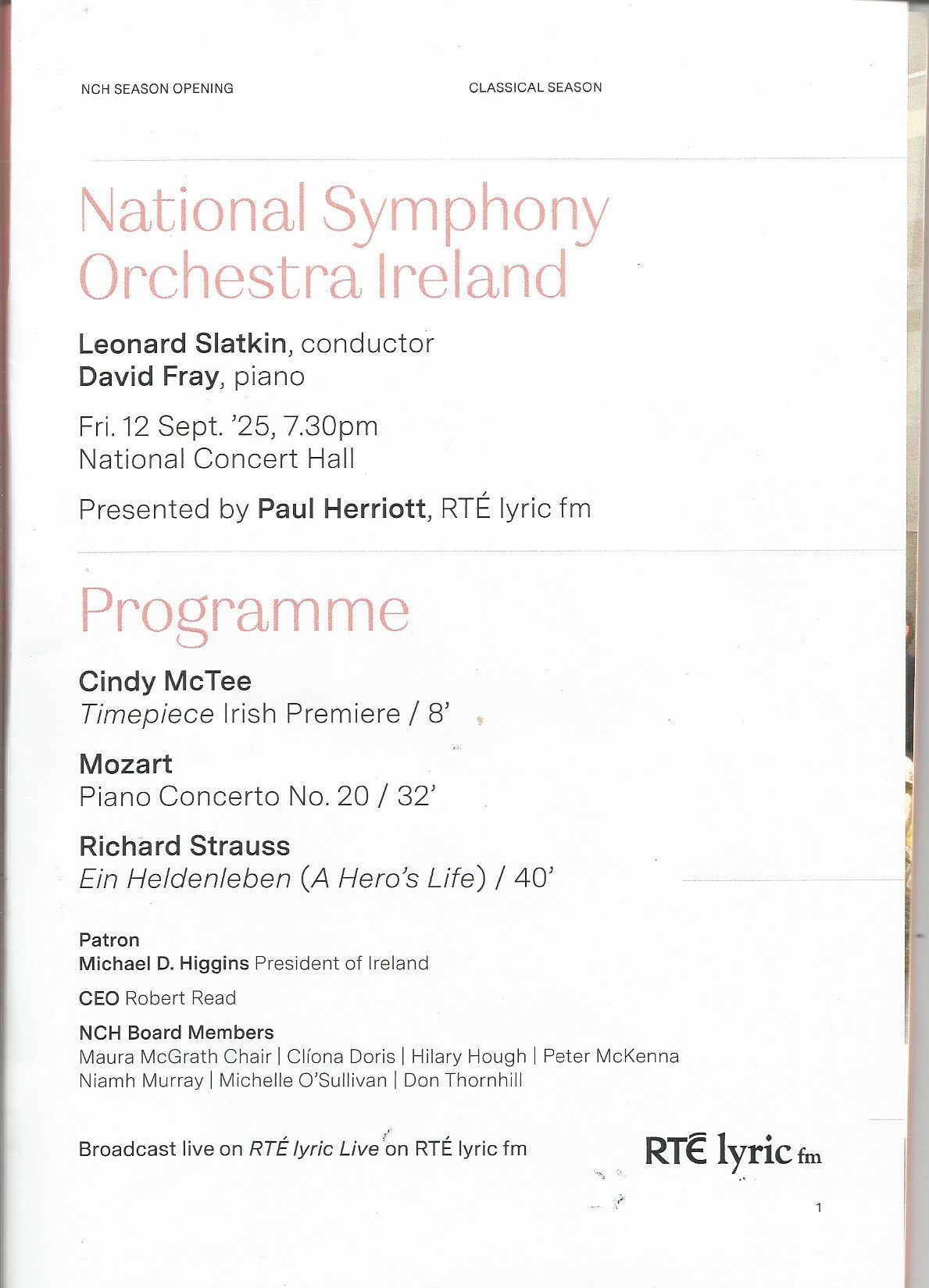
As it was foretold, last night I went to the National Concert Hall in Dublin for the opening performance of the new season by the National Symphony Orchestra Ireland, this time under the baton of veteran conductor Leonard Slatkin.

The appetiser for this concert was Timepiece by American composer Cindy Mctee. It’s a short piece, quite new to me before last night, with a slowish introduction leading into a very energetic main body of the work. This piece brought out some fine playing by the orchestra, especially the percussion section. You can read more about this intriguing and enjoyable composition in the composer’s own words here. She was in the audience last night, and came up on stage at the end of the performance to receive the plaudits.

Next we had a very familiar piece: the Piano Concerto No. 20 in D Minor by Wolfgang Amadeus Mozart, with David Fray at the piano. Mozart apparently composed this in a rush to meet the deadline of its first performance, but it doesn’t seem that way. The three movements (marked Allegro, Romanza and Allegro Assai) are very different in mood: the first (which is quite long) is brooding and rather Sturmy and Drangy, while the second is much gentler; both these movements feature memorable tunes; the third is much more pyrotechnical, with a very propulsive start and some virtuosic cadenzas. I think the last was played the best. David Fray is a curious performer to watch: he sat in the same sort of chair as the members of the orchestra – one with a back – rather than the usual stool, and had a very unusual posture. He slouched, in fact; he often turned round to look at the musicians behind him too. Anyway, he played very well indeed and for an encore he gave us some Bach (a solo piano arrangement of Air on the G String), which was lovely.

After the wine break we came back for a performance of Ein Heldenleben (“A Hero’s Life”) by Richard Strauss. I had never heard this piece in full before last night, and I have to say I didn’t like it much. There are some very nice passages in it, and there was some excellent playing by the brass and solo violin by NSOI leader Elaine Clark, but overall I found it a rather aimless reworking of some of Strauss’s other tone poems (some of which are actually very good). It’s also far too long for what it has to say.

The “Hero” of the title is of course meant to be the composer himself, which says something of the high regard in which Strauss held himself. At times the piece is tediously bombastic. The composer was 34 when he wrote this piece; about the same age that Mozart was when he died. I don’t think had he lived the latter would have written a self-indulgent piece like this crowing about his own achievements, which were far greater than those of the former.

Still, at least I can now say I’ve heard Ein Heldenleben

P.S. For those of you wondering: no, the President of Ireland did not attend this concert.

The Tower Records Experience

Posted in Biographical, Music with tags , , , , on August 16, 2025 by telescoper

I lived in London from late 1990 until the very end of 1998. One of my favourite places for shopping in those days was the excellent Tower Records. There were two stores then, but I only ever visited the one at Number 10 Piccadilly as it was very conveniently placed to skive off from meetings of the Royal Astronomical Society at Burlington House, which is just round the corner.

It wasn’t just the huge selection of records, tapes and CDs across all musical genres but also the extremely helpful and knowledgeable staff. I always found their advice very helpful and often left with many more things than I intended to buy when I went in.

Tower records was acquired by the Virgin Group in 2003 and the store in Piccadilly closed down completely in 2009. I haven’t been past the site recently, but I think it is vacant and awaiting redevelopment.

The reason for mentioning this is that Tower Records is alive and well and living in Dublin. There are two stores in the city but I’ve only ever been to the larger one in Dawson Street. It’s not as big as the one in Piccadilly, but it does have a very good selection of music (including a large section of classical music) and very friendly staff. It also has a wide range of hifi equipment, including turntables for those of us who have a vinyl collection. It also has an online service. The last thing I ordered from them was delivered to my house in Maynooth the next day at no charge.

It brought back a lot of memories when I first went inside as it has the same old yellow and red signage and very much the same vibe as the old London store; you can see some interior pictures here. Tower Records (Ireland) is highly recommended for those who are nostalgic for the old Tower Records (London) as well as those who just want to visit a proper, independent, music store. I hope it not only survives but prospers.

BBC Sounds Confusing

Posted in Music, The Universe and Stuff with tags , , , , on July 22, 2025 by telescoper

The BBC Proms having started on Sunday (20th July), I decided to listen to some of the concerts via BBC Sounds. One can’t get BBC Radio 3 on the radio here in the Republic, at least not this far from the border.

I was disappointed, then, to see that BBC Sounds is no longer available to listeners outside the UK. Apparently The BBC is making BBC Sounds exclusively available to UK license fee payers, meaning users outside the UK, including those in Ireland, will no longer be able to access the full service. This change came into effect yesterday (21st July).

So here I am, as I write this, on 22nd July, listening to this evening’s Promenade concert via BBC Sounds. No, I’m not doing anything illegal or unlawful. Neither did I last night, when I listened to Mahler’s Symphony No. 7. It’s just that the change has been implemented in a very peculiar and confusing way.

To start with, this is what I see a see on my screen right now:

I don’t think you get the top message if you listen in the UK, but then you might be listening on the radio anyway.

At the top it says use the BBC.com or the BBC App. For one thing I can’t find any sign of the “BBC App” on PlayStore on anywhere else. For another, BBC.com offers only Radio 4, BBC World Service and a random selection of podcasts. So neither of those options are any good for listening to Radio 3.

If you click to “Find out how to listen to other BBC stations” you get this page which “explains”:

Earlier this year, we launched a new audio service outside the UK on BBC.com and the BBC app. This includes access to BBC Radio 4 and BBC World Service English, thousands of hours of podcasts (including Global News Podcast, World of Secrets and Infinite Monkey Cage) – as well as some of the best of the BBC’s journalism and storytelling including news and history programming.  

As part of the announcement, we said we planned to close BBC Sounds to audiences living outside the UK later this year, making it available exclusively to people in the UK. Anyone who lives in the UK will still be able to use the BBC Sounds app when they go on holiday abroad. We can now confirm that BBC Sounds closed for listeners based outside the UK on 21 July 2025.

Leaving aside the mystery of the “BBC app”, this suggests that BBC Sounds is closed to listeners outside the UK. Except it isn’t.

The article goes on to explain:

Please use the links below for live listening access to the BBC’s other radio stations from across the UK, including BBC Radio 1, Radio 2 and Radio 3, 6Music, 1Xtra and Asian Network, Radio 4Xtra and 5Live, all the BBC’s stations from the UK nations and every local radio station in England.

The link to BBC Radio 3 is this:

https://www.bbc.co.uk/sounds/play/live/bbc_radio_three#noapp

In other words, it takes you back to BBC Sounds, which is where I am listening now! As far as I understand it, one can still listen to the live internet stream of BBC Radio on BBC Sounds, so it’s not closed to listeners outside the UK after all. What is closed (to us foreigners) is the back catalogue of past recordings. I only ever listen to live broadcasts, however, so after all that it’s business as usual for me.

I hope this clarifies the situation.

Fauré plays Fauré

Posted in Music with tags , , , on March 11, 2025 by telescoper

In my post on Saturday I raised the question of the tempo for the orchestral version of Pavane pour une infante défunte by Maurice Ravel. A pavane is a stately dance, which is to be played quite slow but it’s not a funeral dirge. As Ravel himself is reported to have said “It’s the Princess (infante) who is sup[posed to be dead (defunte), not the Pavane”. There is a temptation when playing a lovely tune to wallow in it a bit too much, I think. In this light I now share a recording of a different Pavane, Opus 50 by Gabriel Fauré which is also quite well known. Here is the composer himself playing it in 1913 on his very own piano at a tempo which I find very pleasing and not too slow…

100 Years of Paul Desmond

Posted in Jazz with tags , , , , , on November 25, 2024 by telescoper

This evening I happened across a reminder that today is the centenary of the birth of saxophonist and composer Paul Desmond, who was born on November 25th 1924. Paul Desmond is best known for his work with Dave Brubeck’s quartet from 1951 to 1967, and particularly as composer of their smash hit Take Five. He didn’t only work with Brubeck, though. He made fine recordings with Chet Baker and Gerry Mulligan amongst others. His gentle tone and lyrical phrasing on alto saxophone were instantly recognizeable and very typical of the West Coast style of cool jazz, and on alto saxophone was instantly recognizeable. Never a speed merchant in the Charlie Parker tradition, Desmond fell out with Brubeck’s drummer Joe Morello who would often set the tempo, especially on Take Five, too fast in live performances, so I thought I’d pay my little tribute by playing a less familiar number, the Japanese-influenced Koto Song on which Paul Desmond plays very beautifully.

Tara Erraught at the National Concert Hall

Posted in Music with tags , , , , , , , , , , on November 2, 2024 by telescoper

Last night’s concert at the National Concert Hall featured star mezzo-soprano Tara Erraught (who is from Mullingar, in County Westmeath, and is artist-in-residence at the National Concert Hall for this season. She was accompanied by the National Symphony Orchestra directed by Laurence Cummings. You can tell how much I like Tara Erraught by the fact I went to the concert despite there being a harpsichord involved in some of the pieces; fortunately it was pointed away from the audience so we couldn’t hear it.

Before the concert, I was trying to remember when I heard her sing before. A look at my back catalogue revealed that it was this concert at which she sang a Mahler song-cycle. Last night’s performance comprised very different material, all from the 18th Century. There were three vocal pieces: a cantata in four sections by a name quite new to me, Marianna Martines, also known as Marianne von Martinez; a concert aria by Joseph Haydn; and by far the most exciting piece, Mozart’s wonderful Exsultate Jubilate. Tara Erraught was in fine voice throughout but I was particularly impressed with the precision of her articulation of the ornamented phrases in the last work. The audience loved it too.

The concert was all about Tara Erraught, however. The first half included Symphony No. 25 by Joseph Haydn, a funny little work only 13 minutes long and lacking the usual slow movement that seemed to me like it wasn’t really finished. It’s certainly not among Haydn’s best symphonies, anyway. It was a bit unfair on Haydn to have Mozart’s Symphony No. 41 “Jupiter” on the same menu as that it is one of the great symphonies by any composer. It did however demonstrate very powerfully how much the symphonic form had evolved in the twenty-odd years separating the two compositions (which incidentally are both in the same key of C Major). The Jupiter symphony is not only brim full of ideas, but the themes are woven into a much richer fabric. I might add that it was very well played by the NSO in a performance that was forceful and energetic without being too bombastic.

A Century of See See Rider

Posted in Jazz with tags , , , , , , , on October 16, 2024 by telescoper

Back in 2023 I posted an item marking the first appearance of Louis Armstrong on record with King Oliver’s Creole Jazz Band back in 1923. Now it’s time to mark another jazz centenary which also involves Satchmo but in a different setting. King Oliver’s band split up at the end of 1923 over a disagreement about a planned nationwide tour and in 1924 Louis Armstrong moved to New York. He was soon snapped up by Fletcher Henderson and spent a glorious year as star trumpet soloist with Henderson’s big band. During that time he also made records with various small bands, including a number with the great vocalist and “Mother of the Blues” Gertrude “Ma” Rainey.

One of the tracks recorded by Ma Rainey in the Paramount studio in New York was called See See Rider. Although not released until 1925, the very first recording of this number was made exactly one hundred years ago today, on 16th October 1924, by “Ma Rainey and her Georgia Jazz Band”, the supporting musicians being Charlie Dixon (Banjo), Buster Bailey (Clarinet), Charlie Green (Trombone), Fletcher Henderson (Piano) and Louis Armstrong (Cornet). The origins of this blues song are lost in the mists of time but it has been recorded a huge number of times, not only by jazz and blues musicians but also by the likes of Elvis Presley; I posted a great version by Peggy Lee here.

Unusually for the time, two takes were made of which the following was the first. Notice that there is an introduction in the form of a verse, which is quite unusual: most blues performances involve only a chorus. Despite the limitations of recording technology at the time you can hear what a tremendously soulful voice Ma Rainey had, and the muted cornet work by Louis Armstrong is unmistakable.

The sound quality may not be great, but it’s a priceless piece of music history.

Pass on Bach

Posted in Music with tags , , , , , , , on October 12, 2024 by telescoper

I thought I’d share this lovely little clip of the late great jazz guitarist Joe Pass. It’s from a show that classical guitarist John Williams presented along with three other exponents of the guitar from different genres. At this point they had been talking about the similarities between Jazz and Baroque music, especially with regards to the improvisation, so Williams invited Pass to improvise on a Chaconne by Johan Sebastian Bach. The result is absolutely fascinating, not least because of the musical jokes in the form of blue notes that Pass includes during his spontaneous elaboration. The first elicits a big smile from John Williams because the tritone Pass plays was regarded as the diabolus in musica in Bach’s time, but for a jazz musician blue notes like this are par for the course.

P.S. it’s amazing how little Joe Pass’s right hand seems to move…

Grieg and Elgar at the National Concert Hall

Posted in Music with tags , , , , , , , , , , on October 5, 2024 by telescoper

Yesterday I once again headed off after work into Dublin by train to attend a concert by the National Symphony Orchestra this time under the direction of guest conductor Dinis Sousa (whose name is new to me). The programme consisted of two very familiar works, Grieg’s Piano Concerto in A Minor by Grieg and Elgar’s Enigma Variations by Elgar.

To start with, however, we heard a very interesting short piece by Anna Clyne called Masquerade which I enjoyed very much. This is only about five minutes long in performance, but full of energy and dynamics, and was a very suitable appetizer for the courses to follow.

The soloist for the Grieg Piano Concerto was Louis Schwizgebel who played it very well indeed. His articulation was crisp where necessary but also flowing when called for in the more romantic sections. The performance was very well received by the audience and by me. Actually I think that was the best performance of this work that I’ve heard live. Incidentally, I’m told the piano on which he performed was a brand new Steinway. Also incidentally, Edvard Grieg was only 24 when he wrote this piece.

During the second movement a member of the viola section of the orchestra had to leave the stage. I don’t know if she had broken a string or was just feeling unwell. I suppose both of these most happen from time to time in concerts, but I’d never seen it before. Thankfully she was back for the second half.

The Enigma Variations is another piece that is performed quite frequently. I’m not a huge fan of Elgar but this work definitely has its moments and I think anyone who doesn’t find Variation IX (“Nimrod”) uplifting must have something wrong with them. That said, that part is often played too slowly for my taste and can sound funereal rather than inspirational. Anyway, I hadn’t heard this in live performance for a long time so it was very pleasant to hear it again. I had forgotten that there is an organ part to this, actually, and it was good to hear the splendid NCH instrument used especially in the finale.

Overall it was a short (just 66 minutes playing time) but enjoyable concert. I’ll certainly be looking out for Louis Schwizgebel’s name on recordings in future as I think he is a fine soloist.

A New Season at the National Concert Hall

Posted in Biographical, Music with tags , , , , , , , , on September 14, 2024 by telescoper

It was just over a year ago that I last went to the National Concert Hall in Dublin. That occasion was the opening of a new season of concerts for 2023-4 by the National Symphony Orchestra. After a year away on sabbatical, last night I went to the season opening of the next year of concerts by the National Symphony Orchestra, this time under the direction of Mihhail Gerts. I’m hoping to see more of the forthcoming season than I did the last!

The programme for the concert is shown in the picture. The first half was dominated by legendary mezzo-soprano Dame Sarah Connolly, resplendent in a turquoise frock, who sang six songs by Alma Mahler (born Alma Schindler) who was of course the wife of Gustav Mahler whose 1st Symphony we heard in the second half. Gustav famously (and reprehensibly) told Alma that she had to give up composing music when they married (which they did in 1902). Until then she had written not only songs but also piano music. Few of her compositions survive, however. Apparently she destroyed many of the manuscripts herself in later life. Of the fifty or so songs she is thought to have written, only 17 (including the 6 we heard last night) still exist on paper. She at least responded by outliving him by more than 50 years: Gustav died in 1911 and Alma Mahler passed away in 1964.

It’s very unfair to compare Alma Mahler’s settings with those of Gustav Mahler, who was a master of the orchestral song cycle. The compositions we heard all all quite short, three or four minutes, and are definitely influenced by Wagner. The first song, for example, deploys the famous Tristan Chord and there are passages that are clearly influenced by the Wesendonck Lieder. None of the manuscripts are dated, but in terms of style they do sound like late Romantic works from around 1900 when she was very young. Overall these works not at the same level of achievement of either Richard Wagner or Gustav Mahler but, with Sarah Connolly in fine voice, there was much to enjoy. I had never heard any of these songs before this evening, and it left me wondering what Alma Mahler might have achieved musically had she continued to compose. We’ll never know.

Before these songs we heard the concert overture In Nature’s Realm by Antonín Dvořák. This is also a piece that feels very late-19th Century (it was composed in 1891). It’s a sort of homage to the beauty of the composer’s native Bohemia with distinct echoes of Beethoven’s Pastoral Symphony, I thought.

After the interval wine break we returned for the second half which consisted of (Gustav) Mahler’s Symphony No. 1 in D Major. This is a very familiar concert work nowadays, but it’s worth remembering that it didn’t exactly set the world on fire when it was first performed in 1889 and Mahler revised it extensively before it arrived at the form now usually performed. Like all Mahler symphonies it covers a vast territory. One of the most famous Mahler quotations is “the symphony is a world”, but in the case of his own symphonies each movement is a world. The first movement begins in hesitant and fragmentary fashion before bursting into life with a metaphorical evocation of daybreak. The second movement is earthier and more forceful, quoting from folk songs and country dances. The third is my favourite, with its humorously up-beat references to Klezmer music before ending in a kind of funeral march. The final movement is tempestuous at first, then calm, then erupts into a glorious finale.

Last night’s performance was broadcast live on RTÉ Lyric FM but what radio listeners won’t have got was the thrilling sight of a symphony orchestra in full flood. At the end of the last movement, members of brass section stood up to give extra power to the climactic resolution of the piece. Mahler does “loud” very well indeed, but I was impressed by the spectacle too: the lights gleaming off the array of trombones and horns as they blasted out the final phrases (in another context I would call them “riffs”). Great stuff, and very well received by the audience.

P.S. On the way into Dublin to see last night’s concert I realized that the Irish Rail timetable had changed while I was away so, instead of terminating at Connolly (the station, not the mezzo-soprano), the train I was on went all the way through to Pearse, thereby saving me a bit of time walking. It only takes about 20 minutes (for me) to walk from Pearse to the NCH, in case you’re wondering, and I do like a bit of a walk to stretch my legs before sitting down for a couple of hours at a concert.