Archive for Edward Elgar

Montgomery, Elgar, Sibelius and Grieg at the National Concert Hall

Posted in Music with tags , , , , , , on November 14, 2026 by telescoper

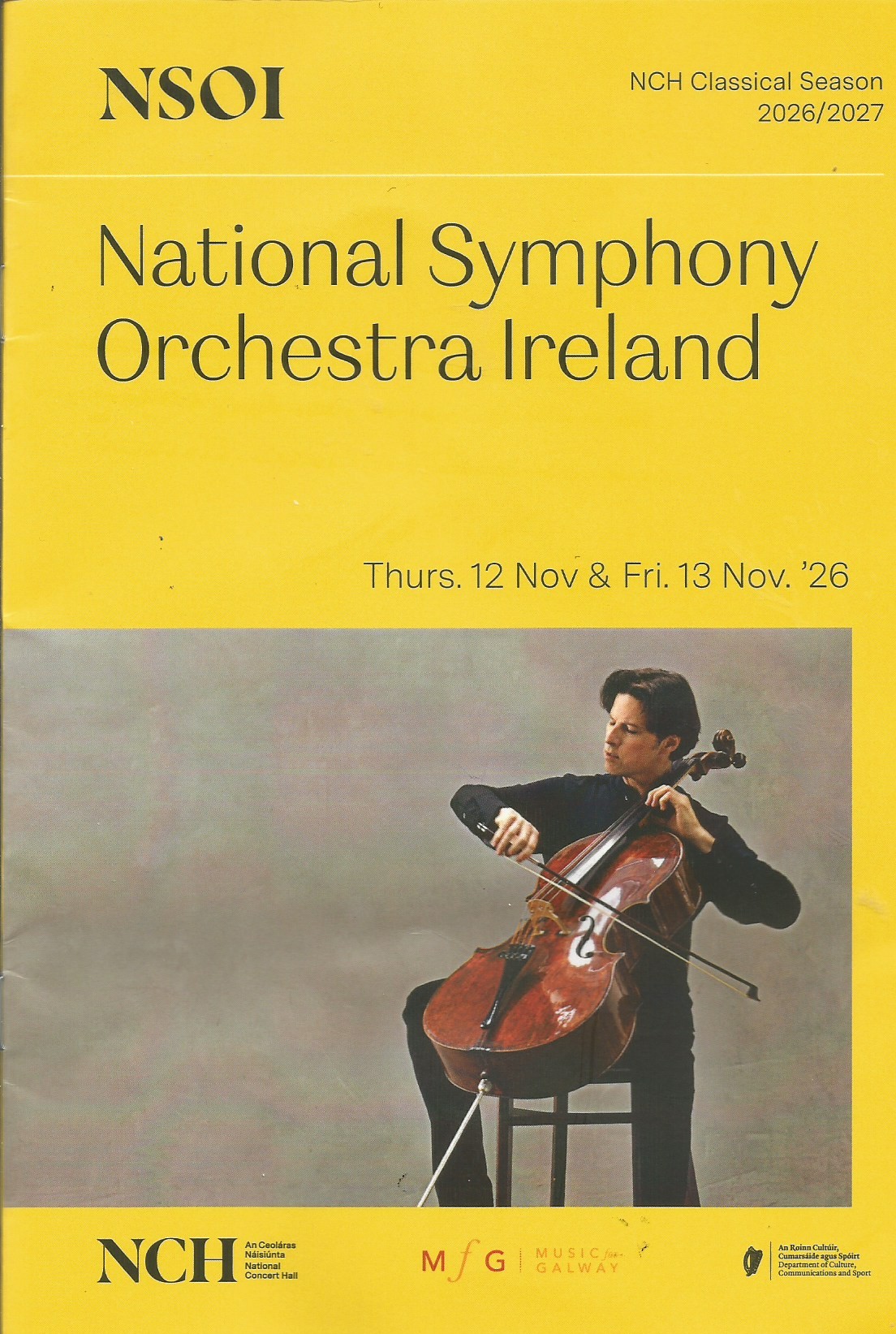
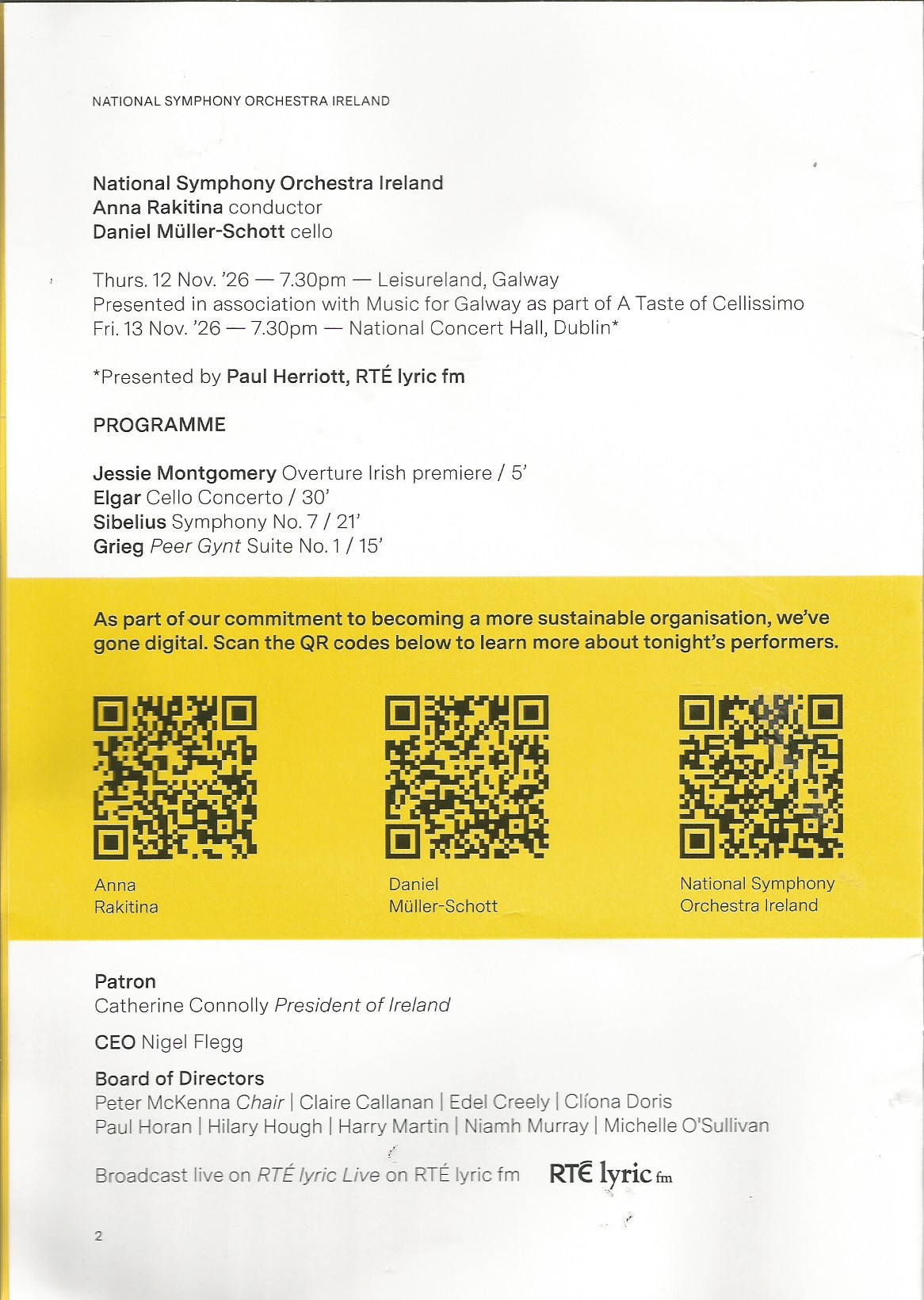
Yesterday evening I once again took the train into Dublin for a concert by National Symphony Orchestra Ireland at the National Concert Hall in Dublin. The guest conductor for this occasion was Anna Rakitina.

After an appetiser in the form of a short piece called Overture by American composer Jessie Montgomery (no, not the gay pornstar), the main item for the first half of the concert was the Cello Concerto in E Minor by Edward Elgar. This was completed in 1919 but didn’t really become a regular part of the concert repertoire until the 1960s, largely as a result of the landmark recording by Jacqueline du Pré. I’ve never really rated Elgar as a great composer but I do think that his cello concerto is a masterpiece. It certainly has a great emotional depth than any other work that I can think of, with the possible exception of the Dream of Gerontius. The melodic beauty of the first movement Adagio really pulls at the heartstrings, but thereafter charts a path through varied moods and soundscapes, ending rooted in its minor key when other works of this type often shift into a major tonality. Although it is, at times, agitated and edgy, the overall atmosphere is sombre and reflective.

Last night’s soloist was Daniel Müller-Schott who gave a very fine account of this much-loved work, and returned to the stage after a standing ovation to give us an encore in the form of the wonderful Gigue from the Cello Suite No. 3 in C Major by Johann Sebastian Bach. That reminded that I must listen to the Bach Cello Suites again, as it has been far too long.

After the wine break we returned for the Symphony No. 7 by Jean Sibelius. This is very short for a symphony – only about 20 minutes – and is in a single movement. It’s also in C Major which you might think is a rather “plain” key for Sibelius to have chosen, but the piece is highly original in construction and wonderful to listen to in live performance. I have various recordings of Sibelius Symponies 1-6, but don’t have any of this one. I’d be grateful for any recommendations.

To end the concert we had the Peer Gynt Suite No. 1 by Edvard Grieg. This comprises some of the incidental music that Grieg wrote for Henrik Ibsen‘s play Peer Gynt. There are four pieces in the Suite, all of them very well established in the popular classics genre. My favourite is perhaps the least known of the four: a poignant expression of grief, The Death of Åse depicts the death of Peer Gynt’s mother; I think its simplicity makes it all the more moving. The most famous part is probably Morning which evokes a Nordic pastoral sunrise, except the setting in the play is North Africa.

I have to say I found it a strange choice to end the concert with this suite. It’s not that I dislike it, just that I think I prefer to finish with a more substantial work. I suppose it was added in because the Sibelius symphony is so short – normally a symphony would fill the entire second half of such a concert. Nevertheless it did send me home wanting to listen to Duke Ellington’s version of Peer Gynt.

Incidentally, on the way to the NCH earlier in the evening, around 6.30pm, while I walked down the western side of Merrion Square, I noticed a Garda cordon. I didn’t think much about it as there had been restrictions in Dublin for a few days owing to various European summits and whatnot. It was only when I got home that I realised that an explosive device had been placed there and dealt with by the defence forces…

Grieg and Elgar at the National Concert Hall

Posted in Music with tags , , , , , , , , , , on October 5, 2024 by telescoper

Yesterday I once again headed off after work into Dublin by train to attend a concert by the National Symphony Orchestra this time under the direction of guest conductor Dinis Sousa (whose name is new to me). The programme consisted of two very familiar works, Grieg’s Piano Concerto in A Minor by Grieg and Elgar’s Enigma Variations by Elgar.

To start with, however, we heard a very interesting short piece by Anna Clyne called Masquerade which I enjoyed very much. This is only about five minutes long in performance, but full of energy and dynamics, and was a very suitable appetizer for the courses to follow.

The soloist for the Grieg Piano Concerto was Louis Schwizgebel who played it very well indeed. His articulation was crisp where necessary but also flowing when called for in the more romantic sections. The performance was very well received by the audience and by me. Actually I think that was the best performance of this work that I’ve heard live. Incidentally, I’m told the piano on which he performed was a brand new Steinway. Also incidentally, Edvard Grieg was only 24 when he wrote this piece.

During the second movement a member of the viola section of the orchestra had to leave the stage. I don’t know if she had broken a string or was just feeling unwell. I suppose both of these most happen from time to time in concerts, but I’d never seen it before. Thankfully she was back for the second half.

The Enigma Variations is another piece that is performed quite frequently. I’m not a huge fan of Elgar but this work definitely has its moments and I think anyone who doesn’t find Variation IX (“Nimrod”) uplifting must have something wrong with them. That said, that part is often played too slowly for my taste and can sound funereal rather than inspirational. Anyway, I hadn’t heard this in live performance for a long time so it was very pleasant to hear it again. I had forgotten that there is an organ part to this, actually, and it was good to hear the splendid NCH instrument used especially in the finale.

Overall it was a short (just 66 minutes playing time) but enjoyable concert. I’ll certainly be looking out for Louis Schwizgebel’s name on recordings in future as I think he is a fine soloist.

Daniel Barenboim’s Proms Speech

Posted in Music, Politics with tags , , , on July 19, 2017 by telescoper

Daniel Barenboim made this wonderful speech at the BBC Proms at the weekend. It seems to have annoyed some people who get annoyed when someone expresses something that doesn’t fit in their own narrow minds, and does it with grace, eloquence and great dignity. I’m posting it here to annoy such people still further. It’s no more than they deserve.

And here is the encore that followed the speech – Elgar’s Pomp and Circumstance  March No. 1 – in full. It’s a piece I usually hate. This was the first time in my whole life that I’ve actually enjoyed it.


Belshazzar’s Feast

Posted in Music with tags , , , , , , , on December 2, 2016 by telescoper

Last night I made my way through the foggy streets of Cardiff to St David’s Hall to attend a concert by the BBC National Orchestra of Wales (joined for the second half by the BBC National Chorus of Wales and Members of Bristol Choral Society) conducted by Martyn Brabbins for a programme of music by British composers, culminating in a performance of Belshazzar’s Feast by William Walton. The whole concert was broadcast live on BBC Radio 3 and you can listen to it here on iPlayer for the next month.

The concert began with the “concert overture” In the South (Alassio) by Edward Elgar. I put “concert overture” in inverted commas because, at about 25 minutes, it’s a bit long for an overture and is really more like a tone poem. Elgar wrote most of it when on holiday in Italy in 1904. He was actually planning to write a full symphony but the inspiration he’d hoped to get from fine weather didn’t transpire because it was even colder and damper in Alassio than in his native Malvern. Incidentally, Alassio is in the North of Italy not the South. The music Elgar composed when the weather improved is not a full symphony, but a bright and colourful piece which comprises a number of episodes, some pastoral and some tempestuous. It’s richly orchestrated and served as an enjoyable warm-up for the musicians (and audience). Conductor Martyn Brabbins, by the way, was sporting an impressive beard which lent him extra gravitas on the podium.

The second item on the agenda was the Double Concerto for Violin and Cello by Frederick Delius, which provided an interesting contrast, from an overture that’s too long for an overture to a concerto that’s too short – at around 20 minutes in duration – to be a concerto. The two principals here were Tasmin Little (violin) and Paul Watkins (cello), both of whom played very well but the sound balance made the cello a little hard to hear over the rest of the orchestra, despite the fact the orchestra was pared down a little for this piece, with some of the strings and the percussion that was heavily used in the Elgar being removed. This work, which is rather rhapsodic in form, certainly has its moments of beauty – especially when the violin and cello combine – but overall I found it hard to discern an overall structure and sense of development. Perhaps I’m being harsh, though, as talk in the bar during the interval that followed immediately was generally very enthusiastic about this piece. Tasmin Little also appeared in the lounge to sign CDs and talk to fans.

After the interval was the main event, William Walton‘s sumptuous Belshazzar’s Feast. This was originally commissioned by the BBC in 1929 who asked for a “small-scale choral work” which would be suitable for a radio broadcast. I’m not sure what part of “small-scale” Walton didn’t understand, but he produced a work that required orchestral and choral forces far too large to be accommodated in the original studio venue, so it wasn’t performed until 1931 at the Leeds Music Festival. To be fair to Walton it is a fairly short work – about 35 minutes long – but it packs a huge range of choral and orchestra textures. It’s of the form of a cantata based on words taken from Psalm 137 (“By the rivers of Babylon…”) and the Book of Daniel, divided into a series of episodes that run into each other. It tells the story of Babylonian king Belshazzar who defiles the holy vessels of the Jews (who are in captivity in Babylon) by using the vessels to toast the heathen gods. A ghostly apparition appears in the form of a human hand which writes on the wall `MENE, MENE, TEKEL UPHARSIN’ (which is to say ‘Thou art weighed in the balance and found wanting’). Belshazzar is killed that very night, and his kingdom falls to bits.

For this piece the Orchestra was back up to full strength, with two additional banks of brass instruments in the tiers above and to either side of the stage and the might St David’s Hall organ was also deployed. Behind the main body of the BBC National Orchestra of Wales were the massed ranks of the singers: the BBC National Chorus of Wales and members of the Bristol Choral Society and on stage was bass soloist Neal Davies. They combined to produce a truly exhilarating performance. I loved every minute and was deeply impressed by the variety and expressiveness of Walton’s score. The end of the concert was greeted with rapturous – and richly deserved – applause. I’ve never heard this piece live before, only on record, and I’m very glad to have been able to hear it done so well in such a great venue with such great singers and musicians.

And then I was out in the cold again, walking back to Pontcanna. The fog was even thicker after the concert than it was before and I found my usual path through Sophia Gardens completely enshrouded in a mist so dense I couldn’t see where I was going. I had to make a diversion onto Cathedral Road where there was at least some illumination. When I got home I realized I hadn’t had any dinner so had a cheese sandwich. Not exactly a feast, but at least I didn’t defile any sacred drinking vessels either…

P.S. The next concert I’ll be going to at St David’s Hall is the traditional seasonal performance of Handel’s Messiah..

The Dream of Gerontius

Posted in Music with tags , , , , , on May 23, 2016 by telescoper

Just a quick lunchtime post to mention that I took yesterday (Sunday) evening off to attend a concert at the Brighton Dome which was part of the annual Brighton Festival. The perf0rmance consisted of just one piece: The Dream of Gerontius by Sir Edward Elgar, performed by the City of Birmingham Symphony Orchestra (conducted by Edward Gardner) together with the Brighton Festival Chorus.

I happen to know a couple of people who sing with the Brighton Festival Chorus. Both were a bit nervous ahead of last night’s performance because it’s a challenging work and although they’ve been rehearsing the choral passages themselves, they only had a short time to practice together with the orchestra. Reading about the performance history of this work, their fears might have been justified: the first performance, in Birmingham in 1900, was a shambles, largely due to inadequate rehearsal time, and it took some time for it to become established in the repertoire. As it turned out, however, they had nothing to worry about. I thought the Chorus was magnificent, as was the Orchestra and indeed the three soloists: Alice Coote (Mezzo), Robert Murray (Tenor) and Matthew Rose (Bass). I particularly liked Matthew Rose’s performance. He cut an imposing figure on the platform, towering over the other musicians, and his sonorous bass tones projected wonderfully.

Although I began by saying that the concert was “just one piece”, The Dream of Gerontius is a very substantial work, lasting over 90 minutes (excluding the interval). It requires a large choir (well over a hundred voices last night) as well as large orchestral forces, including two harps and a big brass section. I’m sure it’s a handful to perform, but last night’s concert was well-controlled and at times simply beautiful.

It’s basically a setting of a long poem, describing the journey of a dying man towards death. It takes a very Roman-Catholic view of Paradise, Purgatory, and the Last Judgement and this may have contributed to its initial lack of popularity in (Protestant) England; it found greater favour in Germany in the years after its first performance.

I’m actually not the biggest fan of Elgar, generally speaking. He’s often very rhythmically unimaginative and predictable, as in the opening passage of Part 1 in last night’s performance which plodded along for a quite a while before getting going. However, there are some thrilling passages too. This work does sound surprisingly modern at times and at others is very reminiscent of Richard Strauss, at least to my ears.

Anyway, an excellent performance of a profound and challenging work. I’m glad to say that it attracted a full house too, though the majority of the audience were (like me) not in the first flush of youth..

P.S. I texted a friend that I was at The Dream of Gerontius, but autocorrect turned it into The Dream of Geronimo. As far as I know there’s no choral work with that title, but perhaps there should be!