Archive for music

Angela Hewitt at St David’s Hall – The Goldberg Variations

Posted in Music with tags , , , , , on April 8, 2018 by telescoper

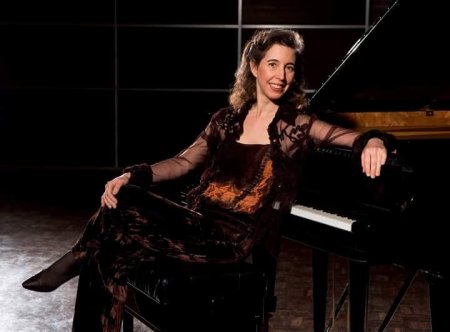
Angela Hewitt (picture credit: St David’s Hall website )

This afternoon I had the great pleasure of attending a solo piano concert at St David’s Hall in Cardiff featuring star pianist Angela Hewitt (pictured above). The programme consisted of one work – but what a work! – the monumental Goldberg Variations by Johann Sebastian Bach.

I’ve been looking forward to this concert for weeks, not only because it was a rare opportunity to hear Angela Hewitt play, but also because although it’s a very special piece to me I’ve never heard the entire work played live before today.

The fact that I love this work so much is probably connected with my love of Jazz. Although ostensibly totally different idioms, the basic idea of ‘theme and variation’ unites these forms. Not much is known about Bach’s approach to the composition of this particular work but it wouldn’t surprise me if he improvised at least some of the variations. Above all, though, it’s when those walking bass lines for the left hand appear (e.g. near the end of the Aria) that Bach really swings; I always imagine Percy Heath or Ray Brown accompanying those passages on the double bass.

The sense of anticipation for this concert probably explains why I arrived earlier than usual:
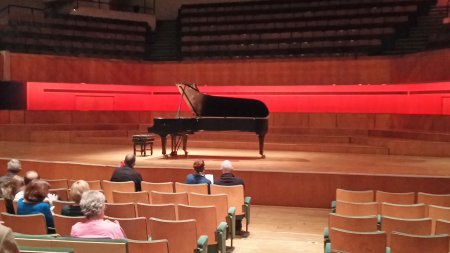
I have eight different versions of the Goldberg Variations on CD, including one by Angela Hewitt and the two extraordinary (and extraordinarily different) recordings by fellow Canadian Glenn Gould. If I had to pick my favourite, however,  it would probably be one by Andras Schiff, but I find much to enjoy in all of them. I think the great thing about Bach’s music is that it’s so beautifully constructed that it can be played in a huge variety of ways and still be exquisite.

I’ve heard some people describe Angela Hewitt’s way of playing Bach as ‘affected and punctilious’ and others ‘elegant and crisply articulated’. They’re probably all describing the same thing, but some people like it and some don’t, it’s just a matter of taste.

Recordings are not the same as a live experience, and today underlined to me just how much more I enjoy live concerts. The concert lasted about 80 minutes (without an interval) – there are 30 variations altogether – and I don’t think I’ve ever seen an audience at St David’s with such rapt attention. For me the time went so quickly that I was quite startled when I heard the start of penultimate section (‘Quodlibet’) signalling that we were near the end. After the final note of the closing recapitulation of the opening Aria had subsided, the soloist kept her face down over the keyboard as if daring anyone to break the spell. Eventually she raised her head, smiled, and the applause began, followed by a standing ovation. The St David’s audience is usually rather reticent so that tells you how good this was. What better way can there be to spend a Sunday afternoon?

P.S. Angela Hewitt walked on and off stage with the aid of a metal crutch, suggesting some form of leg injury. On the unlikely event that she reads this, let me wish her a speedy recovery from whatever it is!

Summer’s Ending

Posted in Bad Statistics, Biographical, Cricket with tags , , , , , on September 11, 2017 by telescoper

There’s no escaping the signs that summer is drawing to a close. The weather took a decidedly autumnal turn  at the end of last week, and though I resisted the temptation to turn the central heating on at Chateau Coles I fear it won’t be long before I have to face reality and take that step. I hope I can hold out at least until the conventional end of summer, the autumnal equinox, which this year happens at 21.02 BST on Friday, 22 September.

Saturday saw the Last Night of the BBC Proms season. I’ve enjoyed a great many of the concerts but I only listened to a bit of the first half of the Last Night as I find the jingoism of the second half rather hard to stomach. I did catch Nina Stemme on the wireless giving it some welly in the Liebestod from Tristan und Insolde, though.  Pretty good, but difficult to compare with my favourite version by Kirsten Flagstad.

One of the highlights of the season, just a few days ago, was Sir András Schiff’s late-night performance of Book I of The Well Tempered Clavier which had me captivated for two hours, until well past my usual bedtime…

However, as the Proms season ends in London the music-making continues in Cardiff with a new series of international concerts at St David’s Hall and Welsh National Opera’s new season at the Wales Millennium Centre (which starts on 23rd September). I notice also that, having finished his complete Beethoven cycle,  Llŷr Williams is embarking on a series of recitals of music by Schubert, starting on November 9th at the Royal Welsh College of Music and Drama.

Another sign that summer is over is that the last Test Match of the summer has ended. Excellent bowling by Jimmy Anderson (and, in the first innings, by Ben Stokes) meant that England had only a small total to chase, which they managed comfortably. Victory at Lord’s gives England a 2-1 win for the series over West Indies. That outcome is welcome for England fans, but it doesn’t do much to build confidence for the forthcoming Ashes series in Australia. England’s pace bowlers have shown they can prosper in English conditions, when the Duke ball can be made to swing, but in Australia with the Kookaburra they may find success much harder to come by. More importantly, however, only two of England’s five top-order batsmen are of proven international class, making their batting lineup extremely fragile. So much depends on Cook and Root, as I don’t think it is at all obvious who should take the other three positions, despite a whole summer of experimentation.

There are a few one-day internationals and Twenty20 matches coming up as well as three full weeks of County Championship fixtures. In particular, there are two home games for Glamorgan in the next two weeks (one against Northants, starting tomorrow, and one next week against Gloucestershire). Their last match (away against Derbyshire) was drawn because three of the four days were lost to rain, but weather permitting there should still be a few opportunities to see cricket at Sophia Gardens this year.

And of course it will soon be time to for the start of the new academic year, welcoming new students (including the first intake on our MSc courses in Data-Intensive Physics and Astrophysics and new PhD students in Data-Intensive Science who form the first intake of our new Centre for Doctoral Training). All that happens just a couple of weeks from today, and we’re having a big launch event on 25th-26th September to welcome the new intake and introduce them to our industrial and academic partners.

Anyway, that reminds me that I have quite a lot to do before term starts so I’d better get on with it, especially if I’m going to make time to watch a few days of cricket between now and the end of the month!

Elegy, by Coles

Posted in Music, Poetry, Uncategorized with tags , , , , , on November 20, 2015 by telescoper

Last night on Radio 3 there was a concert involving music by Cecil Coles (among others). Coles – who, as far as I know, was no relation – was killed in action in the First World War, in April 1918. In fact he was shot and mortally wounded by a sniper while working as a stretcher-bearer trying to rescue injured soldiers from a wood, a task for which he had volunteered. He was 29 when he died and not much of his work as a composer survives. In the interval of the Concert I heard this recording of a work by Coles, which I think is very touching. It’s a setting of one of the Elegiac Stanzas (“Sic Juvat Perire”)  by Thomas Moore. Here’s the text:


When wearied wretches sink to sleep,
How heavenly soft their slumbers lie!
How sweet is death to those who weep,
To those who weep and long to die!

Saw you the soft and grassy bed,
Where flowrets deck the green earth’s breast?
‘Tis there I wish to lay my head,
‘Tis there I wish to sleep at rest.

Oh, let not tears embalm my tomb, —
None but the dews at twilight given!
Oh, let not sighs disturb the gloom, —
None but the whispering winds of heaven!

And here is the setting by Cecil Coles:


We have a Beautiful Cosmos

Posted in Music, Poetry with tags , , on April 27, 2015 by telescoper

On the bus coming up to campus just now, I was looking through the Brighton Festival (which starts on 2nd May) and found that there is a show called The Beautiful Cosmos of Ivor Cutler, which is on at the Theatre Royal. As a devout fan of Ivor Cutler I’ll definitely be going, but in the mean time here is the title track (set to video…)

And here be the lyrics:

You are the centre of your little world
and I am of mine.
No one again we meet for tea
we’re two of a kind.

This is our universe…
cups of tea.
We have a beautiful cosmos,
you and me.
We have a beautiful cosmos.

What do we talk of whenever we meet:
nothing at all.
You sit with a sandwich,
I look at a roll.
Sometimes I open my mouth,
then shut it.

We have a beautiful cosmos,
you and me.
We have a beautiful cosmos.

You are the centre of your little world
and I am of mine.
No one again we meet for tea
we’re two of a kind.

This is our universe…
cups of tea.
We have a beautiful cosmos,
you and me.
We have a beautiful cosmos.

200 Years of Sax – Anniversary Poll

Posted in History, Music with tags , , , on November 6, 2014 by telescoper

Today is the 200th anniversary of the birth of famous Belgian Adolphe Sax, inventor of the saxophone. To mark this occasion I thought I’d undertake a bit of audience participation and get you out there in internet land to vote on the greatest proponent of said instrument. I’ve populated the list with people I consider to be likely contenders, but feel free to add your own if your favourite is missing!

Jim Europe’s Society Orchestra

Posted in History, Jazz with tags , , , , on April 30, 2014 by telescoper

More than a few people have commented on the fact that my musical tastes are a little old-fashioned, but here’s a piece that’s a bit old even by my standards. It’s by a band from the immediately pre-Jazz era called Jim Europe’s Society Orchestra. Led by James Reese Europe this band pre-dated the much more famous Paul Whiteman band in popularity, playing at the Carnegie Hall for example long before Whiteman’s ever did which, for a group of black musicians, was quite remarkable at a time of racial segregation in the United States.

When World War 1 started, Jim Europe enlisted in the 369th Infantry Regiment, which fought with immense distinction on the Western Front. The regiment, comprised of African-American and Puerto Rican soldiers, was dubbed the “Men of Bronze” by the French army and as the “Hellfighters” by the German army, on account of their legendary toughness. In the latter stages of the war, Jim Europe formed a military band to which he gave the name “The Harlem Hellfighters”. He died in 1919, after being stabbed in the neck by one of his own musicians.

This particular record was made over a century ago, on December 29 1913. As you might expect, the recording quality is not particularly good (to put it mildly) but it always strikes me as absolutely amazing that we can hear anything at all that was recorded so long ago. The line-up is very unusual by modern standards: two pianos, five banjo mandolins, three violins, clarinet, cornet, and a drummer. That’s on this particular tune. No personnel information is available except that it is certainly Jim Europe himself who delivers the encouraging shouts.

It’s pretty basic stuff from a musical point of view, in that everyone plays in unison and there’s no improvisation or any other development of the tune, but it’s certainly a performance full of energy and fun as well as a valuable piece of Jazz prehistory. The tune is Downhome Rag, which was written sometime in 1913 by Wilbur C Sweatman, is still performed by traditional jazz bands today. But not like this!

Duet for Violin and Subatomic Particles

Posted in Music, The Universe and Stuff with tags , , , on August 8, 2013 by telescoper

I received an email this morning about this video and thought I’d post the clip here. This short documentary is about the performance of the composition Cloud Chamber (“Duet for violin and subatomic particles”) in San Francisco at the California Academy of Sciences in Golden Gate Park. The video was produced by Patrick Haynes, Adam Behrmann and Chris Whitmore, and features commentaries from , e.g., Hitoshi Murayama, Professor of Physics at Berkeley and Director of the Institute of Physics and Mathematics of the Universe at the University of Tokyo (the commentaries start at 16:10). It is introduced by Professor JoAnne L. Hewitt, Head of Theoretical Physics at SLAC National Accelerator Laboratory, Stanford University. There’s a longer description on the Youtube page if you’re interested in learning more about this interesting project.

Me and my horn….

Posted in Biographical, Music with tags , , on January 6, 2013 by telescoper

How will I amuse myself when I’ve got no TV or internet connection?

Here’s the answer…

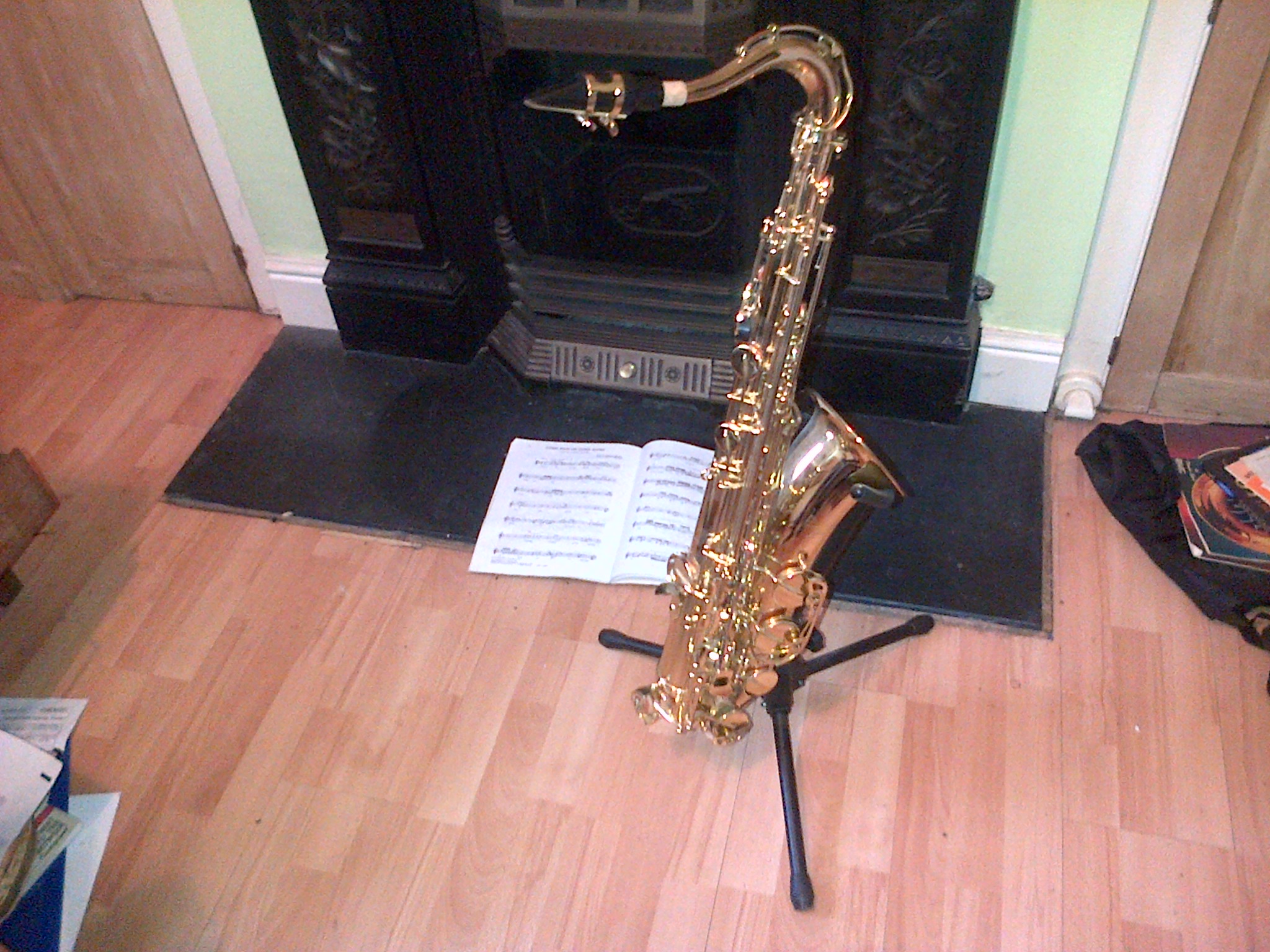
IMG-20130106-00029

..although I’m not sure the neighbours are going to be very happy about it!

All Blues at School

Posted in Biographical, Jazz with tags , , , , , on October 14, 2012 by telescoper

I discovered by accident the other day that the classic Miles Davis composition All Blues has found its way onto the GCSE Music syllabus. I think that’s wonderful. In fact here’s a recording of the track,  produced and distributed as “set work” for that purpose:

I never took any qualifications in music at School – although I did get music lessons, I didn’t find them at all inspiring and it took me years to develop a taste for anything other than Jazz, which I knew about mainly from home, because my father was a (part-time) Jazz drummer. There wasn’t much mention of Jazz at School from teachers, and none of my friends were into it, so it became a very private passion, although I’m glad to say it never faded.

Anyway, what little I know about music I picked up by studying on my own, and trying to figure out what was going on by listening to records. All Blues is a really interesting composition to unpick in this way, as it tells you a lot about how Jazz was evolving in the late 1950s (it was released in 1959). Musicians like Miles Davis were experimenting with ways of breaking away from the standard approach to Jazz improvisation based on chord progressions, and one of the routes that developed was modal Jazz. All Blues is particularly interesting because it teeters on the edge between the old approach and the new; it’s clearly based on the traditional 12-bar blues progression but diverges from it in several respects.

A standard blues progression in G might go  like this (although there are many variations):

|G|G|G|G|
|C|C|G|G|
|D|C|G|G|

It’s based on just three chords: the tonic (in this case G): the sub-dominant IV (C) and the dominant V (D); the V-IV-I progression in the last four bars is usually called the turnaround.

The progression for All Blues is this:

|G7| G7| G7| G7|
|Gm7| Gm7| G7| G7|
|D7| E♭7 D7| F G|F G6|

While the addition of a major 7th note to the basic triad G isn’t unusual, the two G minor 7th chords are more interesting, because they involve adding a blue note (a flattened third) to the basic chord . But it’s in the last four bars that the harmonies move dramatically away from the standard turnaround. Chromatic chords are included and the usual resolution back to G is subtly changed by the addition of a 6th note (E) to the basic G chord (GBD) at the end; that trick became a bit of a trademark for Jazz of this period.

However, it’s the two F chords that represent the strongest connection with modal harmony. The scale of G major involves F-sharp, so the F is a flattened note (a flattened VIIth).  In fact, all the Fs in the piece are natural rather than sharp.  For this reason you could argue that this is a piece not played in the key of G major but in the corresponding Mixolydian mode (the white notes on the piano from G to G).

So it’s a blues that’s not quite a blues, but is (appropriately enough) Kind of BlueThere’s so much going on harmonically that the fact that it’s played in 6/8 rhythm (rather than the more usual 4/4 for the Blues) seems almost irrelevant.

Those are just the bare bones, but the improvisations of Miles Davis, Bill Evans, Cannonball Adderley and John Coltrane et al.  breath life into them and create a living Jazz masterpiece. Although it seems like a complicated tune, apparently what happened at the recording session was that Miles Davis talked the band through the piece, they played it once to get a feel for it, and then recorded the entire track that was released on the album, in one go.

I must have listened to All Blues a thousand times, and I’ve never tired of it. The thing is, though, I could say the same thing about all the other tracks on the album Kind of Blue, about which Stephen Thomas Erlewine wrote

Kind of Blue isn’t merely an artistic highlight for Miles Davis, it’s an album that towers above its peers, a record generally considered as the definitive jazz album, a universally acknowledged standard of excellence. Why does Kind of Blue posses such a mystique? Perhaps because this music never flaunts its genius… It’s the pinnacle of modal jazz — tonality and solos build from the overall key, not chord changes, giving the music a subtly shifting quality… It may be a stretch to say that if you don’t like Kind of Blue, you don’t like jazz — but it’s hard to imagine it as anything other than a cornerstone of any jazz collection.

The Tallis Scholars

Posted in Music with tags , , , , , on May 4, 2012 by telescoper

I’ve always wanted to be at a live performance of the legendary 40 part motet  Spem in Alium by Thomas Tallis, not only  because it’s a gorgeous piece of music but also because I’ve always wondered what the conductor is supposed to do with his hands when there are so many independent parts. It’s such a complicated and demanding work, however, that opportunities to hear it live are rather limited. Last night’s concert at St David’s Hall by the Tallis Scholars (supplemented by a local choir; the Tallis Scholars number only ten singers) actually involved two performances of Tallis’ most famous work, first at the beginning and then again right at the end.

If you’ve never heard Spem in Alium before, then you really should make the effort. It’s an extraordinary piece of music in many different ways. Most writers focus on its complexity, but that shouldn’t make you think Tallis was just showing off when he wrote it, or distract you from the fact that it’s so very beautiful to listen to. The forty parts  involved are divided into eight choirs, each of five voices. The piece starts with one voice from the first choir, and slowly evolves to incorporate all forty voices, waving each individual vocal line into a gorgeous musical tapestry. At times all the voices seem to be acting independently within the overall harmonic framework, at others the choirs act as the basic unit; there’s a wonderful passage, for example, when choirs throw phrases backwards and forwards between them. There are also moments when all the evolving parts come back into phase so that all voices sing the same words at the same time. The effect of this is indescribable; it sent cold shivers down my spine.

There is so much going on in this piece that it’s difficult to understand how Tallis managed to stop the different parts interfering destructively with each other, but Spem in Alium  never dissolves into a shapeless melisma. As the piece unfolds, the various patterns that appear and disappear are always held in sharp focus. It’s a masterpiece, and although the large space of St David’s Hall probably isn’t ideal for performing a work like this, my long wait to hear a live performance of this masterpiece was well worth it.

The concert wasn’t just about Spem in Alium.  The Tallis Scholars performed a number of other works on their own, including pieces by Tallis’ old mate William Byrd and part of one of my other favourite Tallis works, The Lamentations of Jeremiah. The programme called for various combinations of the singers drawn from the ten in the basic line-up, producing a wide range of texture and colour.

It was all extremely enjoyable, but my lasting memory will be the piece that started and ended the show. There’s so much to discover listening to Spem in Alium that the second performance of it that ended the concert made me want to hear a third straight away.

PS. One of the other pieces performed during the concert was Tallis’ Miserere, which aptly described Cardiff City’s performance at home to West Ham in their play-off semi-final which was being played at the same time as the concert!