Archive for National Symphony Orchestra

A New President (of Ireland)

Posted in Biographical, Politics with tags , , , , on September 4, 2025 by telescoper

Yesterday the official Presidential Election Order was tabled which means that an election for the office of President of Ireland (Uachtarán na hÉireann) will be held in the Republic on Friday 24th October 2025. The incumbent Michael D. Higgins will have served his second 7-year term by November and since by the Constitution nobody can hold the office more than twice, we will have a new President of the Republic.

The Irish media have been trying to make news about the presidential election all summer, which has been pointless and tedious to put up as no candidates had even been nominated then. Actually nobody has yet either, as nominations don’t officially open until tomorrow; they close on September 25th. Still, at least the process has started.

In order to progress to the election, a candidate has to receive the support of at least 20 members of the Oireachtas or at least 4 local authorities (i.e. councils). Former or retiring Presidents can nominate themselves but this is not relevant here.

The way the election works is that voters rank all candidates. In the first round of counting, first preference votes are totted up and if one candidate has more than 50% he/she is elected. If not an Instant Runoff method is used, with votes of lower-ranked being reallocated until there’s a winner (ie until one candidate gains a majority).

I just checked the online electoral register to confirm my status:

I will wait to see who has acually been nominated before deciding who to vote for. In the last Presidential Election (2018), five candidates opposed the re-election of Michael D. Higgins, three of them businessmen best known for having appeared on the Irish version of the TV show Dragon’s Den. There’s ample evidence from elsewhere that the products of reality TV shows do not make good presidents. Neither do rapists, so let’s hope Conor McGregor does not get nominated. It is likely that there will be more than six candidates this time and the election will be more closely contested that last time. In 2018 the turnout was very low, no noubt because many people assumed – correctly – that Higgins would win. In the event he got over 56% of the first-preference vote so the transfers were irrelevant. That might not be the case this time.

The Presidency of Ireland is a ceremonial rather than an executive office, and it has little actual power associated with it. It is nevertheless important in that the President is the guardian of the Constitution as well as representing the Irish Nation as a kind of ambassador and as patron of many good causes. Surprisingly, some of the people who want to put themselves forward don’t seem to know anything about what the job entails. Hopefully, the more obvious fruitcakes who put themselves forward will fail to get nominated. I think Michael D. Higgns has carried out his duties in a very dignified and diligent way over the years, and will be a very hard act to follow. I’ve been proud to have him as my President.

It’s hard to believe that seven whole years have passed since the last election. There’s another reminder of that coming up on Friday September 12th when I will be going to the National Concert Hall for a performance by the National Symphony Orchestra that marks the opening of the 2025/6 season. On September 15th 2018 I went to the season opener for that year. That was also my first ever visit to the National Concert Hall. To mark the occasion we were in the presence of the man himself , Michael D Higgins, and his wife Sabena. The President attended as Patron of the National Symphony Orchestra. I don’t know whether he will attend on Friday 12th September, but if he does I’m sure he will get a good ovation. As well as many other things Michael D. Higgins has been a very strong advocate for the Arts in Ireland. I’m not sure his successor will live up to the standard he set.

Ravel 150 at the National Concert Hall

Posted in Music, Rugby with tags , , , , , , , , on March 8, 2025 by telescoper

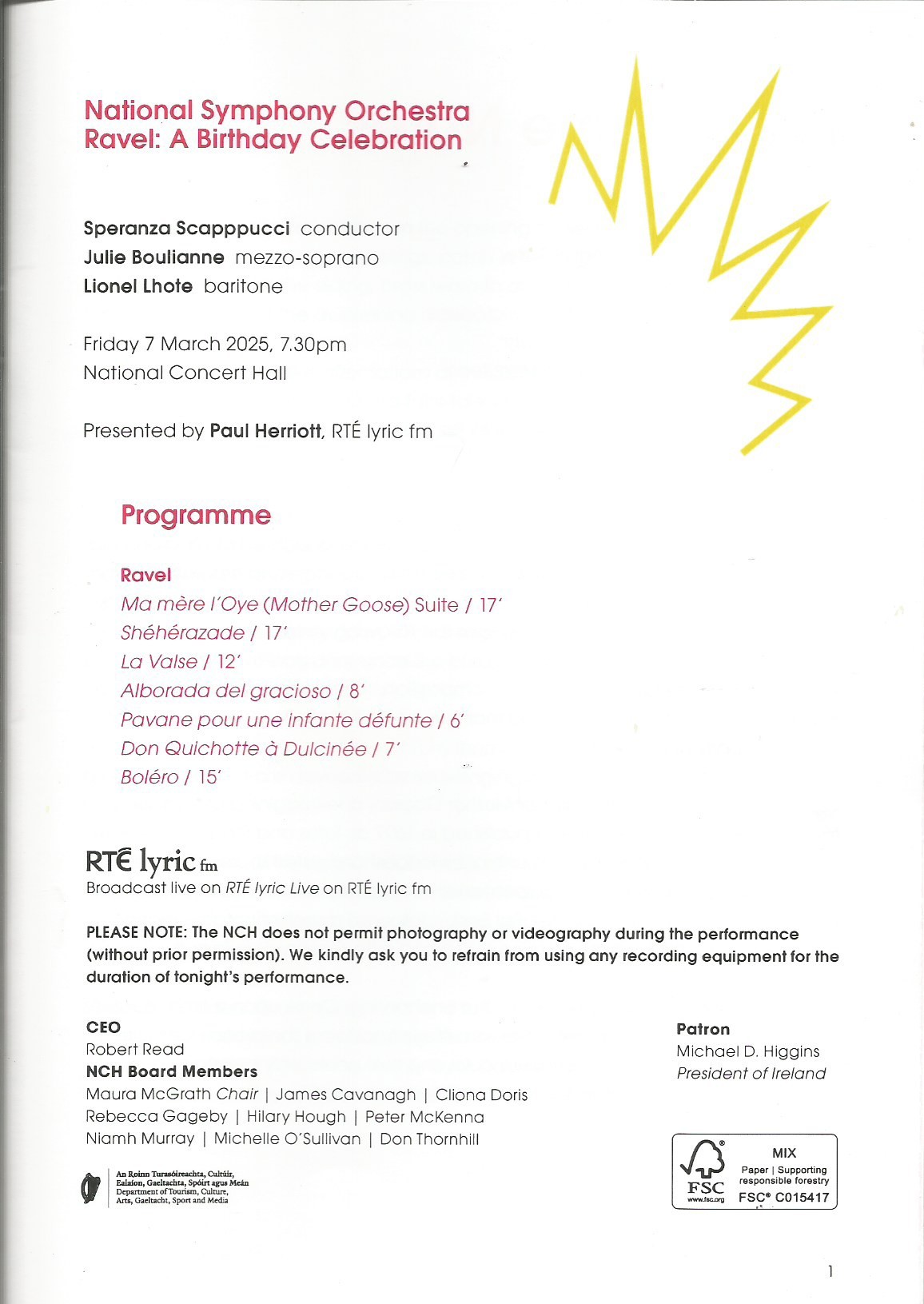
Yesterday (8th March 2025) was the 150th anniversary of the birth of Maurice Ravel and the National Symphony Orchestra celebrated it in fine fashion with all-Ravel programme for last night’s concert under the direction of guest conductor Speranza Scappucci (whose name aquired an extra p for the printed programme):

As you can see, it was basically a selection of Ravel’s greatest hits and there’s no surprise that the concert ended with a performance of Boléro, which is by no means the most interesting of Ravel’s compositions but is easily his most famous. Ravel himself said that `it has no music in it’, meaning that it doesn’t have any variation or thematic development or invention, but was written deliberately as an experiment to see how far he could get in writing a work that was entirely based on rhythm and repetition. The result was a smash hit and earned him a very great deal of money, but he grew to resent the fact that it was so much more popular than the other works he himself thought were much better. I know some people who hate this piece, but I think it’s great fun and always enjoy hearing it. Last night was no exception.

The composition of Boléro is so simple that even a non-musician like me can play it. It’s basically written in a slow 3/4 time signature on which is superimposed the following figure:

The second part is basically a repeat of the first, with the last two eighth notes replaced with triplet. The whole pattern consists of 24 notes. I once tried to count how many times it is repeated in a performance of Boléro, but gave up when I got to 100. I think it must be over 200 times.  This figure is introduced first on a single snare drum, which carries on playing it for the duration, i.e. for about 15 minutes in total. As the piece develops the same pattern is picked up by various other instruments, either alone in combination. A second snare drum joins in too. The key to the piece is to keep this all very strictly in tempo, as the piece gradually gets louder.

As I’ve mentioned before on this blog, my Father was a (jazz) drummer. I remember once borrowing his snare drum and attempting to play along with a recording of Boléro. The pattern shown above is not that hard to play in itself, but it’s not as easy as you probably think to keep in tempo as you play it louder and louder. At the start it’s fine: you begin by tapping the sticks on the skin of the drum very close to the rim. To increase the volume you gradually move the point of impact closer to the centre of the drum, which naturally makes it louder. However, to get louder still you have to increase the distance the sticks move, and that makes it tougher to keep to tempo. Playing along at home is one thing, but playing the percussionist playing this in an orchestra must leave the drummer feeling very exposed. One mistake, any speeding up or slowing down, and the whole performance will be ruined.  Percussionists very often have little to do for long passages in an orchestral work, but this takes it to the opposite extreme. It requires constant concentration, but no variation or embellishment is allowed.  I suppose professional musicians just get into the zone and don’t think about the possibility of screwing up. Last night the task fell to Section Leader Rebecca Celebuski, who performed it flawlessly.

The bolero rhythm is just one element of the composition, of course. There is a melody, in two parts. The first simple and catchy, the second bluesier and a bit syncopated. Each part is played twice, passed around the instruments of the orchestra, first individually and then in combinations. Sometimes the melodic line is doubled, but there are no complicated harmonies and the piece stays in C major throughout, apart from a sudden change of key near the very end. The second part of the melody allows the musicians to release their inner jazz a bit, playing behind or across the beat to generate the feeling that the tune is trying to escape the confines of the incessant rhythm. As is the case in jazz, this sense of tension only works if the basic rhythm is kept strictly in tempo as the crescendo builds

The third element of the composition is the simplest of all, but I feel that it is very important in determining whether a performance of Boléro really rocks. That is a rhythmic pulse based on the three beats of the underlying 3/4. When they’re not playing the melody or shadowing the bolero pattern, the orchestra play this figure and it ends up being boomed out by the timpani in tremendous style but also as the piece progresses the stress shifts between the three beats as different instruments contribute.

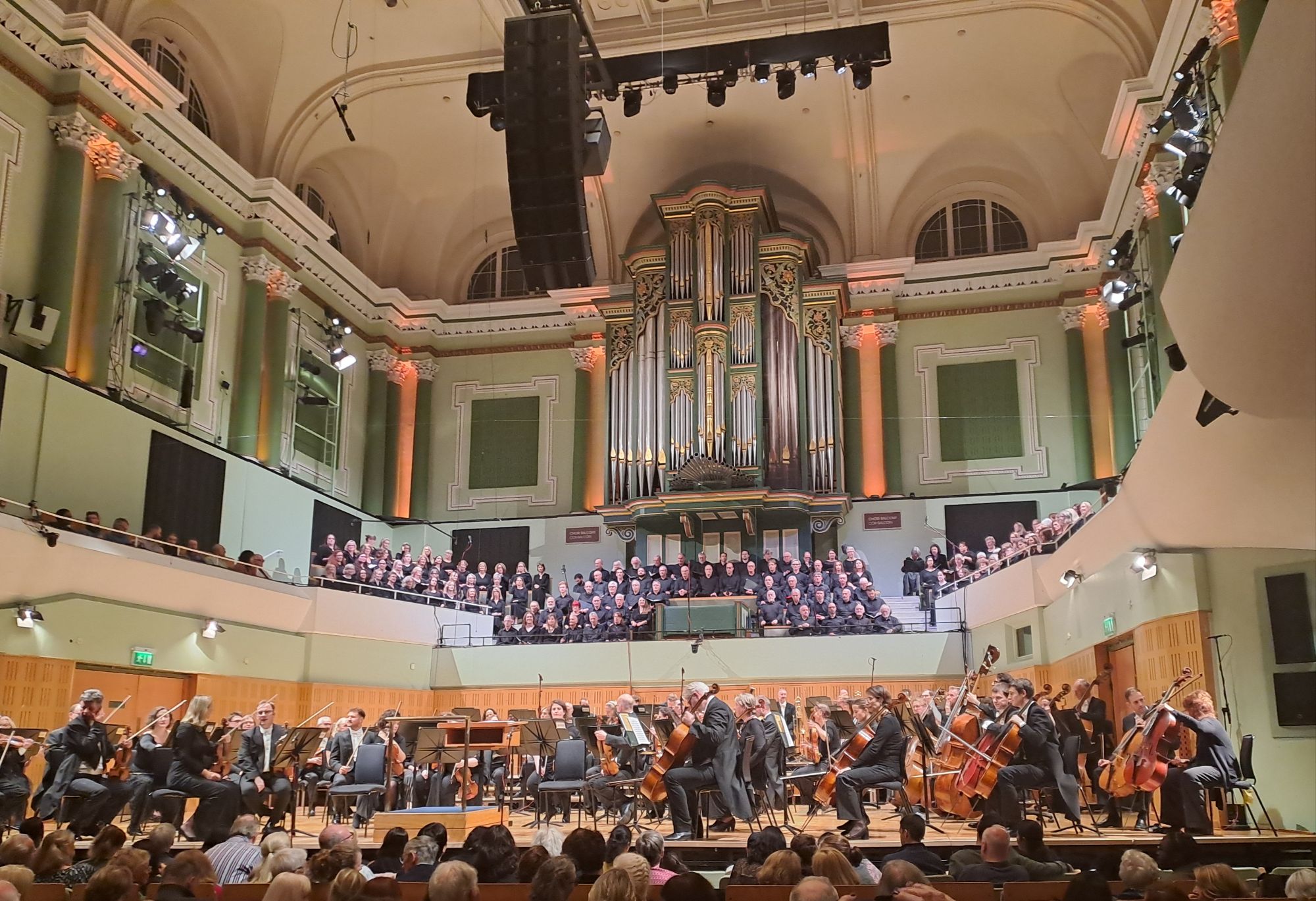
I know it’s a familiar piece but I really enjoyed last night’s performance. I’ll also reiterate that as well as making a great sound, a full symphony orchestra playing during a piece like this is also a tremendous thing to watch.

Anyway, it wasn’t all about Boléro. In the first half we had the orchestral suite Ma mère l’Oye (My Mother the Goose), the song cycle Shéhérazade with vocals by excellent mezzo-soprano Julie Boulianne, and La Valse. The last of these is a masterpiece, originally conceived as a tribute to the Viennese waltz, but not composed until after TheFirst World War, and turned into a kind of tragic parody, starting out sombre and brooding, gradually building into a garish intensity and then into a brutal, almost chaotic, ending.

After the wine break we heard Alborado del Gracioso, a beautifully atmospheric with a strong Spanish influence and the orchestral version of Pavane pour une infante défunte, played well but a little too slowly for my tastes, and the only piece of the evening that I’d never heard before, Don Quichotte à Dulcinée, a miniature song cycle lasting just 7 minutes, comprised of settings of three poems by Paul Morand. Soloist was baritone Lionel Lhote who not only sang very well but had a very engaging stage presence.

And then it was Boléro, received with great applause and a standing ovation, and then by train back to Maynooth. There were a lot of French people in Dublin last night, presumably not for the Ravel, but for this afternoon’s rugby. They will be enjoying themselves in the city right now, as France convincingly beat Ireland 27-42 in the Six Nations, to end the home team’s hopes of a grand slam. Disappointment for the Boys in Green, but France were excellent and thoroughly deserved to win. Losing to a side as good as that is no disgrace.

Das Lied von der Erde

Posted in Biographical, Music with tags , , , , , , , on February 22, 2025 by telescoper

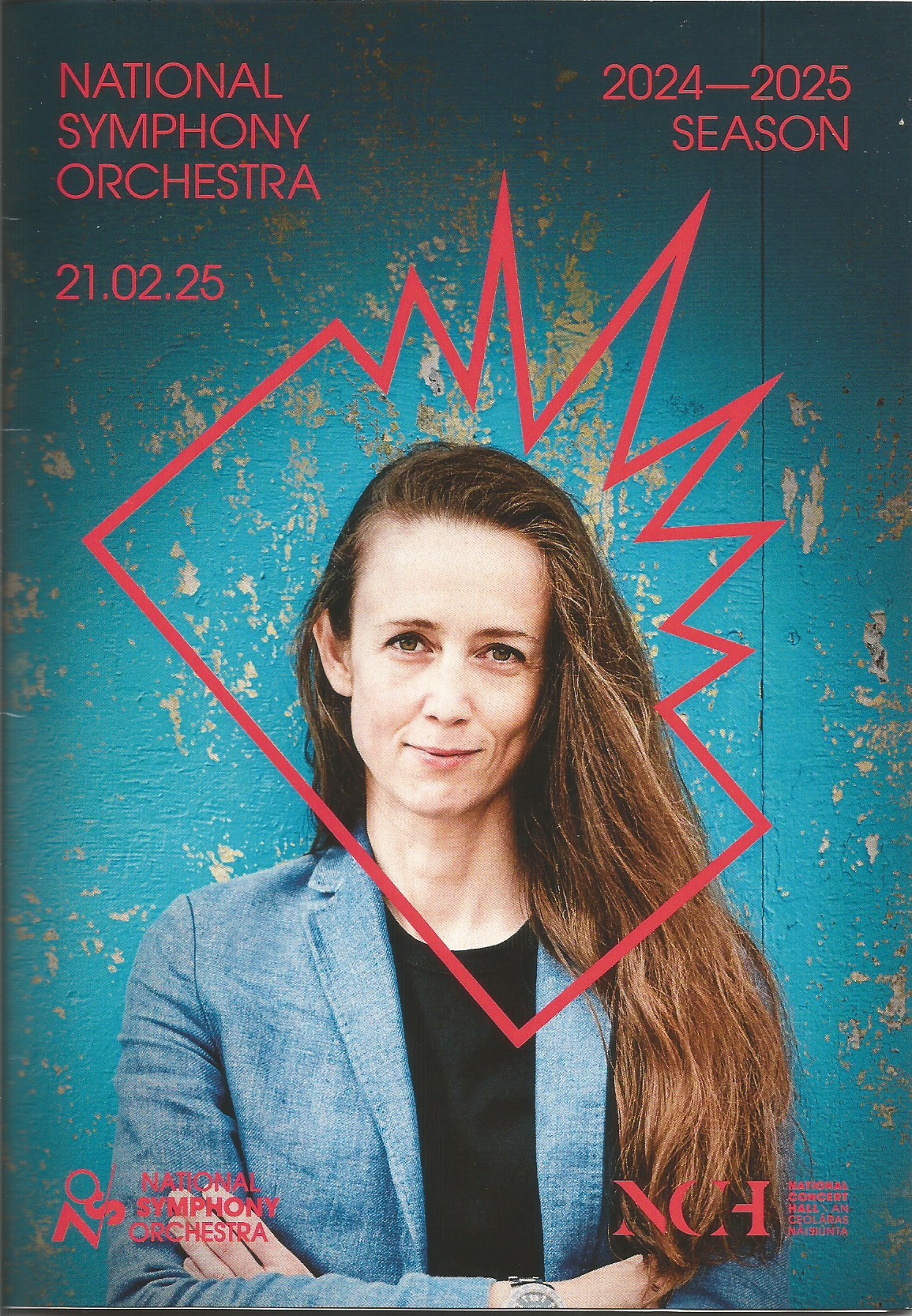
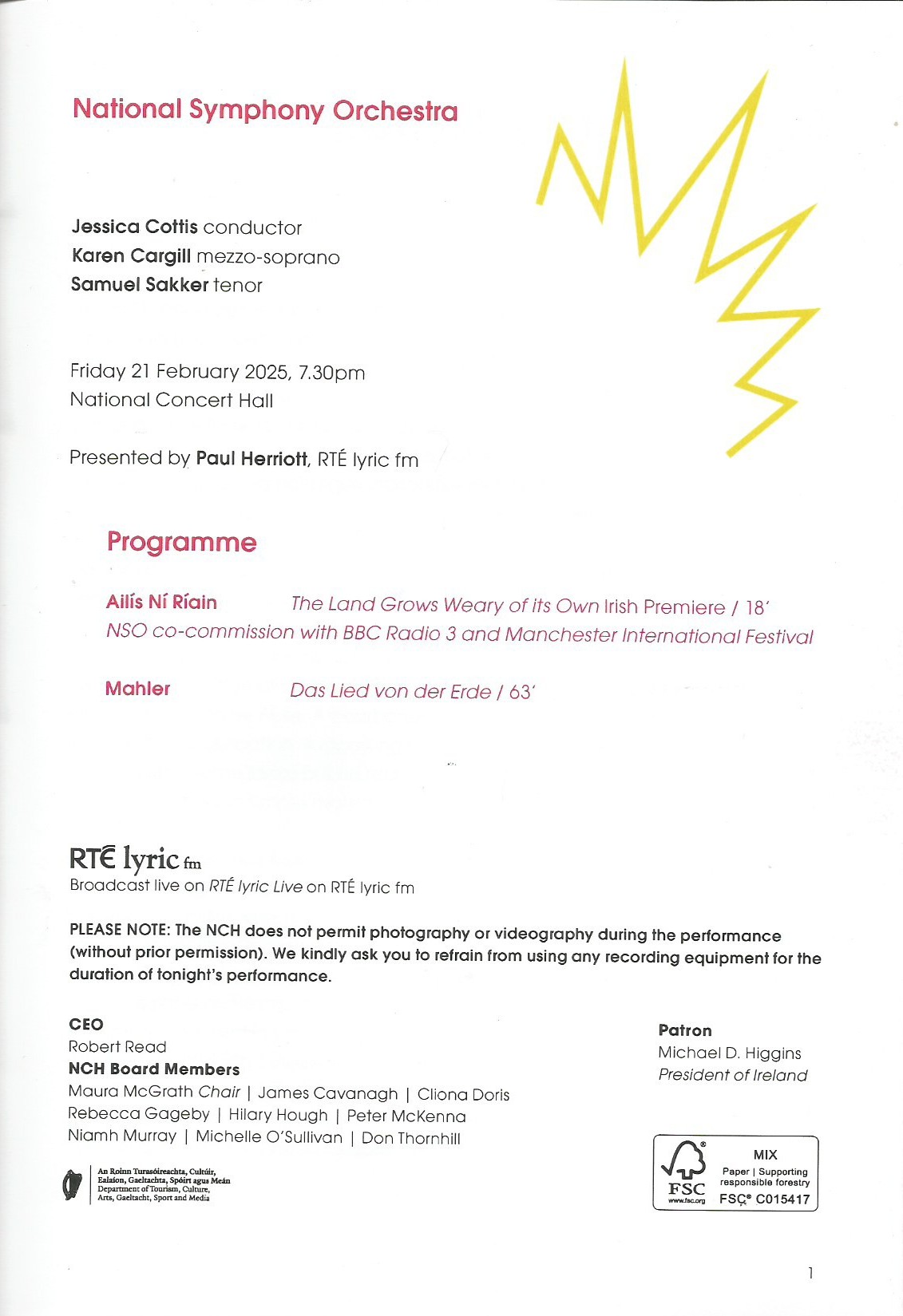
And it came to pass that yesterday evening I travelled into Dublin for another concert at the National Concert Hall. The main item on the menu was Das Lied von der Erde (“The Song of the Earth”), an orchestral work for two voices and orchestra by Gustav Mahler. Sometimes described as a song cycle this piece is a symphony in all but name (and number). Mahler was suspicious about counting this work as his 9th Symphony because of the Curse of the Ninth. He did go on to composer another (numbered) Symphony but did not live to hear it performed. He didn’t live to hear Das Lied von der Erde performed either.

Das Lied von der Erde (“The Song of the Earth”) is a long work – performance time is just over an hour – and it is spread over six movements, thematically linked by translations of classical Chinese poems translated into German by Has Bethge. The final movement, by far the longest, incorporates two texts whereas the others include one each.

This is one of my favourite works but I’ve only ever heard it on the radio or on a recording so I was delighted to see it was coming up at the National Concert Hall. I enjoyed last night’s performance enormously. The National Symphony Orchestra was conducted by Jennifer Cottis with soloists Samuel Sakker (tenor) and Karen Cargill (mezzo-soprano). The start of this piece is difficult for the tenor who has to come in at full volume. At first I thought he was going to struggle, but he hit his straps very quickly and delivered a strong performance. Karen Cargill was superb throughout, her voice very well matched to the demands of the music. I have heard her sing Mahler before, incidentally, in Cardiff, and she was great then too. The whole orchestra played beautifully, but I would pick out the woodwind section for special mention.

That wasn’t the entire concert. There was also the Irish premier of a new work work by Ailís Ní Ríain called The Land Grows Weary of its Own, which is a meditation on the effects on bird populations and migration thereof caused by Earth’s changing climate. It’s an interesting piece, with some fascinatingly complex passages, especially for the percussion. The composer was the audience, but unforunately the auditorium was only about half full for the performance. It only lasts about 20 minutes so the interval came quite quickly. Returning after my glass of wine I could see a much fuller Concert Hall so some people obviously skipped the first piece, which is a shame.

Yesterday was a very rainy and blustery day and on the way home I thought about the number of times I’ve walked from Connolly Station to the NCH yet never been rained on. Last night was no different.

Debussy, McNeff & Rachmaninov at the NCH

Posted in Uncategorized with tags , , , , , , , , on February 1, 2025 by telescoper

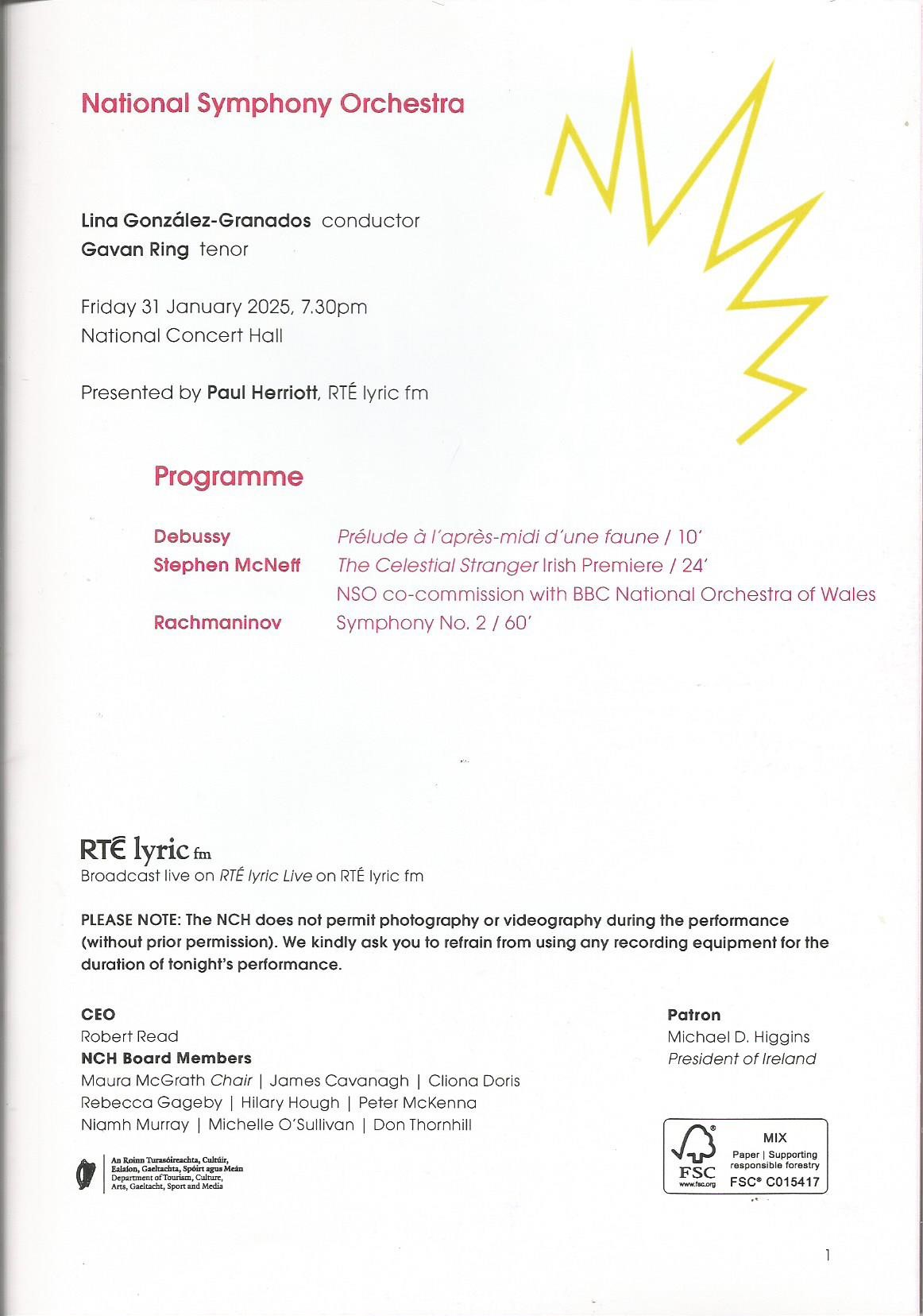
Last night was my first trip of the year to the National Concert Hall in Dublin. I had planned to go on 17th January but by the time I got around to buying a ticket it was sold out. Fortunately, it was broadcast live on the radio and is still available on the RTÉ Player. I had a ticket for last Friday’s concert but bottled out of going because of transport worries about Storm Éowyn. That concert went ahead, apparently, but wasn’t broadcast so I missed it. Last night was third time lucky, and I’m very glad I got there!

The conductor of the National Symphony Orchestra for last night’s performance was Columbian-born Lina González-Granados in what I believe to have been her first appearance with the NSO. I certainly hope she comes back as she was very good indeed. I think the members of the orchestra enjoyed themselves as much as the audience!

As you can see from the programme, the concert opened with a very familiar piece, Prélude à l’après-midi d’un faune by Claude Debussy, which was performed with all the shimmering sensuality it demands. Some very lush playing by the strings on this one, and lovely work by the woodwinds made it sound very fresh although I’ve heard it many times.

After that tenor Gavan Ring joined the orchestra to perform the Irish Premiere of The Celestial Stranger, a song cycle composed by Belfast born composer Stephen McNeff. This consists of settings of five poems, two by Thomas Traherne (including the one that gives its name to the collection, a remarkable work that I will post in its entirety later on). The next poem is by Walt Whitman and is titled As The Time Draws Nigh in the programme, but is not the well-known Whitman poem of that title but seems to have been adapted from various texts, including Years of the Modern. After that is a famous poem by Dylan Thomas, The hand that signed the paper and the cycle concludes with an adaptation of Farewell to Thee, written by Liliʻuokalani (former monarch of Hawaii). It’s a varied collection but there is a narrative behind the choice: a visitor from outerspace (the Celestial Stranger) arrives on Earth and reacts joyfully to begin with. As time goes on, however, he finds out more about war and and death and finally takes his leave.

The music is as varied as the choice of verse. I felt some influence of Britten in the first piece, but the rest is very different. Gavan Ring was in fine voice and the orchestra responded very well to the very different demands of this work compared to the first.

After the interval it was time for the main course of the evening, Rachmaninov’s Second Symphony. It’s a remarkable work because it’s not only a “proper” symphony in its construction and development but also the best part of an hour of one glorious melody after another. It’s a gorgeous work altogether, but the third movement (Adagio) is especially beautiful. I love the way Rachmaninov starts this movement one of his big romantic tunes, but then hides it while passages develop through a solo  clarinet and strings. You know the tune is coming back though, and when it does the emotional impact brought the audience to a collective swoon. This is romantic music in all senses of the word, just the ticket for a cole January evening. It was a very fine performance, not least because you could see how much both conductor and orchestra were enjoying themselves. Hats off to Lina González-Granados who had just the right balance of control and expressiveness. She look quite exhauasted at the end, actually. She had worked hard to earn her standing ovation.

Mozart & Bruckner at the National Concert Hall

Posted in Music with tags , , , , , , on December 7, 2024 by telescoper

It was a dark and stormy night but I braved the inclement weather to travel to the National Concert Hall in Dublin for what will be my last concert of 2024. It look like being a nearly full house when I booked my ticket, but in the end there were quite a few empty seats perhaps because various groups decided not to make a journey owing to Storm Darragh. My own travels went without a hitch and in fact I even managed to walk from Connolly to the NCH before the performance and back to Pearse after it without getting rained on.

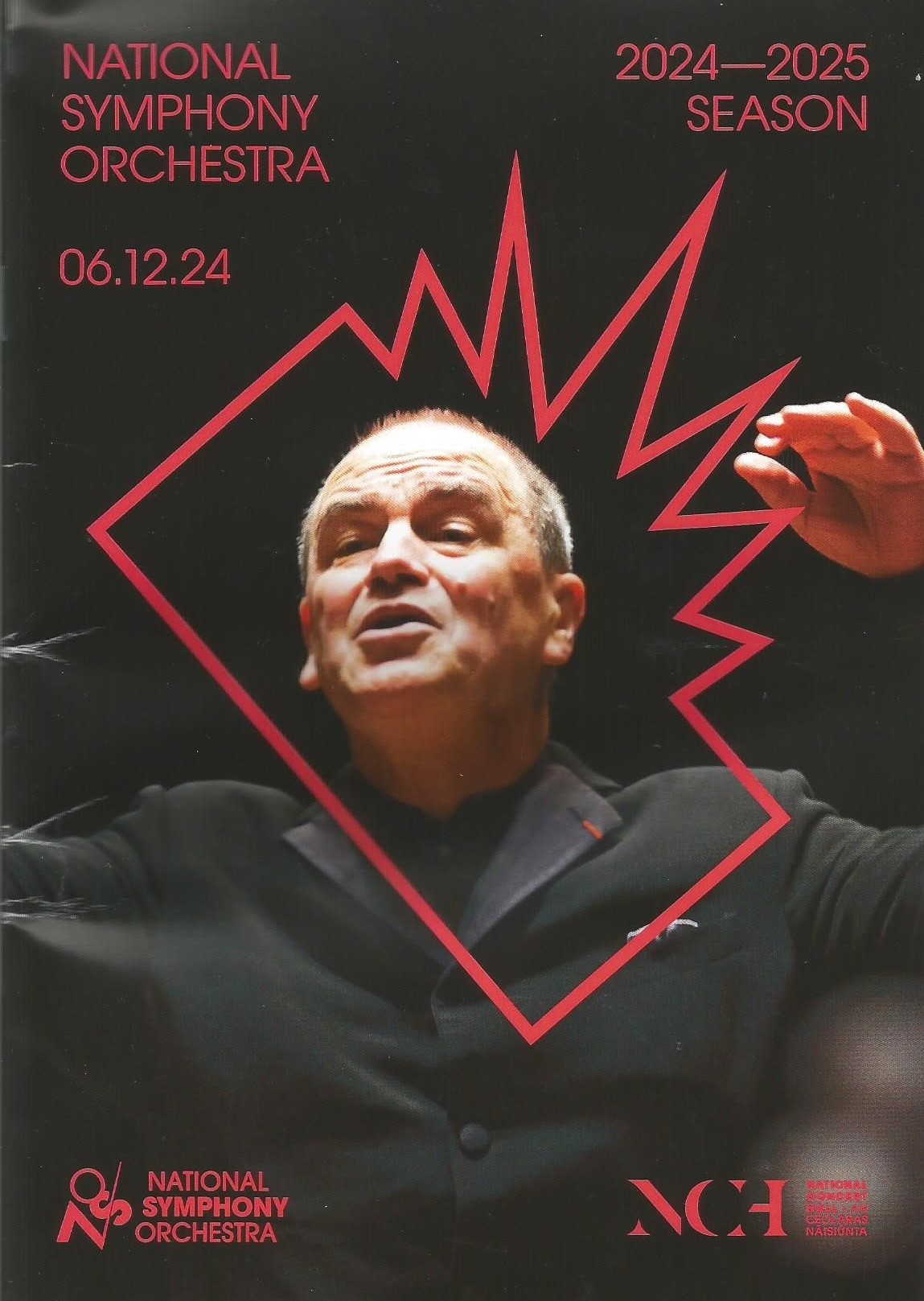
Anyway, there were two items on the menu: Violin Concerto No. 5 in A Major by Wolfgang Amadeus Mozart, with soloist Stefan Jackiw, and the Symphony No. 7 in E Major by Anton Bruckner. The National Symphony Orchestra was conducted by Hans Graf.

Mozart wrote at least five violin concertos, and he was at most 20 when he wrote the last of the five that are known. During last night’s performance I was thinking a lot about all I had failed to achieve by the age of twenty! Influenced by his father Leopold, the violin was Mozart’s first instrument, but he later moved on and preferred to play keyboard instruments. Perhaps he wanted to escape from his father’s domination, which might explain why he didn’t write any more pieces for solo violin in the rest of his (short) life.

The 5th Violin Concerto is sometimes called “The Turkish” though there isn’t much of a Turkish influence in the music. Whatever the name, it is a very enjoyable piece in three movements, played quite beautifully last night by Stefan Jackiw and by the pared-down NSO. The soloist got a very warm ovation and responded with a solo encore in the form of a largo movement from a Bach violin sonata.

After the wine break we returned to find the stage much fuller with a large brass section and extra strings added to the smaller forces required for the Mozart. Bruckner’s Seventh Symphony is a huge and varied work lasting over an hour in performance. The radiant first movement, with its noble melody soaring over shimmering violin tremolos is very reminiscent of Wagner, as is much of the rest of the Symphony (especially in terms of the orchestration). Bruckner famously idolized Wagner and this composition is at least partly a tribute to his musical hero. It is said that Bruckner had a premonition of Wagner’s death in 1883 and the cymbal crash during the second (slow) movement symbolizes the moment that he found out that his premonition had come true. That whole movement (marked Sehr feierlich und sehr langsam; very solemn and very slow) is very moving: sombre though not excessively mournful. The third movement Scherzo is marked Sehr Schnell (very fast) but I found the tempo last night vigorous, but not epecially fast. I was expecting something a bit wilder. The last movement actually sounded to me more like Mahler than Wagner, with a resounding climax.

The Seventh is probably Bruckner’s best known and most performed Symphony. It was certainly a big hit for him when it was first performed in 1884. The composer was born in 1824 and last nigtht’s concert was billed as Bruckner 200. I think the 7th was a good choice to mark the occasion and the performance, with superb playing by the brass section (including the Wagner tuben), and the orchestra very well marshalled by Hans Graf, was a fitting tribute.

My next trip to the NCH won’t be until January, but I’m already looking forward to the Leningrad Symphony after the Christmas break!

Tara Erraught at the National Concert Hall

Posted in Music with tags , , , , , , , , , , on November 2, 2024 by telescoper

Last night’s concert at the National Concert Hall featured star mezzo-soprano Tara Erraught (who is from Mullingar, in County Westmeath, and is artist-in-residence at the National Concert Hall for this season. She was accompanied by the National Symphony Orchestra directed by Laurence Cummings. You can tell how much I like Tara Erraught by the fact I went to the concert despite there being a harpsichord involved in some of the pieces; fortunately it was pointed away from the audience so we couldn’t hear it.

Before the concert, I was trying to remember when I heard her sing before. A look at my back catalogue revealed that it was this concert at which she sang a Mahler song-cycle. Last night’s performance comprised very different material, all from the 18th Century. There were three vocal pieces: a cantata in four sections by a name quite new to me, Marianna Martines, also known as Marianne von Martinez; a concert aria by Joseph Haydn; and by far the most exciting piece, Mozart’s wonderful Exsultate Jubilate. Tara Erraught was in fine voice throughout but I was particularly impressed with the precision of her articulation of the ornamented phrases in the last work. The audience loved it too.

The concert was all about Tara Erraught, however. The first half included Symphony No. 25 by Joseph Haydn, a funny little work only 13 minutes long and lacking the usual slow movement that seemed to me like it wasn’t really finished. It’s certainly not among Haydn’s best symphonies, anyway. It was a bit unfair on Haydn to have Mozart’s Symphony No. 41 “Jupiter” on the same menu as that it is one of the great symphonies by any composer. It did however demonstrate very powerfully how much the symphonic form had evolved in the twenty-odd years separating the two compositions (which incidentally are both in the same key of C Major). The Jupiter symphony is not only brim full of ideas, but the themes are woven into a much richer fabric. I might add that it was very well played by the NSO in a performance that was forceful and energetic without being too bombastic.

Puccini 100 at the National Concert Hall

Posted in Music with tags , , , , , , , , on October 26, 2024 by telescoper

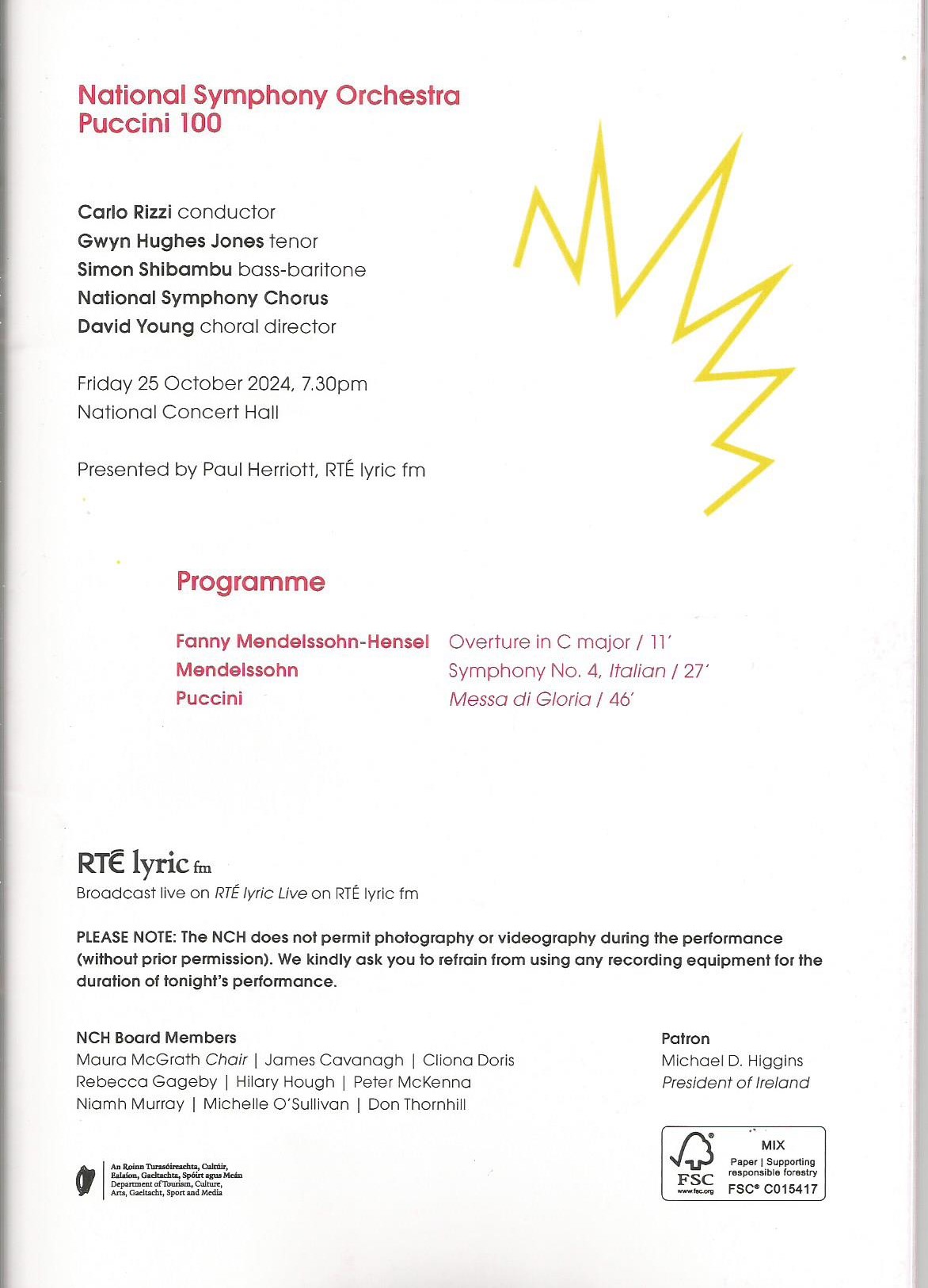
Last night’s Concert at the National Concert Hall in Dublin was billed as Puccini 100 as it was primarily intended to mark the centenary of the death of Giacomo Puccini. Guest conductor Carlo Rizzi had a long association with Welsh National Opera and is well-versed in Puccini’s operatic repertoire but this concert featured a rare treasure in the form of the Messa di Gloria, a large-scale work for choir, two soloists and orchestra Puccini wrote as a graduation piece when he was still a music student in Milan. Contrary to what you might infer from the title, it’s actually a full setting of the Latin Mass. Although written when the composer was only 20, the piece was never officially published until 1952, long after Puccini’s death. He did, however, recycle some pieces from it during his career as a composer of operas, chiefly in Manon Lescaut.

Before the Messa..

Although I’m a fan of Puccini’s operas I had never heard the Messa before and didn’t really know what to expect. It was turned out to be quite a revelation. As you might have anticipated it does sound more “operatic” than you might expect of a religious work and that dramatic certainly heightens the impact of the performance. I’m told that the National Symphony Chorus worked like crazy last week in rehearsals for this concert, and it certainly showed. The choir sounded absolutely amazing. Congratulations to choral director David Young! The two soloists were Welsh tenor Gwyn Hughes Jones and South African bass-baritone Simon Shibambu, both of whom were in fine voice. I particularly enjoyed the duet between them in the final Agnus Dei that brings the piece to a surprisingly gentle conclusion.

I really enjoy concerts that feature compositions I’ve never heard before, and this was a great example of that. I’m really glad that the Messa was chosen to mark Puccini 100. I must get a recording of it…

But the Puccini was only half the concert. Before the wine break we heard a very nice orchestral overture in C Major by Fanny Mendelssohn and then the evergreen 4th Symphony (“The Italian”) written by her kid brother, Felix, as a celebration of the time he spent in Italy on a Grand Tour. It was interesting to hear the two pieces played together as there is so much in common between the styles of composition, but so many subtle differences in voice. It’s a great pity that the sexism of the day prevented Fanny Mendelssohn from fulfilling her potential as a composer.

Grieg and Elgar at the National Concert Hall

Posted in Music with tags , , , , , , , , , , on October 5, 2024 by telescoper

Yesterday I once again headed off after work into Dublin by train to attend a concert by the National Symphony Orchestra this time under the direction of guest conductor Dinis Sousa (whose name is new to me). The programme consisted of two very familiar works, Grieg’s Piano Concerto in A Minor by Grieg and Elgar’s Enigma Variations by Elgar.

To start with, however, we heard a very interesting short piece by Anna Clyne called Masquerade which I enjoyed very much. This is only about five minutes long in performance, but full of energy and dynamics, and was a very suitable appetizer for the courses to follow.

The soloist for the Grieg Piano Concerto was Louis Schwizgebel who played it very well indeed. His articulation was crisp where necessary but also flowing when called for in the more romantic sections. The performance was very well received by the audience and by me. Actually I think that was the best performance of this work that I’ve heard live. Incidentally, I’m told the piano on which he performed was a brand new Steinway. Also incidentally, Edvard Grieg was only 24 when he wrote this piece.

During the second movement a member of the viola section of the orchestra had to leave the stage. I don’t know if she had broken a string or was just feeling unwell. I suppose both of these most happen from time to time in concerts, but I’d never seen it before. Thankfully she was back for the second half.

The Enigma Variations is another piece that is performed quite frequently. I’m not a huge fan of Elgar but this work definitely has its moments and I think anyone who doesn’t find Variation IX (“Nimrod”) uplifting must have something wrong with them. That said, that part is often played too slowly for my taste and can sound funereal rather than inspirational. Anyway, I hadn’t heard this in live performance for a long time so it was very pleasant to hear it again. I had forgotten that there is an organ part to this, actually, and it was good to hear the splendid NCH instrument used especially in the finale.

Overall it was a short (just 66 minutes playing time) but enjoyable concert. I’ll certainly be looking out for Louis Schwizgebel’s name on recordings in future as I think he is a fine soloist.

Leonard Slatkin at 80

Posted in Biographical, Music with tags , , , , , , on September 28, 2024 by telescoper

Last night found me once again at the National Concert Hall in Dublin for a concert by the National Symphony Orchestra conducted this time by Leonard Slatkin, who has a long association with the NSO and who was 80 years old on 1st September. I must say he looked very sprightly for a man eighty years of age!

To start the programme we had the world premiere of a piece by Leonard Slatkin’s son, Daniel. Voyager 130 was inspired by the Voyager space mission, and especially by the Golden Records carried by the Voyager probes. Among the pieces of music included on those records is the exquisite Cavatina from Beethoven’s String Quartet No. 13 (Opus 130) from which the composer borrows thematic material for this piece. Daniel Slatkin was actually in the audience for this – in fact he was sitting just two rows in front of me – and went up on stage after the very enjoyable performance.

After that, and some rearranging on stage, we had a performance of Beethoven’s Piano Concerto No. 4 with Dublin-born soloist Hugh Tinney. Although for its time it was very unconventional in structure, this is now a very familiar piece in the concert hall. For the most part it was played very well but I did think the orchestra were a bit stiff and lacking in expression in places. The performance was warmly received by the NCH audience, and Hugh Tinney received a standing ovation at the end.

After the wine break we had another familiar work, the Symphony No. 3 by Johannes Brahms, which Leonard Slatkin conducted without a score. I’m persevering with Brahms. I still don’t find that he moves me as much as many other composers and so many people rave about him that I think I must be missing something. The 3rd Symphony is a very fine work, offering lots of variety across its four movements while maintaining a strong sense of coherence and remaining relatively concise – it lasts about 33 minutes in performance. I’m no expert on Brahms but it seems to me that the 3rd Symphony is where he really found his voice as a symphonic composer and stepped out from the shadow of Beethoven.

Apart from the first piece, it was a very conventional programme but I enjoyed it as did the audience. It’s a pity there weren’t more people there, though. I’d guess that the NCH was about 2/3 full at most.

P.S. Last night Leinster rugby were playing a match at Landsdowne Road (beating the Dragons 34-6) and Shelbourne were playing Sligo Rovers at home in the League of Ireland (a 0-0 draw) so the train home was a bit busier than last time but still uneventful. When I got home later I decided to listen to a recording of the Beethoven Strong Quartet No. 13 before bed…

A New Season at the National Concert Hall

Posted in Biographical, Music with tags , , , , , , , , on September 14, 2024 by telescoper

It was just over a year ago that I last went to the National Concert Hall in Dublin. That occasion was the opening of a new season of concerts for 2023-4 by the National Symphony Orchestra. After a year away on sabbatical, last night I went to the season opening of the next year of concerts by the National Symphony Orchestra, this time under the direction of Mihhail Gerts. I’m hoping to see more of the forthcoming season than I did the last!

The programme for the concert is shown in the picture. The first half was dominated by legendary mezzo-soprano Dame Sarah Connolly, resplendent in a turquoise frock, who sang six songs by Alma Mahler (born Alma Schindler) who was of course the wife of Gustav Mahler whose 1st Symphony we heard in the second half. Gustav famously (and reprehensibly) told Alma that she had to give up composing music when they married (which they did in 1902). Until then she had written not only songs but also piano music. Few of her compositions survive, however. Apparently she destroyed many of the manuscripts herself in later life. Of the fifty or so songs she is thought to have written, only 17 (including the 6 we heard last night) still exist on paper. She at least responded by outliving him by more than 50 years: Gustav died in 1911 and Alma Mahler passed away in 1964.

It’s very unfair to compare Alma Mahler’s settings with those of Gustav Mahler, who was a master of the orchestral song cycle. The compositions we heard all all quite short, three or four minutes, and are definitely influenced by Wagner. The first song, for example, deploys the famous Tristan Chord and there are passages that are clearly influenced by the Wesendonck Lieder. None of the manuscripts are dated, but in terms of style they do sound like late Romantic works from around 1900 when she was very young. Overall these works not at the same level of achievement of either Richard Wagner or Gustav Mahler but, with Sarah Connolly in fine voice, there was much to enjoy. I had never heard any of these songs before this evening, and it left me wondering what Alma Mahler might have achieved musically had she continued to compose. We’ll never know.

Before these songs we heard the concert overture In Nature’s Realm by Antonín Dvořák. This is also a piece that feels very late-19th Century (it was composed in 1891). It’s a sort of homage to the beauty of the composer’s native Bohemia with distinct echoes of Beethoven’s Pastoral Symphony, I thought.

After the interval wine break we returned for the second half which consisted of (Gustav) Mahler’s Symphony No. 1 in D Major. This is a very familiar concert work nowadays, but it’s worth remembering that it didn’t exactly set the world on fire when it was first performed in 1889 and Mahler revised it extensively before it arrived at the form now usually performed. Like all Mahler symphonies it covers a vast territory. One of the most famous Mahler quotations is “the symphony is a world”, but in the case of his own symphonies each movement is a world. The first movement begins in hesitant and fragmentary fashion before bursting into life with a metaphorical evocation of daybreak. The second movement is earthier and more forceful, quoting from folk songs and country dances. The third is my favourite, with its humorously up-beat references to Klezmer music before ending in a kind of funeral march. The final movement is tempestuous at first, then calm, then erupts into a glorious finale.

Last night’s performance was broadcast live on RTÉ Lyric FM but what radio listeners won’t have got was the thrilling sight of a symphony orchestra in full flood. At the end of the last movement, members of brass section stood up to give extra power to the climactic resolution of the piece. Mahler does “loud” very well indeed, but I was impressed by the spectacle too: the lights gleaming off the array of trombones and horns as they blasted out the final phrases (in another context I would call them “riffs”). Great stuff, and very well received by the audience.

P.S. On the way into Dublin to see last night’s concert I realized that the Irish Rail timetable had changed while I was away so, instead of terminating at Connolly (the station, not the mezzo-soprano), the train I was on went all the way through to Pearse, thereby saving me a bit of time walking. It only takes about 20 minutes (for me) to walk from Pearse to the NCH, in case you’re wondering, and I do like a bit of a walk to stretch my legs before sitting down for a couple of hours at a concert.