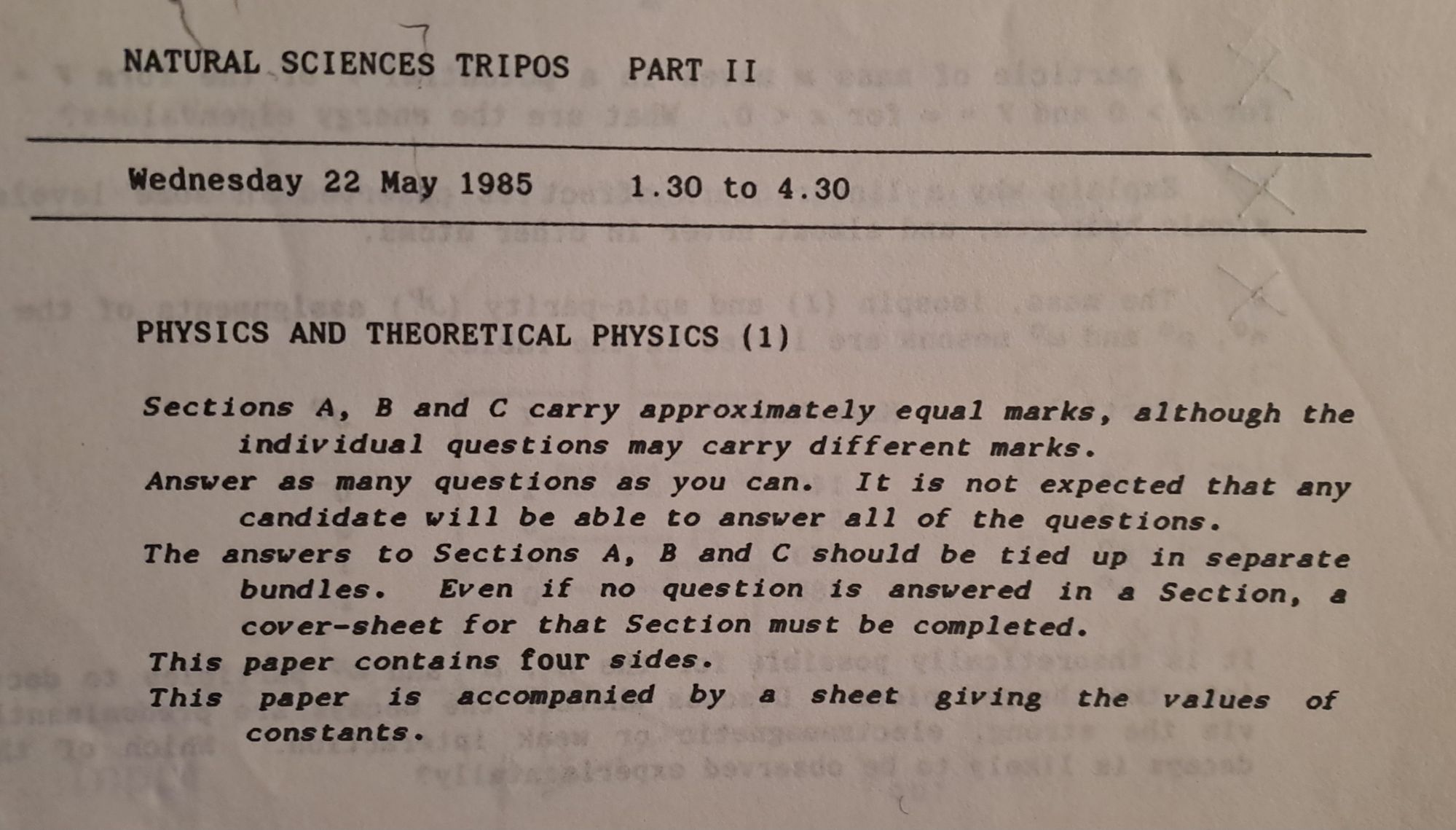
It is May 22nd 2025, so it’s 40 years to the day since started my final examinations in Physics and Theoretical Physics in the Natural Sciences Tripos at Cambridge University. These examinations concluded what was called Part II, the third and last year of a course which started out with four subjects (Part IA), then three (Part IB) I did double-physics and mathematics for IB.
The first paper of Part II was actually Paper Zero, an essay paper which I have already posted here. The five other papers are below; all six (including Paper Zero) were of three hours’ duration. You will see that Paper 4 is a very big one, because it contains questions pertaining to many options but each student did only a few. Unlike most of the theoretical physics students in my year I offered a theoretical project in lieu of part of Paper V, which means I was spared another three-hour paper. My project, incidentally, was on the computer simulation of a laser. My “prepared essay” was also on lasers Kilohertz and picoseconds in laser physics.
Looking at the papers I find a few things are different from what we do nowadays.
One is that Paper I was a general paper, with questions about random bits of physics. Most university physics courses these days do not have such papers (although I know of at least one that does…).
Another is that the course was not really modular. Each paper covered several different topics: Paper 2 for example covers Solid State Physics, Statistical and Thermal Physics and Electromagnetism; Paper 3 is Quantum Physics, Nuclear Physics and Particle Physics. In most modern university courses each of these would have a separate examination.
Other than that, some of the content (e.g. electromagnetism) is close to what you would find nowadays but in some areas (particle physics, for example) the 1985 paper is extremely dated.
As for the level difficulty, I can’t really comment. Take a look a the papers and decide for yourself!
(There is supposed to be a PDF preview, but it seems not to work on many web browsers, so You may hev to download the paper to view it.)
Comments are welcome through the box below.

 In the Dark