Archive for neural networks

Weekly Update from the Open Journal of Astrophysics – 07/06/2025

Posted in OJAp Papers, Open Access, The Universe and Stuff with tags , , , , , , , , , , , on June 7, 2025 by telescoper

It’s Saturday so once again it’s time for the weekly update of papers published at the Open Journal of Astrophysics. Since the last update we have published two new papers, which brings the number in Volume 8 (2025) up to 69 and the total so far published by OJAp  is now up to 304.

The two papers published this week, with their overlays, are as follows. You can click on the images of the overlays to make them larger should you wish to do so.

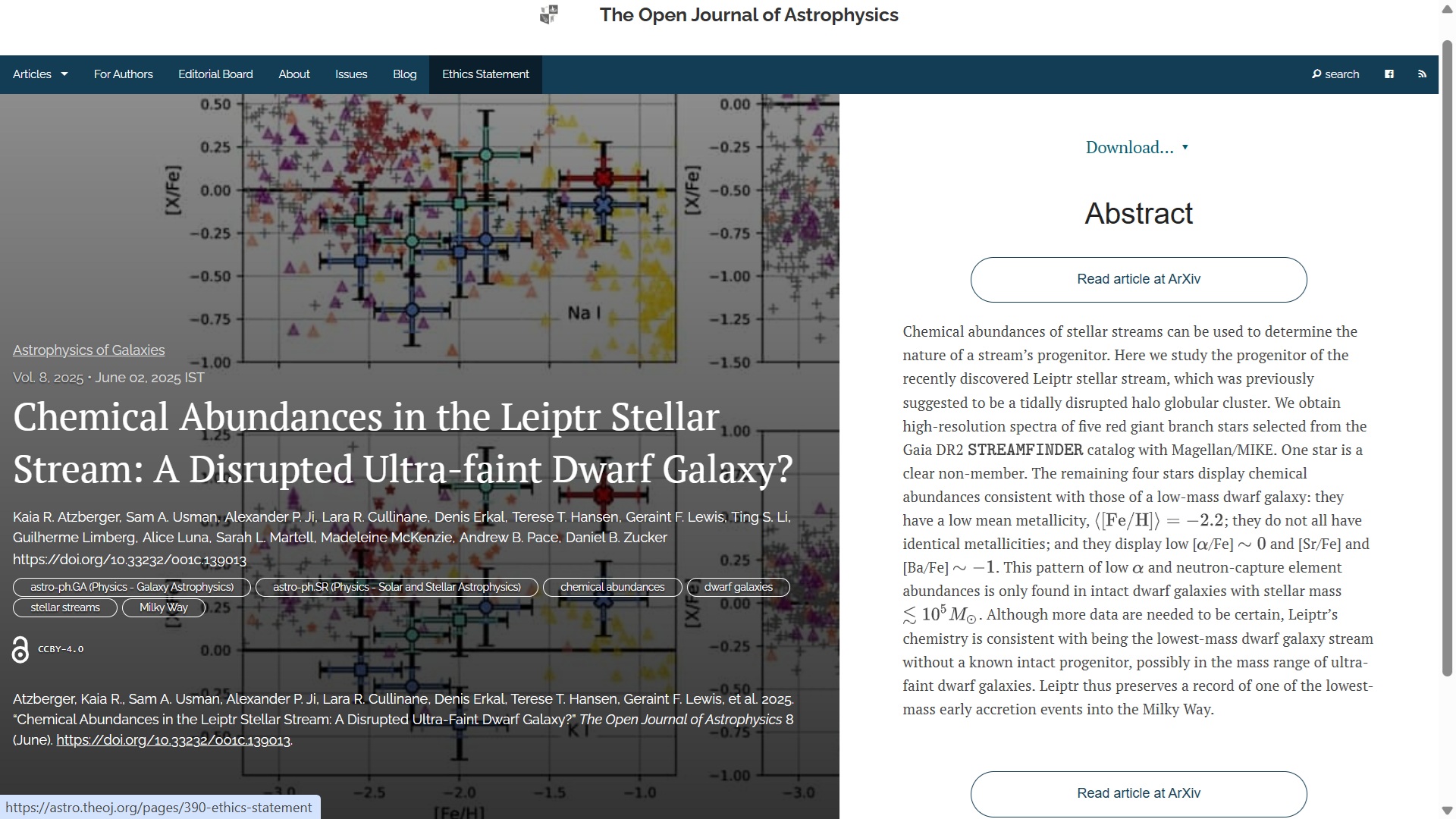
The first paper to report is “Chemical Abundances in the Leiptr Stellar Stream: A Disrupted Ultra-faint Dwarf Galaxy?” by Kaia R. Atzberger (Ohio State University) and 13 others based in the USA, Germany, the UK, Sweden, Australia, Canada and Brazil. This one was published on 2nd June 2025 and is in the folder marked Astrophysics of Galaxies. It presents a spectroscopic study of stars in a stellar stream suggesting that the stream originated by the accretion of a dwarf galaxy by the Milky Way.

The overlay is here:
 

You can read the final accepted version on arXiv here.

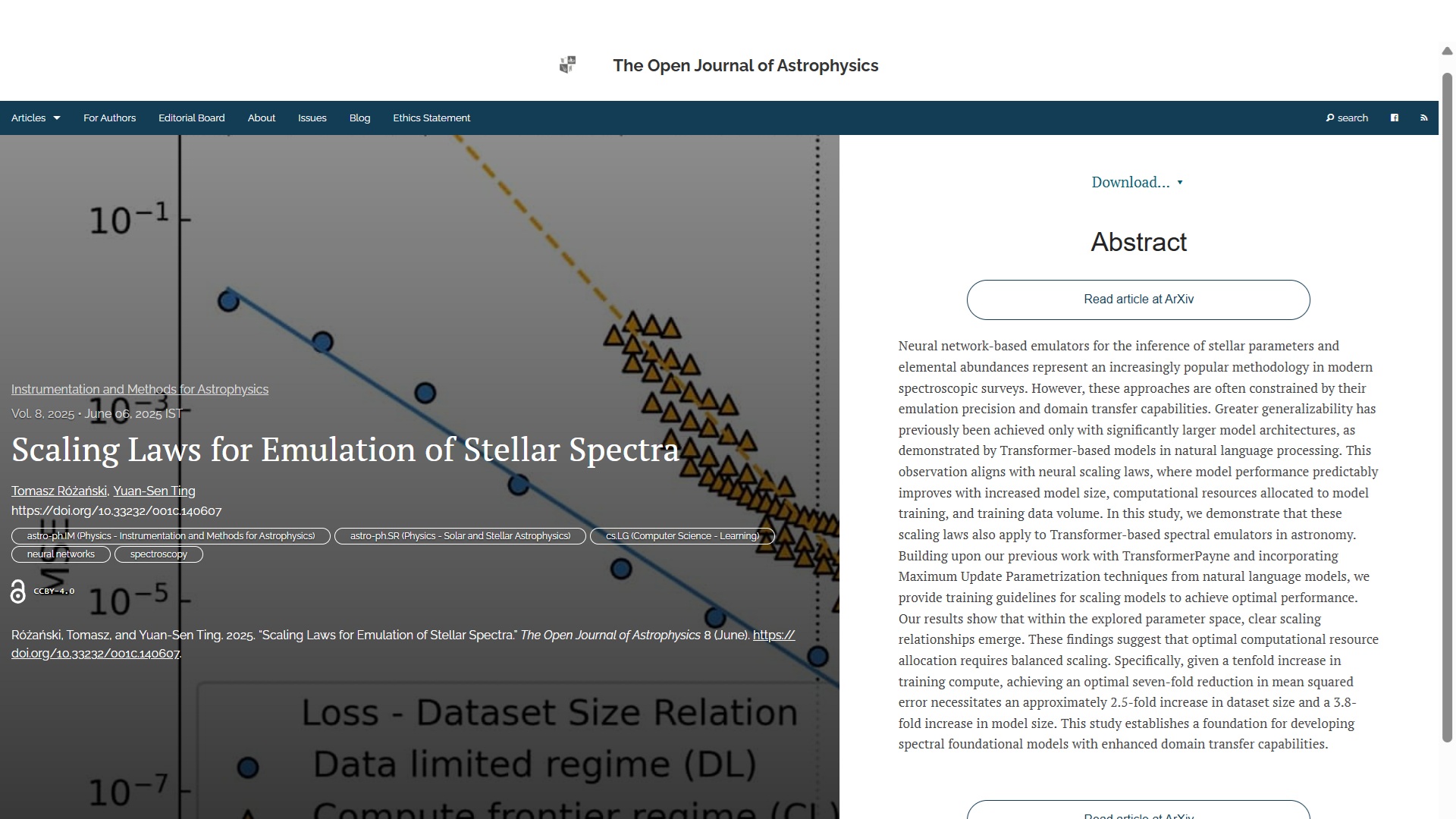
The second paper is “Scaling Laws for Emulation of Stellar Spectra” by Tomasz Różański (Australian Nastional University) and Yuan-Sen Ting (Ohio State University, USA). This was published yesterday, i.e. on 6th June 2025, and is in the folder Instrumentation and Methods for Astrophysics. The paper discusses certain scaling models and their use to achieve optimal performance for neural network emulators in the inference of stellar parameters and element abundances from spectroscopic data.

The overlay is here:
You can find the officially-accepted version of the paper on arXiv here.

That’s the papers for this week. I’ll post another update next weekend.

As a postscript I have a small announcement about our social media. Owing to the imminent demise of Astrodon, we have moved the Mastodon profile of the Open Journal of Astrophysics to a new instance, Fediscience. You can find us here. The old profile currently redirects to the new one, but you might want to update your links as the old server will eventually go offline.
Two New Publications at the Open Journal of Astrophysics

Posted in OJAp Papers, Open Access, The Universe and Stuff with tags , , , , , , , , on October 20, 2023 by telescoper

It’s Friday so it’s a good time to catch up with the week’s action at the Open Journal of Astrophysics, where there have been two new publications so far this week. These papers take us up to a total of 40  in Volume 6 (2023) and 105 in total since we started publishing.

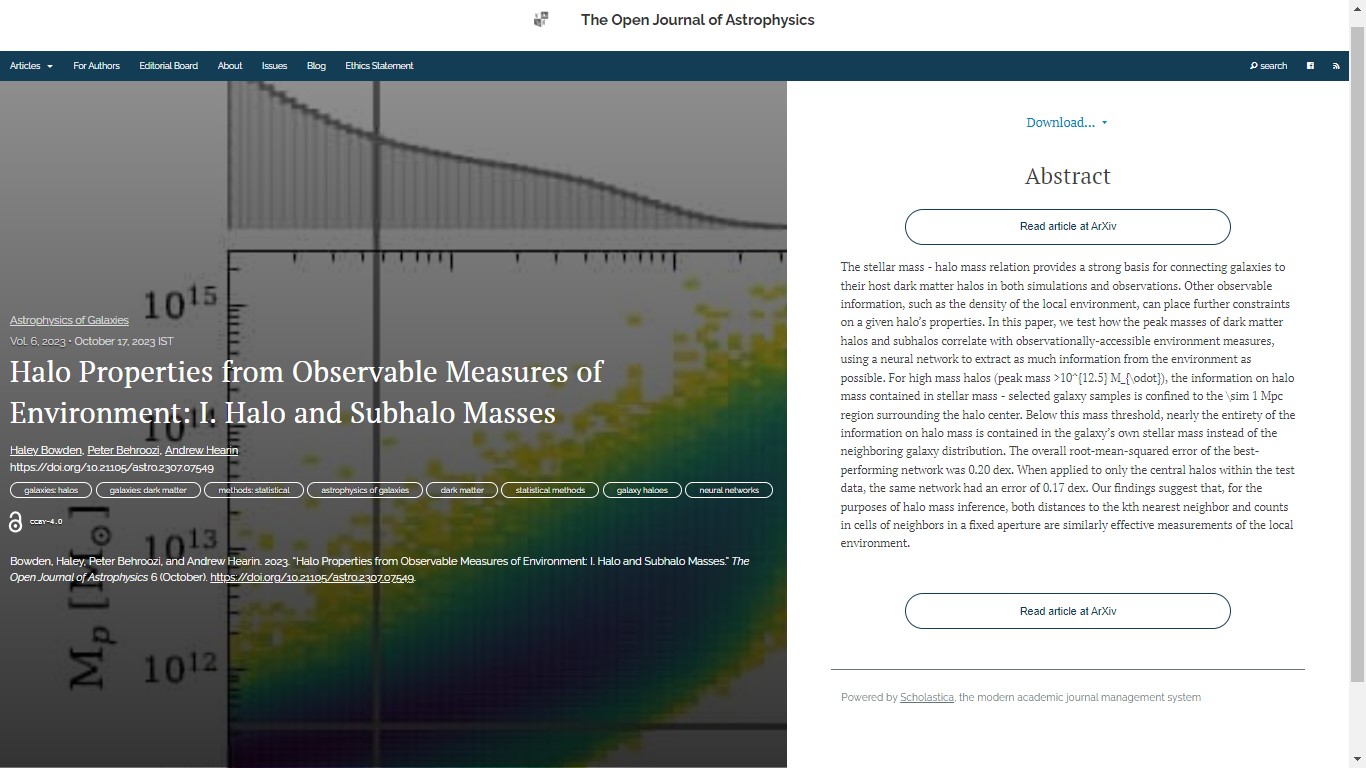
The title of the first paper is “Halo Properties from Observable Measures of Environment: I. Halo and Subhalo Masses” and its primary classification is Astrophysics of Galaxies. it is an exploration using neural networks of how the peak masses of dark matter halos and subhaloes correlate with observationally-accessible measures of their dependence on environment.

The authors based in the United States of America: Haley Bowden and Peter Behroozi of the University of Arizona, and Andrew Hearin of the Argonne National Laboratory

Here is a screen grab of the overlay which includes the abstract:


You can click on the image of the overlay to make it larger should you wish to do so. You can find the officially accepted version of the paper on the arXiv here.

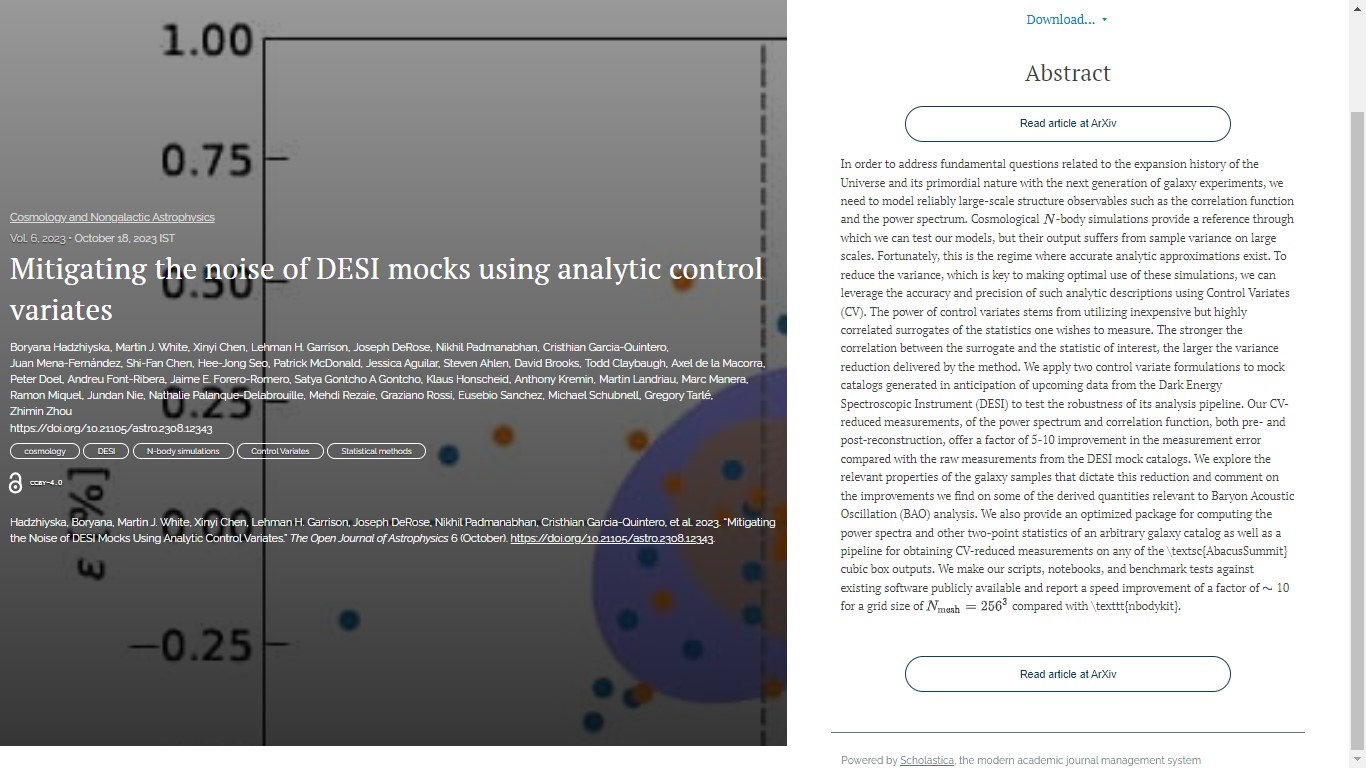
The second paper was published on 18th October 2023.  The primary classification for this one is Cosmology and Nongalactic Astrophysics and is “Mitigating the noise of DESI mocks using analytic control variates”. For those of you not up with the lingo, DESI stands for the Dark Energy Spectroscopic Instrument and you can read more about it here.

The lead author for this one is Boryana Hadzhiyska of the Lawrence Berkeley Laboratory and the University of California, Berkeley (USA) and there are 32 other authors. This paper presents a method for reducing the effects of sample variance on cosmological simulations using analytical approximations and tests it using DESI data.

Here is a screen grab of the overlay which includes the abstract:


You can click on the image of the overlay to make it larger should you wish to do so. You can find the officially accepted version of the paper on the arXiv here.