Archive for news

R.I.P. Maggie Smith (1934-2024)

Posted in Film, R.I.P., Television with tags , , , , , , , , , on September 28, 2024 by telescoper

I heard yesterday of the death at the age of 89 of the great Maggie Smith. Tributes have been appearing around the world at the loss of such a great talent and wonderful personality. I can’t add anything to these except to say that I adored her.

I guess many people will be most familiar her through the work she did in later life, such as the Harry Potter franchise and Downtown Abbey but as an oldie I will always think of her as the eponymous Edinburgh schoolteacher in the 1969 film The Prime of Miss Jean Brodie, based on the Muriel Spark novel of the same name, for which she deservedly won an Oscar as Best Actress for her portrayal of Jean Brodie, an over-zealous teacher with a soft spot for Mussolini’s Fascisti. Here’s the original trailer.

I do hope this film gets shown again soon as a tribute, as it is really superb.

Maggie Smith as Lady Constance Trentham in Gosford Park (2001)

Other roles I particularly remember Maggie Smith for are in are California Suite (for which she also won an Oscar, as Best Supporting Actress). She was absolutely hilarious in Murder by Death, her perfect sense of comic timing generating numerous laugh-out-loud moments in that film.

Maggie Smith with David Niven in Murder by Death (1976)

Maggie Smith was also memorable as the splendidly rude Lady Constance in Gosford Park, a role you might think of as a sort of prelude to her part in Downton Abbey. There are countless other performances I could mention too, on TV, on Film and in the Theatre. She was tremendously versatile and talented, as well as extremely funny. She admitted having learnt a great deal about comedy from Kenneth Williams, with whom she was great friends for a long time.

Rest in peace, Maggie Smith. You’ll be missed so much.

Banning Non-Disclosure Agreements in Sexual Harassment Cases

Posted in Harassment Bullying etc with tags , , , , , on July 24, 2024 by telescoper

This morning I saw a news item that describes a new law in Ireland that would ban the use of Non-Disclosure Agreements (NDAs) in sexual harassment cases. The law is being considered by Cabinet today but, with the summer recess imminent, the earliest the legislation can be passed through the Oireachtas is in the autumn, after the Dáil returns. That is unless a General Election intervenes.

The legislation will amend the Employment Equality Act to state that an employer shall not enter an NDA with an employee where the employee has made allegations of discrimination, harassment or sexual harassment.

Such agreements have been used quite frequently to prevent victims of harassment from speaking publicly about their experiences thus enabling harassers to move elsewhere without anyone knowing what they had done. This ploy is also seen by Management as a way of preventing reputational damage, although it does not seem to me to be a good way of doing that as the truth has a way of coming out anyway and the effect of hiding the misconduct when it does causes more reputational damage than the harassment itself.

This reminds me of things I wrote a while ago in connection with a case at Leiden University where the Management decided not to name a professor involved in such a case (who was subsequently identified as Tim de Zeeuw). I thought this was a nonsense, for at least two reasons. The first is that I think someone who has behaved in such a way should be named as a matter of principle, so that potential collaborators and future employers know what he has done. In previous posts on this topic I had defended confidentiality (e.g. here) during an investigation, but I still think that once it has been decided that a disciplinary offences have been committed there should be full disclosure.

The second is that failing to identify the individual concerned led to a proliferation of rumours inside and outside Leiden (none of which I am prepared to repeat here). As a result, the finger of suspicion was pointed at the wrong people until the name of the abusive Professor is revealed. That made for a very difficult working environment for everyone concerned.

Of course the new law, when passed, will only apply to cases in Ireland. In Astronomy, as in many other parts of academia, there is a great deal of international mobility. The new legislation would not prevent someone who has engaged in such misconduct in, for example, the United Kingdom applying for a job in Ireland without this coming to light. One could hope that other countries follow suit, but the wheels of the legislature are known to turn quickly in any country that I know of.

Finally, I think it’s an important question whether or not this legislation is retroactive. If it is, and past NDAs are declared null and void then it will blow open many cases. I can imagine rather a lot of people getting rather nervous at this prospect…

Opinion Polls, Exit Polls and Election Results

Posted in Politics with tags , , , , , , , , , on July 8, 2024 by telescoper

It has been quite an eventful week for voters either side of the English channel. In the United Kingdom, Keir Starmer’s Labour Party were victorious in the General Election, turfing out the Tories after 14 years of misrule, while in France a left-wing coalition managed against the odds to beat Marine Le Pen’s fascist National Rally into third place in their runoff election. In both elections tactical voting clear played a big role. In France many third-placed candidates of the centre or left stood aside to help defeat the Far Right. What happens now with regard to forming a government is anyone’s guess, even for people who know far more about French politics than me.

In the runup up to the UK general election, opinion polls had Labour much further ahead in terms of popular vote. As it turned out, however, Labour won 411 seats on a share of the vote of just 33.7% compared to the Conservatives 23.7% and a smaller number of votes than in 2019 when they won just 202 seats. The UK system is not proportional – and doesn’t pretend to be – so this kind of outcome is not surprising. Pundits have rightly pointed to the fact that the far-right Reform party got 14.3% of the vote which undoubtedly took seats from the Tories, but only managed 5 seats and that Labour profited greatly from the collapse of the SNP vote in Scotland.

There are other factors, however. One is that the turnout was 59.9%, well down on 2019 (67.35). That may well be partly due to voters generally not being enthused. But there may be more to it than that. The last time the turnout was below 60% in a UK general election was in 2001. In that year, Labour were miles ahead in the opinion polls so I suppose many Labour voters thought the result was a foregone conclusion and didn’t bother to turn out. It seems likely to me that there was a similar effect on the Labour vote this time. Rather than merely predicting the final result, opinion polls often influence it.

Another factor is that there may have been higher levels of tactical voting, especially with Labour voters switching to the Liberal Democrats to remove the Tory. That might account for why the LibDems did so well. Opinion polls play a role in this too. Yet another is that Labour lost several seats to Independents, standing against the stance on Gaza, and former Labour leader Jeremy Corbyn won his seat standing as an Independent.

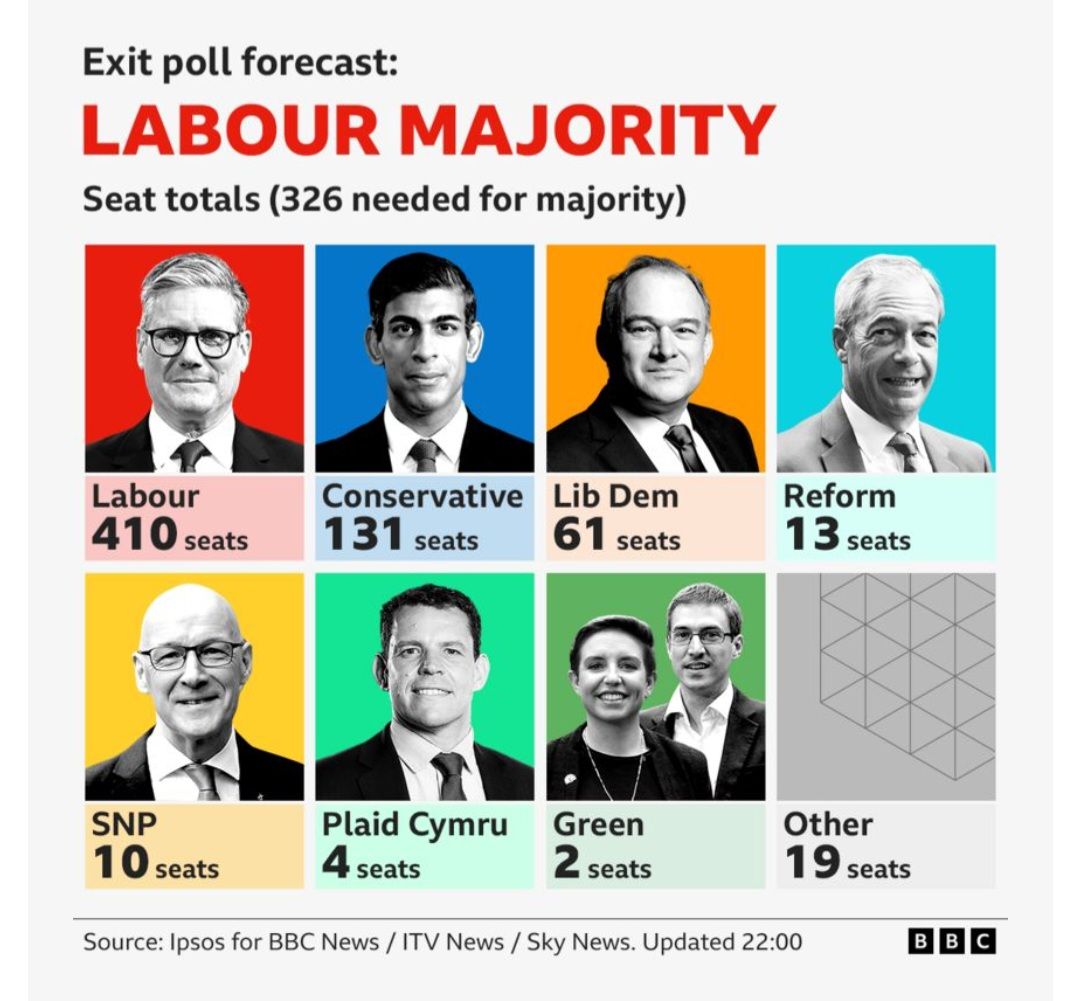
That brings me to the exit polls in the UK and France. Here the projections, the first released at 10pm on Thursday and the second at 9pm on Sunday:

Both are pretty accurate, but I’ve always been annoyed by the way the UK exit poll projection (left) is presented as a point estimate without any indication of the uncertainty (which must be considerable, especially for the smaller parties). The final results were Labour 411, Conservative 121, Lib Dem 72, Reform 5, SNP 9, Plaid Cymru 4, Green 4.

The French method of presenting the results (right) is much better in my opinion. In this case the results were 182, 168 and 143 respectively – all within the range presented.

I have to say that I greatly prefer the voting system used here in Ireland to those deployed in either France or the United Kingdom. Elections here are held under Proportional Representation (Single Transferable Vote) which seems to me a very sensible system. One ranks the candidates in order of preference; you can rank all the candidates or just some. In the system employed here in Ireland, votes are progressively reallocated in various rounds until one ends up with the top n candidates to fill the available seats. The STV system involves a quota for automatic election which is N/(m+1) + 1 votes, where N is the number of valid ballots cast and m is the number of seats in the constituency.  To see why this is the case consider a four-seat constituency, where the quota would be 20% of the votes cast plus one. No more than four candidates can reach this level so anyone managing to get that many votes is automatically elected. Surplus votes from candidates exceeding quota, as well as those of eliminated candidates, are reallocated to lower-preference candidates in this process. This system returns representatives with a local constituency connection but is also (approximately) proportional.

One problem with the First Past The Post system deployed in the UK is that if a Reactionary party (Reform) gets 5 seats while a Progressive party (Green) gets only 4, the former gets all the press coverage and the latter gets none..

P.S. I didn’t vote in the UK general election, but the four constituencies in which I lived before moving to Ireland (Cardiff West, Brighton Kemptown, Broxtowe, and Bethnal Green & Stepney) all voted in Labour MPs.

Back to Barcelona Again

Posted in Barcelona, Biographical, Education, Maynooth with tags , , , , , , on June 12, 2024 by telescoper

Last night I arrived back in a very rainy Barcelona. Although I got a bit damp on the way back to my flat from the bus stop, the journey was otherwise uneventful. The one thing worthy of note is that although the approach to Barcelona Airport was a little bumpy owing to bad weather, the pilot managed to perform one of the softest of soft landings I’ve ever experienced. It was so well done that there was a spontaneous round of applause from the passengers. Clapping when the plane lands used to be fairly common, but nowadays is a rarity reserved for occasions such as this.

The end of my stint in Barcelona is now in sight so I plan to see the sights I haven’t yet seen, or at least as many of them as I can manage. Next week I have to travel to Rome for the 2024 Euclid Consortium Meeting, at which I’m doing a plenary talk on the first morning. The week after that I have to travel to Valencia to give a seminar, so it will be a busy second half of the month.

Talking of the Euclid Consortium, my term as Chair of the Euclid Consortium Diversity Committee (ECDC) closes at the end of June 2024, at which point I will also be leaving the Committee after 4 years on it. Hopefully I will find a bit more time to do research in the last two months of my sabbatical; I’ve spent about 50% of it so far on ECDC matters, and progress on writing papers has consequently been slower than I’d have liked. I hadn’t anticipated such a big increase in papers submitted to the Open Journal of Astrophysics, either but fortunately I’ve managed to get the most time-consuming aspects of that automated and since that it hasn’t taken up that much of my time.

As it happens, yesterday was the day of the Departmental Examination Board for the Department of Theoretical Physics at Maynooth. I haven’t been teaching this year, so wasn’t involved. I do know quite a few students who will be graduating this summer, though, and am a little sad I won’t be around to congratulate them. I might see some of them at their conferring ceremonies in September though.

And then there’s next academic year to look forward to. What will I be teaching, I wonder? I’m not going to think about that until I have to…

Local Election Result

Posted in Maynooth, Politics with tags , , , , , , , , , , on June 9, 2024 by telescoper

Following Friday’s vote, counting in Ireland’s local elections began Saturday morning. As it happened, Maynooth was one of the first LEAs to start counting and, the electorate being fairly small, was completed last night.

In the system employed in these elections, votes are progressively reallocated in various rounds until one ends up with the top n candidates to fill the available seats. The STV system involves a quota for automatic election which is N/(m+1) + 1 votes, where N is the number of valid ballots cast and m is the number of seats in the constituency.  To see why this is the case consider a four-seat constituency, where the quota would be 20% of the votes cast plus one. No more than four candidates can reach this level so anyone managing to get that many vote is automatically elected. Surplus votes from candidates exceeding quota, as well as those of eliminated candidates, are reallocated to lower-preference candidates in this process.

I thought it might be interesting to show how it went. Here is the state of the poll after the initial count of first preference votes:

Incumbent Councillor Naoise Ó Cearúil (Fianna Fáil) led the first preference votes, exceeding the quota of 1566, and was therefore immediately elected. When his surplus votes were reallocated to second-preference candidates they did not result in anyone else exceeding quota, so Peter Hamilton (who finished last) was eliminated and his votes reallocated, etc. And so it came to pass that Tim Durkan (Fine Gael) was elected on the third count, Angela Feeney (Lab) and Peter Melrose (Social Democrats) on the 6th Count, and Paul Ward (FF) on the 7th Count. Durkan, by the way, is the son of sitting Fine Gael TD Bernard Durkan. For those outside Ireland I should mention that the Irish Social Democrats are quite progressive – in contrast to some parties with the same name in other countries – and they have a TD in the form of Caroline Murphy who has strong local support.

The turnout in Maynooth, by the way, was 45.3%. That’s quite high by the standards of local elections in the UK, but I always find it disappointing when people can’t be bothered to vote.

Anyway, of the five councillors elected (2 FF, 1 FG, 1 Lab & 1 SD) four are incumbent. The only change was sitting Green candidate Hamilton was replaced by newbie Peter Melrose for the Social Democrats. It was a disappointing result for Sinn Féin, similar to what happened five years ago in this LEA. The losing candidate then, however, Réada Cronin, went on to win a seat as TD for North Kildare in the General Election of 2020.

As I write, under a quarter of LEAs have completed their counts but it is fairly clear that it has been a disappointing election for Sinn Féin who, despite riding high in the opinion polls a few months ago, have not really recovered significantly from their poor showing in the 2019 Local Elections. Of course the question asked in opinion polls is about a General Election, which is quite a different kettle of fish compared to a Local election. Lots of pundits are trying to interpret these local results as a kind of opinion poll on the General Election which must happen before next year. They do this in the UK too. I don’t think that is wise. I think most people vote in the Local Elections on the local and rather mundane issues which are actually what the County Councils can actually deal with. Councils have very little power in Ireland and candidates who have grandiose plans far beyond the scope of what a councillor can actually achieve are not likely to do well. There is also a definite advantage on being an incumbent who has done a good job for the past five years. A problem for Sinn Féin is that it had to put up new faces in many LEAs to replace those lost five years ago, and few have been successful.

Anyway, it seems the status quo parties have done better than expected, and a variety of Independents have done well. Fianna Fáil and Fine Gael – to me, indistinguishable conservative neoliberal parties – are currently governing Ireland in coalition with the Greens. It surprises me that there is so much support for establishment parties that have presided over a housing shortage, ever-increasing homelessness and steadily deteriorating public services, but there you go.

We’ll have to wait a considerable time for the European Election count to finish, as it hasn’t even started yet, but it seems likely that Sinn Fein will struggle and that Independent will do well.