Archive for Open Access

Open Science in the European Union

Posted in Open Access, Science Politics with tags , on May 29, 2016 by telescoper

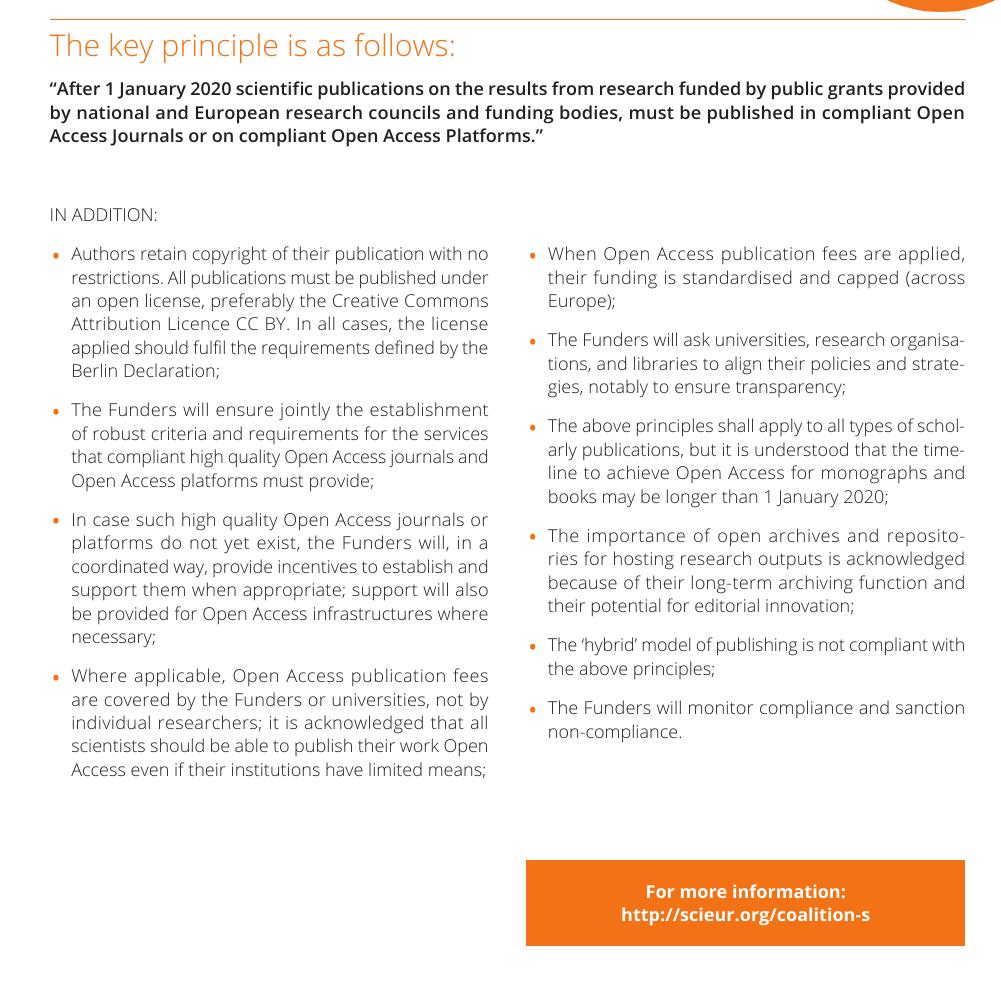
A few days ago I noticed a remarkable announcement about a meeting of European Ministers in Brussels relating to Open Access Publishing.This has subsequently been picked up by the Grauniad and has been creating quite a stir.

To summarise the report coming out of the meeting, here is a quotation from the draft communique, which states that they

…welcome open access to scientific publications as the option by default for publishing the results of publicly-funded research..

They also plan to

To remove financial and legal barriers, and to take the necessary steps for successful implementation in all scientific domains.

In a nutshell, the proposal is a move to abandon the traditional journal subscription model and embrace freely-available scientific research by 2020.

This is definitely a very good move. My only worry is that those involved seem not to have been able to make a decision on whether to go for the Green or Gold Open Access Model. The latter route has, in my opinion, been grossly abused by profiteering academic publishers who charge eye-watering “processing fees” for open access. I hope this initiative by the EU is not hijacked by vested interests as was the case with the UK’s Finch Report.

There’s clearly a lot more to be done before this proposal can be implemented, but it’s a very positive development the EU which will benefit science, both in the UK and across the continent, hugely. The European Union’s enthusiastic embrace of the principles of open access to scientific research is just one more to add to the list of reasons to remain.


Sinister Moves by Elsevier

Posted in Open Access with tags , , , , on May 18, 2016 by telescoper

I’ve been away at yet another Awayday today so only have time for a brief post before I go home and vegetate. I felt obliged, however, to draw the attention of my readership to the fact that there’s something sinister afoot in the world of academic publishing. It seems that the notoriously exploitative academic publishing company Elsevier has acquired the Social Science Research Network (SSRN), which is  the leading social science and humanities repository and online community. The SSRN currently allows readers free access more than 500,000 academic papers for free but that is highly likely to change under Elsevier whose previous practice has always been to squeeze the academic community for every penny it can get. In particular, Elsevier has a reputation for cracking down on academic papers for which it owns licences, so these recent acquisitions look like very bad news.

The Chairman of SSRN is  trying to present this as a positive move:

SSRN announced today that it has changed ownership. SSRN is joining Mendeley and Elsevier to coordinate our development and delivery of new products and services, and we look forward to our new access to data, products, and additional resources that this change facilitates.

Like SSRN, Mendeley and Elsevier are focused on creating tools that enhance researcher workflow and productivity. SSRN has been at the forefront of on-line sharing of working papers. We are committed to continue our innovation and this change will enable that to happen more quickly. SSRN will benefit from access to the vast new data and resources available, including Mendeley’s reference management and personal library management tools, their new researcher profile capabilities, and social networking features. Importantly, we will also have new access for SSRN members to authoritative performance measurement tools such as those powered by Scopus and Newsflo (a global media tracking tool). In addition, SSRN, Mendeley and Elsevier together can cooperatively build bridges to close the divide between the previously separate worlds and workflows of working papers and published papers.

We realize that this change may create some concerns about the intentions of a legacy publisher acquiring an open-access working paper repository. I shared this concern. But after much discussion about this matter and others in determining if Mendeley and Elsevier would be a good home for SSRN, I am convinced that they would be good stewards of our mission. And our copyright policies are not in conflict — our policy has always been to host only papers that do not infringe on copyrights. I expect we will have some conflicts as we align our interests, but I believe those will be surmountable.

Until recently I was convinced that the SSRN community was best served being a stand-alone entity. But in evaluating our future in the evolving landscape, I came to believe that SSRN would benefit from being more interconnected and with the resources available from a larger organization. For example, there is scale in systems administration and security, and SSRN can provide more value to users with access to more data and resources.

On a personal note, it has been an honor to be involved over the past 25 years in the founding and growth of the SSRN website and the incredible community of authors, researchers and institutions that has made this all possible. I consider it one of my great accomplishments in life. The community would not have been successful without the commitment of so many of you who have contributed in so many ways. I am proud of the community we have created, and I invite you to continue your involvement and support in this effort.

The staff at SSRN are all staying (including Gregg Gordon, CEO and myself), the Rochester office is still in place, it will still be free to upload and download papers, and we remain committed to “Tomorrow’s Research Today”. I look forward to and am committed to a successful transition and to another great 25 years for the SSRN community that rivals the first.

Michael C. Jensen
Founder & Chairman, SSRN

It sounds like they made him an offer he couldn’t refuse…

I don’t think Elsevier’s involvement in this is likely to prove beneficial to anything other than their own profits. Elsevier is one of the biggest problems in academic publishing and can  never be part of the solution.

My main concern, however,  is  that some day Elsevier might launch a hostile takeover bid for the arXiv, which would be a major setback to the physics community’s efforts to promote the free exchange of scientific papers. That must be resisted at all costs. How did the academic community allow its publishing culture to be hijacked by such companies?


Nature and the Open Journal of Astrophysics

Posted in Uncategorized with tags , on January 4, 2016 by telescoper

As I prepare to return to Sussex for the new term, I find that Nature News & Comment has published a piece on a pet project I’ve blogged about on a number of occasions, The Open Journal of Astrophysics.

There are a couple of sceptical comments quoted in the piece, which is fair enough. Such views are not at all unexpected. This is a new venture and there are bound to be people who prefer to stick to the established publishing channels. I and the others involved in the Open Journal think traditional journals have long since had their day. We’ll just have to see how many others agree!

“Dutch universities start their Elsevier boycott plan”

Posted in Open Access with tags , on July 3, 2015 by telescoper

Good for them!

jrochkind's avatarBibliographic Wilderness

“We are entering a new era in publications”, said Koen Becking, chairman of the Executive Board of Tilburg University in October. On behalf of the Dutch universities, he and his colleague Gerard Meijer negotiate with scientific publishers about an open access policy. They managed to achieve agreements with some publishers, but not with the biggest one, Elsevier. Today, they start their plan to boycott Elsevier.

Dutch universities start their Elsevier boycott plan

View original post

Elsevier in Australia

Posted in Open Access with tags , on May 23, 2014 by telescoper

More on open access, this time from the perspective of an Australian Mathematician, pointing out that the idea of Gold Open Access Hybrid Journals touted by some publishers is nothing but a scam. I won’t mention any names of course but Elsevier springs to mind.

Scott Morrison's avatarSecret Blogging Seminar

I’ve just got back from talking to Roxanne Missingham, the University Librarian here at ANU, about Elsevier, and I want to quickly report on what I learnt.

I don’t yet have any of the juicy numbers revealing what libraries are paying for their Elsevier subscriptions (as Timothy Gowers has been doing in the UK; if you haven’t read his post do that first!). Nevertheless there are some interesting details.

Essentially all the Australian universities, excepting a few tiny private institutes, subscribe to the Freedom collection (this is the same bundle that nearly everyone is forced into subscribing to). The contracts are negotiated by CAUL (the Council of Australian University Librarians).

My librarian was very frank about Article Processing Charges (APCs) constituting double-dipping, whatever it is that Elsevier and the other publishers say. The pricing of journal bundles is so opaque, and to the extent we understand it primarily based…

View original post 356 more words

Elsevier Journals – The QMUL Figure

Posted in Open Access with tags , on May 18, 2014 by telescoper

More information on the scandalous cost of academic journals.

How would you feel if your institution paid over half a million pounds a year to Elsevier?

edwardfhughes's avatarEdward F Hughes

A few weeks ago I reblogged Tim Gowers’ post about the cost of Elsevier journals. I noticed that my own institution (QMUL) had deflected his Freedom of Information request. Curious to learn more, I did some digging.

It turns out that QMUL paid a total of £545,306.93 to Elsevier for the academic year 2013/14. Interestingly this is more than other universities that joined the Russell Group recently. However it’s still much cheaper than the bill Cambridge, UCL, Imperial or Edinburgh face.

Unfortunately QMUL weren’t able to provide any further breakdown of the figures. Apparently this information isn’t available to the university, which seems like a very odd way of doing business. I think it likely that the vast majority of the cost is the subscription fee.

I should point out that QMUL and Cambridge certainly have differentiated access to Elsevier journals. For example QMUL Library does not have access to Science Direct…

View original post 214 more words

The Open Journal for Astrophysics Project

Posted in Open Access with tags , , , , on May 10, 2014 by telescoper

I owe many people various apologies for not posting anything for a while about the Open Journal for Astrophysics. For a start I have to admit that the call for test submissions last year was a bit premature. I should have been more patient and ensured that the system was complete before going public. I hope nobody has been too seriously inconvenienced by the ongoing delay.

The project has got stalled a bit largely because I have just had too many things to do to devote enough time to complete the final stages needed to go fully live and also one of the people helping with the project Arfon Smith moved to a new job. Arfon and Chris Lintott have posted an account of the project so far which gives a bit more detail about how we wanted to realize the project (hosted by GitHub); the code development has involved major work by Robert Simpson and Stuart Lynn in addition to Arfon and Chris.  In essence they say that the job is now about 80% complete. I would have said it was more like 75%, so the OJFA is in some sense just the OJF at the moment! Much of what remains is not actual programming stuff but administrative stuff involved with, e.g., arranging the assignment of  digital object identifiers (DOIs) and so on, all of which has been on my to-do list for several months now.

Anywhere, just to show you that the whole project isn’t just hot air here is a demonstration of the snazzy user interface which we plan to use to facilitate the online refereeing process:

However, in the spirit not only of open access publishing but also of open source programming, Arfon has made available all the codes that have been developed so far. One intention of this is that  these can be adapted  for other OJFs hence the construction of a generic website (theoj.org) as well as the hope that some folks out there might help us bright the OJFA itself to completion. Anyone out there with the requisite skills is welcome to volunteer, either through the comments box here or through the OJ repository. If we can get enough volunteers we can meet and put together a plan to bring this idea to completion at last.

Despite being forced to accept that my own workload makes it difficult for me to be as involved as I’d like to be in this project I’d still really love to get this project off the ground. I hope I can use the time freed up by no longer being a member of RAS Council to work on the OJFA. I no longer have a conflict of interest in that regard either; like many other learned societies the RAS currently makes a large fraction of its income from academic publishing!

As Arfon mentions in his piece, the recent BICEP2 episode in particular provides pretty strong motivation that we need a new concept of academic publishing. Practical difficulties may have intervened for now but the motivation for the project itself is stronger now than it has ever been.

Research Hive on Open Access

Posted in Open Access, The Universe and Stuff with tags , , , , on March 21, 2014 by telescoper

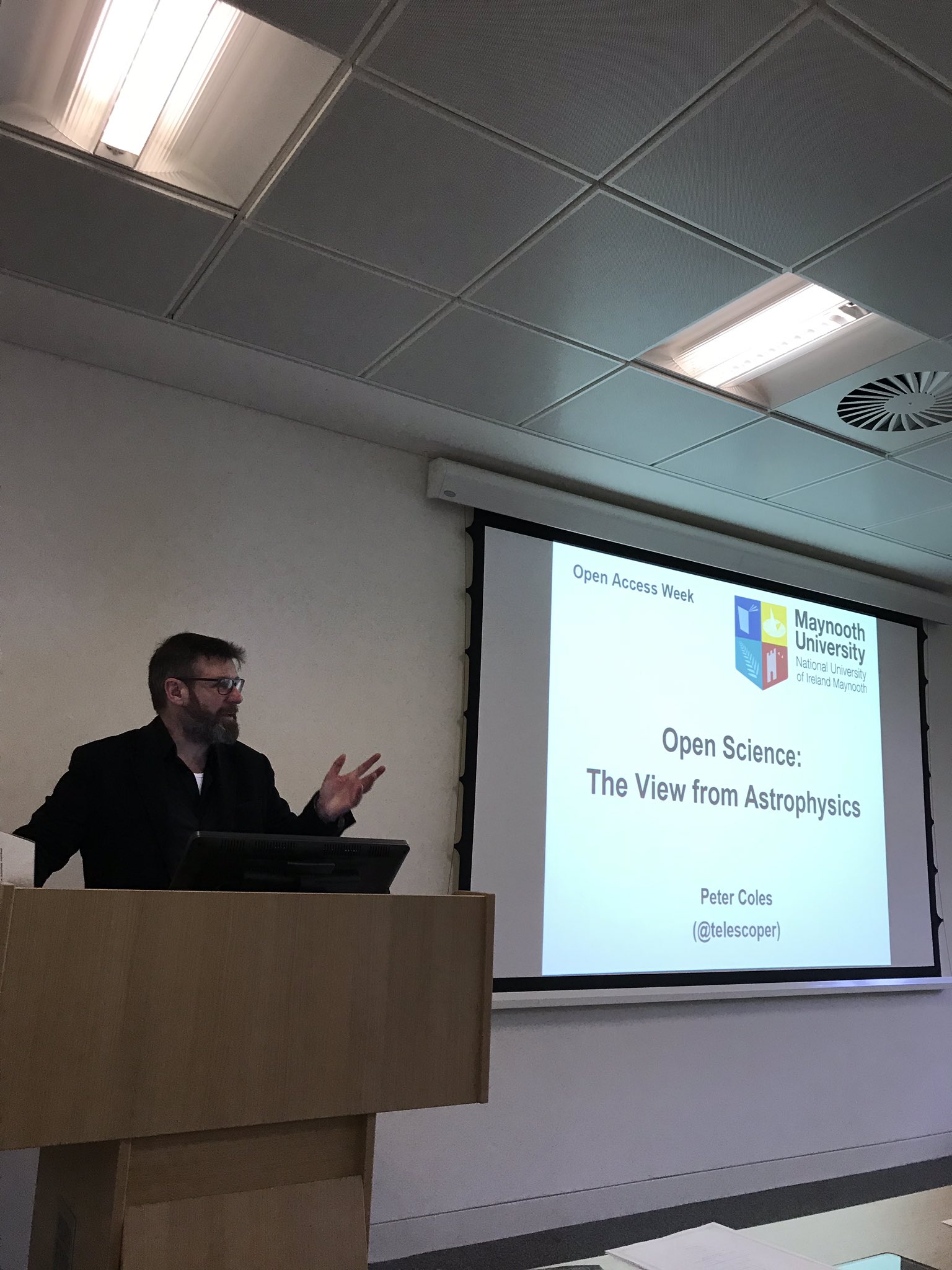
Near the end of a week that has been both exciting and exhausting, I had the opportunity to take part in a seminar on Open Access publishing. I agreed to do this last year sometime, and only remembered that it was today because I got an email reminder a couple of days ago! Anyway it was nice to have an excuse to visit the iconic Library of the University of Sussex for this event.

Fortunately, as things turned out, I had plenty of topical material to draw on for inspiration and spent some time discussion the possibilities of community peer review with reference with what’s been happening with BICEP2. Here’s me in the middle of the talk on that very subject showing the Live Discussion Facebook page:

Hive

I shared the bill with Rupert Gatti from Open House Press which publishes mainly in the Arts and Humanities area; generally speaking these disciplines are a long way behind astrophysics in terms of their readiness for the age of Open Access but I think change across all academia is inevitable.

For those of you interested I realize that an update on the Open Journal For Astrophysics is long overdue. I’ve just been too busy with other things to devote much time to it. I do hope to have further news very soon…

BICEP2, Social Media and Open Science

Posted in Open Access, The Universe and Stuff with tags , , , on March 20, 2014 by telescoper

I’ve been finding it a bit difficult to keep up with all the BICEP2 excitement in between all the other things I’ve had to do this week but at least the blog has been generating some interest and there’s no sign of that abating yet.  In fact, according to the wordpress elves, today is the busiest day I’ve ever had on In the Dark – and it’s not even 6pm yet!

I realize that I’ve posted several items on B-modes without ever showing a picture of what they look like, so here you go, an image of the B-mode polarization seen by the BICEP2 experiment:

b_over_b_rect_BICEP2

When the BICEP2 team announced that  a “major astrophysics discovery” would be announced this Monday I have to admit that I was quite a bit uncomfortable about the way things were being done. I’ve never been keen on “Science by Press Release” and when it became clear that the press conference would be announcing results that hadn’t yet been peer-reviewed my concerns deepened.

However, the BICEP2 team immediately made available not only the “discovery” paper but also the data products, so people with sufficient expertise (and time) could try to unpick the content. This is fully in the spirit of open science and I applaud them for it. Indeed one could argue that putting everything out in the open the way they have is ensuring that that their work is being peer-reviewed in the open by the entire cosmological community not secretly and by one or two anonymous individuals. The more I think about it the more convinced I am becoming that this is a better way of doing peer review than the traditional method, although before I decide that for sure I’d like to know whether the BICEP2 actually does stand up!

One of the particularly interesting developments in this case is the role social media are playing in the BICEP2 story. A Facebook Group was set up in advance of Monday’s announcement and live discussion started immediately the press conference started. The group now has well over 700 members, including many eminent cosmologists. And me. There’s a very healthy scientific discussion going on there which may well prove to be a model of how such things happen in the future. Is this a sign of a major change in the way science is done, the use of digital technology allowing science to break free from the shackles placed on it by traditional publication processes? Maybe.

Anyway, no time to write any more. I just remembered I have to participate in a seminar on Open Access publishing and I have to start thinking about what I’m going to say!

P.S. The Vernal Equinox happened at 16.:57 GMT today, so welcome to Spring!

Elsevier’s Confidentiality Clauses

Posted in Open Access with tags , on December 22, 2013 by telescoper

I came across this a little while ago (here, where the context is explained in more detail). It comes from a conference about the future of scientific publishing, and features David Tempest of Elsevier responding to a question from Dr Stephen Curry.

I hadn’t realised before this question that Elsevier not only charges eye-wateringly expensive subscription rates for its journals but also often requires institutional libraries to sign a confidentiality clause under which they are forbidden from revealing how much the subscription costs. Here Mr Tempest attempts to explain this policy:

So there you have it. If people actually knew what other people were being charged there’s a danger that prices would be driven relentlessly downward. Shocking.

You have to feel some sympathy for Elsevier, struggling along on a profit margin of a mere 36%. It must be so difficult for them to make ends meet…