Archive for Open Access

Open Access and the Open Journal of Astrophysics

Posted in Open Access, YouTube with tags , , on September 18, 2021 by telescoper

Here is the video recording of the Invited Colloquium at the International School Daniel Chalonge – Hector de Vega I gave via Zoom on15th September 2021, introduced by Prof. Norma Sanchez.

In the talk I give a review about the absurdity of the current system of academic publishing, about what Open Access publishing means, and give a short introduction to the Open Journal of Astrophysics, an arXiv overlay journal.

I’m sorry if the recording is a bit choppy but that’s an occupational hazard with Zoom recordings and rather limited broadband!

The talk itself lasts about an hour, but was followed by an interesting discussion session so although the full video is rather long (2 1/2 hours) I’ve put it all there on Youtube.

You can download the video here. A PDF of the slides may be found here. You can also view the slides on slideshare:

Reminder of talk today!

Posted in Open Access with tags , on September 14, 2021 by telescoper

The AAS goes for Gold

Posted in Open Access, The Universe and Stuff with tags , , , , , , on September 2, 2021 by telescoper

Yesterday there was a big announcement from the American Astronomical Society (AAS) , namely that all its journals will switch to Open Access from 1st January 2022. This transition will affect the Astronomical Journal (AJ), the Astrophysical Journal (ApJ), Astrophysical Journal Letters (ApJL), and the Astrophysical Journal Supplement Series (ApJS). Previously authors were able to opt for Open Access but from next year it will apply to all papers.

The positive aspect to this change is that it makes articles published by the AAS freely available to the public and other scientists without requiring the payment of a subscription.

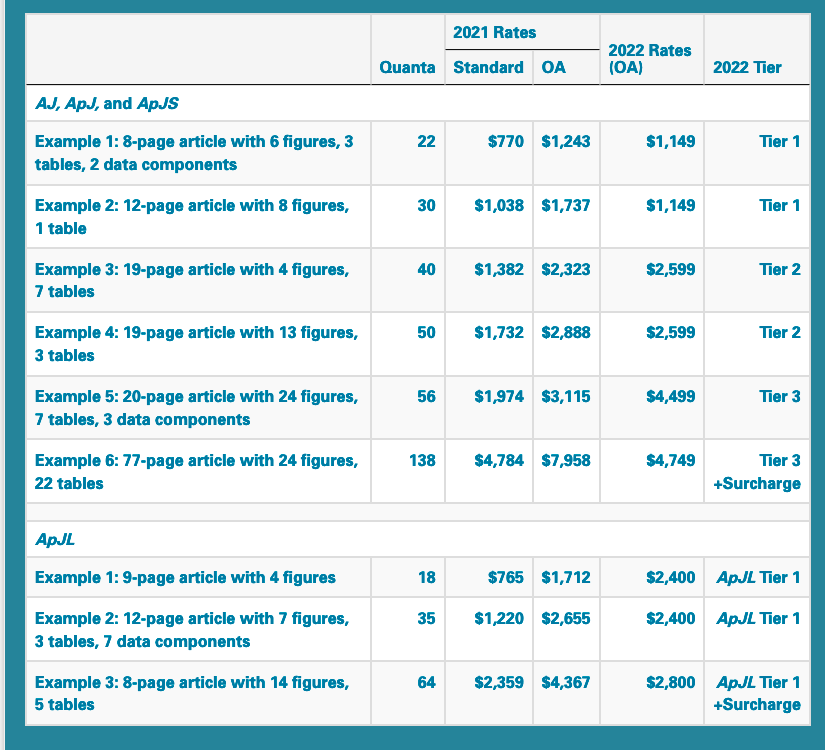
On the other hand, these journals will require authors to pay a hefty sum, equivalent to an Article Processing Charge (APC), that increases with the length and complexity of a paper. AAS journals have in the past levied “page charges” from authors for standard (non-OA) publications. In the new regime these are merged into a unified scheme. Here is a summary of the rates.

What’s on offer is therefore a form of Gold Open Access that switches the cost of publication from subscribers to authors. In my view this level of APC is excessive, which is why I call this Fool’s Gold Open Access. Although the AAS is a not-for-profit organization, its journals are published by the Institute of Physics Publishing which is a definitely-for-profit organization.

The Open Journal of Astrophysics charges neither subscribers nor authors; this form of Open Access is usually called Diamond or Platinum Open Access.

The terminology surrounding Open Access is confusing not least because its usage is evolving. In the current jargon, “Gold” Open Access refers to publication that is free to access at the journal. The principal alternative is “Green” Open Access, which means that free access is offered through depositing the paper in some form of repository separate from the journal. Some astronomical journals allow authors to deposit their articles on arXiv, for example, which is probably the main way in which astrophysicists achieve Green Open Access.

Nowadays “Gold” Open Access refers to anything that is made available freely by a journal regardless of whether an APC is charged or not. The Diamond Open Access provided by the Open Journal of Astrophysics is thus a special case of Gold Open Access. A classification in which Diamond and Platinum are subdivisions of Gold must confuse the heck out of chemists, but that’s where we are at the moment. At least it’s not as bad as in astrophysics where the only terms used to describe chemical elements are hydrogen, helium and “metals”…

While I am glad to see the AAS move its journals into Open Access configurations, I can’t agree with the level of APC. The Open Journal of Astrophysics may be relatively small but it has plenty of capacity for growth while remaining entirely free. The more people realize that it costs tens of dollars rather than thousands to publish a paper the more likely it is that they’ll see the moral case for Diamond Open Access.

Happy 30th Birthday to the arXiv!

Posted in Biographical, Open Access, The Universe and Stuff with tags , , , on August 14, 2021 by telescoper

I was reminded yesterday that today, 14th August, is the 30th anniversary of the start of the arXiv so I thought I’d send a quick birthday greeting to mark the occasion. In case you weren’t aware, arXiv is a free distribution service and an open-access archive containing (currently) 1,928,825 scholarly articles in the fields of physics, mathematics, computer science, quantitative biology, quantitative finance, statistics, electrical engineering and systems science, and economics.

There was a precursor to the arXiv in the form of an email distribution list for preprints, but arXiv proper started on 14th August 1991. It was based at Los Alamos National Laboratory (LANL) with a mirror site in SISSA (Trieste) that was used by those of us in Europe. In the beginning, arXiv was quite a small-scale thing and it wasn’t that easy to upload full papers including figures. In fact the SISSA system was run from a single IBM 386 PC (called “Babbage”). As it expanded, the running of arXiv was taken over Cornell University. You can read more about the history here.

You have to remember that journals didn’t generally have electronic submission in those days: you had to send paper manuscripts in the post to the Editorial office. Likewise many of us carried on sending out paper preprints for some time after the arXiv was set up. Younger researchers should be grateful they don’t have to put up with the absolute chore of producing papers the old-fashioned way!

The astrophysics section of arXiv (“astro-ph”) started in April 1992. Although astrophysicists generally were quick to latch on to this new method of distributing preprints, it took me a little time to get onto arXiv: my first papers did not appear there until February 1993; my first publication was in 1986 so there are quite a few of my early papers that aren’t on arXiv at all. In 1993 I was working at Queen Mary & Westfield College (as it was then called). I was working a lot with collaborators based in Italy at the time and they decided to start posting our joint papers on arXiv. Without that impetus it would have taken me much longer to get to grips with it.

In case you’re interested, my first paper to appear on the arXiv was this one on 23rd February 1993 but it was followed a day later by two others, this one and that one. I don’t remember very well, but this was an exercise in catching up and all three of those papers were actually published in journals before we put them on arXiv. It was only later that we got into the habit of posting papers on arXiv at the same time as submitting to a journal, which I think is the best way to do it!

The Open Journal of Astrophysics would not have been possible without the arXiv but in a wider sense the astrophysics community has a very great deal to thank the arXiv for, but remember that it is funded by donations and is run on a shoestring. If you agree that it’s a tremendously useful asset for your research then please consider making a donation.

Open Science and Open Software

Posted in Open Access, Science Politics, The Universe and Stuff with tags , , , , on May 22, 2021 by telescoper

As the regular readers of this blog – both of them – will know, I’ve been banging on from time to time about Open Access to scientific publications. After posting a video featuring Volker Springel and the GADGET-4 code I thought I’d return to an issue that came up briefly in my recent talk about Open Access and the Open Journal of Astrophysics here which is the question whether open access to scientific results enough, or do we have to go a lot further?

An important aspect of the way science works is that when a given individual or group publishes a result, it should be possible for others to reproduce it (or not as the case may be). Traditional journal publications don’t always allow this. In my own field of astrophysics/cosmology, for example, results in scientific papers are often based on very complicated analyses of large data sets. This is increasingly the case in other fields too. A basic problem obviously arises when data are not made public. Fortunately in astrophysics these days researchers are pretty good at sharing their data, although this hasn’t always been the case.

However, even allowing open access to data doesn’t always solve the reproducibility problem. Often extensive numerical codes are needed to process the measurements and extract meaningful output. Without access to these pipeline codes it is impossible for a third party to check the path from input to output without writing their own version assuming that there is sufficient information to do that in the first place. That researchers should publish their software as well as their results is quite a controversial suggestion, but I think it’s the best practice for science. There isn’t a uniform policy in astrophysics and cosmology, but I sense that quite a few people out there agree with me. Cosmological numerical simulations, for example, can be performed by anyone with a sufficiently big computer using GADGET the source codes of which are freely available. Likewise, for CMB analysis, there is the excellent CAMB code, which can be downloaded at will; this is in a long tradition of openly available numerical codes, including CMBFAST and HealPix. Researchers in these and other areas do tend to share their software on open-access repositories, especially GitHub.

I suspect some researchers might be reluctant to share the codes they have written because they feel they won’t get sufficient credit for work done using them. I don’t think this is true, as researchers are generally very appreciative of such openness and publications describing the corresponding codes are generously cited. In any case I don’t think it’s appropriate to withhold such programs from the wider community, which prevents them being either scrutinized or extended as well as being used to further scientific research. In other words excessively proprietorial attitudes to data analysis software are detrimental to the spirit of open science.

Anyway, my views are by no means guaranteed to be representative of the community, so I’d like to ask for a quick show of hands via a poll that I started about 8 years ago.

You are of course welcome to comment via the usual box, as long as you respect my comments policy…

Name Change Policy at the Open Journal of Astrophysics

Posted in LGBTQ+, Open Access with tags , on April 27, 2021 by telescoper

This lunchtime I took a bit of time out to complete a task that has been on my to-do list for some time. It has been announced in a blog post at the Open Journal of Astrophysics.

The recent announcement by arXiv of a name change policy has enabled the Open Journal of Astrophysics to introduce a policy of its own concerning author name changes. The aim of such a policy is to reduce barriers to changing public records and online identity, thereby fostering diversity and promoting inclusivity. The changes announced follow recommendations by the Committee On Publication Ethics (COPE).

Since the Open Journal of Astrophysics is an arXiv overlay journal which is totally dependent on the arXiv platform we had to wait until arXiv announced its policy before following it with one of our own, which were recently able to do.

The arXiv now allows the following options:

  1. In full text works: the author name can be changed in the PDF and/or LaTeX source where it appears in the author list, acknowledgments, and email address.
  2. In metadata: the name and email address can be changed in the author list metadata and in the submission history metadata for all existing versions.
  3. In user accounts: the name, username, and email address can all be changed.

The arXiv policy notes, however, that

We are not currently able to support name changes in references and citations of works. Also, arXiv cannot make changes to other services, including third party search and discovery tools that may display author lists for papers on arXiv.

Since the Open Journal of Astrophysics deposits author metadata for all our papers with the Crossref system we can plug this gap by undertaking to redeposit all necessary information to reflect author name changes. Since author metadata is attached to the DOI we issue, this will ensure that citations and references tracked through this system are updated when an author changes their name.

If any author of a paper published in the Open Journal of Astrophysics wishes to make use of this policy the best procedure is to first contact the arXiv under their policy. Once any changes have been made to the arXiv submission the author should contact us with a request. We will then make any necessary changes to the overlay on the Open Journal of Astrophysics site and redeposit amended metadata to Crossref free of charge. We also undertake to ensure entries are updated at the NASA/ADS system.

Following the guidance from COPE the Open Journal of Astrophysics will neither seek permission from nor inform co-authors of any such change.

A list of other journals/publishers and their name change policies can be found here.

Thirty Years of Preprints

Posted in Open Access with tags , , , , on February 21, 2021 by telescoper

I thought I’d share an interesting paper (by Xie, Shen & Wang) that I found on the arXiv with the title Is preprint the future of science? A thirty year journey of online preprint services. The abstract reads:

Preprint is a version of a scientific paper that is publicly distributed preceding formal peer review. Since the launch of arXiv in 1991, preprints have been increasingly distributed over the Internet as opposed to paper copies. It allows open online access to disseminate the original research within a few days, often at a very low operating cost. This work overviews how preprint has been evolving and impacting the research community over the past thirty years alongside the growth of the Web. In this work, we first report that the number of preprints has exponentially increased 63 times in 30 years, although it only accounts for 4% of research articles. Second, we quantify the benefits that preprints bring to authors: preprints reach an audience 14 months earlier on average and associate with five times more citations compared with a non-preprint counterpart. Last, to address the quality concern of preprints, we discover that 41% of preprints are ultimately published at a peer-reviewed destination, and the published venues are as influential as papers without a preprint version. Additionally, we discuss the unprecedented role of preprints in communicating the latest research data during recent public health emergencies. In conclusion, we provide quantitative evidence to unveil the positive impact of preprints on individual researchers and the community. Preprints make scholarly communication more efficient by disseminating scientific discoveries more rapidly and widely with the aid of Web technologies. The measurements we present in this study can help researchers and policymakers make informed decisions about how to effectively use and responsibly embrace a preprint culture.

The paper makes a number of good arguments, backed up with evidence, as to why preprints are a good idea. I recommend reading it.

Here is Figure 1 from the paper:

(Parts of the chart are difficult to read, so see the paper for details).

This shows that about 50% of all preprints are in the areas of physics and mathematics and their distribution mode is predominantly through the arXiv. Other scientific disciplines have much lower prevalence of preprints, e.g. biology. I’ve been putting my papers on arXiv since the early Nineties, i.e. for most of the duration of the period covered by the paper. I don’t know why other fields are so backward.

It’s standard practice in my own field of astrophysics to put preprints of articles on the arXiv but younger readers will probably not realize that preprints were not always produced in the electronic form they are today. We all used to make large numbers of these and post them at great expense to (potentially) interested colleagues before publication in order to get comments. That was extremely useful because a paper could take over a year to be published after being refereed for a journal: that’s too long a timescale when a PhD or PDRA position is only a few years in duration. The first papers I was given to read as a new graduate student in 1985 were all preprints that were not published until well into the following year. In some cases I had more or less figured out what they were about by the time they appeared in a journal!

The practice of circulating preprints persisted well into the 1990s. Usually these were produced by institutions with a distinctive design, logo, etc which gave them a professional look, which made it easier to distinguish `serious’ papers from crank material (which was also in circulation). This also suggested that some internal refereeing inside an institution had taken place before an “official” preprint was produced and this lending it an air of trustworthiness. Smaller institutions couldn’t afford all this, so were somewhat excluded from the preprint business.

With the arrival of the arXiv the practice of circulating hard copies of preprints in astrophysics gradually died out, to be replaced by ever-increasing numbers of electronic articles. The arXiv does have some gatekeeping – in the sense there are some controls on who can deposit a preprint there – but it is definitely far easier to circulate a preprint now than it was.

It is still the case that big institutions and collaborations insist on quite strict internal refereeing before publishing a preprint – and some even insist on waiting for a paper to be accepted by a journal before adding it to the arXiv – but there’s no denying that among the wheat there is quite a lot of chaff, some of which attracts media coverage that it does not deserve. It must be admitted, however, that the same can be said of some papers that have passed peer review and appeared in high-profile journals! No system that is operated by human beings will ever be flawless, and peer review is no different.

Nowadays, in astrophysics, the single most important point of access to scientific literature is through the arXiv, which is why the Open Journal of Astrophysics was set up as an overlay journal to provide a level of rigorous peer review for preprints, not only to provide a sort of quality mark but also to improve the paper through the editorial process.

So is the preprint the future of science? I think that depends on how far ahead you are willing to look. In my opinion we are currently in an era of transition trying to shoehorn old publishing practices into a digital world. At some point in the future people will realize that the scientific paper itself – whether a preprint or not – is an outmoded 18th Century concept and there are far more effective ways of disseminating scientific ideas and information at our fingertips if only we stopped living in the past.

The Open Journal at INAM

Posted in Open Access with tags , , , on September 2, 2020 by telescoper

This afternoon I took part in a panel discussion on Academic Writing and Publishing that was held as part of this year’s Irish National Astronomy Meeting (INAM2020). For reasons related to Covid-19 this years meeting is all online so the panel was virtual. Each of the three panellists gave short (10 minute) presentations and then there was a discussion. My contribution was mainly about the Open Journal of Astrophysics but I also included some comments about academic writing generally.

Anyway, in the interest of Open Access here are the few slides I used. Many of you will have seen some or all of them before, but here they are anyway:


The Open Journal of Astrophysics is now in the Directory of Open Access Journals!

Posted in Open Access with tags , , on July 28, 2020 by telescoper

One of the things I did during the recent Covid-19 campus closure was to complete an application for the Open Journal of Astrophysics to be indexed in the Directory of Open Access Journals (DOJA).

I did apply late last year but there was an issue with the registration of the ISSN (International Standard Serial Number) which had not been done correctly when it was issued by the National Library of Ireland. That was easily fixed but DOAJ requires unsuccessful applicants to wait six months before applying again.

Getting listed on DOAJ is by no means trivial. The criteria are rather strict and the application form rather lengthy. All of which means that I was delighted to learn today that my application was successful this time, and we’re now listed.

To prove it here is our entry:

Apart from the intrinsic usefulness of being indexed, being listed on DOAJ is one of the criteria for being an acceptable Open Access publisher for some funding agencies, including those who have signed up for Plan S.

I also imagine that our being on DOAJ might convince new authors to submit to us!

All I have to do now is figure out how to add our papers and metadata to the DOAJ and find the time to do it.

P. S. The Directory of Open Access Journals also has a WordPress blog which you can find here!

Scholastica Webinar – The Open Journal of Astrophysics Project

Posted in Maynooth, Open Access with tags , , on October 2, 2019 by telescoper

As you may know, together with Fiona Morley of Maynooth University Library, last week I contributed to this `webinar’:

If you missed the event itself then you can follow the link here to access a full recording of the webinar. You can also find a quick summary of the goings-on here.

And if all this weren’t exciting enough, here are the slides I used for my bit.