Archive for Particle Physics

Cutting Remarks

Posted in Finance, Politics, Science Politics with tags , , , , , on May 13, 2011 by telescoper

I know you’ve all been waiting with baited breath for news of the outcome of the House of Commons Science and Technology Committee‘s report into Astronomy and Particle Physics in the UK.

Well, it’s out now. You can find the web version of the report here and it’s also available as a PDF file there. There’s also a press release with the headline

MPs warn astronomy and particle physics budgets cuts will hit UK science hard

Journalists have obviously been busy overnight – the report was released at midnight, I believe – and there are stories all over the press this morning, including The Guardian, and the journal Science as well as the BBC. The Royal Astronomical Society and the Institute of Physics have also been quick to respond.

Apart from the savage cuts themselves – which the committee correctly suggest will reduce astronomy and particle physics spending by 2014/15 to about 50% of the level it was at in 2005 – the great tragedy of this story is that it has taken so long to recognize the scale of the disaster. Most of the damage was done way back in 2007 when the Science and Technology Facilities Council (STFC) was first set up. I’d suggest there is an error in the tense of the verb “to hit” in the headline above. It would be more accurate as

MPs warn astronomy and particle physics budgets cuts HAVE ALREADY hit UK science hard, and are getting worse all the time..

Last year’s Comprehensive Spending Review had relatively good news for STFC, with a settlement corresponding to level funding in cash terms. However, the Bank of England has recently stated that it expects inflation to reach 5% this year, which means that science will actually be getting 5% year-on-year real terms cuts on top of what it received in 2007. It’s a pretty dire situation.

The report also raises a doubt over whether the current Chief Executive, Keith Mason, has the “ability to command the confidence of the scientific community”. No shit.

I don’t have time to write much more on this right now as I have lectures to do, but perhaps others out there might feel the urge to start a discussion through the comments box…

Share/Bookmark

When to believe new physics results (via Occasional Musings of a Particle Physicist)

Posted in Science Politics, The Universe and Stuff with tags , on April 23, 2011 by telescoper

This seems like a good day for reblogging, so try this for size. It gives instructions on when to believe stories about discoveries of exciting new physics by large consortia…

It’s an interesting piece, however it does seem to me that it gives necessary conditions for believing a result, but not sufficient ones. It’s not unknown for refereed articles to be wrong…

Here's a brief summary giving my understanding of how physics results are determined in collaborations of hundreds or thousands of physicists such as the experiments at the LHC and when to believe a new physics effect has been seen.  Someone within the collaboration from an institute (university, lab, etc.) has an idea for an analysis. A few people within the institute do some preliminary studies on existing experimental and/or simulated data to … Read More

via Occasional Musings of a Particle Physicist

A Discovery At the Tevatron! – Maybe (via Collider Blog)

Posted in The Universe and Stuff with tags , on April 13, 2011 by telescoper

I mentioned during a particle physics lecture today that sometimes big results grow from small statistical indications, but more often than not these turn out to be false detections. I wonder what this will turn out to be?

A Discovery At the Tevatron! - Maybe The CDF Collaboration released this plot today (arXiv:1104.0699, 6-April-2011): The blue peak at MJJ = 145 GeV is not predicted by the standard model, of course. The CDF paper is very clear and sober, and it is good that the collaboration reported these results. Let me outline the analysis in a few paragraphs. Th … Read More

via Collider Blog


Share/Bookmark

What’s your mixing angle?

Posted in Science Politics, The Universe and Stuff with tags , , , , on April 5, 2011 by telescoper

Today I’ve been preparing tomorrow’s particle physics lecture on the Cabibbo mechanism for quark mixing, which inspired me to go back to Paul Crowther’s guest post of a couple of days ago to present the data in a slightly different way.

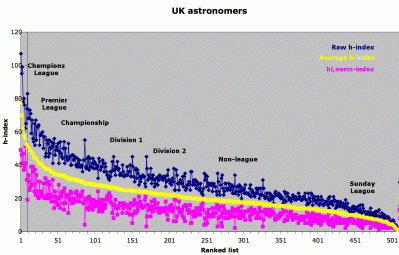
The centrepiece of Paul’s post was the following graph which shows the distribution of two different bibliometric measures for the UK astronomical community. There is the h-index (which is the number h such that the author has h papers cited at least h times) and a normalised version of h in which each paper’s citations are divided by the number of authors of that paper before the index is formed; I call this index hnorm. The results are shown below:

Generally speaking the two indices track each other fairly well, but there are clearly some individuals for whom they diverge. These correspond to researchers whose main mode of productivity is through large consortia and for whom h is correspondingly much larger than hnorm.

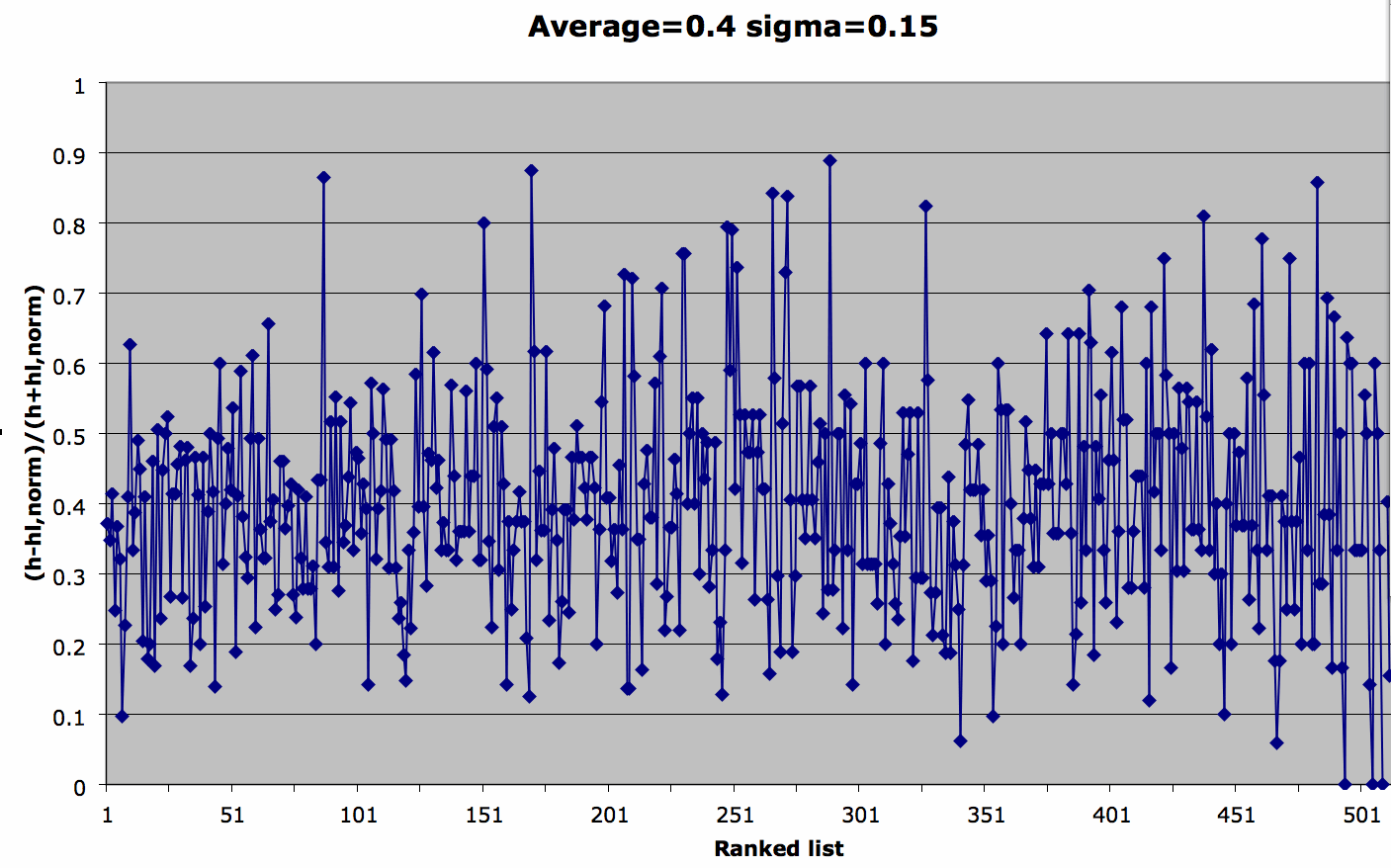
The “outliers” are more easily identified by forming the ratio

l= \frac{h-h_{\rm norm}}{h+h_{norm}}

which is plotted in the graph below kindly provided by Paul Crowther.

Notice that the “lurker index” l is constructed to normalise out any general trend with h and the data do seem consistent with a constant mean across the ranked list. There is, however, a huge spread even among the top performers.

If this were particle physics rather than astronomy the results wouldn’t be presented in terms of a ratio like l but as a mixing angle like the Weinberg angle or the Cabibbo angle. In this scheme we envisage each researcher’s output publication list as involving a mixture of “solo” and “collaborator” basis states, i.e.

|output>=cos(θ) |solo>+sin(θ) |collaborator>

The angle θ gives a quantitative indication of an author’s inclination to lurk in other people’s publication lists. If θ=0 then the individual’s papers are going to be all single-author affairs with no question marks over attribution of impact. If θ=90° then the individual does primarily  collaborative research – perhaps he/she is a good mixer? Most researchers  lie somewhere between these two extremes.

I therefore suggest that we should measure bibliometric productivity and impact not just through one “amplitude”, say h, but by the addition of a mixing angle, i.e. the whole output should be summarised as (h,θ). One could estimate the relevant angle fairly straightforwardly as

\sin\theta = l= \frac{h-h_{\rm norm}}{h+h_{norm}},

but alternative definitions are possible and a more complete understanding of the underlying process is needed to make this more rigorous.

Stephen Hawking has a particularly small mixing angle (~5.7°); many members of the astronomical Premiership have much larger values of this parameter. The value of θ corresponding to the average value of l is about 23.5° and my own angle is about 8.6°.

And here, courtesy of the ever-reliable Paul Crowther, is a graph of mixing angle versus raw h-index for the whole crowd shown in the above diagram.

P.S. If you thinking this application of mixing angle is daft, then you should read this post.


Share/Bookmark

Sentimental Education

Posted in Education, The Universe and Stuff with tags , , , on March 10, 2011 by telescoper

We’ve now reached the half-way point of the Spring Semester, which means that my teaching load has just doubled; I do the “Particle” bit of a third-year module on “Nuclear and Particle Physics”, which means I have 11 lectures from now until the end of the Semester to tell the students everything I know about particle physics. More than enough time.

Anyway, the first lecture today, as it was last year, was all about Natural Units. I always find it fun doing this, partly because the students stare at me as if I’ve taken leave of my senses. Come to think of it, they do that anyway.

The other night I was having a drink with some colleagues after work. Various topics came up, but we spent a bit of time talking about teaching. It appears that I’m in a small minority of my physics colleagues in that I actually like teaching. In fact, the older I’ve got the more I enjoy it. There’s always a limit, of course, and I wouldn’t like to do so much teaching that I couldn’t do other things, especially research, but I wouldn’t like to be in a job that didn’t involve teaching at all. I think most of my colleagues would jump at the chance to abandon teaching altogether. I can’t understand that attitude, mainly because I find it so rewarding myself, but I’m in a minority of one about so many things nowadays that I’ve ceased worrying about it.

I do sometimes wonder why I find teaching so rewarding. Perhaps it’s because I’m already middle-aged and don’t have any kids of my own. Teaching at least gives me a chance to play some sort of a role in someone else’s development as a person. I can’t guarantee that it’s necessarily a positive role, but there you are.  Another thing is that sometimes when I travel about at conferences and whatnot I get to meet people I taught years ago. It means a lot when they say they remember the lectures, especially if they’ve now embarked on scientific careers of their own.

One of the problems of the government’s push for greater concentration of research funds and the simultaneous slashing of teaching budgets is that the quality of University teaching is bound to suffer. If research funding is allocated only to self-styled research  “superstars” then Universities will obviously spare them from other duties. Teaching loads for ordinary foot soldiers will increase, with obvious consequences in decreasing enthusiasm among lecturing staff.

It’s already the case that teaching is grossly undervalued, and it’s probably worse in physics departments than anywhere else because, without research funding, most would simply go bust. Teaching funding is nowhere near sufficient to cover the real cost of a physics degree and in any case we can’t deliver advanced physics training without access to the research labs.

On top of this there’s the way teaching is entirely disregarded in promotion cases. On paper, promotion to Professor requires demonstrated commitment to teaching. In reality, all that committees care about is how much research income the candidate brings in. Excellence in teaching counts very little, if anything at all, in the assessment of a promotion case. I think this situation must change, especially with tuition fees set to rise to unprecedented levels, but all the forces currently at play are acting in precisely the wrong direction.

If we concentrate physics research funding any further then we’ll have a small number of rich institutions stuffed full of research professors whom the undergraduates never see. The less successful academics in these departments will be put on teaching-only contracts, not because they like teaching but because their alternative is Her Majesty’s Dole. Meanwhile, less favoured research labs – i.e. those who don’t get lucky in the REF – won’t be able to sustain world-class research or teaching activities and will be forced to shut up shop. Further research concentration is bad news all round for the higher education system.

But I digress.

One of the other things we talked about in the pub was the National Lottery. As regular readers of this blog might know, I put the princely sum of £1 on the lottery every Saturday. Some think this is strange, but I see it partly as one of those little rituals we all invent for ourselves and partly as a small price to pay for a little frisson of excitement when the numbers are drawn.

But I do sometimes wonder what on Earth I would do if I won a multi-million pound jackpot prize. Would I quit my job? Would I quit teaching? Actually, I’m not sure I would do either of those. If I could ditch the admin stuff, I would of course do so. I don’t have a car and have no interest in getting one, especially a fancy one. I don’t need a bigger house, or a yacht.  In fact, frankly, there’s nothing that I would really want to buy that I couldn’t buy already. It’s not that I have a huge salary, just that I’m not exactly very materialistic.

So even if I were rich I’d probably carry on doing pretty much what I do now. And that thought brings home just how lucky we are, those of us working in academia. For all the frustrations, the fact remains that we are fortunate to be getting paid for things that we enjoy doing.

Or am I just a sentimental old fool?

Anyway, I feel a poll coming on…


Share/Bookmark

Biology done like Particle Physics

Posted in Uncategorized with tags , , on February 16, 2011 by telescoper

Here, courtesy of Abstruse Goose, is an illustration of what Biology would be like if it were done by particle physicists. I hasten to add that no actual frogs were harmed in the making of this post.


Share/Bookmark

The STFC Delivery Plan

Posted in Science Politics with tags , , , , , on December 20, 2010 by telescoper

Excuse the very quick and sketchy post on such an important topic, but I’ve got a lot of things to do before the dreaded Christmas lunch.

This morning the allocations of funding for the research councils were announced. The statement accompanying the ensuing Delivery Plan for the Science and Technology Facilities Council can be found here, while the plan itself is here. You’ll probably also want to read Paul Crowther’s analysis here.

Other research councils have also published their plans; you can find the one for EPSRC here.

The headline announcement reads:

After transferring responsibility for space science to the UK Space Agency, STFC’s overall baseline allocation for 2011-12 for resource funding (previously termed “near-cash”) is £377.5m rising to an allocation of £381.14m in 2014-15. This excludes administration which will be separately allocated. Our capital baseline allocation for 2011-12 is £91m, with an indicative allocation for the remainder of the spending review period reducing to £68m in 2014-15.

So not at all bad news for resource funding, but the implications of the capital cut are unclear (at least to me).

I haven’t had time to read the entire document, but did have a quick look at the crucial Appendix D which shows how each discipline is expected to fare:

  • Particle Physics expenditure will rise from £133M to £148M over 4 years
  • Astronomy expenditure will fall from £77M to £69M over the same period
  • Expenditure on Synchtron facilities (e.g. Diamond Light Source) will increase from £42M to £56M.

Within an approximately flat-cash settlement, therefore, Astronomy is a clear loser (although much of the cuts in expenditure relate to decisions already made, such as withdrawal from the Gemini Telescopes). Confusingly, much of the increase in Particle Physics expenditure relates to an increase in the CERN subscription, which I thought was supposed to be falling …

As far as I understand it, the plan also maintains grant funding at the current level (although it will move into the new consolidated grant system as quickly as this can be achieved).

Anyway, that’s all I’ve got time for right now, and comments/reactions/corrections/clarifications are very welcome through the box below.


Share/Bookmark

Business Class

Posted in Biographical, Science Politics with tags , , , , , on November 9, 2010 by telescoper

I’d never heard of Cardiff Business Club until Friday afternoon, when I received a message that they were hosting a lecture by Dr Lyndon Evans, the Director of the Large Hadron Collider experiment at CERN in Geneva, followed by a dinner, and had sent a bunch of invitations to the School of Physics & Astronomy at Cardiff University, where I work.

Given the short notice it was a bit of a scramble to get a group together, but in the end eight of us – 3 staff and 5 students – headed off in taxis yesterday to the swish St David’s Hotel in Cardiff Bay for the welcoming reception.

Earlier in the day I’d been in contact with Alun  Davies, the Secretary of Cardiff Business Club, who had asked me  if I would deliver the vote of thanks at the end of Dr Evans’ lecture.  Naturally, I agreed to do the honours. I’m not actually a particle physicist, of course, but I was the closest thing available. This all meant that, instead of joining my colleagues at the reception, I went off to meet the speaker and various officers of the club in a private lounge where we were plied with drinks and canapés. As well as meeting Lyn Evans, I also got the chance to chat with the Club Chairman, legendary former rugby international Gerald Davies who is an extremely friendly and charming bloke.

Thence it was downstairs to the lecture, during which I sat on the platform, facing the audience, from where it was extremely difficult to see the speaker’s slides. It was a 30-minute overview of the science, technology, and even politics behind the LHC, which went down extremely well. I remember this quote in particular

The greatest economic benefits of scientific research have always resulted from advances in fundamental knowledge rather than the search for specific applications.

It’s  particularly interesting, in the light of  government suggestions that we should  focus science funding more on applied sciences and technology, to note that this remark was made by Margaret Thatcher.

At the end I did my best to keep my vote of thanks as brief as possible – brevity has never been my strong suit, I’m afraid – and we then went off to dinner, with me rejoining the physics crowd at their table in a far-flung corner of the room.

Not surprisingly, the dinner turned out to be quite a formal affair – preceded by grace and followed by the loyal toast – which I think made some of our party feel a little bit uncomfortable, but at least it was all free! The room was dominated by men in suits who all looked like they were used to going everywhere Business Class. We academics usually travel by  Economy Class only.

Proceedings drew to a close quite early, at 10pm. Unfortunately, the temptation to adjourn to the pub for a “quick drink” proved too strong to resist.

I got home at 2.30am.


Share/Bookmark

A New Theory of Dark Matter

Posted in Science Politics, The Universe and Stuff with tags , , , , , , on November 6, 2010 by telescoper

Since this week has seen the release of a number of interesting bits of news about particle physics and cosmology, I thought I’d take the chance to keep posting about science by way of a distraction from the interminable discussion of  funding and related political issues. This time I thought I’d share some of my own theoretical work, which I firmly believe offers a viable alternative to current orthodox thinking in the realm of astroparticle physics.

As you probably know, one of the most important outstanding problems in this domain is to find an explanation of dark matter, a component of the matter distribution of the Universe which is inferred to exist from its effects on the growth of cosmic structures but which is yet to be detected by direct observations. We know that this dark matter can’t exist in the form of familiar atomic material (made of protons, neutrons and electrons) so it must comrpise some other form of matter. Many candidates exist, but the currently favoured model is that it is made of weakly interacting massive particles (WIMPs) arising in particle physics theories involving supersymmetry, perhaps the fermionic counterpart of the gauge bosons of the standard model, e.g. the photino (the supersymmetric counterpart of the photon).

However, extensive recent research has revealed that this standard explanation may in fact be incorrect and circumstantial evidence is mounting that supports a  radically different scenario. I am now in a position to reveal the basics of a new theory that accounts for many recent observations in terms of an alternative hypothesis, which entails the existence of a brand new particle called the k-Mason.

Standard WIMP dark matter comprises very massive particles which move very slowly, hence the term Cold Dark Matter or CDM, for short.  This means that CDM forms structures very rapidly and efficiently, in a hierarchical or “bottom-up” fashion. This idea is at the core of the standard “concordance” cosmological model.

However, the k-Mason is known to travel such huge distances at such high velocity in random directions between its (rare) encounters that it not only inhibits the self-organisation of other matter, but actively dissipates structures once they have been formed. All this means that structure formation is strongly suppressed and can only happen in a “top-down” manner, which is extremely inefficient as it can only form small-scale structures through the collapse of larger ones. Astronomers have compiled a huge amount of evidence of this effect in recent years, lending support to the existence of the k-Mason as a dominant influence  (which is of course entirely at odds with the whole idea of concordance).

Other studies also provide pretty convincing quantitative evidence of the large mean free path of the k-Mason.

Although this new scenario does seem to account very naturally for the observational evidence of  collapse and fragmentation gathered by UK astronomers since 2007, there are still many issues to be resolved before it can be developed into a fully testable theory. One difficulty is that the k-Mason appears to be surprisingly stable, whereas most theories suggest it would have vanished long before the present epoch. On the other hand, it has also been suggested that, rather than simply decaying, the k-Mason may instead  transform into some other species with similar properties; suggestions for alternative candidates emerging from the decay of the  k-Mason  are actively being sought and it is hoped this process will be observed definitively within the next 18 months or so.

However the biggest problem facing this idea is the extreme difficulty of  detecting the k-Mason  at experimental or observational facilities. Some scientists have claimed evidence of its appearance at various laboratories run by the UK’s Science and Technology Facilities Council (STFC), as well as at the Large Hadron Collider at CERN, but these claims remain controversial: none has really stood up to detailed scrutiny and all lack independent confirmation from reliable witnesses. Likewise there is little proof of the presence of k-Mason at any ground-based astronomical observatory, which has led many astronomers to conclude that  only observations done from space will remain viable in the longer term.

So, in summary, while the k-Mason remains a hypothetical entity, it does furnish a plausible theory that accounts, in a broad-brush sense, for many disparate phenomena. I urge particle physicists, astronomers and cosmologists to join forces in the hunt for this enigmatic object.

NOTE ADDED IN PROOF: The hypothetical “k-Mason” referred to in this article is not to be confused with the better-known “strange” particle the  k-Meson.


Share/Bookmark

Engineering a Conflict

Posted in Finance, Politics, Science Politics with tags , , , on October 25, 2010 by telescoper

I don’t have time to post much today so I thought I’d just put up a quick item about something that the e-astronomer (aka Andy Lawrence) has already blogged about, and generated a considerable amount of discussion about so I’ll just chip in with my two-penny-worth.

Some time ago I posted an item explaining how, in the run-up to last week’s Comprehensive Spending Review, the Royal Academy of Engineering had argued, in a letter to the Department of Business, Innovation and Skills (BIS), that government research funding should be

… concentrated on activities from which a contribution to the economy, within the short to medium term, is foreseeable. I recognise that this calls for significant changes in practice but I see no alternative in the next decade. This may mean disinvesting in some areas in order properly to invest in others.

They went on to say that

BIS should also consider the productivity of investment by discipline and then sub-discipline. Once the cost of facilities is taken into account it is evident that ‘Physics and Maths’ receive several times more expenditure per research active academic compared to those in ‘Engineering and Technology’. This ratio becomes significantly more extreme if the comparison is made between particle physics researchers and those in engineering and technology. Much of particle physics work is carried out at CERN and other overseas facilities and therefore makes a lower contribution to the intellectual infrastructure of the UK compared to other disciplines. Additionally, although particle physics research is important it makes only a modest contribution to the most important challenges facing society today, as compared with engineering and technology where almost all the research is directly or indirectly relevant to wealth creation.

I had hoped that this unseemly attack on particle physics would have been seen for what it was and would have faded into the background, but a recent article by Colin Macilwain has brought it back into the spotlight. I quote

UK engineers have started a scrap that will grow uglier as the spending cuts begin.

I should add that MacIlwain isn’t particularly supportive of the engineers’ position, but he does make some interesting remarks on the comparitively low status held by engineers in the United Kingdom compared to other countries, a point alsotaken up on Andy Lawrence’s blog. In my opinion this bare-faced attempt to feather their own nest at the expense of fundamental physics isn’t likely to generate many new admirers. Neither is the fact – and this is a point I’ve tried to make before – that the engineers’ argument simply doesn’t hold any water in the first place.

The point they are trying to make is that research in engineering is more likely to lead to rapid commercial exploitation than research in particle physics. That may be true, but it’s not a good argument for the government to increase the amount of research funding. If engineering and applied science really is “near market” in the way that the RAEng asserts, then it shouldn’t need research grants, but should instead be supported by venture capital or direct investment from industry. The financial acumen likely to be available from such investors will be much for useful for the commercial exploitation of any inventions or discoveries than a government-run research council. To be fair, as MacIlwain’s article explains, a large fraction of engineering research (perhaps 75%) is funded by commerce and industry. Moreover some engineering research is also too speculative for the market to touch and therefore does merits state support. However, that part that needs state support needs it for precisely the same reason that particle physics does, i.e. that its potential is long-term rather than short term. This means that is in the same boat as fundamental physics and shouldn’t keep pretending that it isn’t. If engineering research needs government funding then ipso facto it’s not likely to generate profits in the short term.

I think scientists and engineers would all be better off if they worked together to emphasize the amazingly successful links between fundamental physics and technology, as demonstrated by, e.g., the Large Hadron Collider at CERN and the mutual interdependence of their disciplines.

United we stand, and all that…


Share/Bookmark