Archive for Particle Physics

The Great Escape? Not yet.

Posted in Finance, Politics, Science Politics with tags , , , , , on October 20, 2010 by telescoper

I expected to wake up this morning with the blues all round my bed, about the results of the Comprehensive Spending Review about to be announced today, but news appearing in the Guardian and the BBC websites last night suggested that the UK Science budget may, repeat may, be spared the worst of the cuts.

This news has been greeted with euphoria in the science community, as we were expecting much worse than the settlement suggested by the news. The RCUK budget, it seems, will be fixed in cash terms around £3.5 billion per annum for four years, as will the approximately £1bn distributed for research through HEFCE’s QR mechanism. This translates into a real terms cut that depends on what figure you pick for inflation over this period. The Treasury suggests it will corresponding to a 10% reduction figured that way, but inflation has defied predictions and remained higher than expected over the past three years so things could be different. Also important to note is that this budget (amounting to around £4.6 billion) is to be ring-fenced within RCUK.

So why the apparent change of heart? Well, I don’t know for sure, but I think the Science is Vital campaign played a very big part in this. Huge congratulations are due to Jenny Rohn and the rest of the team for doing such a fantastic job. The Guardian makes this clear, stating that science is usually a non-issue for the Treasury, but this time it was

high on the political radar because strong representations have been made by the scientific community about what they have described as “long term and irreversible” damage to the UK economy if there are deep cuts to research funding.

That means everyone who wrote to their MP or lobbied or went on the demo really did make a difference. Give yourselves a collective pat on the back!

BUT (and it’s a very big BUT) we’re by no means out of the woods yet, at least not those of us who work in astronomy and particle physics. As the BBC article makes clear, the level cash settlement for RCUK comes with an instruction that “wealth creation” be prioritised. The budget for RCUK covers all the research councils, who will now have to make their pitch to RCUK for a share of the pie. It’s unlikely that it will be flat cash for everyone. There will be winners and losers, and there’s no prize for guessing who the likely losers are.

The performance of the STFC Executive during the last CSR should also be born in mind. STFC did very poorly then at a time when the overall funding allocation for science was relatively generous, and precipitated a financial crisis that STFC’s management still hasn’t properly come to grips with. The track-record doesn’t inspire me with confidence. Moreover, at a town meeting in London in December 2007 at which the Chief Executive of STFC presented a so-called delivery plan to deal with the crisis he led his organisation into, he confidently predicted a similarly poor settlement in the next CSR. Talk about a self-fulfilling prophecy. Let’s hope they get their act together better this time.

Taking all this together it remains by no means improbable that the STFC budget could be squeezed until the pips squeak in order to liberate funds to spend elsewhere within RCUK on things that look more likely to generate profits quickly. The nightmare scenario I mentioned a few days ago is still on the cards.

As we all know, STFC’s budget is dominated by large fixed items so its science programme is especially vulnerable. As the BBC puts it

So any cut in [STFC’s] budget will be greatly magnified and it is expected that it will have to withdraw from a major programme. Alternatively, it would have to cutback or close one of its research institutes.

We could have to wait until December to find out the STFC budget, so the anxiety is by no means over. However, the ring-fencing of RCUK’s budget within BIS may bring that forward a bit as it would appear to suggest one level of negotations could be skipped. We might learn our fate sooner than we thought.

Overall, this is a good result in the circumstances. Although it’s a sad state of affairs when a >10% real terms cut is presented as a success, it’s far less bad than many of us had expected. But I think STFC science remains in grave danger. It’s not an escape, just a stay of execution.

But there is one important lesson to be learned from this. When the STFC crisis broke three years ago, reaction amongst scientists was muted. Fearful of rocking the boat, we sat on our hands as the crisis worsened. I hope that the success of the Science is Vital campaign has convinced you that keeping quiet and not making a fuss is exactly the wrong thing to do.

If only we’d been braver three years ago.


Share/Bookmark

STFC Budget 2010-11

Posted in Finance, Science Politics with tags , , on October 14, 2010 by telescoper

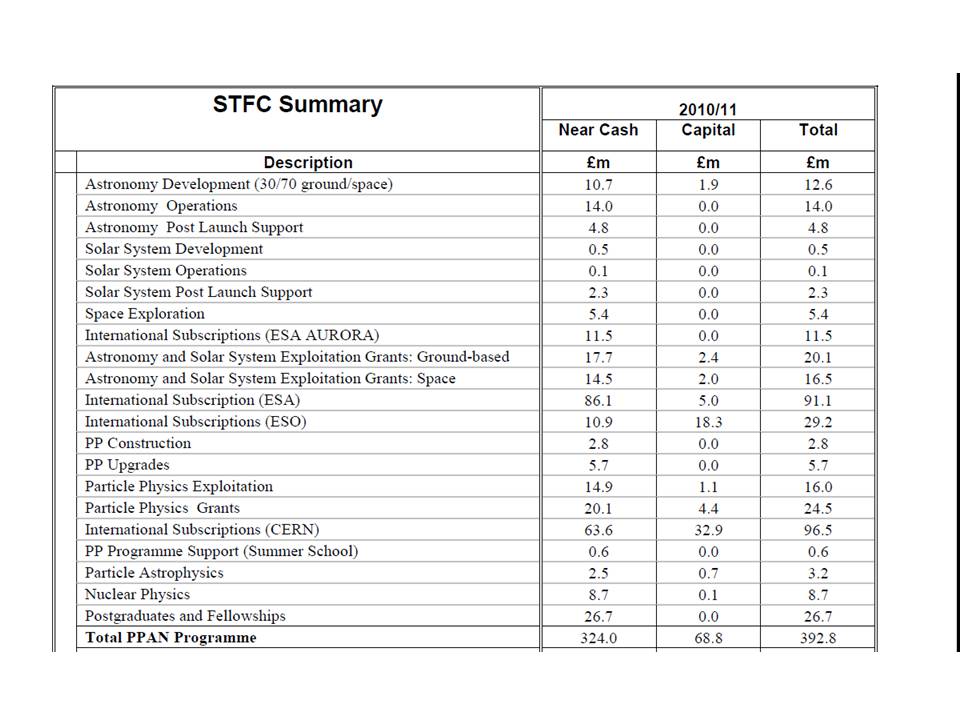
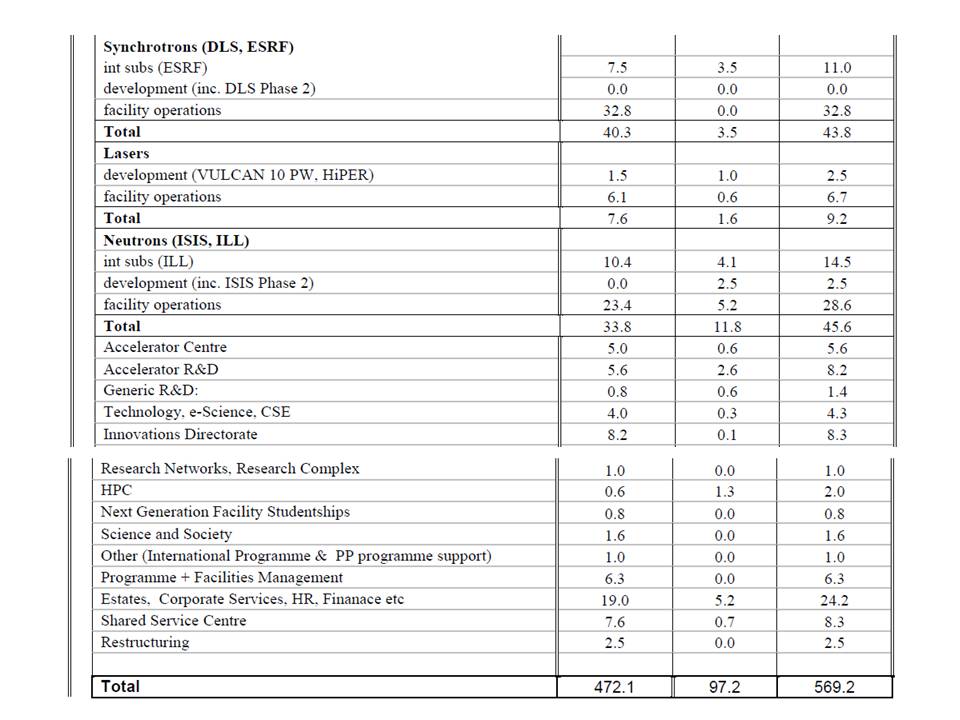
Just a quick post to point out that the Science and Technology Facilities Council have released a reasonably complete breakdown of their current budget. I’m sure many readers working in astronomy and particle physics will find it interesting reading, though others will probably find it incredibly boring.

Here it is, for easy reference, in bits, generated by a clumsy cut-and-paste-technique wholly unbefitting the hi-tech nature of STFC, starting with the PPAN Programme:

and now the rest

For those of you not up with the accounting lingo, “near cash” means assets investments and other things that could in principle be exchanged for cash in a relatively short period of time.

These are, of course, the figures before the impending cuts take place….

There’s a much more legible version of the whole thing here.


Share/Bookmark

There is no Zero

Posted in The Universe and Stuff with tags , , , , on October 1, 2010 by telescoper

The Incredible Shrinking Man is a science fiction film made in 1957. If you haven’t seen it before its title will probably make you think it’s a downmarket B-movie, but it’s far from that. In fact it was very well received by film critics when it was first released and in 2009 was added to the Library of Congress list of films considered to be culturally, historically or aesthetically significant. The  special effects used to portray the main character reducing in size were remarkable in its day, but for me the film is worth it for the wonderful ending shown in the clip:

I first saw this film on TV when I was at school and the final monologue made such an impression on me that it keeps popping into my mind, as it just did. The field of astroparticle physics encompasses cosmology, the study of the Universe on the largest scales accessible to observation (many billions of light years) as well as the smallest dimensions we can probe using the techniques of particle physics.  As the Incredible Shrinking Man realises, these are just two aspects of the same underlying unity. There’s nothing specifically new about this line of reasoning, however; I posted a poem a while ago that dates from 1675 which has a similar theme.

I decided to put the clip up now for two reasons. One is that the phrase “there is no zero” (which has passed me by on previous occasions I’ve watched the clip)  reminds of some stuff I wrote recently for a book that I’m struggling to finish, about how there’s no such thing as nothing in physics. Space is much more than the absence of matter and even empty space isn’t the same thing as nothing at all. Zero is also just the flip side of infinity and I don’t think infinity exists in nature either. When infinity appears in our theories it’s just a flag to tell us we don’t know what we’re doing. Many others have thought this thought: both Gauss and, later, Hilbert argued against the possibility of there being realised infinities in nature. My old friend and erstwhile collaborator George Ellis adheres to this view too.

The other reason for posting it is that, in these days of the Incredible Shrinking Science Budget, it’s important that we recognize and nurture the deep connections between things by supporting science in all its forms. Once we start trying to unpick its strands, the web of knowledge will all too quickly unravel.


Share/Bookmark

Get thee behind me, Plato

Posted in The Universe and Stuff with tags , , , , , , , , , , on September 4, 2010 by telescoper

The blogosphere, even the tiny little bit of it that I know anything about, has a habit of summoning up strange coincidences between things so, following EM Forster’s maxim “only connect”, I thought I’d spend a lazy saturday lunchtime trying to draw a couple of them together.

A few days ago I posted what was intended to be a fun little item about the wave-particle duality in quantum mechanics. Basically, what I was trying to say is that there’s no real problem about thinking of an electron as behaving sometimes like a wave and sometimes like a particle because, in reality (whatever that is), it is neither. “Particle” and “wave” are useful abstractions but they are not in an exact one-to-one correspondence with natural phenomena.

Before going on I should point out that the vast majority of physicists are well away of the distinction between, say,  the “theoretical” electron and whatever the “real thing” is. We physicists tend to live in theory space rather than in the real world, so we tend to teach physics by developing the formal mathematical properties of the “electron” (or “electric field”) or whatever, and working out what experimental consequences these entail in certain situations. Generally speaking, the theory works so well in practice that we often talk about the theoretical electron that exists in the realm of mathematics and the electron-in-itself as if they are one and the same thing. As long as this is just a pragmatic shorthand, it’s fine. However, I think we need to be careful to keep this sort of language under control. Pushing theoretical ideas out into the ontological domain is a dangerous game. Physics – especially quantum physics – is best understood as a branch of epistemology. What is known? is safer ground than what is there?

Anyway, my  little  piece sparked a number of interesting comments on Reddit, including a thread that went along the lines “of course an electron is neither a particle nor a wave,  it’s actually  a spin-1/2 projective representation of the Lorentz Group on a Hilbert space”. That description, involving more sophisticated mathematical concepts than those involved in bog-standard quantum mechanics, undoubtedly provides a more complete account of natural phenomena associated with the electrons and electrical fields, but I’ll stick to my guns and maintain that it still introduces a deep confusion to assert that the electron “is” something mathematical, whether that’s a “spin-1/2 projective representation” or a complex function or anything else.  That’s saying something physical is a mathematical. Both entities have some sort of existence, of course, but not the same sort, and the one cannot “be” the other. “Certain aspects of an electron’s behaviour can be described by certain mathematical structures” is as I’m  prepared to go.

Pushing deeper than quantum mechanics, into the realm of quantum field theory, there was the following contribution:

The electron field is a quantum field as described in quantum field theories. A quantum field covers all space time and in each point the quantum field is in some state, it could be the ground state or it could be an excitation above the ground state. The excitations of the electron field are the so-called electrons. The mathematical object that describes the electron field possesses, amongst others, certain properties that deal with transformations of the space-time coordinates. If, when performing a transformation of the space-time coordinates, the mathematical object changes in such a way that is compatible with the physics of the quantum field, then one says that the mathematical object of the field (also called field) is represented by a spin 1/2 (in the electron case) representation of a certain group of transformations (the Poincaré group, in this example).I understand your quibbling, it seems natural to think that “spin 1/2″ is a property of the mathematical tool to describe something, not the something itself. If you press on with that distinction however, you should be utterly puzzled of why physics should follow, step by step, the path led by mathematics.

For example, one speaks about the ¨invariance under the local action of the group SU(3)” as a fundamental property of the fields that feel the nuclear strong force. This has two implications, the mathematical object that represents quarks must have 3 ¨strong¨ degrees of freedom (the so-called color) and there must be 32-1 = 8 carriers of the force (the gluons) because the group of transformations in a SU(N) group has N2-1 generators. And this is precisely what is observed.

So an extremely abstract mathematical principle correctly accounts for the dynamics of an inmensely large quantity of phenomena. Why does then physics follow the derivations of mathematics if its true nature is somewhat different?

No doubt this line of reasoning is why so many theoretical physicists seem to adopt a view of the world that regards mathematical theories as being, as it were,  “built into” nature rather than being things we humans invented to describe nature. This is a form of Platonic realism.

I’m no expert on matters philosophical, but I’d say that I find this stance very difficult to understand, although I am prepared to go part of the way. I used to work in a Mathematics department many years ago and one of the questions that came up at coffee time occasionally was “Is mathematics invented or discovered?”. In my experience, pure mathematicians always answered “discovered” while others (especially astronomers, said “invented”). For what it’s worth, I think mathematics is a bit of both. Of course we can invent mathematical objects, endow them with certain attributes and proscribe rules for manipulating them and combining them with other entities. However, once invented anything that is worked out from them is “discovered”. In fact, one could argue that all mathematical theorems etc arising within such a system are simply tautological expressions of the rules you started with.

Of course physicists use mathematics to construct models that describe natural phenomena. Here the process is different from mathematical discovery as what we’re trying to do is work out which, if any, of the possible theories is actually the one that accounts best for whatever empirical data we have. While it’s true that this programme requires us to accept that there are natural phenomena that can be described in mathematical terms, I do not accept that it requires us to accept that nature “is” mathematical. It requires that there be some sort of law governing some  of aspects of nature’s behaviour but not that such laws account for everything.

Of course, mathematical ideas have been extremely successful in helping physicists build new physical descriptions of reality. On the other hand, however, there is a great deal of mathematical formalism that is is not useful in this way.  Physicists have had to select those mathematical object that we can use to represent natural phenomena, like selecting words from a dictionary. The fact that we can assemble a sentence using words from the Oxford English Dictionary that conveys some information about something we see doesn’t not mean that what we see “is” English. A whole load of grammatically correct sentences can be constructed that don’t make any sense in terms of observable reality, just as there is a great deal of mathematics that is internally self-consistent but makes no contact with physics.

Moreover, to the person whose quote I commented on above, I’d agree that the properties of the SU(3) gauge group have indeed accounted for many phenomena associated with the strong interaction, which is why the standard model of particle physics contains 8 gluons and quarks carrying a three-fold colour charge as described by quantum chromodynamics. Leaving aside the fact that QCD is such a terribly difficult theory to work with – in practice it involves  nightmarish lattice calculations on a scale to make even the most diehard enthusiast cringe –  what I would ask is whether this  description in any case sufficient for us to assert that it describes “true nature”?  Many physicists will no doubt disagree with me, but I don’t think so. It’s a map, not the territory.

So why am I boring you all with this rambling dissertation? Well, it  brings me to my other post – about Stephen Hawking’s comments about God. I don’t want to go over that issue again – frankly, I was bored with it before I’d finished writing my own blog post  – but it does relate to the bee that I often find in my bonnet about the tendency of many modern theoretical physicists to assign the wrong category of existence to their mathematical ideas. The prime example that springs to my mind is the multiverse. I can tolerate  certain versions of the multiverse idea, in fact. What I can’t swallow, however is the identification of the possible landscape of string theory vacua – essentially a huge set of possible solutions of a complicated set of mathematical equations – with a realised set of “parallel universes”. That particular ontological step just seems absurd to me.

I’m just about done, but one more thing I’d say to finish with is concerns the (admittedly overused) metaphor of maps and territories. Maps are undoubtedly useful in helping us find our way around, but we have to remember that there are always things that aren’t on the map at all. If we rely too heavily on one, we might miss something of great interest that the cartographer didn’t think important. Likewise if we fool ourselves into thinking our descriptions of nature are so complete that they “are” all that nature is, then we might miss the road to a better understanding.

Share/Bookmark

STFC Grants Consultation

Posted in Science Politics with tags , , , , on August 31, 2010 by telescoper

I thought I’d put my community service badge on today and draw the attention of any astronomers or particle physicists reading this blog that the Science and Technology Facilities Council (STFC) is consulting on proposed changes to the ways it funds research grants. I can hardly over-emphasize the importance of this issue, especially for those of us working in University departments who rely on grant funding in order to carry out our research.

There is a consultation form on which you can post comments on the alternatives outlined in the accompanying document.

Regrettably, only three options are offered. In brief, they are

  1. All grants to be 3-year “standard” grants (i.e. no more “rolling” grants at all)
  2. Some (a small number?) of 6-year “core” grants introduced, mainly to cover the cost of technical support staff.
  3. The status quo (i.e. mixture of 3-year “standard” and 5-year “rolling” grants).

I’m not going to comment on these here, as my intention is just to draw your attention to the fact that this consultation is open and that the deadline is very soon: Monday 6th September 2010, at 4pm. I would have thought it’s probably a good idea for groups to submit collective responses where possible, but I’m sure all feedback would be welcomed.

We don’t know how much of a grant programme will remain after the forthcoming Comprehensive Spending Review, but it’s even more important to make the system as efficient and fair as possible when we know money is going to be tight.


Share/Bookmark

No Science Please, We’re British

Posted in Education, Politics, Science Politics with tags , , , , , , , , , on August 27, 2010 by telescoper

The time is getting closer when the Condem government’s hatchet men announce the detailed plans for spending cuts over the next few years. Those of us scientists working in British universities face an anxious few weeks waiting to see how hard the axe is going to fall. Funds for both teaching and research seem likely to be slashed and there’s fear of widespread laboratory closures across the sector, particularly in “pure” science that doesn’t satisfy the current desire for a rapid return on investment.

The mood is pretty accurately summarised by an article in the Guardian, in which John Womersley (who is the Director of Science Programmes at the Science and Technology Facilities Council) pointed out the very real possibility that the UK might be forced to mothball expensive national facilities such the recently built Diamond Light Source and/or withdraw from international collaborations such as CERN (which would also entail pulling out of the Large Hadron Collider). Astronomers also fear that cuts to STFC might force us to withdraw from the European Southern Observatory, which would basically destroy our international competitiveness in a field which for so long we have been world-leading. Withdrawal from CERN would similarly ensure the end of particle physics in Britain.

As well as the loss of facilities and involvement in ongoing international research programmes, big cuts in science funding – especially at STFC – will also lead to a “lost generation” of young scientists having little or no opportunity to carry out their research here in Britain. In fact the process of throwing away the UK’s future as a scientific nation has already begun and is likely to accelerate even without further cuts this year.

The STFC budgets for training young scientists at both postgraduate and postdoctoral levels were slashed even before the General Election because STFC was formed in 2007 with insufficient funds to meet its commitments. The total funding for research grants in astronomy – which is how many postdoctoral researchers are trained has been squeezed by an unsustainable level of 40% already. Many young scientists, whose contracts have been terminated with virtually no notice, have not unreasonably decided that the UK can offer them nothing but a kick in the teeth and gone abroad, taking their expertise (which was developed thanks to funding provided by the UK taxpayer) to one of our competitors in the global economy.

Some say the previous funding crisis was due to downright incompetence on behalf of the STFC Executive, some say it was part of a deliberate policy at the RCUK level to steer funding away from pure science towards technology-related areas. Either way the result is clear. Opportunities for young British scientists to do scientific research have been severely curtailed. Another round of cuts to STFC of the 25% being talked about by the new government will certainly lead to wholesale closures of labs and observatories, the withdrawal from international commitments such as CERN and ESO, and the loss of irreplaceable expertise to other countries.

On top of this, it seems not only STFC but also other research councils (such as EPSRC) are talking about clawing back funds they have already granted, by reneging on contracts they have already signed with Universities to fund research by scientists carried out there. If this does happen, there will be a catastrophic breakdown of trust between University-based scientists and the government government that will probably never be healed.

This government risks destroying the foundations of scientific excellence that have taken over 300 years to build, and all for what level of saving? The annual subscription the UK pays to CERN is about £70 million, a couple of pounds per British taxpayer per year, and a figure that most bankers would regard as small change. It would be madness to throw away so much long-term benefit to save so little in terms of short-term cost.

In the Guardian article, John Womersley is quoted as saying

Our competitor nations such as Germany and the US are investing in science and engineering right now because they recognise that they stimulate economic growth and can help to rebalance the economy. It is pretty obvious that if the UK does the exact opposite, those companies will look elsewhere. That would deepen the deficit – in a recession you need to invest in science and engineering to reap the benefits, not cut back.

Of course we don’t know how the Comprehensive Spending Review will turn out and there may be still time to influence the deliberations going on in Whitehall. I hope the government can be persuaded to see sense.

I’m trying very hard to be optimistic but, given what happened to STFC in 2007, I have to say I’m very worried indeed for the future of British science especially those areas covered by STFC’s remit. The reason for this is that STFC’s expenditure is dominated by the large facilities needed to do Big Science, many of which are international collaborations.

In order to be active in particle physics, for example, we have to be in CERN and that is both expensive and out of STFC’s control. The cost of paying the scientists to do the science is a relatively small add-on to that fixed cost, and that’s the only bit that can be cut easily. If we cut the science spend there’s no point in being in CERN, but we can’t do the science without being in CERN. The decision to be made therefore rapidly resolves itself into whether we do particle physics or not, a choice which once made would be irreversible (and catastrophic). It’s the same logic for ESO and ground-based astronomy. There’s a real possibility in a few years time that the UK will have killed off at least one of these immensely important areas of science (and possibly others too).

A decade ago such decisions would have been unthinkable, but now apparently they’re most definitely on the cards. I don’t know where it all went wrong, but given the (relatively) meagre sums involved and the fact that it started before the Credit Crunch anyway, it’s difficult to escape the conclusion that it’s a deliberate stitch-up by senior mandarins. All I can say is that the future looks so grim I’m glad I’m no longer young.


Share/Bookmark

Nicola Cabibbo (1935-2010)

Posted in The Universe and Stuff with tags , , , , on August 16, 2010 by telescoper

Just a short post to convey the very sad news that the great Italian physicist Nicola Cabibbo passed away today at the age of 75. I know I’m not alone in thinking that he should have received a share of the Nobel prize in 2008, which was awarded to Yoichiro Nambu (half the prize) and the other half was split between Makoto Kobayashi and Toshihide Maskawa.

As I wrote in 2008:

All three are extremely distinguished physicists and their contributions certainly deserve to be rewarded. But, in the case of Kobayashi and Maskawa, the Nobel Foundation has made a startling omission that I really can’t understand at all and which even threatens to undermine the prestige of the prize itself.The work for which these two were given half the Nobel Prize this year relates to the broken symmetry displayed by weak interactions between quarks. We now know that there are three generations of quarks, each containing quarks of two different flavours. The first generation contains the up (u) and the down (d), the second the strange (s) and the charmed (c), and the third has the bottom (b) and the top (t). OK, so the names are daft, but physicists have never been good at names.

The world of quarks is different to penetrate becauses quarks interact via the strong force which binds them close together into hadrons which are either baryons (three quarks) or mesons (a quark and an anti-quark).

But there are other kinds of particles too, the leptons. These are also arranged in three generations but each of these families contains a charged particle and a neutrino. The first generation is an electron and a neutrino, the second a muon and its neutrino, and the third has the tau and another neutrino. One might think that the three quark generations and the three lepton generations might have some deep equivalence between them, but leptons aren’t quarks so can’t interact at all by the strong interaction. Quarks and leptons can both interact via the weak interaction (the force responsible for radioactive beta-decay).

Weak interactions between leptons conserve generation, so the total number of particles of electron type is never changed (ignoring neutrino oscillations, which have only relatively recently been discovered). It seemed natural to assume that weak interactions between quarks should do the same thing, forbidding processes that hop between generations. Unfortunately, however, this is not the case. There are weak interactions that appear to convert u and/or d quarks into c and/or s quarks, but these seem to be relatively feeble compared to interactions within a generation, which seem to happen with about the same strength for quarks as they do for leptons. This all suggests that there is some sort of symmetry lurking somewhere in there, but it’s not quite what one might have anticipated.

The explanation of this was proposed by Nicola Cabibbo who, using a model in which there are only two quark generations, developed the idea that states of pure quark flavour (“u” or “d”, say) are not really what the weak interaction “sees”. In other words, the quark flavour states are not proper eigenstates of the weak interaction. All that is needed is to imagine that the required eigenstates are a linear combination of the flavour states and, Bob’s your uncle, quark generation needn’t be conserved. This phenomenon is called Quark Mixing. What makes it simple for only two generations is that it can be described entirely by one number: the Cabibbo angle, which measures how much the quark flavour basis is misaligned with the weak interaction basis. The angle is small so the symmetry is only slightly broken.

Kobayashi and Maskawa generalized the work of Cabibbo to the case of three quark generations. That’s actually quite a substantial task as the description of mixing in this case requires not just a single number but a 3×3 matrix each of whose entries is complex. This matrix is universally called the Cabibbo-Kobayashi-Maskawa (CKM) matrix and it now crops up all over the standard model of particle physics.

And there’s the rub. Why on Earth was Cabibbo not awarded a share of this year’s prize? I was shocked and saddened to find out that he’d been passed over despite the fact that his work so obviously led the way. I can think of no reason why he was omitted. It’s outrageous. I even feel sorry for Kobayashi and Maskawa, because there is certain to be such an outcry about this gaffe that it may detract from their success.

But really

I hope, however,  that controversy doesn’t intrude too much on what I hope will be the forthcoming celebration of Cabibbo’s immense contributions to particle physics. I’ll leave it to the experts to write more detailed appreciations that do better justice to his achievements. I’ll just say that I only met him once in real life, but found him charmingly modest and altogether quite delightful company. He will be greatly missed.


Share/Bookmark

Lines on the non-Discovery of the Higgs Boson

Posted in Poetry, The Universe and Stuff with tags , , on July 14, 2010 by telescoper

In search of fame I spread around
A
rumour that the Higgs was found;
But now it’s clear
it wasn’t true,
My career has just gone down the loo.


(by Peter Coles, aged 47½)

Science versus Engineering?

Posted in Science Politics with tags , , , , , , on July 13, 2010 by telescoper

I suppose it was inevitable that there would be infighting as academics jostle for an increase intheir share of what is likely to be a diminishing level of research funding to be announced at the end of the ongoing Comprehensive Spending Review.  The first professional society to try to barge its way to the front of the queue appears to be the Royal Academy of Engineering, which has written to the Department of Business, Innovation and Skills (BIS) in terms that make it clear that they think egineering should prosper at the expense of research in fundamental physics.

To quote the RAEng:

we believe that research should be concentrated on activities from which a contribution to the economy, within the short to medium term, is foreseeable. I recognise that this calls for significant changes in practice but I see no alternative in the next decade. This may mean disinvesting in some areas in order properly to invest in others.

And where should the axe fall?

BIS should also consider the productivity of investment by discipline and then sub-discipline. Once the cost of facilities is taken into account it is evident that ‘Physics and Maths’ receive several times more expenditure per research active academic compared to those in ‘Engineering and Technology’. This ratio becomes significantly more extreme if the comparison is made between particle physics researchers and those in engineering and technology. Much of particle physics work is carried out at CERN and other overseas facilities and therefore makes a lower contribution to the intellectual infrastructure of the UK compared to other disciplines. Additionally, although particle physics research is important it makes only a modest contribution to the most important challenges facing society today, as compared with engineering and technology where almost all the research is directly or indirectly relevant to wealth creation.

Obviously whoever wrote this hasn’t heard of the World Wide Web, invented at CERN – precisely the place singled out for vitriol.

I couldn’t agree less with what the RAEng say in their submission to BIS, but instead of going on a rant here I’ll direct you to John Butterworth’s riposte, which says most of what I would want to say, but I would like to add one comment along the lines I’ve blogged about before.

The reason I think that the RAEng is precisely wrong is that I think the Treasury (on behalf of the taxpayer) should only be investing in research that wouldn’t otherwise be carried out. In other words, the state should fund academic esearch precisely because of its “blue sky” nature, not in spite of it.

Conversely, engineering and technology R&D should be funded primarily by the commercial sector precisely because it can yield short-term economic benefits. The decline of the UK’s engineering base has been caused by the failure of British companies to invest sufficiently in research, expecting instead that the Treasury should fund it and all they have to do is cash in later.

I’m not calling for the engineering and technology budgets to be cut – I don’t have such a blinkered view as the RAEng – but I would argue that a much greater share should be funded by private companies. This also goes for energy research. As Martin Rees pointed out in a recent Reith Lecture, the UK’s energy companies spend a pathetically small proportion of their huge profits on R&D. The politicians should be “persuading” industry to get invest more in the future development of their products rather than expecting the taxpayer to fund it. I agree that the UK economy needs “rebalancing” but part of the balance  is private companies need to develop a much stronger sense of the importance of R&D investment.

And, while I’m tut-tutting about the short-sighted self-interest displayed by the RAEng, let me add that, following the logic I’ve stated above,  I see a far stronger case for the state to support research in history and the arts than, e.g. engineering and computer science. I’d even argue that large commercial companies should think about sponsoring pure science in much the same way as they do with the performing art exhibitions and the Opera. We need as a society to learn to celebrate curiosity-driven research not only as a means to economic return (which it emphatically is) but also as something worth doing for its own sake.

Finally, and most depressingly of all, let me point out that the Chief Executive Officer of the Royal Academy of Engineering, Philip Greenish, sits on the Council of the Science and Technology Facilities Council, an organisation whose aims include

To promote and support, by any means, high-quality basic, strategic and applied research and related post-graduate training in astronomy, particle physics, space science and nuclear physics.

Clearly, he should either disown the statements produced by the RAEng or resign from STFC Council. Unless he was put there deliberately as part of the ongoing stitch-up of British physics. If that’s the case we all have the dole queue to look forward to.

The Joy of Natural Units

Posted in The Universe and Stuff with tags , , , on March 5, 2010 by telescoper

I’m glad it’s the end of the week. It’s been ridiculously busy. It didn’t help that I was already exhausted before it started, after a hectic three days in Geneva. Part of the reason for being so heavily occupied is that my teaching duties have just doubled. I teach the second half of a module called Nuclear and Particle Physics, and I’ve just taken over  for the second half of the semester to cover the part about particle physics. I started my set of 11 lectures with one about natural units, which is a lot of fun because it usually divides the class into two opposing camps.

About half the students think natural units are crazy, and the other half think they’re great. I’m in the second camp. The motivation is straightforward: particle physics combines quantum theory, which involves Planck’s constant

\hbar \simeq 1.05 \times 10^{-34}\,\,\,{\rm Js}

with special relativity, which involves the speed of light

c\simeq 3 \times 10^{8}\,\,\,{\rm m s}^{-1} .

Using everyday SI units (metres, seconds and kilograms) to deal with quantities that are either ridiculously small or ridiculously large doesn’t make any sense but, more importantly, the SI units don’t really reflect the physics very clearly.

In natural units we take these two constants to be equal to unity, so they don’t appear in any formulae:

\hbar = c =1

For example, the energy invariant in special relativity is usually written

E^2=p^2c^2 + m^2c^4

This is where the most famous equation in physics

E=mc^2

comes from. However, the equivalence between mass and energy (and also momentum) is much more clearly expressed in the natural units system:

E^2=p^2 + m^2

None of those tiresome factors of c^2 to remember! Mass, energy and momentum are all expressed in terms of the same natural unit of energy (usually, in particle physics, the GeV).  You can keep track of which is which by the simple expedient of using different names.

Velocities are, of course, always expressed as a fraction of c in this system so have no units.

In quantum theory we find energy E=\hbar \omega becomes E=\omega so energy is expressed in the same units as frequency. Energy is thus a measure of inverse time.  Momentum p =\hbar k becomes just p= k so momentum is an inverse length.  This is in accord with the various forms of Heisenberg’s Uncertainty Principle too:  \Delta p \Delta x \sim \hbar is \Delta p \Delta x \sim 1 and \Delta E \Delta t \sim \hbar becomes \Delta E \Delta t \sim 1. A particle with a finite lifetime thus has a finite energy width which is inversely proportional to the lifetime. It makes sense to use energy units for both of these things.

As an extra bonus we can dispense with the clumsy way that electromagnetism is handled in the SI system by noting that

\frac{e^2}{4\pi \epsilon_0 \hbar c} \equiv \alpha\simeq \frac{1}{137}

is dimensionless. In the SI system the coulomb force between two electrons is \frac{e^2}{4\pi \epsilon_0 r^2} whereas in natural units it is just \frac{\alpha}{r^2}, which is much nicer. Incidentally, the strange quantity \epsilon_0 that appears in the SI version is called the permittivity of free space. Nice name, but I wonder what it means?

The dimensionless quantity \alpha on the other hand, has a very clear  physical meaning: it is the fine structure constant,  a coupling constant that measures the strength of the electromagnetic interaction.

Some people – including emeritus professors of observational astronomy – object to natural units because they hide the units that things are expressed in. They don’t actually. What they do is express things in units that are better geared to the physics. In any case, if you want to convert back to SI units you can always do so straightforwardly with a little bit of dimensional analysis. This is necessary if you have to talk to engineers and the like, perhaps so they can build you a particle accelerator, but in the more elevated company of particle physicists you should definitely follow proper etiquette and keep your units natural.