Archive for Particle Physics

No Science Please, We’re British

Posted in Education, Politics, Science Politics with tags , , , , , , , , , on August 27, 2010 by telescoper

The time is getting closer when the Condem government’s hatchet men announce the detailed plans for spending cuts over the next few years. Those of us scientists working in British universities face an anxious few weeks waiting to see how hard the axe is going to fall. Funds for both teaching and research seem likely to be slashed and there’s fear of widespread laboratory closures across the sector, particularly in “pure” science that doesn’t satisfy the current desire for a rapid return on investment.

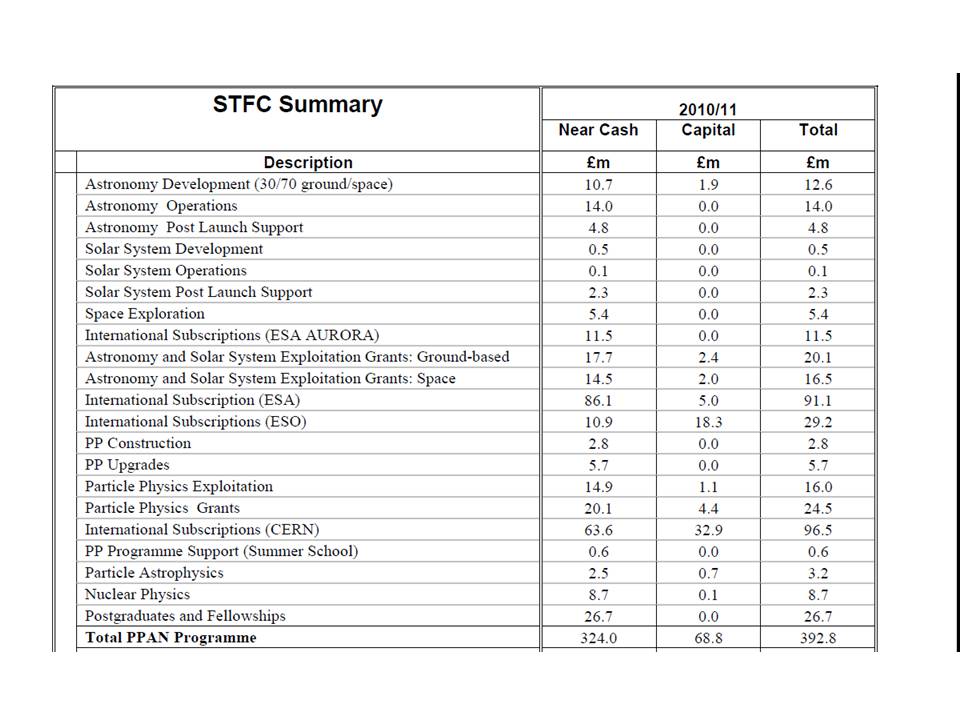
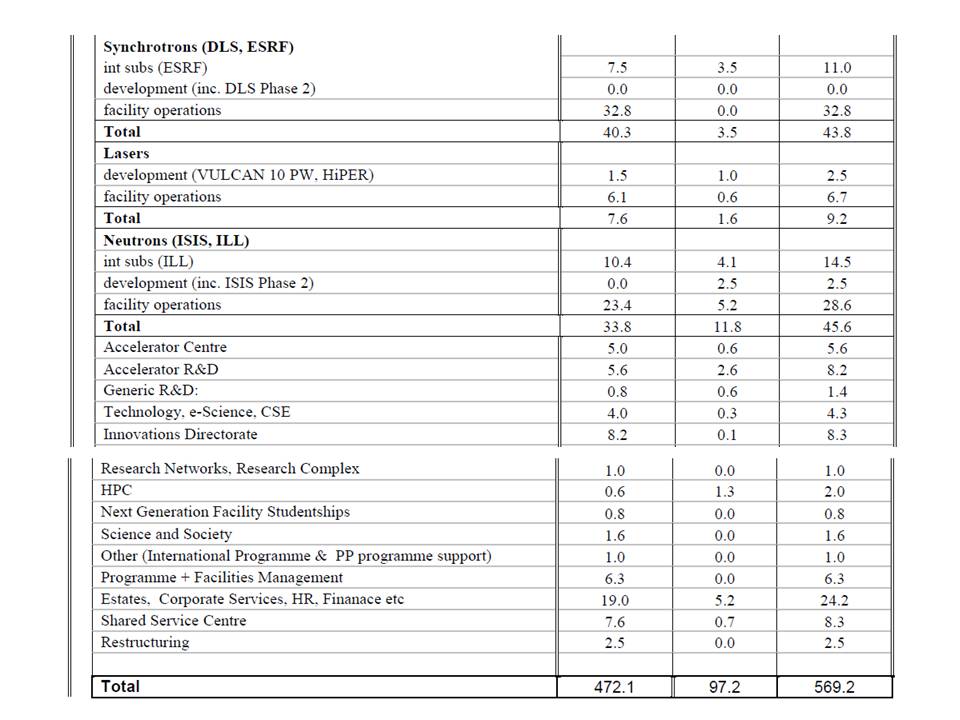
The mood is pretty accurately summarised by an article in the Guardian, in which John Womersley (who is the Director of Science Programmes at the Science and Technology Facilities Council) pointed out the very real possibility that the UK might be forced to mothball expensive national facilities such the recently built Diamond Light Source and/or withdraw from international collaborations such as CERN (which would also entail pulling out of the Large Hadron Collider). Astronomers also fear that cuts to STFC might force us to withdraw from the European Southern Observatory, which would basically destroy our international competitiveness in a field which for so long we have been world-leading. Withdrawal from CERN would similarly ensure the end of particle physics in Britain.

As well as the loss of facilities and involvement in ongoing international research programmes, big cuts in science funding – especially at STFC – will also lead to a “lost generation” of young scientists having little or no opportunity to carry out their research here in Britain. In fact the process of throwing away the UK’s future as a scientific nation has already begun and is likely to accelerate even without further cuts this year.

The STFC budgets for training young scientists at both postgraduate and postdoctoral levels were slashed even before the General Election because STFC was formed in 2007 with insufficient funds to meet its commitments. The total funding for research grants in astronomy – which is how many postdoctoral researchers are trained has been squeezed by an unsustainable level of 40% already. Many young scientists, whose contracts have been terminated with virtually no notice, have not unreasonably decided that the UK can offer them nothing but a kick in the teeth and gone abroad, taking their expertise (which was developed thanks to funding provided by the UK taxpayer) to one of our competitors in the global economy.

Some say the previous funding crisis was due to downright incompetence on behalf of the STFC Executive, some say it was part of a deliberate policy at the RCUK level to steer funding away from pure science towards technology-related areas. Either way the result is clear. Opportunities for young British scientists to do scientific research have been severely curtailed. Another round of cuts to STFC of the 25% being talked about by the new government will certainly lead to wholesale closures of labs and observatories, the withdrawal from international commitments such as CERN and ESO, and the loss of irreplaceable expertise to other countries.

On top of this, it seems not only STFC but also other research councils (such as EPSRC) are talking about clawing back funds they have already granted, by reneging on contracts they have already signed with Universities to fund research by scientists carried out there. If this does happen, there will be a catastrophic breakdown of trust between University-based scientists and the government government that will probably never be healed.

This government risks destroying the foundations of scientific excellence that have taken over 300 years to build, and all for what level of saving? The annual subscription the UK pays to CERN is about £70 million, a couple of pounds per British taxpayer per year, and a figure that most bankers would regard as small change. It would be madness to throw away so much long-term benefit to save so little in terms of short-term cost.

In the Guardian article, John Womersley is quoted as saying

Our competitor nations such as Germany and the US are investing in science and engineering right now because they recognise that they stimulate economic growth and can help to rebalance the economy. It is pretty obvious that if the UK does the exact opposite, those companies will look elsewhere. That would deepen the deficit – in a recession you need to invest in science and engineering to reap the benefits, not cut back.

Of course we don’t know how the Comprehensive Spending Review will turn out and there may be still time to influence the deliberations going on in Whitehall. I hope the government can be persuaded to see sense.

I’m trying very hard to be optimistic but, given what happened to STFC in 2007, I have to say I’m very worried indeed for the future of British science especially those areas covered by STFC’s remit. The reason for this is that STFC’s expenditure is dominated by the large facilities needed to do Big Science, many of which are international collaborations.

In order to be active in particle physics, for example, we have to be in CERN and that is both expensive and out of STFC’s control. The cost of paying the scientists to do the science is a relatively small add-on to that fixed cost, and that’s the only bit that can be cut easily. If we cut the science spend there’s no point in being in CERN, but we can’t do the science without being in CERN. The decision to be made therefore rapidly resolves itself into whether we do particle physics or not, a choice which once made would be irreversible (and catastrophic). It’s the same logic for ESO and ground-based astronomy. There’s a real possibility in a few years time that the UK will have killed off at least one of these immensely important areas of science (and possibly others too).

A decade ago such decisions would have been unthinkable, but now apparently they’re most definitely on the cards. I don’t know where it all went wrong, but given the (relatively) meagre sums involved and the fact that it started before the Credit Crunch anyway, it’s difficult to escape the conclusion that it’s a deliberate stitch-up by senior mandarins. All I can say is that the future looks so grim I’m glad I’m no longer young.


Share/Bookmark

Nicola Cabibbo (1935-2010)

Posted in The Universe and Stuff with tags , , , , on August 16, 2010 by telescoper

Just a short post to convey the very sad news that the great Italian physicist Nicola Cabibbo passed away today at the age of 75. I know I’m not alone in thinking that he should have received a share of the Nobel prize in 2008, which was awarded to Yoichiro Nambu (half the prize) and the other half was split between Makoto Kobayashi and Toshihide Maskawa.

As I wrote in 2008:

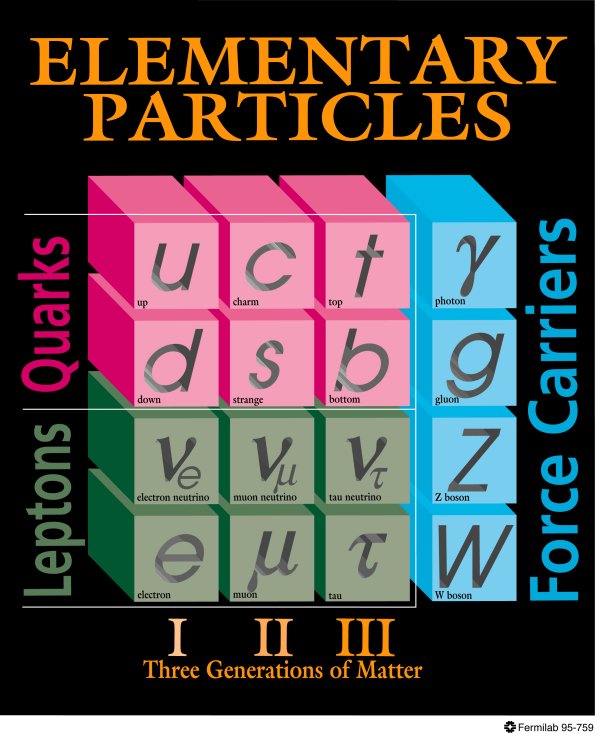
All three are extremely distinguished physicists and their contributions certainly deserve to be rewarded. But, in the case of Kobayashi and Maskawa, the Nobel Foundation has made a startling omission that I really can’t understand at all and which even threatens to undermine the prestige of the prize itself.The work for which these two were given half the Nobel Prize this year relates to the broken symmetry displayed by weak interactions between quarks. We now know that there are three generations of quarks, each containing quarks of two different flavours. The first generation contains the up (u) and the down (d), the second the strange (s) and the charmed (c), and the third has the bottom (b) and the top (t). OK, so the names are daft, but physicists have never been good at names.

The world of quarks is different to penetrate becauses quarks interact via the strong force which binds them close together into hadrons which are either baryons (three quarks) or mesons (a quark and an anti-quark).

But there are other kinds of particles too, the leptons. These are also arranged in three generations but each of these families contains a charged particle and a neutrino. The first generation is an electron and a neutrino, the second a muon and its neutrino, and the third has the tau and another neutrino. One might think that the three quark generations and the three lepton generations might have some deep equivalence between them, but leptons aren’t quarks so can’t interact at all by the strong interaction. Quarks and leptons can both interact via the weak interaction (the force responsible for radioactive beta-decay).

Weak interactions between leptons conserve generation, so the total number of particles of electron type is never changed (ignoring neutrino oscillations, which have only relatively recently been discovered). It seemed natural to assume that weak interactions between quarks should do the same thing, forbidding processes that hop between generations. Unfortunately, however, this is not the case. There are weak interactions that appear to convert u and/or d quarks into c and/or s quarks, but these seem to be relatively feeble compared to interactions within a generation, which seem to happen with about the same strength for quarks as they do for leptons. This all suggests that there is some sort of symmetry lurking somewhere in there, but it’s not quite what one might have anticipated.

The explanation of this was proposed by Nicola Cabibbo who, using a model in which there are only two quark generations, developed the idea that states of pure quark flavour (“u” or “d”, say) are not really what the weak interaction “sees”. In other words, the quark flavour states are not proper eigenstates of the weak interaction. All that is needed is to imagine that the required eigenstates are a linear combination of the flavour states and, Bob’s your uncle, quark generation needn’t be conserved. This phenomenon is called Quark Mixing. What makes it simple for only two generations is that it can be described entirely by one number: the Cabibbo angle, which measures how much the quark flavour basis is misaligned with the weak interaction basis. The angle is small so the symmetry is only slightly broken.

Kobayashi and Maskawa generalized the work of Cabibbo to the case of three quark generations. That’s actually quite a substantial task as the description of mixing in this case requires not just a single number but a 3×3 matrix each of whose entries is complex. This matrix is universally called the Cabibbo-Kobayashi-Maskawa (CKM) matrix and it now crops up all over the standard model of particle physics.

And there’s the rub. Why on Earth was Cabibbo not awarded a share of this year’s prize? I was shocked and saddened to find out that he’d been passed over despite the fact that his work so obviously led the way. I can think of no reason why he was omitted. It’s outrageous. I even feel sorry for Kobayashi and Maskawa, because there is certain to be such an outcry about this gaffe that it may detract from their success.

But really

I hope, however,  that controversy doesn’t intrude too much on what I hope will be the forthcoming celebration of Cabibbo’s immense contributions to particle physics. I’ll leave it to the experts to write more detailed appreciations that do better justice to his achievements. I’ll just say that I only met him once in real life, but found him charmingly modest and altogether quite delightful company. He will be greatly missed.


Share/Bookmark

Lines on the non-Discovery of the Higgs Boson

Posted in Poetry, The Universe and Stuff with tags , , on July 14, 2010 by telescoper

In search of fame I spread around
A
rumour that the Higgs was found;
But now it’s clear
it wasn’t true,
My career has just gone down the loo.


(by Peter Coles, aged 47½)

Science versus Engineering?

Posted in Science Politics with tags , , , , , , on July 13, 2010 by telescoper

I suppose it was inevitable that there would be infighting as academics jostle for an increase intheir share of what is likely to be a diminishing level of research funding to be announced at the end of the ongoing Comprehensive Spending Review.  The first professional society to try to barge its way to the front of the queue appears to be the Royal Academy of Engineering, which has written to the Department of Business, Innovation and Skills (BIS) in terms that make it clear that they think egineering should prosper at the expense of research in fundamental physics.

To quote the RAEng:

we believe that research should be concentrated on activities from which a contribution to the economy, within the short to medium term, is foreseeable. I recognise that this calls for significant changes in practice but I see no alternative in the next decade. This may mean disinvesting in some areas in order properly to invest in others.

And where should the axe fall?

BIS should also consider the productivity of investment by discipline and then sub-discipline. Once the cost of facilities is taken into account it is evident that ‘Physics and Maths’ receive several times more expenditure per research active academic compared to those in ‘Engineering and Technology’. This ratio becomes significantly more extreme if the comparison is made between particle physics researchers and those in engineering and technology. Much of particle physics work is carried out at CERN and other overseas facilities and therefore makes a lower contribution to the intellectual infrastructure of the UK compared to other disciplines. Additionally, although particle physics research is important it makes only a modest contribution to the most important challenges facing society today, as compared with engineering and technology where almost all the research is directly or indirectly relevant to wealth creation.

Obviously whoever wrote this hasn’t heard of the World Wide Web, invented at CERN – precisely the place singled out for vitriol.

I couldn’t agree less with what the RAEng say in their submission to BIS, but instead of going on a rant here I’ll direct you to John Butterworth’s riposte, which says most of what I would want to say, but I would like to add one comment along the lines I’ve blogged about before.

The reason I think that the RAEng is precisely wrong is that I think the Treasury (on behalf of the taxpayer) should only be investing in research that wouldn’t otherwise be carried out. In other words, the state should fund academic esearch precisely because of its “blue sky” nature, not in spite of it.

Conversely, engineering and technology R&D should be funded primarily by the commercial sector precisely because it can yield short-term economic benefits. The decline of the UK’s engineering base has been caused by the failure of British companies to invest sufficiently in research, expecting instead that the Treasury should fund it and all they have to do is cash in later.

I’m not calling for the engineering and technology budgets to be cut – I don’t have such a blinkered view as the RAEng – but I would argue that a much greater share should be funded by private companies. This also goes for energy research. As Martin Rees pointed out in a recent Reith Lecture, the UK’s energy companies spend a pathetically small proportion of their huge profits on R&D. The politicians should be “persuading” industry to get invest more in the future development of their products rather than expecting the taxpayer to fund it. I agree that the UK economy needs “rebalancing” but part of the balance  is private companies need to develop a much stronger sense of the importance of R&D investment.

And, while I’m tut-tutting about the short-sighted self-interest displayed by the RAEng, let me add that, following the logic I’ve stated above,  I see a far stronger case for the state to support research in history and the arts than, e.g. engineering and computer science. I’d even argue that large commercial companies should think about sponsoring pure science in much the same way as they do with the performing art exhibitions and the Opera. We need as a society to learn to celebrate curiosity-driven research not only as a means to economic return (which it emphatically is) but also as something worth doing for its own sake.

Finally, and most depressingly of all, let me point out that the Chief Executive Officer of the Royal Academy of Engineering, Philip Greenish, sits on the Council of the Science and Technology Facilities Council, an organisation whose aims include

To promote and support, by any means, high-quality basic, strategic and applied research and related post-graduate training in astronomy, particle physics, space science and nuclear physics.

Clearly, he should either disown the statements produced by the RAEng or resign from STFC Council. Unless he was put there deliberately as part of the ongoing stitch-up of British physics. If that’s the case we all have the dole queue to look forward to.

The Joy of Natural Units

Posted in The Universe and Stuff with tags , , , on March 5, 2010 by telescoper

I’m glad it’s the end of the week. It’s been ridiculously busy. It didn’t help that I was already exhausted before it started, after a hectic three days in Geneva. Part of the reason for being so heavily occupied is that my teaching duties have just doubled. I teach the second half of a module called Nuclear and Particle Physics, and I’ve just taken over  for the second half of the semester to cover the part about particle physics. I started my set of 11 lectures with one about natural units, which is a lot of fun because it usually divides the class into two opposing camps.

About half the students think natural units are crazy, and the other half think they’re great. I’m in the second camp. The motivation is straightforward: particle physics combines quantum theory, which involves Planck’s constant

\hbar \simeq 1.05 \times 10^{-34}\,\,\,{\rm Js}

with special relativity, which involves the speed of light

c\simeq 3 \times 10^{8}\,\,\,{\rm m s}^{-1} .

Using everyday SI units (metres, seconds and kilograms) to deal with quantities that are either ridiculously small or ridiculously large doesn’t make any sense but, more importantly, the SI units don’t really reflect the physics very clearly.

In natural units we take these two constants to be equal to unity, so they don’t appear in any formulae:

\hbar = c =1

For example, the energy invariant in special relativity is usually written

E^2=p^2c^2 + m^2c^4

This is where the most famous equation in physics

E=mc^2

comes from. However, the equivalence between mass and energy (and also momentum) is much more clearly expressed in the natural units system:

E^2=p^2 + m^2

None of those tiresome factors of c^2 to remember! Mass, energy and momentum are all expressed in terms of the same natural unit of energy (usually, in particle physics, the GeV).  You can keep track of which is which by the simple expedient of using different names.

Velocities are, of course, always expressed as a fraction of c in this system so have no units.

In quantum theory we find energy E=\hbar \omega becomes E=\omega so energy is expressed in the same units as frequency. Energy is thus a measure of inverse time.  Momentum p =\hbar k becomes just p= k so momentum is an inverse length.  This is in accord with the various forms of Heisenberg’s Uncertainty Principle too:  \Delta p \Delta x \sim \hbar is \Delta p \Delta x \sim 1 and \Delta E \Delta t \sim \hbar becomes \Delta E \Delta t \sim 1. A particle with a finite lifetime thus has a finite energy width which is inversely proportional to the lifetime. It makes sense to use energy units for both of these things.

As an extra bonus we can dispense with the clumsy way that electromagnetism is handled in the SI system by noting that

\frac{e^2}{4\pi \epsilon_0 \hbar c} \equiv \alpha\simeq \frac{1}{137}

is dimensionless. In the SI system the coulomb force between two electrons is \frac{e^2}{4\pi \epsilon_0 r^2} whereas in natural units it is just \frac{\alpha}{r^2}, which is much nicer. Incidentally, the strange quantity \epsilon_0 that appears in the SI version is called the permittivity of free space. Nice name, but I wonder what it means?

The dimensionless quantity \alpha on the other hand, has a very clear  physical meaning: it is the fine structure constant,  a coupling constant that measures the strength of the electromagnetic interaction.

Some people – including emeritus professors of observational astronomy – object to natural units because they hide the units that things are expressed in. They don’t actually. What they do is express things in units that are better geared to the physics. In any case, if you want to convert back to SI units you can always do so straightforwardly with a little bit of dimensional analysis. This is necessary if you have to talk to engineers and the like, perhaps so they can build you a particle accelerator, but in the more elevated company of particle physicists you should definitely follow proper etiquette and keep your units natural.

The Management

Posted in Finance, Science Politics with tags , , , , , on January 24, 2010 by telescoper

After my little trip to Denmark last week, it’s now time to settle into the routine of academic life. Teaching starts tomorrow, and I’m actually quite looking forward to it. I find teaching very rewarding, in a way that’s quite different from research, to the extent that I would hate to see further separation between the two in British universities. Call me old-fashioned.

Inevitably, though, it’s been research that’s been occupying my mind for the past few days. I’ve posted a couple of times recently about the ongoing review of the way astronomy and particle physics research are funded here in the United Kingdom (see here and here). The Science Minister, Lord Drayson, seems keen to find a way to stop research grants  being massacred by overruns elsewhere in the Science and Technology Facilities Council (STFC). His aim appears to be come up with a plan before the end of February to find a way of preventing the situation from getting any worse for science. No doubt the idea of a dedicated British Space Agency will also be thrown into pot, so that the bit of STFC’s current portfolio that deals with space things will probably be hived off elsewhere.

The major question that is occupying the minds of scientists – but perhaps not those of the bureaucrats – is whether the research grants currently dispensed by STFC will continue to be held by whatever STFC morphs into or whether they should go elsewhere, probably to EPSRC.  I sense a predisposition towards the former possibility among many of my colleagues. I recognize that the EPSRC route is not without its problems, but I fear that if we remain with STFC then not only is there a very strong probability that recent history will repeat itself but that the damage done by the current STFC structure will be irreparable.

Behind all this is the issue of why STFC is in such a mess in the first place. When it came into being in 2007, it was immediately saddled with an £80 million operating deficit. Why? There are two theories. One is that it was a mistake, resulting from inept STFC management. The other is that the creation of STFC presented various grey eminences that inhabit the superstructure of British science politics represented by RCUK  with an opportunity to slash expenditure on “useless” science (i.e. particle physics and astronomy) without having to go through the tedious rigmarole of public consultation. I don’t know which of these is the truth but, given the choice, I’d put my money on the latter.

Note the behaviour of STFC’s Chief Executive after the yawning gap was discovered in his organization’s finances. If it was a result of management incompetence then he should have been fired. If he was stitched up by RCUK then the only honorable thing to do for someone with the best interests of science at heart was to resign in protest. Neither of these things happened. This leads me to the interpretation that Professor Mason was a willing participant in the game, a  point of view that is supported by his performance at the Town Meeting in December 2007 where the STFC’s delivery plan was presented to an audience of scientists. The document containing the delivery plan is notable for its upbeat and self-congratulatory tone containing no hints of the financial catastrophe engulfing the organization. It was clearly designed to say exactly what the Chief Executive’s political masters wanted it to say. The gross dishonesty of this publication was revealed by Professor Mason’s presentation, wherein he told us scientists something rather closer to the truth, that STFC was facing financial oblivion. It was an appaling performance.

After a botched and panicky initial attempt to cut science projects, and a public dressing down by the House of Commons select committee, it took another two years for its latest Programmatic Review to emerge. Once again, though, the management of STFC put an absurdly glowing light on the wreckage of UK astronomy, nuclear and particle physics; calling it “Investing in the Future” and making light of the devastating cull of research grants and projects that it is proposing. The message that I glean from all this is that STFC’s problems stem from deliberate policy at a high level, probably at the Treasury, and carried out enthusiastically by a hierarchy of yes-men who will do whatever they are told regardless of what it means for science. Some of these creatures may have started out as scientists, but they’ve definitely gone native when lured into the Whitehall jungle.

Of course the public purse is limited. We have to decide how much to spend on different bits of science. Astronomy or particle physics (or any other discipline, for that matter) has to make its case. Somehow a balance must be struck between all the competing demands for cash. Maybe Britain does have too many astronomers. Or too many particle physicists. Who knows?  My point is: who decides? This kind of thing is too important to be settled behind closed doors by  individuals who lap up whatever their masters feed them like mother’s milk.

The STFC debacle  is just one manifestation of the rampant managerialism that is strangling British civil society. Gone are the days when scientists knew best about science, doctors knew best about medicine and teachers knew best about education. Now we’re all subservient to managers who think they know best about everything. Things are no better at EPSRC, an organization notorious  for its top-down structure, mania for meaningless initiatives, and wholehearted endorsement of the ill-considered impact agenda. What I am saying is that the Haldane principle is dead and buried.

While I was in Copenhagen last week attending the inauguration of the Discovery Center I was struck by the differences between how research is funded in Denmark and in the United Kingdom. This new initiative in particle physics and cosmology is funded as a rolling programme by the Danish National Research Foundation (Danmarks Grundforskningsfond). Way back in 1991, Denmark part-privatised its pension system and a large chunk of the resulting cash was invested in scientific research. The organization funds programmes across an entire range of disciplines (including arts and humanities)  for periods of10 years (or, more precisely, 5 years with an extension to 10 after satisfactory performance; most get extended). The primary criterion for funding these programmes is scientific excellence and the vast bulk of the funds goes to funding PhD students and postdoctoral researchers at Danish universities.

A representative of the foundation (whose name I have regrettably forgotten) spoke at the official inauguration of the Discovery Center to describe the parent organization’s philosophy. In a nutshell his message was: “You’re the scientists. You know about science. We don’t. We’re here to help you hire the best people, then get out of your way. Excellence is what we want to fund, wherever it lies. That’s our only agenda.” As it happens, two out of the nine programmes funded in the last round, including the Discovery Center, were in particle physics.

Of course I was jealous. I was also struck by how similar this organization sounds to the suggestion I made in a blog post before christmas. Of course Denmark is a much smaller country than Britain and it has  a very different economic structure. I’m not saying we could simply copy what the Danes have done without any modification. But the  real reason why such an organization could never get set up in Britain, is that The Management would never allow it…

What is to be done?

Posted in Finance, Science Politics with tags , , , , , , , , on January 3, 2010 by telescoper

Just after December’s announcement of huge cuts in spending on science by the Science and Technology Facilities Council (STFC), the minister responsible, Lord Drayson, issued a Press release that included the following

… it has become clear to me that there are real tensions in having international science projects, large scientific facilities and UK grant giving roles within a single Research Council. It leads to grants being squeezed by increases in costs of the large international projects which are not solely within their control. I will work urgently with Professor Sterling, the STFC and the wider research community to find a better solution by the end of February 2010.

I’ve decided to post a few thoughts here under a deliberately bolshie title not because I think I have all the answers, but in the hope that somebody out there will come up with better suggestions.

Superficially the problem dates back to the formation of STFC in 2007 via the merger of the Particle Physics and Astronomy Research Council (PPARC) and the Council for the Central Laboratories of the Research Councils (CCLRC). Previously, PPARC had looked after particle physics and astronomy (including space science) and CCLRC had run large experimental facilities in other branches of science. The idea of merging them wasn’t silly. A large chunk of PPARC’s budget went on managing large facilities, especially ground based astronomical observatories, and it was probably hoped that it would be more efficient to put all these big expensive pieces of kit under the same roof (so to speak).

However, at the time, there was considerable discussion about what should happen with science grants. For example, physicists working in UK universities in areas outside astronomy and particle physics previously obtained research grants from the Engineering and Physical Sciences Research Council (EPSRC), along with chemists, engineers and even mathematicians. Some experimentalists working in these areas used facilities run by the CCLRC to do their work. However, astronomers and particle physicists got their grants from PPARC, the same organisation that ran their facilities and also paid subscriptions to international agencies such as CERN and ESA. These grants were often termed “exploitation”  or “responsive mode” grants; they involved funding for postdoctoral researchers and staff time used in analysing observational or experimental data and comprised relatively little money compared the the cost of the PPARC facilities themselves. PPARC also funded PhD studentships and postdoctoral fellowships under the umbrella of its Education and Training division, although needless to say all the Education and Training involved was done in host universities, not by PPARC itself.

The question was whether the new merged organisation, STFC should continue giving grants to university groups or whether they should be moved elsewhere, perhaps to EPSRC. At the time, most astronomers were keen to have their research grants administered by the same organisation that ran the facilities. I thought it made more sense to have research scientists all on the same footing when it came to funding and in any case thought there were too many absurd divisions between, say, general relativity (EPSRC) and relativistic astrophysics (PPARC), so I was among the (relatively few) dissenting voices at the time.

There were other reasons for my unease. One was that during a previously funding squeeze, PPARC had taken money from the grants line (the pot of money used for funding research groups) in order to balance the books, necessarily reducing the amount of science being done with its facilities. If STFC decided to do this it would probably cause even more pain, because grants would be an even smaller fraction of the budget in STFC than they were in PPARC. Those EPSRC physicists using CCLRC facilities seem to have managed pretty well so I didn’t really see the argument for astronomy and particle physics being inside STFC.  

The other reason for me wanting to keep research grants out of STFC was that the (then) new Chief Executive of PPARC, Keith Mason, had made no secret of the disdain he felt towards university-based astronomy groups and had stated on a number of occasions his opinion that there were too many astronomers in the United Kingdom. There are two flaws with this argument. One is that astronomy is essential to the viability of many physics departments because of its appeal to potential students; without it, many departments will fold. The other problem is that Mason’s claim that the number of astronomers had grown by 40% in a few years was simply bogus.  This attitude convinced me that he in particular would need only the slightest excuse to divert funds away from astronomy into areas such as space exploration.

It all seems a very distant memory now, but three years ago UK physics (including astronomy) was experiencing a time of relative plenty. The government had introduced a system whereby the research councils would fund research groups on the basis of the Full Economic Cost of the research, which meant more money coming into research groups that were successful at winning grants. The government increased funding for the councils to pay for this largesse and probably diminished the fear of another funding pinch. Astronomers and particle physicists also felt they would have more influence over future strategy in facility development by remaining within the same organisation. In the end what happened was that STFC not only kept the portfolio of astronomy and particle physics grants, but also acquired responsibility for nuclear physics from EPSRC.

But then, in 2007, just after STFC came into existence,  a major financial disaster broke: that year’s comprehensive spending review left the newly formed STFC with a huge gap in its finances. I don’t know why this happened but it was probably a combination of gross incompetence on behalf of the STFC Executive and deliberate action by persons higher up in the Civil Service. The subsequent behaviour of the Chief Executive of STFC led to a public dressing down by the House of Commons Select Committee and a complete loss of confidence in him by the scientific community. Miraculously, he survived. Unfortunately, so did the financial problems that are his responsibility. After two years of head-scratching, STFC has finally grasped the nettle and slashed its spending, including research grants,  in an attempt to balance the books.

I don’t like to say I told you so, but that’s exactly what I am doing. Everything that has happened was predictable given the initial conditions. You might argue that STFC wasn’t to know about the global economic downturn. In fact, I’d agree. However, the terrible cuts in the science budget we have seen have very little to do with that. They all stem from the period before the Credit Crunch even started. We still have the aftermath of that to look forward to. Unless something is done, grants will be hit again. Things are bad now, but will only get worse as long as the current arrangements persist.

Now, back to Lord Drayson’s press statement. He is of course right to say that there are tensions in putting large facilities and grant giving roles in the same organisation. That’s particularly true when it’s an organisation run by a one-man disaster area, but the main problem seems to me that actually doing science is very far down the list of priorities for STFC. The point I want to make is that by far the most of the very best science in the United Kingdom is actually done in university groups. Some of these groups use shiny new facilities but some continue to do first-rate research with older gear, not to mention us theorists who need very little in the way of facilities at all. What has happened is that the axe has fallen across the programme, apparently without regard for scientific value for money so that highly rated theory grants are being slashed along with those related to lower priority facilities.

Here it seems appropiate to make an aside to the effect that,  in my opinion, even taking into account the difficult financial circumstances in which it was done, the recent prioritisation review was completely botched. All the STFC advisory panels placed university research grants at the highest priority but the management has slashed them anyway. Moreover, instead of really biting the bullet and making tough decisions to shut down more facilities projects, they have kept as many of them going as possible (although with reduced budgets).  Cutting exploitation grants for the highest priority experiments was a particularly stupid decision. If STFC wanted to put science first, what they should have done is baled out of more facilities but preserved exploitation grants.  If that means abandoning whole areas of astronomy then that’s very sad, but surely it is better to do a smaller number of things well than a larger number of things poorly? Isn’t management meant to be about making difficult decisions?

I know this preamble has been a bit long-winded, but I think it’s necessary to see the background to what I’m going to propose. These are the steps I think need to be taken to put UK physics back on track.

First, the powers that be have to realise that university researchers are not just the icing on the cake when it comes to science. They actually do most of the science. The problem is that the way they are supported is a total mess. It’s called the dual support system, because the research councils pay 80% of the cost of research grants and Higher Education Funding Councils (i.e. HEFCE in England) are meant to provide the other 20%, but in reality it is a bureaucratic nightmare that subjects researchers to endless form-filling and costs hundreds of millions in wasteful duplication. The Research Councils already have well-managed systems to judge the quality of research grant applications, so why do we have to have the additional burden of a Research Assessment Exercise every few years on top of that? Just a few millions saved by slashing red tape could restore a large proportion of the physics grant budget.

What we need is a system that recognises the central importance of universities in science research. In order to safeguard this, research grants for all disciplines need to be adminstered organisations that cannot raid the funds allocated for this purpose to offset management failures elsewhere. The funds allocated to STFC under the Full Economic Cost system have already been systematically misappropriated in this way, and things will get worse unless something is done to protect them.

Moving grants from STFC to EPSRC would go part of the way, but I’m not a particular fan of the latter organisation’s heavy-handed top-down management style and gung ho enthusiasm for the  impact agenda which may be appropriate for applied sciences and engineering but surely doesn’t make any sense for, say, pure mathematics. I would prefer instead to see a new organisation, specifically intended to fund blue-skies scientific research in universities. This organisation would have a mission statement that  makes its remit clear, and it would take over grants, studentships and fellowships from STFC, EPSRC and possibly some of the other research councils, such as NERC.  The new outfit would need a suitable acronym, but I can’t think of a good one at the moment. Answers on a postcard.

As a further suggestion,  I think there’s a strong case to be made that HEFCE should be deprived of its responsibility for research funding. The apparatus of research assessment it uses is obviously  flawed, but why is it needed anyway? If the government believes that research is essential to universities, its policy on selectivity doesn’t make any sense. On the other hand, if it believes that university departments don’t need to be research groups then why shouldn’t the research funding element be administered by a reserch organisation? Even better, a new University Research Council along the lines I have suggested  could fund research at 100% of the Full Economic Cost instead of only 80%. The substantial cash saved by scrapping the RAE should be pumped into grants to be administered by the new organisation, reversing the recent savage cuts imposed by STFC.

And what should happen to STFC? Clearly there is still a role for an organisation to manage large experimental facilities. However, the fact that the UK is now going to have its own Space Agency should mean space science is taken out of the STFC remit.  The CERN and ESO subscriptions could continue to be managed by STFC along with other facilities, and it would in some cases commission projects in university research groups or industrial labs as it does now. Astronomers and particle physicists would continue to sit on its Board.  However, its status would change radically, in that it would become an organisation whose job is to manage facilities, not research. The tail will no longer be wagging the dog.

I very much doubt if these suggestions are at all in line with current political “thinking”. I don’t think politicians really appreciate the importance of research in universities, especially if its of the open-ended, blue-sky variety. The self-serving bureaucrats in RCUK and HEFCE won’t like it either, because the’ll all have to go and do something more useful.  But unless someone stands up for the university sector and does something to safeguard future funding then things are just going to go from bad to worse. This may be the last chance we have to avert a catastrophe.

I very much doubt if many of my fellow physicists or astronomers agree with my suggestion either. Not to worry. I’m used to being in a minority of one. However, even if this is the case I hope this somewhat lengthy post will at least get you thinking. I’d be interested in comments.

(Physics and) Astronomy Look-alikes, No. 4

Posted in Astronomy Lookalikes with tags , , on December 31, 2009 by telescoper

Oh go on then, it’s raining outside so here’s one more.

Has anyone ever noticed the resemblance between former musician, now particle physicist and media star Professor Brian Cox , and the Cat in the Hat from the Dr Seuss Books? Apart from the hat, that is…

Day of Reckoning

Posted in Science Politics, The Universe and Stuff with tags , , , , , on December 16, 2009 by telescoper

10.45am. I came in this morning determined to get on with some work to distract my attention from the looming announcement of budget cuts from the Science & Technology Facilities Council (STFC). I was up nearly all night worrying about the future, especially for the current generation of postdocs whose careers I’m pretty sure are going to sacrificed in large numbers to balance the books. It reminded me a bit about a poem I posted a while ago: I could not sleep for thinking of the Sky STFC.

Anyway, I’ve spent over an hour trying to write one paragraph of the paper I’m trying to finish and I can’t settle so I thought I’d start a post, with the intention of updating it as the day goes on, the picture gets a bit clearer, and I become increasingly suicidal.

The actual announcement of the result of the prioritisation exercise will appear this afternoon on the STFC website here under the heading

STFC: Investing in the Future

Who said these guys don’t have a sense of humour? What’s underneath is currently completely blank. Hang on, they might have put the result up early in that case…

Most of the blogs and tweets I follow – at least those emanating from this side of the Atlantic – are about this today, so if you’d like to keep up here are some useful links:

Paul Crowther at Sheffield has kept up with all the ongoings and downturnings at STFC and you can expect him to understand it better and quicker than the rest of us  here.

There’s a very good (and nearly anonymous) post about all this on the blog To Left of Centre.

The e-astronomer (Andy Lawrence at the ROE)  has written about this and a lot of important people have commented on it.

Rob Simpson, a PhD student here in Cardiff,  is probably expressing the fears of many younger researchers as is Sarah Kendrew who gives a postdoc perspective.

There’s a list of things astronomical that are probably about to eat the dirt at this website. My bet is that everything on their list will go, plus more. The reason is that most of the things at the bottom of the prioritisation exercise are actually fairly cheap, so just closing a few won’t plug the gap. As a colleague of mine said the other day, “It’s a big shit sandwich, and we all have to take a bite.”

11.15am. If the phrase “going forward” appears anywhere on the STFC announcement page, then I won’t be responsible for my actions…

11.50am. WICKET! Prince c Collingwood b Swann 45. Oh sorry. Wrong blog.

12.08pm. Incoming transatlantic link from the Starving Economist, from whose page I’ve pulled the following comment:

So I’d almost forgotten that other countries are out there, facing the Great Recession as well, and making really stupid decisions in the face of it. IMHO one example of blatant incompetence in an economic sense is being perpetrated by none other than the UK. We kind of look up to them, don’t we? It’s the accent or something. But they are busy tossing some of their world-renowned science, and much of their past investment in such, out the door rather than restructure some of their government funding. Talk about inertia. Their astronomy program appears to be particularly hard-hit. Interesting way to close 2009, the International Year of Astronomy.

I couldn’t agree more. It also reminded that I haven’t made enough of the irony that this is indeed the International Year of Astronomy. For a lot of people it will be the last year they’ll be doing astronomy.

12.25pm. Meanwhile, our man in Madrid, Matt Griffin has been wowing the audience with some of the new results from Herschel. I hope to be able to post a few of them later when the official workshop results go live.

12.45pm. STFC operatives have been phoning project leaders this morning to tell them the bad news. Our head of school, Walter Gear, has got his phone call telling him that our attempt to resurrect Clover will not be funded. Disappointing, but not entirely unexpected…

13.15pm. It’s tea-time in sunny  South Africa (with the home side at 159-4) but here in Blighty it’s the long dark lunch break of the soul, waiting for news of the inevitable.

13.30pm. Half an hour to go. Most of the astronomers in the department have now left to travel to Madrid for the big workshop starting tomorrow. They tell me the new results probably won’t be available for public consumption until Friday (18th December). Nothing to sugar the pill, then.

13.55pm. I’m not often right, but I was wrong again. I’ve just noticed that there is already an ESA press release that includes this stunning image of a star-forming region in the constellation of Aquila made using both PACS and SPIRE observations. This is just a first look at part of an extended survey of stellar nurseries that Herschel will be undertaking over the forthcoming months.

14.00pm. And there were are, right on cue. Here is the announcement. As expected, there is a ridiculous attempt to put a positive spin on it all, but you will find immediately, sigh, another 10% cut in research grants to universities (on top of the 25% we already had) to reduce the amount of “exploitation”, plus 25% cuts in the number of PhD students and fellowships “mirroring the overall reduction in the programme”. I read that as meaning that STFC wants, in the long term, about 25% of the astronomers in the UK to go somewhere else and, preferably,  never come back.

I’ll post more when I’ve read the details.

14.10pm. So here’s a quick summary of what projects will be funded in (ground-based) astronomy:

Advanced LIGO, JCMT (to 2012), Gemini (until end 2012), ING (to 2012), KMOS, VISTA, Dark Energy Survey, E-ELT R&D, SKA R&D, SuperWASP, e-Merlin, Zeplin III; Total cost of £87m over 5 years

(the big surprise to me in there is  e-Merlin, which I thought would get the chop) and what won’t

Auger, Inverse Square Law, ROSA, ALMA regional centre, JIVE, Liverpool Telescope, UKIRT. Additional reduction imposed on ongoing projects of £16m. Total savings of £29m over 5 years

And on the space side we have the lucky ones:

Aurora, GAIA, Herschel, JWST-MIRI, LISA Pathfinder, Rosetta, Planck, ExoMars, Hinode, Cosmic Vision, Solar Orbiter, Stereo, Swift, Bepi-Colombo; Total cost of £114m over 5 years

and the losers

Cassini, Cluster, SOHO, Venus Express, XMM. Additional reduction imposed on ongoing projects of £28m. Total Savings of £42m over 5 years

Note that both Aurora and Bepi-Colombo were both rated very low on scientific grounds but have been retained in the programme, presumably for political reasons.

However, the big downside for everyone is the cut in university grants for “exploitation” that I mentioned above. STFC wants to have lots of expensive facilities, but doesn’t want to fund the modest among of staff needed to actually get science out of them. The stupidity of this decision is made even more depressing by its inevitability.

Even the top-rated projects are getting cuts to their funding. It just shows how little thinking is going on about the actual science that STCF is supposed to be supporting. Isn’t it a more sensible strategy to do a few things well, rather than a lot of things poorly? It’s a mess.

14.38pm. From a Cardiff perspective this is nowhere near as bad as it could have been, but is still pretty dire. The primary activities for our current astronomy programme, Herschel and Planck, are both very high in the priority list and the relativity group is relieved to see ground-based gravitational wave research, including Advanced LIGO, at the highest priority. Moreover, it looks like what I feared most of all – an immediate clawback of existing grants with consequent immediate redundancies – is not going to happen, owing to what appears to be a last-minute injection of funds from RCUK. We’re still looking at cash cuts though, and we’re vulnerable because so much of our research income comes from STFC.

14.43pm. Not on the STFC webpage, but it appears that they are not going to support LOFAR-UK either.

15.05pm. If you want to read the full outcome of the prioritisation exercise, in terms of a batting order of projects, you can download it here. It includes a recommendation that the top funded (alpha-5) projects should get a 15% cut and those at the next leveldown (alpha-4) should get a 20% cut. However, things will probably turn out worse than that because those cuts were suggested on the basis that only those projects would be funded at all. As it turns out, some alpha-3 projects have made it through also, so the cuts to the higher-rated projects must be larger to compensate. Mustn’t they?

15.24pm. I note that STFC have decided to carry on their programme of outreach activities:

Ongoing support for public outreach and science communication, through continuance of our award schemes and Fellowships, and public engagement and communications, helping to ensure new generations of children are enthused and inspired by science, and encouraged to continue study in science, technology, engineering and mathematics (STEM) subjects.

..so we can kick them in the teeth when they’ve just started a scientific career.

15.30pm. Press release, from Unelected Minister for Science and Innovation, Strategic Defence Acquisition Reform, and Formula 1 Car Racing,  Lord  Drayson of Twitter.  I quote:

… it has become clear to me that there are real tensions in having international science projects, large scientific facilities and UK grant giving roles within a single Research Council. It leads to grants being squeezed by increases in costs of the large international projects which are not solely within their control.   I will work urgently with Professor Sterling, the STFC and the wider research community to find a better solution by the end of February 2010.

Is there a possibility that a light has gone on somewhere to the effect that something must be done to stop STFC killing University research? I hope so. If he can pull something out of the fire before March 2010, though, I’d be very impressed.

16.07pm. I may be clutching at straws here, but it is interesting to join the dots between Lord Drayon’s comment above and the following excerpt from the STFC announcement

discussions would be held in coming months with national and international partners, including universities, departments and project teams, on implementation of the investment strategy. This will include discussions with EPSRC and the University funding councils on the impact of these measures on physics departments in universities.

I doubt if EPSRC is going to come running to the rescue without a great deal of encouragement. However, taken together with the comment above by Lord Drayson, there’s at least a hint of a possibility that a way to protect grants might be found. Calling them “research” rather than “exploitation” grants would be a start…

16.18pm. Press statements from Jocelyn Bell-Burnell, President of the Institute of Physics here and Andy Fabian, President of the Royal Astronomical Society here.

17.08pm. I think that’s enough for the day. It hasn’t been good, but the nightmare scenario was that my own research grant would be terminated immediately and I’d have to break the news to my PDRA. At least that didn’t happen, not yet anyway. I suppose we should be thankful for small mercies. But I’m exhausted after sleeping so badly last night, so I think I’ll close this for now. Keep your comments coming if there’s anything significant I missed…

19.45pm Before I settle down with my gramophone records for the evening, I just thought I’d remind anyone not sufficiently depressed at the state of STFC that the drastic cuts announced today do not take account of whatever share of the £600 million “efficiency savings” announced in the budget has been allocated to them. It may look bad now, but it’s probably going to get worse. On that cheery note, I’m going to have a drink and listen to Mahler.

Advanced Fellowships

Posted in Science Politics with tags , , , on July 11, 2009 by telescoper

This is just a quick Newsflash that UK Astronomers will be  interested in (and depressed by). My attention was drawn to it yesterday by Frazer Pearce of Nottingham.

The Science and Technology Facilities Council (STFC) has decided in its finite wisdom to cut in half the number of Advanced Fellowships (AFs) it awards each year, that is from 12 to 6, that number to cover all of Astronomy and Particle Physics.

These fellowships are awarded to researchers who do not have a permanent position but wish to pursue research, and are designed to further the careers of individuals with outstanding potential. They last 5 years – longer than the usual 2-3 year postdoctoral positions and have been for many a scientist an important stepping-stone to an academic career. A very large fraction of my colleagues who have permanent positions were awarded one of these fellowships when they were run by PPARC (including Frazer), as was I myself but, being an Oldie, mine was even pre-PPARC so was in fact given by SERC. Of course the fact that they gave me one doesn’t itself serve as much of a recommendation for continuing them, but it is worth drawing attention to the huge amount of  high quality research done in the UK by holders of these Fellowships.

A number of people have expressed to me their shock at this decision but it doesn’t surprise me at all. For one thing, it’s an open secret that STFC considers the academic community in these areas to be too large so the last thing it wants is more people getting permanent jobs through the AF route.  In any case, STFC’s prime concern is with facilities, not with scientific research.

Who needs half a dozen top class scientists when you can have Moonlite instead?