Archive for Philip Nolan

The Nolan Case

Posted in Maynooth, Science Politics with tags , , , on June 13, 2024 by telescoper

A couple of weeks ago I posted an item about the sudden departure of Prof. Philip Nolan from his post as Director General of Science Foundation Ireland (SFI) after allegations of misconduct (including bullying). That post included these words:

As an outsider I have no idea what has been going on at SFI, so have no dirt to dish, but it must have been rather serious for Prof. Nolan to have been forced out so quickly.

Despite that clear statement I have received a number of emails from “journalists” asking for gossip. Obviously I didn’t reply to them.

Anyway, it’s not only the sudden decision that led to Prof. Nolan’s dismissal that is striking; there’s also the fact that no formal disciplinary process took place and it was accompanied by immediate termination of his access to emails, etc. Actions so extreme are usually reserved for situations in which a staff member has committed gross misconduct, but that is not the accusation here.

Anyway, just a few days after his apparent departure from SFI, Prof. Nolan went to court and obtained a temporary injunction restraining his dismissal ahead of a further hearing about the case which began on 11th June and has not yet completed. Although no longer fired, Prof. Nolan has not been allowed physically to return to work.

I have no idea how this mess will end. It does seem that there must have been a complete meltdown in SFI that will be very difficult to reverse. Perhaps the best way forward is to hasten the end of SFI and the beginning up of the new entity (Taighde Éireann– Research Ireland) supposed to be formed by the merger of SFI with the Irish Research Council.

I have no idea who is in the wrong at SFI. Perhaps both sides are. However, for the record, I will state that when my Mam died in 2019 Prof. Nolan (who was President of Maynooth University at the time) sought me out and offered his condolences in person. That was a kind gesture that I greatly appreciated at the time, and one which few University managers I have known would have made in the circumstances. Certainly not the current President of Maynooth University.

P.S. I discovered from reading this article about the Nolan Case that the Chairman of the Board of Science Foundation Ireland, Professor Peter Clinch, an economist; presumably no actual scientists were available.

Exit Nolan

Posted in Covid-19, Harassment Bullying etc, Maynooth, Politics, Science Politics with tags , , , , on May 28, 2024 by telescoper
Simon Harris and Philip Nolan at the launch of Research Ireland

I just saw the news that Prof. Philip Nolan has left his post as Director General of Science Foundation Ireland (SFI) after allegations of misconduct (including bullying). Prof. Nolan was the previous President of Maynooth University, a post he left at the end of September 2021; for 18 months while still President he was also chair of the the Epidemiological Modelling as part of National Public Health Emergency Team dealing with the Covid-19 pandemic. He moved to SFI in January 2022 when Simon Harris, who is now Taoiseach, was Minister for Further and Higher Education, Research, Innovation and Science. Prof. Nolan was due to take charge of a new entity (Taighde Éireann– Research Ireland) formed by the merger of SFI with the Irish Research Council when the legislation required to create it it passes through the Oireachtas.

It seems there were no fewer than five serious complaints about Prof. Nolan’s conduct made under protected disclosure legislation, and an investigation found that he had displayed “inappropriate behaviour” towards the staff concerned, which was at the “upper level” in respect of two senior staff.

As an outsider I have no idea what has been going on at SFI, so have no dirt to dish, but it must have been rather serious for Prof. Nolan to have been forced out so quickly. I suppose it is reassuring in a way that SFI – unlike many organizations – takes bullying allegations seriously, but it is not at all good for the science ecosystem in Ireland for its main funding agency to be rocked by a scandal of these dimensions. I hope whoever takes over can steady the ship. It’s not an auspicious situation for the embryonic Research Ireland either. The first question that needs to be answered is whether Prof. Nolan will lead it despite being removed from SFI and, if not, who will?

From Maynooth to SFI

Posted in Maynooth, Science Politics with tags , , , on October 20, 2021 by telescoper

Last month I mentioned that I attended an event to mark the departure of Professor Philip Nolan at the end of his term as President of Maynooth University. Over drinks afterwards he wasn’t very forthcoming about what he was planning to do next, but yesterday news broke that he is to become the Director General of Science Foundation Ireland.

Amusingly, I see the slogan for SFI is ‘For What’s Next…’

Congratulations to Professor Nolan on this appointment! For the last 18 months, as well as being President of Maynooth University, he has been chairing the Epidemiological Modelling effort as part of National Public Health Emergency Team dealing with Covid-19. He won’t be starting his new job until January, so is now probably taking a bit of a rest.

The job at SFI will be a big challenge. Science in Ireland is in a dire state of under-investment, especially in basic (i.e. fundamental) research. Until recently SFI really only funded applied science, but recently seemed to have shifted its emphasis a little bit in its latest strategic plan.

Currently Ireland spends just 1.1% of its GDP on scientific research and development and SFI currently has a heavy focus on applied research (i.e. research aligned with industry that can be exploited for short-term commercial gain). This has made life difficult for basic or fundamental science and has driven many researchers in such areas abroad, to the detriment of Ireland’s standing in the international scientific community.

The new strategy, which covers the period from now to 2025, plans for 15% annual rises that will boost the agency’s grant spending — the greater part of the SFI budget — from €200 million in 2020 to €376 million by 2025. Much of this is focused in top-down manner on specific programmes and research centres but there is at least an acknowledgement of the need to support basic research, including an allocation of €11 million in 2021 for early career researchers. The overall aim is to increase the overall R&D spend from 1.1% of gross domestic product, well below the European average of 2.2%, to 2.5% by 2025.

Obviously this increase in funding is welcome and that is a big positive for the incoming Director General, but important strategic decisions will need to be taken about the overall balance of the programme. I wish Professor Nolan well as he takes over the helm.

The End of an Era

Posted in Covid-19, Education, Maynooth with tags , on September 29, 2021 by telescoper

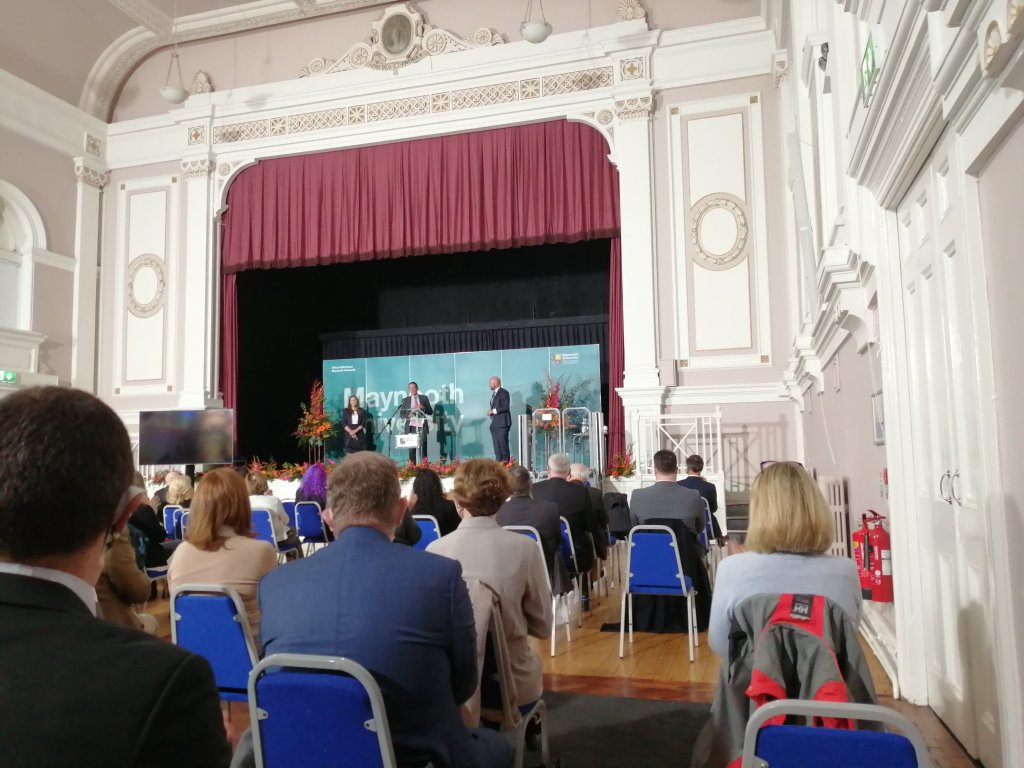
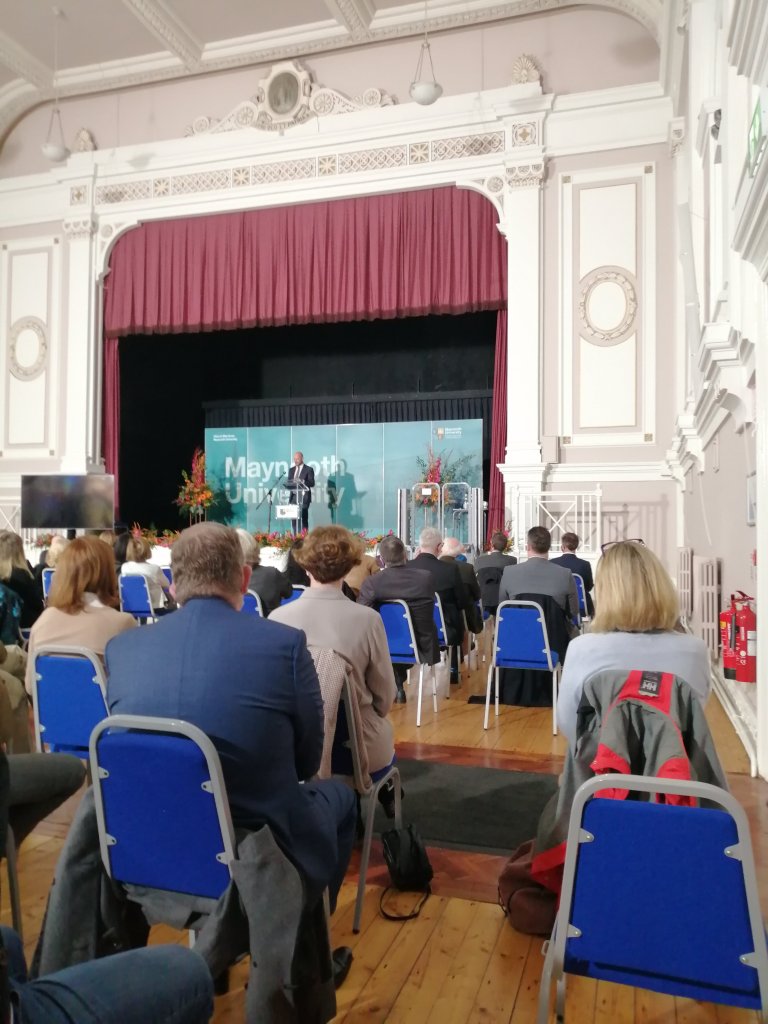
This afternoon I attended an event in the Aula Maxima on Maynooth University Campus to bid farewell to the President of Maynooth University, Professor Philip Nolan who has been in that position for 10 years and who steps down at the end of September (i.e tomorrow). For the last 18 months he has been chairing the Epidemiological Modelling effort as part of National Public Health Emergency Team dealing with Covid-19.

Here are two views of the ceremony taken from my position next to a radiator (it was quite cold today) :

Presentation of Gifts
Farewell Speech

After the formal indoor bit of the event in which the number in the audience was strictly limited and masks were worn, we adjourned outside for a reception which was especially nice because it’s the first social event I’ve attended in person for a very long time. In fact I haven’t been in the Aula Maxima for a couple of years either!

It was a pleasant occasion with many warm and well-delivered contributions, and I think was a fitting tribute to a President who has held his office with great distinction. I had the opportunity to wish Professor Nolan all the best in person over a glass of wine at the reception but I’d like to repeat it publicly here. After all, it was on his watch that I got my position here. Farewell, Prof. Nolan, and please accept my very best wishes for the future.

The only disappointment for me is that among the speeches by academics and other staff there was no time for personal appearance by Maynooth University Library Cat…

Ireland’s Covid-19 Models

Posted in Covid-19, mathematics, Maynooth with tags , , , , , on July 1, 2021 by telescoper

Yesterday the Chair of the National Public Health Emergency Team (NPHET), who also happens to be the President of Maynooth University, Professor Philip Nolan published a lengthy but interesting Twitter thread (which you can find unrolled here). In these tweets he explained the reason behind NPHET’s recommendation to pause the process of relaxing Covid-19 restrictions, postponing the next phase which was due to begin on 5th July with indoor dining.

The basic reason for this is obvious. When restrictions were lifted last summer the reproduction number increased to a value in the range 1.4 to 1.6 but the infection rate was then just a handful per day (on July 1st 2020 the number of new cases reported was 6). Now the figures are orders of magnitude higher (yesterday saw 452 new cases). A period of exponential growth starting from such a high base would be catastrophic. It was bad enough last year starting from much lower levels and the Delta variant currently in circulation is more transmissable. Vaccination obviously helps, but only about 40% of the Irish population is fully immunized.

Incidentally the target earlier this year was that 82% of the adult population should have received one jab. We are missing detailed numbers because of the recent ransomware attack on the HSE system, but it is clear that number has been missed by a considerable margin. The correct figure is more like 67%. Moreover, one dose does not provide adequate protection against the Delta variant so we’re really not in a good position this summer. In fact I think there’s a strong possibility that we’ll be starting the 2021/22 academic year in worse shape than we did last year.

In general think the Government’s decision was entirely reasonable, though it obviously didn’t go down well with the hospitality sector and others. What does not seem reasonable to me is the suggestion that restaurants should be open for indoor dining only for people who are fully vaccinated. This would not only be very difficult to police, but also ignores the fact that the vast majority of people serving food in such environments would not be vaccinated and are therefore at high risk.

As things stand, I think it highly unlikely that campuses will be open in September. Rapidly growing pockets of Delta variant have already been seeded in Ireland (and elsewhere in Europe). It seems much more likely to me that September will see us yet again in a hard lockdown with all teaching online.

But the main reason for writing this post is that the thread I mentioned above includes a link to a paper on the arXiv (by Gleeson et al.) that describes the model used to describe the pandemic here in Ireland. Here is the abstract:

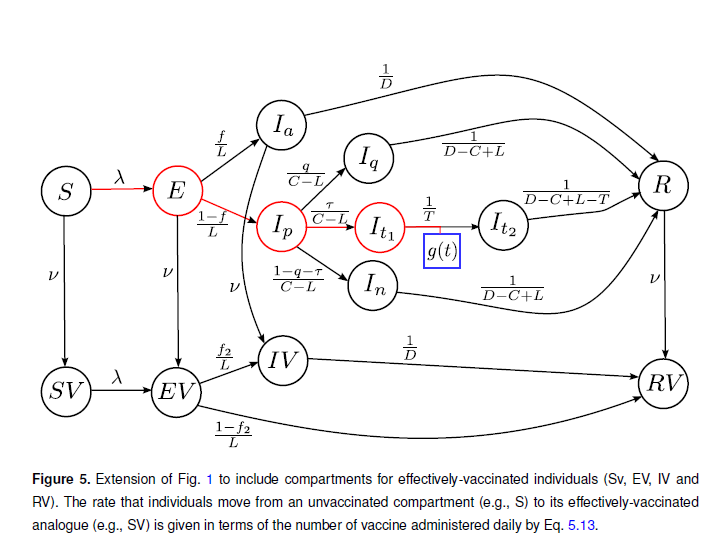
We describe the population-based SEIR (susceptible, exposed, infected, removed) model developed by the Irish Epidemiological Modelling Advisory Group (IEMAG), which advises the Irish government on COVID-19 responses. The model assumes a time-varying effective contact rate (equivalently, a time-varying reproduction number) to model the effect of non-pharmaceutical interventions. A crucial technical challenge in applying such models is their accurate calibration to observed data, e.g., to the daily number of confirmed new cases, as the past history of the disease strongly affects predictions of future scenarios. We demonstrate an approach based on inversion of the SEIR equations in conjunction with statistical modelling and spline-fitting of the data, to produce a robust methodology for calibration of a wide class of models of this type.

You can download a PDF of the paper here.

This model is a more complicated variation of the standard compartment-based models described here. Here’s a schematic of the structure:

This model that makes a number of simplifying assumptions but it does capture the main features of the growth of the pandemic reasonably well.

Coincidentally I set a Computational Physics project this year that involved developing a Python code that does numerical solutions of this model. It’s not physics of course, but the network of equations is similar to what you mind find in physical systems – it’s basically just a set of coupled ODEs- and I thought it would be interesting because it was topical. The main point is that if you study Theoretical Physics you can apply the knowledge and skills you obtain in a huge range of fields and disciplines. Developing the model does of course require domain-specific epidemiological knowledge but the general task of modelling complex time-evolving systems is definitely something physicists should be adept at doing. Transferable skills is the name of the game!

P.S. It came as no surprise to learn that the first author of the modelling paper, Prof. James Gleeson of the University of Limerick, has an MSc in Mathematical Physics.