Archive for Physics

Sussex and the World Premier League of Physics

Posted in Education, The Universe and Stuff with tags , , , , , on August 16, 2014 by telescoper

In the office again busy finishing off a few things before flying off for another conference (of which more anon).

Anyway, I thought I’d take a short break for a cup of tea and a go on the blog.

Today is the first day of the new Premiership season and , coincidentally, last week saw some good news about the Department of Physics and Astronomy at the University of Sussex in a different kind of league table.

The latest (2014) Academic Rankings of World Universities (often called the “Shanghai Rankings”) are out so, as I suspect many of my colleagues also did, I drilled down to look at the rankings of Physics departments.

Not surprisingly the top six (Berkeley, Princeton, MIT, Harvard, Caltech, & Stanford) are all based in the USA. The top British university is, also not surprisingly, Cambridge in 9th place. That’s the only UK university in the top ten for Physics. The other leading UK physics departments are: Manchester (13th), Imperial (15th), Edinburgh (20th), Durham (28th), Oxford (39th) and UCL (47th). I don’t think there will be any surprise that these all made it into the top 50 departments worldwide.

Just outside the top 50 in joint 51st place in the world is the Department of Physics & Astronomy at the University of Sussex. For a relatively small department in a relatively small university this is a truly outstanding result. It puts the Department  clear in 8th place in the UK, ahead of Birmingham, Bristol, Leicester, Queen Mary, Nottingham, Southampton,  St Andrews, Lancaster, Glasgow, Sheffield and Warwick, all of whom made the top 200 in the world.

Incidentally, two of the other departments tied in 51st place are at Nagoya University in Japan (where I visited in January) and Copenhagen University in Denmark (where I’m going next week).

Although I have deep reservations about the usefulness of league tables, I’m not at all averse to using them as an excuse for a celebration and to help raise the profile of Physics and Astronomy at Sussex generally.  I’d therefore like to take the opportunity to offer hearty congratulations to the wonderful staff of the Department of Physics & Astronomy on their achievement. 

With the recent investments we’ve had and further plans for growth I hope over the next few years we can move even further up the rankings. Unless of course the methodology changes or we’re subect to a “random” (ie downward) fluctuation…


Combining Research and Teaching in Physics & Astronomy

Posted in Education, The Universe and Stuff with tags , , , , , on August 7, 2014 by telescoper

Among the distinctive things we do here in the School of Mathematical and Physical Sciences at the University of Sussex are our degree programmes that involve a Research Placement (RP). Students on these courses take the normal lectures, laboratory classes and workshops during the academic year, but they spend the summer vacation doing (paid) work with research groups in the School to get an experience of what the world of research is really like. Various combinations of Physics and Astronomy with a Research Placement have been around for some time. These courses have been so popular and successful that we’ve extended the idea to Mathematics for 2015 entry. We have also started extending the RP scheme to include placements in laboratories elsewhere, either in industry or in a university abroad; we even have two students currently doing their placements in China.

Here are a couple of videos we’ve made featuring two RP students who have been working in the Department of Physics & Astronomy this summer.

This is Ross Callaghan:

And this is Nathaniel Wiesendanger Shaw:

Both these students are in between their 2nd and 3rd years of a 4-year MPhys programme. As it happens, both survived the experience of being in my Theoretical Physics class last term too!

It’s an ongoing frustration of mine that so many influential people think that teaching and research are separate functions of a university and should not be mixed. I believe that the two go hand-in-hand and that you can’t really claim to be getting a real university education if it’s not informed by the latest developments in research. Moreover, some also imply that research-led teaching only happens in the Russell Group, which is not the case at all. In fact, I think we provide a much better environment for this in Sussex than either of the Russell Group universities in which I’ve previously worked.

Many Departments talk about how important it is that their teaching is based on state-of-the-art research, but here at Sussex we don’t just talk about research to undergraduates – we let them do it!

Talking About Undergraduate Physics Research…

Posted in Education, The Universe and Stuff with tags , , , , , , , on July 2, 2014 by telescoper

One of the courses we offer in the School of Physics & Astronomy here at the University of Sussex is the integrated Masters in Physics with a Research Placement. Aimed at high-flying students with ambitions to become research physicists, this programme includes a paid research placement as a Junior Research Associate each summer vacation for the duration of the course; that means between Years 1 & 2, Years 2 & 3 and Years 3 & 4 . This course has proved extremely attractive to a large number of very talented students and it exemplifies the way the Department of Physics & Astronomy integrates world-class research with its teaching in a uniquely successful and imaginative way.

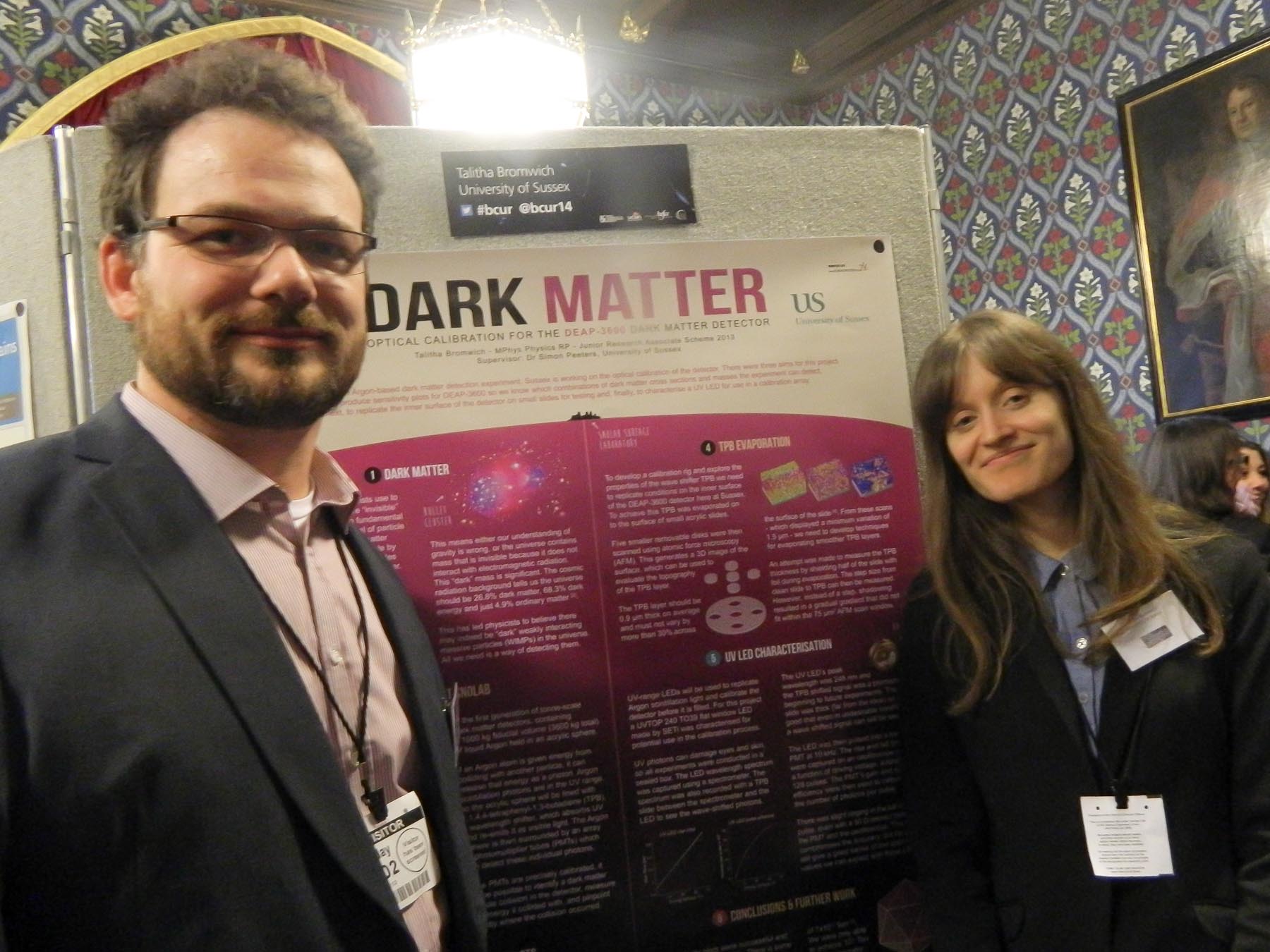
Some time ago I blogged about  some very good news about one of our undergraduate researchers, Talitha Bromwich, who is about to graduate from her MPhys degree, after which she will be heading to Oxford to start her PhD DPhil; she is pictured below with her supervisor Dr Simon Peeters:

Talitha Bromwich with her JRA supervisor Dr Simon Peeters at 'Posters in Parliament' event 25 Feb 14

Talitha spent last summer working on the DEAP3600 dark-matter detector after being selected for the University’s Junior Research Associate scheme. Her project won first prize at the University’s JRA poster exhibition last October, and she was then chosen to present her findings – alongside undergraduate researchers from 22 other universities – in Westminster yesterday as part of the annual Posters in Parliament exhibition, organized under the auspices of the British Conference of Undergraduate Research (BCUR).

A judging panel – consisting of Ben Wallace MP, Conservative MP for Wyre and Preston North; Sean Coughlan, Education Correspondent for the BBC; and Professor Julio Rivera, President of the US Council of Undergraduate Research; and Katherine Harrington of the Higher Education Academy – decided to award Talitha’s project First Prize in this extremely prestigious competition.

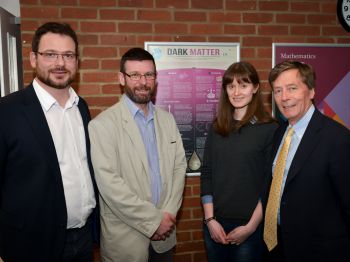
We held a small drinks party in the School of Mathematical and Physical Sciences to congratulate Talitha on her success. Here are a couple of pictures of that occasion:

3479.item

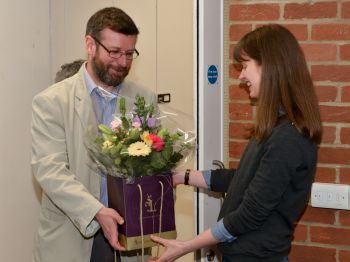
From left to right you see Simon Peeters, myself, Talitha and Prof. Michael Farthing (the Vice Chancellor of the University of Sussex); the winning poster is in the background. Here’s me presenting a little gift:

3478.item

More recently still, the MPS Elves have made a little video featuring Talitha talking about her research placement:

We take undergraduate research very seriously here at the University of Sussex, and are now extending the Research Placement scheme to Mathematics. Many Departments talk about how important it is that their teaching is based on state-of-the-art research, but here at Sussex we don’t just talk about research to undergraduates – we let them do it!


The Cake Equation

Posted in The Universe and Stuff with tags , , , on May 31, 2014 by telescoper

Yesterday being the last Friday of the month of May it was time for another tea-and-cake event in the School of Mathematical and Physical Sciences. These provide an opportunity for staff to get together and chat while demolishing a specially-themed cake. The cakes themselves are organized by the inestimable Miss Lemon and I never know what the theme is before the goods arrive, so I have to ad lib a short introduction (for just a minute, without repetition, hesitation, deviation or repetition) before cutting the cake.

As you will observe, this time the (Lemon Drizzle) cake was decorated with the Dirac Equation (which I consider to be the most beautiful equation in physics)..

Examination Times

Posted in Biographical, Education with tags , , , , , on May 19, 2014 by telescoper

After a gloriously sunny weekend, it’s now a gloriously sunny Monday. There always seems to be good weather when students are revising for, or actually taking, their examinations. It’s Mother Nature’s special torture. The bus I was on this morning went past a large crowd of students waiting outside the Sports Hall in the bright sunshine for some examination or other.  The sight did remind me that I usually post something about examinations at this time of year, so here’s a lazy rehash of my previous offerings on the subject.

My feelings about examinations agree pretty much with those of  William Wordsworth, who studied at the same University as me, as expressed in this quotation from The Prelude:

Of College labours, of the Lecturer’s room
All studded round, as thick as chairs could stand,
With loyal students, faithful to their books,
Half-and-half idlers, hardy recusants,
And honest dunces–of important days,
Examinations, when the man was weighed
As in a balance! of excessive hopes,
Tremblings withal and commendable fears,
Small jealousies, and triumphs good or bad–
Let others that know more speak as they know.
Such glory was but little sought by me,
And little won.

It seems to me a great a pity that our system of education – both at School and University – places such a great emphasis on examination and assessment to the detriment of real learning. On previous occasions, before I moved to the University of Sussex, I’ve bemoaned the role that modularisation has played in this process, especially in my own discipline of physics.

Don’t get me wrong. I’m not opposed to modularisation in principle. I just think the way modules are used in many British universities fails to develop any understanding of the interconnection between different aspects of the subject. That’s an educational disaster because what is most exciting and compelling about physics is its essential unity. Splitting it into little boxes, taught on their own with no relationship to the other boxes, provides us with no scope to nurture the kind of lateral thinking that is key to the way physicists attempt to solve problems. The small size of many module makes the syllabus very “bitty” and fragmented. No sooner have you started to explore something at a proper level than the module is over. More advanced modules, following perhaps the following year, have to recap a large fraction of the earlier modules so there isn’t time to go as deep as one would like even over the whole curriculum.

In most UK universities (including Sussex), tudents take 120 “credits” in a year, split into two semesters. In many institutions, these are split into 10-credit modules with an examination at the end of each semester; there are two semesters per year. Laboratories, projects, and other continuously-assessed work do not involve a written examination, so the system means that a typical  student will have 5 written examination papers in January and another 5 in May. Each paper is usually of two hours’ duration.

Such an arrangement means a heavy ratio of assessment to education, one that has risen sharply over the last decades,  with the undeniable result that academic standards in physics have fallen across the sector. The system encourages students to think of modules as little bit-sized bits of education to be consumed and then forgotten. Instead of learning to rely on their brains to solve problems, students tend to approach learning by memorising chunks of their notes and regurgitating them in the exam. I find it very sad when students ask me what derivations they should memorize to prepare for examinations. A brain is so much more than a memory device. What we should be doing is giving students the confidence to think for themselves and use their intellect to its full potential rather than encouraging rote learning.

You can contrast this diet of examinations with the regime when I was an undergraduate. My entire degree result was based on six three-hour written examinations taken at the end of my final year, rather than something like 30 examinations taken over 3 years. Moreover, my finals were all in a three-day period. Morning and afternoon exams for three consecutive days is an ordeal I wouldn’t wish on anyone so I’m not saying the old days were better, but I do think we’ve gone far too far to the opposite extreme. The one good thing about the system I went through was that there was no possibility of passing examinations on memory alone. Since they were so close together there was no way of mugging up anything in between them. I only got through  by figuring things out in the exam room.

I think the system we have here at the University of Sussex is much better than I’ve experienced elsewhere. For a start the basic module size is 15 credits. This means that students are usually only doing four things in parallel, and they consequently have fewer examinations, especially since they also take laboratory classes and other modules which don’t have a set examination at the end. There’s also a sizeable continuously assessed component (30%) for most modules so it doesn’t all rest on one paper. Unusually compared with the rest of the University, Physics students don’t have many examinations in the January mid-year examination period either. Although there’s still in my view too much emphasis on assessment and too little on the joy of finding things out, it’s much less pronounced than elsewhere. Maybe that’s one of the reasons why the Department of Physics & Astronomy does so consistently well in the National Student Survey?

We also have modules called Skills in Physics which focus on developing the problem-solving skills I mentioned above; these are taught through a mixture of lectures and small-group tutorials. I don’t know what the students think of these sessions, but I always enjoy them because the problems set for each session are generally a bit wacky, some of them being very testing. In fact I’d say that I’m very impressed at the technical level of the modules in the Department of Physics & Astronomy generally. I’ve been teaching Green’s Functions, Conformal Transformations and the Calculus of Variations to second-year students this semester. Those topics weren’t on the syllabus at all in my previous institution!

Anyway, my Theoretical Physics paper is next week (on 28th May) so I’ll find out if the students managed to learn anything despite having such a lousy lecturer. Which reminds me, I must get the rest of their revision notes onto the Study Direct website…

A Sticky Physics Problem

Posted in Cute Problems with tags , , on May 1, 2014 by telescoper

As I often do when I’m too busy to write anything strenuous I thought I’d post something from my back catalogue of physics problems. I don’t remember where this one comes from but I think you’ll find it interesting…

Oil of viscosity η and density ρ flows downhill in a flat shallow channel of width w which is sloped at an angle θ. The oil is everywhere of the same depth, d, where d<<w. The effect of viscosity on the side walls can be assumed to be negligible.

If x is a coordinate that represents the vertical position within the flow (i.e. x=0 at the bottom and x=d at the top), write down a differential equation for the velocity within the flow  v(x) as a function of x. Use physical arguments to derive appropriate boundary conditions at x=0 and x=d and use these to solve the equation, thereby determining an explicit form for v(x). Hence determine the volume flow rate in terms of η, ρ, θ, d and w as well as the acceleration due to gravity, g.

As usual, answers through the comments box please!


Promoting Women in Physics at Sussex

Posted in Education, The Universe and Stuff with tags , , , , , on April 28, 2014 by telescoper

At the end of a very busy day of meetings I suddenly remembered that I forgot to pass on a nice bit of news about the Department of Physics & Astronomy at the University of Sussex.

It doesn’t seem very long ago at all that I announced the promotion of its first ever female Professor of Physics in the Department, Prof. Antonella de Santo. In fact it was in July last year. Well, just before the Easter break I was delighted at the promotion panel’s decision  to appoint the second female Professor in the Department. The successful candidate this time was Clauda Eberlein, who has been promoted to a Chair in Theoretical Physics with immediate effect.

I’ve already posted about how the proportion of female undergraduates studying physics as been stuck at around the 20% mark for a decade despite strenuous efforts to widen participation. A recent (2012) study by the Institute of Physics contains a wealth of statistical information about staff in Physics departments, which I encourage people to read if they’re interested in the overall issue with equality and diversity in physics. Here I’ll just pull out the figure (based on a 2010 survey) that out of a total of 650 Professors of Physics (and/or Astronomy) in the UK, just 5.5% were female. At that date about 20 physics departments had no female professors at all; that would have included Sussex, of course.

The first ever female Professor of Physics in the United Kingdom was Daphne Jackson, a nuclear physicist, who took up her Chair at the University of Surrey way back in 1971. It’s interesting to note that when Daphne Jackson studied physics as an undergraduate at Imperial College she was one of only two women among the 88 undergraduates in her year.

Congratulations to Claudia on her promotion, but the news doesn’t end there. Claudia will actually be taking over as Head of the Department of Physics & Astronomy in January 2015. She is currently Director of Teaching and Learning for the School of Mathematical and Physical Sciences and will take up her new role when the current Head of Physics & Astronomy, Philip Harris, stands down, having served his term in admirable fashion. Anyway, when Claudia takes up her post as Head of Department she will join an elite band of female physicists to have been appointed to such a role. Does anyone out there know how many other women have headed a Physics department?


Who was the Bringer of the Lines from Pauli?

Posted in History, The Universe and Stuff with tags , , , , on April 13, 2014 by telescoper

Part of the entertainment at last night’s Physics & Astronomy Ball was a marvellously entertaining and informative after-dinner speech by particle physicist David Wark. David had to leave before the evening ended in order to get a taxi to Heathrow and thence a flight to Japan, so he missed out on the dancing and general merriment. I may get time tomorrow to write a bit more about the Ball itself, including the fact that I received an award from the students! For the time being, though, I’ll just pass on a fascinating snippet that David Wark, an expert on neutrinos, mentioned in his speech.

It is well known that the neutrino was first postulated by Wolfgang Pauli in 1930 to account measurements that suggested that energy and momentum were not conserved in beta decay. What is perhaps less well known – it was certainly new to me until I heard about it last night – is that Pauli’s proposal is described in famous letter, addressed rather charmingly to “Radioactive Ladies and Gentlemen” of Tübingen from his base the ETH in Zürich. Part of the letter is reproduced here:

pauli_1930_neutrino_letter_head_smaller

The opening phrases of the letter “Wie der überbringer dieser Zeilen den ich huldvollst anzuhören bitte…” is a polite request that the recipient(s) listen to the “bearer of these lines”. Presumably, Pauli being unable to visit Tübingen himself, he sent someone else along with the letter and that person gave some sort of seminar or informal presentation of the idea.

The mystery is that despite the obvious importance of this episode for the history of physics, nobody seems to know who the “bearer of the lines” from Pauli actually was. In his speech David Wark said he had been trying for 15 years to identify the individual, without success.

Anyone out there in Internetshire got any ideas?

Equations in Physics

Posted in Education with tags , , on April 10, 2014 by telescoper

Just so you know that our education system is safe in the hands of Michael Gove I thought I would pass on a couple of examples from the latest official guidance on subject content for GCSE Combined Science. These are both from Appendix 1, entitled Equations in Physics.

Example one:

kinetic energy = 0.5 x mass x (acceleration)2

Example two:

(final velocity)– (initial velocity)= 2 x acceleration x time

Neither of these is even dimensionally correct!

Such sloppiness from the Department of Education is really unforgivable. Has anyone else spotted any similar howlers elsewhere in the document?  If so please let me know via the comments box…

UPDATE: Monday 14th April. Apparently these errors in the document have now been corrected, but still…


A Problem of Capacitors

Posted in Cute Problems, The Universe and Stuff with tags , , on April 3, 2014 by telescoper

Time for another entry in the Cute Problems  category. I’ve been teaching a course module  in theoretical physics this term so here’s one that my students should find a doddle…

A spherical capacitor consists of an outer conducting sphere of fixed radius b and a concentric inner conducting sphere whose radius a can be varied. The space between the spheres is filled with air which has a breakdown electric field strength E0. What are the greatest achievable values for (i) the potential difference between the spheres, and (ii) the electrostatic energy stored in the capacitor?

Answers via the comments box please.