Archive for Physics

A Sticky Physics Problem

Posted in Cute Problems with tags , , on May 1, 2014 by telescoper

As I often do when I’m too busy to write anything strenuous I thought I’d post something from my back catalogue of physics problems. I don’t remember where this one comes from but I think you’ll find it interesting…

Oil of viscosity η and density ρ flows downhill in a flat shallow channel of width w which is sloped at an angle θ. The oil is everywhere of the same depth, d, where d<<w. The effect of viscosity on the side walls can be assumed to be negligible.

If x is a coordinate that represents the vertical position within the flow (i.e. x=0 at the bottom and x=d at the top), write down a differential equation for the velocity within the flow  v(x) as a function of x. Use physical arguments to derive appropriate boundary conditions at x=0 and x=d and use these to solve the equation, thereby determining an explicit form for v(x). Hence determine the volume flow rate in terms of η, ρ, θ, d and w as well as the acceleration due to gravity, g.

As usual, answers through the comments box please!


Promoting Women in Physics at Sussex

Posted in Education, The Universe and Stuff with tags , , , , , on April 28, 2014 by telescoper

At the end of a very busy day of meetings I suddenly remembered that I forgot to pass on a nice bit of news about the Department of Physics & Astronomy at the University of Sussex.

It doesn’t seem very long ago at all that I announced the promotion of its first ever female Professor of Physics in the Department, Prof. Antonella de Santo. In fact it was in July last year. Well, just before the Easter break I was delighted at the promotion panel’s decision  to appoint the second female Professor in the Department. The successful candidate this time was Clauda Eberlein, who has been promoted to a Chair in Theoretical Physics with immediate effect.

I’ve already posted about how the proportion of female undergraduates studying physics as been stuck at around the 20% mark for a decade despite strenuous efforts to widen participation. A recent (2012) study by the Institute of Physics contains a wealth of statistical information about staff in Physics departments, which I encourage people to read if they’re interested in the overall issue with equality and diversity in physics. Here I’ll just pull out the figure (based on a 2010 survey) that out of a total of 650 Professors of Physics (and/or Astronomy) in the UK, just 5.5% were female. At that date about 20 physics departments had no female professors at all; that would have included Sussex, of course.

The first ever female Professor of Physics in the United Kingdom was Daphne Jackson, a nuclear physicist, who took up her Chair at the University of Surrey way back in 1971. It’s interesting to note that when Daphne Jackson studied physics as an undergraduate at Imperial College she was one of only two women among the 88 undergraduates in her year.

Congratulations to Claudia on her promotion, but the news doesn’t end there. Claudia will actually be taking over as Head of the Department of Physics & Astronomy in January 2015. She is currently Director of Teaching and Learning for the School of Mathematical and Physical Sciences and will take up her new role when the current Head of Physics & Astronomy, Philip Harris, stands down, having served his term in admirable fashion. Anyway, when Claudia takes up her post as Head of Department she will join an elite band of female physicists to have been appointed to such a role. Does anyone out there know how many other women have headed a Physics department?


Who was the Bringer of the Lines from Pauli?

Posted in History, The Universe and Stuff with tags , , , , on April 13, 2014 by telescoper

Part of the entertainment at last night’s Physics & Astronomy Ball was a marvellously entertaining and informative after-dinner speech by particle physicist David Wark. David had to leave before the evening ended in order to get a taxi to Heathrow and thence a flight to Japan, so he missed out on the dancing and general merriment. I may get time tomorrow to write a bit more about the Ball itself, including the fact that I received an award from the students! For the time being, though, I’ll just pass on a fascinating snippet that David Wark, an expert on neutrinos, mentioned in his speech.

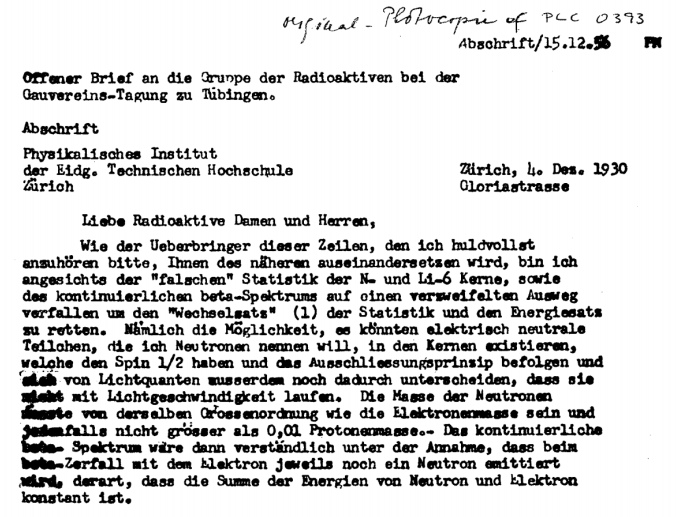
It is well known that the neutrino was first postulated by Wolfgang Pauli in 1930 to account measurements that suggested that energy and momentum were not conserved in beta decay. What is perhaps less well known – it was certainly new to me until I heard about it last night – is that Pauli’s proposal is described in famous letter, addressed rather charmingly to “Radioactive Ladies and Gentlemen” of Tübingen from his base the ETH in Zürich. Part of the letter is reproduced here:

pauli_1930_neutrino_letter_head_smaller

The opening phrases of the letter “Wie der überbringer dieser Zeilen den ich huldvollst anzuhören bitte…” is a polite request that the recipient(s) listen to the “bearer of these lines”. Presumably, Pauli being unable to visit Tübingen himself, he sent someone else along with the letter and that person gave some sort of seminar or informal presentation of the idea.

The mystery is that despite the obvious importance of this episode for the history of physics, nobody seems to know who the “bearer of the lines” from Pauli actually was. In his speech David Wark said he had been trying for 15 years to identify the individual, without success.

Anyone out there in Internetshire got any ideas?

Equations in Physics

Posted in Education with tags , , on April 10, 2014 by telescoper

Just so you know that our education system is safe in the hands of Michael Gove I thought I would pass on a couple of examples from the latest official guidance on subject content for GCSE Combined Science. These are both from Appendix 1, entitled Equations in Physics.

Example one:

kinetic energy = 0.5 x mass x (acceleration)2

Example two:

(final velocity)– (initial velocity)= 2 x acceleration x time

Neither of these is even dimensionally correct!

Such sloppiness from the Department of Education is really unforgivable. Has anyone else spotted any similar howlers elsewhere in the document?  If so please let me know via the comments box…

UPDATE: Monday 14th April. Apparently these errors in the document have now been corrected, but still…


A Problem of Capacitors

Posted in Cute Problems, The Universe and Stuff with tags , , on April 3, 2014 by telescoper

Time for another entry in the Cute Problems  category. I’ve been teaching a course module  in theoretical physics this term so here’s one that my students should find a doddle…

A spherical capacitor consists of an outer conducting sphere of fixed radius b and a concentric inner conducting sphere whose radius a can be varied. The space between the spheres is filled with air which has a breakdown electric field strength E0. What are the greatest achievable values for (i) the potential difference between the spheres, and (ii) the electrostatic energy stored in the capacitor?

Answers via the comments box please.

Day Trip to Harwell

Posted in Education, Science Politics with tags , , , on April 1, 2014 by telescoper

Only time for a quick post as I’ve just got back from a visit to the Rutherford Appleton Laboratory which is located at Harwell (in the heart of the Midlands).

I was there to find out about the Science and Technology Facilities Council‘s Apprenticeship scheme, as we are planning to introduce a similar scheme at the University of Sussex and needed some advice about how to set it up. I hope to write more about that in due course.

Anyway, it was a very informative and useful visit with the added bonus that we also got an impromptu guided tour of the Diamond Light Source (and its associated workshops where some of the current STFC apprentices are employed). The Diamond Light Source is actually shut down at the moment so various upgrades can be performed, and we were therefore allowed up close to where the beam lines are. That was very interesting indeed, especially when I saw that special devices are apparently deployed to counteract the effects of Cold Dark Matter..

Some B-Mode Background

Posted in Astrohype, Science Politics, The Universe and Stuff with tags , , , , , , , , , , , on March 15, 2014 by telescoper

Well, in case you hadn’t noticed, the cosmology rumour mill has gone into overdrive this weekend primarily concerning the possibility that an experiment known as BICEP (an acronym formed from Background Imaging of Cosmic Extragalactic Polarization). These rumours have been circulating since it was announced last week that the Harvard-Smithsonian Center for Astrophysics (CfA) will host a press conference  on Monday, March 17th, to announce “a major discovery”. The grapevine is full of possibilities, but it seems fairly clear that the “major discovery” is related to one of the most exciting challenges facing the current generation of cosmologists, namely to locate in the pattern of fluctuations in the cosmic microwave background evidence for the primordial gravitational waves predicted by models of the Universe that involve inflation.

Anyway, I thought I’d add a bit of background on here to help those interested make sense of whatever is announced on Monday evening.

Looking only at the temperature variation across the sky, it is not possible to distinguish between tensor  (gravitational wave) and scalar (density wave) contributions  (both of which are predicted to be excited during the inflationary epoch).  However, scattering of photons off electrons is expected to leave the radiation slightly polarized (at the level of a few percent). This gives us additional information in the form of the  polarization angle at each point on the sky and this extra clue should, in principle, enable us to disentangle the tensor and scalar components.

The polarization signal can be decomposed into two basic types depending on whether the pattern has  odd or even parity, as shown in the nice diagram (from a paper by James Bartlett)

The top row shows the E-mode (which look the same when reflected in a mirror and can be produced by either scalar or tensor modes) and the bottom shows the B-mode (which have a definite handedness that changes when mirror-reflected and which can’t be generated by scalar modes because they can’t have odd parity).

The B-mode is therefore (at least in principle)  a clean diagnostic of the presence of gravitational waves in the early Universe. Unfortunately, however, the B-mode is predicted to be very small, about 100 times smaller than the E-mode, and foreground contamination is likely to be a very serious issue for any experiment trying to detect it. To be convinced that what is being measured is cosmological rather than some sort of contaminant one would have to see the signal repeated across a range of different wavelengths.

Moreover, primordial gravitational waves are not the only way that a cosmological B-mode signal could be generated. Less than a year ago, a paper appeared on the arXiv by Hanson et al. from SPTpol, an experiment which aims to measure the polarization of the cosmic microwave background using the South Pole Telescope. The principal result of this paper was to demonstrate a convincing detection of the so-called “B-mode” of polarization from gravitational lensing of the microwave background photons as they pass through the gravitational field generated by the matter distributed through the Universe. Gravitational lensing can produce the same kind of shearing effect that gravitational waves generate, so it’s important to separate this “line-of-sight” effect from truly primordial signals.

So we wait with bated breath to see exactly what is announced on Monday. In particular, it will be extremely interesting to see whether the new results from BICEP are consistent with the recently published conclusions from Planck. Although Planck has not yet released the analysis of its own polarization data, analysis of the temperature fluctuations yields a (somewhat model-dependent) conclusion that the ratio of tensor to scalar contributions to the CMB pattern is no more than about 11 per cent, usually phrased in the terms, i.e. R<0.11. A quick (and possibly inaccurate) back-of-the-envelope calculation using the published expected sensitivity of BICEP suggests that if they have made a detection it might be above that limit. That would be really interesting because it might indicate that something is going on which is not consistent with the standard framework. The limits on R arising from temperature studies alone assume that both scalar and tensor perturbations are generated by a relatively simple inflationary model belonging to a class in which there is a direct relationship between the relative amplitudes of the two modes (and the shape of the perturbation spectrum). So far everything we have learned from CMB analysis is broadly consistent with this simplifying assumption being correct. Are we about to see evidence that the early Universe was more complex than we thought? We'll just have to wait and see…

Incidentally, once upon a time there was a British experiment called Clover (involving the Universities of  Cardiff, Oxford, Cambridge and Manchester) which was designed to detect the primordial B-mode signal from its vantage point in Chile. I won’t describe it in more detail here, for reasons which will become obvious.

The chance to get involved in a high-profile cosmological experiment was one of the reasons I moved to Cardiff in 2007, and I was looking forward to seeing the data arriving for analysis. Although I’m primarily a theorist, I have some experience in advanced statistical methods that might have been useful in analysing the output.  Unfortunately, however, none of that actually happened. Because of its budget crisis, and despite the fact that it had spent a large amount (£4.5M) on it already,  STFC decided to withdraw the funding needed to complete it (£2.5M)  and cancelled the Clover experiment. Had it gone ahead it would probably have had two years’ data in the bag by now.

It wasn’t clear that Clover would have won the race to detect the B-mode cosmological polarization, but it’s a real shame it was withdrawn as a non-starter. C’est la vie.

Charlotte Church and Physics

Posted in Music, The Universe and Stuff with tags , , , , on March 14, 2014 by telescoper

I just noticed an interesting news item about popular vocal artiste Charlotte Church. Apparently she is thinking about doing a degree in physics. She is quoted on the BBC Website as saying

“I just think it’s important to keep the brain active and keep educating yourself.

“I have an interest in it and I should try to follow it. It’s something I’ve been interested in for the last year or two.”

I hope she does it, as it will set an excellent example. In the article, however, she also says “I will have to do an A-level in physics and maths first though”. That’s not necessarily the case, actually. It is possible instead to opt for a physics degree programme with a Foundation year. Many universities run such programmes. We have one here at the University of Sussex but there is also one at Cardiff University, which happens to be in Charlotte Church’s home town.

These courses are specifically designed for people who didn’t do the traditional mix of A-level subjects for a Physics degree and I always recommend that students who are coming to the subject late in life give them serious consideration rather than assuming they should go via the usual A-level route. Widening participation in higher education by offering such access courses is something many universities work very hard at and do very well.

In fact, as I’ve pointed out before, that the current A-level Physics courses are part of the reason why we have so few female physics students; the fraction is a meagre 20%. That might start to change if high-profile women like Charlotte Church lead the way, but in the mean time it’s definitely worth thinking about alternatives to A-level such as those I’ve described.

In any case, and whatever Charlotte Church does decide to do in the future, I’m sure I speak on behalf of the vast majority of physicists when I express thanks to her for putting such a nice story about physics into the news!

POSTRSCRIPT: I wasn’t aware of this when I wrote the above piece, but it seems a former colleague of mine from Cardiff University, Edward Gomez helped get Charlotte Church interested in physics.

A Spring Physics Problem

Posted in Cute Problems with tags , , , on March 9, 2014 by telescoper

It’s been a while since I posted anything in the Cute Problems  category, so since Spring is in the air I thought I’d post a physics problem which involves springing into the air…

Two identical fleas, each of which has mass m, sit at opposite ends of a straight uniform rigid hair of mass M, which is lying flat and at rest on a smooth frictionless table. If the two fleas make simultaneous jumps with the same speed and angle of take-off relative to the hair as they view it, under what circumstances can they change ends in one jump without colliding in mid air?

UPDATE Monday 10th March: No complete answers yet, so let’s try this slightly easier version:

Two identical fleas, each of which has mass m, sit at opposite ends of a straight uniform rigid hair of mass M, which is lying flat and at rest on a smooth frictionless table. Show that, by making simultaneous jumps with the same speed and angle of take-off relative to the hair as they view it, the two fleas can change ends without colliding in mid-air as long as 6m>M.

Answers via the comments box please..

A Bit of Green Trivia..

Posted in Film, History, The Universe and Stuff, Uncategorized with tags , , , on March 8, 2014 by telescoper

Following on from yesterday’s post about George Green, I thought I’d add this little bit of Green trivia.

George Green’s sponsor and patron  was the mathematician Edward Bromhead, a Baronet and member of the landed gentry of the county of Lincolnshire. Two generations later in the Bromhead family you will find a certain Gonville Bromhead (presumably named after Gonville & Caius College, the Cambridge college that both Edward Bromhead and George Green attended). As a young man, in January 1879, Lt. Gonville Bromhead fought in the Battle of Rorke’s Drift. Almost a century later he was played by Michael Caine in the film Zulu.

Not a lot of people know that.