Archive for Physics

Local Matters

Posted in Education, Finance, Politics, Science Politics with tags , , , , , on May 12, 2011 by telescoper

I think I’ve caught up with most of the signficant things that happened during my travels, so I thought I’d end this series of updates with some local news from Cardiff (and Wales generally).

First, I can pass on some information relating to the  number of potential students applying to study Physics (and related subjects) this forthcoming academic year (2011/12) in the School of Physics & Astronomy at Cardiff University.  I blogged about this a few months ago when it became obvious that we were having a bumper year. As it turns out, we finished with applications up by a whopping 53% on last year.

Second, and related to the first item, the detailed allocations of university funding in Wales have finally filtered down all the way from HEFCW, through the Cardiff University management, and onto individual schools.  As it happens, this has also turned out not too badly for us here in Physics & Astronomy. For various reasons we’ve finally been given the increase in student numbers that we have been requesting for some time without success. In fact we’ve been given an extra 60 funded places, which is a significant uplift in our quota and a much-needed financial boost for the School. This has happened basically because of HECFW‘s desire to bolster STEM subjects as part of a range of measures related to the Welsh Assembly Government’s plans for the regions.

Unfortunately the admissions team have so far been proceeding on the basis that demand would exceed supply for this year so has set our undergraduate offers rather high. In order to fill the extra places that have been given to us late in the day, even with our vastly increased application numbers we may have to go into the clearing system to recruit some of the extra bodies. We’ll have to wait until the A-level results come out in August, however, before we know what the situation really is.

It would have been a lot easier if we’d known the rules at the start of the game, rather than near the end, but that’s the way it goes when politicians start tinkering with things…

We will have to lay on extra tutorials and laboratory sessions to cope with the anticipated increase in student numbers, which will be a bit of a struggle, but the extra money they bring in should keep the wolf from the door for a while.

Another thing worth mentioning concerns research in Wales. In the run-up to the Welsh Assembly elections, the Campaign for Science and Engineering (CASE) produced a couple of interesting documents. One was about science policy in the devolved nations and the other was a comparison of STEM subjects across the UK.

These documents make it clear that Wales lags far beyond England and (particularly) Scotland in terms of investment in, and productivity of, its scientific research.  In its  recommendations for Wales, CASE included

    • The Higher Education Funding Council for Wales must increase its investment in research – as well as improving the research base directly, this investment should bring more success in winning competitive, UK-wide funding. The indirect costs of charitably funded research should continue to be covered.
    • Policies should continue to build up the critical mass of research through collaboration, including with overseas researchers or businesses.

As I reported recently, we (Cardiff, Swansea and Aberystwyth) have tried to persuade HECFW to fund a Welsh physics initiative, intended to achieve precisely what CASE suggests. Unfortunately HECFW turned our bid down. At least for the short term, additional investment in physics research is clearly not on the agenda for HEFCW.  There’s not much sign of it happening in the future either, but we will have to wait and see…

Share/Bookmark

(Guest Post) Physics and Binary Creep

Posted in Education, Finance, Science Politics with tags , , , , , , on April 15, 2011 by telescoper

His Excel-lence (geddit?) Paul Crowther has been at it again, using his favourite packages sophisticated graph-plotting facilities to produce the interesting figures that go with another guest post….

–0–

Last week’s Times Higher Ed included a news item headlined ‘binary creep’, in which HEFCE were considering restricting support for PhD research students to universities of the highest research quality. Concerns were expressed in the article about a two stream future for universities – research intensives in the fast lane and ‘the rest’ in the slow lane. This reminded me of a recent Times Higher Ed interview with the former Commons’ Science and Technology Committee chairman, Lord (Phil) Willis. Lord Willis argued that the UK could probably sustain “no more than 30” universities with the capacity to attract the best global researchers and carry out world-class research, a view no doubt shared by ministers and civil servants within BIS. I should qualify the following line of thought by emphasising that this is not Government policy, although both stories reflect moves by funding agencies to further concentrate increasingly scarce resources on the highest ranked research universities. For example, in England HEFCE is expected to withdraw all quality-related (QR) support from 2* RAE research from 2012 onwards.

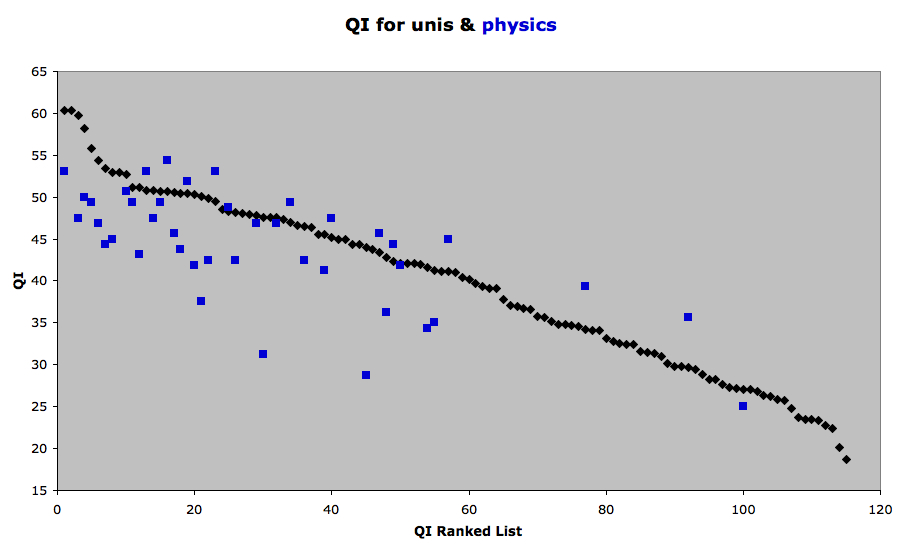
Mindful of the fact that in such a vision for the future, there would be a comparatively few, research intensive universities (`winners’) where would that leave the remainder (‘losers’), especially for physics? Research quality can be quantified in all manner of ways, but for simplicity I have adopted the Quality Index (QI) from Research Fortnight which provides a single mark out of 100 based on RAE quality profiles (4*:3*:2*:1* weighted 8:4:2:1). The chart below shows the  QI-ranked list of more-or-less all 120 UK universities who were rated in RAE 2008. It will come as no surprise to anyone that Oxbridge, LSE and Imperial top the rankings, closely followed by UCL and a few other high flyers, but beyond the top 10 perhaps more surprising there are no natural breaks in quality from Durham and QMUL in joint 11th place, to Bolton at 107th.

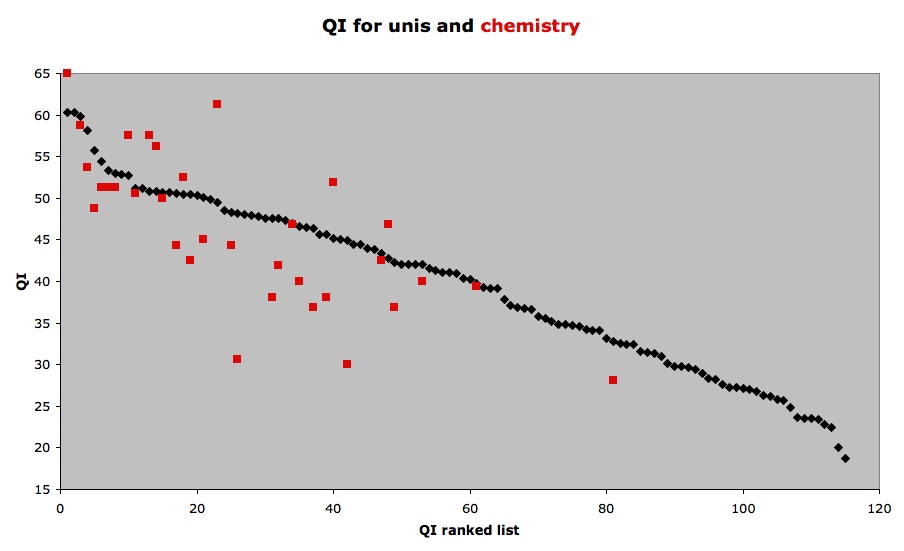
Thinking out loud about Willis’ assertion that the UK should not be spreading the jam more thinly than, say, the leading 30 universities, there would obviously be individual physics departments currently outside the top 30 which are ranked significantly higher than those within the top 30. To illustrate this, the chart also includes (in blue) physics QI scores for all teaching institutions that were assessed under the UOA 19 in RAE 2008. To blindly follow Lord Willis’ suggestion, 16 out of 42 institutions involved with physics research – comprising 37 per cent of all academic staff – would be clear losers. These would include one physics department raked within the top 10 (scoring 49) because its host institution is ranked 34th overall, while winners would include a department scoring 31, i.e. ranked 40th (out of 42) for physics, as a result of its university squeezing into the top 30. Chemistry – within the same RAE sub-panel as physics – reveals a broadly similar distribution, although there is perhaps a greater concentration of the highest research quality in the overall top 20, as the chart below illustrates.

Alternatively, if there is to be further concentration, one could argue that research funding should focus on, say, the top 20 physics departments regardless of the performance of their host institution. Indeed, already 80 percent of STFC spending goes to only 16 universities. Still, as RAE grades indicate, a strength of UK physics is the breadth of high quality research, with no natural break points until beyond 30th place in the rankings, as the final chart shows. Of course, RAE scores aren’t the sole criterion being discussed, with “critical mass” the other main driver. Due in large part to the big four, 70 per cent of physics academic staff submitted for RAE 2008 are in departments that are currently ranked in the top 20. Chemistry has a similar story to tell in the chart, albeit displaying a somewhat steeper QI gradient.

What might be the long-term consequences of a divergence between a small number of “research-facing” universities and the rest? It is apparent that if the number of physics departments involved in research were reduced by a third, some high quality research groups would be lost, regardless of precisely where the cleaver ultimately fell. Let’s too not forget that astrophysics represents the largest sub-field of physics from the last IOP survey, as measured in numbers of academics.

If policy makers don’t see anything fundamentally wrong with A-level physics being taught by teachers qualified, say, in biology, then they might too wonder whether physics degrees could be taught by academics lacking a physics research background? This might work for first year undergraduate courses, but thereafter isn’t more specialist knowledge needed that a research background most readily provides? How would the third of physics academics outside the top 30 universities react to the prospects of a teaching-only future? Many surely would consider jumping ship either to one of the chosen few or overseas, further decreasing the pool of those with research experience in the remaining physics departments. This is further complicated by the expected political desire that physics departments should be appropriately distributed geographically across England, Scotland, Wales and Northern Ireland.

As a final thought experiment, the fate of physics departments facing the prospect of a teaching-only future might also be binary in nature, either (a) whither and die, decreasing the range of institutions offering degrees in physics (or physical sciences, natural sciences etc.); perversely at a time when the Government are anxious to maintain the number of students studying Science, Technology, Engineering and Mathematics (STEM) subjects, or (b) thriving – free from the distractions of chasing dwinding research grants – by adapting to offer shorter duration physics degrees, described as “cheap and cheerful” by Dr David Starkey during the discussion on student fees on last Thursday’s Newsnight. To reiterate, it is not explicit Government policy to actively reduce the number of physics departments that receive research allocations, but this seems to be the general “direction of travel” in policy-makers speak, so I fear a rocky path ahead..


Share/Bookmark

The Ernest Rutherford Fellowships Scheme

Posted in Finance, Science Politics with tags , , , on April 1, 2011 by telescoper

It seems timely to use the medium of this blog to pass on some important news from the Science and Technology Facilities Council (STFC) to those who might find it useful.

This week saw the unveiling of a brand new STFC scheme to be called the Ernest Rutherford Fellowships. These will be in some respects similar to the previous Advanced Fellowships in that each Fellowship will last for five years with 12 being offered by STFC each year, and will cover the salary costs of the holder for that period. An important new element, however, is that holders of these Fellowships will be able to bid for “significant additional funds to support their research”.

The announcement of this new programme is sure to be warmly welcomed by the scientific community because the previous Advanced Fellowships have been  a stepping stone to an academic career for many a budding scientist (including myself, in fact). There will however be some restrictions on eligibility that did not apply to previous schemes.

The first new restriction is to bring the scheme into line with the attitudes of Ernest Rutherford, in whose honour the new fellowships are to be named. One of the most frequently-quoted remarks by Rutherford is the following:

Don’t let me catch anyone talking about the Universe in my department

Obviously therefore it has proved necessary to close the scheme to astronomers and cosmologists. This shouldn’t prove too much of a problem, however, as the STFC press statement by John Le Mesurier makes it clear that the only notable recipients of Advanced Fellowships in the past are actually particle physicists:

Previous recipients of Advanced Fellowships include Professor Brian Cox who has done much to popularise/demystify physics through his recent TV series, Professor Ruth Gregory who was awarded the IoP Maxwell Medal for outstanding contributions to theoretical, mathematical or computational physics in 2006; and Professor Brian Foster who was awarded the IoP Born medal (for outstanding contributions to physics) in 2003.

The second new rule is intended to control the number of applications in order to make the selection of the recipients of these Elite Fellowships more manageable. The criteria applied to the previous Advanced Fellowship programme were very flexible, with the result that each round typically generated well over a hundred applications. This made the relevant Panel’s task extremely difficult. STFC has therefore decided to impose a restriction on the age seniority of the candidates in order to streamline the process.

To be eligible for an Ernest Rutherford Fellowship,  candidates must have completed their PhD between 5 years 11 months and 30 days and 6 years of the date of application. This is in addition to the usual requirement of being a white heterosexual male. According to rigorous investigations by STFC staff, this reduces the pool of potential applicants substantially. To one, actually.

The successful candidate (Dr Jamie B’Stard of Oxbridge University) will be eligible to bid for, and be given on the nod, additional ring-fenced funding to support those things that an Elite Fellow needs, both to carry out their research and to feel generally superior to everyone else (e.g. private jet, fleet of Rolls-Royce motor cars, and gold-plated taps in their private lavatory). Never in the history of British science will a physicist have been so generously endowed. The new scheme will allow science to compete in prestige and public acclaim with other forms of employment, such as in the banking sector.

To liberate the funds needed for this initiative it has inevitably proved necessary to make savings elsewhere in the STFC programme. After minutes of arduous deliberation it was decided, as usual, to pay for it by top-slicing the budget for research grants (this time by 95%). Unfortunately this means that no grants will be available for any other research within the STFC remit. However, as a gesture of goodwill, the Chief Executive of STFC has given the instruction that the remaining 5% of the now defunct grants line will be distributed to universities to help cover the cost of making all existing PDRAs redundant.

I hope this clarifies the situation.


Share/Bookmark

Local News

Posted in Education, Finance, Politics with tags , , , , , , , on March 25, 2011 by telescoper

I’m looking forward to tonight’s Annual Chaos Society Physics Ball, in advance of which I’ll have to go home to get my glad rags sorted out.

This posh night out should provide some welcome fun at the end of a week in which various items of news concerning Welsh universities have generated considerable anxiety around these parts.

For a start the Welsh Assembly Government has announced funding levels for HEFCW, the body that distributes funding to Welsh universities. According to a newspaper article

The Higher Education Funding Council for Wales (Hefcw) has seen its core budget slashed by 8.5% from £453m in 2010-11 to £388m in 2011-12.

Well, pardon my numeracy but a cut from £453m  to £388m is actually a drop of 14.3% not 8.5%. This is much worse than the cuts already announced by HEFCE for English universities, although it remains to be seen how HEFCW will pass on this cut to the institutions it funds. Whatever it does will cause considerable pain, as this cut is being imposed a full year before universities will be allowed to recoup any losses by charging increased tuition fees.

There was also some even more local and even more disappointing news this week concerning HEFCW. Over the past year or so, the three remaining physics departments in Wales (at Cardiff, Swansea and Aberystwyth) have developed a proposal to form a strategic alliance along the lines of similar initiatives in Scotland, the Midlands, and South-East of England which resulted in the injection of large amounts of cash into physics research in those areas. The bid went into HEFCW in January and this week we received the decision. No.

I suppose the decision wasn’t surprising given the current funding climate, but it’s nevertheless extremely disappointing to realise we’ve  missed a very important boat. If  Welsh physics had gone down this road a decade ago – which I believe it should – then we would be in much better shape to face the very uncertain future that hangs over us. Still, I suppose it spares us the effort of trying to think up an acronym.

What’s especially worrying about this is that it seems to me that it makes it  inevitable that Welsh physics will do as poorly in the forthcoming Research Excercise Framework as it did in the 2008 Research Assessment Exercise.
I think it’s worth quoting the observations made by Sub-panel 19 (physics) after the 2008 Research Assessment Exercise:

Sub-panel 19 regards the Scottish Universities Physics Alliance collaboration between Scottish departments as a highly positive development enhancing the quality of research in Scotland. South of the border other collaborations have also been formed with similar objectives. On the other hand we note with concern the performance of three Welsh departments where strategic management did not seem to have been as effective as elsewhere.

Ouch! The final sentence is completely out of order, of course, as it exceeds the remit of HEFCE (which administered the RAE) to try to dictate how Higher Education is run in Wales, as this responsibility is devolved to the Welsh Assembly Government. It is, however, to some extent a valid criticism. England and Scotland have pumped money into physics in order the develop strategic alliances. Wales hasn’t. And it isn’t going to either.

Given Wales’ relative autonomy when it comes to Higher Education I still don’t understand why its universities forced to participate in the REF anyway, but since it looks like we are stuck with it, I worry what the outcome will be, especially since Welsh physicists have been systematically excluded from the physics panel.

The last item of news concerns HEFCW itself. A report produced by John McCormick has recommended that it be scrapped and replaced with a new body called Universities Wales.

There are many reasons why scrapping HEFCW could turn out to be a good thing. For one thing, a new body might realise that continuing involvement in the REF is wasting a huge amount of time and money in the Welsh HE sector on an exercise that takes no account of Welsh strategic objectives. Nevertheless, I’m  a bit worried by some of the rhetoric coming out of the Welsh Assembly about this issue.

Universities are not the property of the Welsh Assembly (which in fact only funds part of their activity). Universities are independent charitable institutions. Their autonomy is essential in allowing them to do what they do best, free from the short-term expediency that dominates the thinking of the political establishment.

But that’s not to say that the Welsh Assembly is wrong to expect universities to respond to the changing socio-economic landscape. It’s all a matter of balance. If Universities Wales is sufficiently “hands-off” to allow universities to do what they do best – teaching and research – but sufficiently “hands-on” that it can help the HE sector to reorganize in the ways it clearly must, then this could be a very good move.

And if HEFCW does die, I’m afraid there will be few around these parts that mourn its passing.


Share/Bookmark

Sentimental Education

Posted in Education, The Universe and Stuff with tags , , , on March 10, 2011 by telescoper

We’ve now reached the half-way point of the Spring Semester, which means that my teaching load has just doubled; I do the “Particle” bit of a third-year module on “Nuclear and Particle Physics”, which means I have 11 lectures from now until the end of the Semester to tell the students everything I know about particle physics. More than enough time.

Anyway, the first lecture today, as it was last year, was all about Natural Units. I always find it fun doing this, partly because the students stare at me as if I’ve taken leave of my senses. Come to think of it, they do that anyway.

The other night I was having a drink with some colleagues after work. Various topics came up, but we spent a bit of time talking about teaching. It appears that I’m in a small minority of my physics colleagues in that I actually like teaching. In fact, the older I’ve got the more I enjoy it. There’s always a limit, of course, and I wouldn’t like to do so much teaching that I couldn’t do other things, especially research, but I wouldn’t like to be in a job that didn’t involve teaching at all. I think most of my colleagues would jump at the chance to abandon teaching altogether. I can’t understand that attitude, mainly because I find it so rewarding myself, but I’m in a minority of one about so many things nowadays that I’ve ceased worrying about it.

I do sometimes wonder why I find teaching so rewarding. Perhaps it’s because I’m already middle-aged and don’t have any kids of my own. Teaching at least gives me a chance to play some sort of a role in someone else’s development as a person. I can’t guarantee that it’s necessarily a positive role, but there you are.  Another thing is that sometimes when I travel about at conferences and whatnot I get to meet people I taught years ago. It means a lot when they say they remember the lectures, especially if they’ve now embarked on scientific careers of their own.

One of the problems of the government’s push for greater concentration of research funds and the simultaneous slashing of teaching budgets is that the quality of University teaching is bound to suffer. If research funding is allocated only to self-styled research  “superstars” then Universities will obviously spare them from other duties. Teaching loads for ordinary foot soldiers will increase, with obvious consequences in decreasing enthusiasm among lecturing staff.

It’s already the case that teaching is grossly undervalued, and it’s probably worse in physics departments than anywhere else because, without research funding, most would simply go bust. Teaching funding is nowhere near sufficient to cover the real cost of a physics degree and in any case we can’t deliver advanced physics training without access to the research labs.

On top of this there’s the way teaching is entirely disregarded in promotion cases. On paper, promotion to Professor requires demonstrated commitment to teaching. In reality, all that committees care about is how much research income the candidate brings in. Excellence in teaching counts very little, if anything at all, in the assessment of a promotion case. I think this situation must change, especially with tuition fees set to rise to unprecedented levels, but all the forces currently at play are acting in precisely the wrong direction.

If we concentrate physics research funding any further then we’ll have a small number of rich institutions stuffed full of research professors whom the undergraduates never see. The less successful academics in these departments will be put on teaching-only contracts, not because they like teaching but because their alternative is Her Majesty’s Dole. Meanwhile, less favoured research labs – i.e. those who don’t get lucky in the REF – won’t be able to sustain world-class research or teaching activities and will be forced to shut up shop. Further research concentration is bad news all round for the higher education system.

But I digress.

One of the other things we talked about in the pub was the National Lottery. As regular readers of this blog might know, I put the princely sum of £1 on the lottery every Saturday. Some think this is strange, but I see it partly as one of those little rituals we all invent for ourselves and partly as a small price to pay for a little frisson of excitement when the numbers are drawn.

But I do sometimes wonder what on Earth I would do if I won a multi-million pound jackpot prize. Would I quit my job? Would I quit teaching? Actually, I’m not sure I would do either of those. If I could ditch the admin stuff, I would of course do so. I don’t have a car and have no interest in getting one, especially a fancy one. I don’t need a bigger house, or a yacht.  In fact, frankly, there’s nothing that I would really want to buy that I couldn’t buy already. It’s not that I have a huge salary, just that I’m not exactly very materialistic.

So even if I were rich I’d probably carry on doing pretty much what I do now. And that thought brings home just how lucky we are, those of us working in academia. For all the frustrations, the fact remains that we are fortunate to be getting paid for things that we enjoy doing.

Or am I just a sentimental old fool?

Anyway, I feel a poll coming on…


Share/Bookmark

A First Problem in Astrophysics

Posted in Education, The Universe and Stuff with tags , , , , on February 25, 2011 by telescoper

When I first arrived at Cambridge University (nearly 30 years ago) to begin my course in Natural Sciences, eventually leading to a specialism in Physics, one of the books we were all asked to buy was the Cavendish Problems in Physics. One of the first problems I had to solve for tutorial work was from that collection, and I have been setting it (in a slightly amended form) for my own students ever since I started lecturing. I thought I’d put it up here because I think there might be a few budding theoretical astrophysicists who’ll find it interesting and because it provides a simple refutation of a crazy theory that has been doing the rounds on Twitter all morning.

I like this problem because it involves a little bit of lateral thinking, because not all the information given seems immediately relevant to the question being asked, but you can get a long way by just writing down the pieces of information given and thinking about how you might use simple physical ideas to connect them to the answer.

If you haven’t seen this problem before, why not have a go?

Using only the information given in this Question, estimate the ratio of the mean densities of the Earth and Sun:

i) the angular diameter of the Sun as seen from Earth is half a degree

ii) the length of 1° of latitude on the Earth’s surface is 100km

iii) the length of a year is 3×10⁷ seconds

iv) the acceleration due to gravity at the Earth’s surface is 10 m s-2.

HINT: You do not need to look up anything else, not even G!

The answer you should get is that the mean density of the Earth is something like 3.5 times that of the Sun, although the information given in the question isn’t all that accurate.

In fact the mean density of the Earth is about 5500 kg per cubic metre, and that of the Sun is about 1400 kg per cubic metre; the average density of the Sun is just 40% higher than water, which is perhaps surprising to the uninitiated….

The density of solid iron on the other hand is about 7900  kg per cubic  metre, and even higher than that if it is compressed…

UPDATE: I’ve added my Solution.

Share/Bookmark

Bayes’ Razor

Posted in Bad Statistics, The Universe and Stuff with tags , , , , , , , , , on February 19, 2011 by telescoper

It’s been quite while since I posted a little piece about Bayesian probability. That one and the others that followed it (here and here) proved to be surprisingly popular so I’ve been planning to add a few more posts whenever I could find the time. Today I find myself in the office after spending the morning helping out with a very busy UCAS visit day, and it’s raining, so I thought I’d take the opportunity to write something before going home. I think I’ll do a short introduction to a topic I want to do a more technical treatment of in due course.

A particularly important feature of Bayesian reasoning is that it gives precise motivation to things that we are generally taught as rules of thumb. The most important of these is Ockham’s Razor. This famous principle of intellectual economy is variously presented in Latin as Pluralites non est ponenda sine necessitate or Entia non sunt multiplicanda praetor necessitatem. Either way, it means basically the same thing: the simplest theory which fits the data should be preferred.

William of Ockham, to whom this dictum is attributed, was an English Scholastic philosopher (probably) born at Ockham in Surrey in 1280. He joined the Franciscan order around 1300 and ended up studying theology in Oxford. He seems to have been an outspoken character, and was in fact summoned to Avignon in 1323 to account for his alleged heresies in front of the Pope, and was subsequently confined to a monastery from 1324 to 1328. He died in 1349.

In the framework of Bayesian inductive inference, it is possible to give precise reasons for adopting Ockham’s razor. To take a simple example, suppose we want to fit a curve to some data. In the presence of noise (or experimental error) which is inevitable, there is bound to be some sort of trade-off between goodness-of-fit and simplicity. If there is a lot of noise then a simple model is better: there is no point in trying to reproduce every bump and wiggle in the data with a new parameter or physical law because such features are likely to be features of the noise rather than the signal. On the other hand if there is very little noise, every feature in the data is real and your theory fails if it can’t explain it.

To go a bit further it is helpful to consider what happens when we generalize one theory by adding to it some extra parameters. Suppose we begin with a very simple theory, just involving one parameter p, but we fear it may not fit the data. We therefore add a couple more parameters, say q and r. These might be the coefficients of a polynomial fit, for example: the first model might be straight line (with fixed intercept), the second a cubic. We don’t know the appropriate numerical values for the parameters at the outset, so we must infer them by comparison with the available data.

Quantities such as p, q and r are usually called “floating” parameters; there are as many as a dozen of these in the standard Big Bang model, for example.

Obviously, having three degrees of freedom with which to describe the data should enable one to get a closer fit than is possible with just one. The greater flexibility within the general theory can be exploited to match the measurements more closely than the original. In other words, such a model can improve the likelihood, i.e. the probability  of the obtained data  arising (given the noise statistics – presumed known) if the signal is described by whatever model we have in mind.

But Bayes’ theorem tells us that there is a price to be paid for this flexibility, in that each new parameter has to have a prior probability assigned to it. This probability will generally be smeared out over a range of values where the experimental results (contained in the likelihood) subsequently show that the parameters don’t lie. Even if the extra parameters allow a better fit to the data, this dilution of the prior probability may result in the posterior probability being lower for the generalized theory than the simple one. The more parameters are involved, the bigger the space of prior possibilities for their values, and the harder it is for the improved likelihood to win out. Arbitrarily complicated theories are simply improbable. The best theory is the most probable one, i.e. the one for which the product of likelihood and prior is largest.

To give a more quantitative illustration of this consider a given model M which has a set of N floating parameters represented as a vector \underline\lambda = (\lambda_1,\ldots \lambda_N)=\lambda_i; in a sense each choice of parameters represents a different model or, more precisely, a member of the family of models labelled M.

Now assume we have some data D and can consequently form a likelihood function P(D|\underline{\lambda},M). In Bayesian reasoning we have to assign a prior probability P(\underline{\lambda}|M) to the parameters of the model which, if we’re being honest, we should do in advance of making any measurements!

The interesting thing to look at now is not the best-fitting choice of model parameters \underline{\lambda} but the extent to which the data support the model in general.  This is encoded in a sort of average of likelihood over the prior probability space:

P(D|M) = \int P(D|\underline{\lambda},M) P(\underline{\lambda}|M) d^{N}\underline{\lambda}.

This is just the normalizing constant K usually found in statements of Bayes’ theorem which, in this context, takes the form

P(\underline{\lambda}|DM) = K^{-1}P(\underline{\lambda}|M)P(D|\underline{\lambda},M).

In statistical mechanics things like K are usually called partition functions, but in this setting K is called the evidence, and it is used to form the so-called Bayes Factor, used in a technique known as Bayesian model selection of which more anon….

The  usefulness of the Bayesian evidence emerges when we ask the question whether our N  parameters are sufficient to get a reasonable fit to the data. Should we add another one to improve things a bit further? And why not another one after that? When should we stop?

The answer is that although adding an extra degree of freedom can increase the first term in the integral defining K (the likelihood), it also imposes a penalty in the second factor, the prior, because the more parameters the more smeared out the prior probability must be. If the improvement in fit is marginal and/or the data are noisy, then the second factor wins and the evidence for a model with N+1 parameters lower than that for the N-parameter version. Ockham’s razor has done its job.

This is a satisfying result that is in nice accord with common sense. But I think it goes much further than that. Many modern-day physicists are obsessed with the idea of a “Theory of Everything” (or TOE). Such a theory would entail the unification of all physical theories – all laws of Nature, if you like – into a single principle. An equally accurate description would then be available, in a single formula, of phenomena that are currently described by distinct theories with separate sets of parameters. Instead of textbooks on mechanics, quantum theory, gravity, electromagnetism, and so on, physics students would need just one book.

The physicist Stephen Hawking has described the quest for a TOE as like trying to read the Mind of God. I think that is silly. If a TOE is every constructed it will be the most economical available description of the Universe. Not the Mind of God.  Just the best way we have of saving paper.


Share/Bookmark

Admissions

Posted in Education with tags , , on February 11, 2011 by telescoper

Busy day today, necessitating an early start and a packed morning followed by a trip to the Big Smoke later on.

I thought I’d use my daily post to try a little experiment.

Yesterday I mentioned that applications to do Physics courses in the School of Physics & Astronomy at Cardiff University had increased enormously since last year. That prompted a couple of people to contact me, via email and Twitter, to admit that the same thing is happening at their institutions. With UCAS reporting that applications nationwide are up by only about 4%, I’m a bit confused as to what is going on.

I don’t know how many of my (1000+) daily readers work in UK universities, let alone which ones or whether they’re in a position to know what undergraduate applications are doing, but I would be very interested to hear whether this pattern is being repeated and whether it’s just physics that’s booming.

So, in lieu of a proper blog post for today, let me invite you to take part in a straw poll through the comments box. Where are you? What’s your subject? Are your applications up?

Do tell.


Share/Bookmark

Bristol and Back

Posted in Biographical, The Universe and Stuff with tags , , on January 17, 2011 by telescoper

I almost did the unthinkable today by not posting anything on my blog. It’s been such a busy day that I wasn’t able to post at lunchtime, chiefly because I didn’t have a lunch break.  I don’t want to let the side down, so I decided to put something up, but the following “quick” post will have to do for today.

After an interminable meeting (zzzz...) of the Board of Studies this morning in the School of Physics & Astronomy at Cardiff, where I work, I had to rush back to the office, grab my things and dash off to the station to catch a train to the fine city of Bristol, where I was giving a colloquium in the School of Physics at the University of Bristol. I got there just in time for a quick slurp of tea before heading off to do my bit. I hope the talk was OK, but that’s not really for me to judge.

After the colloquium I got the chance to relax over a pint of beer, chat to staff and students and was then whisked off for a splendid curry. One of the folks that looked after me was Professor Mark Birkinshaw, who taught a course I took when I was an undergraduate at Cambridge; he seemed quite chuffed when I told him I still had the notes! And if Anton is reading this, he asked me to pass on his good wishes to you too! Thence it was back by train in the rain to Cardiff.

I think that’s all I have the energy to write. In fact, this is the first time ever I’ve used the “Quick Post” feature on WordPress, a streamlined interface limited to shorter items without graphics and other complicated extras which I don’t usually use because my typical posts don’t count as “quick” on account of the fact that I usually keep on writing long after I’ve made the points I was going to make and have run out of useful things to say, the excessive verbosity of the resulting articles giving me a bad name in the blogosphere, which, notwithstanding its more problematic aspects, does seem to me at least to have the virtue of encouraging a more concise form of communication than is to be found in other contexts while at the same time … [continued, page 94]


Share/Bookmark

Einstein and the Eclipse

Posted in Biographical, The Universe and Stuff with tags , , , , , , , on January 4, 2011 by telescoper

Following on from my previous post, I thought you might be interested in this. It’s the last programme in a series called Six Experiments that Changed the World which was presented by the late Ken Campbell. It was made for Channel 4 and first broadcast in 2000. It’s in two parts. If you watch the second one, you might see someone you recognize…


Share/Bookmark