Archive for Physics

A Problem in Dynamics

Posted in Poetry, The Universe and Stuff with tags , , on July 23, 2010 by telescoper

I thought you might enjoy this “poem” which, believe it or not, was written by the great physicist James Clerk Maxwell. You can find other examples of his verse here. All I can say is I’m glad he didn’t give up his day job…

An inextensible heavy chain
Lies on a smooth horizontal plane,
An impulsive force is applied at A,
Required the initial motion of K.

Let ds be the infinitesimal link,
Of which for the present we’ve only to think;
Let T be the tension, and T + dT
The same for the end that is nearest to B.
Let a be put, by a common convention,
For the angle at M ’twixt OX and the tension;
Let Vt and Vn be ds’s velocities,
Of which Vt along and Vn across it is;
Then Vn/Vt the tangent will equal,
Of the angle of starting worked out in the sequel.

In working the problem the first thing of course is
To equate the impressed and effectual forces.
K is tugged by two tensions, whose difference dT
Must equal the element’s mass into Vt.
Vn must be due to the force perpendicular
To ds’s direction, which shows the particular
Advantage of using da to serve at your
Pleasure to estimate ds’s curvature.
For Vn into mass of a unit of chain
Must equal the curvature into the strain.

Thus managing cause and effect to discriminate,
The student must fruitlessly try to eliminate,
And painfully learn, that in order to do it, he
Must find the Equation of Continuity.
The reason is this, that the tough little element,
Which the force of impulsion to beat to a jelly meant,
Was endowed with a property incomprehensible,
And was “given,” in the language of Shop, “inexten-sible.”
It therefore with such pertinacity odd defied
The force which the length of the chain should have modified,
That its stubborn example may possibly yet recall
These overgrown rhymes to their prosody metrical.
The condition is got by resolving again,
According to axes assumed in the plane.
If then you reduce to the tangent and normal,
You will find the equation more neat tho’ less formal.
The condition thus found after these preparations,
When duly combined with the former equations,
Will give you another, in which differentials
(When the chain forms a circle), become in essentials
No harder than those that we easily solve
In the time a T totum would take to revolve.

Now joyfully leaving ds to itself, a-
Ttend to the values of T and of a.
The chain undergoes a distorting convulsion,
Produced first at A by the force of impulsion.
In magnitude R, in direction tangential,
Equating this R to the form exponential,
Obtained for the tension when a is zero,
It will measure the tug, such a tug as the “hero
Plume-waving” experienced, tied to the chariot.
But when dragged by the heels his grim head could not carry aught,
So give a its due at the end of the chain,
And the tension ought there to be zero again.
From these two conditions we get three equations,
Which serve to determine the proper relations
Between the first impulse and each coefficient
In the form for the tension, and this is sufficient
To work out the problem, and then, if you choose,
You may turn it and twist it the Dons to amuse.

Science versus Engineering?

Posted in Science Politics with tags , , , , , , on July 13, 2010 by telescoper

I suppose it was inevitable that there would be infighting as academics jostle for an increase intheir share of what is likely to be a diminishing level of research funding to be announced at the end of the ongoing Comprehensive Spending Review.  The first professional society to try to barge its way to the front of the queue appears to be the Royal Academy of Engineering, which has written to the Department of Business, Innovation and Skills (BIS) in terms that make it clear that they think egineering should prosper at the expense of research in fundamental physics.

To quote the RAEng:

we believe that research should be concentrated on activities from which a contribution to the economy, within the short to medium term, is foreseeable. I recognise that this calls for significant changes in practice but I see no alternative in the next decade. This may mean disinvesting in some areas in order properly to invest in others.

And where should the axe fall?

BIS should also consider the productivity of investment by discipline and then sub-discipline. Once the cost of facilities is taken into account it is evident that ‘Physics and Maths’ receive several times more expenditure per research active academic compared to those in ‘Engineering and Technology’. This ratio becomes significantly more extreme if the comparison is made between particle physics researchers and those in engineering and technology. Much of particle physics work is carried out at CERN and other overseas facilities and therefore makes a lower contribution to the intellectual infrastructure of the UK compared to other disciplines. Additionally, although particle physics research is important it makes only a modest contribution to the most important challenges facing society today, as compared with engineering and technology where almost all the research is directly or indirectly relevant to wealth creation.

Obviously whoever wrote this hasn’t heard of the World Wide Web, invented at CERN – precisely the place singled out for vitriol.

I couldn’t agree less with what the RAEng say in their submission to BIS, but instead of going on a rant here I’ll direct you to John Butterworth’s riposte, which says most of what I would want to say, but I would like to add one comment along the lines I’ve blogged about before.

The reason I think that the RAEng is precisely wrong is that I think the Treasury (on behalf of the taxpayer) should only be investing in research that wouldn’t otherwise be carried out. In other words, the state should fund academic esearch precisely because of its “blue sky” nature, not in spite of it.

Conversely, engineering and technology R&D should be funded primarily by the commercial sector precisely because it can yield short-term economic benefits. The decline of the UK’s engineering base has been caused by the failure of British companies to invest sufficiently in research, expecting instead that the Treasury should fund it and all they have to do is cash in later.

I’m not calling for the engineering and technology budgets to be cut – I don’t have such a blinkered view as the RAEng – but I would argue that a much greater share should be funded by private companies. This also goes for energy research. As Martin Rees pointed out in a recent Reith Lecture, the UK’s energy companies spend a pathetically small proportion of their huge profits on R&D. The politicians should be “persuading” industry to get invest more in the future development of their products rather than expecting the taxpayer to fund it. I agree that the UK economy needs “rebalancing” but part of the balance  is private companies need to develop a much stronger sense of the importance of R&D investment.

And, while I’m tut-tutting about the short-sighted self-interest displayed by the RAEng, let me add that, following the logic I’ve stated above,  I see a far stronger case for the state to support research in history and the arts than, e.g. engineering and computer science. I’d even argue that large commercial companies should think about sponsoring pure science in much the same way as they do with the performing art exhibitions and the Opera. We need as a society to learn to celebrate curiosity-driven research not only as a means to economic return (which it emphatically is) but also as something worth doing for its own sake.

Finally, and most depressingly of all, let me point out that the Chief Executive Officer of the Royal Academy of Engineering, Philip Greenish, sits on the Council of the Science and Technology Facilities Council, an organisation whose aims include

To promote and support, by any means, high-quality basic, strategic and applied research and related post-graduate training in astronomy, particle physics, space science and nuclear physics.

Clearly, he should either disown the statements produced by the RAEng or resign from STFC Council. Unless he was put there deliberately as part of the ongoing stitch-up of British physics. If that’s the case we all have the dole queue to look forward to.

Science Examination Blues

Posted in Education, The Universe and Stuff with tags , , , , , on June 16, 2010 by telescoper

I woke up this morning …

.. to the 7am news on BBC Radio 3, including a story about how GCSE science examinations are not “sufficiently rigorous”. Then, on Twitter, I saw an example of an Edexcel GCSE (Multiple-choice) Physics paper.  It’s enough to make any practising physicist weep.

Most of the questions are very easy, but there’s just as many that are so sloppily put together that they  don’t make any sense at all. Take Question 1:

I suppose the answer is meant to be C, but since it doesn’t say that A is the orbit of a planet, as far as I’m concerned, it might just as well be D. Are we meant to eliminate D simply because it doesn’t have another orbit going through it?

On the other hand, the orbit of a moon around the Sun is in fact similar to the orbit of its planet around the Sun, since the orbital speed and radius of the moon around its planet are smaller than those of the planet around the Sun. At a push, therefore you could argue that A is the closest choice to a moon’s orbit around the Sun. The real thing would be something close to a circle with a 4-week wobble variation superposed.

You might say I’m being pedantic, but the whole point of exam questions is that they shouldn’t be open to ambiguities like this, at least if they’re science exams. I can imagine bright and knowledgeable students getting thoroughly confused by this question, and many of the others on the paper.

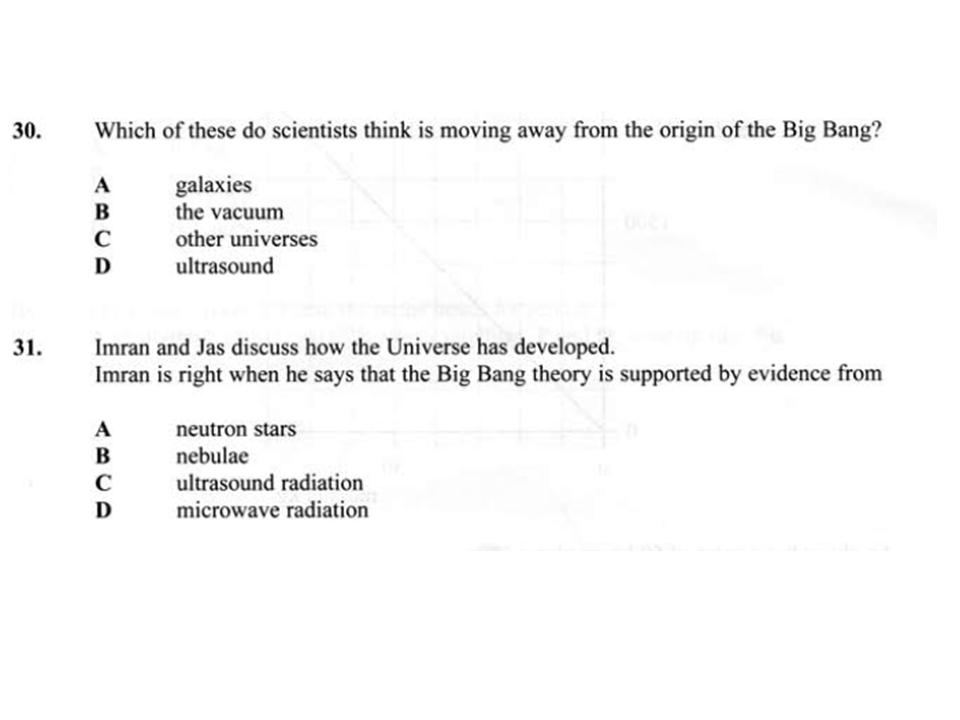
Here’s a couple more, from the “Advanced” section:

The answer to Q30 is, presumably, A. But do any scientists really think that galaxies are “moving away from the origin of the Big Bang”?  I’m worried that this implies that the Big Bang was located at a specific point. Is that what they’re teaching?

Bearing in mind that only one answer is supposed to be right, the answer to Q31 is presumably D. But is there really no evidence from “nebulae” that supports the Big Bang theory? The expansion of the Universe was discovered by observing things Hubble called “nebulae”..

I’m all in favour of school students being introduced to fundamental things such as cosmology and particle physics, but my deep worry is that this is being done at the expense of learning any real physics at all and is in any case done in a garbled and nonsensical way.

Lest I be accused of an astronomy-related bias, anyone care to try finding a correct answer to this question?

The more of this kind of stuff I see, the more admiration I have for the students coming to study physics and astronomy at University. How they managed to learn anything at all given the dire state of science education in the UK is really quite remarkable.

Announcement of Opportunities

Posted in Education, The Universe and Stuff with tags , , , , on June 16, 2010 by telescoper

I mentioned this a while ago, but I thought it wouldn’t do any harm to repeat the official advertisement here. Cardiff is going large (or at least larger) in experimental physics, and the first deadline is approaching..

..so get cracking with your applications now!

Chair in Experimental Physics

Reader/Senior Lecturer/Lecturer in Experimental Physics

School of Physics and Astronomy

As the first stage of a major initiative to broaden its research activity the School of Physics and Astronomy at Cardiff University has some immediate vacancies for permanent faculty positions at either full Professor/Reader/Senior Lecturer/Lecturer level in any area of Experimental Physics, other than Astrophysics.

Applications are welcome in fields new to the School as well as those complementary to the existing strengths. Candidates working in interdisciplinary areas with a firm Physics base are also welcomed. You will be expected to have demonstrated an established programme of research, and will also be expected to teach Physics at undergraduate and postgraduate level.

The School of Physics and Astronomy at Cardiff University has strong research groups in Photons & Matter (theory and experimental), Gravitational Physics and Nanophysics, as well as a large Astrophysics programme.

You should have a PhD in Physics, Mathematics or closely-related subject.

Salary:
A point on the Cardiff Professorial Salary Scale (Chair)
£45155 – £55535 per annum (Reader)
£37839 – £43840 per annum (Senior Lecturer)
£29853 – £35646 per annum (Lecturer)

Further information about the School may be found at http://www.astro.cardiff.ac.uk/

Informal enquiries regarding these positions may be made to Professor Walter Gear, Head of School, email Walter.Gear@astro.cardiff.ac.uk

To work for an employer that values and promotes equality of opportunity, visit www.cardiff.ac.uk/jobs telephone + 44 (0) 29 2087 4017 or email vacancies@cardiff.ac.uk for an application form quoting vacancy number 186 for the Chair position and 188 for the Reader/Senior Lecturer/Lecturer position.

Closing date: Friday, 23 July 2010.

Please note vacancies are for one Chair and three Senior Lecturer/Lecturer positions.

www.cardiff.ac.uk/jobs


Universities Challenged

Posted in Education, Politics with tags , , , , , on June 10, 2010 by telescoper

The news headlines over the last couple of days have been dominated by remarks made by David Willetts, Minister for Universities and Science, who has called for a radical overhaul of the way UK universities are organized and funded. Predictably, his comments set alarm bells ringing about the savage cuts likely to be coming our way, but I hope it’s not just about slash-and-burn and that some imagination is applied to the problem of sorting out the mess the system has become. We’ll see.

According to a piece in the Guardian, for example, Willetts suggested that some students could study at smaller local colleges instead of going to a big university, but these colleges would teach courses designed and administered by the larger “elite” institutions, such as the University of London. This suggestion isn’t  exactly new because it’s actually how things used to work many years ago. In fact, Nottingham University, where I used to work used to be Nottingham University College and its degrees, along with those of a number of similar provincial universities, were University of London degrees. Nottingham University only got the power to award its own degrees in 1948. Of course, there wasn’t really such a thing as distance learning in those days, so there’s a possibility that a 21st Century revival of this basic idea could turn out very differently in terms of how things are actually taught.

On the up side of this suggestion is the fact that it would be a lot easier to maintain standards, if examinations were set by a common body. On the down side is the fact that the distinctive flavour of speciality courses taught in different colleges, which is a strength of research-led teaching, would be lost. In between these positives and negatives there is a huge grey area of questions, such as where the funding would go, precisely which universities should administer the changes and so on. A lot of thinking and planning will be  needed before anything like this could be implemented.

Let me add two more specific comments to this. First, I think Willetts’ suggestion would make a lot of sense here in Wales where it could be easily implemented by returning to the old University of Wales.  As I’ve mentioned before, as well as suffering from many of the problems besetting the English university system, the Principality has a few extra ones all its own. Among the most pressing is the proliferation of small colleges and the consequent duplication of administrative systems. I think a great deal of money could be saved and teaching quality improved by cutting out the unnecessary bureaucracy and having the smaller places administered by a larger central University (as Willetts imagined with the University of London).

My other comment is specific to my own subject, physics (and astronomy). The problem with this – and other laboratory based STEM subjects – is that it’s very difficult to imagine how they can actually be taught at all at degree level without access to research laboratories for, e.g., project work. This is why physics is only taught in 40-0dd of the 131 universities and colleges around the UK. You can call me old-fashioned, but I just don’t think it’s either possible or desirable to separate teaching from research in science subjects in the way this plan seems to suggest. I know some colleagues of mine disagree strongly with this, but there you go.

Behind this proposal is the issue of student funding, as it is at least partly motivated by the suggestion that students could stay at home and study at a local college instead of moving to a university further away, which would necessitate them taking out student loans which the Treasury has to pay out. 

There’s also the issue of fees. At the moment students in England are expected to pay a flat-rate annual fee of £3225. In addition to this the government pays to the University concerned an amount called the “Unit of Resource”. Last year, in England, the basic amount was around £4K but there is multiplier for more expensive courses. Clinical medicine, for example, attracts four times the basic rate. Subjects like physics and chemistry get a multiplier of 1.7 (so each student comes with around £6.7K of funding). Subjects with no laboratory component, i.e. most Arts and Humanities courses,  just get the bog-standard amount.

I think there’s an obvious problem with this system, namely that physics (and other science subjects) are  much more expensive to teach than the formula allows for. The total income per student for an arts subject would be about £7.2K, while that for physics is about £10K. Why bother with all that expensive laboratory space and shiny new kit when the funding differential is so small. That’s another reason why so many universities have scrapped their physics departments in favour of cheaper disciplines that generate a profit much more easily.

Coincidentally I attended a lunch yesterday with some of our soon-to-be-graduating students. I’ve been a member of a committee working on updating our Physics courses and we wanted to discuss the proposed changes with them. One of the group was a mature student who had already done an English degree (at another university). She said that a physics drgee was much harder work, but was impressed at how much more contact she had with staff. Like most physics department, virtually all our teaching is done by permanent academic staff. Students doing  Physics at Cardiff get about three times as many contact hours with staff as students doing English. It’s unfair to compare apples with oranges, but I’m convinced the funding model is stacked against STEM subjects.

The awful financial climate we’re in has led to a general sense of resignation that the government contribution to university education (the Unit of Resource) is going to decrease and the student contribution go up to compensate. However, there’s a Catch-22 here for the Treasury. If the tuition fee goes up students will have to borrow more, and the Treasury doesn’t want to take on more  subsidised student loans. It seems much more likely to me that the cuts will be achieved by simply reducing the number of funded places. However, in the light of what I argued above, I think this is a great opportunity to think about what is the correct Unit of Resource for different subjects. If we all agree the country needs more scientists and engineers, not less, I’d argue that funded places elsewhere should be cut, and that the difference between arts and science units of resource also be substantially increased.

I’d even go so far as to suggest that there should be zero-rated courses, i.e. those which students are welcome to take if they pay the full cost but to which the government will not contribute at all. That should put an end to the Mickey Mouse end of Higher Education provision once and for all.

PS. A review of the tuition fee system is currently taking place but isn’t due to report until the autumn. It is led by Lord Browne who was formerly the boss of BP. I wonder if there’ll be any leaks?

Pecha Kucha

Posted in Education with tags , , , , , on June 8, 2010 by telescoper

A few months ago I was invited to take part in an evening of Pecha Kucha in a hotel in Geneva. I’ll try anything once, so I agreed. I have to admit, though, that I wasn’t actually very good at it. Neither were any of the other scientists present.

No idea what a Pecha Kucha is? Well then you’re probably not an architect or an artist or a designer. Then again, you’re reading this blog so that’s pretty much a given anyway. Pecha Kucha is a style of presentation at which arty types display their portfolios in a strictly disciplined format. The standard form is twenty slides with twenty seconds allowed for each one, i.e. a total time of 6 minutes and 40 seconds. The timing is ruthlessly regulated.

Those of us scientists used to taking at least a few  minutes per slide find this format very challenging, but then that’s because we tend to have text and equations on our slides and they take some explaining. Designers and the like tend to just show pictures, and these should – if they’re any good – be pretty self-explanatory. I guess this is why the Pecha Kucha format is de rigeur in such disciplines while it has yet to catch on in physics.

I only just survived my initiation into the strange world of Pecha Kucha. Before being told what it was I thought it was a mountain in the Andes. I was reminded about it this morning by a tweet from John Butterworth (a particle physicist who, incidentally, has a nice blog of his own) confessing similar trepidation to what I experienced before I lost my Pecha Kucha virginity. The first time can be disappointing, but I hope he survived his inauguration.

Looking back on it though I think this might be an interesting idea to try in a physics context. We’re trying increasingly hard these to teach our physics and astronomy students transferable skills, but when it comes to presentations we’re fixated by the traditional presentation format. Why not get undergraduate students to do a Pecha Kucha about their project, instead of a 20-minute lecture? Why not include a Pecha Kucha in the PhD viva?

The more I think about it, the more attractive the idea seems. Has anyone out there tried a physics Pecha Kucha?

Experiments and Observations

Posted in Science Politics, The Universe and Stuff with tags , , , , , on May 8, 2010 by telescoper

It’s nice to be able to pass on some upbeat news for once.

The first thing is that, after a lot of delays and a bit of haggling, the School of Physics & Astronomy at Cardiff University has finally issued advertisements for a bunch of new Faculty positions in Experimental Physics. The positions, which are tenured,  involve both Chair and Lecturer/Reader levels and there are several positions available. The School and University  have  put together a handsome start-up package for a new group and there’s plenty of spanking new experimental laboratory space to set up shop. Coupled with the fact that Cardiff is a great city to live in, with low costs and great sporting and cultural infrastructure, this should prove a tempting opportunity for someone to set up their own group.

It’s also a welcome vote of confidence from Cardiff University which, despite cuts in its overall budget, has decided to invest heavily in the School’s strategic plan. I hope and believe we’ll attract a strong field for these appointments and look forward to seeing what develops. We need a shot in the arm and this might just deliver it.

What’s particularly interesting about this clutch of new appointments is that they are open to people working in any area of physics, with the exception of astrophysics. Given the massive cuts in STFC’s budget, this is no time to be expanding in areas covered by its remit. I say that as an astrophysicist, with considerable regret but pragmatism in the face of the changing landscape of British science funding. In times of risk you have to broaden your portfolio. However, that’s not to say that astrophysics at Cardiff is downbeat. Far from it, in fact.

ESA held an international press conference to present exciting new results from the Herschel Observatory at the European Space Research and Technology Centre, Noordwijk, The Netherlands, on Thursday 6 May. A webcast of the press conference with Cardiff’s Professors Matt Griffin and Steve Eales taking part, can be seen at from http://www.esa.int/SPECIALS/Herschel. At the conference Steve Eales talked about the latest results from the Herschel ATLAS survey: an ATLAS of the Universe. ATLAS will cover one eightieth of the sky, four times larger than all the other Herschel surveys combined and is led by Professor Eales and Dr Loretta Dunne at Nottingham University.

Herschel ATLAS has measured the infrared light from thousands of galaxies, spread across billions of light-years. Each galaxy appears as just a pinprick but its brightness allows astronomers to determine how quickly it is forming stars. Roughly speaking, the brighter the galaxy the more stars it is forming. The Herschel images show that in the past there were many more galaxies forming stars much faster than our own Galaxy. But what triggered this frantic activity is not completely understood. Steve Eales said

every time astronomers have observed the universe in a new waveband, they have discovered something new. So as well as our regular science programmes, I am hoping for the unexpected.

I am hoping to get involved with the ATLAS data myself at some point as I am formally a member of the consortium, but I’ve been too busy doing other things to get involved in these initial stages so am not on any of the preliminary science papers. I hope I can get properly involved in this project sooner rather than later…

The ATLAS survey, image courtesy of ESA and the ATLAS consortium

The full press release also includes surprises on how stars are formed including work carried out by Cardiff’s Professor Derek Ward-Thompson. Herschel’s star formation surveys are beginning to reveal the mysteries behind how massive stars are created.

Lecture Notes

Posted in Education with tags , , , on April 25, 2010 by telescoper

One week to go before the end of teaching term, and it’s time for the dreaded questionnaires to be handed out for the purpose of gauging student feedback on our teaching. The responses from the students go off somewhere to be counted and I’ll get a summary back in due course and learn what the students made of the  series of chaotic and rambling performances I strung together to masquerade as lecture courses. At the end of the year we usually get to see a league table of who’s popular and who isn’t, but the scores aren’t very useful beyond that. More important than the tick boxes are the comments that students write about what’s good and what isn’t. I read through all those and they’re often very helpful in suggesting things to be done differently in subsequent years.

Lecturing has changed an enormous amount since I was at university almost thirty years ago. In those days we got very little in the way of printed notes and we were expected to write everything down in classes that were primarily delivered in the chalk-and-talk style, although some lecturers used overhead projectors. The disadvantage of the latter over the former was a tendency to go too quickly through the material.

As a student I just accepted this was the way things were and developed my own note-taking strategy. I trained myself to be able to write things down about as fast as the lecturer could speak. I did this by cutting out the biggest hindrance to taking notes quickly, which is the business of  making your eyes go backwards and forwards between the blackboard (or projection screen) and paper in front of you. I just wrote everything I could on the paper without looking at it. Although my handwriting was scrappy when I did this, I could keep track of just about everything that was said as well as what was written by the lecturer. Later on, I’d turn these notes into a neat copy and in the process of doing that I tried to iron out any bugs in the original notes as well as figure out things I couldn’t make sense of.

When I started lecturing I primarily used blackboards and chalk. I was teaching quite mathematical things and found this the best way to do it. For one thing the physical effort of writing made me go through the material at a reasonable pace. The other advantage is that I think mathematical proofs and derivations should not just be presented, but should happen as a process for the students to see. I always felt that a lecture would be more interesting if it appeared to be spontaneous rather than delivered from a pre-prepared script. Even if the students disagreed, I certainly enjoyed lecturing much more if there was an element of improvisation in the performance.

However, I soon noticed that many students didn’t really know how to take notes even at the modest speed I was going. They would generally only write down what I wrote on the board, not the little verbal explanations and embellishments I put in. My response to this observation was to make sure I wrote down more and consequently went through the material even more slowly. When I got to sit in as a peer reviewer of other staff lecturers, I looked at what the students around me were doing and realised that the vast majority simply didn’t know how to take notes efficiently or accurately. For many the act of writing things down took so much effort that they weren’t listening to the lecturer. I guess this stems from the changing style of teaching in schools, but even if that is true it is something that university teachers need to come to terms with.

Incidentally, I have from time to time given final-year undergraduate lectures at Italian universities (in English). When I used the same style there as at home – writing full notes on the board rather than just the equations – the students asked me why I was doing it. They all expected to have to write down what I was saying. If they could manage to do that with lectures in their second language, I don’t really see why our students can’t do it in their mother tongue!

Gradually the ubiquitous powerpoint has largely the old-fashioned style of lecturing to the extent that many lecture theatres don’t even have a blackboard. We’re generally expected to hand out complete sets of printed notes, with the result that the students don’t have to take notes of their own but also turning a lecture into an entirely passive experience.

I resisted the move to powerpoint for undergraduate lecturing for many years, but gave up and went with the flow when I moved to Cardiff.  However, what I do is a bit different from the others who teach this way. I generally use slides which have only a few bits of text, key equations and figures on them. I hand out copies of these slides at the start of each lecture and then go through them during the class, and also make the powerpoint files available on the web. This gives them all the important things, but I tell the students I expect students to annotate the handouts and make their own set of notes based on the skeleton I’ve handed out. However, it is clear that many students don’t write anything down at all during the lecture. We’ll see from the forthcoming exams how much they have actually learned.

Newer educational technology should enable us to improve the standards of teaching in universities, but I think there’s still a long way to go before we work out how to use it effectively.  In particular I think we need to question whether lectures in the old-fashioned sense should continue to provide the primary mode of teaching. My personal opinion is that we should be moving to more independent, problem-based, learning and much less of the passive spoon-feeding.  I think we should be aiming to cut the number of lectures we give by about 50% across the school and use the time and effort saved in more creative and effective ways.

We’re in the middle of a review of our course structure in the School of Physics & Astronomy at Cardiff University and I hope we take the opportunity to make radical changes not just to the curriculum but also to the way we present it. Not everyone in the School is keen on really radical changes. I think I understand why. I actually enjoy lecturing. I always have. It’s fun and it’s also a lot easier to give a lecture than to prepare large numbers of problems and write pages and pages of printed notes. Looking back at my time as a student, though, I am bound to admit that I learnt next to nothing from lectures. This was partly because many of the lecturers I had were poorly delivered but also partly because I’m not sure lectures are the best way to teach physics. We carry on doing it this way just because it’s what we’re used to.

Perhaps the biggest problem with the way we teach physics these days is that it encourages students to think of each module as a bite-sized piece that can be retained until the examinations, regurgitated, and then forgotten.  I’ve no doubt that memorizing notes  is how many students pass the examinations we set.  Little genuine understanding or problem-solving ability is needed. We promote physics as a subject that nurtures these skills, but I don’t think many physics graduates – even those with good degrees – actually possess them at the end. We should be making much more of an effort in teaching students how to use their brains in other ways than as memory devices.

(Guest Post) The Emperor’s New Math

Posted in The Universe and Stuff with tags , on April 20, 2010 by telescoper

Time for another guest post from my old chum Anton, this time on the topic of mathematics. I’m not sure any mathematicians reading this piece will be too happy, but if that applies to you then blame him not me. As usual, comments are welcome through the proper channel at the bottom of the page..

-0-

Nowadays a page of mathematics looks to a physicist or engineer like gobbledygook. This was not always so: a century ago a physicist might hope to understand everything in journals of mathematics, and even contribute to them. Fifty years ago a physicist might not be able to understand everything written there, but the mathematics would appear comprehensible in principle. A qualitative change has since taken place.

This change has coincided, roughly, with acceptance of the distinction between ‘pure’ and ‘applied’ (impure??) mathematics, and with the consequent, deliberate, emancipation of ‘pure’ mathematics. This is a new departure: for centuries mathematics evolved side by side with physics, and the mathematics that was studied was the mathematics used in tackling physical problems. Galileo had said (in his work Il Saggiatore, The Assayer) that

…the universe… cannot be understood unless one first learns to comprehend the language… in which it is written. It is written in the language of mathematics.

So the change is recent, and it is huge. I suggest that it is a change for the worse; that in divorcing themselves from physical science pure mathematicians have cut off their air supply; and that the suffocating style of modern pure mathematics is a result. Mathematics was not born in a vacuum, and it will not ultimately flourish in one.

A pure mathematician might respond that I would say that, since I am a physicist. But perhaps an outsider is needed to see the problem; insiders generally adopt the party line. The justification for my stance is this. Mathematicians acknowledge that their subject is the formal study of patterns. And mathematicians think in patterns, not formulae – which are really a highly efficient way to express their thoughts. Crucially, the patterns arising in the natural world are far richer and more diverse than the patterns that even the best pure mathematicians can pull out of their heads by introspection. Even number theory is not an exception, for the positive integers are abstractions – ideals – of the physical realisations of one, two, three etc sheep in a field, or boats on a lake.

The role of pattern explains the “unreasonable effectiveness” of mathematics in physical science (as Eugene Wigner put it), since physics is concerned with relations – correlations – between variables in space and time, and correlation is synonymous with pattern. The theoretical physicist Lev Landau vehemently believed that the best mathematics is the mathematics used in physics. An opposing point of view was taken by the pure mathematician Paul Halmos, in an essay titled Applied Mathematics is Bad Mathematics. Not all mathematicians share Halmos’ view, however. The mathematician Morris Kline was the author of many books about mathematics and its embedding in the cultures which nurtured it. In his book Mathematics: The Loss of Certainty, Kline demonstrated that the history of mathematics in the 20th century has not been the smooth progression that it appears to the outsider; and that arguments about the foundations have led not to resolution, but to schism into differing schools – based on different foundations – that do not talk to each other. Mathematics is not in fact a one-way road running from self-evident axioms to consequences, but is open at both top and bottom.

Already in the 19th century a formal style was developing in the mathematical study of logic, and such distinguished noses as Henri Poincaré (in Science et Methodes, part II) protested as early as 1909 that this tended to hide misleading or negligible content. To no avail: the dominance of the formalistic logical viewpoint led to the adoption of its house style across the whole of mathematics. Below university level, mathematics is still taught today as it used to be, with the emphasis on the understanding of ideas rather than their formal presentation. Freshmen are often shocked when they first meet the new way of doing things, in university lectures given by professional mathematicians. I doubt that the form of modern mathematical writing is governed by its content, for whenever my research has demanded I read some contemporary mathematics, and I have had to translate a piece of modern mathematical writing into something comprehensible to scientists, I have found it difficult to distinguish substantial points from trivia. When, for instance, four axioms are needed to establish a result, they will typically be presented as having equal weight, even if one is the crucial axiom that allows most of the proof to be constructed, and another is used only in closing loopholes. Acknowledging the quality of axioms, as well as the quantity, does not compromise rigour.

When I think of the work of Andrew Wiles and Grigori Perelman, I realise that magnificent work is done today by mathematicians far beyond my own competence. But might mathematicians question whether what they regard as the only way to write mathematics is actually a convention, and not necessarily a good one? If they wrote mathematics as they did fifty years ago, others might be able to see for themselves. More fundamentally, might they also realise what their predecessors understood, that by its abstraction mathematics is given an autonomy of its own, and that to look to the physical world for inspiration is not to make mathematics a slave of physics? The present divorce between mathematics and physics impoverishes everyone.

Space without Physics…

Posted in Uncategorized with tags , , , , , on March 24, 2010 by telescoper

I’m indebted to a colleague (Annabel Cartwright) for sending me this (coincidentally topical) sample question, illustrating the quality of a modern British school science examination.

Since it’s now clear  that there is no room for science in the new era of the UK Space Agency, I suppose we should get used to the removal of science from other things too. Starting with science exams.

This question is taken from a GCSE Physics examination.

Some people think that governments spend too much money on space research.

Which ONE of the following statements is true?

  1. Science can tell us what the planets are made of, and whether they ought to be explored.
  2. Science can tell us what the planets are made of, but not whether they ought to be explored.
  3. Science cannot tell us what the planets are made of but can tell us whether they ought to be explored.
  4. Science cannot tell us what the planets are made of, nor whether they ought to be explored.

Apparently one (and only one) answer is correct. Any offers?