Archive for Plan S

Learned Societies, Equity, and Open Access

Posted in Open Access with tags , , , , , on November 8, 2021 by telescoper

I’m not getting much time these days to think about new ideas for blog posts so yet again I’m going to rehash an old one, but at least it is somewhat topical because of an interesting blog post I saw recently about the American Sociological Association. Referring to the inequity of the way this particular society is funded the author says

The greatest source of income for the association is publications, which is mostly subscriptions to journals paid by academic libraries, which are being bled dry by profit-making publishers that ASA organizes academic labor to subsidize with free content and editorial services. This is a wealth transfer from poorer, teaching-intensive libraries to richer, research-intensive libraries.

I tthink it’s relevant to raise some points about the extent that such organizations (including, in my field,  the Royal Astronomical Society and the Institute of Physics) rely for their financial security upon the revenues generated by publishing traditional journals and why this is not in the best interests of their disciplines.

Take IOP Publishing, for example. This is a wholly-owned subsidiary of the Institute of Physics that has an annual turnover of around £60M generated from books and journals. This revenue is the largest contribution to the income that the IoP needs to run its numerous activities relating to the promotion of physics.  A similar situation pertains to the Royal Astronomical Society, although on a smaller scale, as it relies for much of its income from Monthly Notices of the Royal Astronomical Society, in which as a matter of fact I have published quite a few papers.

Not surprisingly, these and other learned societies are keen to protect their main source of cash. When I criticized the exploitative behaviour of IoP Publishing some time ago in a recent blog post, I drew a stern response from the Chief Executive of the Institute of Physics, Paul Hardaker. That comment seems to admit that the high prices charged by IOP Publishing for access to  its journals is nothing to do with the real cost of disseminating scientific knowledge but is instead a means of generating income to allow the IoP to pursue its noble aim of  “promoting Physics”.

This is the case for other learned societies too, and it explains why such organizations have lobbied very hard for the “Gold” Open Access some authorities are attempting to foist on the research community, rather than the far more sensible and sustainable approaches to Open Access employed, for example, by the Open Journal of Astrophysics.

Some time ago I came across another blog post, pointing out that other learned societies around the world are also opposing anything other than the most expensive forms of Open Access:

There is also great incentive for the people who manage and run these organisations to defend their cartel. For example, the American Chemical Society, a huge opponent to open access, pays many of its employees, as reported in their 990 tax return, over six figures. These salaries ranged from $304,528 to $1,084,417 in 2010.

The problem with the learned societies behaving this way is twofold.

First, I consider it to be inevitable that the traditional journal industry will very soon be completely bypassed in favour of  other forms of Open Access publishing. The internet has changed the entire landscape of scientific publication. It’s now so cheap and so easy to disseminate knowledge that traditional journals are already virtually redundant, especially in my field of astrophysics where we have been using the arXiv for so long that many of us hardly ever look at journals.

The comfortable income stream that has been used by the IoP to “promote Physics”, as well as to furnish its brand new building in King’s Cross, will dry up unless these organizations find a way of defending it. The “Gold” OA favoured by such organizations their attempt to stem the tide. I think this move into Gold `Open Access’, paid for by ruinously expensive Article Processing Charges paid by authors (or their organizations) is unsustainable because the research community will see through it and refuse to pay.

The other problematic aspect of the approach of these learned societies is that I think it is fundamentally dishonest. University and other institutional libraries are provided with funds to provide access to published research, not to provide a backdoor subsidy for a range of extraneous activities that have nothing to do with that purpose. The learned societies do many good things – and some are indeed outstandingly good – but that does not give them the right to siphon off funds from their constituents in this way.  Institutional affiliation, paid for by fee, would be a much fairer way of funding these activities.

I should point out that, as a FRAS and a FInstP, I pay annual subscriptions to both the RAS and the IoP. I am happy to do so, as I feel reasonably comfortable spending some of my own money supporting astronomy and physics. What I don’t agree with is my department having to fork out huge amounts of money from an ever-dwindling budget for access to scientific research that should be in the public domain because it has already been funded by the taxpayer.

Some time ago I had occasion to visit the London offices of a well-known charitable organization which shall remain nameless. The property they occupied was glitzy, palatial, and obviously very expensive. I couldn’t help wondering how they could square the opulence of their headquarters with the quoted desire to spend as much as possible on their good works. Being old and cynical, I came to the conclusion that, although charities might start out with the noblest intentions, there is a grave danger that they simply become self-serving, viewing their own existence in itself as more important than what they do for others.

The commercial academic publishing industry has definitely gone that way. It arose because of the need to review, edit, collate, publish and disseminate the fruits of academic labour. Then the ease with which profits could be made led it astray. It now fulfills little or no useful purpose, but simply consumes financial resources that could be put to much better effect actually doing science. Fortunately, I think the scientific community knows this and the parasite will die a natural death.

The question for learned societies is whether they can find a sustainable funding model that isn’t reliant upon effectively purloining funds from university library budgets. If their revenue from publishing does fall, can they replace it? And, if not, in what form can they survive?

And the most viewed paper at the Open Journal of Astrophysics in 2020 is…

Posted in Open Access, The Universe and Stuff with tags , , , , , , on January 6, 2021 by telescoper

Yesterday I was looking at the Publishing Analytics tool on the Open Journal of Astrophysics to see which paper(s) had attracted the most interest in 2020. The winner in terms of  page views is  this paper, A Beginner’s Guide to working with Astronomical Data. Here is a grab of the overlay:

You can find the arXiv version of the paper here.

The author is Markus Pössel of the Haus der Astronomie at the Max Planck Institute for Astronomy in Heidelberg (Germany). This is a long paper – 71 pages with over a hundred figures – that gives a comprehensive introduction to the various kinds of astronomical data and techniques for working with such data. This paper has obviously attracted a lot of interest from many different kinds of people, especially  students doing undergraduate projects involving astronomical data (and their supervisors). It has had more than three times as many views as the runner-up.

It’s interesting to note that this paper has not yet obtained any citations from academic papers through the Crossref system and it may never that because of the kind of paper it is. Nevertheless, I think this is a valuable resource for the astronomical community and I am very glad we published it. I do hope, however, that anyone who does use this paper does remember to cite it!

It is perhaps also worth mentioning that we do not track download statistics for the papers we publish. This is because the PDF files are held on the arXiv, which does not publish download statistics for individual papers.

Plan S – are you compliant?

Posted in Open Access with tags , , on November 19, 2020 by telescoper

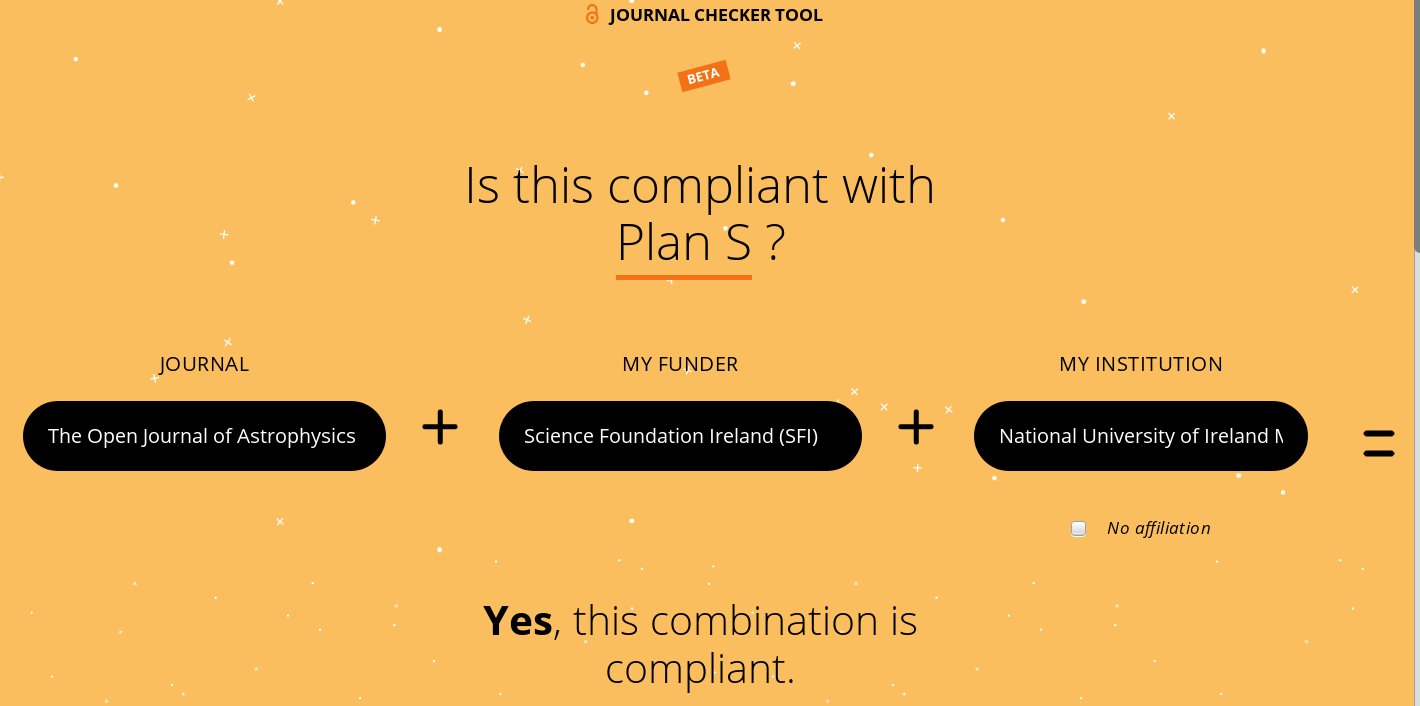
Those nice people at cOAlition S have produced a new online tool that allows authors to check whether a given academic journal complies with the requirements of Plan S as they apply to a given funder and institution. For information on how ot works see here. For the actual tool (beta version) see here.

Obviously I checked how it applies to the Open Journal of Astrophysics and here’s an example result!

New Publication at the Open Journal of Astrophysics!

Posted in OJAp Papers, Open Access, The Universe and Stuff with tags , , , , , , , on March 13, 2020 by telescoper

Well Maynooth University may have shut down but the The Open Journal of Astrophysics certainly has not.

In fact we have just published another paper! This one is called Halo Spins from Primordial Inner Motions and the first author is Mark Neyrinck (based in Bilbao). The other authors are Miguel Aragon-Calvo (based in Mexico), Bridget Falck and Alex Szalay (based in the USA) and Jie Wang (China).

Here is a grab of the overlay:

You can find the arXiv version of the paper here.

As an added bonus there are some groovy videos to go with this paper:

You might have to read the paper, however, to understand exactly what they mean (although they are very pretty anyway).

New Publication at the Open Journal of Astrophysics!

Posted in OJAp Papers, Open Access, The Universe and Stuff with tags , , , , , , on January 8, 2020 by telescoper

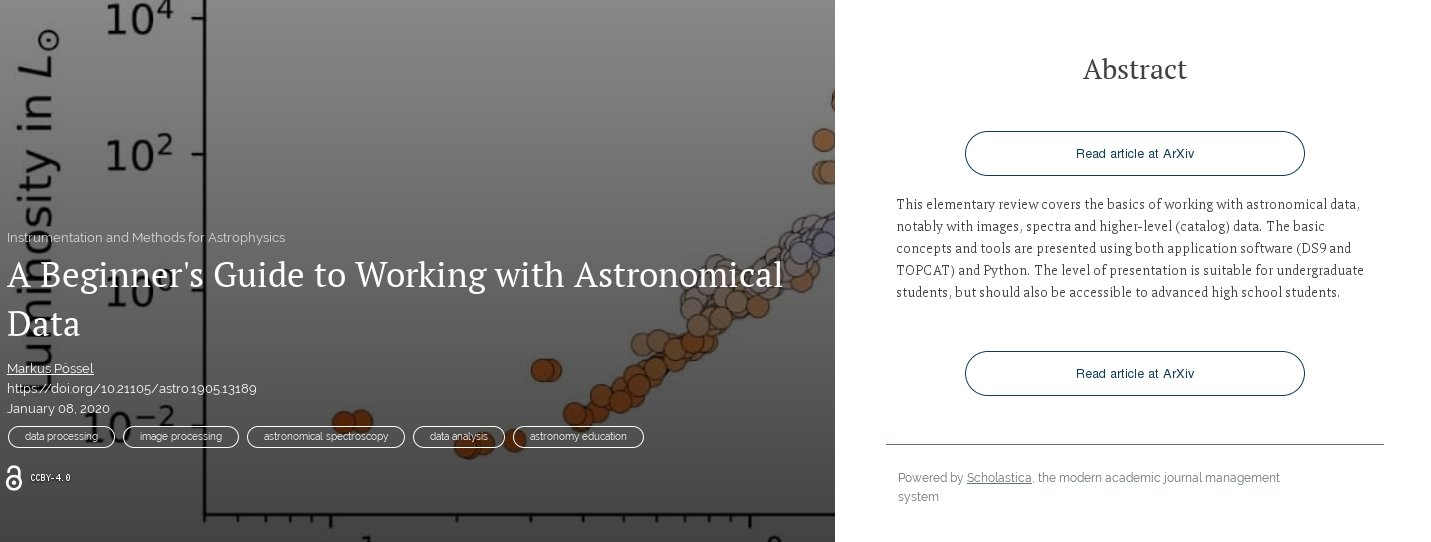
It’s two in two days because we have published another new paper at The Open Journal of Astrophysics. The title is A Beginner’s Guide to working with Astronomical Data. Here is a grab of the overlay:

You can find the arXiv version of the paper here.

The author is Markus Pössel of the Haus der Astronomie at the Max Planck Institute for Astronomy in Heidelberg (Germany). This is a long paper – 71 pages with over a hundred figures – that gives a comprehensive introduction to the various kinds of astronomical data and techniques for working with such data. I think this paper will attract a lot of interest from many different kinds of people but it will be particularly interesting to students doing undergraduate projects involving astronomical data (and their supervisors).

Another point worth noting is that there’s a small addition to the overlay for this paper, which will apply to all future papers (and retrospectively once we have worked through the back catalogue) and that is in the bottom left of the image above. It shows that the article is published with the latest form of Creative Commons License (CC-BY-4.0). It has always been our policy to publish under a CC-BY licence but Scholastica have very helpfully set up a new facility to make this explicit on each page. This is part of our efforts to ensure that we are compliant with Plan S which makes CC-BY licenses mandatory.

UPDATE: the CC-BY-4.0 license has now been applied retrospectively to all our publications.

The Open Journal of Astrophysics: Scholastica Webinar and Plan S

Posted in Open Access, The Universe and Stuff with tags , , on September 13, 2019 by telescoper

Just a quick post to advertise the fact that I’ve been invited by Scholastica to do a webinar (whatever that is) about the Open Journal of Astrophysics, which will involved a short presentation delivered over the interwebs jointly by myself and Fiona Morley (Head of Digital Programmes and Information Systems at Maynooth University Library), followed by a question and answer session. The session will be conducted via Zoom (which is the pretty neat platform we use, e.g., for Euclid teleconference meetings).

Here is the advert:

You can sign up here.

While I’m on the subject(s) of Scholastica and the Open Journal of Astrophysics, I thought I’d add a bit of news about Plan S. Scholastica has been working hard behind the scenes to develop a roadmap that will enable its journals to become compliant with Plan S. The roadmap is here. Three important landmarks on it are:

  • Core machine-readable XML metadata in the JATS standard for all articles
  • Automated Digital Object Identifier (DOI) registration through Crossref
  • Automated metadata, including funding sources, deposited into major indexes and archives including DOAJ and Portico

Currently we do some of these manually for each article, and it’s nice to see that Scholastica is intending to provide these services automatically which will save us (i.e. me) a considerable amount of fiddling about!


Plan S and the Open Journal of Astrophysics

Posted in Open Access with tags , , , , on June 24, 2019 by telescoper

Things have been a little quiet on this side of the Open Journal of Astrophysics but rest assured it has been very busy behind the scenes, with a sizeable batch of papers going through peer review and a number of those are very near the finishing post.

My target was to build up to an average of about one submission a week by the end of 2019, and I think we’re on track to reach that comfortably by the end of summer.

I’ll report more on new publications as they are published, but before that I thought I’d report on a couple of bits of news to do with Plan S, following the issuance last month of revised guidelines.

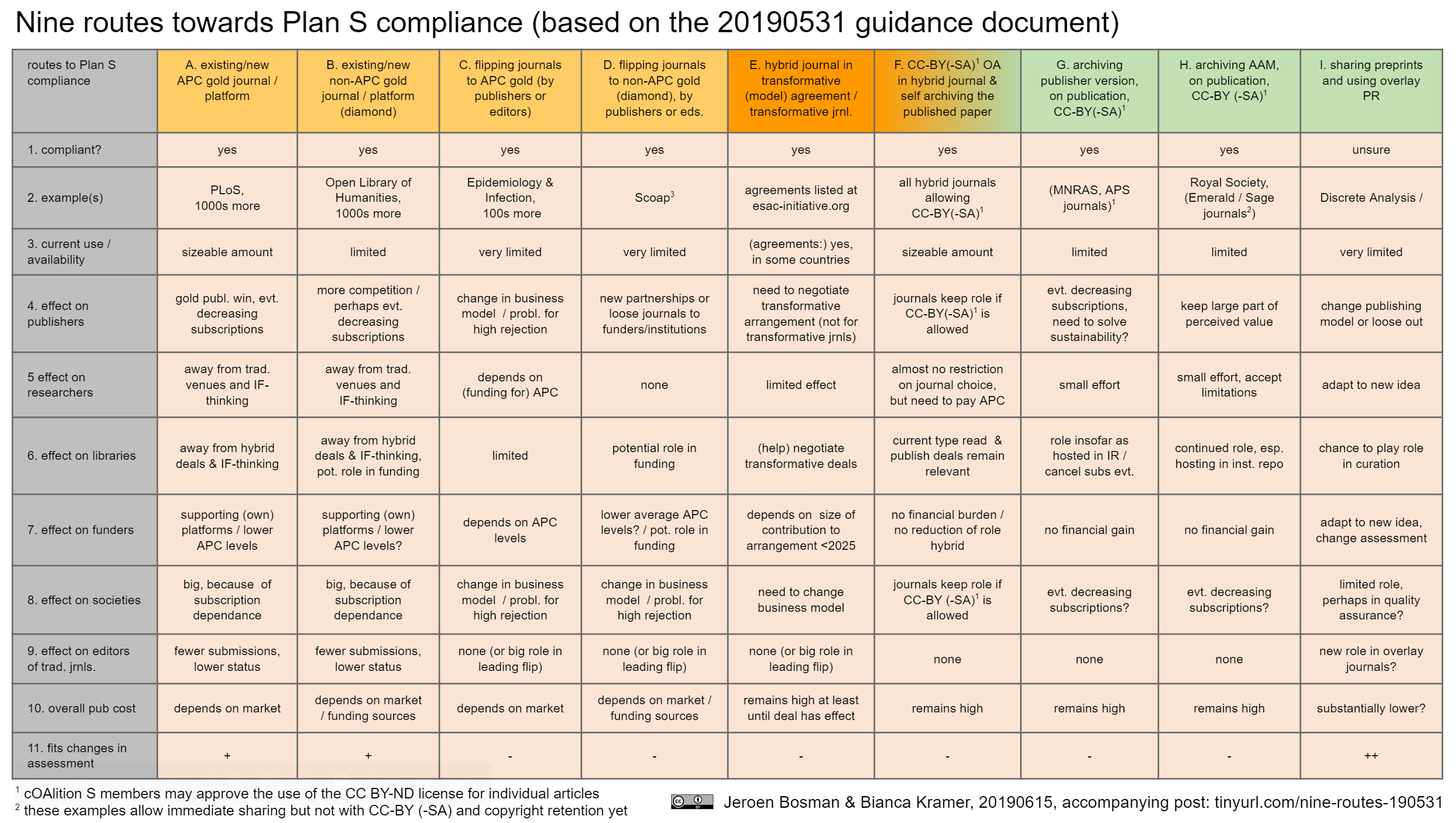
First, here is a nice summary (taken from this article) of the different ways in principle one could deliver Open Access publishing in a manner consistent with Plan S:

You can click on the image to make it bigger.

The important thing is that the Open Journal of Astrophysics belongs in the column on the far right of the table. I draw your attention to the various comments, especially the one at the end that says the cost of overlay journals is substantially lower. It is, as I explain here.

the authors of this post think it is unclear whether these are compliant with Plan S. That’s a fair comment, but it can be clarified into a definite yes with very few tweaks. It is very encouraging on this point that the CEO of Scholastica (who provide our platform) has written a blog in which he describes the steps being taken to ensure that all Scholastica journals are indeed compliant with Plan S.

Over the coming months, we will announce new functionality that supports complying with Plan S guidelines, and we’re committed to updating our software to meet changes to the Plan S implementation rules as they come out.

I was very happy to read this plan as it includes adding a number of things to the Scholastica system that we currently have to do ourselves (e.g. registering DOIs with CrossRef).

Anyway, another notification from Scholastica has just come in so that will have to be that for now.


Open Access Publishing: Plan S Update

Posted in Open Access with tags , on May 31, 2019 by telescoper

I haven’t had time to go through the details yet, but yesterday saw the release of revised Principles and Implemenation for Plan S, which I have blogged about before, e.g. here. There’s also a rationale for the changes here.

For those of you who have never heard of Plan S, it For those that haven’t it is a proposal by funding agencies from 11 European Nations to give the public free access to publicly funded science. The 11 countries involved in this initiative are: France, Italy, Austria, Ireland, Luxembourg, the Netherlands, Norway, Poland, Slovenia, Sweden, and the UK. Together, these nations compise `cOAlition S’ – the `OA’ is for `Open Access’ – to carry out the plan.

The principal change is that the deadline for implementation has been moved back a year, which is sensible as the original deadline of January 2020 was never going to be feasible. The principal principle is however unchanged:

With effect from 2021, all scholarly publications on the results from research funded by public or private grants provided by national, regional and international research councils and funding bodies, must be published in Open Access Journals, on Open Access Platforms, or made immediately available through Open Access Repositories without embargo.

I’ll go through the revised guidelines when I get time but in the meantime if you can are so minded you can read them yourself and comment thereon through the comments box below.

The future of journal publishing here today – Guest Post by Syksy Räsänen

Posted in Open Access with tags , , , , on February 8, 2019 by telescoper

You may recall that the Open Journal of Astrophysics recently published a paper by Syksy Räsänen of the University of Helsinki. I invited Syksy to write a blog post on the Open Journal for Astrophysics about why he chose to publish with us, and I’m delighted to say that his post is now available there and, with the author’s permission, I am reproducing it below on this blog. It’s also available at Syksy’s own blog . It’s quite a long post, but there is some very interesting information in it, which will probably surprise you!

—0—

The bad news:: the scientific community can no longer afford commercial science journals.

The good news: the scientific community no longer needs commercial science journals.

The bottom line: open internet archives and overlay journals are the solution.

Scientific journal publishing is in crisis. Already 25 years ago librarians referred to the rising costs of journals as a “doomsday machine”. In 2012, Harvard University Library announced that it can no longer afford scientific journals, warning that publishers had created a “fiscally unsustainable” situation. The library took the unprecedented step of asking faculty to resign from publications that keep articles behind paywalls.

In its 2015 Open Access Policy White Paper, the Max Planck Digital Library assessed the annual revenue of scientific journal publishing as 7.6 billion euros. Divided by an estimated 1.5-2.0 million published articles, they arrived at a cost of €3800 to €5000 per article. The International Association of Scientific, Technical and Medical Publishers has estimated $10 billion in revenue and 2.5 million articles annually, which gives €3500 per article. According to them, 68-75% of the costs are borne by academic libraries.

These are enormous sums, funnelled from science to the pockets of large corporations. (Some journals are published by scientific societies, but this doesn’t change the overall picture.)

To put the numbers in perspective, the total construction cost of the Large Hadron Collider at CERN –the largest scientific experiment in the history of humanity–was around 5 billion euros, or 500 million euros per year. The cost of science publishing would cover the construction of 10 to 20 top-of-the-line successor experiments to the LHC. It is equivalent to the salaries and overheads of 150,000 to 200,000 postdoctoral researchers per year. This is likely more than the combined number of postdocs in the United States and the European Union.

Scientific publishing is a strange business. Scientists carry out research for free, write it up for free, give the article to the publisher for free, manage the peer review process as editors (some editors get paid), do peer-review for the publisher for free – and then the scientists’ institutions pay the publisher so that they can read the articles. In some cases scientists even pay the publisher to have their articles published. (Here “free” simply means the scientists are not paid by the publisher, but rather by their university or research institute – in the end, mostly by taxpayers.)

Is there any other industry where corporations pay nothing for the raw materials, have negligible processing costs and enjoy a captive market that automatically buys everything they produce? This setup leads to record profits. For example, the profit margin of Elsevier’s Scientific, Technical & Medical publishing division in the years 1991-2013 was consistently over 30%, and in 2013 it was 39%. For comparison, in the same year Apple, Google and Microsoft had profit margins of 22%, 20% and 28%, respectively. No wonder Robert Maxwell, a pioneer of scientific journal publishing, described the business as a “perpetual financing machine”.

In the past, publishers at least had the expenses of printing and shipping journals. With the internet, this cost has disappeared for many journals. However, prices have not come down – quite the opposite. Thankfully, the same technological advances that have made commercial journals so profitable have also rendered them unnecessary.

Journals used to be needed for registering and communicating research, for archiving it (via paper journals in libraries), and for performing quality control via peer review. In cosmology and particle physics, the first three services have been provided by the internet archive arXiv since 1991. Depositing articles to arXiv is free, and they can be read for free in perpetuity. In 2018, 140,616 articles appeared on arXiv, and its estimated total expenditures were $1,915,997, or 12€ per article. Other disciplines, such as economics and biology, have followed suit, either starting new categories on arXiv or setting up their own archives such as bioRxiv. There is no reason why this model cannot be extended to all fields of science.

A lot of discussion around the cost of journals centred on open access, so it is important to emphasise one thing: the issue is not open access. That problem has been solved by arXiv 27 years ago. The question is how to organise peer review in a cost-effective manner. This is where overlay journals come in.

The idea of overlay journals is simple: they are journals that concentrate on the only thing journals are needed for anymore, namely peer review. As articles appear on arXiv (or other online archives) anyway, there is no need to duplicate their work. An overlay journal has a website where papers (typically already available on arXiv) can be submitted. Peer review is conducted as usual, and in case of acceptance, the final version of the paper is updated on arXiv, with a journal reference and DOI link to the journal website.

Custom toolkits for overlay journals have been designed for more than 10 years, for example in the astrophysics RIOJA project. These days the necessary software is also available off the shelf from Scholastica. The service costs $99 per month plus $10 per submitted article, and getting a DOI from Crossref costs $1 per published article. As in the case of arXiv, the costs scale well with the number of papers. If a journal publishes 100 articles annually and has a 2/3 rejection rate, the cost works out to €38 per article – about 100 times less than the sum currently paid for article publishing.

Given that open archives and overlay journals could save 7 to 9 billion euros every year, why haven’t they already replaced commercial journals?

Unfortunately, the existence of a more optimal configuration does not automatically lead the community to shift there. Instead, people respond to individual incentives, and scientists are no exception. The publishing peer Robert Maxwell noted that “scientists are not as price-conscious as other professionals, mainly because they are not spending their own money”. As journal fees are paid centrally, there is little motivation for an individual researcher to change their publication pattern. Established journals are seen to provide a quality stamp that is necessary in the competition over positions and grants. Also, founding an overlay journal requires an investment of time that does not necessarily yieldproportionate professional rewards.

So researchers as individuals have rational reasons for not changing the system. What about libraries and scientific consortia that are struggling to bring the costs down? Unfortunately, institutional efforts have often concentrated on the narrow problem of getting journals to accept payment from the author rather than the reader (i.e. open access). However, the main issue is not whether the money is paid by the author or the reader (or rather their institutions), but what they are paying for.

Thus, for example, the SCOAP3 consortium has become part of the problem by providing life support to commercial journals. It has arranged to pay publishers vast amounts of money, entirely incommensurate with the actual costs, to make articles open access, guaranteeing them a steady stream of revenue.

The open access initiative Plan S launched last September is more ambitious. Particularly noteworthy is the commitment to provide incentives to establish new open access journals and platforms. However, open archives are only “acknowledged because of their long-term archiving function and their potential for editorial innovation”, not as publishing channels of their own right when paired with overlay journals. A lot depends on how the initiative will be implemented, but for now the scheme seems to focus on the old-fashioned aim of getting commercial publishers to convert journals to open access.

According to the Max Planck Digital Library White Paper, switching all commercial journals to an open access model would drop the cost of publication to between €1,100 and €2,000 per article. This would cut expenditures by a factor of 2 to 5, saving billions of euros every year – and continuing to waste billions of euros every year.

It is striking that the principles of Plan S contain no commitment to maximising the returns on public money and optimising financial sustainability, even though this is the heart of the matter. Instead, it supports the continuation of the commercial publishing model in co-operation with corporations, whose interests are at odds with those of the scientific community. We do not need to reform the business model of scientific journal publishing, we have to abandon it.

Open access consortia should start supporting a publishing model that begins from the needs of the scientific community and aims to fulfil them in an economical manner, while helping to make the transition as smooth as possible. This involves communicating with scientists about the costs of corporate publishing, following and expanding on Harvard’s example of calling on scientists to use the power of their labour (often given to the publishers for free) to change the situation, and providing incentives and support to establish and publish in overlay journals. Scientists, in turn, need to re-evaluate their brand loyalty to established journals, and give appropriate career merits for time spent on changing the publishing system.

Open archives and overlay journals are not a utopian solution for the future. Discrete Analysis, Open Journal of Astrophysics and others are publishing already. They are a proven model for open access publishing and quality peer review in a modern, cost-effective manner tailored to the needs of the scientific community. The sooner they become the new standard, the more money we will save for science.

Plan S – Get your feedback in!

Posted in Open Access with tags , , on February 4, 2019 by telescoper

It’s been a rather busy first day back at teaching, and I’m a bit tired after my first Engineering Mathematics lecture, so I’ll just post a couple of quick items on the topic of Open Access Publishing.

The most important thing is a reminder that the deadline for submission of feedback on the Plan S proposals is February 8th 2019, which is this Friday so please get your finger out and submit feedback.

I haven’t written my feedback yet, but when I do I will post it here.

The nice people at the arXiv have already sent in their feedback, and have released it publicly here. There’s a lot of good sense in their comments, which I encourage you to read.

In particular I agree with their comment that the reference XML should be removed. I agree very much with the principle underlying the decision by CoalitionS to include this, I don’t think mandating XML is a sensible way forward. For one thing, it is not a useful format when a paper contains lots of figures and mathematical equations. It’s not that it is particularly difficult to do, just that it’s a waste of time for mathematical disciplines. We could implement a fix to make XML versions of papers available on the Open Journal of Astrophysics, but I’m not going to do it unless and until it’s made obligatory (which I hope it isn’t).

Finally, let me just point out that Scholastica have chosen the latest publication in the Open Journal of Astrophysics as an article highlight!