Archive for Poetry

A Poem for St David’s Day

Posted in Poetry with tags , , , on March 1, 2019 by telescoper

It’s St David’s Day today, and a lovely spring morning it is, so I wish you all a big

Dydd Gŵyl Dewi Hapus!


Gratuitous Picture of some Daffodils near the Maynooth University Library.

It has become a bit of a St David’s Day tradition on this this blog to post a piece of verse by the great Welsh poet R.S. Thomas. An Anglican clergyman, Thomas was vicar at St Hywyn’s Church (which was built 1137) in Aberdaron at the western tip of the Llŷn Peninsula. In this, one of his most famous poems, he speaks eloquently and movingly of the frustrations of his calling.

I was vicar of large things
in a small parish. Small-minded
I will not say, there were depths
in some of them I shrank back
from, wells that the word “God”
fell into and died away,
and for all I know is still
falling. Who goes for water
to such must prepare for a long
wait. Their eyes looked at me
and were the remains of flowers
on an old grave. I was there,
I felt, to blow on ashes
that were too long cold. Often,
when I thought they were about
to unbar to me, the draught
out of their empty places
came whistling so that I wrapped
myself in the heavier clothing
of my calling, speaking of light and love
in the thickening shadows of their kitchens

The Arrival of the Bee Box

Posted in Literature with tags , , , on January 9, 2019 by telescoper

I ordered this, clean wood box
Square as a chair and almost too heavy to lift.
I would say it was the coffin of a midget
Or a square baby
Were there not such a din in it.

The box is locked, it is dangerous.
I have to live with it overnight
And I can’t keep away from it.
There are no windows, so I can’t see what is in there.
There is only a little grid, no exit.

I put my eye to the grid.
It is dark, dark,
With the swarmy feeling of African hands
Minute and shrunk for export,
Black on black, angrily clambering.

How can I let them out?
It is the noise that appalls me most of all,
The unintelligible syllables.
It is like a Roman mob,
Small, taken one by one, but my god, together!

I lay my ear to furious Latin.
I am not a Caesar.
I have simply ordered a box of maniacs.
They can be sent back.
They can die, I need feed them nothing, I am the owner.

I wonder how hungry they are.
I wonder if they would forget me
If I just undid the locks and stood back and turned into a tree.
There is the laburnum, its blond colonnades,
And the petticoats of the cherry.

They might ignore me immediately
In my moon suit and funeral veil.
I am no source of honey
So why should they turn on me?
Tomorrow I will be sweet God, I will set them free.

The box is only temporary.

by Sylvia Plath (1932-1963)


Fourier, Hamilton and Ptolemy

Posted in History, Poetry, The Universe and Stuff with tags , , , , , , , on December 17, 2018 by telescoper

As we stagger into the last week of term I find myself with just two lectures to give in my second-year module on Vector Calculus and Fourier Series. I didn’t want to present the two topics mentioned in the title as disconnected, so I linked them in a lecture in which I used the divergence theorem of vector calculus to derive the heat equation, the solution of which led Joseph Fourier to devise his series in Mémoire sur la propagation de la chaleur dans les corps solides (1807), a truly remarkable work for its time that inspired so many subsequent developments.

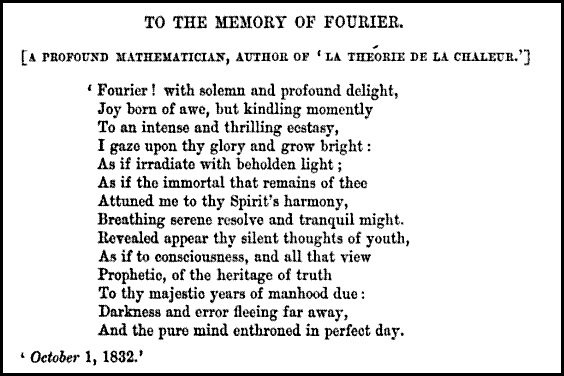
Fourier’s work was so influential and widely admired that it inspired a famous Irish mathematician William Rowan Hamilton to write the following poem:

Hamilton-for Fourier

The serious thing that strikes me is not the quality of the verse, but how many scientists of the 19th Century, Hamilton included, saw their scientific interrogation of Nature as a manifestation of the human condition just as the romantic poets saw their artistic contemplation and how many poets of the time were also interested in science.

Anyway I was looking for nice demonstrations of Fourier series to help my class get to grips with them when I remembered this little video recommended to me some time ago by esteemed Professor George Ellis. It’s a nice illustration of the principles of Fourier series, by which any periodic function can be decomposed into a series of sine and cosine functions.

This reminds me of a point I’ve made a few times in popular talks about Astronomy. It’s a common view that Kepler’s laws of planetary motion according to which which the planets move in elliptical motion around the Sun, is a completely different formulation from the previous Ptolemaic system which involved epicycles and deferents and which is generally held to have been much more complicated.

The video demonstrates however that epicycles and deferents can be viewed as the elements used in the construction of a Fourier series. Since elliptical orbits are periodic, it is perfectly valid to present them in the form a Fourier series. Therefore, in a sense, there’s nothing so very wrong with epicycles. I admit, however, that a closed-form expression for such an orbit is considerably more compact and elegant than a Fourier representation, and also encapsulates a deeper level of physical understanding.

Winter Garden, by Patrick Kavanagh

Posted in Poetry with tags , , , on December 11, 2018 by telescoper

No flowers are here
No middle-class vanities –
Only the decapitated shanks
Of cabbages
And prostrate
On a miserable ridge
Bean-stalks.

by Patrick Kavanagh (1904-1967)


Arms and the Boy, by Wilfred Owen (who died on 4th November 1918)

Posted in Poetry with tags , , , on November 4, 2018 by telescoper

Wilfred Owen, probably the greatest poet of the First World War, died precisely 100 years ago today, on 4th November 1918, aged 25, just one week before the Armistice that brought the war to an end. I am posting this poem in his memory.

Let the boy try along this bayonet-blade
How cold steel is, and keen with hunger of blood;
Blue with all malice, like a madman’s flash;
And thinly drawn with famishing for flesh.

Lend him to stroke these blind, blunt bullet-leads,
Which long to nuzzle in the hearts of lads,
Or give him cartridges of fine zinc teeth
Sharp with the sharpness of grief and death.

For his teeth seem for laughing round an apple.
There lurk no claws behind his fingers supple;
And God will grow no talons at his heels,
Nor antlers through the thickness of his curls.

by Wilfred Owen (1893-1918).

Especially when the October Wind

Posted in Poetry with tags , , on October 15, 2018 by telescoper

Especially when the October wind
With frosty fingers punishes my hair,
Caught by the crabbing sun I walk on fire
And cast a shadow crab upon the land,
By the sea’s side, hearing the noise of birds,
Hearing the raven cough in winter sticks,
My busy heart who shudders as she talks
Sheds the syllabic blood and drains her words.

Shut, too, in a tower of words, I mark
On the horizon walking like the trees
The wordy shapes of women, and the rows
Of the star-gestured children in the park.
Some let me make you of the vowelled beeches,
Some of the oaken voices, from the roots
Of many a thorny shire tell you notes,
Some let me make you of the water’s speeches.

Behind a pot of ferns the wagging clock
Tells me the hour’s word, the neural meaning
Flies on the shafted disk, declaims the morning
And tells the windy weather in the cock.
Some let me make you of the meadow’s signs;
The signal grass that tells me all I know
Breaks with the wormy winter through the eye.
Some let me tell you of the raven’s sins.

Especially when the October wind
(Some let me make you of autumnal spells,
The spider-tongued, and the loud hill of Wales)
With fists of turnips punishes the land,
Some let me make you of the heartless words.
The heart is drained that, spelling in the scurry
Of chemic blood, warned of the coming fury.
By the sea’s side hear the dark-vowelled birds.

by Dylan Thomas (1914-1953)


On His Queerness

Posted in Poetry with tags , , on August 2, 2018 by telescoper

When I was young and wanted to see the sights,
They told me: ‘Cast an eye over the Roman Camp
If you care to.
But plan to spend most of your day at the Aquarium –
Because, after all, the Aquarium –
Well, I mean to say, the Aquarium –
Till you’ve seen the Aquarium you ain’t seen nothing.’

So I cast my eye over
The Roman Camp –
And that old Roman Camp,
That old, old Roman Camp
Got me
Interested.

So that now, near closing-time,
I find that I still know nothing –
And am still not even sorry that I know nothing –
About fish.

by Christopher Isherwood (1904-1986)


The Old Stoic – by Emily Jane Brontë

Posted in Literature, Poetry with tags , , , on July 30, 2018 by telescoper

Today, 30th July 2018, is the 200th anniversary of the birth of Emily Jane Brontë. There are many items celebrating her life in circulation on this day, most of them concentrating on her most famous work, her only novel Wuthering Heights, published under the pseudonym Ellis Bell in 1847. But Emily Brontë was also a fine poet, as indeed were her sisters Anne and Charlotte, so I thought I’d post a poem by her here. Much of her poetry is dominated by images of death and suffering, and her own health was affected by the harsh conditions in which she lived; she died of tuberculosis at the at the age of just 30.

Riches I hold in light esteem,
And Love I laugh to scorn;
And lust of fame was but a dream,
That vanished with the morn:

And if I pray, the only prayer
That moves my lips for me
Is, “Leave the heart that now I bear,
And give me liberty!”

Yes, as my swift days near their goal:
‘Tis all that I implore;
In life and death a chainless soul,
With courage to endure.

Have A Nice Day, by Spike Milligan

Posted in Poetry with tags , , on April 17, 2018 by telescoper

‘Help, help,’ said a man. ‘I’m drowning.’
‘Hang on,’ said a man from the shore.
‘Help, help,’ said the man. ‘I’m not clowning.’
‘Yes, I know, I heard you before.
Be patient dear man who is drowning,
You, see I’ve got a disease.
I’m waiting for a Doctor J. Browning.
So do be patient please.’
‘How long, ‘ said the man who was drowning,
‘Will it take for the Doc to arrive? ‘
‘Not very long,’ said the man with the disease,
‘Till then try staying alive.’
‘Very well,’ said the man who was drowning.
‘I’ll try and stay afloat.
By reciting the poems of Browning
And other things he wrote.’
‘Help, help,’ said the man with the disease,
‘I suddenly feel quite ill.’
‘Keep calm.’ said the man who was drowning,
‘Breathe deeply and lie quite still.’
‘Oh dear,’ said the man with the awful disease.
‘I think I’m going to die.’
‘Farewell,’ said the man who was drowning.
Said the man with the disease, ‘goodbye.’
So the man who was drowning, drownded
And the man with the disease passed away.
But apart from that,
And a fire in my flat,
It’s been a very nice day.

by Spike Milligan (1918-2002)


A Man’s a Man for a’ that – Robert Burns

Posted in Poetry with tags , , , , on January 25, 2018 by telescoper

Is there for honest Poverty
That hings his head, an’ a’ that;
The coward slave-we pass him by,
We dare be poor for a’ that!
For a’ that, an’ a’ that.
Our toils obscure an’ a’ that,
The rank is but the guinea’s stamp,
The Man’s the gowd for a’ that.

What though on hamely fare we dine,
Wear hoddin grey, an’ a that;
Gie fools their silks, and knaves their wine;
A Man’s a Man for a’ that:
For a’ that, and a’ that,
Their tinsel show, an’ a’ that;
The honest man, tho’ e’er sae poor,
Is king o’ men for a’ that.

Ye see yon birkie, ca’d a lord,
Wha struts, an’ stares, an’ a’ that;
Tho’ hundreds worship at his word,
He’s but a coof for a’ that:
For a’ that, an’ a’ that,
His ribband, star, an’ a’ that:
The man o’ independent mind
He looks an’ laughs at a’ that.

A prince can mak a belted knight,
A marquis, duke, an’ a’ that;
But an honest man’s abon his might,
Gude faith, he maunna fa’ that!
For a’ that, an’ a’ that,
Their dignities an’ a’ that;
The pith o’ sense, an’ pride o’ worth,
Are higher rank than a’ that.

Then let us pray that come it may,
(As come it will for a’ that,)
That Sense and Worth, o’er a’ the earth,
Shall bear the gree, an’ a’ that.
For a’ that, an’ a’ that,
It’s coming yet for a’ that,
That Man to Man, the world o’er,
Shall brothers be for a’ that.

by Robert Burns (1759-1796)