Archive for Poetry

Hamiltonian Poetry

Posted in Poetry, The Universe and Stuff with tags , , , , , , on January 8, 2018 by telescoper

I posted a couple of items last week inspired by thoughts of the mathematician William Rowan Hamilton. Another thing I thought I might mention about Hamilton is that he also wrote poetry, and since both science and poetry feature quite regularly on this blog I thought I’d share an example.

In fact during the `Romantic Era‘ (in which Hamilton lived) many scientists wrote poetry related either to their work or to nature generally. One of the most accomplished of these scientist-poets was chemist and inventor Humphry Davy who, inspired by his friendship with the poets Wordsworth and Coleridge, wrote poems throughout his life. Others to do likewise were: physician Erasmus Darwin; and astronomer William Herschel (who was also a noted musician and composer),

William Rowan Hamilton interests me because seems to have been a very colourful character as well as a superb mathematician, and because his work relates directly to physics and is still widely used today. Interestingly, he was a very close friend of William Wordsworth, to whom he often sent poems with requests for comments and feedback. In the subsequent correspondence, Wordsworth was usually not very complimentary, even to the extent of telling Hamilton to stick to his day job (or words to that effect). What I didn’t know was that Hamilton regarded himself as a poet first and a mathematician second. That just goes to show you shouldn’t necessarily trust a man’s judgement when he applies it to himself.

Here’s an example of Hamilton’s verse – a poem written to honour Joseph Fourier, another scientist whose work is still widely used today:
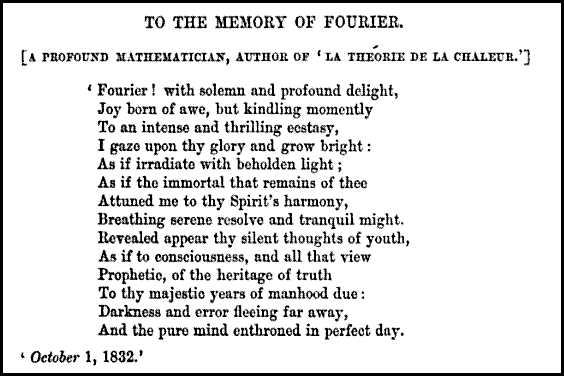
Hamilton-for Fourier

If that’s one of his better poems, then I think Wordsworth may have had a point!

The serious thing that strikes me is not the quality of the verse, but how many scientists of the 19th Century, Hamilton included, saw their scientific interrogation of Nature as a manifestation of the human condition just as the romantic poets saw their artistic contemplation. It is often argued that romanticism is responsible for the rise of antiscience. I’m not really qualified to comment on that but I don’t see any conflict at all between science and romanticism. I certainly don’t see Wordsworth’s poetry as anti-scientific. I just find it inspirational:

I HAVE seen
A curious child, who dwelt upon a tract
Of inland ground, applying to his ear
The convolutions of a smooth-lipped shell;
To which, in silence hushed, his very soul
Listened intensely; and his countenance soon
Brightened with joy; for from within were heard
Murmurings, whereby the monitor expressed
Mysterious union with its native sea.
Even such a shell the universe itself
Is to the ear of Faith; and there are times,
I doubt not, when to you it doth impart
Authentic tidings of invisible things;
Of ebb and flow, and ever-during power;
And central peace, subsisting at the heart
Of endless agitation.

Love in the Asylum

Posted in Poetry with tags , , on January 2, 2018 by telescoper

A stranger has come
To share my room in the house not right in the head,
A girl mad as birds

Bolting the night of the door with her arm her plume.
Strait in the mazed bed
She deludes the heaven-proof house with entering clouds

Yet she deludes with walking the nightmarish room,
At large as the dead,
Or rides the imagined oceans of the male wards.

She has come possessed
Who admits the delusive light through the bouncing wall,
Possessed by the skies

She sleeps in the narrow trough yet she walks the dust
Yet raves at her will
On the madhouse boards worn thin by my walking tears.

And taken by light in her arms at long and dear last
I may without fail
Suffer the first vision that set fire to the stars.

by Dylan Thomas (1914-1953)

Gravity begins at home

Posted in Music, Poetry with tags , , on November 30, 2017 by telescoper


The Stare’s Nest

Posted in Poetry with tags , , , , on November 28, 2017 by telescoper

The bees build in the crevices
Of loosening masonry, and there
The mother birds bring grubs and flies.
My wall is loosening; honey-bees,
Come build in the empty house of the stare.

We are closed in, and the key is turned
On our uncertainty; somewhere
A man is killed, or a house burned,
Yet no cleat fact to be discerned:
Come build in he empty house of the stare.

A barricade of stone or of wood;
Some fourteen days of civil war;
Last night they trundled down the road
That dead young soldier in his blood:
Come build in the empty house of the stare.

We had fed the heart on fantasies,
The heart’s grown brutal from the fare;
More Substance in our enmities
Than in our love; O honey-bees,
Come build in the empty house of the stare.

by William Butler Yeats (1865-1939)

I Grant You Ample Leave

Posted in Poetry with tags , , , on September 28, 2017 by telescoper

“I grant you ample leave
To use the hoary formula ‘I am’
Naming the emptiness where thought is not;
But fill the void with definition, ‘I’
Will be no more a datum than the words
You link false inference with, the ‘Since’ & ‘so’
That, true or not, make up the atom-whirl.
Resolve your ‘Ego’, it is all one web
With vibrant ether clotted into worlds:
Your subject, self, or self-assertive ‘I’
Turns nought but object, melts to molecules,
Is stripped from naked Being with the rest
Of those rag-garments named the Universe.
Or if, in strife to keep your ‘Ego’ strong
You make it weaver of the etherial light,
Space, motion, solids & the dream of Time–
Why, still ’tis Being looking from the dark,
The core, the centre of your consciousness,
That notes your bubble-world: sense, pleasure, pain,
What are they but a shifting otherness,
Phantasmal flux of moments?–“

by George Eliot (1819-1880)


Nothing, by Basil Bunting

Posted in Poetry with tags , , on September 4, 2017 by telescoper

I spent this weekend catching up with some old friends in London, and making the most of the opportunity to behave as a tourist. Most of my visits to the Capital are on business so it was nice to have the chance to wander around aimlessly. Anyway, when I got to Charing Cross I suddenly remembered I had a half-spent book token in my wallet, so popped into Foyles and bought this hefty tome, which had been on my list since I read about it when it was reviewed in TLS.

Basil Bunting was born in 1900 in the Scotswood area of Newcastle upon Tyne (i.e. not in the Midlands). His life story is fascinating. Imprisoned as a conscientious objector during World War 1, Bunting worked for the intelligence services in Persia during World War 2, after which he remained as the Times Correspondent in Iran. Eventually, after much travelling, he returned to England, winding up as a journalist working for the Newcastle Evening Chronicle. Largely through a very long poem called Briggflats Bunting established a reputation as a very important modernist poet who some felt was a worthy successor to T.S. Eliot, though Eliot did not rate his work particularly highly and Bunting’s main poetic influence was clearly Ezra Pound.

One thing I particularly like about the poems of Basil Bunting is that they sound so great when read out loud. `Compose aloud. Poetry is a sound.’ is a famous quotation of his. Unlike many poets he was utterly compelling when reading his own work ; see here for an excerpt of him reading Briggflats. He has a wonderful voice, and there’s music in the way he speaks.

Briggflats  is too long to reproduce here, so here’s a shorter one called Nothing:

Nothing
substance utters or time
stills and restrains
joins design and

supple measure deftly
as thought’s intricate polyphonic
score dovetails with the tread
sensuous things
keep in our consciousness.

Celebrate man’s craft
and the word spoken in shapeless night, the
sharp tool paring away
waste and the forms
cut out of mystery!

When taut string’s note
passes ears’ reach or red rays or violet
fade, strong over unseen
forces the word
ranks and enumerates…

mimes clouds condensed
and hewn hills and bristling forests,
steadfast corn in its season
and the seasons
in their due array,

life of man’s own body
and death…
The sound thins into melody,
discourse narrowing, craft
failing, design
petering out.

Ears heavy to breeze of speech and
thud of the ictus.


by Basil Bunting (1900-85).

August, a poem by Viggo Stuckenberg

Posted in Poetry with tags , , , on August 1, 2017 by telescoper

Hr. Preben pusler i Skovens Bryn,
fæster Doner, binder Bær, Bær saa rosenrøde,
bryder et Blad og bøjer en Kvist,
at liflig de Bær kunne gløde.

‘Kramsfugl! Kramsfugl! nu er det Tid!
Falder Havren, synger Segl over alle Agre,
bliver ej større en eneste Blomst,
ej Lundene mere fagre!

Gunild! Gunild! nu gulnes goldt
alle Løfter, al Lokken, al Leg fra Skærsommer!
Viger den Haand, som ikke jeg greb,
og aldrig vi sammen kommer!

Thi længst er leden den lyse Vaar,
levnet Nætter i Mulm, levnet flygtende Fugle!
Den, som ved det, maa sidde kvær
og skogre som gammel Ugle!’

Hr. Preben pusler i Skovens Bryn,
fæster Doner, binder Bær, Bær saa lifligt røde:
‘Kramsfugl! Dig sender jeg hende kvalt
og ler stor Elskov til Døde!’

by Viggo Stuckenberg (1863-1905)


The Dead Statesman

Posted in Poetry, Politics with tags , , on July 21, 2017 by telescoper

I could not dig; I dared not rob:
Therefore I lied to please the mob.
Now all my lies are proved untrue
And I must face the men I slew.
What tale shall serve me here among
Mine angry and defrauded young?

by Rudyard Kipling (1865-1936)

It isn’t Time that’s passing

Posted in Poetry with tags , , on June 23, 2017 by telescoper

Remember the long ago when we lay together
In a pain of tenderness and counted
Our dreams: long summer afternoons
When the whistling-thrush released
A deep sweet secret on the trembling air;
Blackbird on the wing, bird of the forest shadows,
Black rose in the long ago summer,
This was your song:
It isn’t time that’s passing by,
It is you and I.

by Ruskin Bond (b. 1934)


The Bright Field, by R.S. Thomas

Posted in Poetry with tags , , , on May 31, 2017 by telescoper

I heard this recording of R.S. Thomas reading one of his most famous poems on Private Passions on BBC Radio 3 this Sunday. It was only later that I realised that although I’ve posted quite a few poems by R.S. Thomas over the years, I’ve never posted this one so I’m correcting that omission now. The poem is called The Bright Field:

I have seen the sun break through
to illuminate a small field
for a while, and gone my way
and forgotten it. But that was the pearl
of great price, the one field that had
treasure in it. I realize now
that I must give all that I have
to possess it. Life is not hurrying

on to a receding future, nor hankering after
an imagined past. It is the turning
aside like Moses to the miracle
of the lit bush, to a brightness
that seemed as transitory as your youth
once, but is the eternity that awaits you.

Here is R.S. Thomas himself reading it. The comments made about this reading on the radio programme weren’t entirely complimentary, but I rather like it. Notice, however, that in the spoken version he adds a `the’ between `had’ and `treasure’, which isn’t there in my printed copy of the poem.

http://www.dailymotion.com/video/xuohy0_r-s-thomas-the-bright-field_creation