Archive for Poetry

The Love Song of J Alfred Prufrock

Posted in Poetry with tags , , , on January 15, 2015 by telescoper

S’io credesse che mia risposta fosse
A persona che mai tornasse al mondo,
Questa fiamma staria senza piu scosse.
Ma perciocche giammai di questo fondo
Non torno vivo alcun, s’i’odo il vero,
Senza tema d’infamia ti rispondo.

Let us go then, you and I,
When the evening is spread out against the sky
Like a patient etherized upon a table;
Let us go, through certain half-deserted streets,
The muttering retreats
Of restless nights in one-night cheap hotels
And sawdust restaurants with oyster-shells:
Streets that follow like a tedious argument
Of insidious intent
To lead you to an overwhelming question…
Oh, do not ask, “What is it?”
Let us go and make our visit.

In the room the women come and go
Talking of Michelangelo.

The yellow fog that rubs its back upon the window-panes,
The yellow smoke that rubs its muzzle on the window-panes
Licked its tongue into the corners of the evening,
Lingered upon the pools that stand in drains,
Let fall upon its back the soot that falls from chimneys,
Slipped by the terrace, made a sudden leap,
And seeing that it was a soft October night,
Curled once about the house, and fell asleep.

And indeed there will be time
For the yellow smoke that slides along the street,
Rubbing its back upon the window-panes;
There will be time, there will be time
To prepare a face to meet the faces that you meet;
There will be time to murder and create,
And time for all the works and days of hands
That lift and drop a question on your plate;
Time for you and time for me,
And time yet for a hundred indecisions,
And for a hundred visions and revisions,
Before the taking of a toast and tea.

In the room the women come and go
Talking of Michelangelo.

And indeed there will be time
To wonder, “Do I dare?” and, “Do I dare?”
Time to turn back and descend the stair,
With a bald spot in the middle of my hair—
[They will say: “How his hair is growing thin!”]
My morning coat, my collar mounting firmly to the chin,
My necktie rich and modest, but asserted by a simple pin—
[They will say: “But how his arms and legs are thin!”]
Do I dare
Disturb the universe?
In a minute there is time
For decisions and revisions which a minute will reverse.

For I have known them all already, known them all—
Have known the evenings, mornings, afternoons,
I have measured out my life with coffee spoons;
I know the voices dying with a dying fall
Beneath the music from a farther room.
So how should I presume?

And I have known the eyes already, known them all—
The eyes that fix you in a formulated phrase,
And when I am formulated, sprawling on a pin,
When I am pinned and wriggling on the wall,
Then how should I begin
To spit out all the butt-ends of my days and ways?
And how should I presume?

And I have known the arms already, known them all—
Arms that are braceleted and white and bare
[But in the lamplight, downed with light brown hair!]
Is it perfume from a dress
That makes me so digress?
Arms that lie along a table, or wrap about a shawl.
And should I then presume?
And how should I begin?

. . . . .

Shall I say, I have gone at dusk through narrow streets
And watched the smoke that rises from the pipes
Of lonely men in shirt-sleeves, leaning out of windows? …

I should have been a pair of ragged claws
Scuttling across the floors of silent seas.

. . . . .

And the afternoon, the evening, sleeps so peacefully!
Smoothed by long fingers,
Asleep… tired… or it malingers,
Stretched on the floor, here beside you and me.
Should I, after tea and cakes and ices,
Have the strength to force the moment to its crisis?
But though I have wept and fasted, wept and prayed,
Though I have seen my head [grown slightly bald] brought in upon a platter,
I am no prophet—and here’s no great matter;
I have seen the moment of my greatness flicker,
And I have seen the eternal Footman hold my coat, and snicker,
And in short, I was afraid.

And would it have been worth it, after all,
After the cups, the marmalade, the tea,
Among the porcelain, among some talk of you and me,
Would it have been worth while,
To have bitten off the matter with a smile,
To have squeezed the universe into a ball
To roll it toward some overwhelming question,
To say: “I am Lazarus, come from the dead,
Come back to tell you all, I shall tell you all”—
If one, settling a pillow by her head,
Should say: “That is not what I meant at all.
That is not it, at all.”

And would it have been worth it, after all,
Would it have been worth while,
After the sunsets and the dooryards and the sprinkled streets,
After the novels, after the teacups, after the skirts that trail along the floor—
And this, and so much more?—
It is impossible to say just what I mean!
But as if a magic lantern threw the nerves in patterns on a screen:
Would it have been worth while
If one, settling a pillow or throwing off a shawl,
And turning toward the window, should say:
“That is not it at all,
That is not what I meant, at all.”

. . . . .

No! I am not Prince Hamlet, nor was meant to be;
Am an attendant lord, one that will do
To swell a progress, start a scene or two,
Advise the prince; no doubt, an easy tool,
Deferential, glad to be of use,
Politic, cautious, and meticulous;
Full of high sentence, but a bit obtuse;
At times, indeed, almost ridiculous—
Almost, at times, the Fool.

I grow old… I grow old…
I shall wear the bottoms of my trousers rolled.

Shall I part my hair behind? Do I dare to eat a peach?
I shall wear white flannel trousers, and walk upon the beach.
I have heard the mermaids singing, each to each.

I do not think that they will sing to me.

I have seen them riding seaward on the waves
Combing the white hair of the waves blown back
When the wind blows the water white and black.

We have lingered in the chambers of the sea
By sea-girls wreathed with seaweed red and brown
Till human voices wake us, and we drown.

by T.S. Eliot (1888-1965)


Solitude

Posted in Poetry with tags , , , on January 6, 2015 by telescoper

Laugh, and the world laughs with you;
Weep, and you weep alone.
For the sad old earth must borrow its mirth,
But has trouble enough of its own.
Sing, and the hills will answer;
Sigh, it is lost on the air.
The echoes bound to a joyful sound,
But shrink from voicing care.

Rejoice, and men will seek you;
Grieve, and they turn and go.
They want full measure of all your pleasure,
But they do not need your woe.
Be glad, and your friends are many;
Be sad, and you lose them all.
There are none to decline your nectared wine,
But alone you must drink life’s gall.

Feast, and your halls are crowded;
Fast, and the world goes by.
Succeed and give, and it helps you live,
But no man can help you die.
There is room in the halls of pleasure
For a long and lordly train,
But one by one we must all file on
Through the narrow aisles of pain.

by Ella Wheeler Wilcox (1850-1919)


The Year

Posted in Poetry with tags , , , on January 1, 2015 by telescoper

What can be said in New Year rhymes,
That’s not been said a thousand times?

The new years come, the old years go,
We know we dream, we dream we know.

We rise up laughing with the light,
We lie down weeping with the night.

We hug the world until it stings,
We curse it then and sigh for wings.

We live, we love, we woo, we wed,
We wreathe our brides, we sheet our dead.

We laugh, we weep, we hope, we fear,
And that’s the burden of the year.

by Ella Wheeler Wilcox (1850-1919)

The Definition of Love

Posted in Poetry with tags , , on December 19, 2014 by telescoper

My love is of a birth as rare
As ’tis for object strange and high;
It was begotten by Despair
Upon Impossibility.

Magnanimous Despair alone
Could show me so divine a thing
Where feeble Hope could ne’er have flown,
But vainly flapp’d its tinsel wing.

And yet I quickly might arrive
Where my extended soul is fixt,
But Fate does iron wedges drive,
And always crowds itself betwixt.

For Fate with jealous eye does see
Two perfect loves, nor lets them close;
Their union would her ruin be,
And her tyrannic pow’r depose.

And therefore her decrees of steel
Us as the distant poles have plac’d,
(Though love’s whole world on us doth wheel)
Not by themselves to be embrac’d;

Unless the giddy heaven fall,
And earth some new convulsion tear;
And, us to join, the world should all
Be cramp’d into a planisphere.

As lines, so loves oblique may well
Themselves in every angle greet;
But ours so truly parallel,
Though infinite, can never meet.

Therefore the love which us doth bind,
But Fate so enviously debars,
Is the conjunction of the mind,
And opposition of the stars.

by Andrew Marvell (1621-1678)


Anthem for Doomed Academics

Posted in Poetry, Science Politics with tags , , on December 17, 2014 by telescoper

Well, not long now until the announcement of the results of the 2014 Research Excellence Framework are known publicly. I’ll post something in the way of a personal reflection tomorrow, as long as I haven’t thrown myself off Brighton Pier by then. In the meantime, I couldn’t resist sharing this brilliant parody of Wilfred Owen I found via Twitter…

Paul Kleiman's avatarStumbling with Confidence

(This has been written as the momentous results of the Research Excellence Framework, known to all and sundry as the dreaded REF, are about to be announced, and as careers hang in the balance depending on who are the winners and losers.)

Anthem for Doomed Academics

(with apologies to Wilfred Owen)

What lasting hell for these who try as authors?
Only the monstrous anger of the dons.
Only the stuttering academic’s crippled cursor
Can patter out career horizons.
No metrics now for them; no citations nor reviews;
Nor any voice of warning save the choirs, –
The shrill, demented choirs of wailing peers;
And lost opportunities calling them from sad HEIs.
What meetings may be held to speed them all?
Not in the hand of managers but in their eyes
Shall shine the unholy glimmers of goodbyes.
The cost of student fees shall be their pall;
Their inheritance the frustrations…

View original post 11 more words

Lying is an Occupation

Posted in Poetry, Politics with tags , , on December 10, 2014 by telescoper
Lying is an occupation,
     Used by all who mean to rise;
Politicians owe their station,
     But to well concerted lies.
These to lovers give assistance,
     To ensnare the fair-one’s heart;
And the virgin’s best resistance
     Yields to this commanding art.
Study this superior science,
     Would you rise in Church or State;
Bid to Truth a bold defiance,
     ‘Tis the practice of the great.

by Laetitia Pilkington (1709-1750)


At a Lecture

Posted in Education, Poetry with tags , , , on November 27, 2014 by telescoper

Since mistakes are inevitable, I can easily be taken
for a man standing before you in this room filled
with yourselves. Yet in about an hour
this will be corrected, at your and at my expense,
and the place will be reclaimed by elemental particles
free from the rigidity of a particular human shape
or type of assembly. Some particles are still free. It’s not all dust.

So my unwillingness to admit it’s I
facing you now, or the other way around,
has less to do with my modesty or solipsism
than with my respect for the premises’ instant future,
for those afore-mentioned free-floating particles
settling upon the shining surface
of my brain. Inaccessible to a wet cloth eager to wipe them off.

The most interesting thing about emptiness
is that it is preceded by fullness.
The first to understand this were, I believe, the Greek
gods, whose forte indeed was absence.
Regard, then, yourselves as rehearsing perhaps for the divine encore,
with me playing obviously to the gallery.
We all act out of vanity. But I am in a hurry.

Once you know the future, you can make it come
earlier. The way it’s done by statues or by one’s furniture.
Self-effacement is not a virtue
but a necessity, recognised most often
toward evening. Though numerically it is easier
not to be me than not to be you. As the swan confessed
to the lake: I don’t like myself. But you are welcome to my reflection.

by Joseph Brodsky (1940-1996)


The New Mariner

Posted in Poetry, The Universe and Stuff, Uncategorized with tags , , , , on November 16, 2014 by telescoper

In the silence
that is his chosen medium
of communication and telling
others about it
in words. Is there no way
not to be the sport
of reason? For me now
there is only the God-space
into which I send out
my probes. I had looked forward
to old age as a time
of quietness, a time to draw
my horizons about me,
to watch memories ripening
in the sunlight of a walled garden.
But there is the void
over my head and the distance
within that the tireless signals
come from. An astronaut
on impossible journeys
to the far side of the self
I return with the messages
I cannot decipher, garrulous
about them, worrying the ear
of the passer-by, hot on his way
to the marriage of plain fact with plain fact.

by Ronald Stuart Thomas (1913-2000)


Science, Poetry and Romanticism

Posted in Poetry, The Universe and Stuff with tags , , , , , , on November 4, 2014 by telescoper

I listened to a very interesting programme on BBC Radio 3 on Sunday evening, part of which was a documentary about science and poetry presented by Gregory Tate. Given that both these subjects feature heavily on this blog I couldn’t resist a quick post about it.

The feature explored why so many scientists have been inspired to write poetry, and the nature of the relationship between their artistic work and their science.

Among the famous scientists included in the programme was chemist and inventor Humphry Davy who, inspired by his friendship with the poets Wordsworth and Coleridge, wrote poems throughout his life. Others to do likewise were: physician Eramus Darwin; mathematician William Rowan Hamilton; astronomer William Herschel (who was also a noted musician and composer); J. Robert Oppenheimer; and Erwin Schrödinger.

Doing a quick google about after the programme I came across this example by Hamilton, which I searched for because he is the scientist from the list above with whose mathematical work I am most familiar because of its huge influence on physics, and because he seems to have been a very colourful character as well as a superb mathematician. Interestingly, he too was a very close friend of Wordsworth, to whom he often sent poems with requests for comments and feedback. In the subsequent correspondence, Wordsworth was usually not very complimentary even to the extent of telling Hamilton to stick to his day job (or words to that effect). What I didn’t know was that Hamilton regarded himself as a poet first and a mathematician second. That just goes to show you shouldn’t necessarily trust a man’s judgement when he applies it to himself.

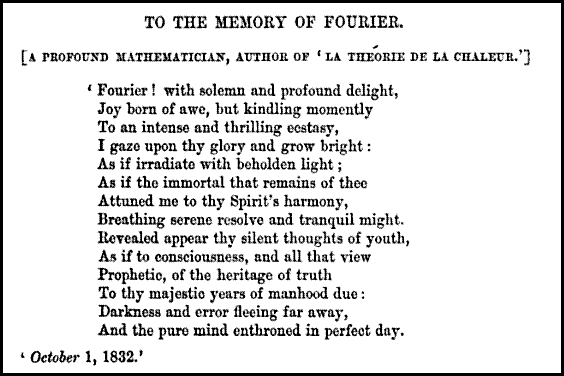
Here’s an example of Hamilton’s verse – a poem written to honour Joseph Fourier:

Hamilton-for Fourier

If that’s one of his better poems, then I think Wordsworth may have had a point!

The serious thing that struck me about this programme though was how many scientists of the 19th Century, Hamilton included, saw their scientific interrogation of Nature as a manifestation of the human condition just as the romantic poets saw their artistic contemplation. It is often argued that romanticism is responsible for the rise of antiscience. I’m not really qualified to comment on that but I don’t see any conflict at all between science and romanticism. I certainly don’t see Wordsworth’s poetry as antiscientific. I just find it inspirational:

I HAVE seen
A curious child, who dwelt upon a tract
Of inland ground, applying to his ear
The convolutions of a smooth-lipped shell;
To which, in silence hushed, his very soul
Listened intensely; and his countenance soon
Brightened with joy; for from within were heard
Murmurings, whereby the monitor expressed
Mysterious union with its native sea.
Even such a shell the universe itself
Is to the ear of Faith; and there are times,
I doubt not, when to you it doth impart
Authentic tidings of invisible things;
Of ebb and flow, and ever-during power;
And central peace, subsisting at the heart
Of endless agitation.

A Dirge

Posted in Poetry with tags , , on October 21, 2014 by telescoper

Rough Wind, that moanest loud
Grief too sad for song;
Wild wind, when sullen cloud
Knells all the night long;
Sad storm, whose tears are vain,
Bare woods, whose branches strain,
Deep caves and dreary main, _
Wail, for the world’s wrong!

by Percy Bysshe Shelley