A couple of weeks ago I bought a copy of Dark Matter: Poems of Space, an anthology of poems old and new with astronomical connections edited by Maurice Riordan and Dame Jocelyn Bell Burnell.
I quite like having anthologies because if you open one randomly you’re not absolutely sure what’s going to crop up, which can lead to pleasant surprises. But they’re also unsatisfactory to read through from cover to cover because there are huge differences in style and substance that are difficult to adjust to on a poem-by-poem basis. Random access is definitely better than sequential for this type of thing, so rather than attempt to study it all, over the last fortnight or so I’ve been taking regular dips into this particular collection, and very interesting it has been too.
The book contains over 200 poems mostly by different authors, although there is more than one contribution from a few (including Shelley and Auden). It’s a mixture of the familiar and the brand new, including some commissioned especially for this book. I couldn’t possibly write about the whole, but a few things struck me as I sampled various tidbits.
The first is that while many of these poems celebrate the beauty and majesty of the heavens, and some even embrace the wonder of scientific discovery, quite a few are quite anti-scientific. Two examples spring to mind (both of them paradoxically by favourite poets of mine!). This excerpt from The Song of the Happy Shepherd, a very early poem by WB Yeats is a good example
………………………………Seek, then,
No learning from the starry men,
Who follow with the optic glass
The whirling ways of stars that pass –
Seek, then, for this is also sooth,
No word of theirs – the cold star-bane
Has cloven and rent their hearts in twain,
And dead is all their human truth.
Hardly a ringing endorsement of observational astronomy, although strictly speaking it only refers to optical techniques so I suppose those working in radio-, X-ray and other types of astronomy are off the hook.
Incidentally, if I’d been given the task of picking a poem by Yeats for this collection it would have been this:
HAD I the heavens’ embroidered cloths,
Enwrought with gold and silver light,
The blue and the dim and the dark cloths
Of night and light and the half light,
I would spread the cloths under your feet:
But I, being poor, have only my dreams;
I have spread my dreams under your feet;
Tread softly because you tread on my dreams.
It’s not really much to do with astronomy or space but it’s one of his most beautiful lyrical verses, with a wonderful use of repetition (e.g. light, dreams, spread, tread) and assonance (light/night, spread/tread).
Anyway, another example of this kind of attitude displayed by Yeats Happy Shepherd is provided by Walt Whitman:
WHEN I heard the learn’d astronomer;
When the proofs, the figures, were ranged in columns before me;
When I was shown the charts and the diagrams, to add, divide, and measure them;
When I, sitting, heard the astronomer, where he lectured with much applause in the lecture-room,
How soon, unaccountable, I became tired and sick;
Till rising and gliding out, I wander’d off by myself,
In the mystical moist night-air, and from time to time,
Look’d up in perfect silence at the stars.
I think I’ve been to enough boring seminars to understand how he feels, but the theme of both these poems is that studying the stars or applying science to them somehow robs them of their wonder. I think many non-scientists probably go along with this view: it’s beautiful to gaze at the sky but reducing it to measurements and graphs somehow ruins it.
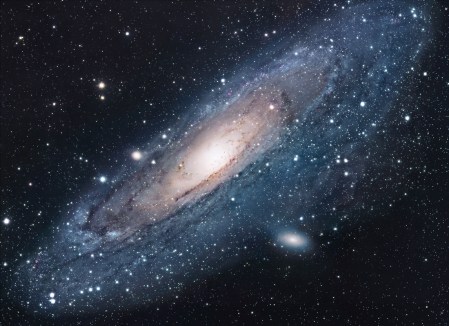 Of course I don’t agree. Without professional astronomers we would never have discovered that, say, the Andromeda Nebula (shown above) was a galaxy just like our own Milky Way containing thousands of millions of stars like our Sun and that it is rotating about its axis with a timescale of hundreds of millions of years. Knowing things like this surely increases the sense of wonder rather than decreasing it?
On the other hand it is true that the nature of science makes it rather prosaic. When scientists try to write for a popular readership they often spice up their accounts with quotations from poems, even if the quotes aren’t really all that appropriate. Perhaps some will turn to this collection for a source of such snippets. I know I will!
Another thing that struck me was that I always tended to think that engagement between science and poetry was a relatively recent thing, typified by WH Auden’s humorously perplexed After Reading a Child’s Guide to Modern Physics:
Our eyes prefer to suppose
That a habitable place
Has a geocentric view,
That architects enclose
A quiet Euclidian space:
Exploded myths – but who
Could feel at home astraddle
An ever expanding saddle?
But in fact the metaphysical poets of the 17th century also grappled with such issues. Consider this fragment from John Donne’s An Anatomy of the World:
We think the Heavens enjoy their spherical,
Their round proportion embracing all.
But yet their various and perplexed course,
Observed in divers ages, doth enforce
Men to find out so many eccentric parts,
Such divers down-right lines, such overthwarts,
As disproportion that pure form….
That could almost have been written about the possibility of a lop-sided universe that I’ve blogged about here and there, and which is a major topic of current cosmological research.
Other reactions I had were more personal. There is a poem in the collection by Fleur Adcock, who visited the Royal Grammar School in Newcastle when I was there. She judged a poetry reading competition (which I didn’t win) for which the test piece was Stevie Smith’s Not Waving but Drowning. I remember that she was quite a glamorous-looking lady, but she got everybody’s name wrong in her presentation address. She must be getting on a bit by now.
I have also met one of the other poets represented here too, Gwyneth Lewis, who was elected the first national poet for Wales and also spent some time as poet-in-residence in the School of Physics & Astronomy at Cardiff University where I now work. She wrote a number of poems about science but is probably most famous for writing the words “In These Stones Horizons Sing” which are incorporated in the design of the facade of the Wales Millennium Centre.
Anyway, I thoroughly recommend this book which is a rich treasury of verse ancient and modern. Some of the lovely things in it are quite new to me and I am definitely going to read more by some of the poets represented in it. That’s the way to use an anthology: go and read more systematically whoever catches your eye.
Being an old-fashioned romantic I think I’ll finish off with an excerpt from William Wordsworth‘s epic The Prelude. Regular readers (both of you) will know that I greatly admire Wordsworth and, for me, The Prelude is one of the highest pinnacles in all of English literature.
The universal spectacle throughout
Was shaped for admiration and delight,
Grand in itself alone, but in that breach
Through which the homeless voice of waters rose,
That dark deep thoroughfare, had Nature lodged
The Soul, the Imagination of the whole.


 In the Dark