Archive for Polarization

Weekly Update from the Open Journal of Astrophysics – 22/11/2025

Posted in OJAp Papers, Open Access, The Universe and Stuff with tags , , , , , , , , , , , , , , , , , , , , , on November 22, 2025 by telescoper

It’s Saturday again, so it’s time for the usual update of the week’s new papers at the Open Journal of Astrophysics. Since the last update we have published another five papers, which brings the number in Volume 8 (2025) up to 180, and the total so far published by OJAp up to 415.

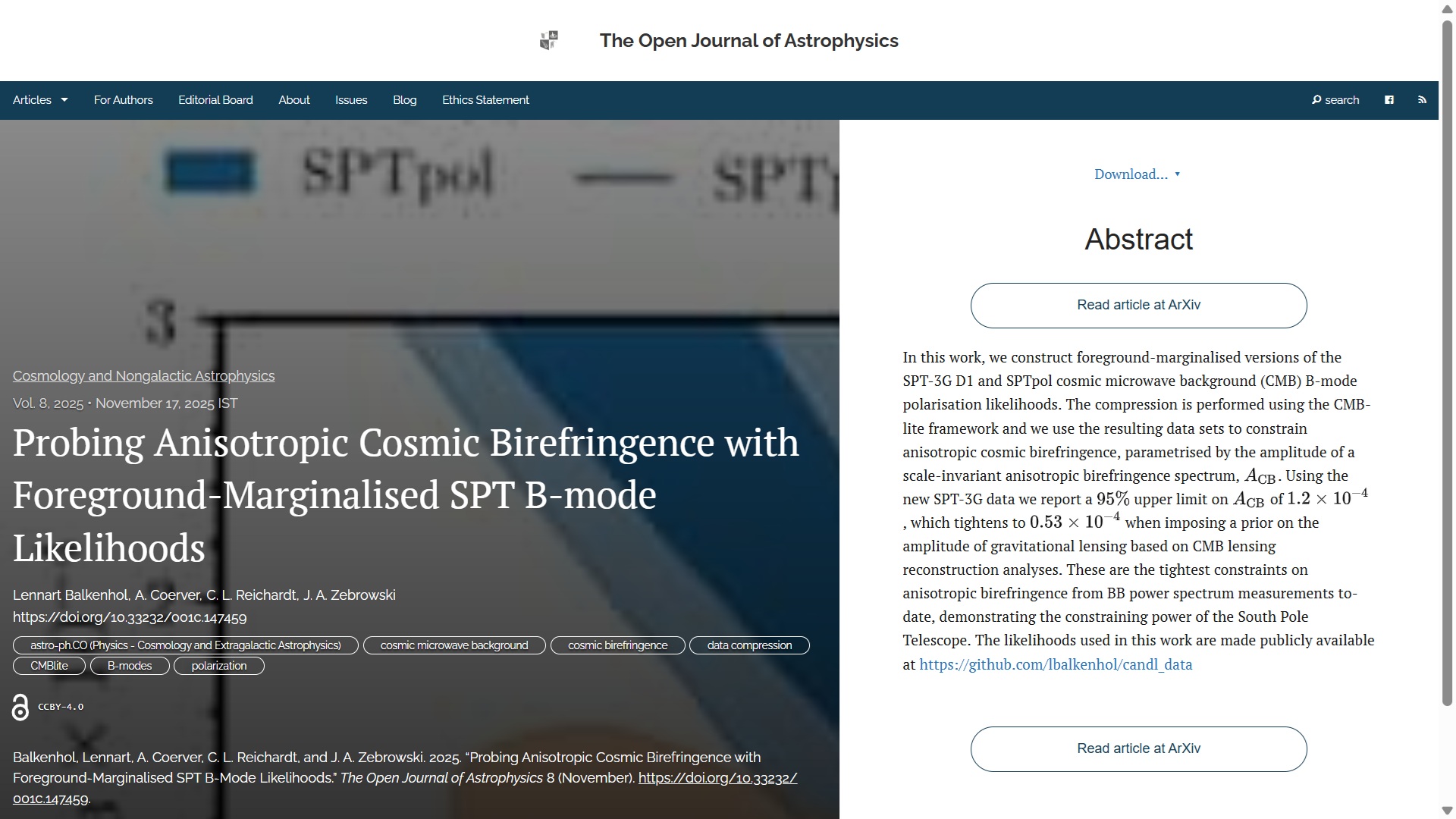
The first paper to report this week is “Probing Anisotropic Cosmic Birefringence with Foreground-Marginalised SPT B-mode Likelihoods” by Lennart Balkenhol (Sorbonne Université, France), A. Coerver (UC Berkeley, USA), C. L. Reichardt (U. Melbourne, Australia) and J. A. Zebrowski (U. Chicago, USA). This paper was published on Monday November 17th in the folder Cosmology and Nongalactic Astrophysics. It presents a way of using data from the Souh Pole Telescope (SPT) in the CMB-lite framework to constrain the level of cosmic birefringence.  The overlay is here:
You can find the officially accepted version on arXiv here and the The Fediverse announcement is here:

Open Journal of Astrophysics

New Publication at the Open Journal of Astrophysics: "Probing Anisotropic Cosmic Birefringence with Foreground-Marginalised SPT B-mode Likelihoods" by Lennart Balkenhol (Sorbonne Université, France), A. Coerver (UC Berkeley, USA), C. L. Reichardt (U. Melbourne, Australia) and J. A. Zebrowski (U. Chicago, USA)

doi.org/10.33232/001c.147459

November 17, 2025, 8:43 am 1 boosts 0 favorites

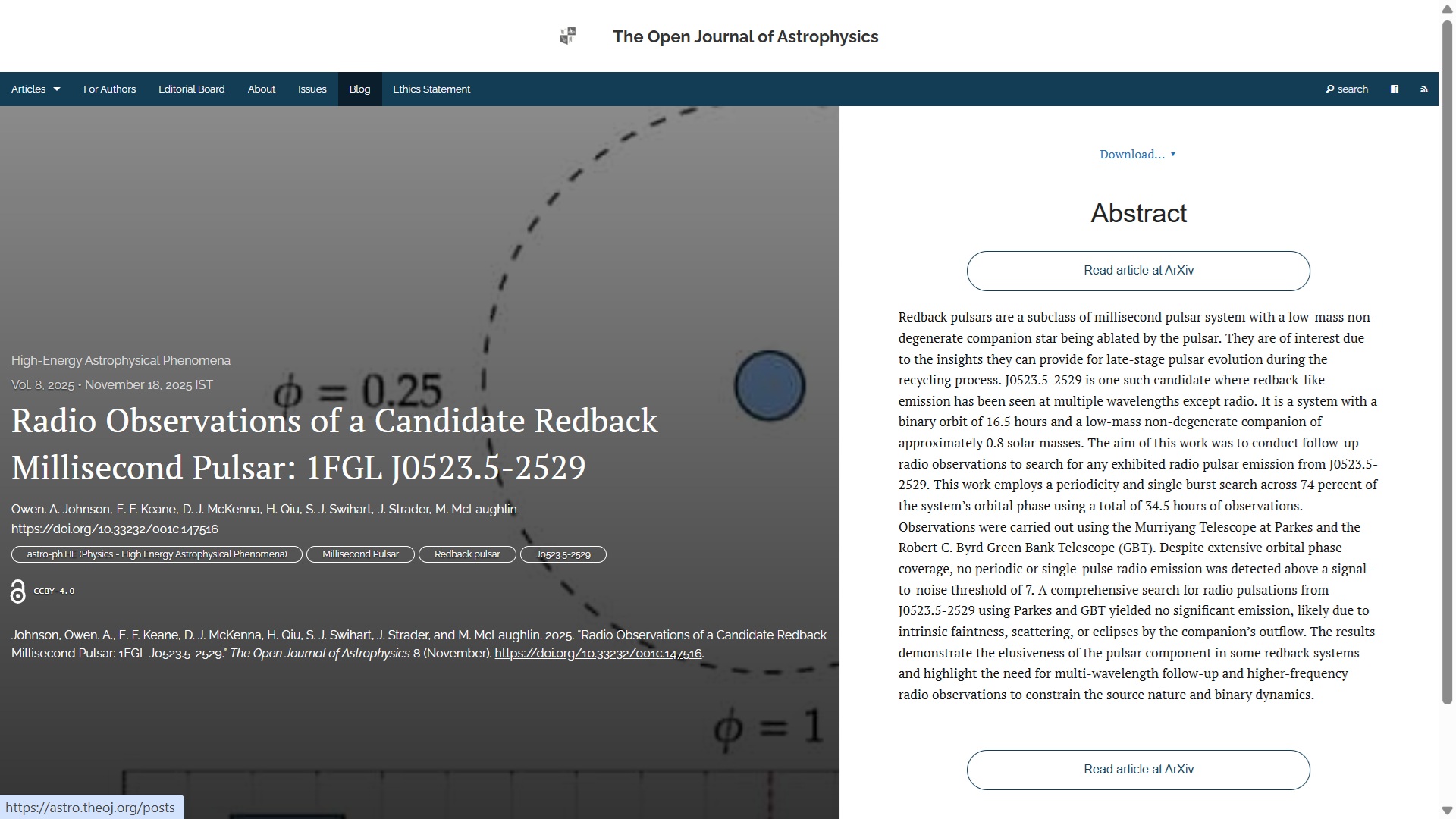
The second paper of the week is “Radio Observations of a Candidate Redback Millisecond Pulsar: 1FGL J0523.5-2529” by Owen. A. Johnson & E. F. Keane (Trinity College Dublin, Ireland), D. J. McKenna (ASTRON, NL), H. Qiu (SKAO, UK), S. J. Swihart (Insitute for Defense Analyses, USA), J. Strader (Michigan State U., USA) and M. McLaughlin (West Virginia U., USA). This one was published on Tuesday November 18th 2025 in the folder marked High-Energy Astrophysical Phenomena and it describes a search for radio emission from a candidate “redback pulsar” J0523.5-2529 resulting in upper limits but no detection.

The overlay is here:
You can find the official version of this one on arXiv here. The federated announcement on Mastodon is here:

Open Journal of Astrophysics

New Publication at the Open Journal of Astrophysics: "Radio Observations of a Candidate Redback Millisecond Pulsar: 1FGL J0523.5-2529" by Owen. A. Johnson & E. F. Keane (Trinity College Dublin, Ireland), D. J. McKenna (ASTRON, NL), H. Qiu (SKAO, UK), S. J. Swihart (Insitute for Defense Analyses, USA), J. Strader (Michigan State U., USA) and M. McLaughlin (West Virginia U., USA)

doi.org/10.33232/001c.147516

November 18, 2025, 8:42 am 1 boosts 0 favorites

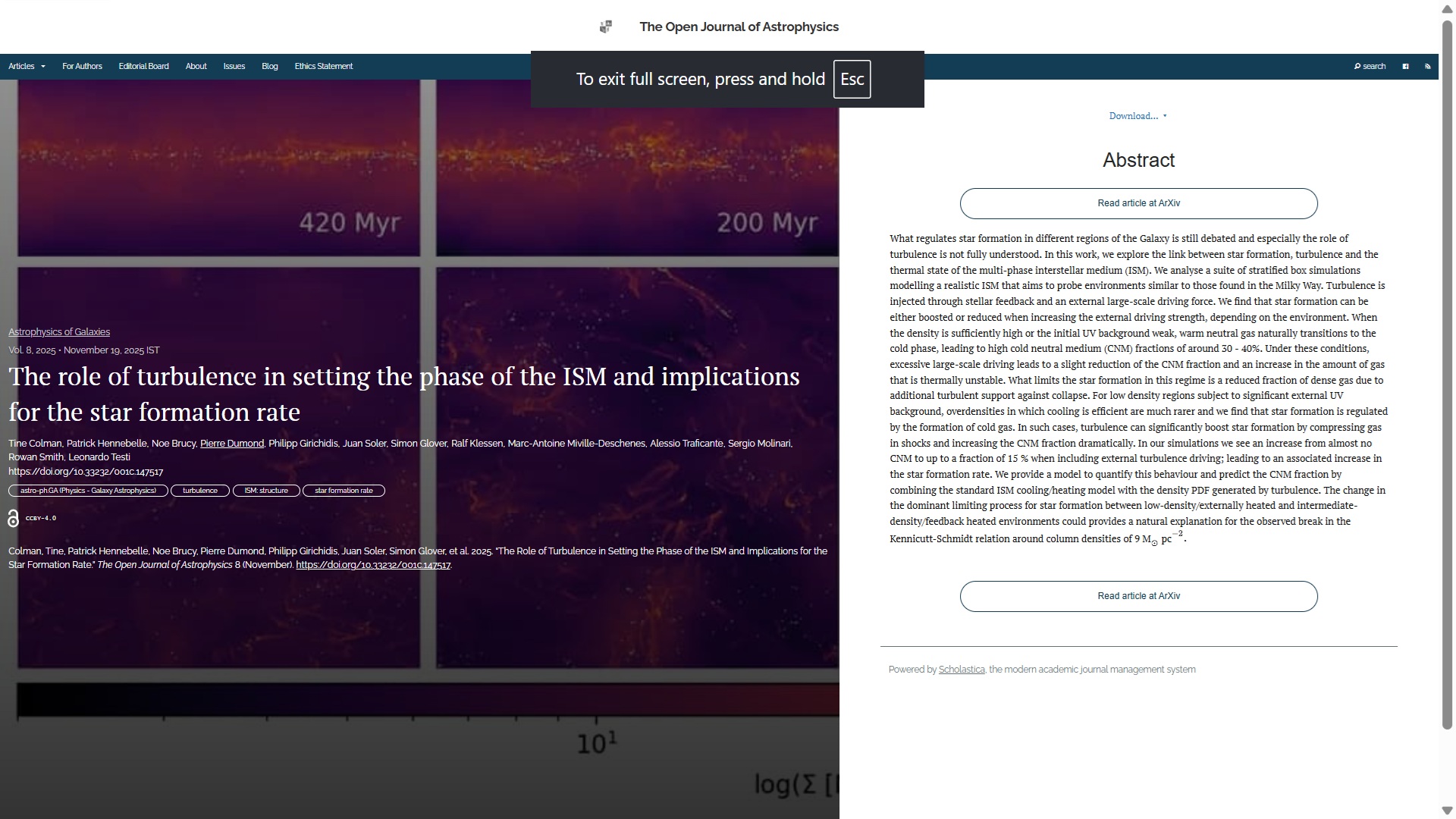
Next one up is “The role of turbulence in setting the phase of the ISM and implications for the star formation rate” by Tine Colman (Université Paris-Saclay, France) and 13 others based in France, Germany, Italy and the UK. This was published in the folder Astrophysics of Galaxies on Tuesday November 18th. It descrtibes using a suite of stratified box simulations to explore the link between star formation, turbulence and the thermal state of the multi-phase interstellar medium (ISM).

The overlay is here:
You can find the official accepted version on arXiv here. The fediverse announcement is here:

Open Journal of Astrophysics

New Publication at the Open Journal of Astrophysics: "The role of turbulence in setting the phase of the ISM and implications for the star formation rate" by Tine Colman (Université Paris-Saclay, France) and 13 others based in France, Germany, Italy and the UK.

doi.org/10.33232/001c.147517

November 19, 2025, 8:19 am 0 boosts 0 favorites

The fourth paper of the week is “A Bimodal Metallicity Distribution Function in the Ultra-Faint Dwarf Galaxy Reticulum II” by Alice M. Luna (U. Chicago, USA) and 8 others based in the USA, Korea and Canada. This was published on Wednesday November 19th in the folder Astrophysics of Galaxies. It decribes low-resolution Magellan/IMACS spectroscopy of 167 stars in the ultra-faint galaxy Reticulum II, revealing a clearly bimodal distribution.

The overlay is here:
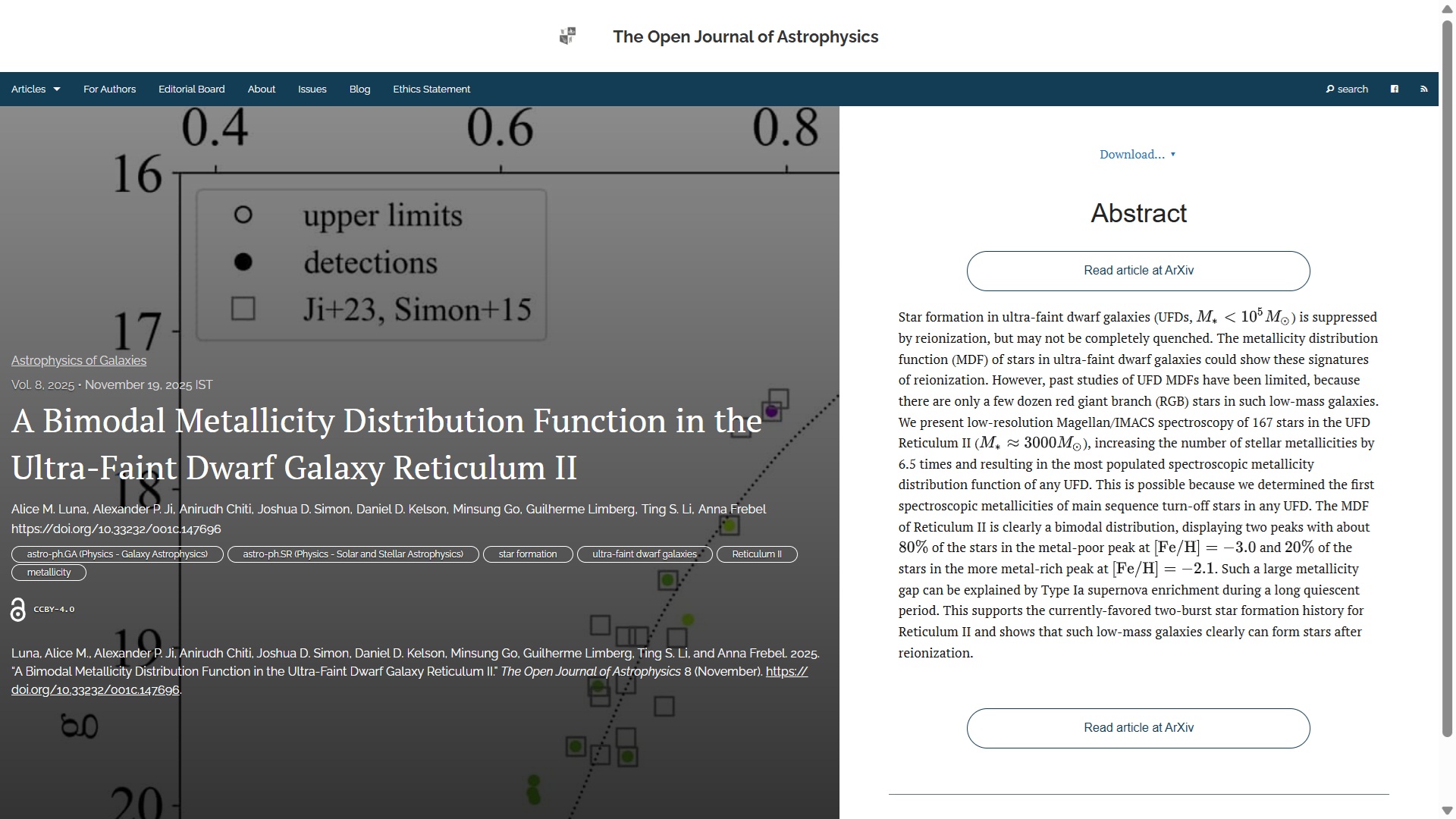
You can find the official published version on arXiv here. The Fediverse announcement follows:

Open Journal of Astrophysics

New Publication at the Open Journal of Astrophysics: "A Bimodal Metallicity Distribution Function in the Ultra-Faint Dwarf Galaxy Reticulum II" by Alice M. Luna (U. Chicago, USA) and 8 others based in the USA, Korea and Canada.

doi.org/10.33232/001c.147696

November 19, 2025, 8:37 am 0 boosts 0 favorites

The fifth and final paper for this week is “Cool Gas in the Circumgalactic Medium of Massive Post Starburst Galaxies” by Zoe Harvey, Sahyadri Krishna, Vivienne Wild & Rita Tojeiro (U. St Andrews, UK) and Paul Hewett (U. Cambridge, UK). This was published on Thursday November 20th in the folder Astrophysics of Galaxies.

The overlay is here:

The officially accepted version can be found on arXiv here. The Fediverse announcement is here:

Open Journal of Astrophysics

New Publication at the Open Journal of Astrophysics: "Cool Gas in the Circumgalactic Medium of Massive Post Starburst Galaxies" by Zoe Harvey, Sahyadri Krishna, Vivienne Wild & Rita Tojeiro (U. St Andrews, UK) and Paul Hewett (U. Cambridge, UK)

doi.org/10.33232/001c.147836

November 20, 2025, 9:02 am 1 boosts 0 favorites

And that concludes the update for this week. I will do another next Saturday.

In Search of Stokes V

Posted in The Universe and Stuff with tags , , , , on September 17, 2024 by telescoper

Many moons ago I went to a seminar on the design of an experiment to measure the polarization of the cosmic microwave background. At the end of the talk I asked what seemed to me to be an innocent question. The point of my question was the speaker had focussed entirely on measuring the intensity of the radiation (I) and the two Stokes Parameters that measure linear polarization of the radiation (usually called Q and U). How difficult, I asked, would it be to measure the remaining Stokes parameter V (which quantifies circular polarization)?

There was a sharp intake of breath among the audience and the speaker responded with a curt “the cosmic microwave background is not circularly polarized”. It is true that in the standard cosmological theory the microwave background is produced by Thomson scattering in the early Universe which produces partial linear polarization, so that Q and U are non-zero, but not circular polarization so V=0. I knew that, but had asked my question because I had an idea that it might be worth measuring V (or at least putting an upper limit on it) in order to assess the level of instrumental systematics (which are a serious issue with polarization measurements). It might also help constrain variations from the standard model too.

Well, that thought came back today when I saw a new paper on the arXiv with the abstract:

V-mode polarization of the cosmic microwave background is expected to be vanishingly small in the ΛCDM model and, hence, usually ignored. Nonetheless, several astrophysical effects, as well as beyond standard model physics could produce it at a detectable level. A realistic half-wave plate – an optical element commonly used in CMB experiments to modulate the polarized signal – can provide sensitivity to V modes without significantly spoiling that to linear polarization. We assess this sensitivity for some new-generation CMB experiments, such as the LiteBIRD satellite, the ground-based Simons Observatory and a CMB-S4-like experiment. We forecast the efficiency of these experiments to constrain the phenomenology of certain classes of BSM models inducing mixing of linear polarization states and generation of V modes in the CMB. We find that new-generation experiments can improve current limits by 1-to-3 orders of magnitude, depending on the data combination. The inclusion of V-mode information dramatically boosts the sensitivity to these BSM models.

arXiv:2409.10424

It seems it might be feasible to measure Stokes V after all!

The Radio and Microwave Sky from Juno

Posted in The Universe and Stuff with tags , , , , , , , on May 16, 2024 by telescoper

I found out about an interesting paper by Anderson et al. at a discussion group this morning. The abstract reads:

We present six nearly full-sky maps made from data taken by radiometers on the Juno satellite during its 5-year flight to Jupiter. The maps represent integrated emission over ∼4% passbands spaced approximately in octaves between 600 MHz and 21.9 GHz. Long time-scale offset drifts are removed in all bands, and, for the two lowest frequency bands, gain drifts are also removed from the maps via a self-calibration algorithm similar to the NPIPE pipeline used by the Planck collaboration. We show that, after this solution is applied, residual noise in the maps is consistent with thermal radiometer noise. We verify our map solutions with several consistency tests and end-to-end simulations. We also estimate the level of pixelization noise and polarization leakage via simulations.

arXiv:2405.08388

For those of you unaware about Juno, it is a NASA space mission (launched in 2011) intended to study the planet Jupiter (which it is still doing). On the way there, however, this spacecraft made continuous measurements of the radiation field around it, at radio and microwave frequencies. The work described by Anderson et al. involved turning these observations into maps at a range of frequency; they also studied the polarization properties of the radiation.

The full maps and other relevant data can be downloaded here. Here are some pretty pictures (the grey bits represent the parts of the sky that were not covered; radio emission from our own Galaxy is the most obvious component at low frequencies, but it looks more complicated at higher frequencies).

It’s always fun when data sets are used for something so different from the purpose originally intended, and what has come out of this analysis are rather nice maps of the emission from the Milky Way. These might turn out to be useful for many things, such as foreground removal for extragalactic surveys or studies of our own Galaxy.

Still no Primordial Gravitational Waves…

Posted in Astrohype, Bad Statistics, The Universe and Stuff with tags , , , , , , on October 27, 2021 by telescoper

During March 2014 this blog received the most traffic it has ever had (reaching almost 10,000 hits per day at one point). The reason for that was the announcement of the “discovery” of primordial gravitational waves by the BICEP2 experiment. Despite all the hype at the time I wasn’t convinced. This is what I said in an interview with Physics World:

It seems to me though that there’s a significant possibility of some of the polarization signal in E and B [modes] not being cosmological. This is a very interesting result, but I’d prefer to reserve judgement until it is confirmed by other experiments. If it is genuine, then the spectrum is a bit strange and may indicate something added to the normal inflationary recipe.

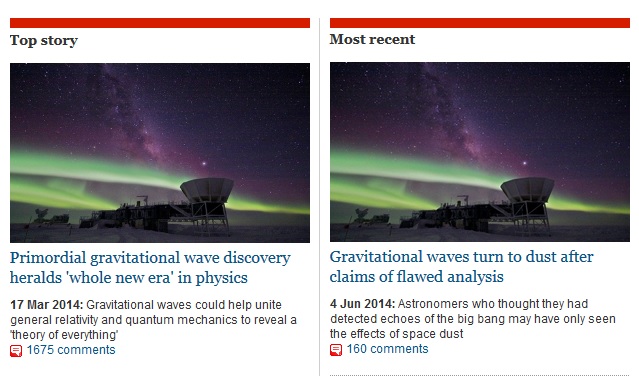
I also blogged about this several times, e.g. here. It turns out I was right to be unconvinced as the signal detected by BICEP2 was dominated by polarized foreground emission. The story is summarized by these two news stories just a few months apart:

Anyway, the search for primordial gravitational waves continues. The latest publication on this topic came out earlier this month in Physical Review Letters and you can also find it on the arXiv here. The last sentence of the abstract is:

These are the strongest constraints to date on primordial gravitational waves.

In other words, seven years on from the claimed “discovery” there is still no evidence for anything but polarized dust emission…

Oh Larmor! Energy in Electromagnetic Waves

Posted in Cute Problems, The Universe and Stuff with tags , , , on April 16, 2021 by telescoper

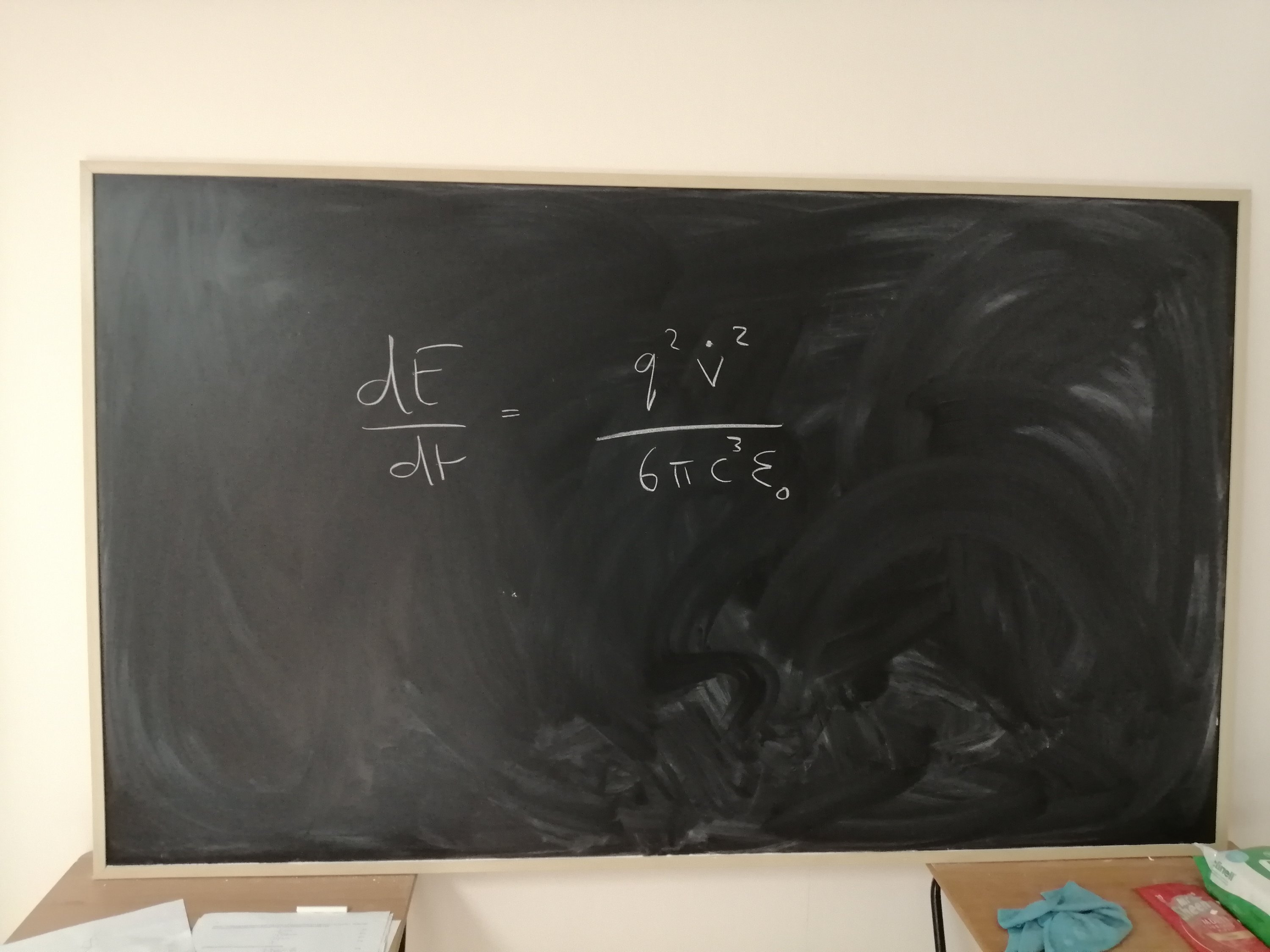
This week I started the bit of my Advanced Electromagnetism module that deals with electromagnetic radiation, including deriving the famous Larmor Formula. It reminded me of this little physics riddle, which I thought I’d share again here.

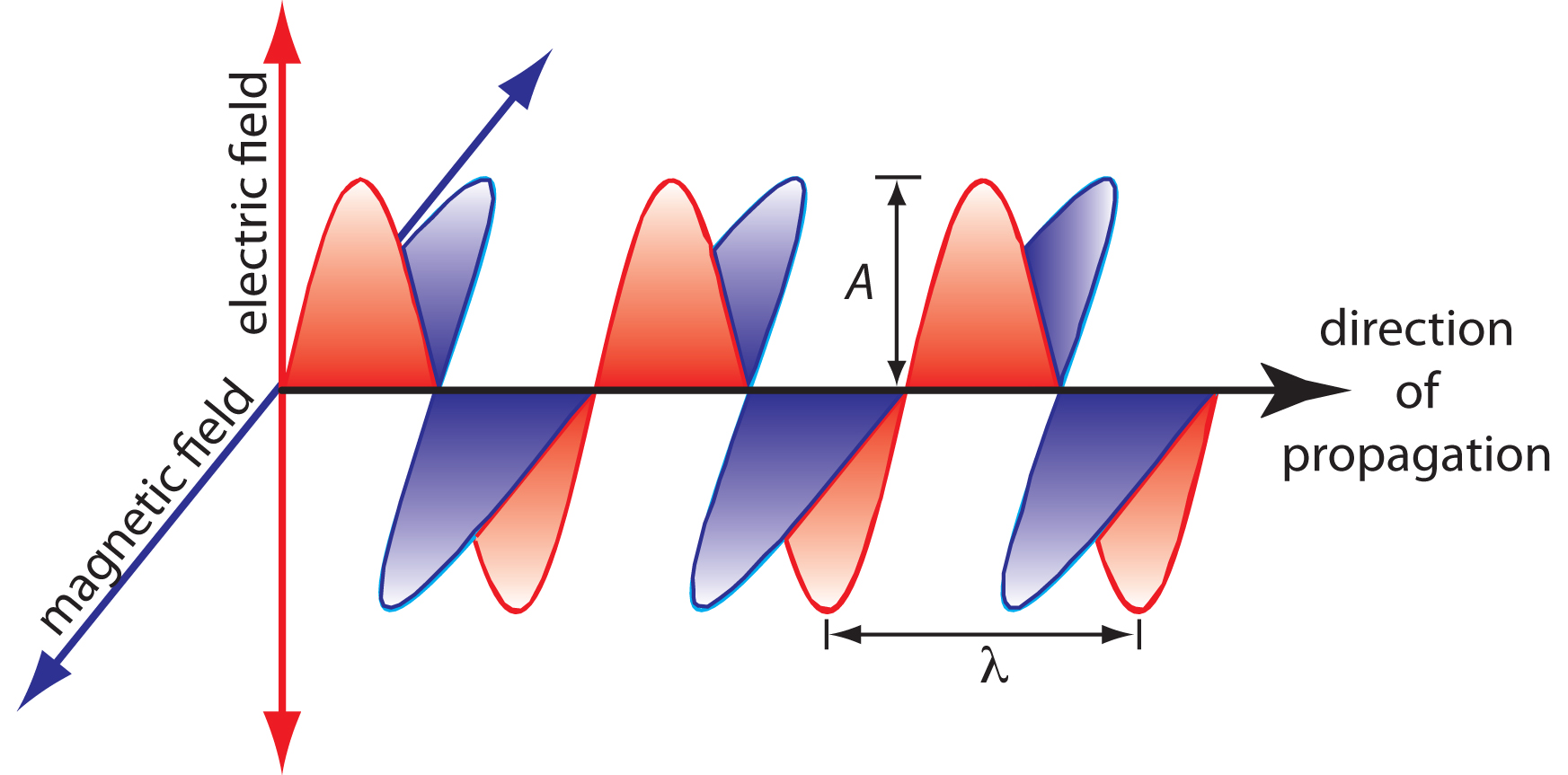
As you all know, electromagnetic radiation consists of oscillating electric and magnetic fields rather like this:

Figure10.1

(Graphic stolen from here.) The polarization state of the wave is defined by the direction of the Electric field, in this case vertically upwards.

Now the energy carried by an electromagnetic wave of a given wavelength is proportional to the square of its amplitude, denoted in the Figure by A, so the energy is of the form kA2 in this case with k constant. Two separate electromagnetic waves with the same amplitude and wavelength would thus carry an energy = 2kA2.

But now consider what happens if you superpose two waves in phase, each having the same wavelength, polarization and amplitude to generate a single wave with amplitude 2A. The energy carried now is k(2A)2 = 4kA2, which is twice the value obtained for two separate waves.

Where does the extra energy come from?

Answers through the Comments Box please!

Cosmology Talks: Eiichiro Komatsu & Yuto Minami on Parity Violation in the Cosmic Microwave Background

Posted in Cardiff, Maynooth, The Universe and Stuff with tags , , , , , , , , on December 2, 2020 by telescoper

It’s time I shared another one of those interesting cosmology talks on the Youtube channel curated by Shaun Hotchkiss. This channel features technical talks rather than popular expositions so it won’t be everyone’s cup of tea but for those seriously interested in cosmology at a research level they should prove interesting.

In this video, Eiichiro Komatsu and Yuto Minami talk about their recent work, first devising a way to extract a parity violating signature in the cosmic microwave background, as manifested by a form of birefringence. If the universe is birefringent then E-mode polarization would change into B-mode as electromagnetic radiation travels through space, so there would be a non-zero correlation between the two measured modes. They  try to measure this correlation using the Planck 2018 data, getting  a 2.4 sigma `hint’ of a result.

A problem with the measurement is that systematic errors, such as imperfectly calibrated detector angles,  could mimic the signal. Yuto and Eiichiro’s  idea was to measure the detector angle by looking at the E-B correlation in the foregrounds, where light hasn’t travelled far enough to be affected by any potential birefringence in the universe. They argue that this allows them to distinguish between the two types of measured E-B correlation. However, this is only the case if there is no intrinsic correlation between the E-mode and B-mode polarization in the foregrounds, which may not be the case, but which they are testing. The method can be applied to any of the plethora of CMB experiments currently underway so there will probably be more results soon that may shed further light on this issue.

Incidentally this reminds me of Cardiff days when work was going on about the same affect using the Quad instrument. I wasn’t involved with Quad but I do remember having interesting chats about the theory behind the measurement or upper limit as it was (which is reported here). Looking at the paper I realize that paper involved researchers from the Department of Experimental Physics at Maynooth University.

P. S. The paper that accompanies this talk can be found here.

Circular Polarization in the Cosmic Microwave Background?

Posted in The Universe and Stuff with tags , , , , on November 23, 2018 by telescoper

Some years ago I went to a seminar on the design of an experiment to measure the polarization of the cosmic microwave background. At the end of the talk I asked what seemed to me to be an innocent question. The point of my question was the speaker had focussed entirely on measuring the intensity of the radiation (I) and the two Stokes Parameters that measure linear polarization of the radiation (usually called Q and U). How difficult, I asked, would it be to measure the remaining Stokes parameter V (which quantifies circular polarization)?

There was a sharp intake of breath among the audience as if I had uttered an obscenity, and the speaker responded with a glare and a curt `the cosmic microwave background is not circularly polarized’. It is true that in the standard cosmological theory the microwave background is produced by Thomson scattering in the early Universe which produces partial linear polarization, so that Q and U are non-zero, but not circular polarization, so V=0. However, I had really asked my question because I had an idea that it might be worth measuring V (or at least putting an upper limit on it) in order to assess the level of instrumental systematics (which are a serious issue with polarization measurements).

I was reminded of this episode when I saw a paper on the arXiv by Keisuke Inomata and Marc Kamionkowski which points out that the CMB may well have some level of circular polarization. Here is the abstract of the paper:

(You can click on the image to make it more readable.) It’s an interesting calculation, but it’s hard to see how we will ever be able to measure a value of Stokes V as low as 10-14.

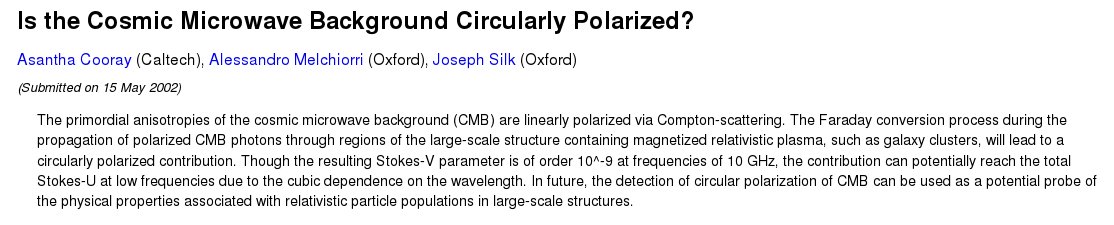
A few years ago there was a paper on the arXiv by Asantha Cooray, Alessandro Melchiorri and Joe Silk which pointed out that the CMB may well have some level of circular polarization. When light travels through a region containing plasma and a magnetic field, circular polarization can be generated from linear polarization via a process called Faraday conversion. For this to happen, the polarization vector of the incident radiation (defined by the direction of its E-field) must have non-zero component along the local magnetic field, i.e. the B-field. Charged particles are free to move only along B, so the component of E parallel to B is absorbed and re-emitted by these charges, thus leading to phase difference between it and the component of E orthogonal to B and hence to the circular polarization. This is related to the perhaps more familiar process of which causes the plane of linear polarization to rotate when polarized radiation travels through a region containing a magnetic field.

Here is the abstract of that paper:

(Also clickable.) This is a somewhat larger effect but differs from the first paper in that it is produced by foreground processes rather than primordial physics. In any case a Stokes V of 10-9 is also unlikely to be measurable at any time in the foreseeable future.

Remembering Clover

Posted in Biographical, Science Politics, The Universe and Stuff with tags , , , , , , , on April 10, 2018 by telescoper

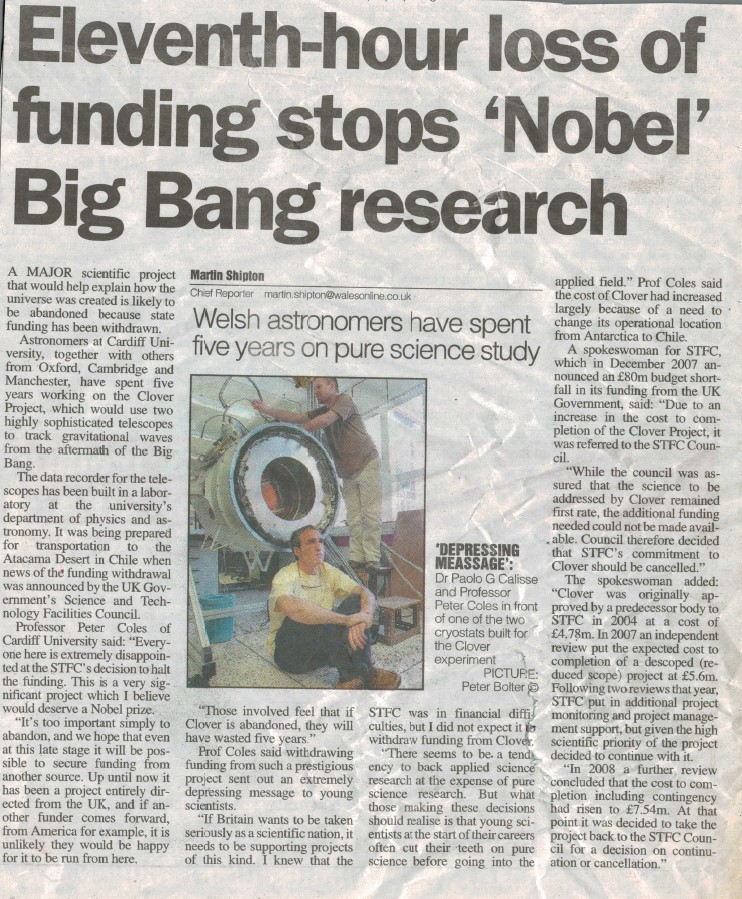
I was tidying up some papers in my desk yesterday and came across a clipping dated April 9th 2009, i.e. exactly nine years ago to the day. Amazed by this coincidence, I resolved to post it on here but was unable to work out how to use the new-fangled scanner in the Data Innovation Institute office so had to wait until I could get expert assistance this morning:

Sorry it’s a bit crumpled, but I guess that demonstrates the authenticity of its provenance.

The full story, as it appeared in the print edition of the Western Mail, can also be found online here. By the way it’s me on the stepladder, pretending to know something about astronomical instrumentation.

I wrote at some length about the background to the cancellation of the Clover experiment here. In a nutshell, however, Clover involved the Universities of Cardiff, Oxford, Cambridge and Manchester and was designed to detect the primordial B-mode signal from its vantage point in Chile. The chance to get involved in a high-profile cosmological experiment was one of the reasons I moved to Cardiff from Nottingham almost a decade ago, and I was looking forward to seeing the data arriving for analysis. Although I’m primarily a theorist, I have some experience in advanced statistical methods that might have been useful in analysing the output. It would have been fun blogging about it too.

Unfortunately, however, none of that happened. Because of its budget crisis, and despite the fact that it had already spent a large amount (£4.5M) on Clover, the Science and Technology Facilities Council (STFC) decided to withdraw the funding needed to complete it (£2.5M) and cancel the experiment. I was very disappointed, but that’s nothing compared to Paolo (shown in the picture) who lost his job as a result of the decision and took his considerable skills and knowledge abroad.

We will never know for sure, but if Clover had gone ahead it might well have detected the same signal found five years later by BICEP2, which was announced in 2014. Working at three different frequencies (95, 150 and 225GHz) Clover would have had a better capability than BICEP2 in distinguishing the primordial signal from contamination from Galactic dust emission (which, as we now know, is the dominant contribution to the BICEP2 result; see thread here), although that still wouldn’t have been easy because of sensitivity issues. As it turned out, the BICEP2 signal turned out to be a false alarm so, looking on the bright side, perhaps at least the members of the Clover team avoided making fools of themselves on TV!

P.S. Note also that I moved to Cardiff in mid-2007, so I had not spent 5 years working on the Clover project by the time it was cancelled as discussed in the newspaper article, but many of my Cardiff colleagues had.

BICEP3 Cometh…

Posted in The Universe and Stuff with tags , , , , , on January 6, 2016 by telescoper

Back in the office after the Christmas and New Year break, with a mountain of stuff to work through..

Anyway, I saw this paper on the arXiv yesterday and thoought I’d share it here. It’s from a paper by Wu et al. entitled Initial Performance of BICEP3: A Degree Angular Scale 95 GHz Band Polarimeter.  The abstract follows:

BICEP3 is a 550 mm aperture telescope with cold, on-axis, refractive optics designed to observe at the 95 GHz band from the South Pole. It is the newest member of the BICEP/Keck family of inflationary probes specifically designed to measure the polarization of the cosmic microwave background (CMB) at degree-angular scales. BICEP3 is designed to house 1280 dual-polarization pixels, which, when fully-populated, totals to 9× the number of pixels in a single Keck 95 GHz receiver, thus further advancing the BICEP/Keck program’s 95 GHz mapping speed. BICEP3 was deployed during the austral summer of 2014-2015 with 9 detector tiles, to be increased to its full capacity of 20 in the second season. After instrument characterization measurements were taken, CMB observation commenced in April 2015. Together with multi-frequency observation data from Planck, BICEP2, and the Keck Array, BICEP3 is projected to set upper limits on the tensor-to-scalar ratio to r 0.03 at 95% C.L..

It all looks very promising, with science results likely to appear later this year, but who will win the race to find those elusive primordial B-modes?


Amplitude & Energy in Electromagnetic Waves

Posted in Cute Problems, The Universe and Stuff with tags , , , on September 22, 2015 by telescoper

Here’s a little physics riddle. As you all know, electromagnetic radiation consists of oscillating electric and magnetic fields rather like this:

Figure10.1(Graphic stolen from here.) The polarization state of the wave is defined by the direction of the Electric field, in this case vertically upwards.

Now the energy carried by an electromagnetic wave of a given wavelength is proportional to the square of its amplitude, denoted in the Figure by A, so the energy is of the form kA2 in this case with k constant. Two separate electromagnetic waves with the same amplitude and wavelength would thus carry an energy = 2kA2.

But now consider what happens if you superpose two waves in phase, each having the same wavelength, polarization and amplitude to generate a single wave with amplitude 2A. The energy carried now is k(2A)2 = 4kA2, which is twice the value obtained for two separate waves.

Where does the extra energy come from?

Answers through the Comments Box please!