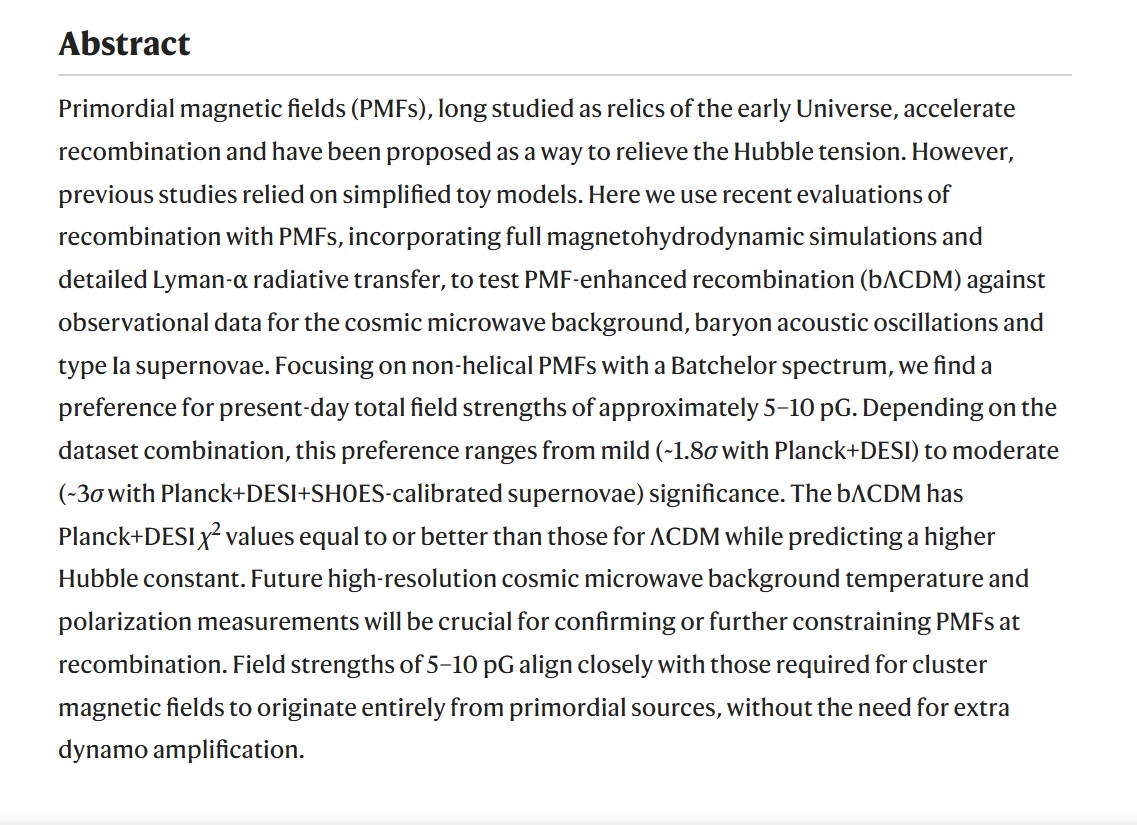
I saw mention of paper recently published in Nature Astronomy by Karsten Jedamzik, Levon Pogosian and Tom Abel with the title Hints of primordial magnetic fields at recombination and implications for the Hubble tension. It’s behind a paywall but there is a version available on the arXiv here. The abstract of the Nature Astronomy version looks like this:
This paper reminded me of a paper I wrote a long time ago (in 1991, when I was at Queen Mary) about primordial magnetic fields and galaxy formation. It had its origins in a lunchtime talk I gave which was based on an old paper from the 1970s by Ira Wasserman. All I did was go through the paper and add a few small comments to update it, including some more recent observational constraints and mentions of dark non-baryonic matter; the Wasserman paper was framed in a model in which all the matter in the Universe was baryonic.
Anyway, the talk went down quite well and I was encouraged to write it up. I did so, and submitted it to a journal (MNRAS). Not unreasonably, it was rejected on the grounds that it didn’t have sufficient original content. I therefore expanded the discussion and submitted it as a review article to Comments on Astrophysics. That journal is now defunct, but the paper can be found on NASA/ADS here. It’s even got some citations!
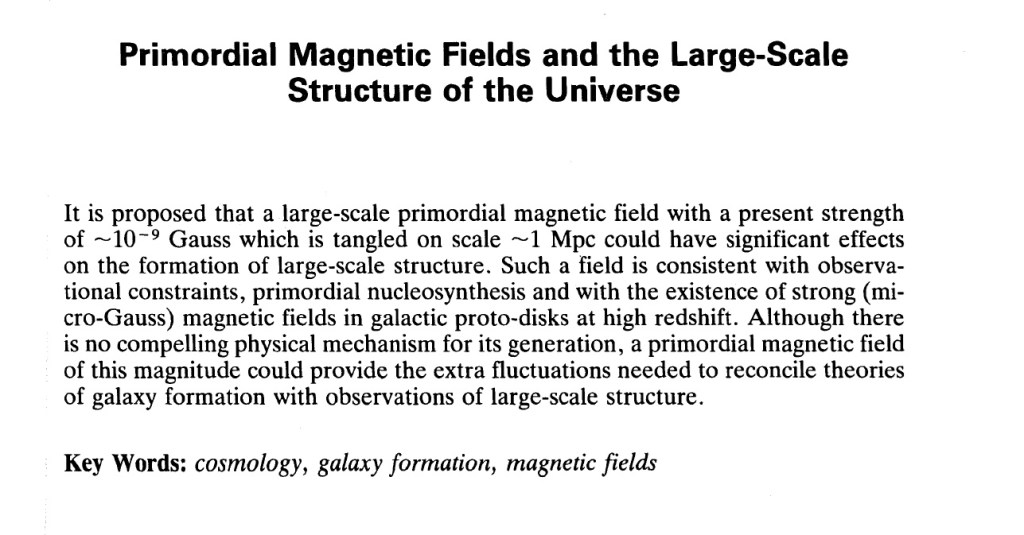
Here’s the title and abstract:
You can find the whole paper here:
You will see I was advocating a larger magnetic field than in the recent one, with a view to affecting galaxy formation directly rather than larger scale features of the Universe. An important point is that primordial magnetic fields can have a large effect soon after recombination, so they might play a role in the formation of galaxies at high redshift which we are struggling to explain. At least – unlike some of the more exotic explanations that have been proposed – we know that magnetic fields actually exist…


 In the Dark