Archive for pulsars

Supplement to the Open Journal of Astrophysics – “Pulsar Science with the SKAO”

Posted in OJAp Papers, Open Access, The Universe and Stuff with tags , , , , , , , , on December 19, 2025 by telescoper

It’s been a busy day at the Open Journal of Astrophysics as we’ve published 12 related papers in the form of our first ever Supplement; officially it is Vol. 8 Supplement Issue 1. The idea of a Supplement is to publish a set of related papers together. I imagine it might be of interest for publishing conference proceedings, etc.

The topic of this Supplement is Pulsar Science with the Square Kilometre Array Observatory and it includes updates to the Science Case for the SKAO, the previous version of which is 10 years old. All the papers are indendependently peer-reviewed, which took some organizing and a lot of time because many potential referees are themselves members of the SKA Pulsar Science Working Group! Anyway, the final versions of all the papers hit the arXiv this morning so I published them all today.

Rather than include all 12 papers in tomorrow’s Saturday update I decided just to show the overlay for the overview of the special issue, which is here:

The following paragraph describes the content of the supplement and includes links to the other 11 papers in the issue.

The large instantaneous sensitivity, a wide frequency coverage and flexible observation modes with large number of beams in the sky are the main features of the upcoming SKA observatory’s two telescopes, the SKA-Low and the SKA-Mid, which are located on two different continents. Owing to these capabilities, the SKAO telescopes are going to be a game-changer for radio astronomy in general and pulsar astronomy in particular. The eleven articles in this special issue on pulsar science with the SKA Observatory describe its impact on different areas of pulsar science. Phase 1 of the rollout of the SKAO telescope is likely to double the known pulsar population in new surveys described in the first three papers (Keane et al. 2025Abbate et al. 2025Bagchi et al. 2025). These new discoveries will improve our understanding of the dynamics, evolution and gas content of globular clusters and the black hole at the centre of the Milky Way galaxy apart from increasing the samples for each of different kinds of radio emitting neutron stars (Levin et al. 2025). The larger population sample will enhance our understanding of the magneto-ionic interstellar medium (Tiburzi et al. 2025Xu et al. 2025), the pulsar magnetosphere (Oswald et al. 2025) and pulsar wind nebulae (Gelfand et al. 2025). Moreover, the discovery of exotic neutron star systems will test gravity theory ever more stringently (Krishnan et al. 2025) and will probe fundamental physics at sub-atomic level (Basu et al. 2025). Finally, this enhanced sample is likely to make the sky portrait sharper in nano-Hertz gravitational waves impacting on our understanding of the Universe in a fundamental way (Shannon et al. 2025). In summary, the papers in this special issue describe the way the upcoming SKA Observatory’s telescopes address fundamental physics through the study of pulsars and gravitational waves.
R.I.P. Tony Hewish (1924-2021)

Posted in The Universe and Stuff with tags , , , , , on September 17, 2021 by telescoper

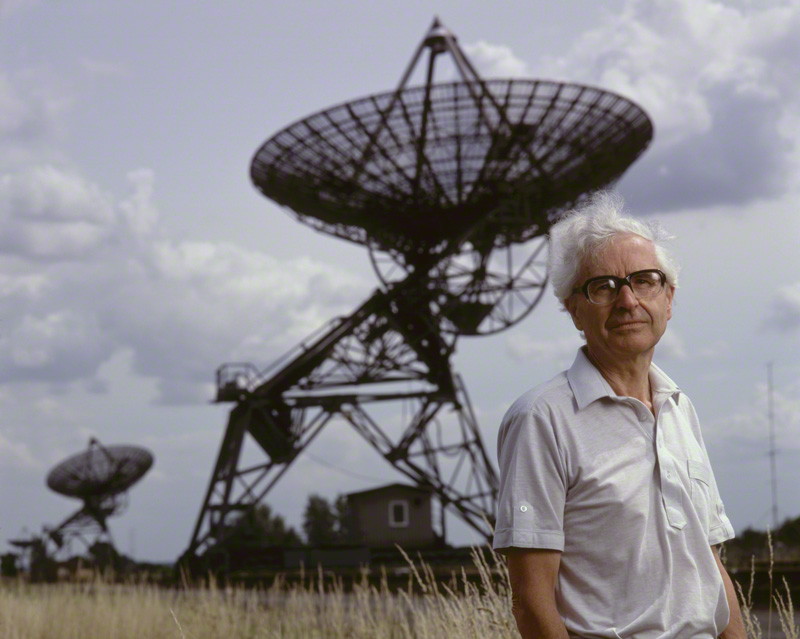
It’s a grim day when I have three R.I.P. posts on this blog, but I learned this afternoon via email that Nobel Prize winning Cambridge radio astronomer Antony Hewish has passed away on 13th September this year at the age of 97. You can read a full obituary at his college website here so I’ll keep my own remarks brief.

Tony Hewish was one of the pioneering generation of radio astronomers who were involved with the development of radar during World War 2 and went on to apply the knowledge they had gained to explore the Universe. He is most famous for winning the 1974 Nobel Prize for Physics (jointly with Martin Ryle) for the discovery of pulsars. Although the Nobel Foundation were clearly wrong not to give a share to Jocelyn Bell Burnell (who actually made the discovery). Indeed I would argue that Hewish should have declined the award unless Jocelyn Bell Burnell had been included. These errors should not however detract from Hewish’s scientific achievement in conceiving and constructing the Interplanetary Scintillation Array with which the discovery was made.

I’ll just add on a personal note that when I was a final-year undergraduate student at Cambridge (in the Lent Term in 1985) I took what was called a Major Option in Observational Cosmology which was lectured by Tony Hewish. As a matter of fact I still have the notes. Here’s the file opened at a random page:

It’s very out of date now, of course. A lot has happened in cosmology since 1985! At the time, though, I enjoyed the course very much and that affected my choice of potential areas in which to do my PhD. Although I ended up doing Theoretical rather than Observational Cosmology, at Sussex rather than at Cambridge, this course of lectures played a big part in me starting out on a career in that field.

Rest in peace Tony Hewish (1924-2021).

Breakthrough Prize for Dame Jocelyn Bell Burnell

Posted in The Universe and Stuff with tags , , , , , on September 6, 2018 by telescoper

I awoke this morning to find my Twitter feed full of news about the award of a special Breakthrough Prize to Dame Jocelyn Bell Burnell. To quote the press release:

The Selection Committee of the Breakthrough Prize in Fundamental Physics today announced a Special Breakthrough Prize in Fundamental Physics recognizing the British astrophysicist Jocelyn Bell Burnell for her discovery of pulsars – a detection first announced in February 1968 – and her inspiring scientific leadership over the last five decades.

Bell Burnell receives the Prize “for fundamental contributions to the discovery of pulsars, and a lifetime of inspiring leadership in the scientific community.” Pulsars are a highly magnetized, rapidly spinning form of the super-dense stars known as neutron stars. Their discovery was one of the biggest surprises in the history of astronomy, transforming neutron stars from science fiction to reality in a most dramatic way. Among many later consequences, it led to several powerful tests of Einstein’s Theory of Relativity, and to a new understanding of the origin of the heavy elements in the universe.

For the full citation and background information, see here.

The prize is not only prestigious but also substantial in cash terms: $3M no less. Jocelyn has made it clear however that she intends to use the money to set up a fund to encourage greater diversity in physics, through the Institute of Physics. That is a wonderful gesture, but if you know Jocelyn at all then you will not be at all surprised by it, as she is a person of enormous integrity who has for many years demonstrated a huge commitment to the cause of increasing diversity. I look forward to hearing more about how this initiative works out.

In an interview with the Guardian, Jocelyn said “Increasing the diversity in physics could lead to all sorts of good things.” I agree, and not just because an open and inclusive environment is a good thing in itself (which it is) but also because the fewer barriers there are to entry for a particular field, the broader the pool of talent from which it can recruit.

P.S. What would you do if you won a prize of $3M?

P. P. S. If I had $3M to spend, I think I’d spend it on whatever would most annoy all the miserable twerps complaining on Twitter about what Jocelyn Bell Burnell is doing with her Breakthrough Prize money.

LIGO, Leaks and NGC 4993

Posted in Open Access, The Universe and Stuff with tags , , , , on August 23, 2017 by telescoper

No matter what the official policy may be, the more people there are in a collaboration the more likely it is that someone will let their excitement get to their head and start leaking news and starting rumours either directly or indirectly via social media. And so it came to pass last Friday that the following tweet appeared:

I didn’t comment on the time as I thought it might be unreliable – as it indeed it still may be – but now New Scientist has amplified the signal I feel I can’t really be blamed for mentioning it here.

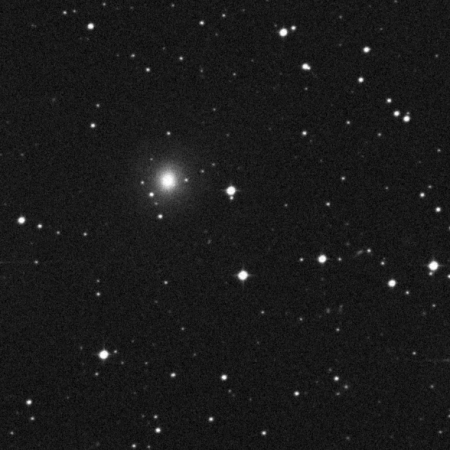
The rumours going round identify the optical counterpart as being in the galaxy NGC 4993 , a red band image of which, from the Second Digitized Sky Survey (DSS2) is shown below:

NGC 4993 is the fuzzy blob slightly above and to the left of the centre of the image. It’s a fairly nondescript lenticular galaxy in a group that can be found in the constellation of Hydra. It lies in the constellation of Hydra, was actually first discovered by William Herschel and it is about 10 arcmin across on the sky. It’s quite nearby, as these things go, with a distance of about 124 million light years (i.e. 40 Mpc or so) and is about 14th magnitude.

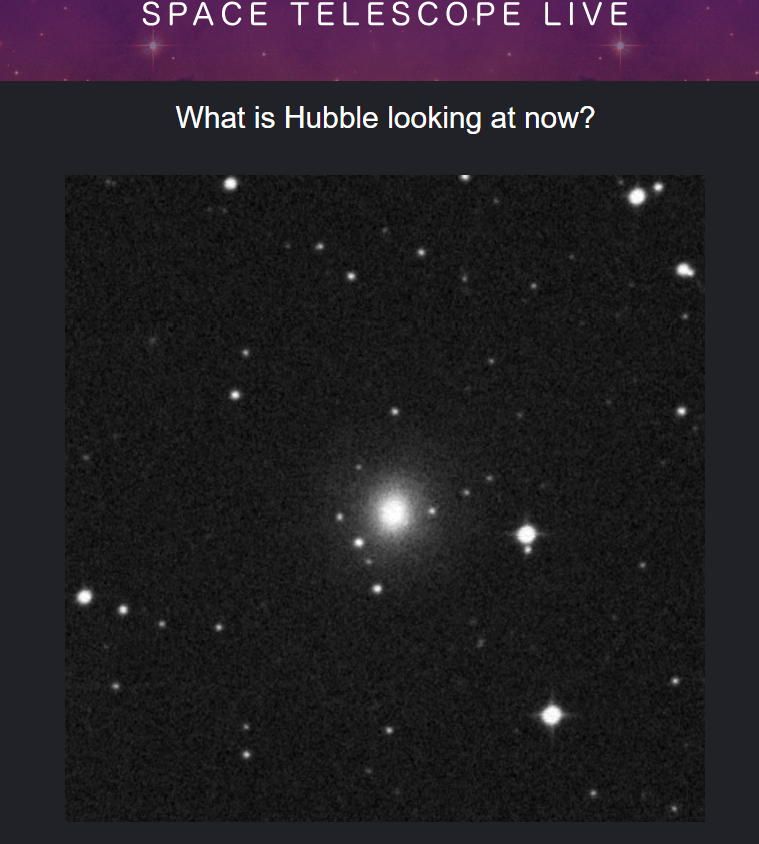
If there is an optical counterpart to a gravitational wave event coming from this galaxy then that suggests it may be a coalescence of neutron stars. The black hole mergers that appear to be responsible to the three existing gravitational wave signals that are claimed to have been detected are not expected to release optical light. Confirmation of this interpretation can be found by where the Hubble Space Telescope was pointed yesterday:

Look familiar? HST was, in fact, observing a `BNS-Merger’ (which is short for `Binary Neutron Star’)…

BNS

If this rumour is true then it’s obviously exciting, but there are questions to be asked. Chief among these is how sure is the identification of the counterpart? A transient optical source in NGC4993 may have been observed at the same time as a gravitational wave signal was detected,  but the ability of LIGO to resolve positions on the sky is very poor. On the other hand, the European VIRGO experiment joined Advanced LIGO for the ongoing `O2′ observing run (which ends in a couple of days). Although VIRGO is less sensitive than LIGO having a third detector does improve the localization of the source – assuming, of course, that it detects a signal. Even in that case it certainly won’t be possible to pinpoint the GW source to within 10 arc minutes, which is the precision needed to place it definitely within NGC 4993.

Anyway, we wait and see what, if anything, has been found. If it is a claimed detection then I hope that LIGO and VIRGO will release sufficient data to enable the analysis to be checked and verified. That’s what most of the respondents to my poll seem to hope too!